
Judge, 1921-11-26 · page 5 of 36
Judge — November 26, 1921 — page 5: what you’re looking at
What you’re looking at
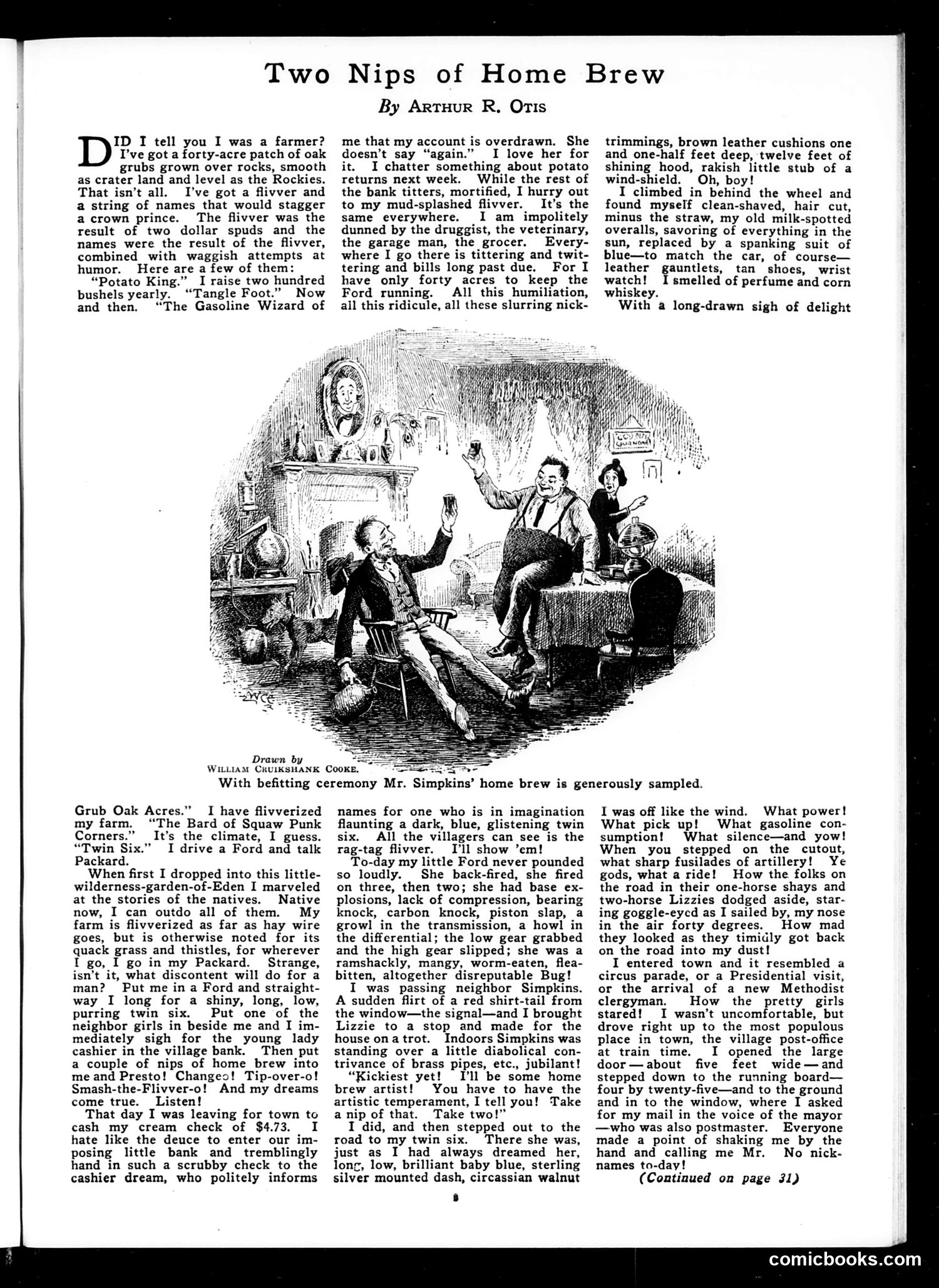
This is a humorous short story illustrated with a satirical sketch. The narrative follows a farmer boasting about his various money-making schemes—potato farming, raising cattle, and driving a Ford—all apparently failures that leave him perpetually broke and embarrassed. The illustration depicts men sampling "home brew" (illegally distilled alcohol during Prohibition era), with the caption noting it's "generously sampled." The story's title "Two Nips" puns on both drinking and the farmer's financial misfortunes. The satire targets rural incompetence and the widespread illegal alcohol production during Prohibition, presenting the farmer's failed enterprises and his resort to bootlegging as comedic commentary on Depression-era economic struggles.
📄 Transcribed text from this page (OCR, searchable)
Machine-transcribed from the original scan — historical spelling and the odd misread are preserved.
Two Nips of Home Brew By Artuur R. Oris I’ve got a forty-acre patch of oak grubs grown over rocks, smooth as crater land and level as the Rockies. That isn’t all. I’ve got a flivver and a string of names that would stagger acrown prince. The flivver was the result of two dollar spuds and the names were the result of the flivver, combined with waggish attempts at humor. Here are a few of them: “Potato King.” I raise two hundred bushels yearly. “Tangle Foot.” Now and then. “The Gasoline Wizard of D* I tell you I was a farmer? Drawn by WILLIAM CRUIKSHANK COOKE. me that my account is overdrawn. She doesn’t say “again.” I love her for it. I chatter something about potato returns next week. While the rest of the bank titters, mortified, I hurry out to my mud-splashed flivver. It’s the same everywhere. I am impolitely dunned by the druggist, the veterinary, the garage man, the grocer. Every- where I go there is tittering and twit- tering and bills long past due. For I have only forty acres to keep the Ford running. All this humiliation, all this ridicule, all these slurring nick- Sa trimmings, brown leather cushions one and one-half feet deep, twelve feet of shining hood, rakish little stub of a wind-shield. Oh, boy! I climbed in behind the wheel and found myself clean-shaved, hair cut, minus the straw, my old milk-spotted overalls, savoring of everything in the sun, replaced by a spanking suit of blue—to match the car, of course— leather gauntlets, tan shoes, wrist watch! I smelled of perfume and corn whiskey. With a long-drawn sigh of delight = With befitting ceremony Mr. Simpkins’ home brew is generously sampled. Grub Oak Acres.” I have flivverized my farm. “The Bard of Squaw Punk Corners.” It’s the climate, I guess. “Twin Six.” I drive a Ford and talk Packard. When first I dropped into this little- wilderness-garden-of-Eden I marveled at the stories of the natives. Native now, I can outdo all of them. My farm is flivverized as far as hay wire goes, but is otherwise noted for its quack grass and thistles, for wherever I go, I go in my Packard. Strange, isn’t it, what discontent will do for a man? Put me in a Ford and straight- way I long for a shiny, long, low, purring twin six. Put one of the neighbor girls in beside me and I im- mediately sigh for the young lady cashier in the village bank. Then put a couple of nips of home brew into me and Presto! Changeo! Tip-over-o! Smash-the-Flivver-o! And my dreams come true. Listen! That day I was leaving for town to cash my cream check of $4.73. I hate like the deuce to enter our im- posing little bank and tremblingly hand in such a scrubby check to the cashier dream, who politely informs names for one who is in imagination flaunting a dark, blue, glistening twin six. All the villagers can see is the rag-tag flivver. I'll show ’em! To-day my little Ford never pounded so loudly. She back-fired, she fired on three, then two; she had base ex- plosions, lack of compression, bearing knock, carbon knock, piston slap, a growl in the transmission, a howl in the differential; the low gear grabbed and the high gear slipped; she was a ramshackly, mangy, worm-eaten, flea- bitten, altogether disreputable Bug! I was passing neighbor Simpkins. A sudden flirt of a red shirt-tail from the window—the signal—and I brought Lizzie to a stop and made for the house onatrot. Indoors Simpkins was standing over a little diabolical con- trivance of brass pipes, etc., jubilant! “Kickiest yet! Ill be some home brew artist! You have to have the artistic temperament, I tell you! Take a nip of that. Take two!” I did, and then stepped out to the road to my twin six. There she was, just as I had always dreamed her, long, low, brilliant baby blue, sterling silver mounted dash, circassian walnut I was off like the wind. What power! What pick up! What gasoline con- sumption! What silence—and yow! When you stepped on the cutout, what sharp fusilades of artillery! Ye gods, what a ride! How the folks on the road in their one-horse shays and two-horse Lizzies dodged aside, star- ing goggle-eycd as I sailed by, my nose in the air forty degrees. How mad they looked as they timidly got back on the road into my dust! I entered town and it resembled a circus parade, or a Presidential visit, or the arrival of a new Methodist clergyman. How the pretty girls stared! I wasn’t uncomfortable, but drove right up to the most populous place in town, the village post-office at train time. I opened the large door— about five feet wide—and stepped down to the running board— four by twenty-five—and to the ground and in to the window, where I asked for my mail in the voice of the mayor —who was also postmaster. Everyone made a point of shaking me by the hand and calling me Mr. No nick- names to-day! (Continued on page 31) comicbooks.com