
Judge, 1921-11-26 · page 15 of 36
Judge — November 26, 1921 — page 15: what you’re looking at
What you’re looking at
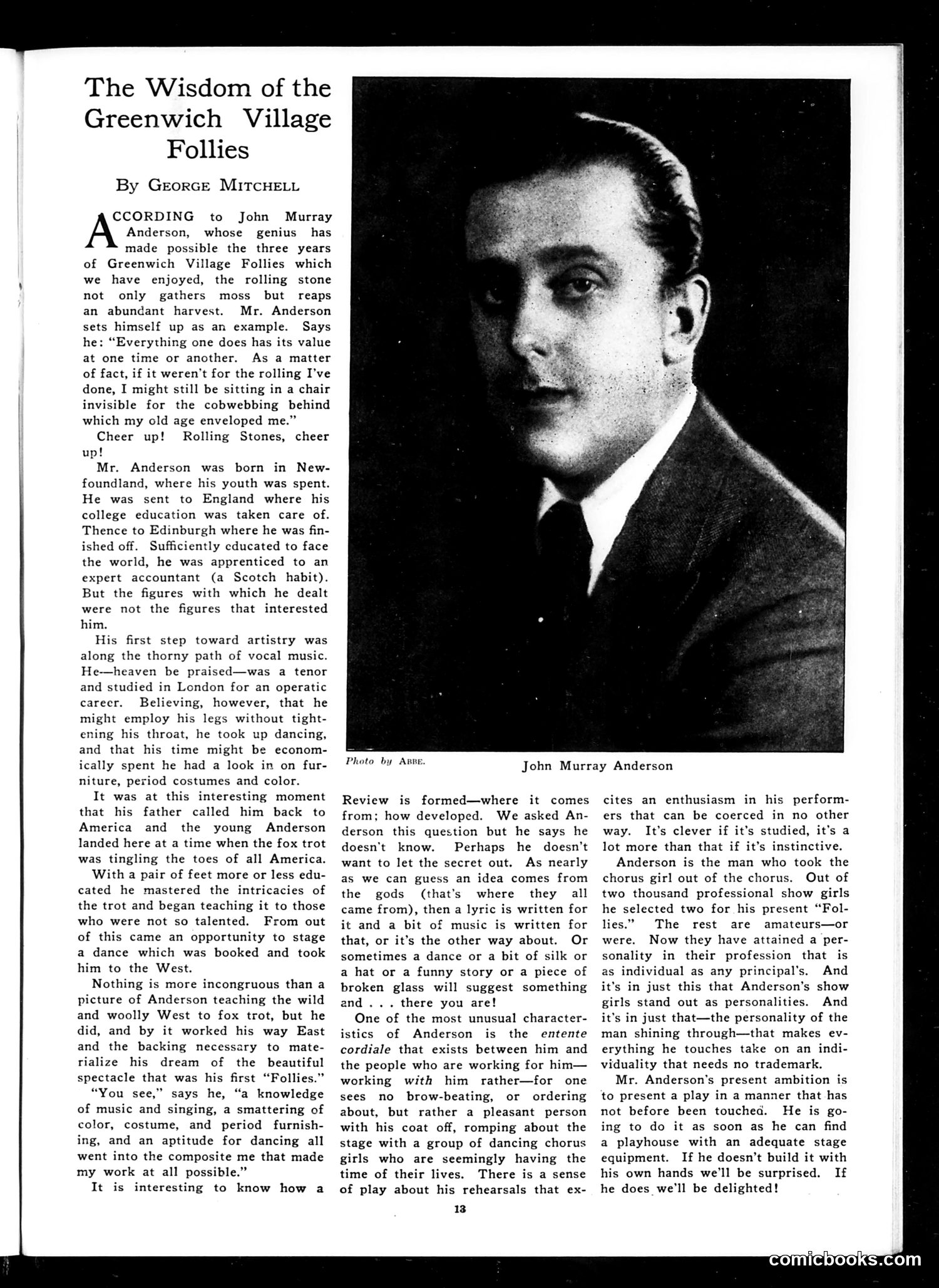
This is a **profile/interview article**, not a political cartoon. It celebrates John Murray Anderson, the director of the *Greenwich Village Follies*, a popular Broadway revue running in the early 1920s. The piece chronicles Anderson's unconventional path to theatrical success: born in Newfoundland, educated in England and Scotland, trained as an accountant, then pivoting to vocal music, dance, and stagecraft. The article praises his philosophy that "everything one does has its value"—his varied experiences (the "rolling stone") enabled his artistic achievements. Key to the satire is Anderson's reputation as an unusually progressive director who treats chorus girls as collaborators rather than subordinates, works "with his coat off," and cultivates genuine enthusiasm rather than enforcing discipline through authority. The accompanying photograph shows Anderson in formal dress, presenting him as a serious artistic figure—underscoring *Judge* magazine's admiration for his unconventional success story during the Jazz Age theatrical boom.
📄 Transcribed text from this page (OCR, searchable)
Machine-transcribed from the original scan — historical spelling and the odd misread are preserved.
The Wisdom of the Greenwich Village Follies By Gerorce MITCHELL CCORDING tto John Murray Anderson, whose genius has made possible the three years of Greenwich Village Follies which we have enjoyed, the rolling stone not only gathers moss but reaps an abundant harvest. Mr. Anderson sets himself up as an example. Says he: “Everything one does has its value at one time or another. As a matter of fact, if it weren't for the rolling I've done, I might still be sitting in a chair invisible for the cobwebbing behind which my old age enveloped me.” Cheer up! Rolling Stones, cheer up! Mr. Anderson was born in New- foundland, where his youth was spent. He was sent to England where his college education was taken care of. Thence to Edinburgh where he was fin- ished off. Sufficiently educated to face the world, he was apprenticed to an expert accountant (a Scotch habit). But the figures with which he dealt were not the figures that interested him. His first step toward artistry was along the thorny path of vocal music. He—heaven be praised—was a tenor and studied in London for an operatic carecr. Believing, however, that he might employ his legs without tight- ening his throat, he took up dancing, and that his time might be econom- ically spent he had a look in on fur- niture, period costumes and color. It was at this interesting moment that his father called him back to America and the young Anderson landed here at a time when the fox trot was tingling the toes of all America. With a pair of feet more or less edu- cated he mastered the intricacies of the trot and began teaching it to those who were not so talented. From out of this came an opportunity to stage a dance which was booked and took him to the West. Nothing is more incongruous than a picture of Anderson teaching the wild and woolly West to fox trot, but he did, and by it worked his way East and the backing necessary to mate- rialize his dream of the beautiful spectacle that was his first “Follies.” “You see,” says he, “a knowledge of music and singing, a smattering of color, costume, and period furnish- ing, and an aptitude for dancing all went into the composite me that made my work at all possible.” It is interesting to know how a Photo by Ape Review is formed—where it comes from; how developed. We asked An- derson this question but he says he doesn't know. Perhaps he doesn't want to let the secret out. As nearly as we can guess an idea comes from the gods (that’s where they all came from), then a lyric is written for it and a bit of music is written for that, or it’s the other way about. Or sometimes a dance or a bit of silk or a hat or a funny story or a piece of broken glass will suggest something and... there you are! One of the most unusual character- istics of Anderson is the entente cordiale that exists between him and the people who are working for him— working with him rather—for one sees no brow-beating, or ordering about, but rather a pleasant person with his coat off, romping about the stage with a group of dancing chorus girls who are seemingly having the time of their lives. There is a sense of play about his rehearsals that ex- 13 John Murray Anderson cites an enthusiasm in his perform- ers that can be coerced in no other way. It’s clever if it’s studied, it’s a lot more than that if it’s instinctive. Anderson is the man who took the chorus girl out of the chorus. Out of two thousand professional show girls he selected two for his present “Fol- lies.” The rest are amateurs—or were. Now they have attained a per- sonality in their profession that is as individual as any principal's. And it's in just this that Anderson’s show girls stand out as personalities. And it’s in just that—the personality of the man shining through—that makes ev- erything he touches take on an indi- viduality that needs no trademark. Mr. Anderson's present ambition is to present a play in a manner that has not before been touched. He is go- ing to do it as soon as he can find a playhouse with an adequate stage equipment. If he doesn’t build it with his own hands we'll be surprised. If he does we'll be delighted!