
Judge, 1921-11-26 · page 12 of 36
Judge — November 26, 1921 — page 12: what you’re looking at
What you’re looking at
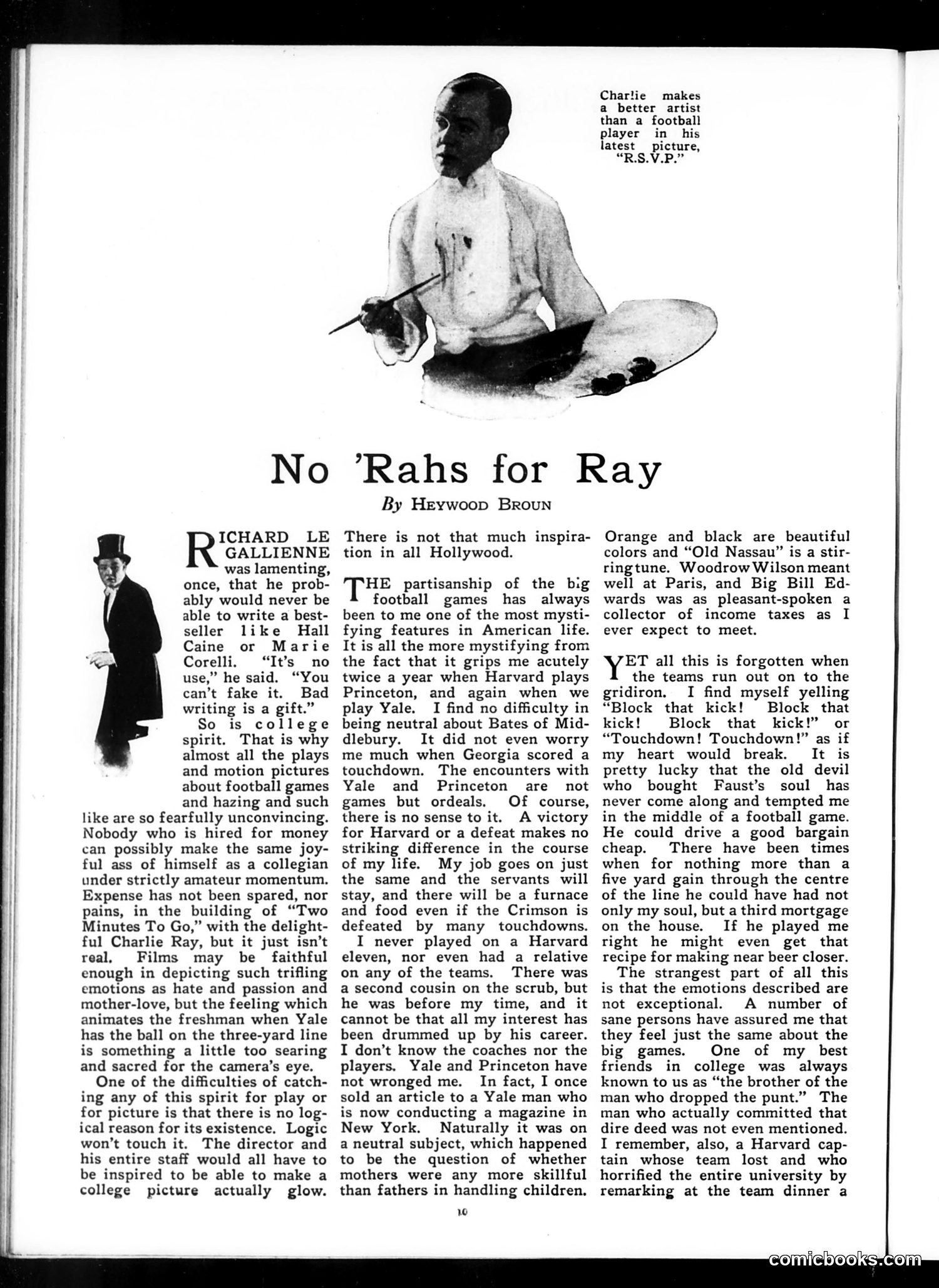
This article by Heywood Broun critiques a college football film starring Charlie Ray (titled "Two Minutes To Go"), arguing it fails to capture authentic collegiate spirit. The accompanying illustration shows Ray as an artist, noting he's "a better artist than a football player." Broun's point: genuine college football enthusiasm—particularly the irrational fervor surrounding Harvard-Yale and Harvard-Princeton games—cannot be manufactured for cinema. He describes this tribal passion as illogical yet irresistible, admitting his own inability to remain neutral about these rivalries despite having no logical stake in them. The satire targets Hollywood's tendency to cheaply replicate authentic emotion. Broun suggests that the "sacred" intensity of collegiate football fandom is too genuine and inexplicable to survive professional dramatization. Only amateurs genuinely living the experience can authentically embody such spirit—professionals hired to fake it will always fall short. The reference to figures like Woodrow Wilson and income tax collector Bill Edwards grounds his argument in 1920s contemporary life.
📄 Transcribed text from this page (OCR, searchable)
Machine-transcribed from the original scan — historical spelling and the odd misread are preserved.
Charlie makes a better artist than a football player in his latest picture, “R.S.V.P.” No ’Rahs for Ray ICHARD LE R GALLIENNE was lamenting, once, that he prob- ably would never be able to write a best- seller like Hall Caine or Marie Corelli. “It’s no use,” he said. “You can’t fake it. Bad writing is a gift.” So is college spirit. That is why almost all the plays and motion pictures about football games and hazing and such like are so fearfully unconvincing. Nobody who is hired for money can possibly make the same joy- ful ass of himself as a collegian under strictly amateur momentum. Expense has not been spared, nor pains, in the building of “Two Minutes To Go,” with the delight- ful Charlie Ray, but it just isn’t real, Films may be faithful enough in depicting such trifling emotions as hate and passion and mother-love, but the feeling which animates the freshman when Yale has the ball on the three-yard line is something a little too searing and sacred for the camera’s eye. One of the difficulties of catch- ing any of this spirit for play or for picture is that there is no log- ical reason for its existence. Logic won’t touch it. The director and his entire staff would all have to be inspired to be able to make a college picture actually glow. By Heywoop Broun There is not that much inspira- tion in all Hollywood. rae partisanship of the big football games has always been to me one of the most mysti- fying features in American life. It is all the more mystifying from the fact that it grips me acutely twice a year when Harvard plays Princeton, and again when we play Yale. I find no difficulty in being neutral about Bates of Mid- dlebury. It did not even worry me much when Georgia scored a touchdown. The encounters with Yale and Princeton are not games but ordeals. Of course, there is no sense to it. A victory for Harvard or a defeat makes no striking difference in the course of my life. My job goes on just the same and the servants will stay, and there will be a furnace and food even if the Crimson is defeated by many touchdowns. I never played on a Harvard eleven, nor even had a relative on any of the teams. There was a second cousin on the scrub, but he was before my time, and it cannot be that all my interest has been drummed up by his career. I don’t know the coaches nor the players. Yale and Princeton have not wronged me. In fact, I once sold an article to a Yale man who is now conducting a magazine in New York. Naturally it was on a neutral subject, which happened to be the question of whether mothers were any more skillful than fathers in handling children. 1 Orange and black are beautiful colors and “Old Nassau” is a stir- ringtune. Woodrow Wilson meant well at Paris, and Big Bill Ed- wards was as pleasant-spoken a collector of income taxes as I ever expect to meet. yFr all this is forgotten when the teams run out on to the I find myself yelling Block that gridiron. “Block that kick! kick! Block that kick!” or “Touchdown! Touchdown!” as if my heart would break. It is pretty lucky that the old devil who bought Faust’s soul has never come along and tempted me in the middle of a football game. He could drive a good bargain cheap. There have been times when for nothing more than a five yard gain through the centre of the line he could have had not only my soul, but a third mortgage on the house. If he played me right he might even get that recipe for making near beer closer. The strangest part of all this is that the emotions described are not exceptional. A number of sane persons have assured me that they feel just the same about the big games. One of my best friends in college was always known to us as “the brother of the man who dropped the punt.” The man who actually committed that dire deed was not even mentioned. I remember, also, a Harvard cap- tain whose team lost and who horrified the entire university by remarking at the team dinner a