
Judge, 1921-11-26 · page 20 of 36
Judge — November 26, 1921 — page 20: what you’re looking at
What you’re looking at
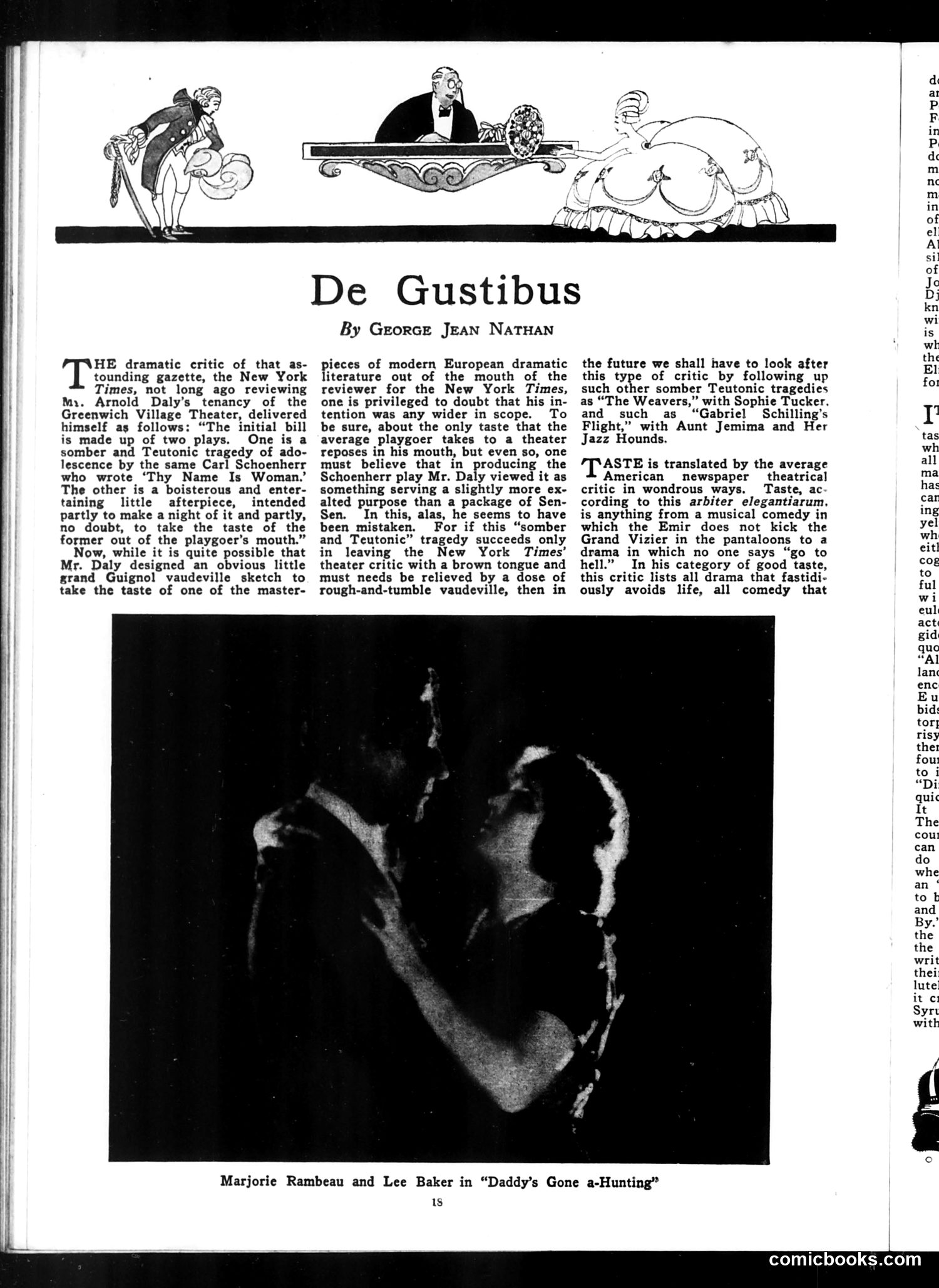
This article satirizes the New York Times theater critic's review of Arnold Daly's production at Greenwich Village Theater. Nathan mocks the critic for praising a heavy Teutonic tragedy solely because it was "relieved" by a lighter vaudeville afterpiece—suggesting the critic's palate needed cleansing from serious art. Nathan argues the Times critic confuses "taste" with escapism, believing good theater must avoid depicting real life or using mild profanity. He ridicules this narrow aesthetic by suggesting future serious plays should be paired with Sophie Tucker or "Aunt Jemima and Her Jazz Hounds"—obviously absurd pairings that expose the critic's shallow standards. The accompanying photograph shows Marjorie Rambeau and Lee Baker in "Daddy's Gone a-Hunting," apparently an example of theatrical entertainment the critic would judge favorably.
📄 Transcribed text from this page (OCR, searchable)
Machine-transcribed from the original scan — historical spelling and the odd misread are preserved.
HE dramatic critic of that as- tounding gazette, the New York Times, not long ago reviewing M.. Arnold Daly’s tenancy of the Greenwich Village Theater, delivered himself as follows: “The initial bill is made up of two plays. One is a somber and Teutonic tragedy of ado- lescence by the same Carl Schoenherr who wrote ‘Thy Name Is Woman.’ The other is a boisterous and enter- taining little afterpiece, intended partly to make a night of it and partly, no doubt, to take the taste of the former out of the playgoer’s mouth.” Now, while it is quite possible that Mr. Daly designed an obvious little grand Guignol vaudeville sketch to take the taste of one of the master- De Gustibus By Grorce Jean NaTHAN pieces of modern European dramatic literature out of the mouth of the reviewer for the New York Times, one is privileged to doubt that his in- tention was any wider in scope. To be sure, about the only taste that the average playgoer takes to a theater reposes in his mouth, but even so, one must believe that in producing the Schoenherr play Mr. Daly viewed it as something serving a slightly more ex- alted purpose than a package of Sen- Sen. In this, alas, he seems to have been mistaken. For if this “somber and Teutonic” tragedy succeeds only in leaving the New York Times’ theater critic with a brown tongue and must needs be relieved by a dose of rough-and-tumble vaudeville, then in the future we shall have to look after this type of critic by following up such other somber Teutonic tragedies as “The Weavers,” with Sophie Tucker. and such as “Gabriel Schilling’s Flight,” with Aunt Jemima and Her Jazz Hounds. ‘TASTE is translated by the average American newspaper theatrical critic in wondrous ways. Taste, ac cording to this arbiter elegantiarum, is anything from a musical comedy in which the Emir does not kick the Grand Vizier in the pantaloons to a drama in which no one says “go to hell.” In his category of good taste, this critic lists all drama that fastidi- ously avoids life, all comedy that Marjorie Rambeau and Lee Baker in “Daddy’s Gone a-Hunting” 1s comicbooks.com