
Judge, 1921-11-26 · page 26 of 36
Judge — November 26, 1921 — page 26: what you’re looking at
What you’re looking at
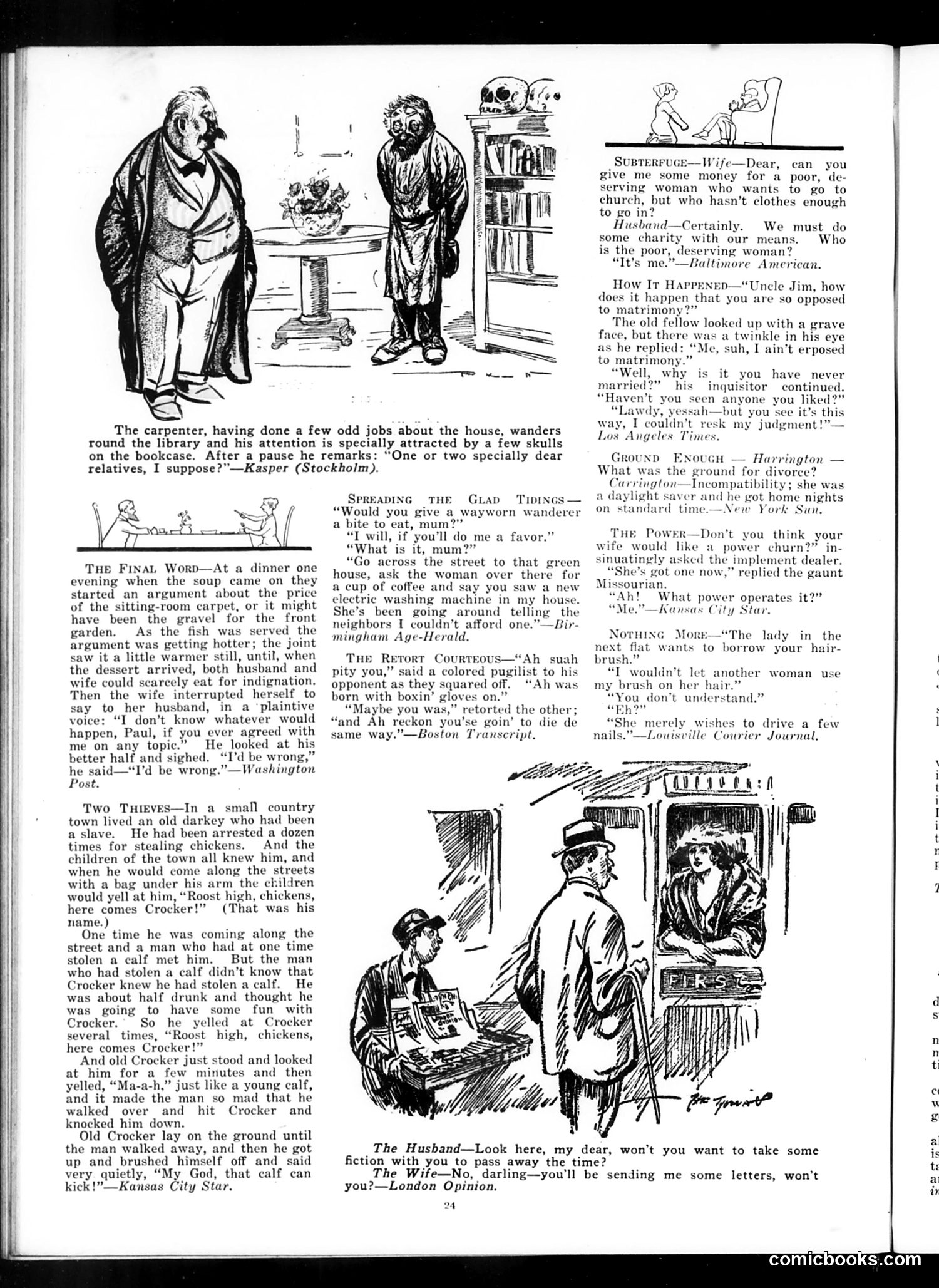
This page contains multiple brief humorous anecdotes satirizing domestic life and social conventions of early 20th-century America. The cartoons mock marital dynamics: wives manipulating husbands for personal expenses under pretense of charity; husbands resisting matrimony; couples arguing over household purchases. One sketch depicts a carpenter observing skulls on a bookcase—likely relatives' remains, suggesting dark family secrets. A recurring theme is women's deception and manipulation within marriage, presented as comedic inevitability. Another sketch uses a racist caricature of a formerly enslaved man repeatedly called "Crocker" for stealing chickens—the humor relies on stereotype and degradation. The "Two Thieves" story presents a crude moral lesson using offensive racial language and imagery common to the era. Overall, these anecdotes reflect contemporary attitudes: skepticism toward marriage, domestic conflict as entertainment, and casual racism presented as harmless humor. The satire targets marital absurdities rather than challenging social injustices.
📄 Transcribed text from this page (OCR, searchable)
Machine-transcribed from the original scan — historical spelling and the odd misread are preserved.
_ SUBTERFU GE—Wife—Dear, can you give me some money for a poor, de- serving woman who wants to go to church, but who hasn’t clothes enough to go in? Husband—Certainly. We must do some charity with our means. Who is the poo serving woman? “It's me.”—Baltimore American. How It Haprenep—‘Uncle Jim, how does it happen that you are so opposed to matrimony The old fellow looked up with a grave face, but there was a twinkle in his eye as he replied: “Me, suh, I ain’t erposed to matrimony. Ww why is it you have never his inquisitor continued. ou seen anyone you liked?” ssah—but you see it’s th The carpenter, having done a few odd jobs about the house, wanders Angel at rests my judgment! round the library and his attention is specially attracted by a few skulls angen fess on the bookcase. After a pause he remarks: “One or two specially dear Grounp Enoucu — Harrington — relatives, I suppose?”—Kasper (Stockholm). What the ground for divorce? Carrington—Incompatibility; she was a daylight saver and he got home nights SPREADING E TIDINGS 1 iS on standard time.—New York Sun. “Would you give worn wanderer a bite to eat, mum?” ip ° ; r “I will, if you'll do me a favor.” _THe PoweR—Don’t you think your “What ” wife would like a power churn?” in- a . . “Go across the street to that green sinuatingly asked the implement dealer. THE FinaL Worp—At a dinner one house, ask the woman over there for “’s got one now,” replied the gaunt evening when the soup came on they |". : and say you saw a new Missourian. spon started an argument about the price i] “Ah! Wh: was pe an arg Me OMS vee bey electric washing machine in my house. aul Vhat power operates it? of the sifting-roata carpet. oF it might She’s been going around telling the “Me.”—Kansas City Star. poy re ‘A th & sh was served the neighbors I couldn’t afford one.”—Bir- garden. s the 7 mingham Age-Herald. NotuinG More—*The lady i 2 argument was getting hotter; the joint next flat wants to Leow Mier bane saw it a little warmer still, until, when Tue Ret ‘ouRTEOUS—“Ah suah brush.” ~ the dessert arrived, both husband and pity you,” said a colored pugilist to his “I wouldn't let another woman use wife could scarcely for indignation. opponent as they squared off. “Ah was my brush on her h Then the wife interrupted herself to born with boxin’ gloves on.” “You don’t understand.” say to her husband, in a ‘plaintive “Maybe you was,” retorted the other; iO voice: “I don’t know whatever would “and Ah reckon you’se goin’ to die de “s rely wishes to drive a few happen, Paul, if you ever agreed with same way.”—Boston Transcript. ils."—Louisville Courier Journal. me on any topic.’ He looked at his 5 better half and sighed. “I'd be wrong,” he d—“I’d be wrong.”—Washington Post. Two THiEves—In small country town lived an old darkey who had been a slave. He had been arrested a dozen times for stealing chickens. And the children of the town all knew him, and when he would come along the streets with a bag under his arm the dren would yell at him, “Roost high, chick here comes Crocker!” (That was his name.) One time he was coming along the street and a man who had at one time stolen a calf met him. But the man who had stolen a calf didn’t know that Crocker knew he had stolen a calf. He was about half drunk and thought he was going to have some fun i Crocker. So he yelled at Cro several tim Roost high, i here comes Crocker And old Crocker just stood and looked at him for a few minutes and then yelled, “Ma-a-h,” just like a young calf, and it made the man so mad that he walked over and hit Crocker and knocked him down. Old Crocker lay on the ground until the man walked away, and then he got The Husband—Look here, my dear, won't you want to take some up and brushed himself off and said fiction with you to pass away the time? very quietly, “My God, that calf can The Wife—No, darling—you'll be sending me some letters, won't kick!”—Kansas City Star. you?—London Opinion. 24 comicbooks.com