
Judge, 1921-11-26 · page 8 of 36
Judge — November 26, 1921 — page 8: what you’re looking at
What you’re looking at
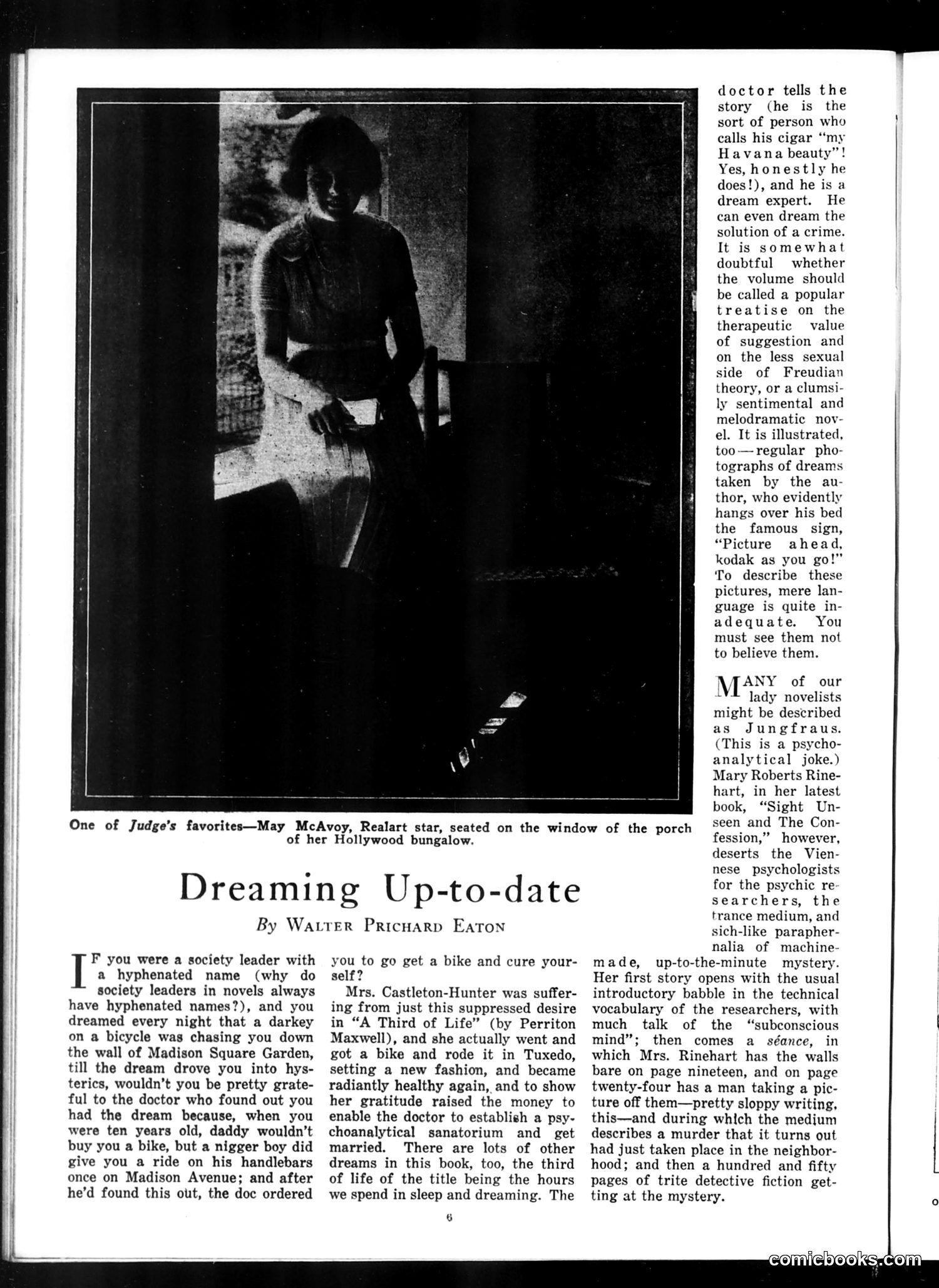
This page contains a book review essay titled "Dreaming Up-to-date" by Walter Prichard Eaton, not a political cartoon. The accompanying photograph shows actress May McAvoy, identified as a "Judge's favorite," sitting on a Hollywood bungalow porch. The essay reviews two contemporary novels: Perriton Maxwell's "A Third of Life" (about psychoanalysis and dream therapy) and Mary Roberts Rinehart's "Sight Unseen and The Confession" (featuring séances and psychic phenomena). Eaton mocks both books' engagement with trendy psychological and spiritualist ideas—Freudianism and trance mediums—that were fashionable among 1920s intellectuals. He satirizes the pretentious pseudo-science by noting Rinehart's "sloppy writing" and the absurdity of photographing dreams. The casual use of a racial slur reflects the casual bigotry of the era, though it appears incidental to the satire's main targets: intellectualism and faddish theories.
📄 Transcribed text from this page (OCR, searchable)
Machine-transcribed from the original scan — historical spelling and the odd misread are preserved.
One of Judge’s favorites—May McAvoy, Realart star, seated on the window of the porch of her Hollywood bungalow. Dreaming Up-to-date By Wa rer Pricuarp Eaton F you were a society leader with I a hyphenated name (why do society leaders in novels always have hyphenated names?), and you dreamed every night that a darkey on a bicycle was chasing you down the wall of Madison Square Garden, till the dream drove you into hys- terics, wouldn’t you be pretty grate- ful to the doctor who found out you had the dream because, when you were ten years old, daddy wouldn’t buy you a bike, but a nigger boy did give you a ride on his handlebars once on Madison Avenue; and after he’d found this out, the doc ordered you to go get a bike and cure your- self? Mrs. Castleton-Hunter was suffer- ing from just this suppressed desire in “A Third of Life” (by Perriton Maxwell), and she actually went and got a bike and rode it in Tuxedo, setting a new fashion, and became radiantly healthy again, and to show her gratitude raised the money to enable the doctor to establish a psy- choanalytical sanatorium and get married. There are lots of other dreams in this book, too, the third of life of the title being the hours we spend in sleep and dreaming. The 6 doctor tells the story (he is the sort of person who calls his cigar “‘my Havana beauty”! Yes, honestly he does!), and he is a dream expert. He can even dream the solution of a crime. It is somewhat doubtful whether the volume should be called a popular treatise on the therapeutic value of suggestion and on the less sexual side of Freudian theory, or a clumsi- ly sentimental and melodramatic nov- el. It is illustrated, too—regular pho- tographs of dreams taken by the au- thor, who evidently hangs over his bed the famous sign, “Picture ahead, kodak as you go!” To describe these pictures, mere lan- guage is quite in- adequate. You must see them not to believe them. N ANY of our e lady novelists might be described as Jungfraus. (This is a psycho- analytical joke.) Mary Roberts Rine- hart, in her latest book, “Sight Un- seen and The Con- fession,” however, deserts the Vien- nese psychologists for the psychic re searchers, the trance medium, and sich-like parapher- nalia of machine- made, up-to-the-minute mystery. Her first story opens with the usual introductory babble in the technical vocabulary of the researchers, with much talk of the “subconscious mind”; then comes a séance, in which Mrs. Rinehart has the walls bare on page nineteen, and on page twenty-four has a man taking a pic- ture off them—pretty sloppy writing, this—and during which the medium describes a murder that it turns out had just taken place in the neighbor- hood; and then a hundred and fifty pages of trite detective fiction get- ting at the mystery.