
Judge, 1921-11-26 · page 9 of 36
Judge — November 26, 1921 — page 9: what you’re looking at
What you’re looking at
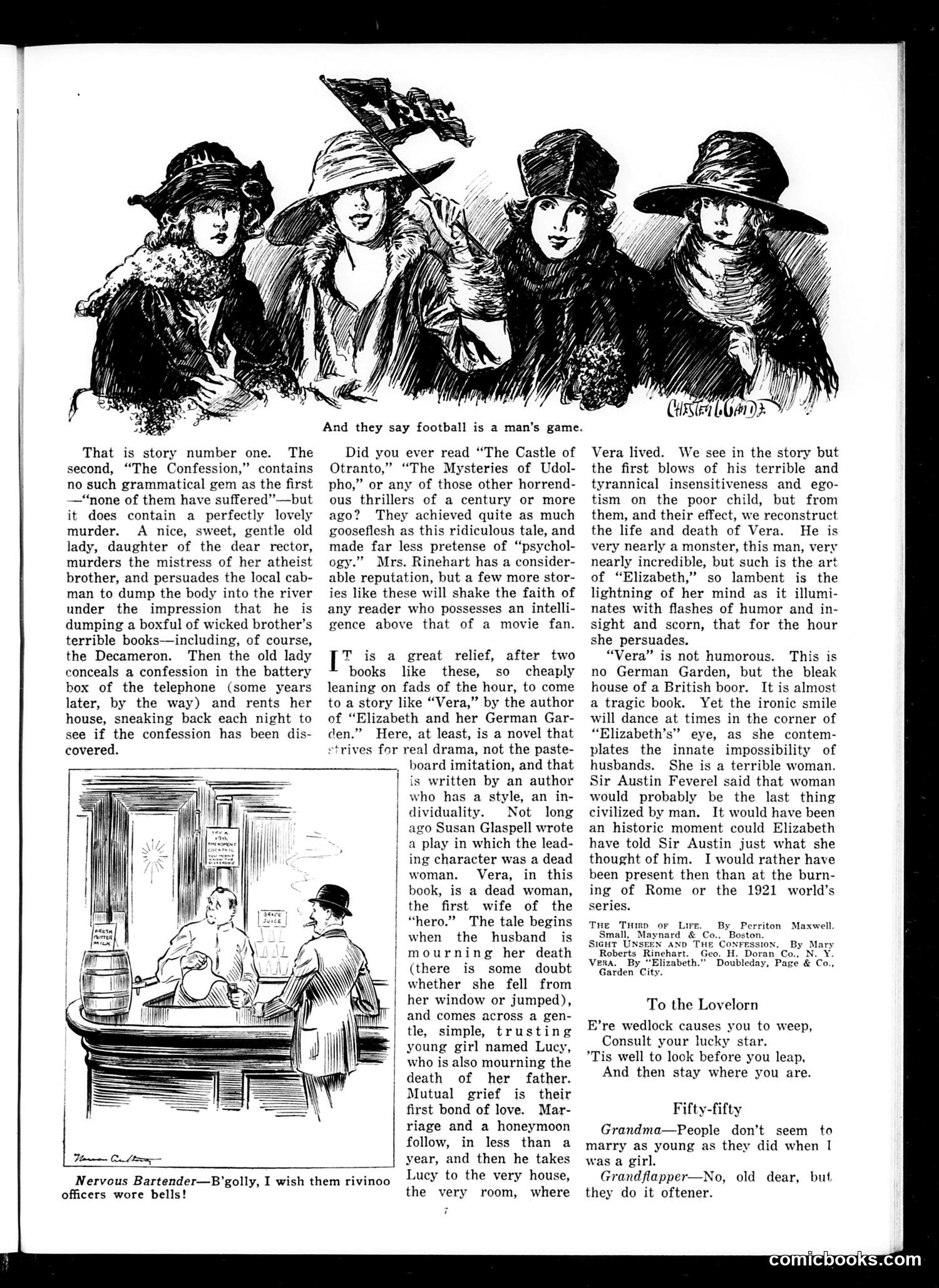
This page reviews three books, with particular focus on critiquing popular author **Mrs. Rinehart** (likely Mary Roberts Rinehart, a bestselling mystery writer of the 1920s). **The satire:** The opening cartoon shows four fashionable women with the caption "And they say football is a man's game"—a joke suggesting women's intense interest in sensational mystery novels rivals men's sports obsession. **The literary criticism:** The reviewer dismisses Rinehart's detective novels as formulaic, melodramatic drivel reminiscent of Gothic horror from a century prior. They contain ridiculous plots (an old lady confessing murder via a telephone battery box) yet pretend to psychological sophistication, appealing only to readers with "an intelligence...above that of a movie fan." **The praise:** By contrast, "Vera" by "Elizabeth and her German Garden" receives approval for genuine artistry and style, depicting a tyrannical husband's emotional abuse with real dramatic weight rather than cheap sensationalism. **The bottom cartoon** ("Nervous Bartender") appears unrelated advertising filler. The page reflects 1920s intellectual snobbery toward popular women's fiction and cinema.
📄 Transcribed text from this page (OCR, searchable)
Machine-transcribed from the original scan — historical spelling and the odd misread are preserved.
That is story number one. The second, “The Confession,” contains no such grammatical gem as the first —‘none of them have suffered”—but it does contain a perfectly lovely murder. A nice, sweet, gentle old lady, daughter of the dear rector, murders the mistress of her atheist brother, and persuades the local cab- man to dump the body into the river under the impression that he is dumping a boxful of wicked brother’s terrible books—including, of course, the Decameron. Then the old lady conceals a confession in the battery box of the telephone (some years later, by the way) and rents her house, sneaking back each night to see if the confession has been dis- covered. And they say football is a man’s game. Did you ever read “The Castle of Otranto,” “The Mysteries of Udol- pho,” or any of those other horrend- ous thrillers of a century or more ago? They achieved quite as much gooseflesh as this ridiculous tale, and made far less pretense of “psychol- ogy.” Mrs. Rinehart has a consider- able reputation, but a few more stor- ies like these will shake the faith of any reader who possesses an intelli- gence above that of a movie fan. [* is a great relief, after two books like these, so cheaply leaning on fads of the hour, to come to a story like “Vera,” by the author of “Elizabeth and her German Gar- den.” Here, at least, is a novel that strives for real drama, not the paste- _ board imitation, and that Vim Cal Pome is written by an author who has a style, an in- dividuality. Not long ago Susan Glaspell wrote | a play in which the lead- ing character was a dead woman. Vera, in this book, is a dead woman, | the first wife of the “hero.” The tale begins when the husband is mourning her death (there is some doubt whether she fell from her window or jumped), | and comes across a gen- | tle, simple, trusting =| young girl named Lucy, | who is also mourning the | death of her father. Mutual grief is their first bond of love. Mar- riage and a honeymoon follow, in less than a year, and then he takes Nervous Bartender—B’golly, I wish them rivinoo officers wore bells! Lucy to the very house, the very room, where Fide CH Vera lived. We see in the story but the first blows of his terrible and tyrannical insensitiveness and ego- tism on the poor child, but from them, and their effect, we reconstruct the life and death of Vera. He is very nearly a monster, this man, very nearly incredible, but such is the art of “Elizabeth,” so lambent is the lightning of her mind as it illumi- nates with flashes of humor and in- sight and scorn, that for the hour she persuades. “Vera” is not humorous. This is no German Garden, but the bleak house of a British boor. It is almost a tragic book. Yet the ironic smile will dance at times in the corner of “Elizabeth’s” eye, as she contem- plates the innate impossibility of husbands. She is a terrible woman. Sir Austin Feverel said that woman would probably be the last thing civilized by man. It would have been an historic moment could Elizabeth have told Sir Austin just what she thought of him. I would rather have been present then than at the burn- ing of Rome or the 1921 world’s series. iton Maxwell ox. By Mary N.Y Geo. H. Doran Co., é Elizabeth.” Doubleday, Page & Co., To the Lovelorn E’re wedlock causes you to weep, Consult your lucky star. ’Tis well to look before you leap, And then stay where you are. Fifty-fifty Grandma—People don’t seem to marry as young as they did when I was a girl. Grandflapper—No, old dear, but they do it oftener.