
Judge, 1921-11-26 · page 21 of 36
Judge — November 26, 1921 — page 21: what you’re looking at
What you’re looking at
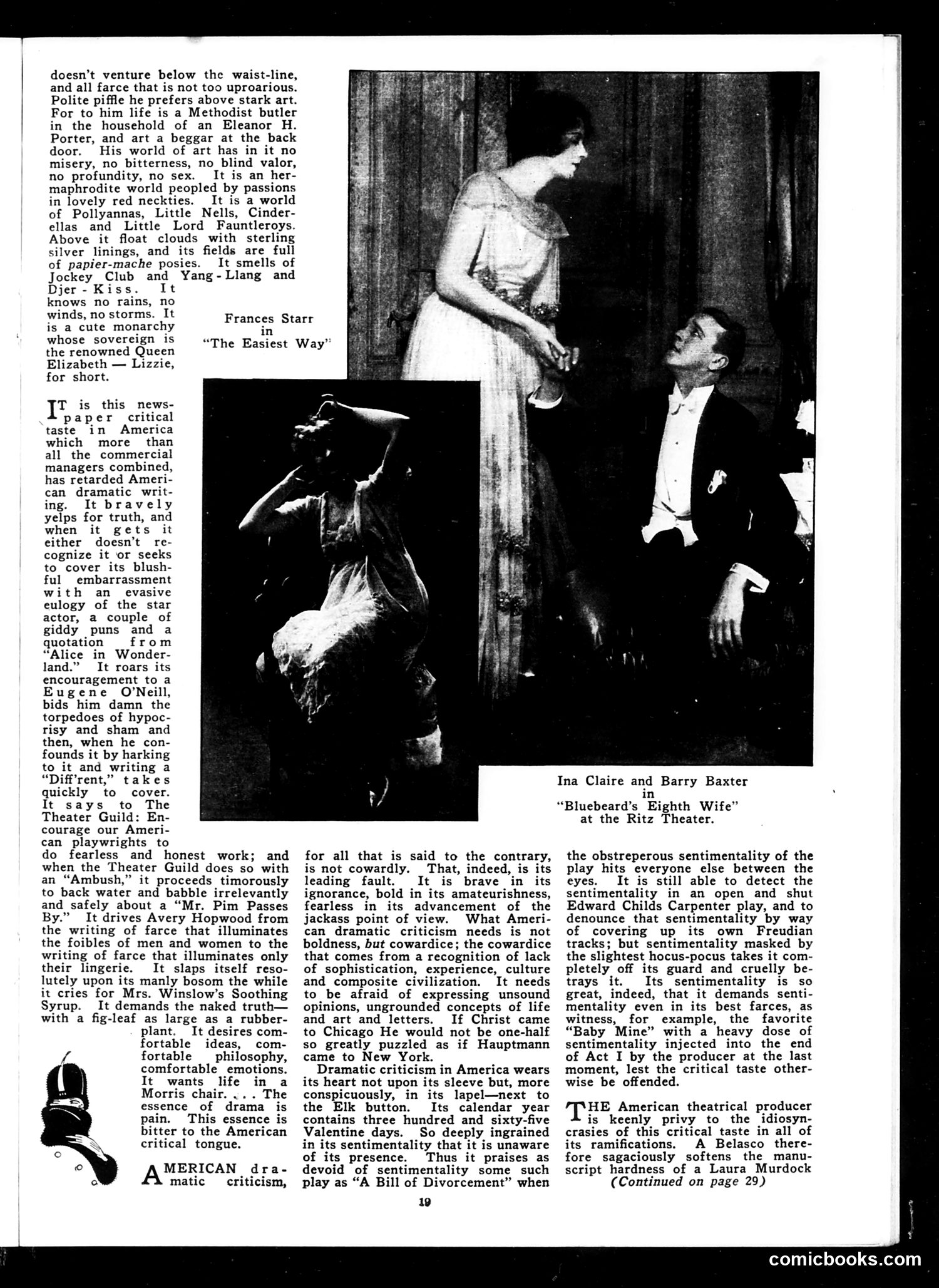
This page critiques American theatrical criticism circa the 1920s, using specific plays and playwrights as examples. The author argues that critics demand "fearless" drama while punishing playwrights who deliver it—citing Eugene O'Neill's experience with "Diff'rent" and the Theater Guild's reception of "Ambush." The piece attacks critics' sentimentality disguised as sophistication: they praise emotionally manipulative plays like "A Bill of Divorcement" while condemning openly sentimental works. The author mocks their preference for safe, pleasant art (evoking Eleanor Porter's "Pollyanna") and their inability to tolerate genuine depiction of human suffering and sexuality. Two theatrical photographs illustrate the piece: Frances Starr in "The Easiest Way" and Ina Claire with Barry Baxter in "Bluebeard's Eighth Wife" at the Ritz Theater. The satire essentially accuses American critics of hypocrisy—demanding courage from writers while demonstrating cowardice through their own sentimental blind spots.
📄 Transcribed text from this page (OCR, searchable)
Machine-transcribed from the original scan — historical spelling and the odd misread are preserved.
doesn’t venture below the waist-line, and all farce that is not too uproarious. Polite piffle he prefers above stark art. For to him life is a Methodist butler in the household of an Eleanor H. Porter, and art a beggar at the back door. His world of art has in it no misery, no bitterness, no blind valor, no profundity, no sex. It is an her- maphrodite world peopled by passions in lovely red neckties. It is a world of Pollyannas, Little Nells, Cinder- ellas and Little Lord Fauntleroys. Above it float clouds with sterling silver linings, and its fields are full of papier-mache posies. It smells of Jockey Club and Yang-Llang and Djer - Kiss. It knows no rains, no winds, no storms. It is a cute monarchy whose sovereign is the renowned Queen Elizabeth — Lizzie, for short. T is this news- paper critical taste in America which more than all the commercial managers combined, has retarded Ameri- can dramatic writ- ing. It bravely yelps for truth, and when it gets it either doesn’t re- cognize it or seeks to cover its blush- ful embarrassment with an_ evasive eulogy of the star actor, a couple of giddy puns and a quotation from “Alice in Wonder- land.” It roars its encouragement to a Eugene O'Neill, bids him damn the torpedoes of hypoc- risy and sham and then, when he con- founds it by harking to it and writing a “Diff’rent,” takes quickly to cover. It says to The Theater Guild: En- courage our Ameri- can playwrights to do fearless and honest work; and when the Theater Guild does so with an “Ambush,” it proceeds timorously to back water and babble irrelevantly and safely about a “Mr. Pim Passes By.” It drives Avery Hopwood from the writing of farce that illuminates the foibles of men and women to the writing of farce that illuminates only their lingerie. It slaps itself reso- lutely upon its manly bosom the while it cries for Mrs. Winslow’s Soothing Syrup. It demands the naked truth— with a fig-leaf as large as a rubber- plant. It desires com- fortable ideas, com- fo fortable philosophy, comfortable emotions. It wants life in a Morris chair. ... The essence of drama is pain. This essence is bitter to the American critical tongue. MERICAN dra- matic criticism, Frances Starr in “The Easiest Way” for all that is said to the contrary, is not cowardly. That, indeed, is its leading fault. It is brave in its ignorance, bold in its amateurishness, fearless in its advancement of the jackass point of -w. What Ameri- can dramatic criticism needs is not boldness, but cowardice; the cowardice that comes from a recognition of lack of sophistication, experience, culture and composite civilization. It needs to be afraid of expressing unsound opinions, ungrounded concepts of life and art and letters. If Christ came to Chicago He would not be one-half so greatly puzzled as if Hauptmann came to New York. Dramatic criticism in America wears its heart not upon its sleeve but, more conspicuously, in its lapel—next to the Elk button. Its calendar year contains three hundred and sixty-five Valentine days. So deeply ingrained in its sentimentality that it is unaware of its presence. Thus it praises as devoid of sentimentality some such play as “A Bill of Divorcement” when 19 Ina Claire and Barry Baxter in “Bluebeard’s Eighth Wife” at the Ritz Theater. the obstreperous sentimentality of the play hits everyone else between the eyes. It is still able to detect the sentimentality in an open and shut Edward Childs Carpenter play, and to denounce that sentimentality by way of covering up its own Freudian tracks; but sentimentality masked by the slightest hocus-pocus takes it com- pletely off its guard and cruelly be- trays it. Its sentimentality is so great, indeed, that it demands senti- mentality even in its best farces, as witness, for example, the favorite “Baby Mine” with a heavy dose of sentimentality injected into the end of Act I by the producer at the last moment, lest the critical taste other- wise be offended. THE American theatrical producer is keenly privy to the idiosyn- crasies of this critical taste in all of its ramifications. A Belasco there- fore sagaciously softens the manu- script hardness of a Laura Murdock (Continued on page 29) comicbooks.com