
A complete issue · 36 pages · 1921
Judge — October 22, 1921
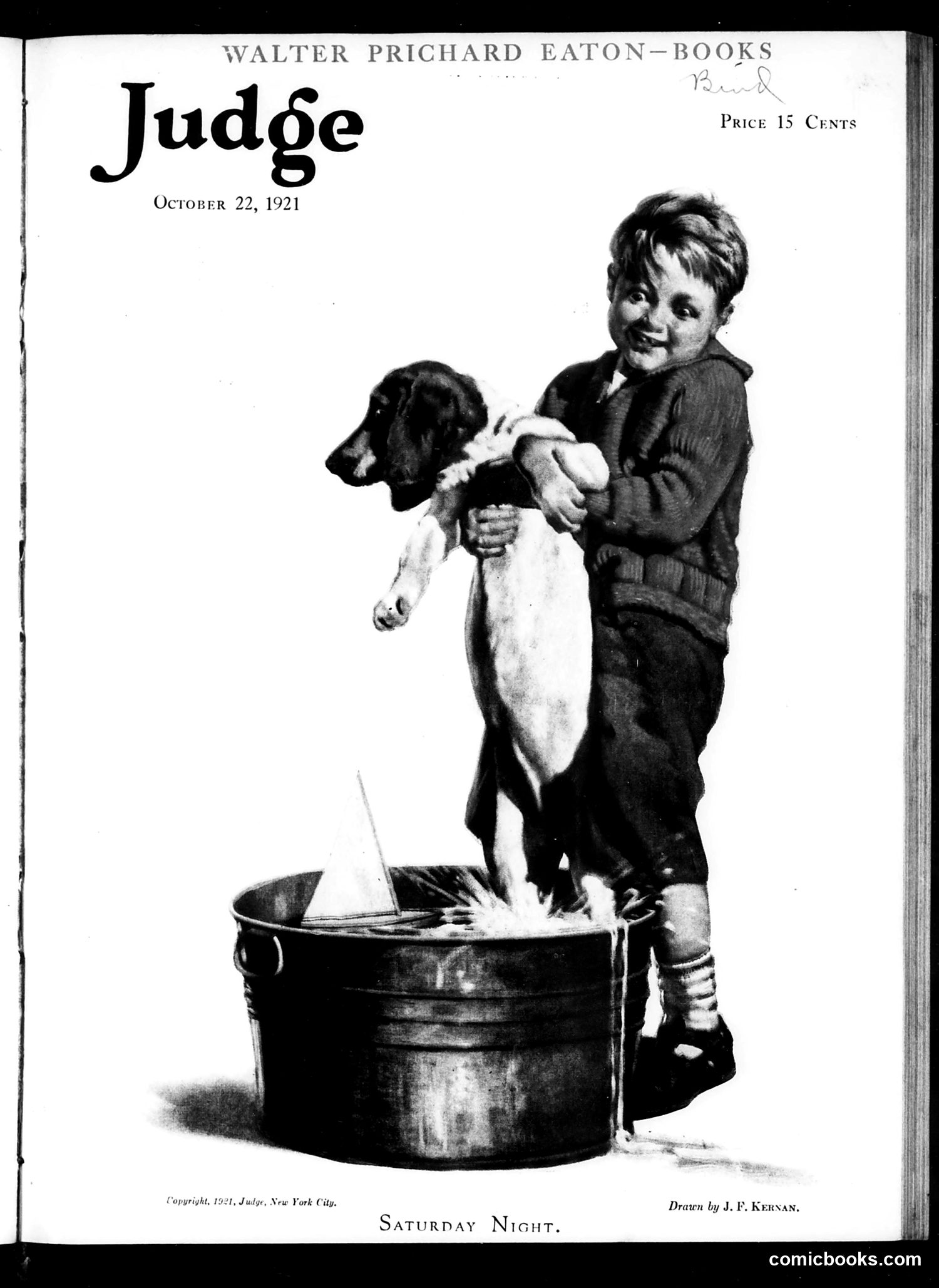
This cartoon depicts a young boy doing laundry, wringing out what appears to be a cloth or garment into a large metal tub. The illustration is titled "Saturday Night," suggesting this references the common domestic chore schedule of the era. The satire likely comments on child labor or domestic responsibilities expected of children in the 1920s. The cheerful demeanor of the child contrasts with the unglamorous work, possibly mocking either parental expectations or societal attitudes normalizing children's household drudgery. The artwork is credited to J.F. Kernan. Without additional context from the magazine's surrounding content, the specific satirical target remains unclear, though it appears social commentary on childhood and labor.

This page features a formal portrait photograph with an autograph of **George Jean Nathan**, identified by the caption below. The text announces that beginning October 15, Nathan will contribute a weekly "Dramatic article" to *Judge* magazine. Nathan was a prominent American drama critic and editor active in the early 20th century, known for his sharp theatrical commentary. This appears to be a professional announcement rather than satire—*Judge* is promoting a new regular column by a respected cultural figure. The formal portrait photography and signature are standard presentation conventions for introducing a notable contributor to the publication's readers. There is no apparent cartoon or satirical content on this page; it functions as a straightforward announcement of editorial content.
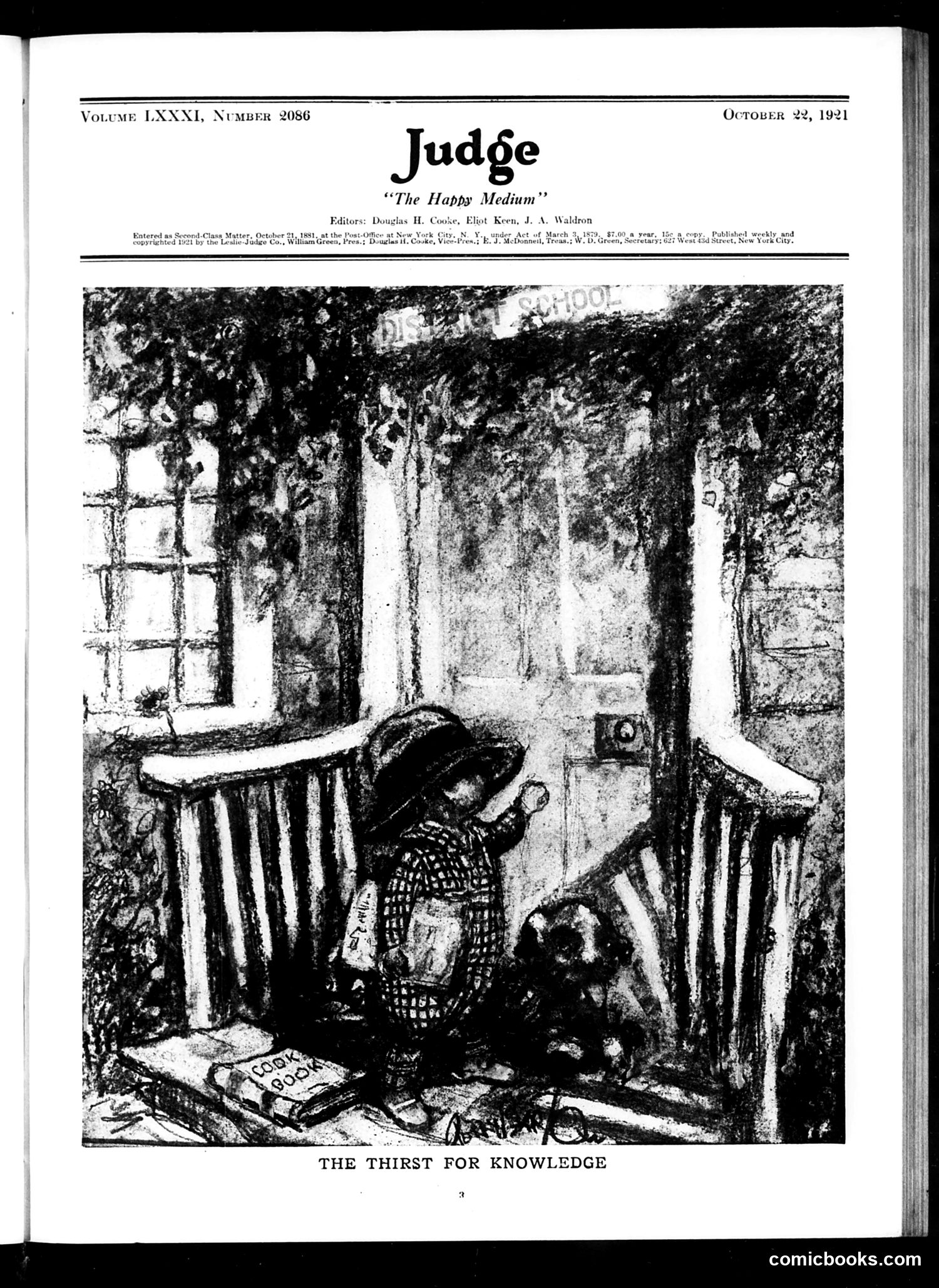
This cartoon depicts a child sitting in a modest room or alcove, reading intently by a window with ivy-covered walls. The child holds what appears to be a schoolbook, with additional educational materials visible nearby. The caption "The Thirst for Knowledge" suggests the image celebrates youthful eagerness for learning despite humble circumstances. In 1921 America, this likely reflected contemporary debates about education access and poverty. The composition—showing a determined child in modest surroundings pursuing education—appears designed to inspire or perhaps comment on educational inequality. Whether satirical or earnest, the image romanticizes determination to learn among working-class or poor children, a common Progressive-era theme in American magazines.
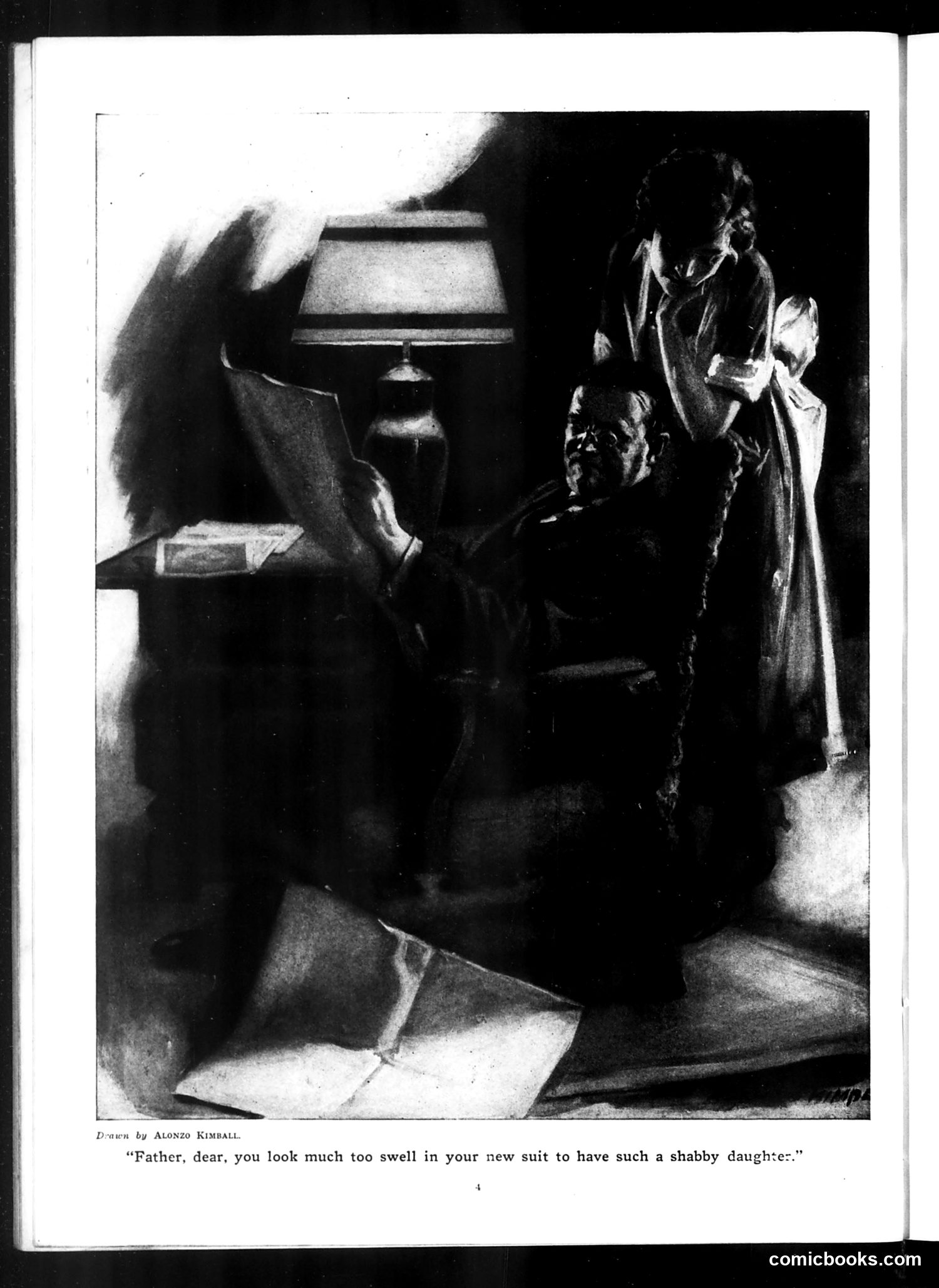
This cartoon by Alonzo Kimball satirizes class anxieties and conspicuous consumption in early 20th-century America. A well-dressed father in an expensive new suit is confronted by a poorly-dressed daughter, creating comic irony through contrast. The satire targets nouveau riche fathers who prioritize displaying wealth through personal luxury while neglecting family obligations—particularly daughters' appearances and social standing. The daughter's complaint highlights the absurdity of such misplaced priorities: a man flaunting wealth yet failing to maintain his family's respectable appearance suggests moral or financial disorder beneath the fashionable exterior. The joke reflects period anxieties about proper wealth management and social responsibility among the newly wealthy.
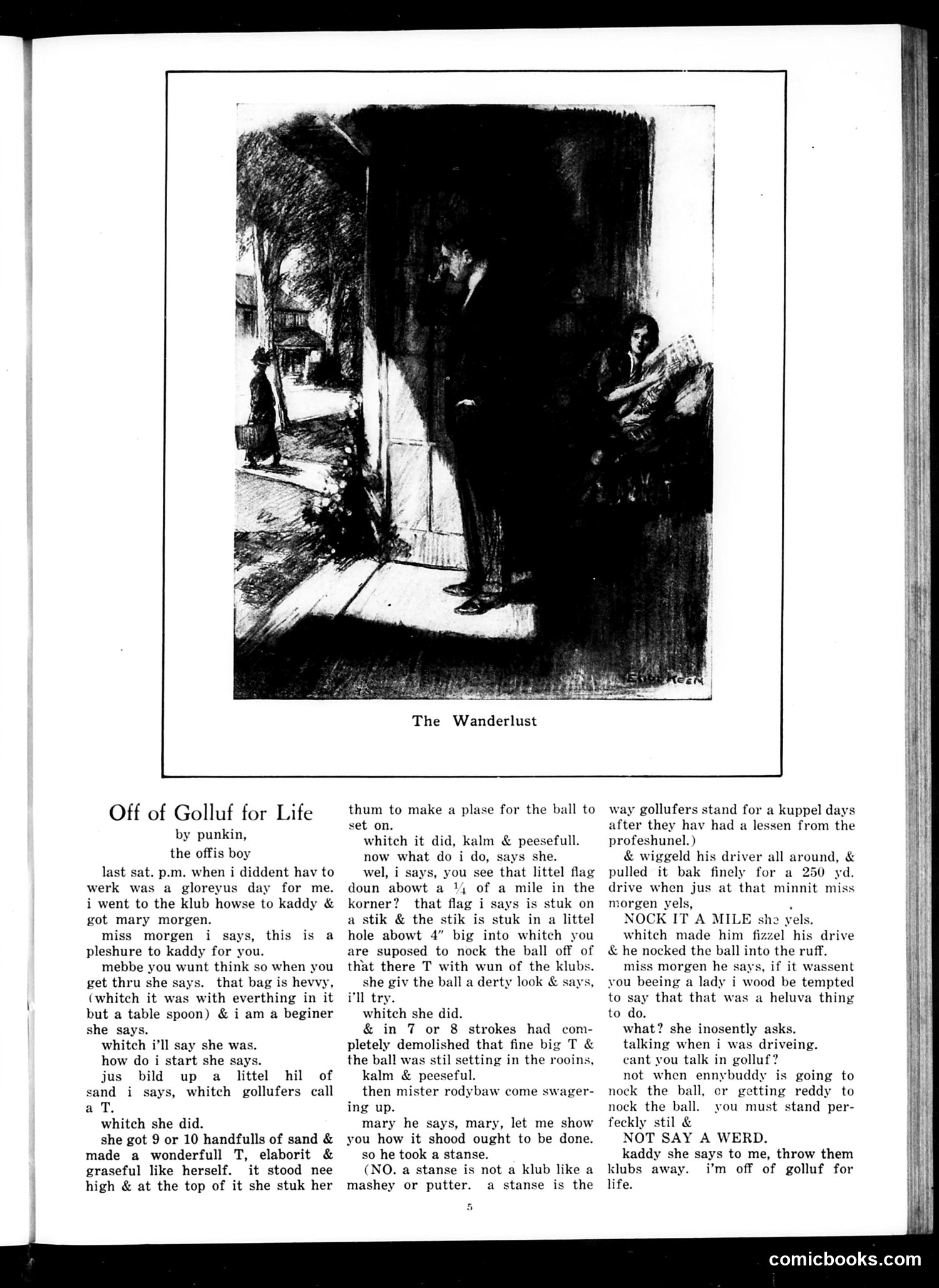
This appears to be a humorous illustrated story about golf rather than political satire. The sketch shows figures at what looks like a golf club entrance or doorway. The accompanying text is a first-person narrative about a woman learning to play golf. She describes her struggles with the sport's basics—proper stance, how to hold the club, and fundamentals—in colloquial, self-deprecating language. The narrator mentions her "kaddy" (caddy) attempting to teach her, with mixed results. The satire here is social rather than political: it gently mocks amateur golfers (particularly women) trying to learn the game, their instructors' frustrations, and the general confusion of beginners confronting golf's technical demands and terminology.
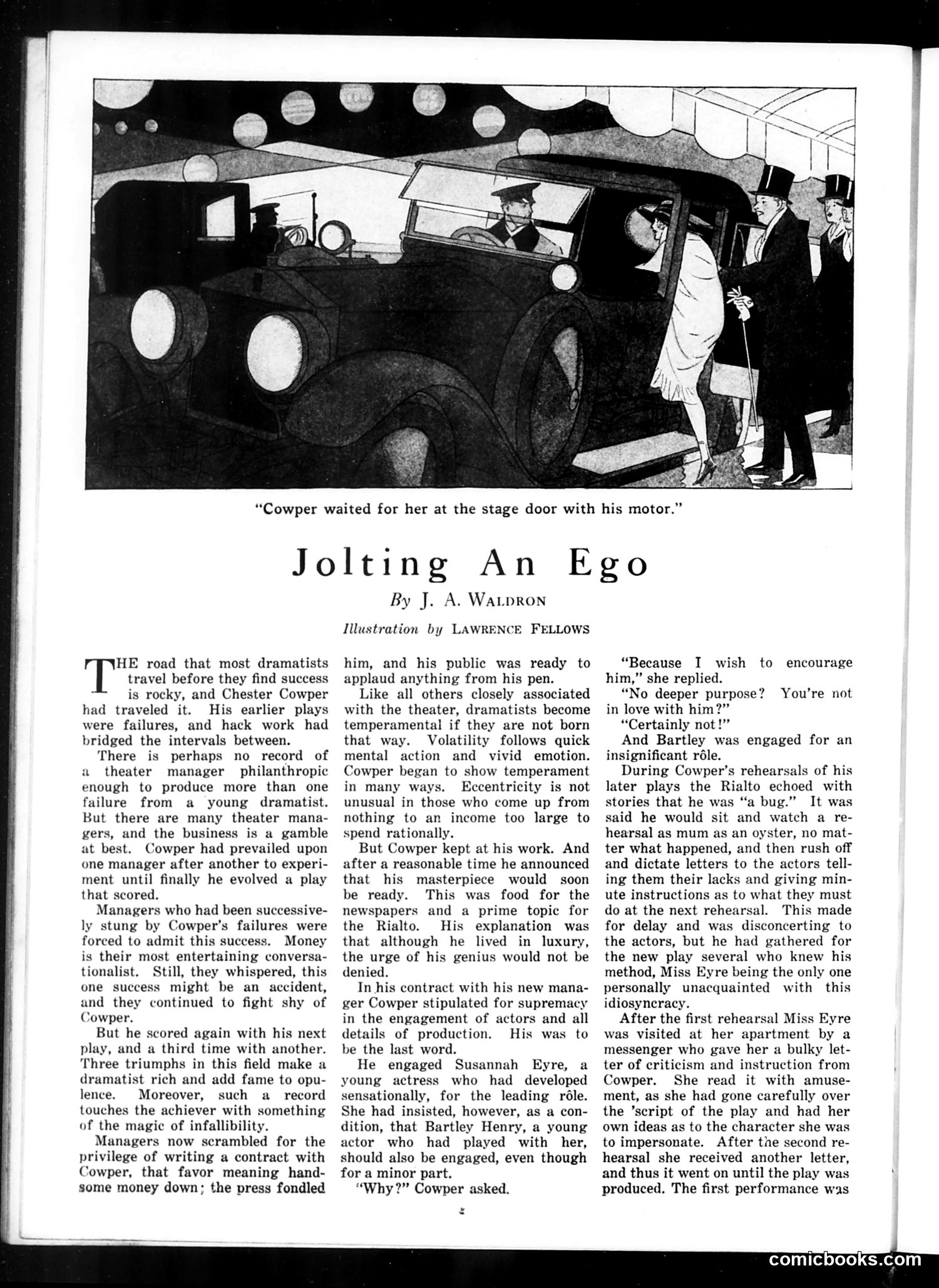
This is a short story rather than a political cartoon. The illustration shows a well-dressed woman being escorted to a motor car by men in top hats at what appears to be a theater stage door. The narrative concerns Chester Cowper, a temperamental dramatist whose earlier plays failed until he achieved success. The story satirizes theatrical ego and artistic pretension: Cowper demands total control over production details and becomes difficult during rehearsals. He engages actress Susannah Eyre for a leading role, then insists on also casting Bartley Henry in a minor part. The satire targets the vanity of theater professionals—particularly how success inflates artistic egos and leads to demanding, irrational behavior toward collaborators and subordinates.
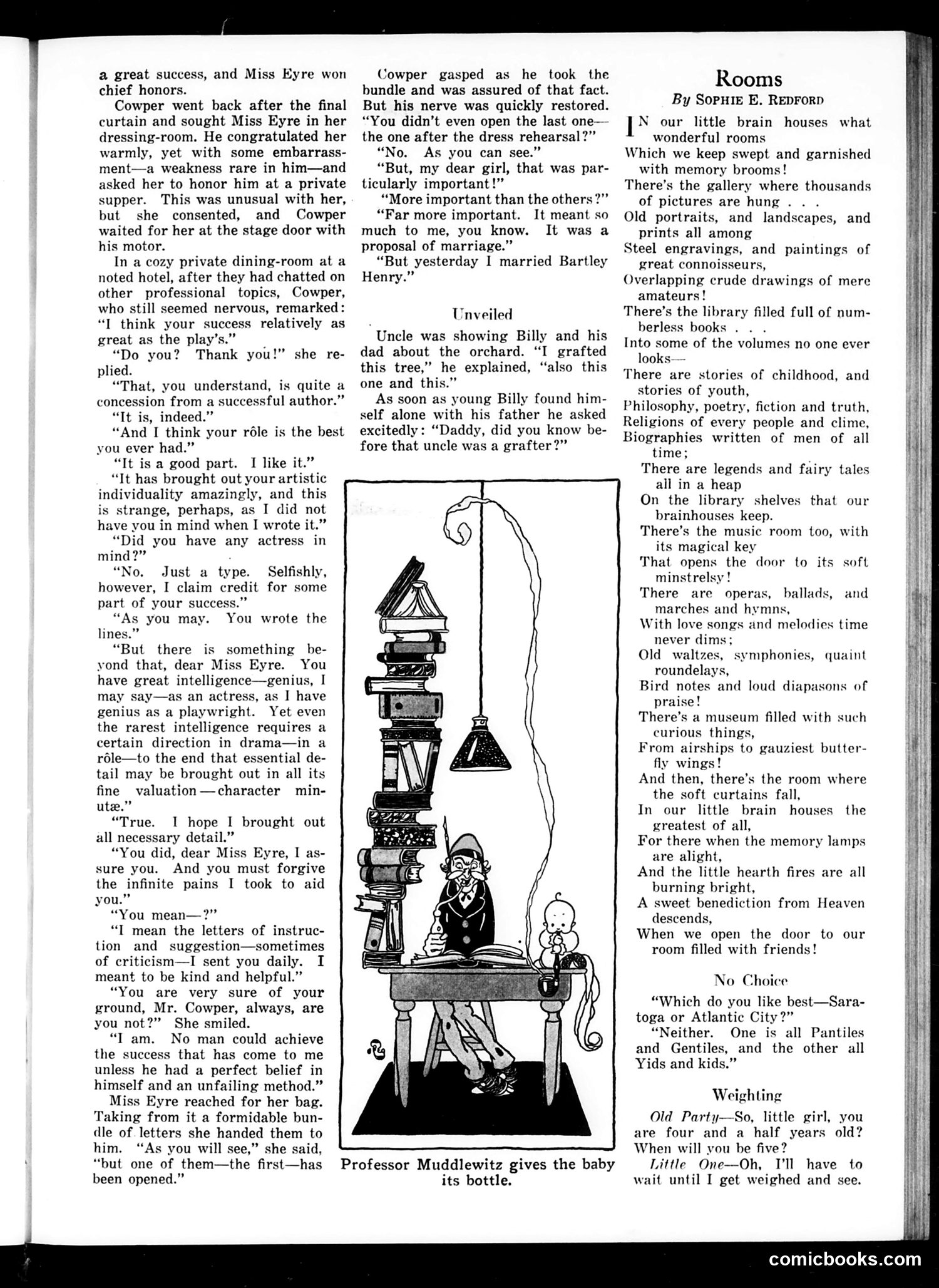
This page contains three distinct items: **Main Story: "Unveiled"** A narrative about playwright Cowper and actress Miss Eyre. After her theatrical success, Cowper takes her to dinner and reveals he sent her daily instructional letters—culminating in an unread marriage proposal. The joke: Miss Eyre never opened his final letter because she married someone else (Bartley Henry) yesterday. The satire mocks male authorial presumption and the arrogance of men who assume their guidance ensures romantic reciprocation. **Short Joke: "Unveiled" (second)** A child's misunderstanding: Uncle explains he "grafted" trees in his orchard. The boy later asks his father if uncle was "a grafter"—conflating horticultural grafting with graft (corruption). This plays on the era's common association of grafting with political/business corruption. **Poem: "Rooms"** A whimsical poem by Sophie Redford about the mind as a house with various "rooms" storing memories, books, and experiences. Non-satirical; appears to be filler content. The page primarily satirizes male ego and romantic presumption through the main narrative.
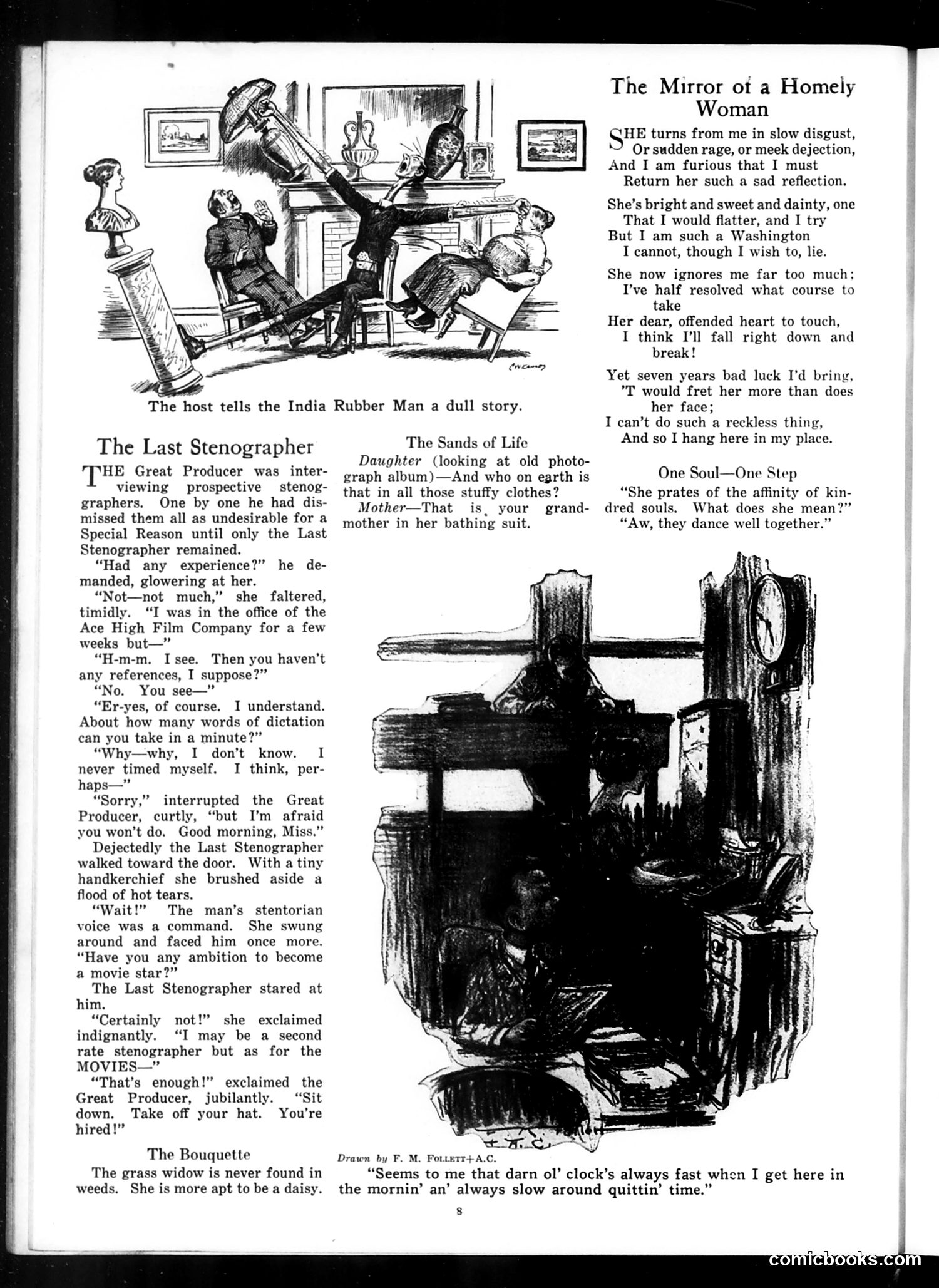
**Top Cartoon ("The India Rubber Man"):** A contortionist performer entertains a bored host and guests. The satire mocks tedious social obligation—the host's dull storytelling compels polite listening, while the acrobat's spectacular contortions fail to impress the unresponsive audience. It's commentary on forced entertainment and social pretense. **"The Last Stenographer" Story:** Satirizes the film industry's exploitation of women. A movie producer rejects qualified stenographers for lacking ambition to become actresses, then hires an unqualified woman specifically *because* she refuses to pursue stardom. The joke exposes how studios preferred compliant, desperate women over skilled workers, exploiting them as potential talent rather than valuing professional competence. **Bottom Image & Caption:** Depicts an employee's observation about workplace timekeeping—clocks mysteriously run fast during work hours and slow at quitting time. It's cynical commentary on management manipulation and worker exploitation. These pieces collectively critique early 20th-century American business practices regarding labor, entertainment, and gender.
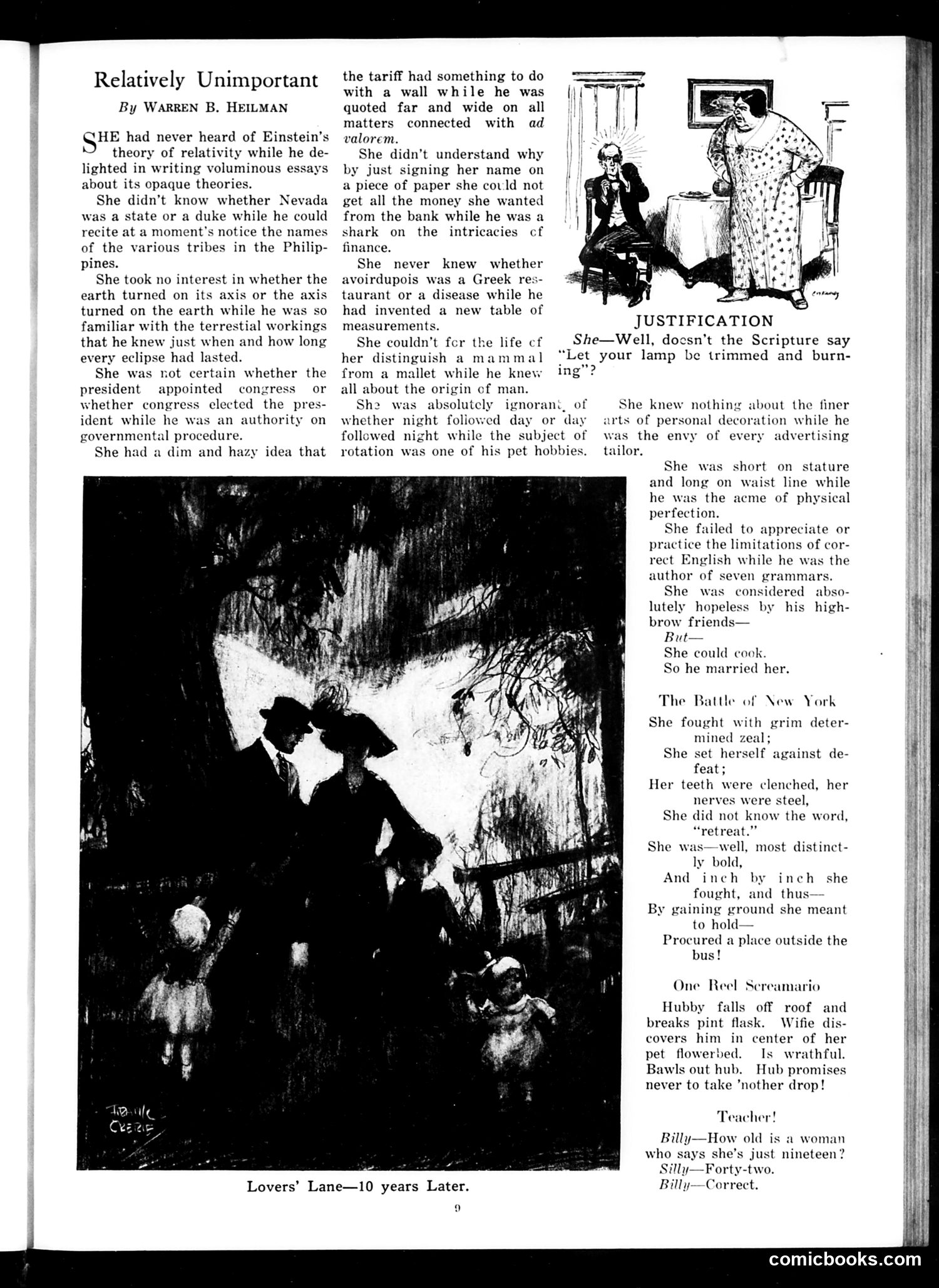
This page contains a humorous essay titled "Relatively Unimportant" by Warren B. Heilman, satirizing gender differences in knowledge and priorities circa the 1920s. The piece contrasts a woman's ignorance of "important" intellectual matters—Einstein's relativity, geography, astronomy, government, finance, measurements, biology, grammar—with a man's expertise in these areas. The satire's point: despite her intellectual inadequacy by contemporary standards, **she could cook, so he married her anyway**. The accompanying illustration ("Lovers' Lane—10 Years Later") shows a couple in silhouette, suggesting domestic routine has replaced romance. The "Justification" section reinforces this: Scripture permits her to trim lamps; she lacks fashion sense but possesses "physical perfection"; her poor English contrasts his seven grammars—yet she's considered "absolutely hopeless" by intellectuals. Subsequent short comedic pieces ("The Battle of New York," "One Reel Screamario," "Teacher!") continue mocking women's limitations while celebrating their domestic utility. The satire targets both gender stereotypes and intellectual pretension of the era.
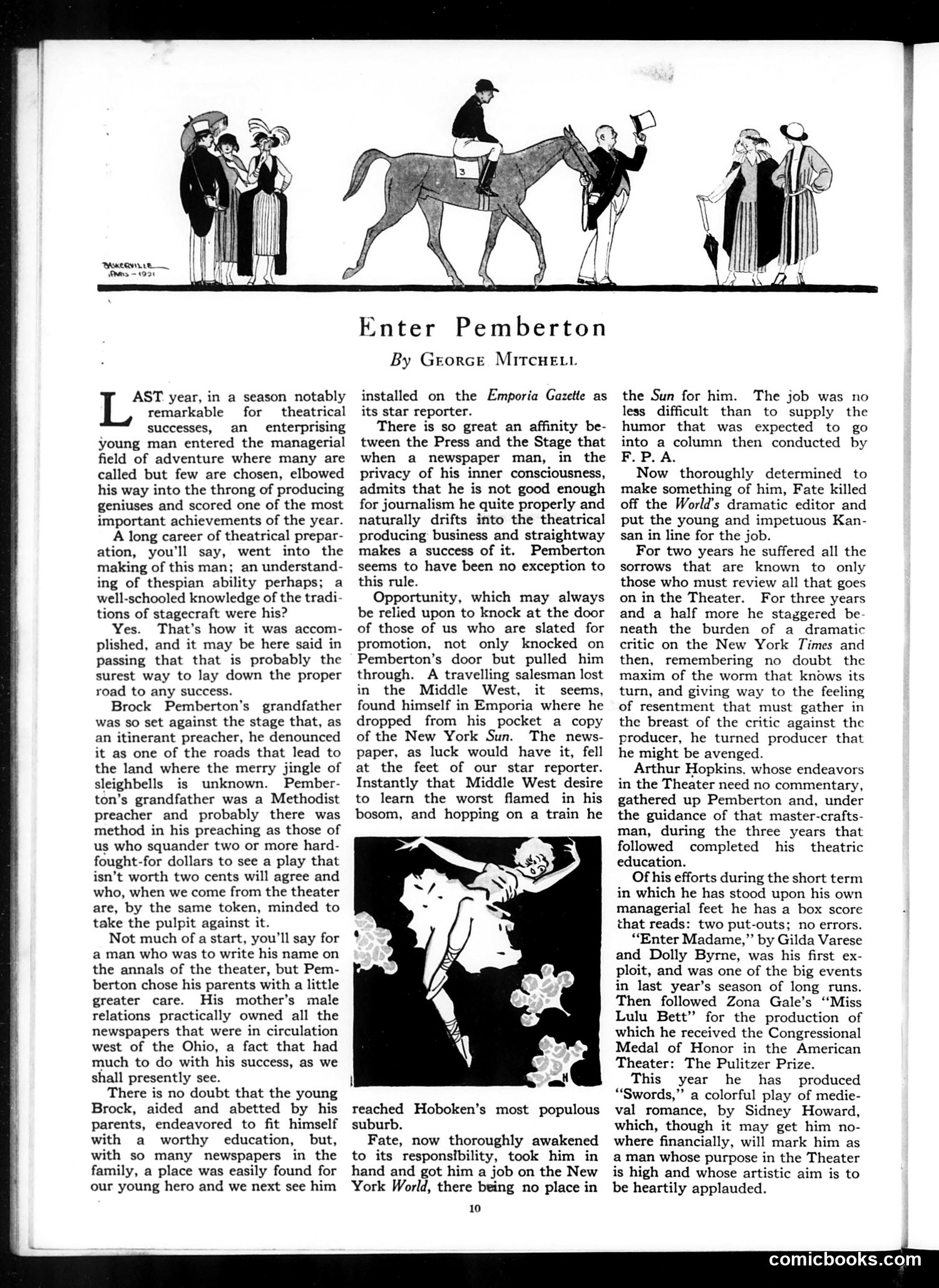
This is a biographical sketch of **Brock Pemberton**, a theater producer who achieved success despite (or because of) an unlikely background. The satire works on multiple levels: **The Joke:** Pemberton's grandfather was a Methodist preacher who condemned the theater as sinful, yet Pemberton became a theatrical producer—a ironic reversal. The article sarcastically credits his success not to talent or hard work, but to luck ("Fate") and family newspaper connections. **The Social References:** The piece mocks how newspaper journalists often drift into theater production when they admit they're "not good enough for journalism"—suggesting theater is a lesser field. It also satirizes how newspaper family connections and sheer chance determine success more than merit. **The Cartoon at top** shows Pemberton on horseback meeting various theater people, illustrating his "entrance" into the theatrical world. The overall tone is gently mocking: success comes from privilege and luck, not ability or virtue—a common Judge magazine theme critiquing American society.
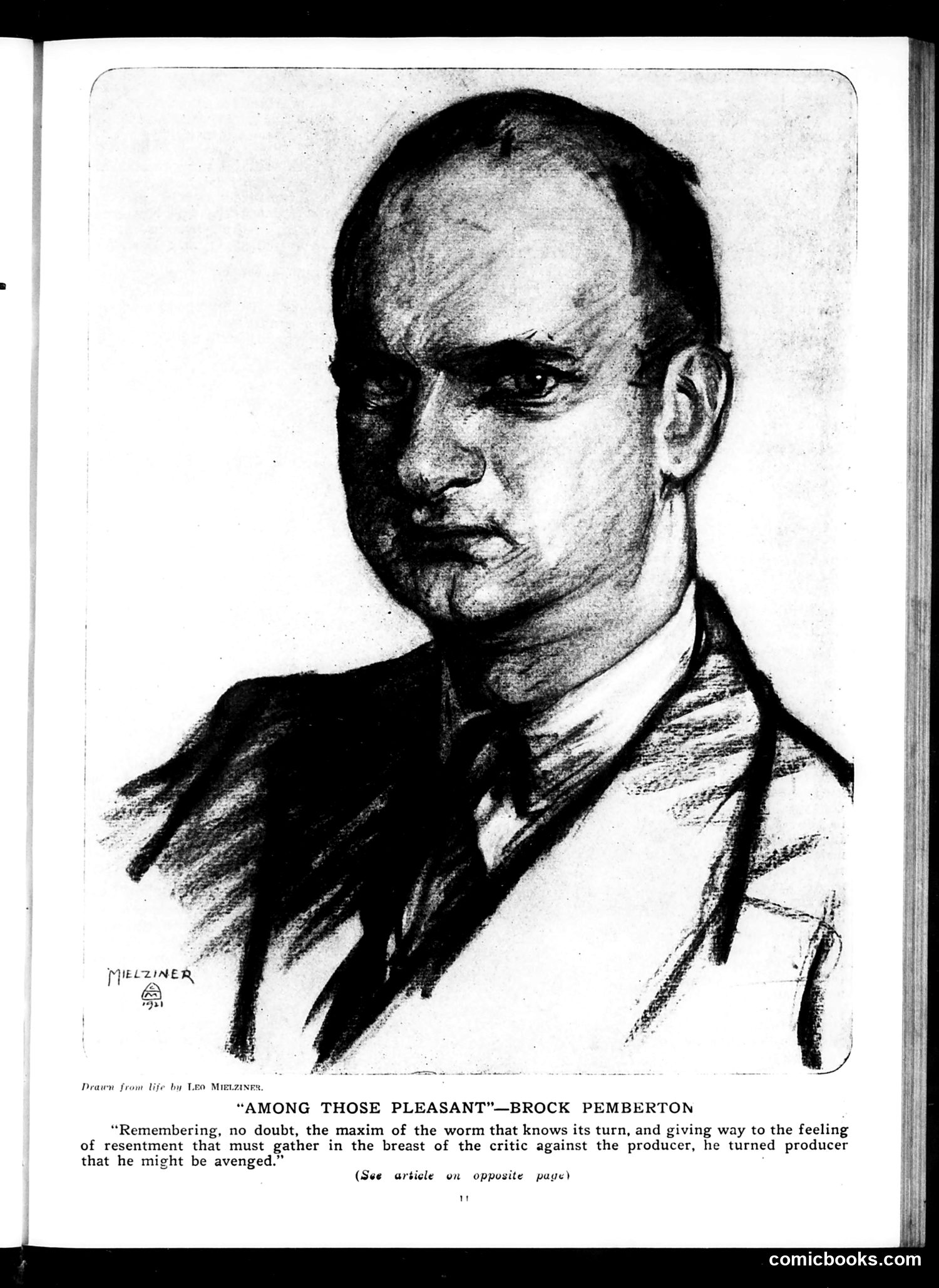
This page features a portrait sketch of **Brock Pemberton**, a theater producer, drawn by artist Leo Mielziner. The accompanying quotation is satirical commentary on Pemberton's transition from theater critic to producer. The satire suggests Pemberton became a producer out of spite—that as a critic, he harbored resentment against producers, and thus "turned producer that he might be avenged." The phrase "among those pleasant" (likely from the article referenced) implies this was a notably petty motivation. The image itself is a straightforward portrait; the satire resides entirely in the text's characterization of Pemberton's career move as revenge rather than genuine artistic ambition. Judge is mocking what it presents as his unprofessional, emotionally-driven career change. The piece would be more meaningful with the referenced opposite-page article providing fuller context.
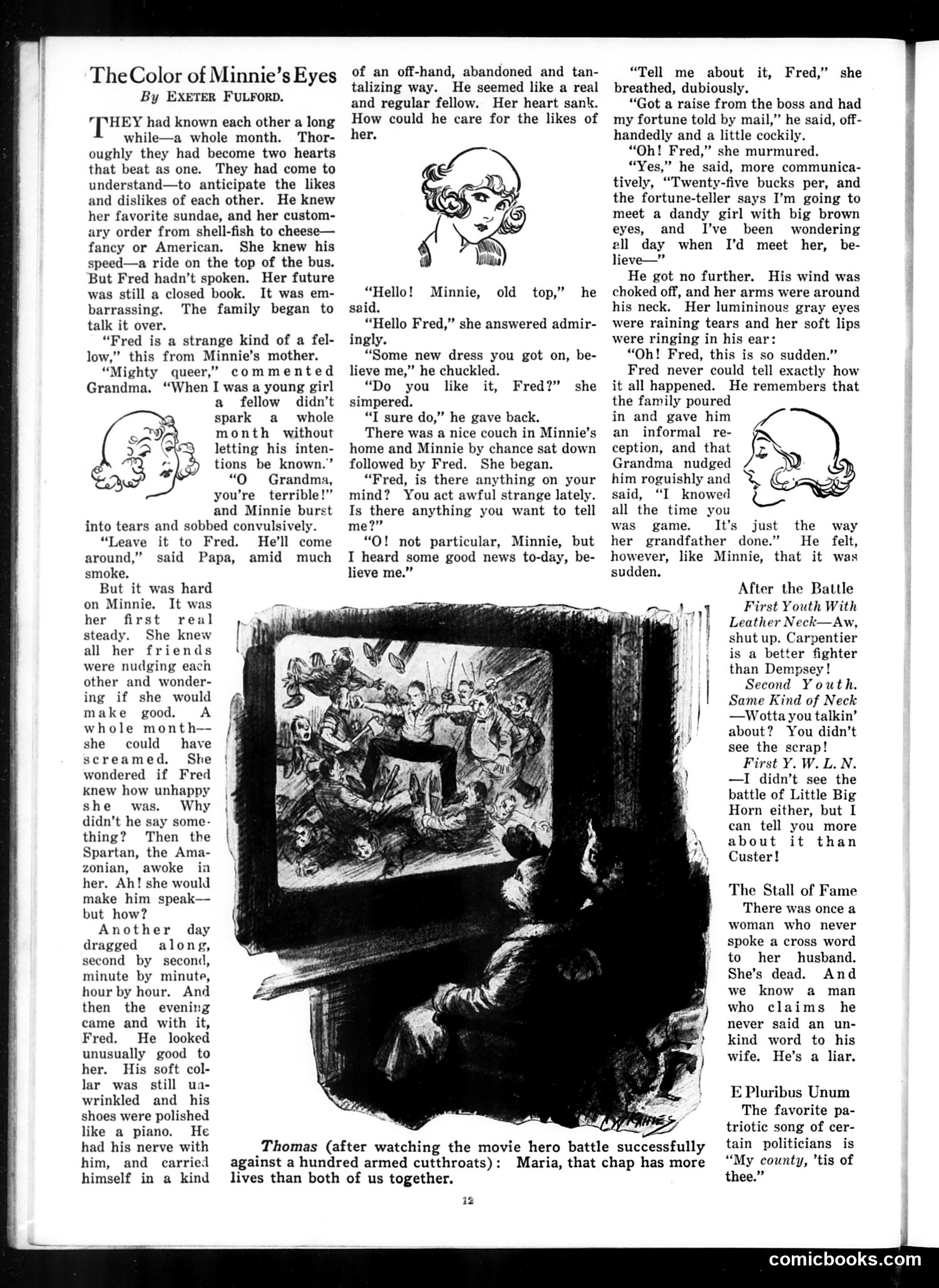
This page contains a romantic short story titled "The Color of Minnie's Eyes" by Exeter Fulford, depicting a courtship scenario from the early 20th century. **Main Story:** Fred and Minnie have been "steadily" dating for a month without Fred proposing or declaring intentions. Minnie's family—including her mother and grandmother—grows impatient, as social convention expected formal declarations within shorter timeframes. The grandmother explicitly references outdated customs: "When I was a young girl a fellow didn't spark a whole month without letting his intentions be known." Fred finally reveals he received a raise and a fortune-teller predicted he'd meet a girl with brown eyes, prompting Minnie to embrace him emotionally—misinterpreting this as an engagement signal. **The Satire:** The joke mocks both outdated social expectations around courtship and the miscommunication between the sexes. Minnie assumes his vague fortune-teller comment is a proposal, while Fred appears oblivious. **Bottom Cartoons:** Brief satirical quips about movie heroes and eyewitness reliability unrelated to the main story. The content reflects early 1900s dating conventions and gender dynamics now considered antiquated.
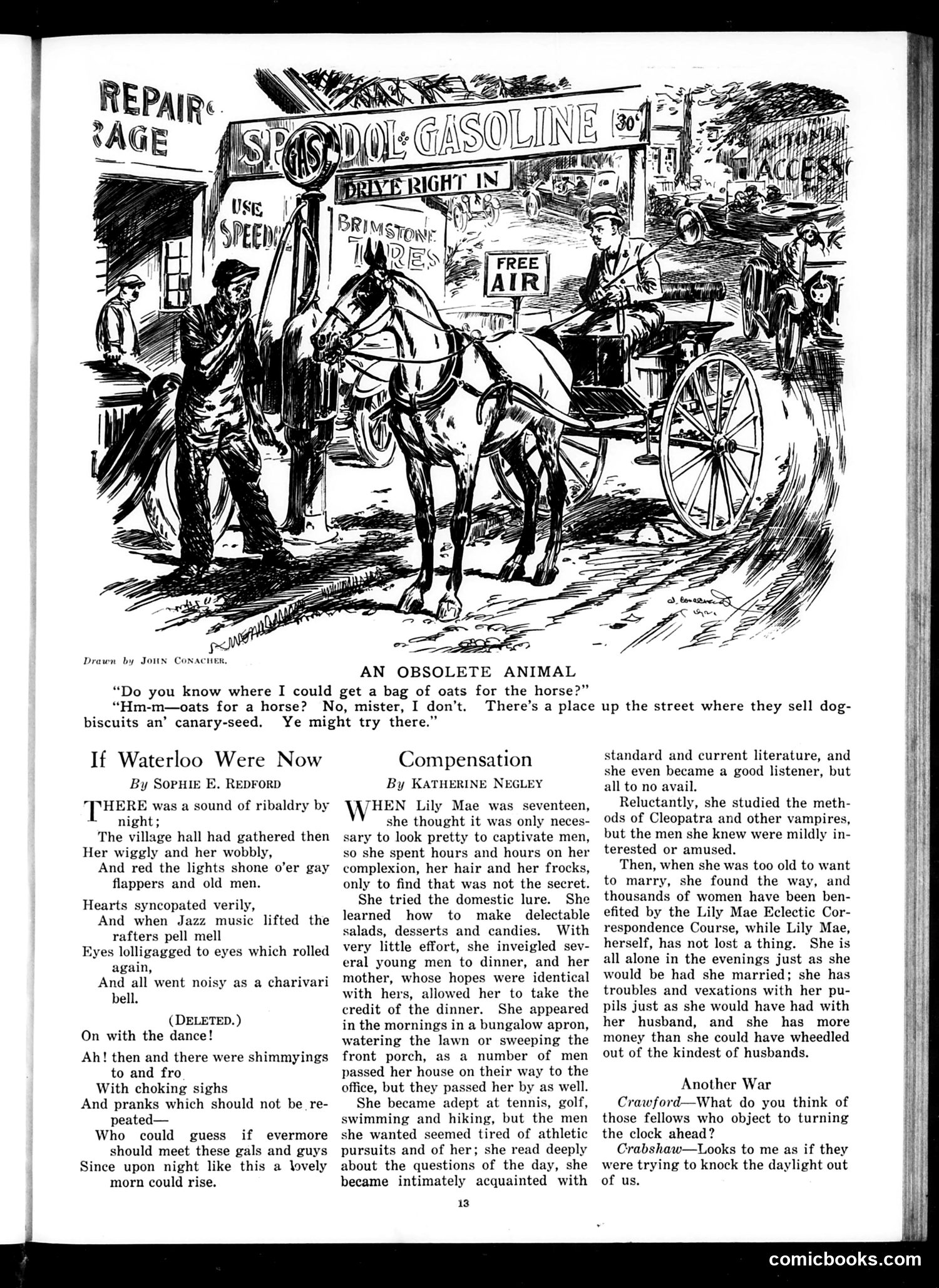
**The Cartoon:** "An Obsolete Animal" satirizes the rapid modernization of the 1920s. A man with a horse-drawn wagon seeks oats at a gasoline station offering "Free Air" and other automotive services. The joke: horses and their feed have become obsolete relics in an automobile-dominated world. The shopkeeper suggests dog biscuits instead, treating the horse as equally outdated. **The Surrounding Content:** The page includes poetry about Jazz Age dancing ("If Waterloo Were Now") and a story about a woman ("Compensation") who tries every traditional method to attract men—beauty, cooking, domesticity, athletics, intellectualism—before finding success by teaching a correspondence course. This satirizes changing gender roles and women's shifting independence in the 1920s. **Context:** Both pieces mock old social orders displaced by modernity: the horse by automobiles, and traditional female roles by women's economic independence.
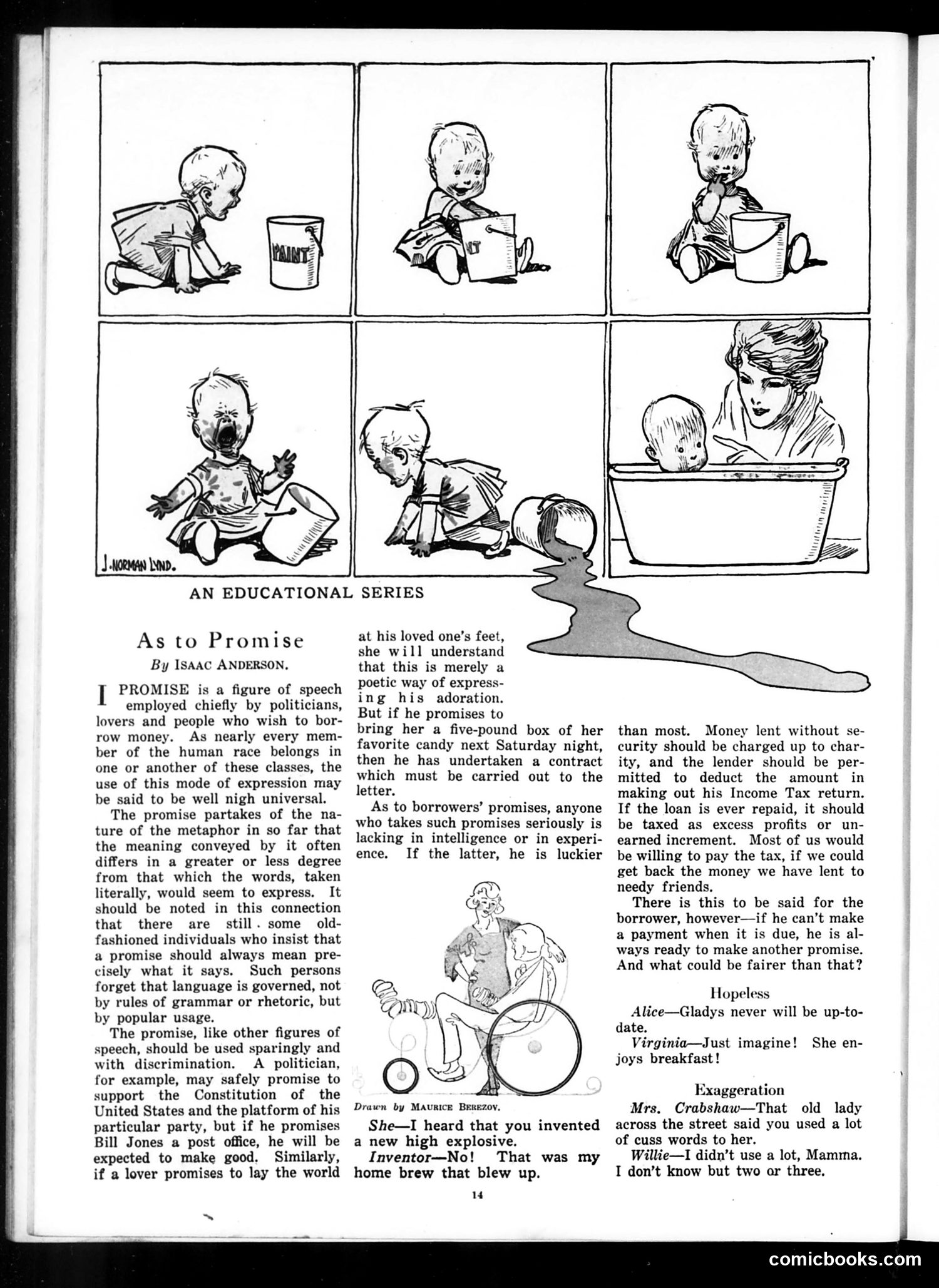
This essay satirizes the meaninglessness of promises in early 20th-century American life. Author Isaac Anderson argues that "promise" functions as deliberately vague language, especially among three groups: politicians, lovers, and borrowers. The satire's key insight: a promise's actual meaning depends on who makes it. Politicians safely promise constitutional support; lovers poetically pledge devotion without literal obligation. But borrowers' promises are worthless—lenders who take them seriously lack intelligence. Anderson mockingly suggests taxing repaid loans as "excess profits" and treating unpaid debts as charity. The accompanying comic strip shows a baby's progression with a paint bucket, illustrating how promises (and consequences) develop through stages. A sidebar joke about home-brew exploding reinforces the theme of failed expectations. The piece reflects Progressive-era cynicism about political rhetoric and financial irresponsibility, suggesting that in common usage, "promise" has become essentially meaningless.
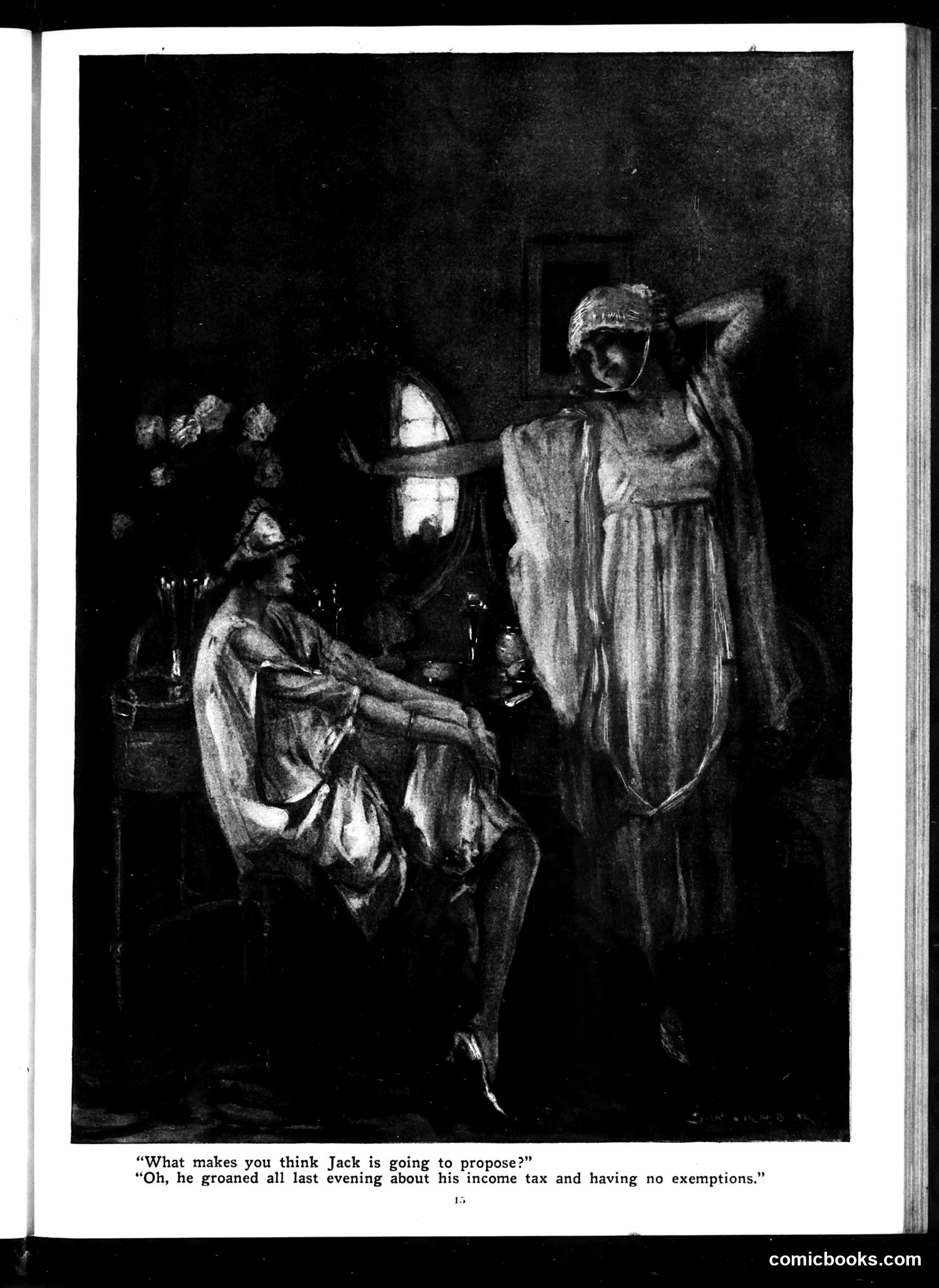
This is a single-panel cartoon from Judge magazine satirizing marriage proposals and income tax complaints. The setting appears classical or allegorical, with figures in draped clothing. The joke plays on a man's financial grievances as a sign of romantic commitment: a woman predicts her suitor "Jack" will propose because he spent the evening complaining about his income tax burden and lack of tax exemptions. The humor suggests that a man so financially stressed and preoccupied with taxes is desperate enough—or sufficiently trapped by circumstances—to marry. The cartoon satirizes both the financial pressures on American men during the income tax era and the cynical reality that financial desperation might drive marriage proposals. It reflects early-to-mid 20th century attitudes toward both taxation and matrimony.
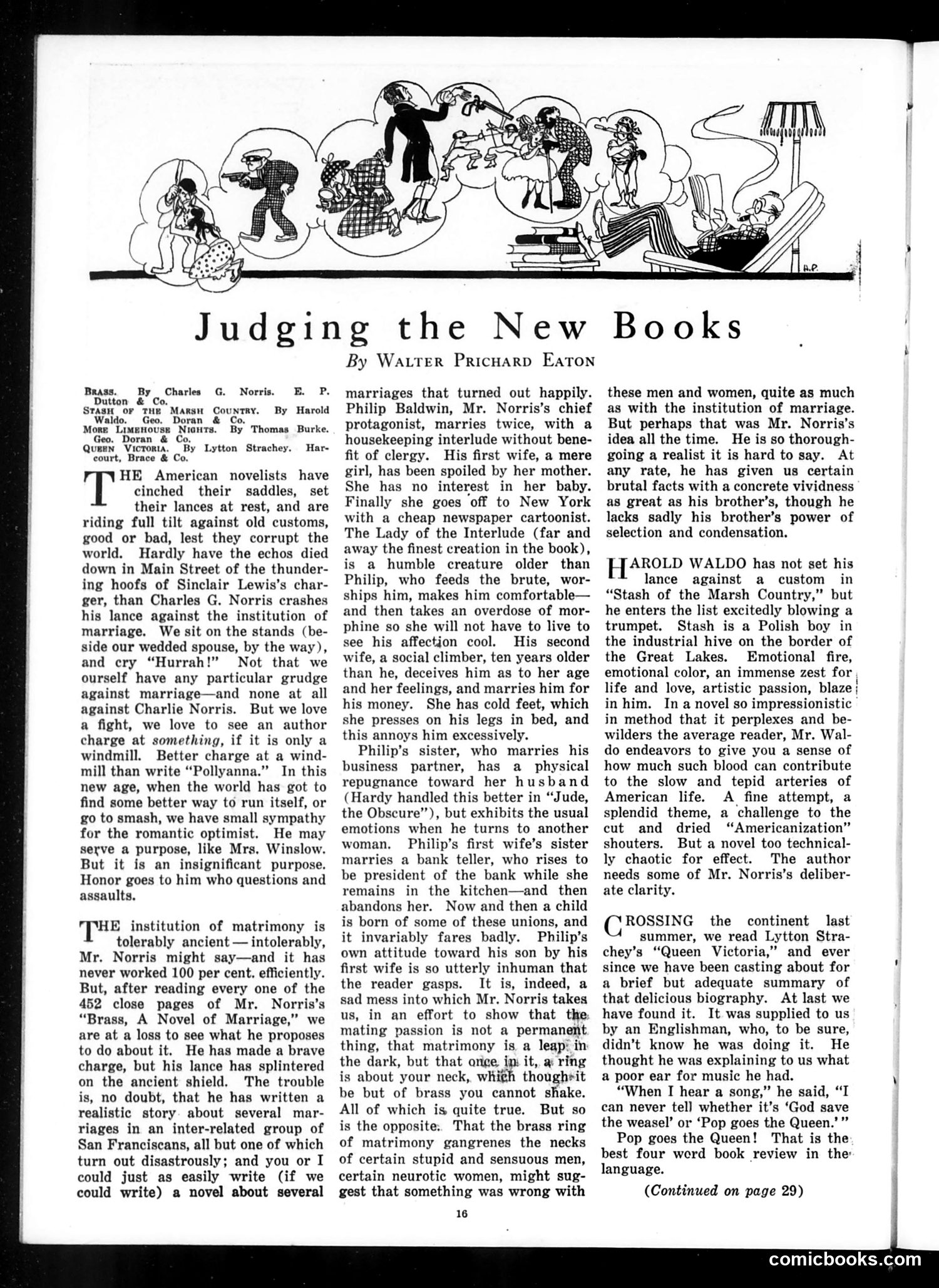
This is a book review column critiquing Charles G. Norris's novel *Brass: A Novel of Marriage*. The illustration depicts various domestic scenes and marital situations. Eaton praises Norris for attacking an established institution (marriage) rather than writing comforting escapism like "Pollyanna," valuing social critique over romantic optimism. However, he faults Norris for offering only realistic depiction of marriage failures without proposing solutions. The novel follows San Francisco characters through multiple disastrous marriages: a protagonist whose first wife abandons their baby for a cartoonist, a selfless second woman who commits suicide, his second marriage to a mercenary social climber, and his sister's unhappy union. Eaton notes Norris portrays matrimony as inescapable ("a ring is about your neck"), comparing it to a brass ring one "cannot shake"—suggesting marriage as both unbreakable and worthless.
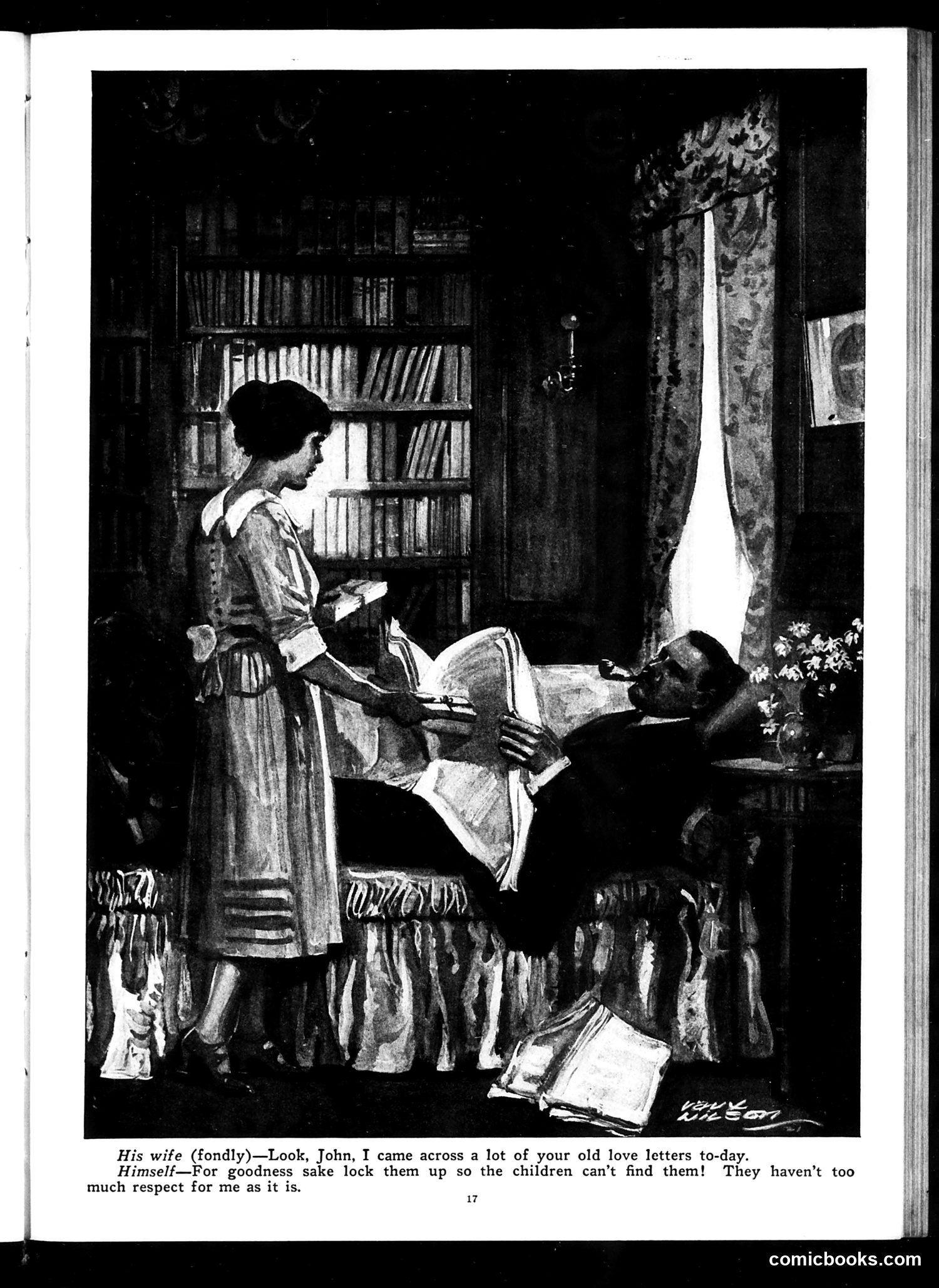
This illustration depicts a domestic scene satirizing male hypocrisy and marital dynamics. A wife has discovered her husband's old love letters and playfully shows them to him. Rather than being romantic or sentimental, the husband's reaction is embarrassed concern—he fears his children will find the letters and lose respect for him. The satire targets the contradiction between a man's youthful romantic persona (evidenced by passionate letters) and his current domestic authority. The joke suggests that husbands wish to maintain a respectable, dignified image before their children, even at the cost of appearing unromantic or emotionally restrained in marriage. It's commentary on early 20th-century masculine pretense and the gap between private passion and public propriety.
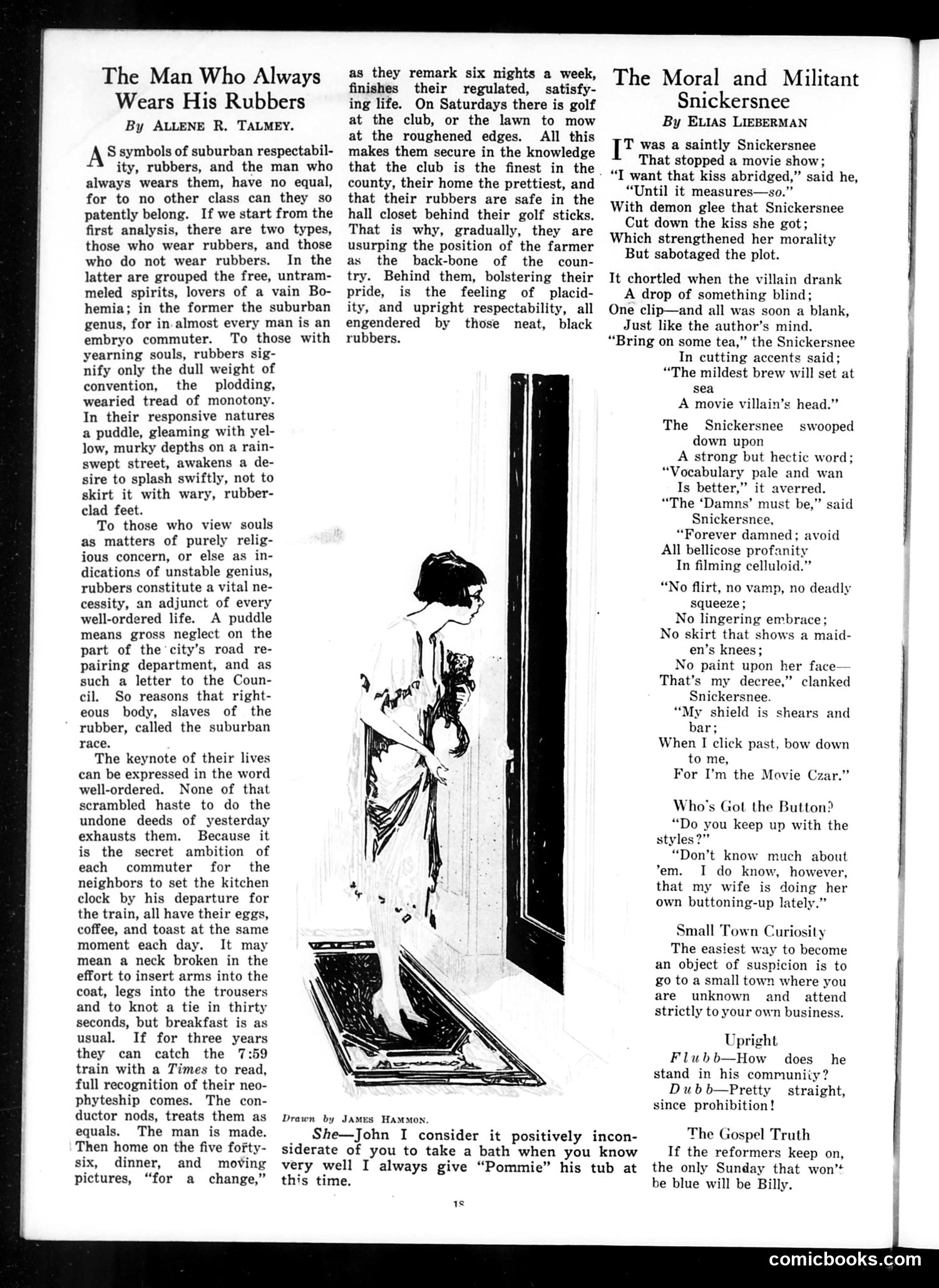
**"The Man Who Always Wears His Rubbers"** satirizes suburban conformity through the figure of the commuter. Talmey contrasts two types: carefree bohemians who splash through puddles versus uptight suburbanites who meticulously protect themselves with rubbers (galoshes). The satire targets the suburban man's obsessive routine—catching the 7:59 train daily with his newspaper, timing breakfast identically, golfing Saturdays—as hollow respectability masquerading as moral virtue. The rubber-wearer represents conformist mediocrity: orderly, predictable, and self-congratulating about his "well-ordered life." **"The Moral and Militant Snickersnee"** mocks film censorship. Snickersnee represents a zealous censor who aggressively edits movie content: shortening kisses, removing villains' drinking scenes, banning profanity and "vamp" behavior. The humor lies in depicting censorship as comically excessive and destructive to storytelling—the censor's cuts create nonsensical plots ("just like the author's mind"). Both pieces critique early 20th-century American conformity and social regulation.
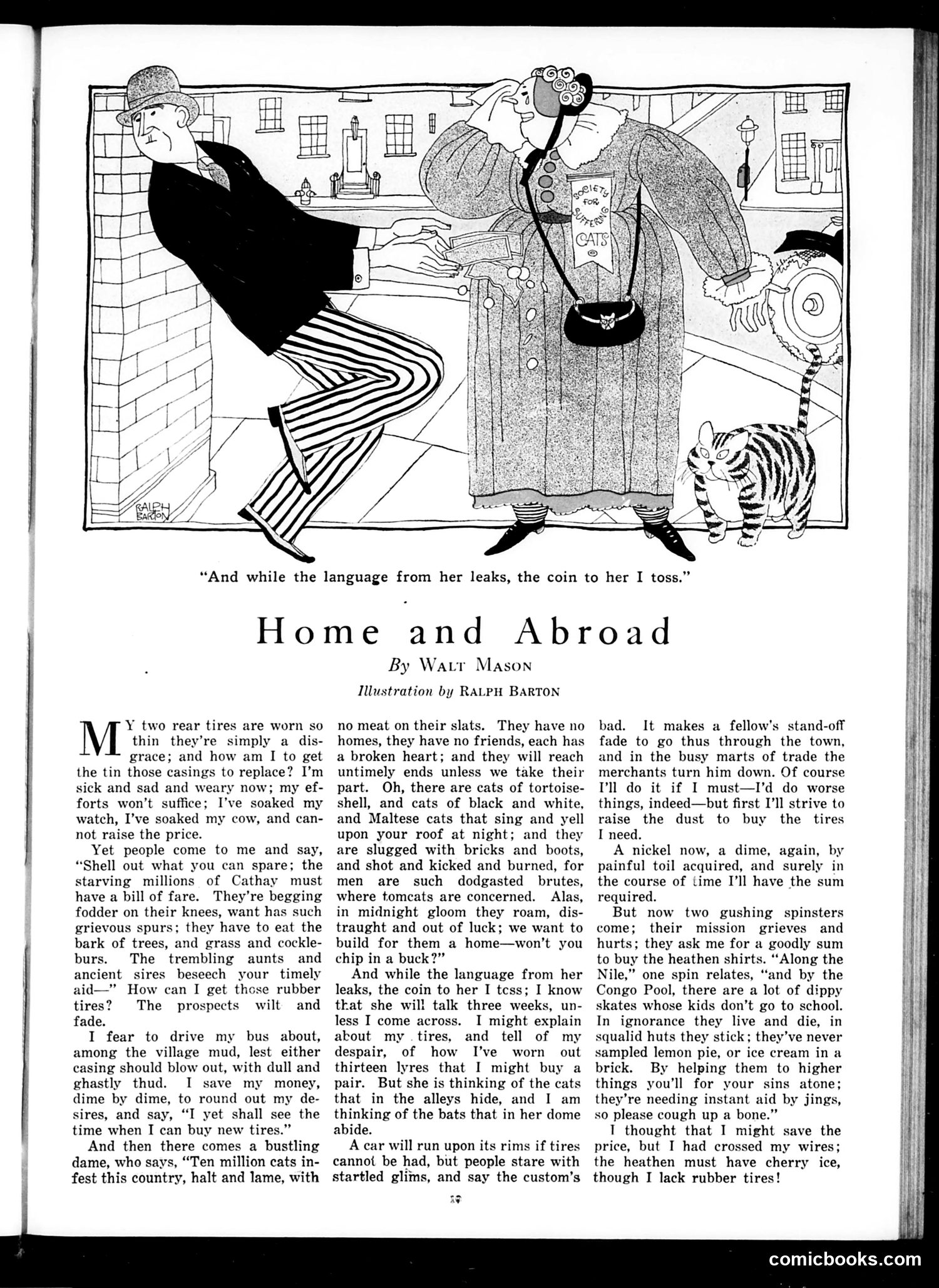
This satirical piece mocks the tension between personal financial hardship and relentless charitable appeals. The central figure—a struggling working man who needs new tires for his bus—is repeatedly accosted by well-meaning solicitors: a woman concerned about starving Chinese people and stray cats, and two "spinsters" collecting for missions to clothe impoverished African children. The satire's point: while the protagonist faces genuine local poverty (worn tires, inability to afford replacements), he's guilted into donating to distant causes. Mason critiques both the donor's helplessness and the endless parade of competing charitable demands, each more emotionally manipulative than the last. Ralph Barton's illustration emphasizes the comedy through exaggerated character types and the protagonist's hapless stance. The joke centers on how charitable appeals prey on guilt, leaving ordinary struggling people unable to address their own needs.
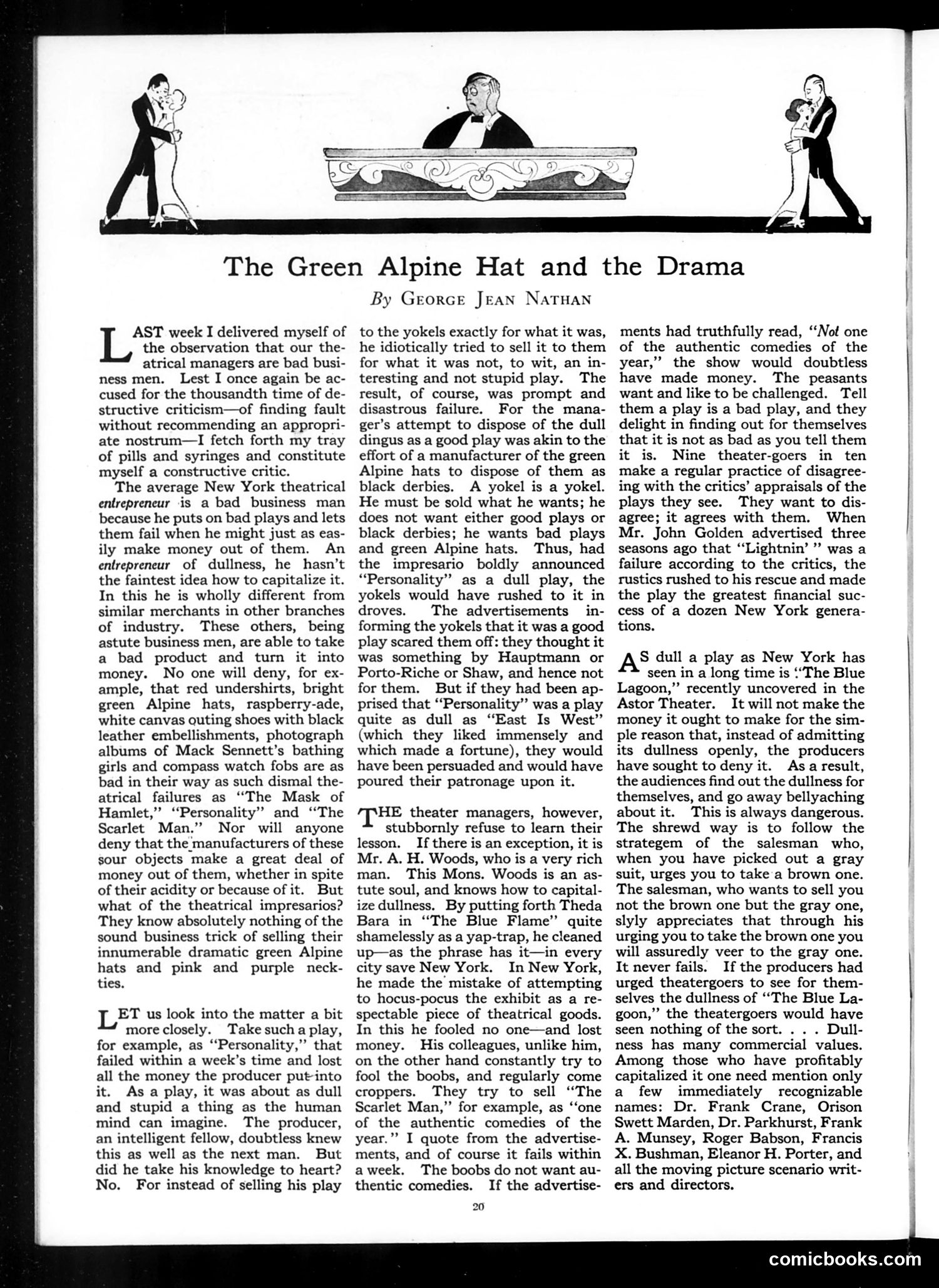
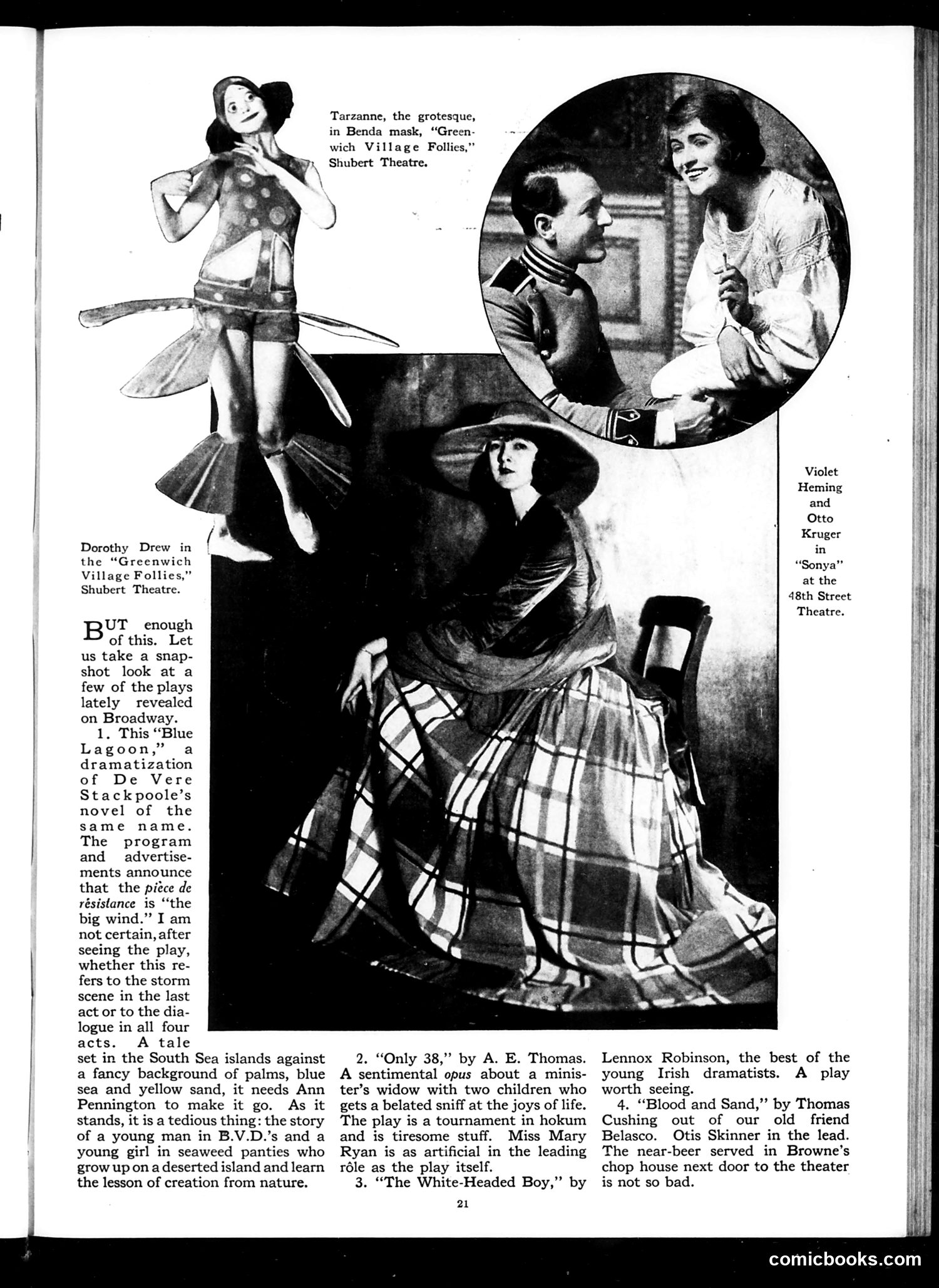
This is a theater critic's review of recent Broadway productions, not a political cartoon. The page features photographs and sketches of actors from four plays, with brief critical commentary. The critic dismisses "Blue Lagoon" as tedious despite its exotic South Seas setting, sarcastically suggesting it needs star Ann Pennington to succeed. "Only 38" is called sentimental hokum with an artificial lead performance. "The White-Headed Boy" by Irish playwright Lennox Robinson receives genuine praise as "worth seeing." The final jab at "Blood and Sand"—comparing the theater's nearby bar favorably to a chophouse's "near-beer"—is likely a Prohibition-era joke about weak alcohol substitutes. The sketches show performers in costume and character, documenting 1920s Broadway entertainment.
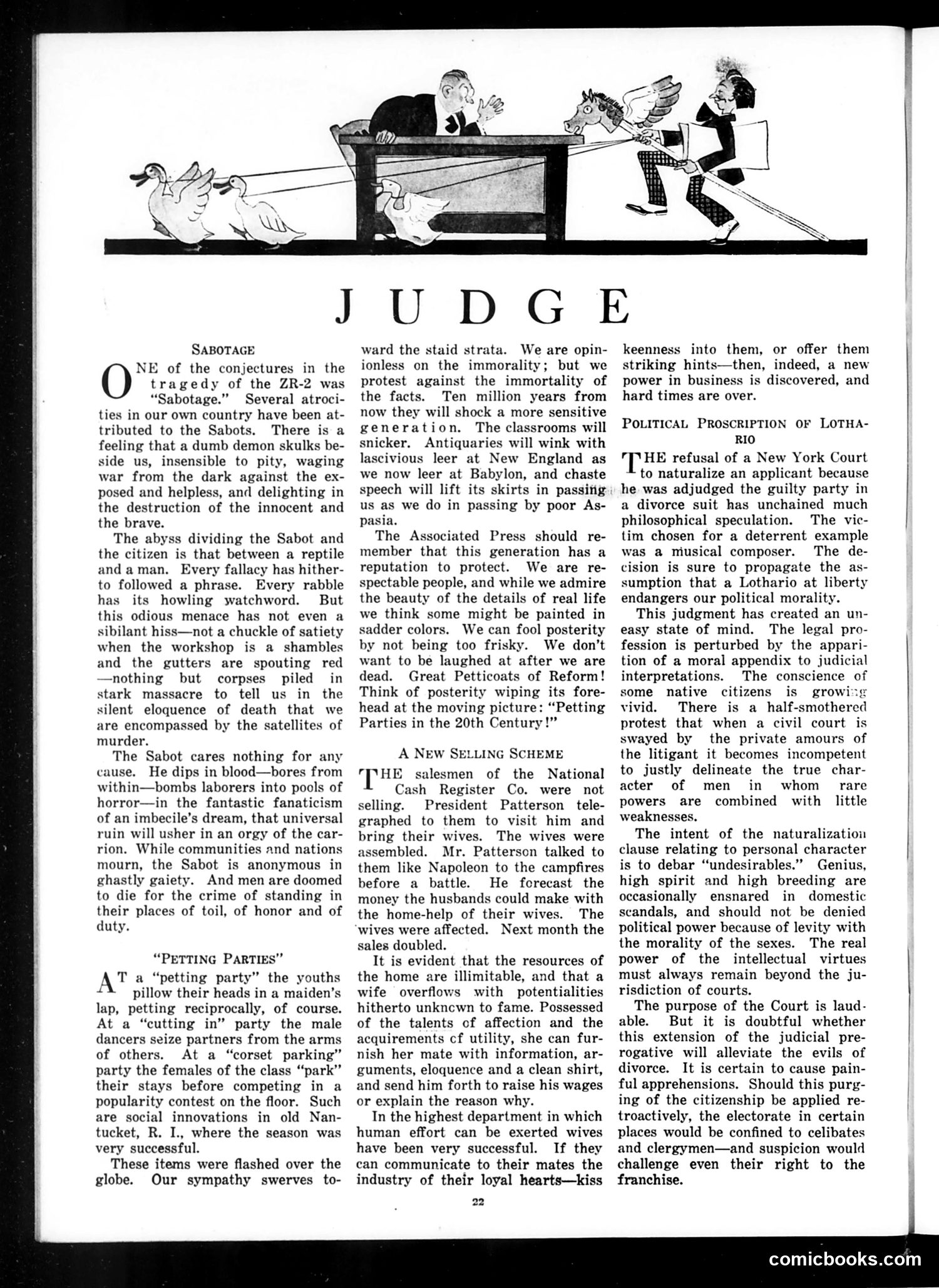
**The "Sabotage" Editorial Cartoon** (top) depicts a tug-of-war between figures representing labor saboteurs and citizens/authorities over what appears to be industrial infrastructure. The accompanying text references the ZR-2 airship disaster, blaming "Sabots" (anarchist saboteurs) for destructive acts against workers and industry. The editorial expresses anxiety about anonymous, ideologically-unmotivated violence threatening innocent laborers—reflecting post-WWI American fears of anarchist terrorism and labor unrest. **"Petting Parties" Section** mocks social innovations among youth in Nantucket, Rhode Island—including "cutting in" dances and "corset parking" (removing undergarments during contests). Judge satirizes the Associated Press for publicizing these behaviors, warning that future generations will judge contemporary morality harshly. The tone is moralistic panic about youth immorality. **"A New Selling Scheme"** praises National Cash Register president Patterson's strategy of motivating salesmen's wives to encourage their husbands' productivity—portraying women as domestic motivators whose "affection" and "utility" drive male economic success.
This page collects brief comedic anecdotes reflecting early 20th-century American social attitudes. Key satirical targets include: **"The Value of a Disguise"** mocks political corruption—a senator's lobbyist deliberately dresses shabby to hide he's paid $10,000-$15,000 annually for doing "nothing in particular," skewering the hidden nature of political influence-peddling. **"He Takes Your Time"** satirizes know-it-alls who bore everyone with unsolicited expertise. **"Modern Version"** contrasts religious faith with contemporary materialism—a backslider prefers earthly jazz bands to heavenly harps, mocking both shallow modern values and traditional piety. **"An Advantage"** jokes darkly about debt: corner offices let businessmen spot approaching creditors coming from multiple directions—reflecting Depression-era financial anxiety. The "Tough Hides" and "Wheezes" sections present various domestic and social observations, with recurring themes of marital friction, commercial deception, and class commentary. The illustrations show period-typical character types: flappers, businessmen, and working-class figures.
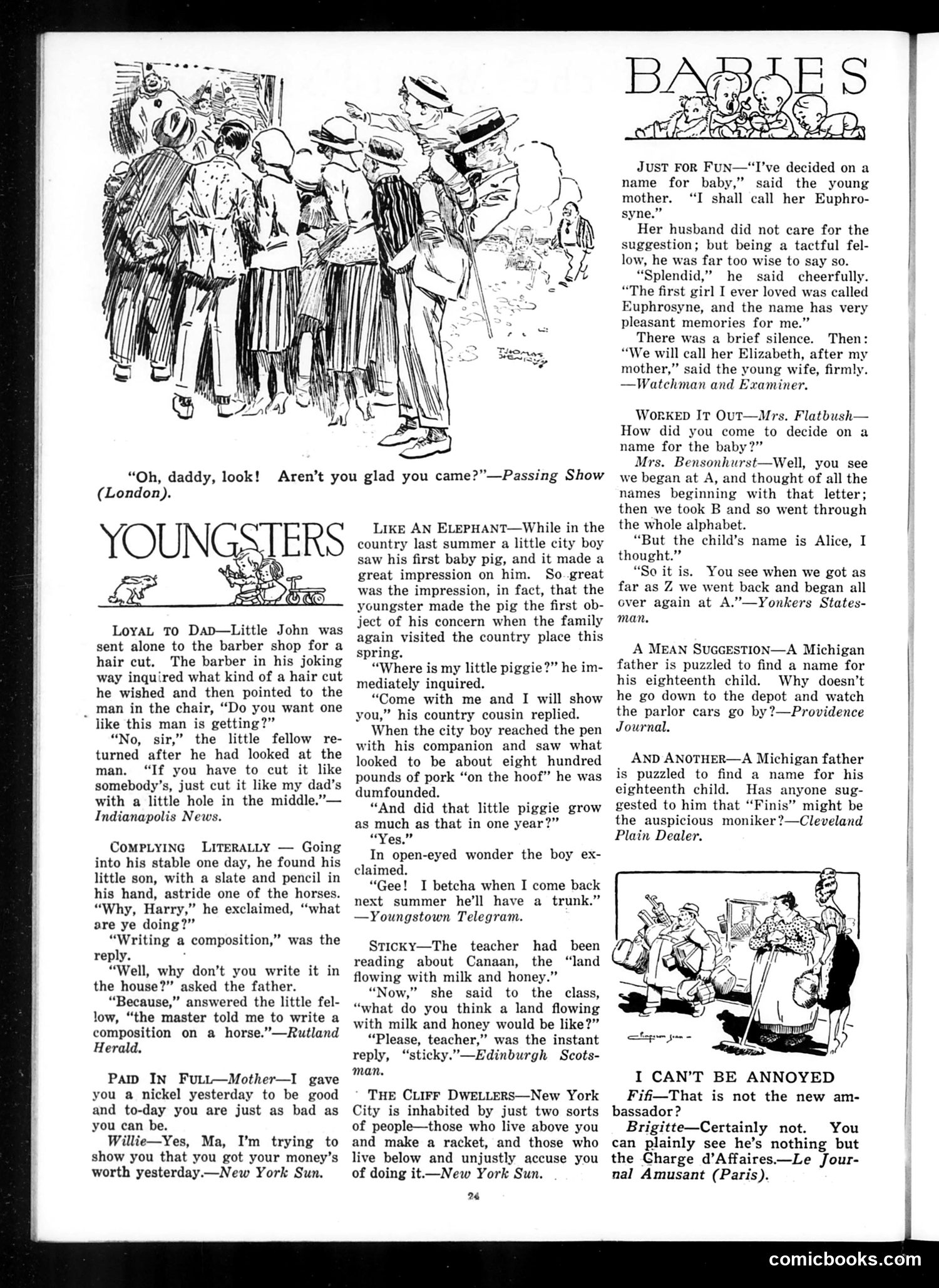
This page from *Judge* contains humorous anecdotes about children and naming rather than political satire. The content includes: **Main sections:** - "Babies" section featuring a story about a couple naming their daughter. The husband tactfully accepts "Euphrosyne" by claiming his first love had that name, prompting the wife to immediately change it to "Elizabeth" — satirizing marital psychology and feminine jealousy. - "Youngsters" section with children's jokes: a boy at a barber shop, a child writing a composition "on a horse" (literal interpretation of instructions), and a city boy amazed at a pig's growth, predicting it will develop a trunk like an elephant. - Miscellaneous jokes about naming (the "A to Z" naming method), New York City apartment dwellers, and a Michigan father with eighteen children. The cartoon at top left shows a street scene, likely illustrating the "Passing Show" reference. **Overall:** This is light domestic humor typical of *Judge*'s family-oriented content—no significant political commentary or caricature.
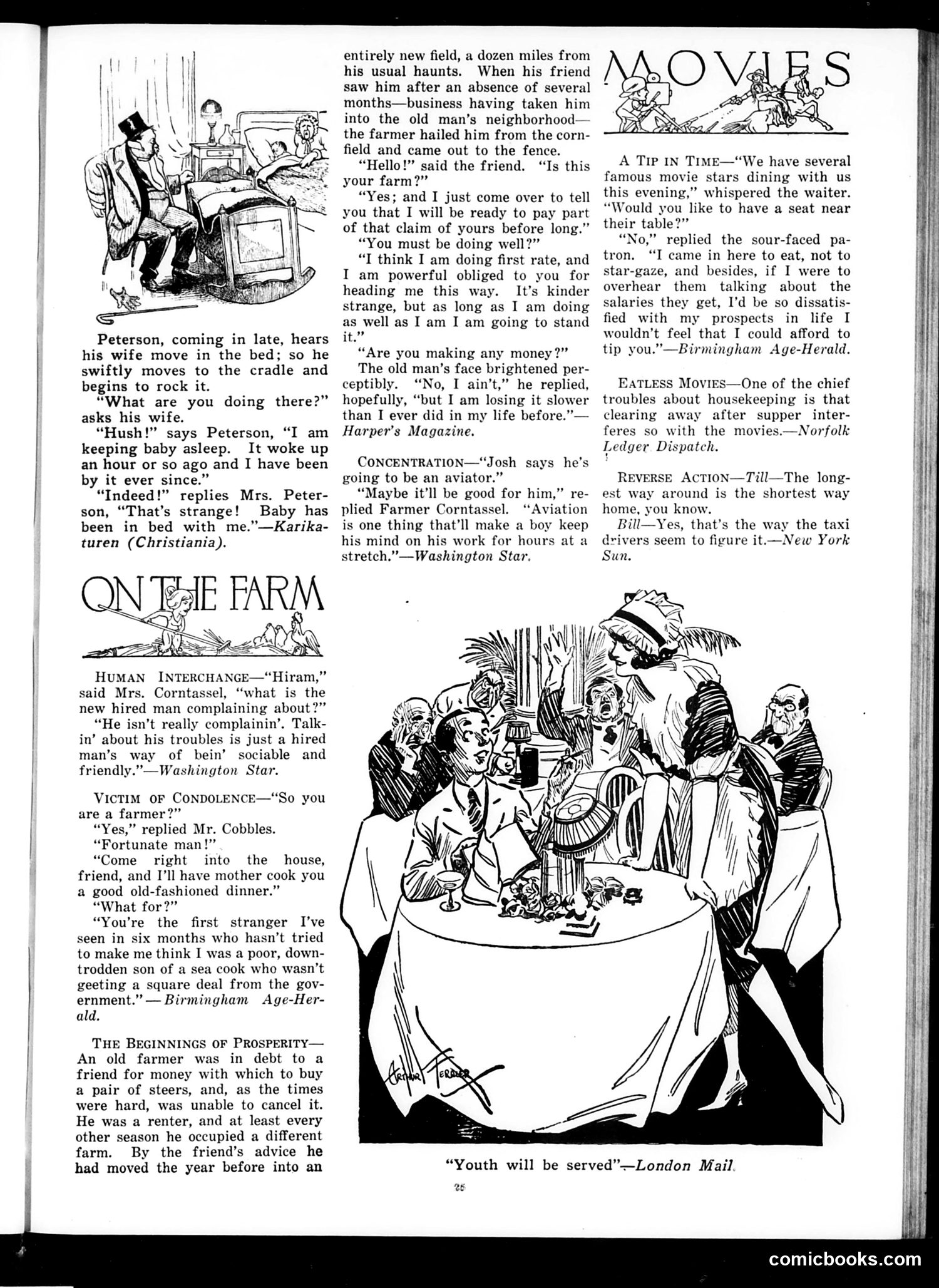
This page contains multiple brief humorous anecdotes typical of early 20th-century satirical magazines. The jokes target recognizable social types: **"Peterson" story**: A husband caught rocking an empty cradle, pretending the baby is asleep when it's actually in bed with his wife—a simple domestic absurdity about marital deception. **Farm anecdotes**: Several rural humor pieces featuring farmers (Mr. Corntassel, Mr. Cobbles) dealing with urban attitudes. One satirizes city visitors who patronizingly sympathize with farmers as "downtrodden," while another celebrates a farmer's improved circumstances through relocation—poking fun at agrarian struggles and the myth of farming prosperity. **"Movie stars" anecdote**: Mocks class anxiety; a diner refuses proximity to famous actors lest hearing their high salaries make him feel poor and unable to afford tipping. **Illustrations**: The bottom cartoon shows well-dressed diners at a formal table, likely accompanying the "Youth will be served" caption—probably satirizing youth culture or dining etiquette. The overall tone reflects period-appropriate satire of rural versus urban life, class consciousness, and emerging celebrity culture.
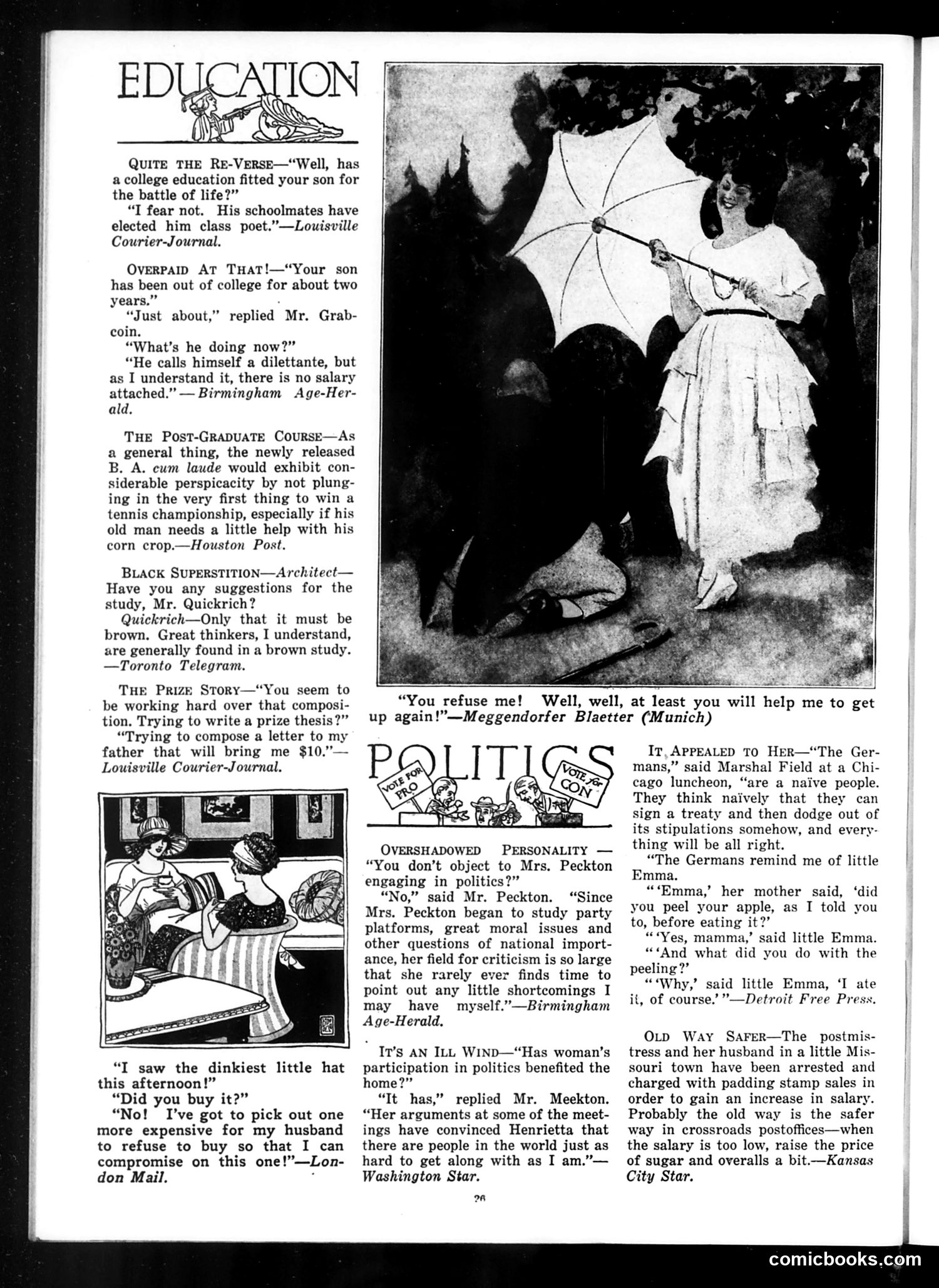
This page collects satirical jokes about early 20th-century American life, centered on education, marriage dynamics, and politics. **Education Jokes**: Multiple items mock college graduates as impractical—they become "class poets" or "dilettantes" with no salary prospects, forcing parents to support them. The humor targets both overqualified graduates and parents' financial burden. **Marriage/Gender Satire**: Several pieces joke about wives' newfound political engagement. The recurring theme: when women focus on politics and "great moral issues," they stop criticizing their husbands' minor flaws. This reflects anxiety about women's expanding public roles (voting rights were emerging during this era). **The Marshal Field anecdote** compares Germans' naïveté about treaties to a child eating apple peels—likely referencing pre-WWI diplomatic tensions and German reliability concerns. **The postmaster joke** suggests small-town corruption (inflating stamp sales for salary increases) was so normalized that it represented the "old way" of doing business. The overall tone is genteel mockery of social pretension, changing gender roles, and institutional hypocrisy—typical of Judge's satirical approach.
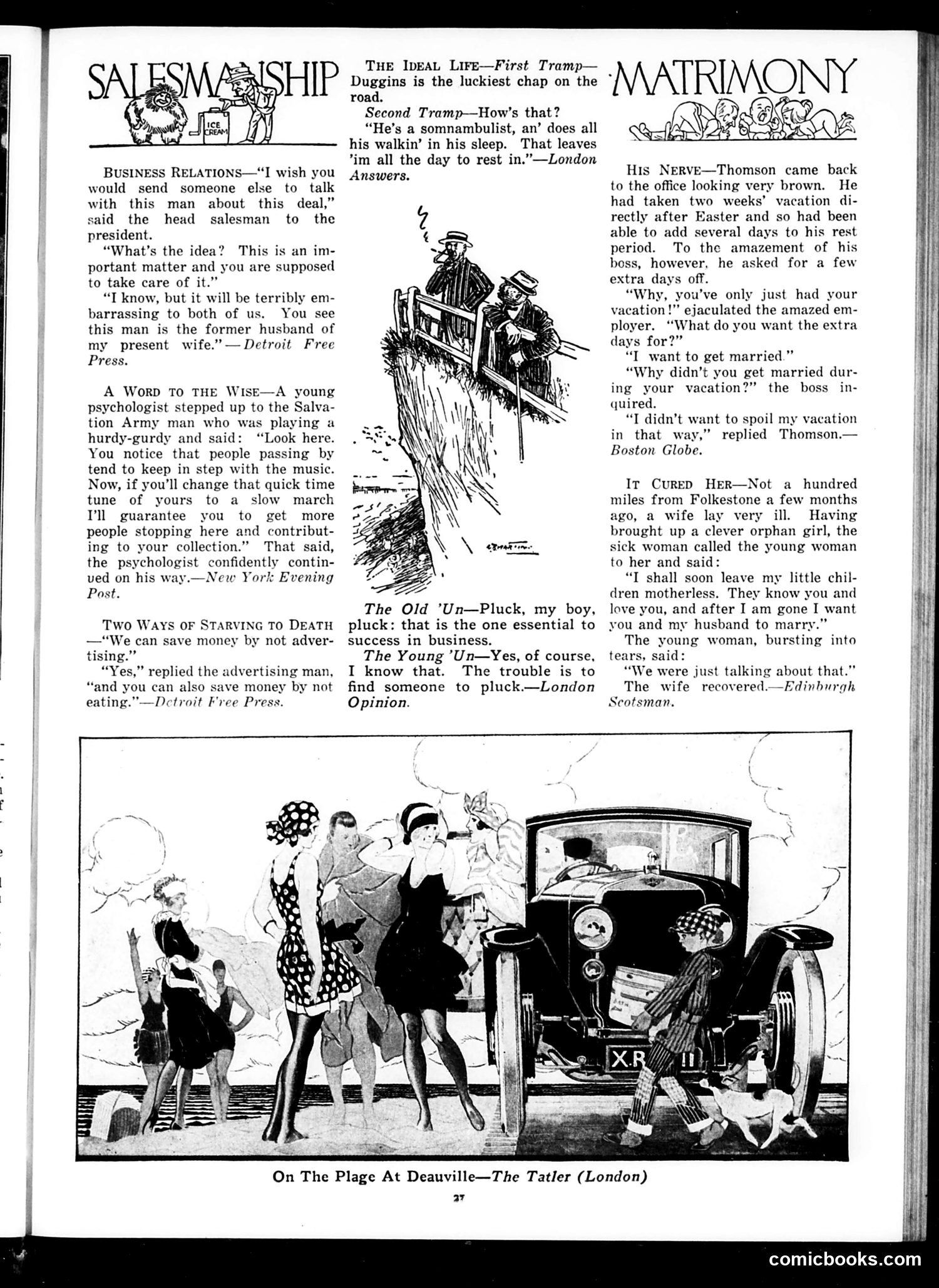
This page contains several brief humorous anecdotes typical of early 20th-century American satirical magazines, plus one illustration. **The jokes** target familiar themes: business awkwardness (a salesman must negotiate with his wife's ex-husband), economic absurdity (advertising and eating are equally necessary), and labor cynicism (a con man's advice to "pluck" someone in business). The "Matrimony" section includes domestic humor—a man prioritizes his vacation over his honeymoon, and a dying wife's deathbed matchmaking unexpectedly succeeds. **The illustration** ("On The Plage At Deauville") shows fashionable beachgoers in 1920s-style clothing around a parked automobile, satirizing leisure-class beach culture at this French resort. **The satire's point**: These pieces mock everyday social hypocrisy, business ethics, and middle-class pretension through gentle, domestic humor rather than sharp political commentary. The tone is wry observation of human nature rather than biting critique.
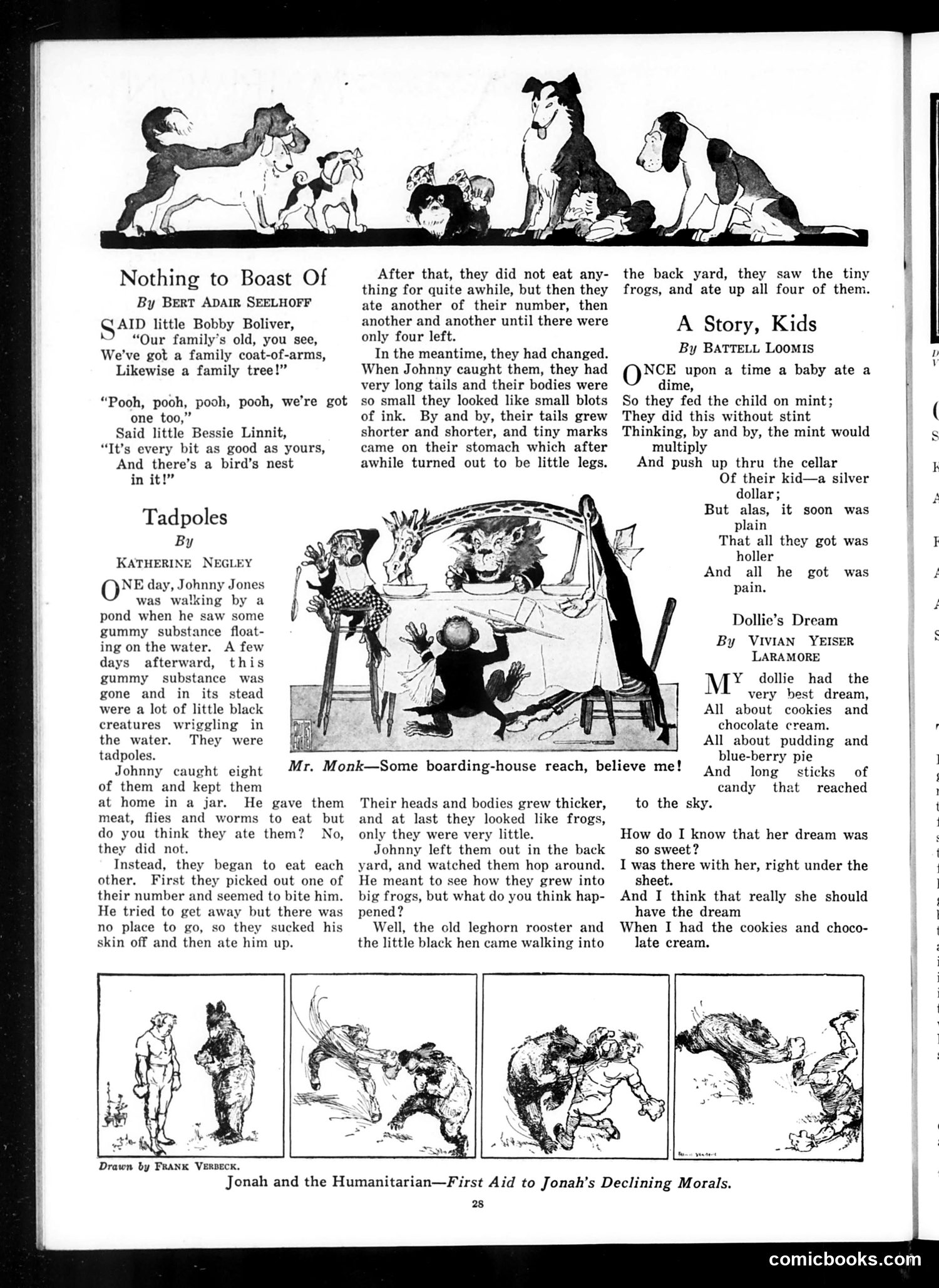
This page contains three children's stories and one satirical cartoon, all typical of early 20th-century American humor magazines. **"Nothing to Boast Of"** and **"Tadpoles"** are straightforward children's tales with modest moral lessons—one about family pride, one about nature observation. **"A Story, Kids"** is absurdist nonsense humor: parents feed a baby who swallowed a dime with mint, hoping the mint will multiply into a silver dollar underground. The joke is on parental foolishness. **"Dollie's Dream"** is sentimental verse about a child's sweet dream. The actual **satire** appears in the bottom cartoon: **"Jonah and the Humanitarian—First Aid to Jonah's Declining Morals."** The four panels show a man (appearing to be a "humanitarian" or social reformer) physically beating another man (presumably "Jonah"), ostensibly to improve his morals. This mocks progressive-era reformers and their sometimes harsh "uplift" methods—suggesting that aggressive intervention in others' moral behavior is counterproductive or absurd.
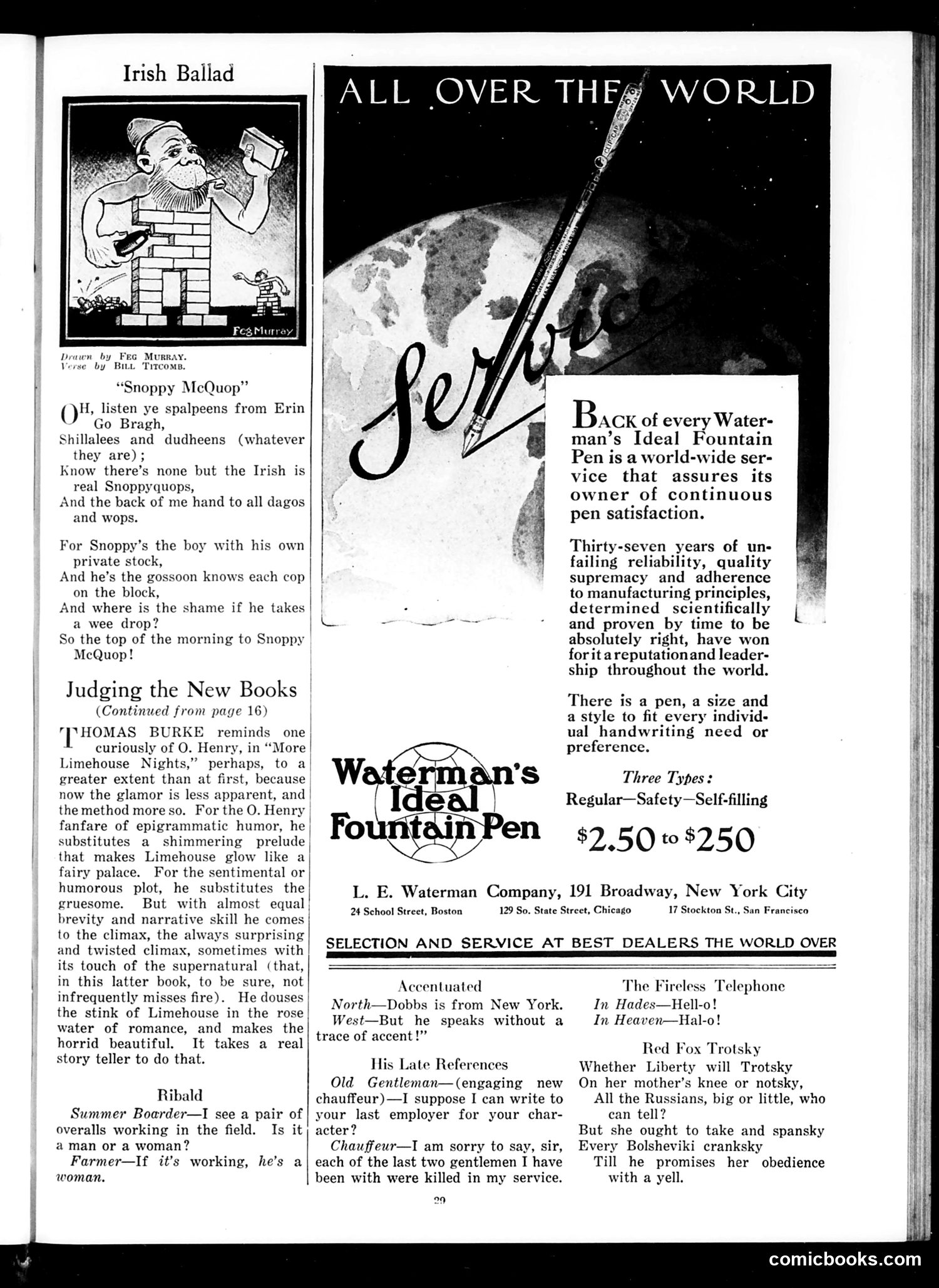
This cartoon stereotypes Irish immigrants through an exaggerated character who brags about his drinking, connections with police ("knows each cop on the block"), and dismisses other ethnic groups with slurs ("dagos and wops"). The ballad celebrates lawbreaking and alcohol consumption—likely referencing Prohibition-era bootlegging—while portraying the Irish as corrupt and prideful. The satire targets Irish-American identity and stereotypes prevalent in 1920s America. The heavy dialect and crude caricature (drawn by Fec Murray) reflect widespread prejudice against Irish immigrants. The verse mocks Irish nationalism ("Erin Go Bragh") alongside criminal behavior, suggesting the Irish community's supposed involvement in illegal alcohol distribution during Prohibition. The accompanying humor column and Waterman pen advertisement complete an ordinary Judge magazine page mixing satire with advertising.
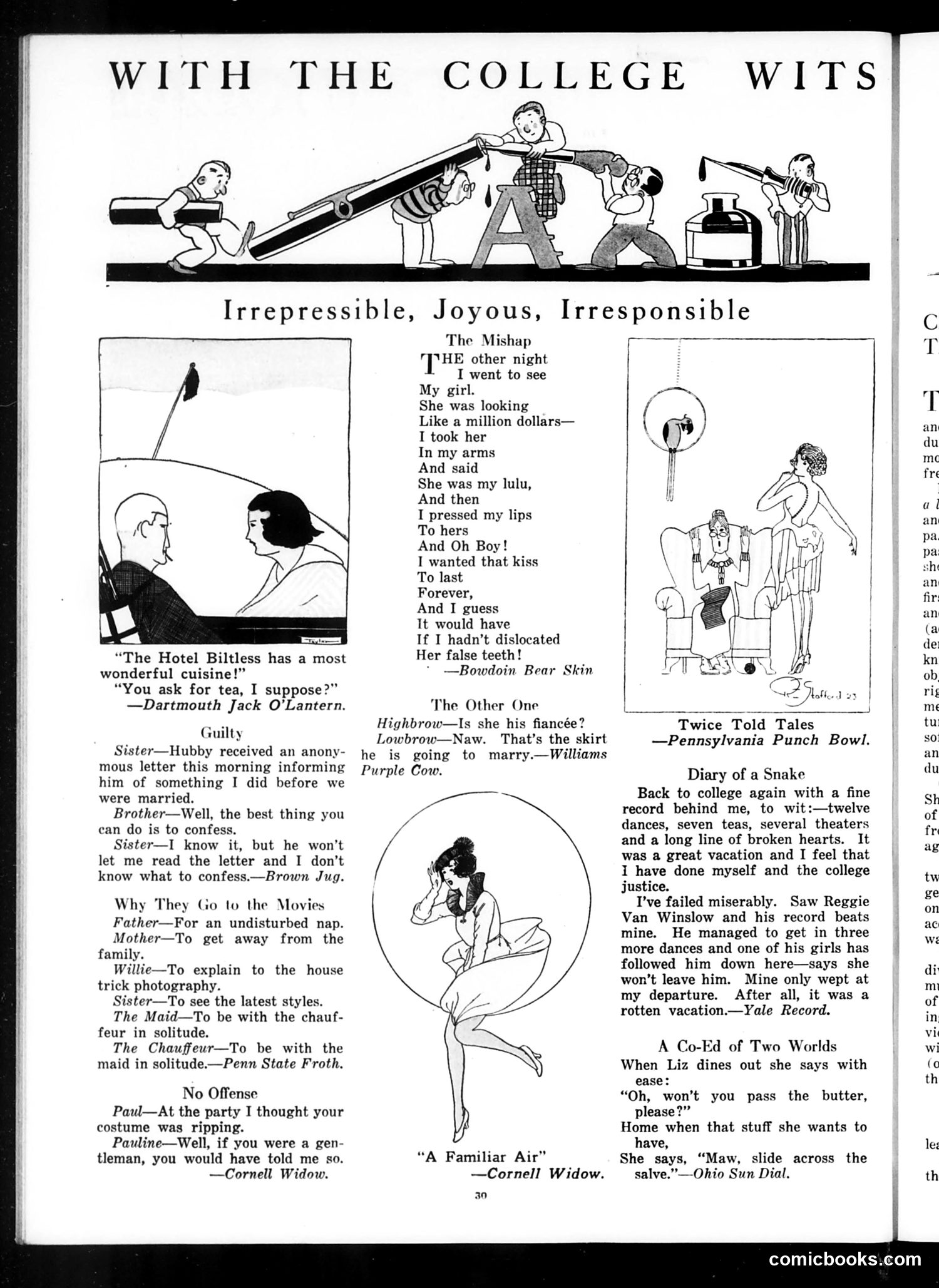
This page compiles humorous college-humor submissions from various university publications (Yale Record, Cornell Widow, Brown Jug, etc.). The content reflects 1920s-era college social life through short jokes and cartoons. **Key themes:** - **Dating and romance** dominate ("The Mishap" features a mishap during kissing; "Diary of a Snake" tracks romantic conquests) - **Class distinctions** appear in "A Co-Ed of Two Worlds," contrasting refined dining etiquette with crude home speech - **Gender dynamics**: wives keeping secrets from husbands; women's fashion obsession - **Movie-going** satirizes family escape and servant romance The humor relies on wordplay, mild scandal (pre-marital indiscretion), and observational comedy about courtship rituals. The page title's descriptor—"Irrepressible, Joyous, Irresponsible"—characterizes college students as carefree and somewhat reckless, reflecting period attitudes toward youth culture and higher education as spaces of social liberation.
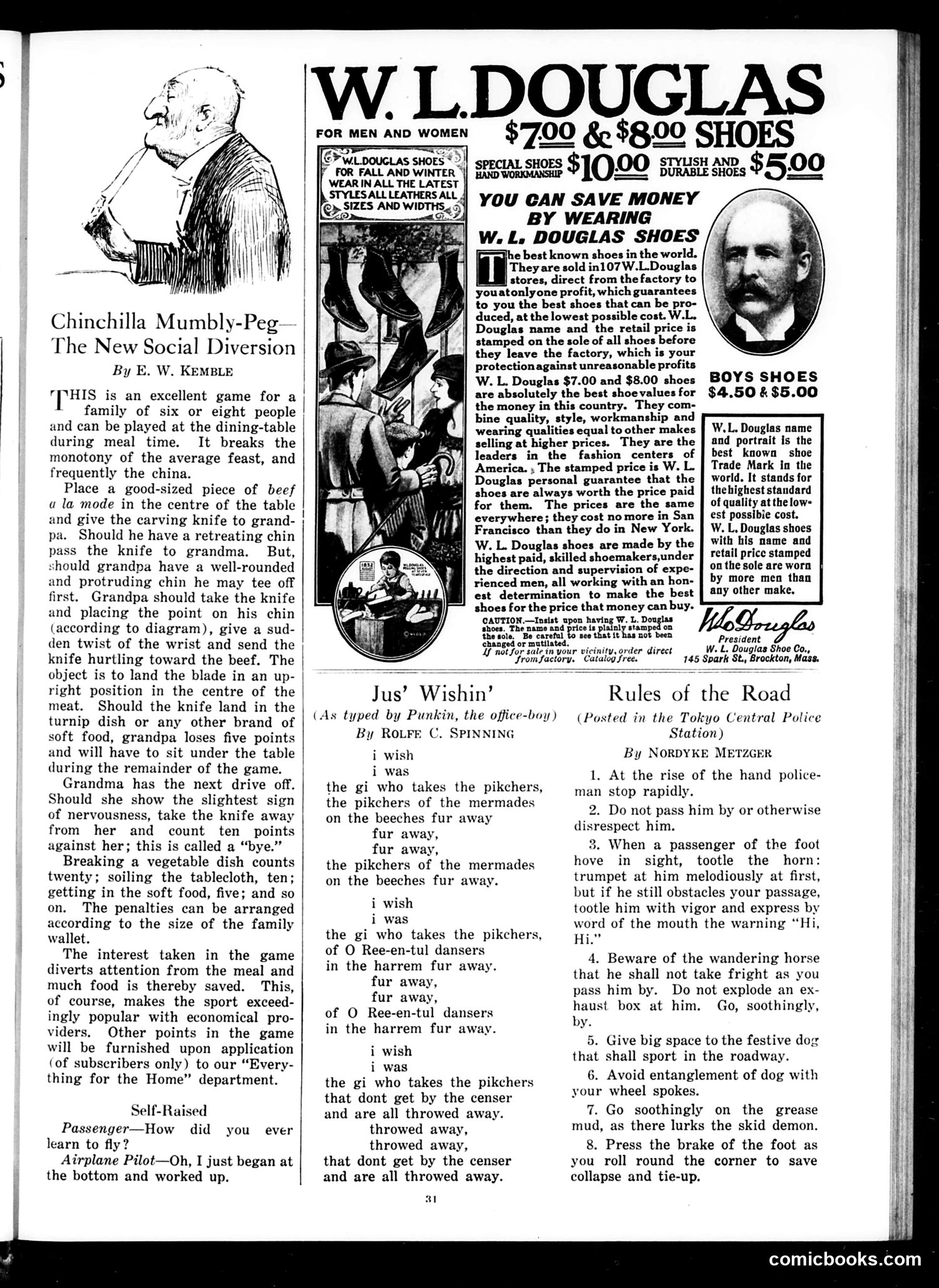
This page contains primarily **advertising** (W.L. Douglas shoes dominate) alongside three short humor pieces by Judge magazine contributors. **"Chinchilla Mumbly-Peg"** by E.W. Kemble is a satirical "parlor game" description mocking upper-class dining rituals. The joke: grandparents flick dinner knives at beef while seated at the table, with scoring penalties for breaking dishes or hitting soft foods. It's absurdist humor targeting wealthy families' elaborate etiquette and the author's implied criticism that the "sport" serves economical purposes—diverting attention from food to save money. The cartoon illustration shows an elderly man performing this ridiculous gesture. **"Jus' Wishin'"** by Rolfe C. Spinning is a vernacular poem (appears to mock dialect humor popular then) expressing wishes, possibly about military/naval life ("pikchers," "mermades"). **"Rules of the Road"** from Tokyo Police Station offers humorous traffic safety advice for early automobile era drivers—practical yet comedic guidance about pedestrian and horse interactions. The **W.L. Douglas shoe advertisement** emphasizes factory-direct sales and quality guarantees—typical early 20th-century consumer marketing.
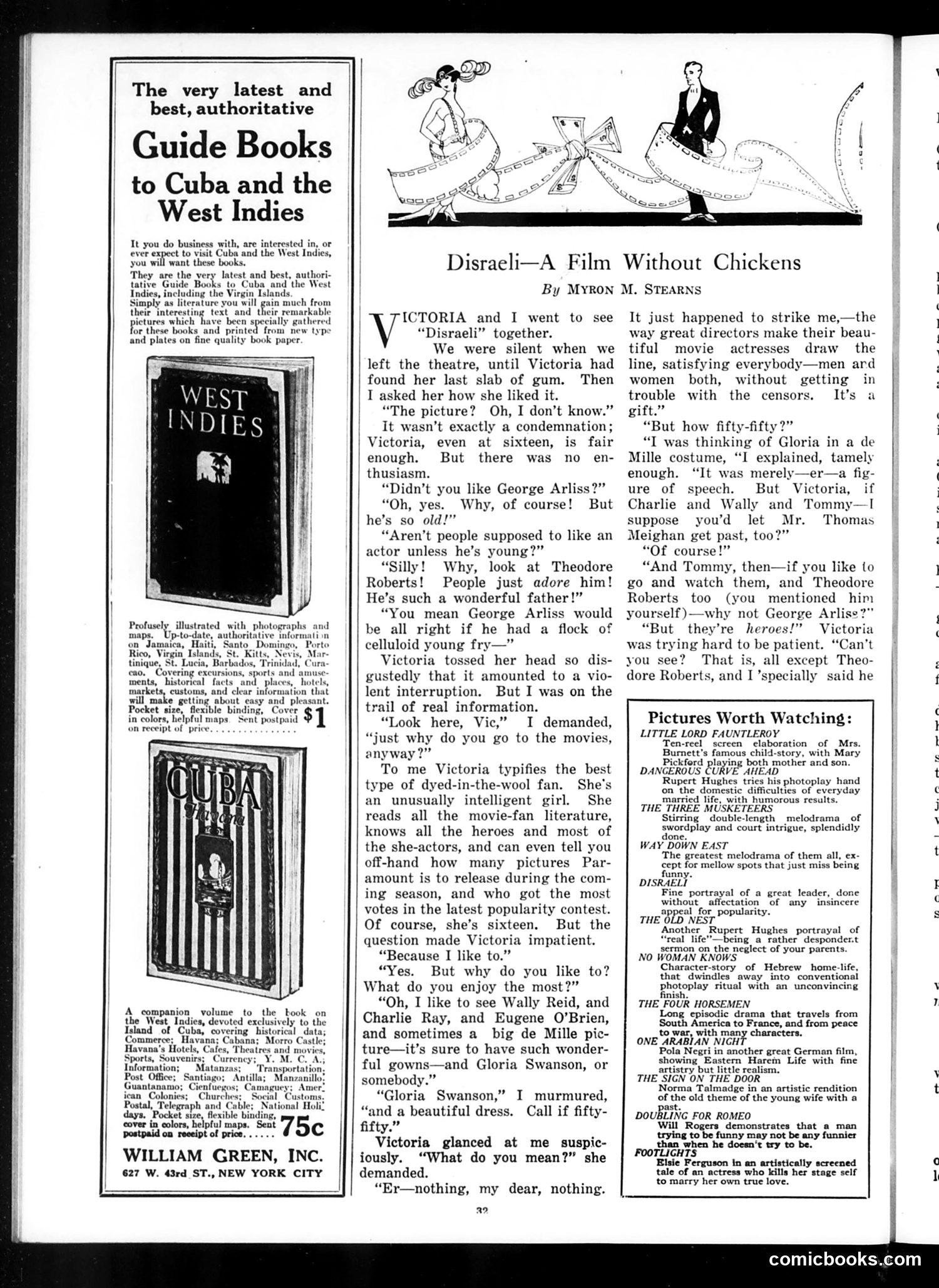
This is a film criticism essay, not a political cartoon. The author (Myron M. Stearns) satirizes teenage moviegoers' shallow tastes through a conversation with his sixteen-year-old daughter Victoria about the film *Disraeli* (1929), starring George Arliss. The satire targets two things: (1) Victoria's dismissal of Arliss because he's "old," despite his talent; (2) her preference for younger male stars and glamorous costume dramas over serious historical films. The essay mocks the "dyed-in-the-wool fan" mentality—that cinema audiences, particularly young women, care only about physical attractiveness and spectacle (beautiful gowns, stars like Wally Reid and Gloria Swanson) rather than acting ability or substantive storytelling. The title's phrase "without chickens" (slang for young women/glamour) underscores the complaint: *Disraeli* fails to satisfy because it lacks the visual appeal and romantic elements audiences crave, regardless of its artistic merit.
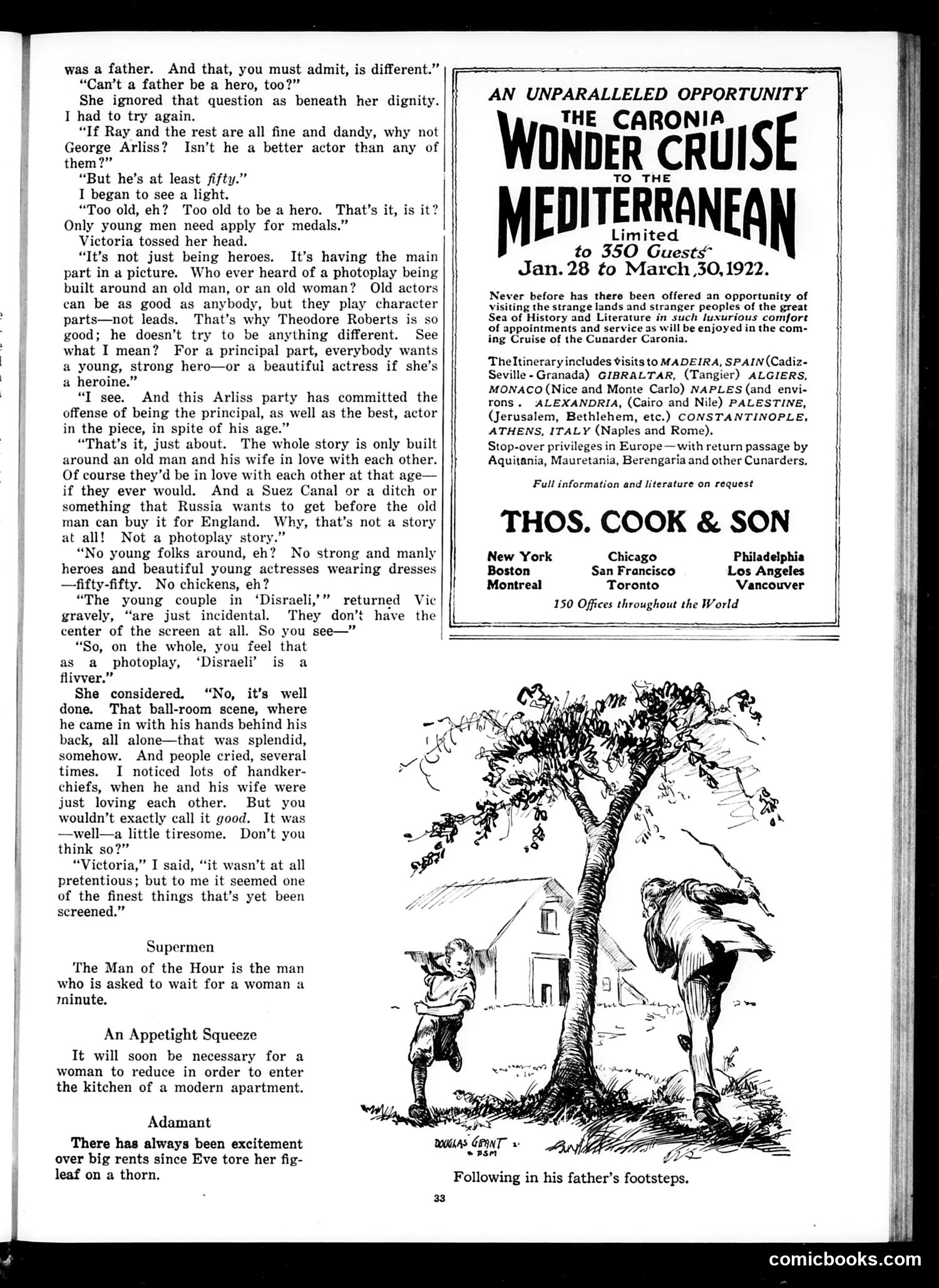
This page contains a debate about cinema and aging actors, framed around the film "Disraeli" (likely the 1921 production starring George Arliss). The conversation critiques Hollywood's youth obsession: a character named Victoria argues that lead roles must go to young, attractive stars, while the narrator defends "Disraeli" as excellent despite centering an elderly man and his wife's love story. The satire targets **ageism in early cinema**—the industry's refusal to make protagonists of older actors, relegating them to "character parts." George Arliss's casting as a lead despite being over fifty was apparently noteworthy enough to debate. The accompanying illustration, "Following in his father's footsteps," shows a child and adult figure by a tree, likely commenting on generational cycles or inheritance of traits. The page also includes a Thomas Cook cruise advertisement and period humor fragments about modern life (apartments, women's weight, rent).
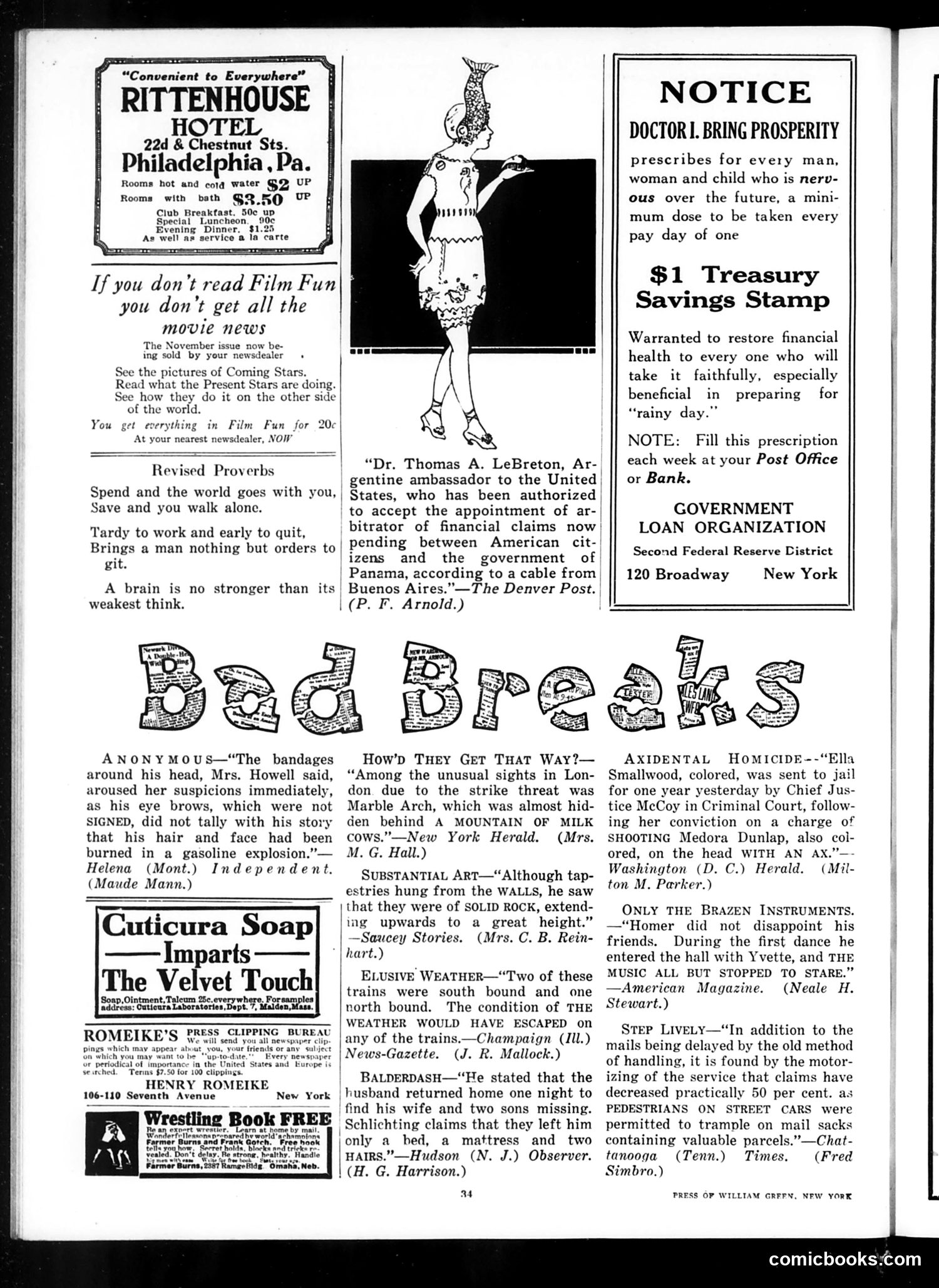
This page is primarily advertising and administrative content rather than political cartoons. The "Bad Breaks" section (lower half) is a humor column featuring newspaper printing errors or absurd phrasings, a common magazine feature of the era. Examples include: a bandaged man without visible eyebrows, a "mountain of milk cows" blocking Marble Arch in London during a strike, and stone tapestries. These highlight contradictions and logical impossibilities in published prose—the satire being directed at careless journalism rather than politics. The remainder consists of hotel and product advertisements (Cuticura Soap, Rittenhouse Hotel) typical of 1920s magazine pages, plus a government notice encouraging Americans to purchase Treasury Savings Stamps as financial security—a wartime savings initiative.
This is not a cartoon but rather an **advertisement/editorial announcement** from Leslie's Weekly magazine. The page announces a special commemorative issue dedicated to Theodore Roosevelt, who had died approximately three years prior. The text emphasizes that "T.R." (his initials) have become iconic shorthand instantly recognizable to all Americans, reflecting widespread affection for the former president. The special October 22nd issue features: - Roosevelt's birthday commemoration (October 27th) - A full-color portrait by artist Joseph Cummings Chase - Multiple articles exploring Roosevelt's "many-sided personality" The magazine uses this tribute to promote the issue to readers, urging them to purchase copies from newsdealers. This reflects the common early 20th-century practice of magazines capitalizing on major public figures and national commemorative occasions to boost circulation.
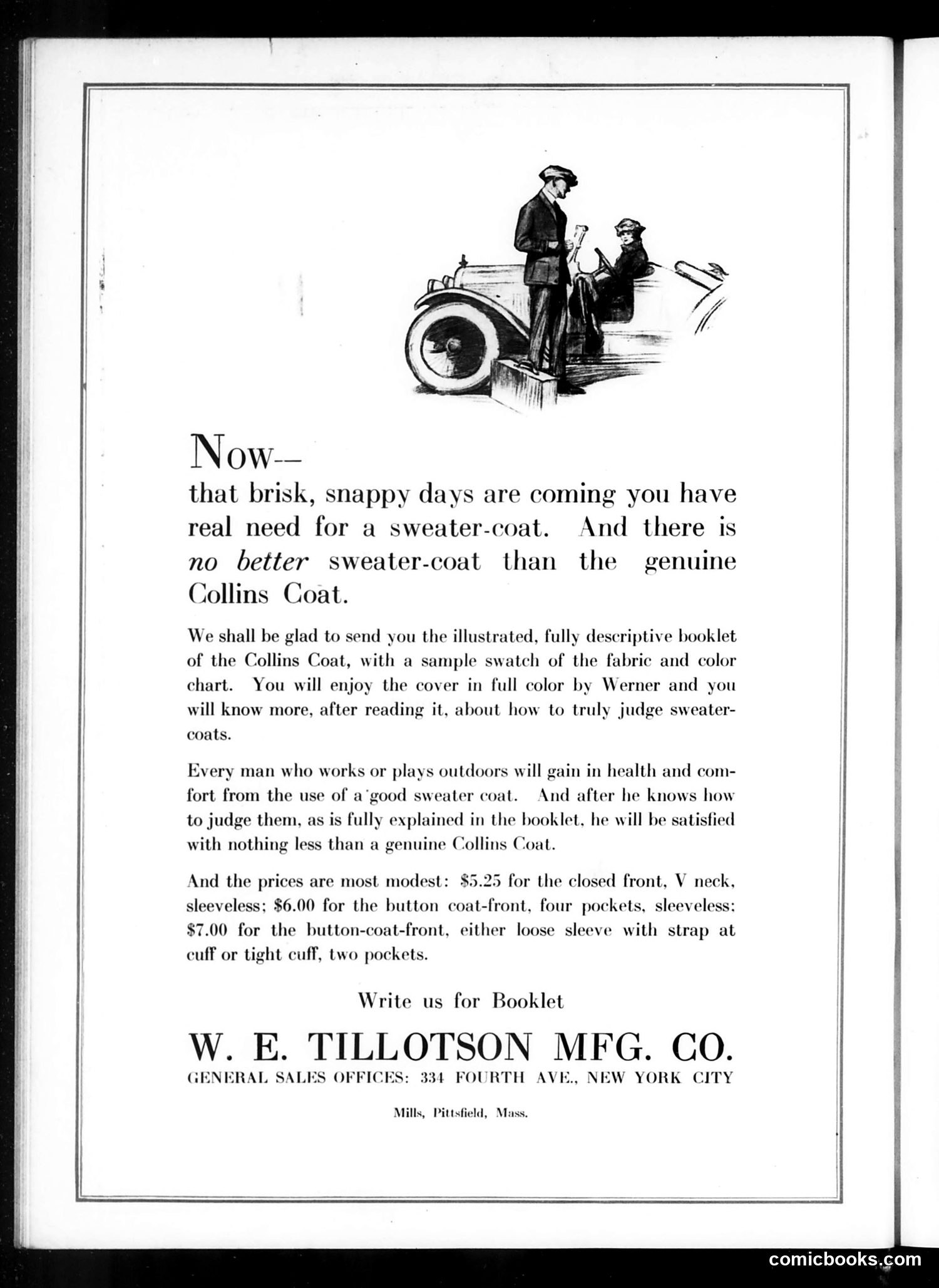
This is a full-page advertisement, not political satire. It promotes the Collins Coat, a men's sweater-coat manufactured by W.E. Tillotson MFG. Co. The illustration shows two men examining an early automobile, establishing the product's appeal to active outdoor workers and motorists—a relevant market in the early automotive era. The ad emphasizes durability and value, listing three models ranging from $5.25 to $7.00 with varying features (sleeves, pockets, necklines). It promises a detailed illustrated booklet with fabric samples and a color cover illustration by an artist named Werner to help buyers judge quality. The pitch targets practical masculinity: men who "work or play outdoors" will benefit from health and comfort. The copy suggests that once educated about sweater-coats, buyers will demand genuine Collins Coats specifically. This is standard early-20th-century product advertising using emerging consumer education tactics.