
Judge, 1921-10-22 · page 12 of 36
Judge — October 22, 1921 — page 12: what you’re looking at
What you’re looking at
This page contains a romantic short story titled "The Color of Minnie's Eyes" by Exeter Fulford, depicting a courtship scenario from the early 20th century. **Main Story:** Fred and Minnie have been "steadily" dating for a month without Fred proposing or declaring intentions. Minnie's family—including her mother and grandmother—grows impatient, as social convention expected formal declarations within shorter timeframes. The grandmother explicitly references outdated customs: "When I was a young girl a fellow didn't spark a whole month without letting his intentions be known." Fred finally reveals he received a raise and a fortune-teller predicted he'd meet a girl with brown eyes, prompting Minnie to embrace him emotionally—misinterpreting this as an engagement signal. **The Satire:** The joke mocks both outdated social expectations around courtship and the miscommunication between the sexes. Minnie assumes his vague fortune-teller comment is a proposal, while Fred appears oblivious. **Bottom Cartoons:** Brief satirical quips about movie heroes and eyewitness reliability unrelated to the main story. The content reflects early 1900s dating conventions and gender dynamics now considered antiquated.
📄 Transcribed text from this page (OCR, searchable)
Machine-transcribed from the original scan — historical spelling and the odd misread are preserved.
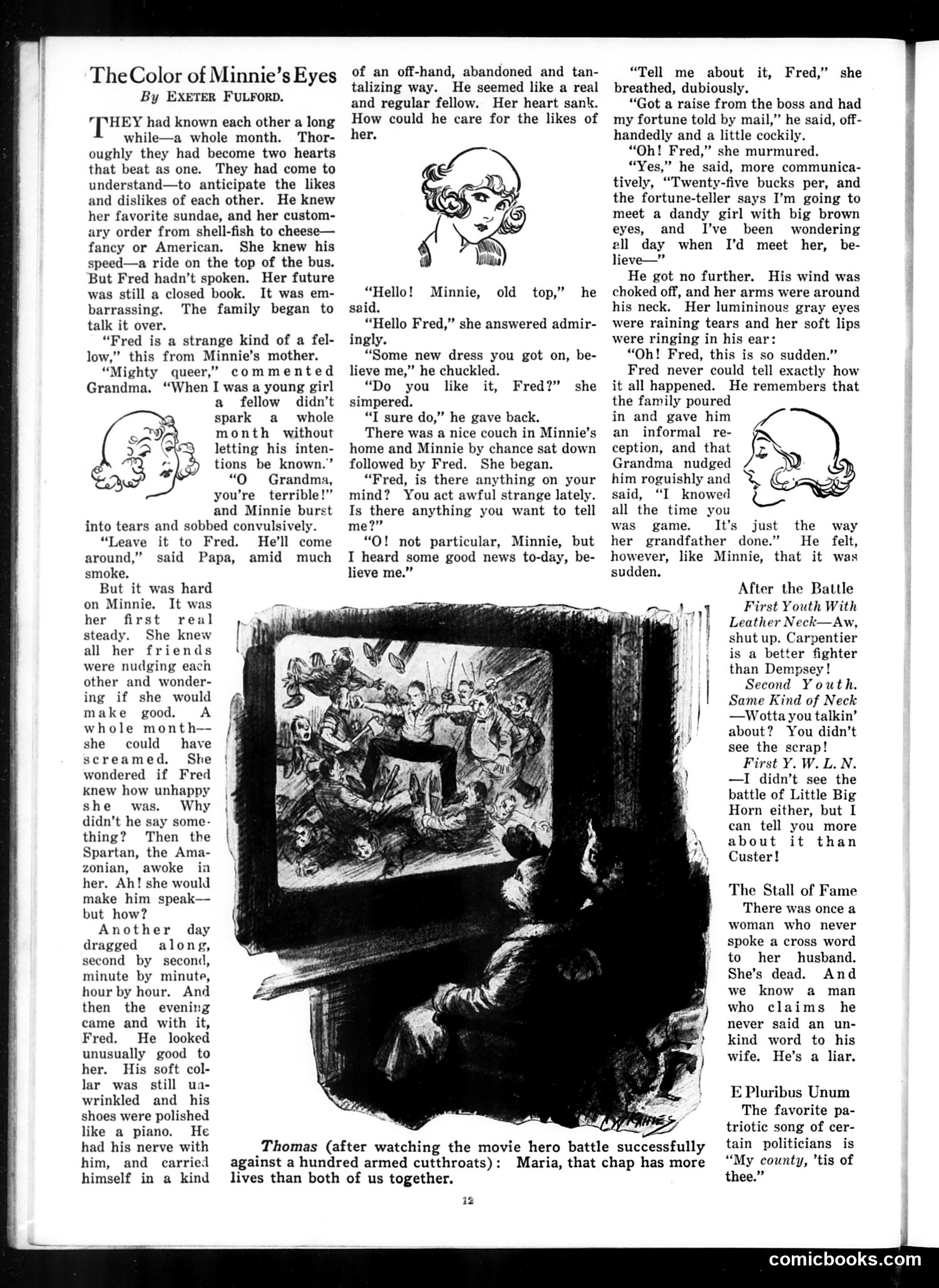
TheColor of Minnie’s Eyes By EXETER FULFORD. "THEY had known each other a long while—a whole month. Thor- oughly they had become two hearts that beat as one. They had come to understand—to anticipate the likes and dislikes of each other. He knew her favorite sundae, and her custom- ary order from shell-fish to cheese— fancy or American. She knew his speed—a ride on the top of the bus. But Fred hadn’t spoken. Her future was still a closed book. It was em- barrassing. The family began to talk it over. “Fred is a strange kind of a fel- low,” this from Minnie’s mother. “Mighty queer,’ commented Grandma. ‘When I was a young girl a fellow didn’t spark a_ whole month without letting his inten- tions be known.” “QO Grandma, you’re terrible!” and Minnie burst into tears and sobbed convulsively. “Leave it to Fred. He'll come around,” said Papa, amid much smoke. But it was hard on Minnie. It was her first real steady. She knew all her friends were nudging each other and wonder- ing if she would make good. A whole month— she could have sereamed., She wondered if Fred knew how unhappy she was. Why didn’t he say some- thing? Then the Spartan, the Ama- zonian, awoke in her. Ah! she would make him speak— but how? Another day dragged along, second by second, minute by minute, hour by hour. And then the evening came and with it, Fred. He looked unusually good to her. His soft col- lar was still ua- wrinkled and his shoes were polished like a piano. He had his nerve with him, and carried himself in a kind of an off-hand, abandoned and tan- talizing way. He seemed like a real and regular fellow. Her heart sank. How could he care for the likes of her. “Hello! Minnie, old top,” he said. “Hello Fred,” she answered admir- ingly. “Some new dress you got on, be- lieve me,” he chuckled. “Do you like it, simpered. “I sure do,” he gave back. There was a nice couch in Minnie’s home and Minnie by chance sat down followed by Fred. She began. “Fred, is there anything on your mind? You act awful strange lately. Is there anything you want to tell me?” “O! not particular, Minnie, but I heard some good news to-day, be- lieve me.” Fred?” she Thomas (after watching the movie hero battle successfully against a hundred armed cutthroats) : lives than both of us together. iz Maria, that chap has more “Tell me about it, breathed, dubiously. “Got a raise from the boss and had my fortune told by mail,” he said, off- handedly and a little cockily. “Oh! Fred,” she murmured. “Yes,” he said, more communica- tively, “Twenty-five bucks per, and the fortune-teller says I’m going to meet a dandy girl with big brown eyes, and I’ve been wondering ell day when I’d meet her, be- lieve—” He got no further. His wind was choked off, and her arms were around his neck. Her lumininous gray eyes were raining tears and her soft lips were ringing in his ear: “Oh! Fred, this is so sudden.” Fred never could tell exactly how it all happened. He remembers that the family poured in and gave him an informal re- ception, and that Grandma nudged him roguishly and said, “I knowed all the time you was game. _ It’s her grandfather Fred,” she the way He felt, just done.” however, like Minnie, that it was sudden. After the Battle First Youth With Leather Neck—Aw, shut up. Carpentier is a better fighter than Dempsey! Second Youth. Same Kind of Neck —wWotta you talkin’ about? You didn’t see the scrap! First Y. W. L.N. —I didn’t see the battle of Little Big Horn either, but I can tell you more about it than Custer! The Stall of Fame There was once a woman who never spoke a cross word to her husband. She’s dead. And we know a man who claims he never said an un- kind word to his wife. He’s a liar. E Pluribus Unum The favorite pa- triotic song of cer- tain politicians is “My county, ’tis of thee.” comicbooks.com