
Judge, 1921-10-22 · page 13 of 36
Judge — October 22, 1921 — page 13: what you’re looking at
What you’re looking at
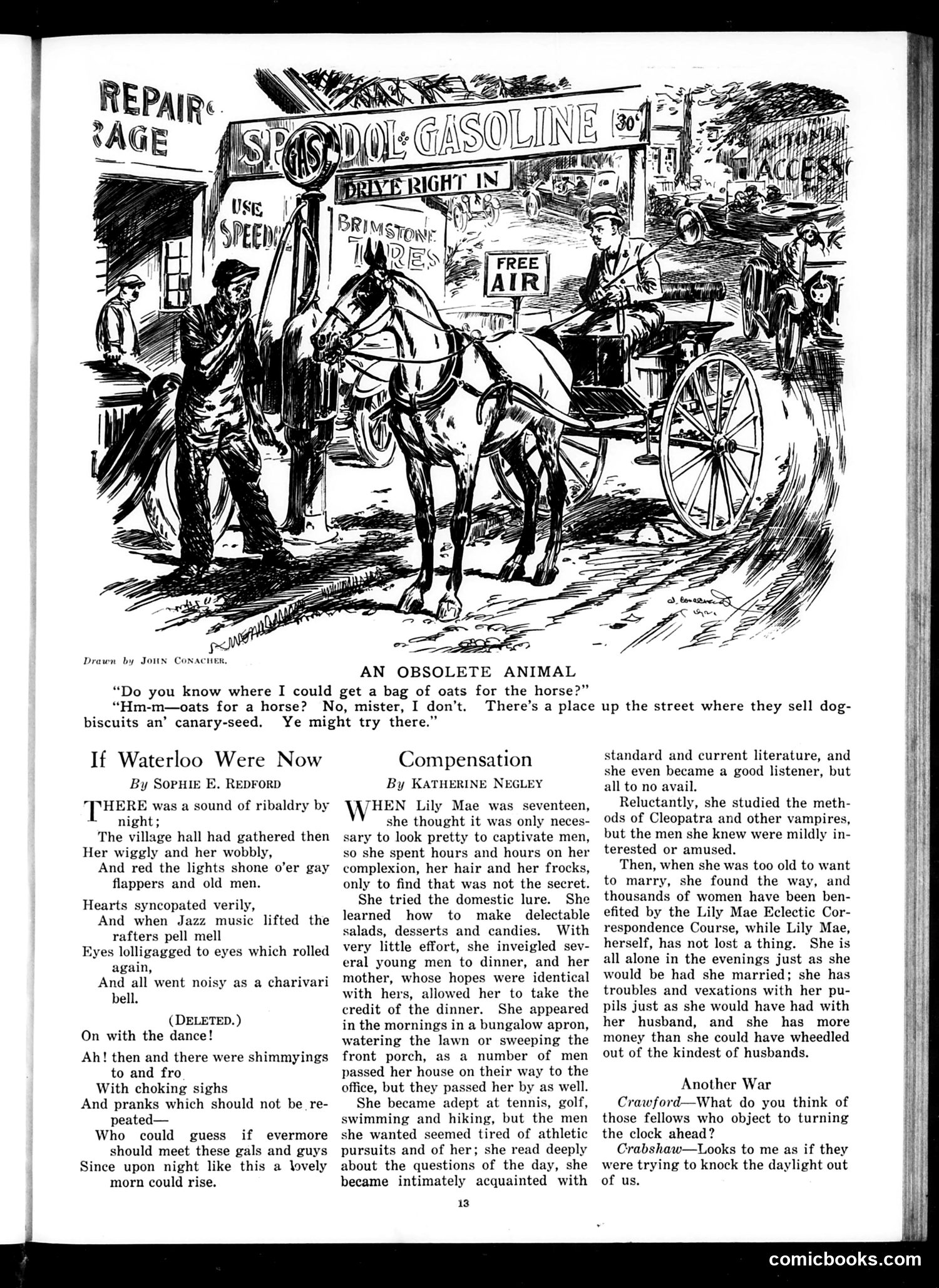
**The Cartoon:** "An Obsolete Animal" satirizes the rapid modernization of the 1920s. A man with a horse-drawn wagon seeks oats at a gasoline station offering "Free Air" and other automotive services. The joke: horses and their feed have become obsolete relics in an automobile-dominated world. The shopkeeper suggests dog biscuits instead, treating the horse as equally outdated. **The Surrounding Content:** The page includes poetry about Jazz Age dancing ("If Waterloo Were Now") and a story about a woman ("Compensation") who tries every traditional method to attract men—beauty, cooking, domesticity, athletics, intellectualism—before finding success by teaching a correspondence course. This satirizes changing gender roles and women's shifting independence in the 1920s. **Context:** Both pieces mock old social orders displaced by modernity: the horse by automobiles, and traditional female roles by women's economic independence.
📄 Transcribed text from this page (OCR, searchable)
Machine-transcribed from the original scan — historical spelling and the odd misread are preserved.
Drawn by JOUN CoNAcueER, AN OBSOLETE ANIMAL “Do you know where I could get a bag of oats for the horse?” “Hm-m—oats for a horse? biscuits an’ canary-seed. If Waterloo Were Now By SOPHIE E. REDFORD [THERE was a sound of ribaldry by night; The village hall had gathered then Her wiggly and her wobbly, And red the lights shone o’er gay flappers and old men. Hearts syncopated verily, And when Jazz music lifted the rafters pell mell Eyes lolligagged to eyes which rolled again, And all went noisy as a charivari bell. (DELETED. ) On with the dance! Ah! then and there were shimmyings to and fro With choking sighs And pranks which should not be_re- peated— Who could guess if evermore should meet these gals and guys Since upon night like this a lovely morn could rise. No, mister, I don’t. Ye might try there.” Compensation By KATHERINE NEGLEY \ JHEN Lily Mae was seventeen, she thought it was only neces- sary to look pretty to captivate men, so she spent hours and hours on her complexion, her hair and her frocks, only to find that was not the secret. She tried the domestic lure. She learned how to make delectable salads, desserts and candies. With very little effort, she inveigled sev- eral young men to dinner, and her mother, whose hopes were identical with hers, allowed her to take the credit of the dinner. She appeared in the mornings in a bungalow apron, watering the lawn or sweeping the front porch, as a number of men passed her house on their way to the office, but they passed her by as well. She became adept at tennis, golf, swimming and hiking, but the men she wanted seemed tired of athletic pursuits and of her; she read deeply about the questions of the day, she became intimately acquainted with 13 There’s a place up the street where they sell dog- standard and current literature, and she even became a good listener, but all to no avail. Reluctantly, she studied the meth- ods of Cleopatra and other vampires, but the men she knew were mildly in- terested or amused. Then, when she was too old to want to marry, she found the way, and thousands of women have been ben- efited by the Lily Mae Eclectic Cor- respondence Course, while Lily Mae, herself, has not lost a thing. She is all alone in the evenings just as she would be had she married; she has troubles and vexations with her pu- pils just as she would have had with her husband, and she has more money than she could have wheedled out of the kindest of husbands. Another War Crawford—What do you think of those fellows who object to turning the clock ahead? Crabshaw—Looks to me as if they were trying to knock the daylight out of us. comicbooks.com