
Judge, 1921-10-22 · page 20 of 36
Judge — October 22, 1921 — page 20: what you’re looking at
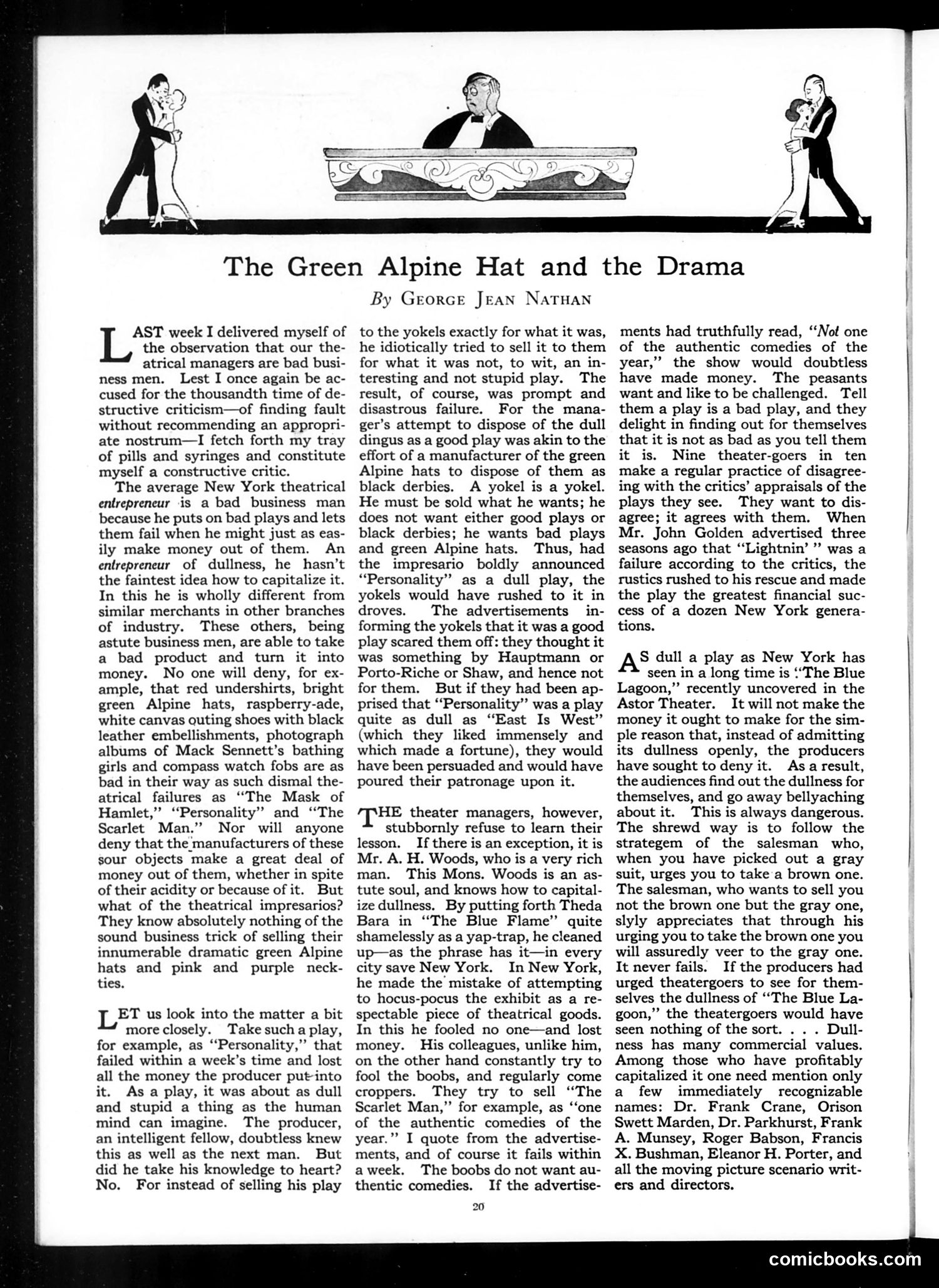
A restored page from Judge, 1921-10-22. Page through the whole issue in the reader above.
📄 Transcribed text from this page (OCR, searchable)
Machine-transcribed from the original scan — historical spelling and the odd misread are preserved.
AST week I delivered myself of the observation that our the- atrical managers are bad busi- ness men. Lest I once again be ac- cused for the thousandth time of de- structive criticism—of finding fault without recommending an appropri- ate nostrum—I fetch forth my tray of pills and syringes and constitute myself a constructive critic. The average New York theatrical entrepreneur is a bad business man because he puts on bad plays and lets them fail when he might just as eas- ily make money out of them. An entrepreneur of dullness, he hasn’t the faintest idea how to capitalize it. In this he is wholly different from similar merchants in other branches of industry. These others, being astute business men, are able to take a bad product and turn it into money. No one will deny, for ex- ample, that red undershirts, bright green Alpine hats, raspberry-ade, white canvas guting shoes with black leather embellishments, photograph albums of Mack Sennett’s bathing girls and compass watch fobs are as bad in their way as such dismal the- atrical failures as “The Mask of Hamlet,” “Personality” and “The Scarlet Man.” Nor will anyone deny that the manufacturers of these sour objects make a great deal of money out of them, whether in spite of their acidity or because of it. But what of the theatrical impresarios? They know absolutely nothing of the sound business trick of selling their innumerable dramatic green Alpine hats and pink and purple neck- ties. Lt us look into the matter a bit more closely. Take sucha play, for example, as ‘‘Personality,” that failed within a week’s time and lost all the money the producer put-into it. As a play, it was about as dull and stupid a thing as the human mind can imagine. The producer, an intelligent fellow, doubtless knew this as well as the next man. But did he take his knowledge to heart? No. For instead of selling his play The Green Alpine Hat and the Drama By Georce JEAN NATHAN to the yokels exactly for what it was, he idiotically tried to sell it to them for what it was not, to wit, an in- teresting and not stupid play. The result, of course, was prompt and disastrous failure. For the mana- ger’s attempt to dispose of the dull dingus as a good play was akin to the effort of a manufacturer of the green Alpine hats to dispose of them as black derbies. A yokel is a yokel. He must be sold what he wants; he does not want either good plays or black derbies; he wants bad plays and green Alpine hats. Thus, had the impresario boldly announced “Personality” as a dull play, the yokels would have rushed to it in droves. The advertisements in- forming the yokels that it was a good play scared them off: they thought it was something by Hauptmann or Porto-Riche or Shaw, and hence not for them. But if they had been ap- prised that “Personality” was a play quite as dull as “East Is West” (which they liked immensely and which made a fortune), they would have been persuaded and would have poured their patronage upon it. THE theater managers, however, stubbornly refuse to learn their lesson. If there is an exception, it is Mr. A. H. Woods, who is a very rich man. This Mons. Woods is an as- tute soul, and knows how to capital- ize dullness. By putting forth Theda Bara in “The Blue Flame” quite shamelessly as a yap-trap, he cleaned up—as the phrase has it—in every city save New York. In New York, he made the’ mistake of attempting to hocus-pocus the exhibit as a re- spectable piece of theatrical goods. In this he fooled no one—and lost money. His colleagues, unlike him, on the other hand constantly try to fool the boobs, and regularly come croppers. They try to sell “The Scarlet Man,”’ for example, as ‘‘one of the authentic comedies of the year.”” I quote from the advertise- ments, and of course it fails within aweek. The boobs do not want au- thentic comedies. If the advertise- 20 ments had truthfully read, “Not one of the authentic comedies of the year,” the show would doubtless have made money. The peasants want and like to be challenged. Tell them a play is a bad play, and they delight in finding out for themselves that it is not as bad as you tell them it is. Nine theater-goers in ten make a regular practice of disagree- ing with the critics’ appraisals of the plays they see. They want to dis- agree; it agrees with them. When Mr. John Golden advertised three seasons ago that ‘Lightnin’ ” was a failure according to the critics, the tustics rushed to his rescue and made the play the greatest financial suc- cess of a dozen New York genera- tions. AS dull a play as New York has seen in a long time is ‘“The Blue Lagoon,” recently uncovered in the Astor Theater. It will not make the money it ought to make for the sim- ple reason that, instead of admitting its dullness openly, the producers have sought to deny it. Asa result, the audiences find out the dullness for themselves, and go away bellyaching about it. This is always dangerous. The shrewd way is to follow the strategem of the salesman who, when you have picked out a gray suit, urges you to take a brown one. The salesman, who wants to sell you not the brown one but the gray one, slyly appreciates that through his urging you to take the brown one you will assuredly veer to the gray one. It never fails. If the producers had urged theatergoers to see for them- selves the dullness of ‘The Blue La- goon,” the theatergoers would have seen nothing of the sort. . . . Dull- ness has many commercial values. Among those who have profitably capitalized it one need mention only a few immediately recognizable names: Dr. Frank Crane, Orison Swett Marden, Dr. Parkhurst, Frank A. Munsey, Roger Babson, Francis X. Bushman, Eleanor H. Porter, and all the moving picture scenario writ- ers and directors. comicbooks.com