
Judge, 1921-10-22 · page 8 of 36
Judge — October 22, 1921 — page 8: what you’re looking at
What you’re looking at
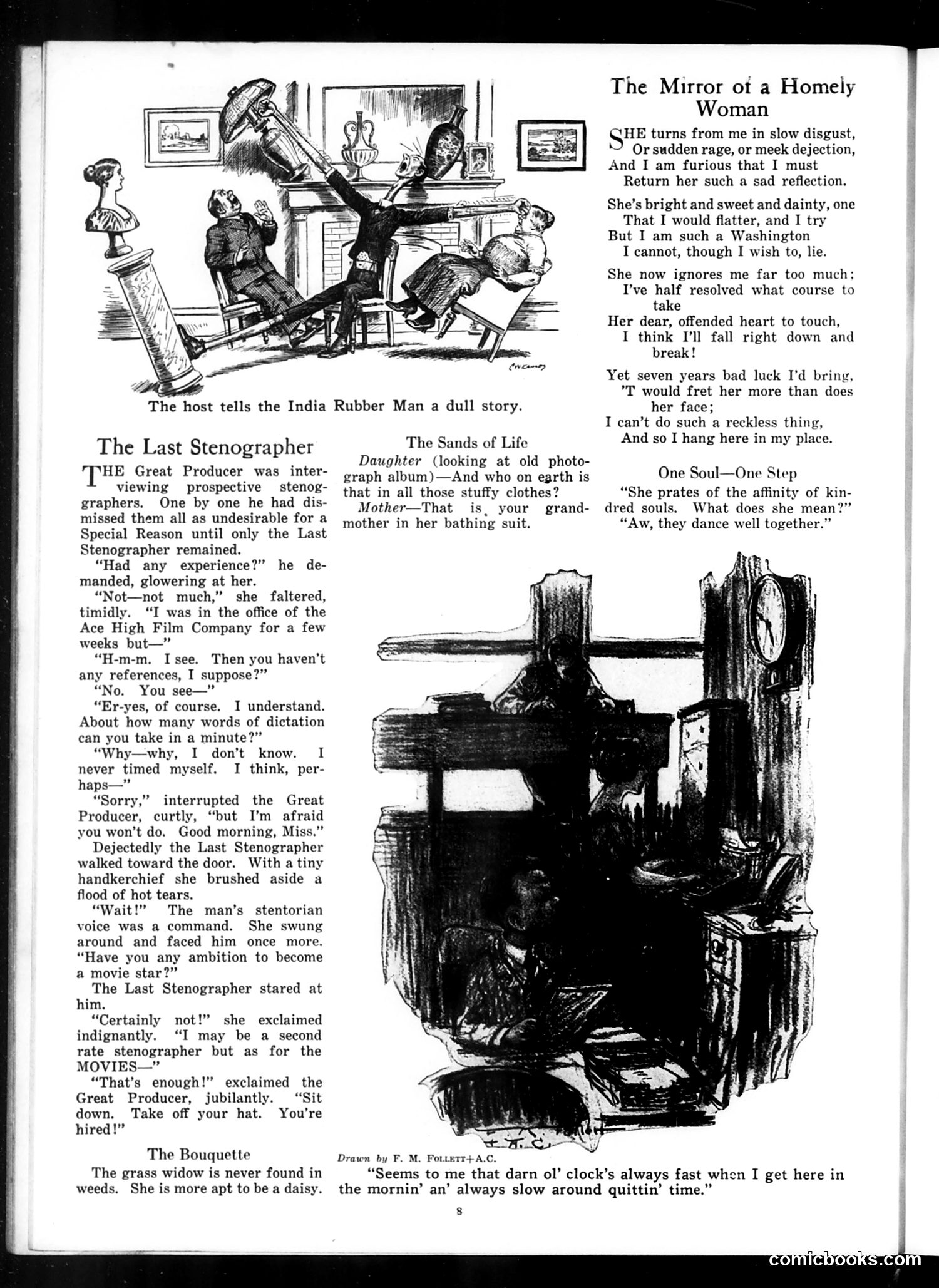
**Top Cartoon ("The India Rubber Man"):** A contortionist performer entertains a bored host and guests. The satire mocks tedious social obligation—the host's dull storytelling compels polite listening, while the acrobat's spectacular contortions fail to impress the unresponsive audience. It's commentary on forced entertainment and social pretense. **"The Last Stenographer" Story:** Satirizes the film industry's exploitation of women. A movie producer rejects qualified stenographers for lacking ambition to become actresses, then hires an unqualified woman specifically *because* she refuses to pursue stardom. The joke exposes how studios preferred compliant, desperate women over skilled workers, exploiting them as potential talent rather than valuing professional competence. **Bottom Image & Caption:** Depicts an employee's observation about workplace timekeeping—clocks mysteriously run fast during work hours and slow at quitting time. It's cynical commentary on management manipulation and worker exploitation. These pieces collectively critique early 20th-century American business practices regarding labor, entertainment, and gender.
📄 Transcribed text from this page (OCR, searchable)
Machine-transcribed from the original scan — historical spelling and the odd misread are preserved.
The host tells the India Rubber Man a dull story. The Last Stenographer HE Great Producer was inter- viewing prospective stenog- graphers. One by one he had dis- missed them all as undesirable for a Special Reason until only the Last Stenographer remained. “Had any experience?” manded, glowering at her. “Not—not much,” she faltered, timidly. “I was in the office of the Ace High Film Company for a few weeks but—” “H-m-m. I see. Then you haven't any references, I suppose?” “No. You see—” “Er-yes, of course. I understand. About how many words of dictation can you take in a minute?” “Why—why, I don’t know. I never timed myself. I think, per- he de- “Sorry,” interrupted the Great Producer, curtly, “but I’m afraid you won’t do. Good morning, Miss.” Dejectedly the Last Stenographer walked toward the door. With a tiny handkerchief she brushed aside a flood of hot tears. “Wait!” The man’s stentorian voice was a command. She swung around and faced him once more. “Have you any ambition to become a movie star?” The Last Stenographer stared at him. “Certainly not!” she exclaimed indignantly. “I may be a second rate stenographer but as for the MOVIES—” “That’s enough!” exclaimed the Great Producer, jubilantly. “Sit down. Take off your hat. You're hired!” The Bouquette The grass widow is never found in She is more apt to be a daisy. weeds. The Sands of Life Daughter (looking at old photo- graph album)—And who on earth is that in all those stuffy clothes? Mother—That is, your grand- mother in her bathing suit. — Rose Drawn by F. M. Foutett+A.C. The Mirror ot a Homely Woman QHE turns from me in slow disgust, Or sudden rage, or meek dejection, And I am furious that I must Return her such a sad reflection. She’s bright and sweet and dainty, one That I would flatter, and I try But I am such a Washington I cannot, though I wish to, lie. She now ignores me far too much; I’ve half resolved what course to take Her dear, offended heart to touch, I think I’ll fall right down and break! Yet seven years bad luck I'd bring, ’T would fret her more than does her face; I can’t do such a reckless thing, And so I hang here in my place. One Soul—One Step “She prates of the affinity of kin- dred souls. What does she mean?” “Aw, they dance well together.” “Seems to me that darn ol’ clock’s always fast when I get here in the mornin’ an’ always slow around quittin’ time.” 8