
Judge, 1921-10-22 · page 6 of 36
Judge — October 22, 1921 — page 6: what you’re looking at
What you’re looking at
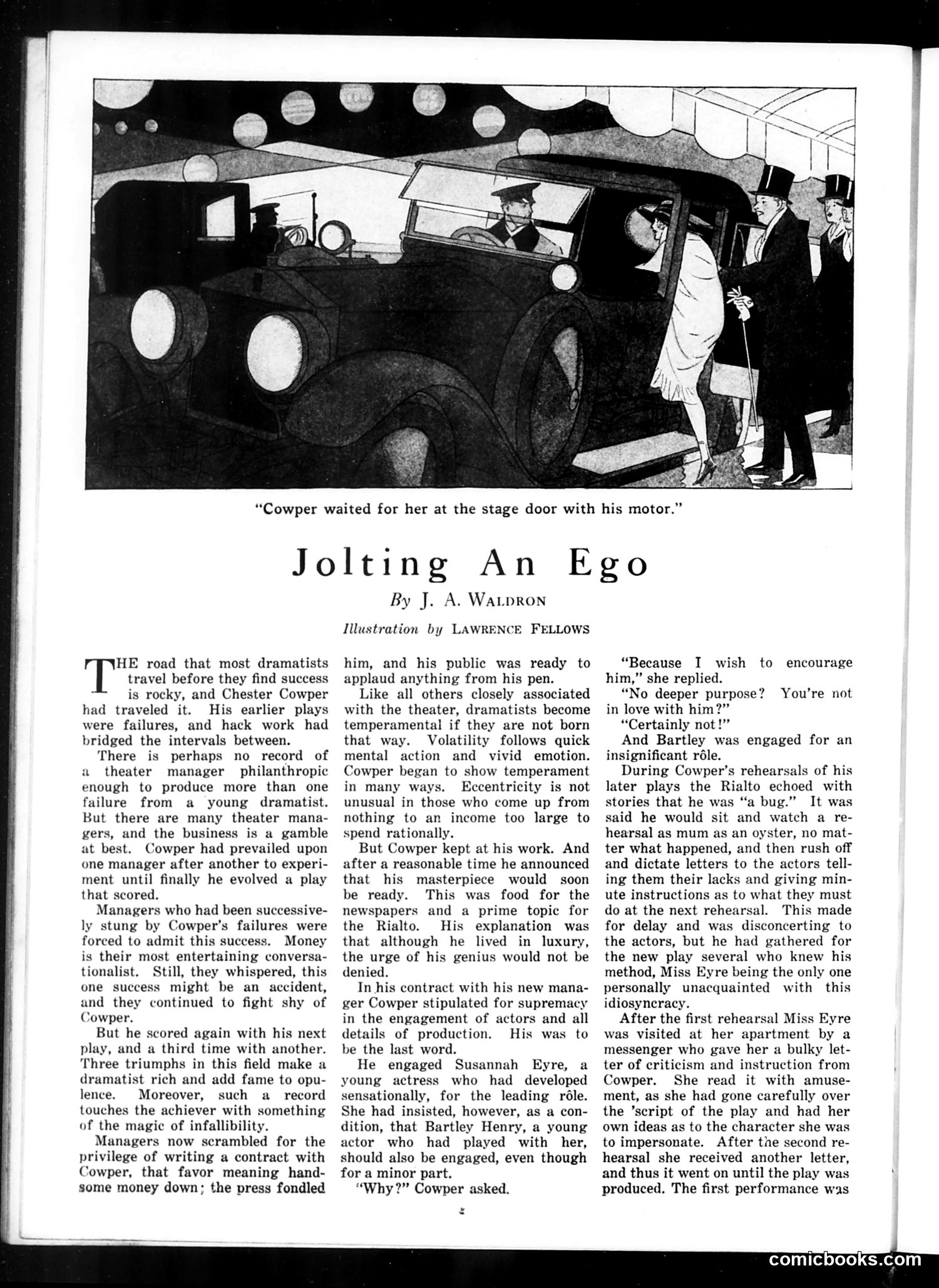
This is a short story rather than a political cartoon. The illustration shows a well-dressed woman being escorted to a motor car by men in top hats at what appears to be a theater stage door. The narrative concerns Chester Cowper, a temperamental dramatist whose earlier plays failed until he achieved success. The story satirizes theatrical ego and artistic pretension: Cowper demands total control over production details and becomes difficult during rehearsals. He engages actress Susannah Eyre for a leading role, then insists on also casting Bartley Henry in a minor part. The satire targets the vanity of theater professionals—particularly how success inflates artistic egos and leads to demanding, irrational behavior toward collaborators and subordinates.
📄 Transcribed text from this page (OCR, searchable)
Machine-transcribed from the original scan — historical spelling and the odd misread are preserved.
“Cowper waited for her at the stage door with his motor.” Jolting An Ego HE road that most dramatists T travel before they find success is rocky, and Chester Cowper had traveled it. His earlier plays were failures, and hack work had bridged the intervals between. There is perhaps no record of a theater manager philanthropic enough to produce more than one failure from a young dramatist. But there are many theater mana- gers, and the business is a gamble at best. Cowper had prevailed upon one manager after another to experi- ment until finally he evolved a play that scored. Managers who had been successive- ly stung by Cowper's failures were forced to admit this success. Money is their most entertaining conversa- tionalist. Still, they whispered, this one suc might be an accident, and they continued to fight shy of Cowper. But he scored again with his next play, and a third time with another. Three triumphs in this field make a dramatist rich and add fame to opu- lence. Moreover, such a_ record touches the achiever with something of the magic of infallibility. Managers now scrambled for the privilege of writing a contract with Cowper, that favor meaning hand- some money down; the press fondled By J. A. WALDRON Illustration by LAWRENCE FELLOWS him, and his public was ready to applaud anything from his pen. Like all others closely sociated with the theater, dramatists become temperamental if they are not born that way. Volatility follows quick mental action and vivid emotion. Cowper began to show temperament in many ways. Eccentricity is not unusual in those who come up from nothing to an income too large to spend rationally. But Cowper kept at his work. And after a reasonable time he announced that his masterpiece would soon be ready. This was food for the newspapers and a prime topic for the Rialto. His explanation was that although he lived in luxury, the urge of his genius would not be denied. In his contract with his new mana- ger Cowper stipulated for supremacy in the engagement of actors and all details of production. His was to be the last word. He engaged Susannah Eyre, a young actress who had developed sensationally, for the leading rdle. She had insisted, however, as a con- dition, that Bartley Henry, a young actor who had played with her, should also be engaged, even though for a minor part. “Why?” Cowper asked. to encourage wish him,” she replied. “No deeper purpose? “Because I You're not in love with him?” “Certainly not!” And Bartley was engaged for an insignificant réle. During Cowper’s rehearsals of his later plays the Rialto echoed with stories that he was “a bug.” It was said he would sit and watch a re- hearsal as mum as an oyster, no mat- ter what happened, and then rush off and dictate letters to the actors tell- ing them their lacks and giving min- ute instructions as to what they must do at the next rehearsal. This made for delay and was disconcerting to the actors, but he had gathered for the new play several who knew his method, Miss Eyre being the only one personally unacquainted with this idiosyncracy. After the first rehearsal Miss Eyre was visited at her apartment by a messenger who gave her a bulky let- ter of criticism and instruction from Cowper. She read it with amuse- ment, as she had gone carefully over the ’script of the play and had her own ideas as to the character she was to impersonate. After the second re- hearsal she received another letter, and thus it went on until the play was produced. The first performance was comicbooks.com