
Judge, 1921-10-22 · page 16 of 36
Judge — October 22, 1921 — page 16: what you’re looking at
What you’re looking at
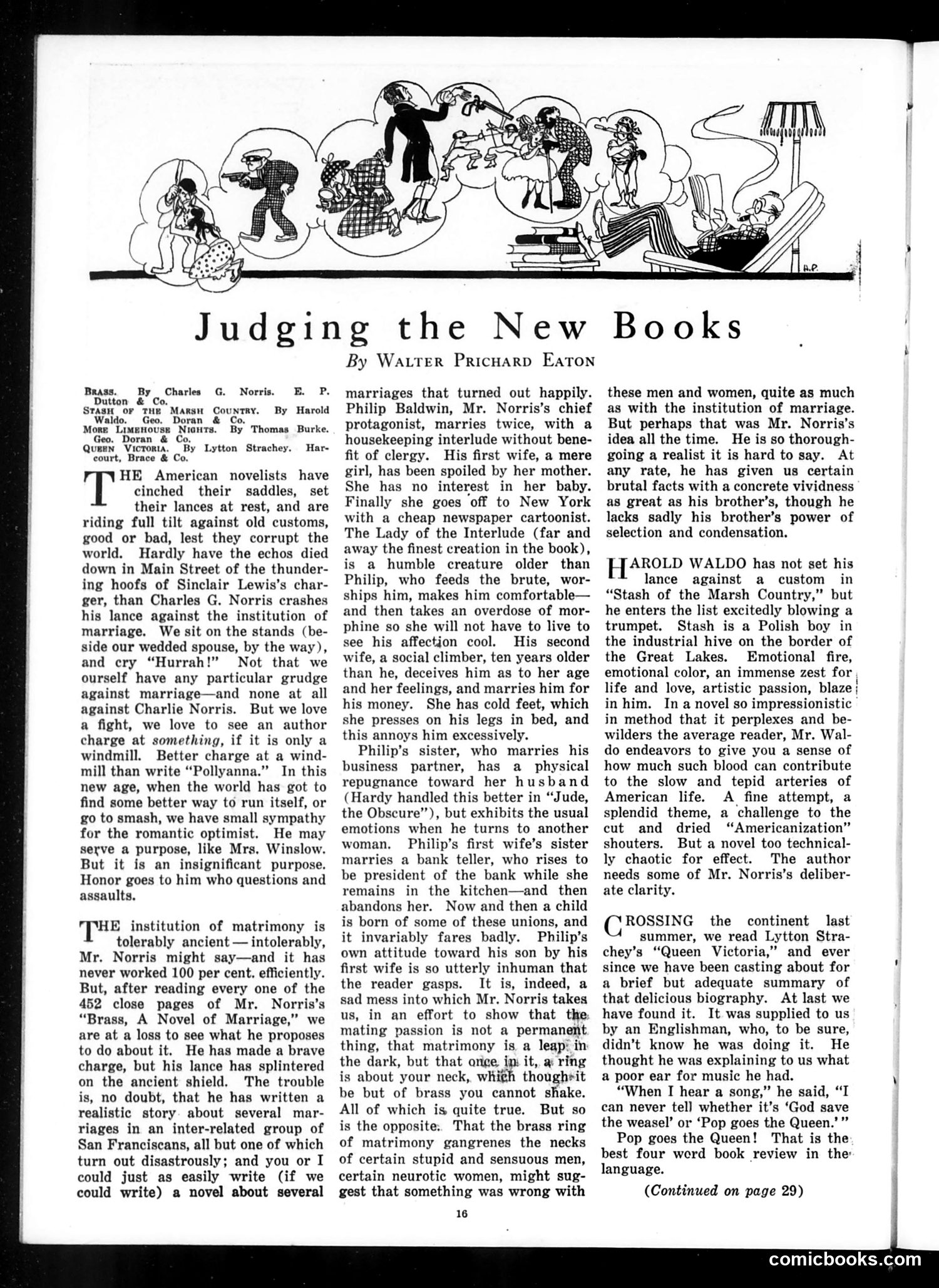
This is a book review column critiquing Charles G. Norris's novel *Brass: A Novel of Marriage*. The illustration depicts various domestic scenes and marital situations. Eaton praises Norris for attacking an established institution (marriage) rather than writing comforting escapism like "Pollyanna," valuing social critique over romantic optimism. However, he faults Norris for offering only realistic depiction of marriage failures without proposing solutions. The novel follows San Francisco characters through multiple disastrous marriages: a protagonist whose first wife abandons their baby for a cartoonist, a selfless second woman who commits suicide, his second marriage to a mercenary social climber, and his sister's unhappy union. Eaton notes Norris portrays matrimony as inescapable ("a ring is about your neck"), comparing it to a brass ring one "cannot shake"—suggesting marriage as both unbreakable and worthless.
📄 Transcribed text from this page (OCR, searchable)
Machine-transcribed from the original scan — historical spelling and the odd misread are preserved.
Brass. By Charles G. Norris. EB P. Dutton & Co. STASH oF THE MaRsH CounTRY. By Harold Waldo. Geo. Doran & Co. More Limenouse Niouts. By Thomas Burke. Geo. Doran & Co, Queen Vicroria. By Lytton Strachey, Har- court, Brace & Co, HE American novelists have T cinched their saddles, set their lances at rest, and are riding full tilt against old customs, good or bad, lest they corrupt the world. Hardly have the echos died down in Main Street of the thunder- ing hoofs of Sinclair Lewis’s char- ger, than Charles G. Norris crashes his lance against the institution of marriage. We sit on the stands (be- side our wedded spouse, by the way), and ery “Hurrah!” Not that we ourself have any particular grudge against marriage—and none at all against Charlie Norris. But we love a fight, we love to see an author charge at something, if it is only a windmill. Better charge at a wind- mill than write “Pollyanna.” In this new age, when the world has got to find some better way to run itself, or go to smash, we have small sympathy for the romantic optimist. He may serve a purpose, like Mrs, Winslow. But it is an insignificant purpose. Honor goes to him who questions and assaults, [He institution of matrimony is tolerably ancient — intolerably, Mr. Norris might say—and it has never worked 100 per cent. efficiently. But, after reading every one of the 452 close pages of Mr. Norris’s “Brass, A Novel of Marriage,” we are at a loss to see what he proposes to do about it. He has made a brave charge, but his lance has splintered on the ancient shield, The trouble is, no doubt, that he has written a realistic story. about several mar- riages in an inter-related group of San Franciscans, all but one of which turn out disastrously; and you or I could just as easily write (if we could write) a novel about several Judging the New Books By Wa.rer Pricuarp Eaton marriages that turned out happily. Philip Baldwin, Mr. Norris’s chief protagonist, marries twice, with a housekeeping interlude without bene- fit of clergy. His first wife, a mere girl, has been spoiled by her mother. She has no interest in her baby. Finally she goes off to New York with a cheap newspaper cartoonist. The Lady of the Interlude (far and away the finest creation in the book), is a humble creature older than Philip, who feeds the brute, wor- ships him, makes him comfortable— and then takes an overdose of mor- phine so she will not have to live to see his affection cool. His second wife, a social climber, ten years older than he, deceives him as to her age and her feelings, and marries him for his money. She has cold feet, which she presses on his legs in bed, and this annoys him excessively. Philip’s sister, who marries his business partner, has a_ physical repugnance toward her husband (Hardy handled this better in “Jude, the Obscure”), but exhibits the usual emotions when he turns to another woman. Philip’s first wife’s sister marries a bank teller, who rises to be president of the bank while she remains in the kitchen—and then abandons her. Now and then a child is born of some of these unions, and it invariably fares badly. Philip’s own attitude toward his son by his first wife is so utterly inhuman that the reader gasps. It is, indeed, a sad mess into which Mr. Norris takes us, in an effort to show that the. mating passion is not a permanent. thing, that matrimony is. a leap! in the dark, but that one im: it, a ring is about your neck, whith thoughsit be but of brass you cannot shake. All of which is quite true. But so is the opposite. That the brass ring of matrimony gangrenes the necks of certain stupid and sensuous men, certain neurotic women, might sug- gest that something was wrong with 16 these men and women, quite as much as with the institution of marriage. But perhaps that was Mr. Norris's idea all the time. He is so thorough- going a realist it is hard to say. At any rate, he has given us certain brutal facts with a concrete vividness as great as his brother’s, though he lacks sadly his brother’s power of selection and condensation. AROLD WALDO has not set his lance against a custom in “Stash of the Marsh Country,” but he enters the list excitedly blowing a trumpet. Stash is a Polish boy in the industrial hive on the border of the Great Lakes. Emotional fire, emotional color, an immense zest for life and love, artistic passion, blaze } in him. In a novel so impressionistic in method that it perplexes and be- wilders the average reader, Mr. Wal- do endeavors to give you a sense of how much such blood can contribute to the slow and tepid arteries of American life. A fine attempt, a splendid theme, a challenge to the cut and dried ‘“Americanization” shouters. But a novel too technical- ly chaotic for effect. The author needs some of Mr. Norris’s deliber- ate clarity. ROSSING the continent last summer, we read Lytton Stra- chey’s “Queen Victoria,” and ever since we have been casting about for a brief but adequate summary of that delicious biography. At last we have found it. It was supplied to us by an Englishman, who, to be sure, didn’t know he was doing it. He thought he was explaining to us what a poor ear for music he had. “When I hear a song,” he said, “I can never tell whether it’s ‘God save the weasel’ or ‘Pop goes the Queen.’” Pop goes the Queen! That is the best four werd book review in the language. (Continued on page 29) comicbooks.com