
Judge, 1921-10-22 · page 10 of 36
Judge — October 22, 1921 — page 10: what you’re looking at
What you’re looking at
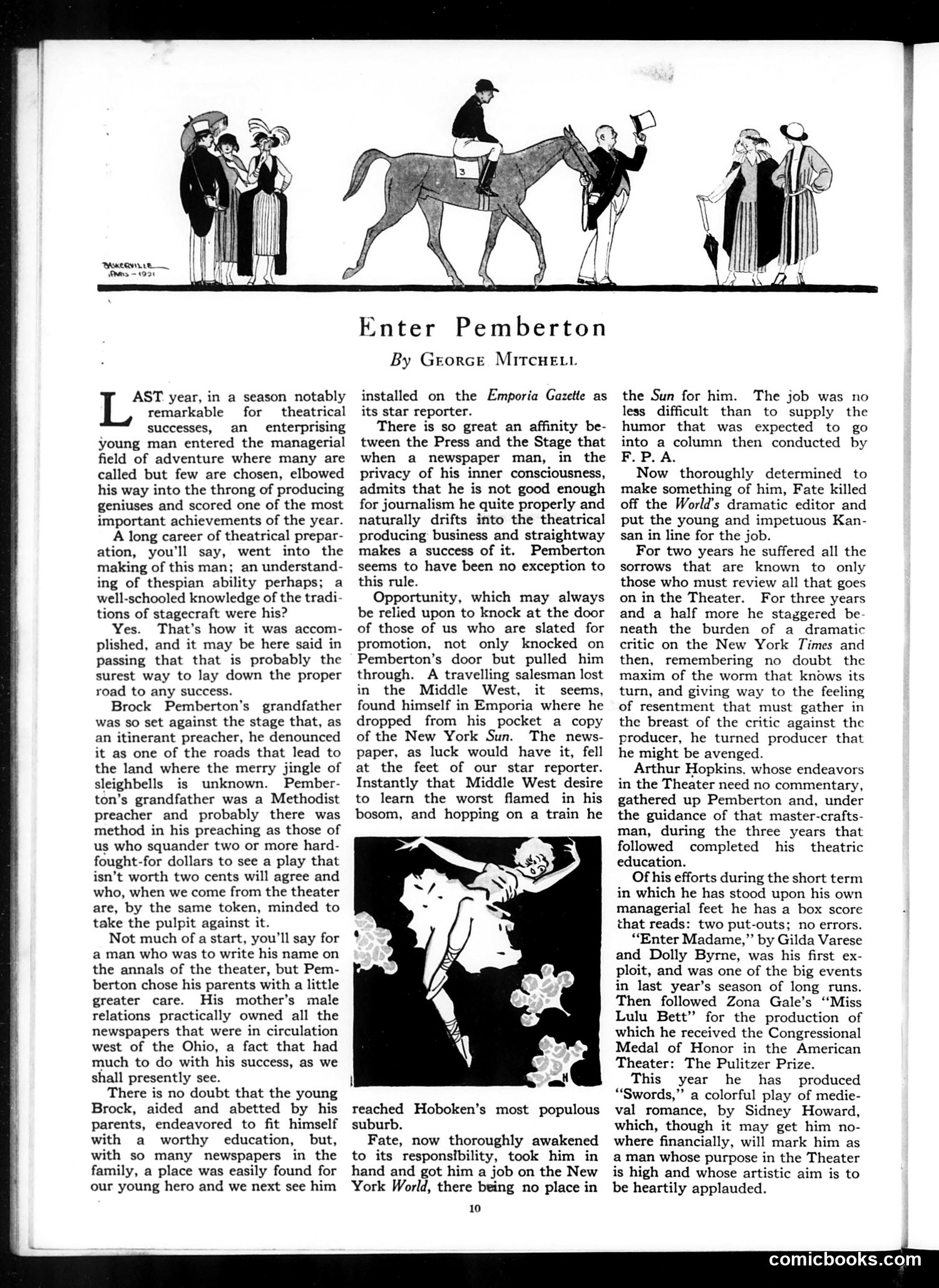
This is a biographical sketch of **Brock Pemberton**, a theater producer who achieved success despite (or because of) an unlikely background. The satire works on multiple levels: **The Joke:** Pemberton's grandfather was a Methodist preacher who condemned the theater as sinful, yet Pemberton became a theatrical producer—a ironic reversal. The article sarcastically credits his success not to talent or hard work, but to luck ("Fate") and family newspaper connections. **The Social References:** The piece mocks how newspaper journalists often drift into theater production when they admit they're "not good enough for journalism"—suggesting theater is a lesser field. It also satirizes how newspaper family connections and sheer chance determine success more than merit. **The Cartoon at top** shows Pemberton on horseback meeting various theater people, illustrating his "entrance" into the theatrical world. The overall tone is gently mocking: success comes from privilege and luck, not ability or virtue—a common Judge magazine theme critiquing American society.
📄 Transcribed text from this page (OCR, searchable)
Machine-transcribed from the original scan — historical spelling and the odd misread are preserved.
remarkable for theatrical successes, an enterprising young man entered the managerial field of adventure where many are called but few are chosen, elbowed his way into the throng of producing geniuses and scored one of the most important achievements of the year. A long career of theatrical prepar- ation, you'll say, went into the making of this man; an understand- ing of thespian ability perhaps; a well-schooled knowledge of the tradi- tions of stagecraft were his? Yes. That's how it was accom- plished, and it may be here said in passing that that is probably the surest way to lay down the proper road to any success. Brock Pemberton’s grandfather was so set against the stage that, as an itinerant preacher, he denounced it as one of the roads that lead to the land where the merry jingle of sleighbells is unknown. Pember- ton’s grandfather was a Methodist preacher and probably there was method in his preaching as those of us who squander two or more hard- fought-for dollars to see a play that isn’t worth two cents will agree and who, when we come from the theater are, by the same token, minded to take the pulpit against it. Not much of a start, you'll say for a man who was to write his name on the annals of the theater, but Pem- berton chose his parents with a little greater care. His mother’s male relations practically owned all the newspapers that were in circulation west of the Ohio, a fact that had much to do with his success, as we shall presently see. There is no doubt that the young Brock, aided and abetted by his parents, endeavored to fit himself with a worthy education, but, L= year, in a season notably with so many newspapers in the family, a place was easily found for our young hero and we next see him Enter Pemberton By Grorce MitcHeEt. installed on the Emporia Gazette as its star reporter. There is so great an affinity be- tween the Press and the Stage that when a newspaper man, in the privacy of his inner consciousness, admits that he is not good enough for journalism he quite properly and naturally drifts into the theatrical producing business and straightway makes a success of it. Pemberton seems to have been no exception to this rule. Opportunity, which may always be relied upon to knock at the door of those of us who are slated for promotion, not only knocked on Pemberton’s door but pulled him through. A travelling salesman lost in the Middle West, it seems, found himself in Emporia where he dropped from his pocket a copy of the New York Sun. The news- paper, as luck would have it, fell at the feet of our star reporter. Instantly that Middle West desire to learn the worst flamed in his bosom, and hopping on a train he reached Hoboken’s most populous suburb. Fate, now thoroughly awakened to its responsibility, took him in hand and got him a job on the New York World, there being no place in 10 the Sun for him. The job was no less difficult than to supply the humor that was expected to go into a column then conducted by F.P.A. Now thoroughly determined to make something of him, Fate killed off the World's dramatic editor and put the young and impetuous Kan- san in line for the job. For two years he suffered all the sorrows that are known to only those who must review all that goes on in the Theater. For three years and a half more he staggered be- neath the burden of a dramatic critic on the New York Times and then, remembering no doubt the maxim of the worm that knows its turn, and giving way to the feeling of resentment that must gather in the breast of the critic against the producer, he turned producer that he might be avenged. Arthur Hopkins, whose endeavors in the Theater need no commentary, gathered up Pemberton and, under the guidance of that master-crafts- man, during the three years that followed completed his theatric education. Of his efforts during the short term in which he has stood upon his own managerial feet he has a box score that reads: two put-outs; no errors. “Enter Madame,” by Gilda Varese and Dolly Byrne, was his first ex- ploit, and was one of the big events in last year’s season of long runs. Then followed Zona Gale’s “Miss Lulu Bett” for the production of which he received the Congressional Medal of Honor in the American Theater: The Pulitzer Prize. This year he has produced “Swords,” a colorful play of medie- val romance, by Sidney Howard, which, though it may get him no- where financially, will mark him as aman whose purpose in the Theater is high and whose artistic aim is to be heartily applauded. comicbooks.com