
Judge, 1921-10-22 · page 14 of 36
Judge — October 22, 1921 — page 14: what you’re looking at
What you’re looking at
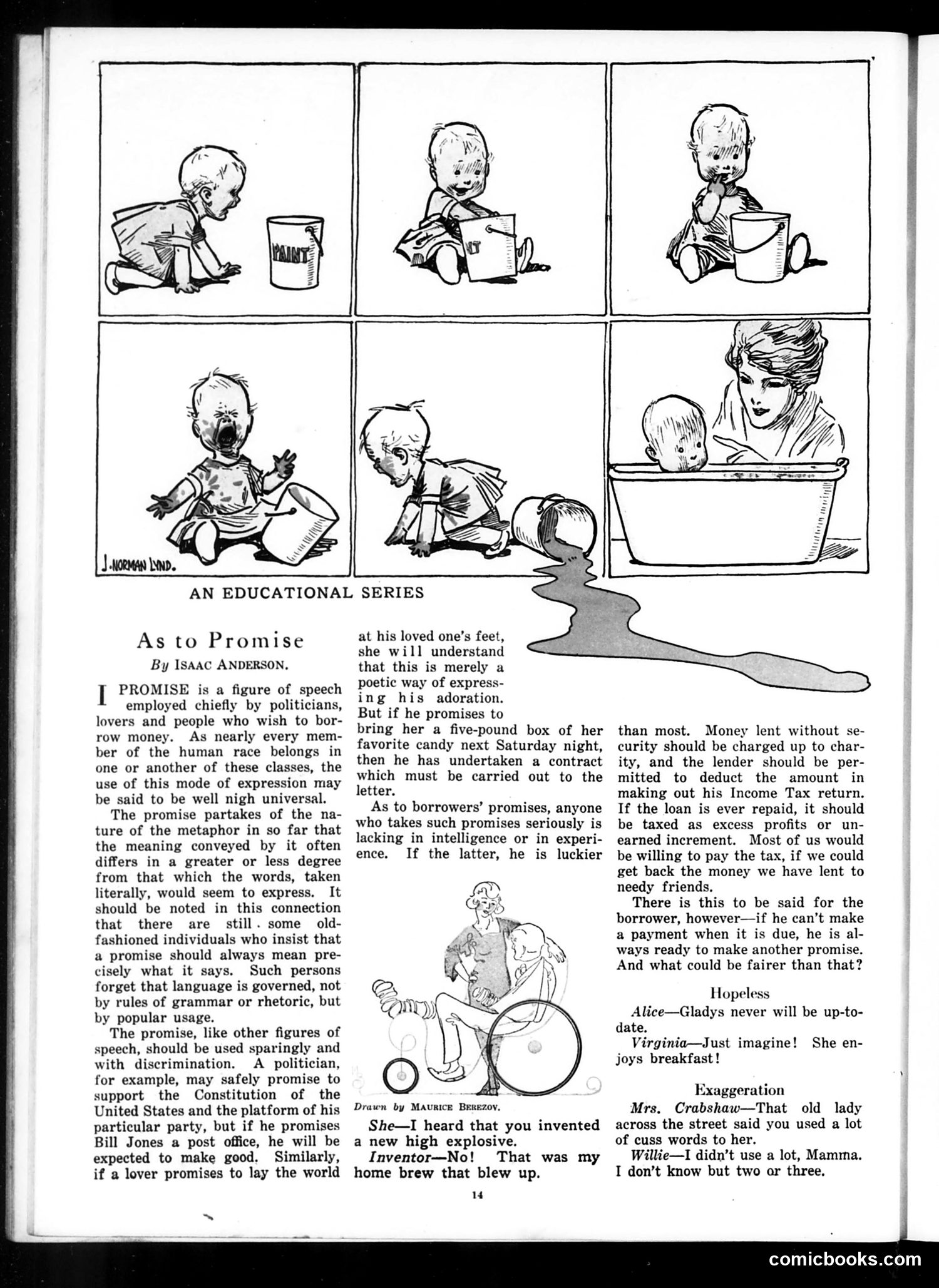
This essay satirizes the meaninglessness of promises in early 20th-century American life. Author Isaac Anderson argues that "promise" functions as deliberately vague language, especially among three groups: politicians, lovers, and borrowers. The satire's key insight: a promise's actual meaning depends on who makes it. Politicians safely promise constitutional support; lovers poetically pledge devotion without literal obligation. But borrowers' promises are worthless—lenders who take them seriously lack intelligence. Anderson mockingly suggests taxing repaid loans as "excess profits" and treating unpaid debts as charity. The accompanying comic strip shows a baby's progression with a paint bucket, illustrating how promises (and consequences) develop through stages. A sidebar joke about home-brew exploding reinforces the theme of failed expectations. The piece reflects Progressive-era cynicism about political rhetoric and financial irresponsibility, suggesting that in common usage, "promise" has become essentially meaningless.
📄 Transcribed text from this page (OCR, searchable)
Machine-transcribed from the original scan — historical spelling and the odd misread are preserved.
As to Promise By ISAAC ANDERSON, I PROMISE is a figure of speech employed chiefly by politicians, lovers and people who wish to bor- row money. As nearly every mem- ber of the human race belongs in one or another of these classes, the use of this mode of expression may be said to be well nigh universal. The promise partakes of the na- ture of the metaphor in so far that the meaning conveyed by it often differs in a greater or less degree from that which the words, taken literally, would seem to express. It should be noted in this connection that there are still. some old- fashioned individuals who insist that a promise should always mean pre- cisely what it says. Such persons forget that language is governed, not by rules of grammar or rhetoric, but by popular usage. The promise, like other figures of speech, should be used sparingly and with discrimination. A politician, for example, may safely promise to support the Constitution of the United States and the platform of his particular party, but if he promises Bill Jones a post office, he will be expected to make good. Similarly, if a lover promises to lay the world AN EDUCATIONAL SERIES at his loved one’s feet, she will understand that this is merely a poetic way of express- ing his adoration. But if he promises to bring her a five-pound box of her favorite candy next Saturday night, then he has undertaken a contract which must be carried out to the letter. As to borrowers’ promises, anyone who takes such promises seriously is lacking in intelligence or in experi- ence. If the latter, he is luckier Drawn by MauRICE BEREZov. She—I heard that you invented a new high explosive. Inventor—No! That was my home brew that blew up. 4 Money lent without se- curity should be charged up to char- ity, and the lender should be per- mitted to deduct the amount in making out his Income Tax return. If the loan is ever repaid, it should be taxed as excess profits or un- than most. earned increment. Most of us would be willing to pay the tax, if we could get back the money we have lent to needy friends. There is this to be said for the borrower, however—if he can’t make a payment when it is due, he is al- ways ready to make another promise. And what could be fairer than that? Hopeless Alice—Gladys never will be up-to- date. Virginia—Just imagine! joys breakfast! She en- Exaggeration Mrs. Crabshaw—That old lady across the street said you used a lot of cuss words to her. Willie—I didn’t use a lot, Mamma. I don’t know but two or three, comicbooks.com