
Judge, 1921-10-22 · page 22 of 36
Judge — October 22, 1921 — page 22: what you’re looking at
What you’re looking at
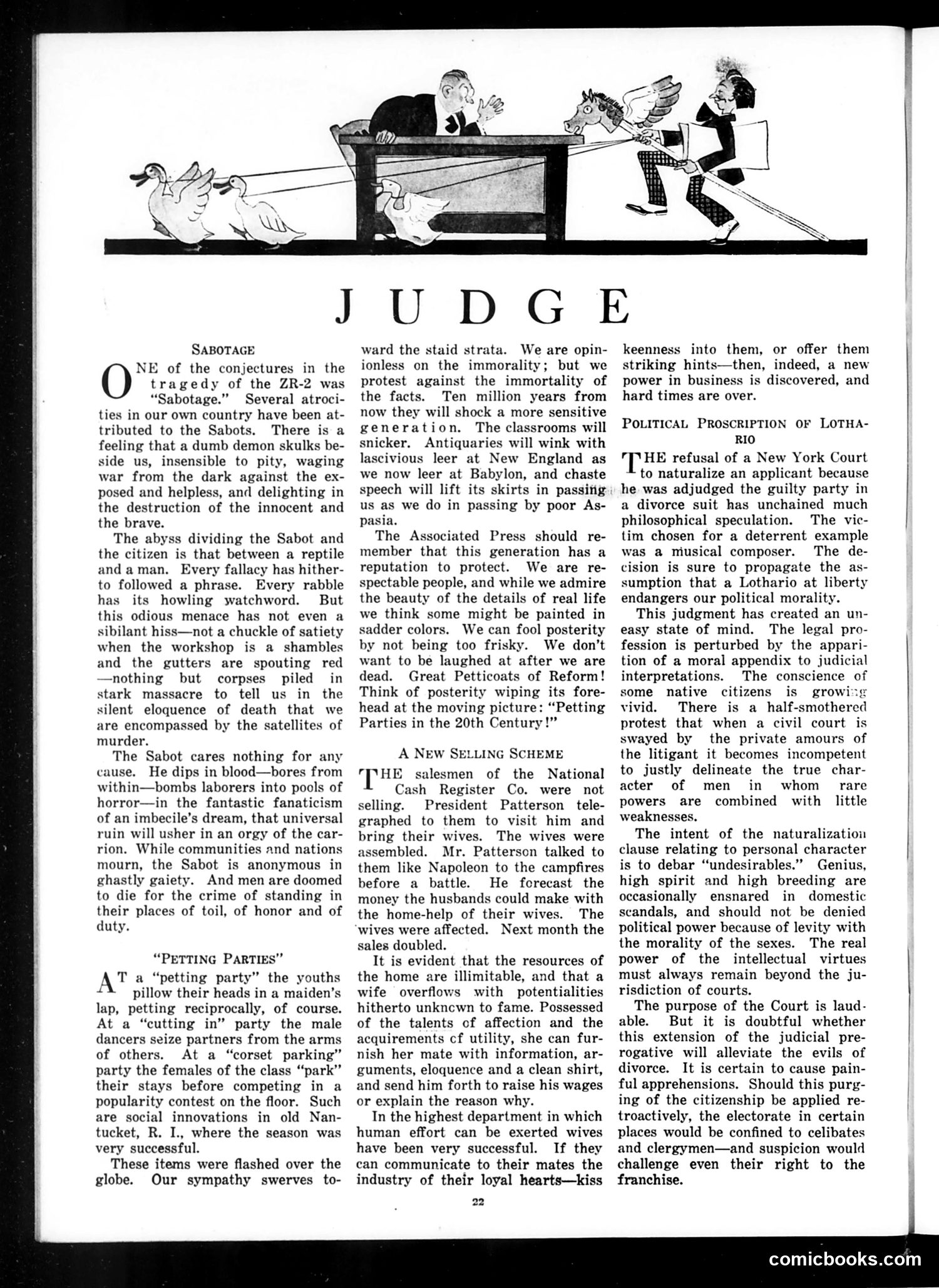
**The "Sabotage" Editorial Cartoon** (top) depicts a tug-of-war between figures representing labor saboteurs and citizens/authorities over what appears to be industrial infrastructure. The accompanying text references the ZR-2 airship disaster, blaming "Sabots" (anarchist saboteurs) for destructive acts against workers and industry. The editorial expresses anxiety about anonymous, ideologically-unmotivated violence threatening innocent laborers—reflecting post-WWI American fears of anarchist terrorism and labor unrest. **"Petting Parties" Section** mocks social innovations among youth in Nantucket, Rhode Island—including "cutting in" dances and "corset parking" (removing undergarments during contests). Judge satirizes the Associated Press for publicizing these behaviors, warning that future generations will judge contemporary morality harshly. The tone is moralistic panic about youth immorality. **"A New Selling Scheme"** praises National Cash Register president Patterson's strategy of motivating salesmen's wives to encourage their husbands' productivity—portraying women as domestic motivators whose "affection" and "utility" drive male economic success.
📄 Transcribed text from this page (OCR, searchable)
Machine-transcribed from the original scan — historical spelling and the odd misread are preserved.
SABOTAGE NE of the conjectures in the O tragedy of the ZR-2 was “Sabotage.” Several atroci- ties in our own country have been at- tributed to the Sabots. There is a feeling that a dumb demon skulks be- side us, insensible to pity, waging war from the dark against the ex- posed and helpless, and delighting in the destruction of the innocent and the brave. The abyss dividing the Sabot and the citizen is that between a reptile andaman. Every fallacy has hither- to followed a phrase. Every rabble has its howling watchword. But this odious menace has not even a sibilant hiss—not a chuckle of satiety when the workshop is a shambles and the gutters are spouting red —nothing but corpses piled in stark massacre to tell us in the silent eloquence of death that we are encompassed by the satellites of murder. The Sabot cares nothing for any cause. He dips in blood—bores from within—bombs laborers into pools of horror—in the fantastic fanaticism of an imbecile’s dream, that universal ruin will usher in an orgy of the car- rion. While communities and nations mourn, the Sabot is anonymous in ghastly gaiety. And men are doomed to die for the crime of standing in their places of toil, of honor and of duty. “PETTING PARTIES” A T a “petting party” the youths = pillow their heads in a maiden’s lap, petting reciprocally, of course. At a “cutting in” party the male dancers seize partners from the arms of others. At a “corset parking” party the females of the class “park” their stays before competing in a popularity contest on the floor. Such are social innovations in old Nan- tucket, R. I., where the season was very successful. These items were flashed over the globe. Our sympathy swerves to- ward the staid strata. We are opin- ionless on the immorality; but we protest against the immortality of the facts. Ten million years from now they will shock a more sensitive generation. The classrooms will snicker. Antiquaries will wink with lascivious leer at New England as we now leer at Babylon, and chaste speech will lift its skirts in passing us as we do in passing by poor As- pasia, The Associated Press should re- member that this generation has a reputation to protect. We are re- spectable people, and while we admire the beauty of the details of real life we think some might be painted in sadder colors. We can fool posterity by not being too frisky. We don’t want to be laughed at after we are dead. Great Petticoats of Reform! Think of posterity wiping its fore- head at the moving picture: “Petting Parties in the 20th Century!” A NEw SELLING SCHEME T HE salesmen of the National Cash Register Co. were not selling. President Patterson tele- graphed to them to visit him and bring their wives. The wives were assembled. Mr. Patterson talked to them like Napoleon to the campfires before a battle. He forecast the money the husbands could make with the home-help of their wives. The wives were affected. Next month the sales doubled. It is evident that the resources of the home are illimitable, and that a wife overflows with potentialities hitherto unkncwn to fame. Possessed of the talents of affection and the acquirements cf utility, she can fur- nish her mate with information, ar- guments, eloquence and a clean shirt, and send him forth to raise his wages or explain the reason why. In the highest department in which human effort can be exerted wives have been very successful. If they can communicate to their mates the industry of their loyal hearts—kiss keenness into them, or offer them striking hints—then, indeed, a new power in business is discovered, and hard times are over. POLITICAL PROSCRIPTION OF LOTHA- RIO HE refusal of a New York Court to naturalize an applicant because he was adjudged the guilty party in a divorce suit has unchained much philosophical speculation. The vic- tim chosen for a deterrent example was a musical composer. The de- cision is sure to propagate the as- sumption that a Lothario at liberty endangers our political morality. This judgment has created an un- easy state of mind. The legal pro- fession is perturbed by the appari- tion of a moral appendix to judicial interpretations. The conscience of some native citizens is growizg vivid. There is a half-smothered protest that when a civil court is swayed by the private amours of the litigant it becomes incompetent to justly delineate the true char- | acter of men in whom rare powers are combined with little weaknesses. The intent of the naturalization clause relating to personal character is to debar “undesirables.” Genius, high spirit and high breeding are occasionally ensnared in domestic scandals, and should not be denied political power because of levity with the morality of the sexes. The real power of the intellectual virtues must always remain beyond the ju- risdiction of courts. The purpose of the Court is laud- able. But it is doubtful whether this extension of the judicial pre- rogative will alleviate the evils of divorce. It is certain to cause pain- ful apprehensions. Should this purg- ing of the citizenship be applied re- troactively, the electorate in certain places would be confined to celibates and clergymen—and suspicion would challenge even their right to the franchise. comicbooks.com