
Judge, 1921-10-22 · page 7 of 36
Judge — October 22, 1921 — page 7: what you’re looking at
What you’re looking at
This page contains three distinct items: **Main Story: "Unveiled"** A narrative about playwright Cowper and actress Miss Eyre. After her theatrical success, Cowper takes her to dinner and reveals he sent her daily instructional letters—culminating in an unread marriage proposal. The joke: Miss Eyre never opened his final letter because she married someone else (Bartley Henry) yesterday. The satire mocks male authorial presumption and the arrogance of men who assume their guidance ensures romantic reciprocation. **Short Joke: "Unveiled" (second)** A child's misunderstanding: Uncle explains he "grafted" trees in his orchard. The boy later asks his father if uncle was "a grafter"—conflating horticultural grafting with graft (corruption). This plays on the era's common association of grafting with political/business corruption. **Poem: "Rooms"** A whimsical poem by Sophie Redford about the mind as a house with various "rooms" storing memories, books, and experiences. Non-satirical; appears to be filler content. The page primarily satirizes male ego and romantic presumption through the main narrative.
📄 Transcribed text from this page (OCR, searchable)
Machine-transcribed from the original scan — historical spelling and the odd misread are preserved.
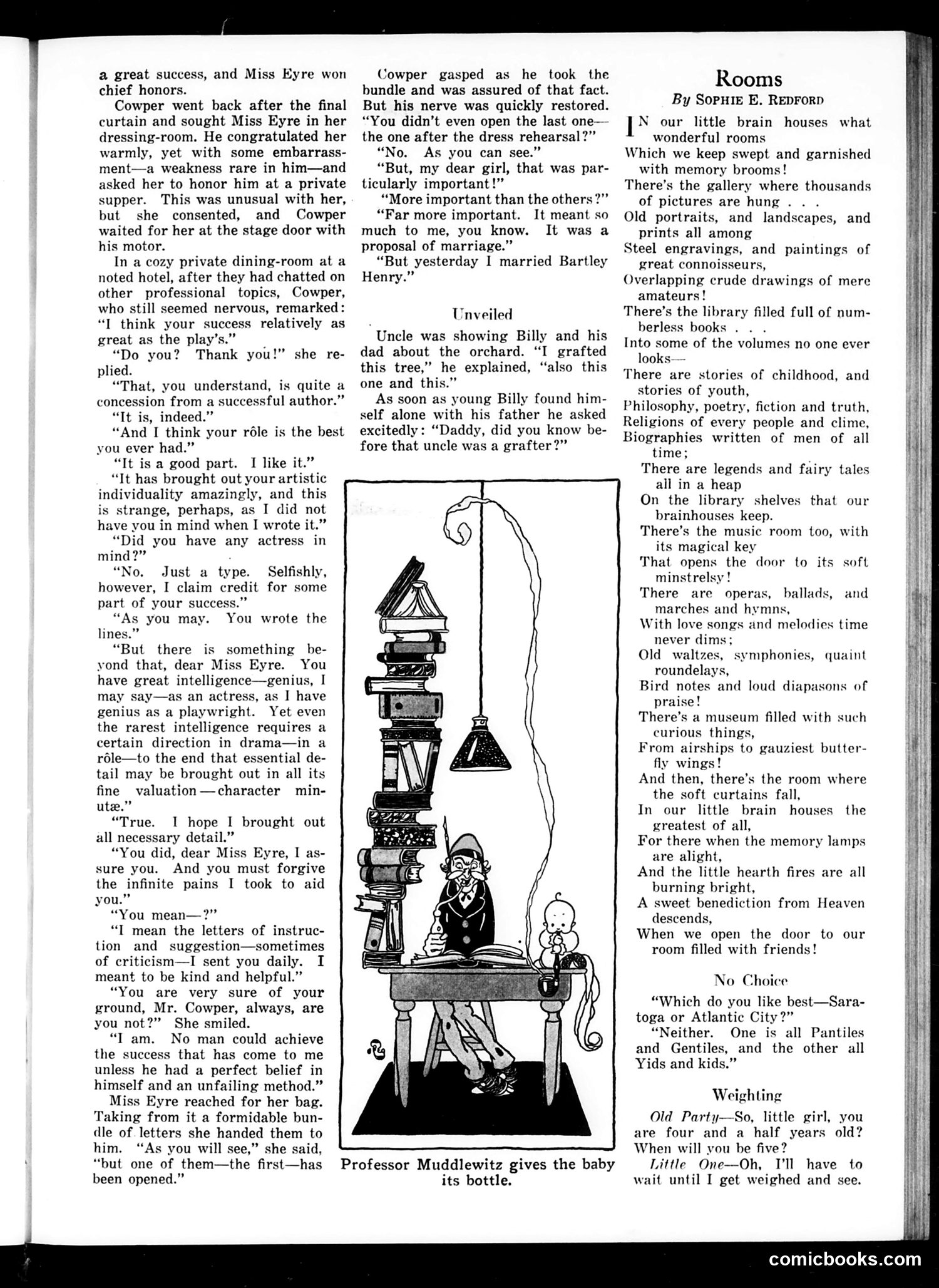
a great success, and Miss Eyre won chief honors. Cowper went back after the final curtain and sought Miss Eyre in her dressing-room. He congratulated her warmly, yet with some embarrass- ment—a weakness rare in him—and asked her to honor him at a private supper. This was unusual with her, but she consented, and Cowper waited for her at the stage door with his motor. In a cozy private dining-room at a noted hotel, after they had chatted on other professional topics, Cowper, who still seemed nervous, remarked : “I think your success relatively as great as the play’s.” . “Do you? Thank you!” she re- plied. “That, you understand, is quite a concession from a successful author.” “Tt is, indeed.” “And I think your réle is the best you ever had.” “It is a good part. I like it.” “It has brought out your artistic individuality amazingly, and this is strange, perhaps, as I did not have you in mind when I wrote it.” “Did you have any actress in mind?” “No. Just a type. Selfishly, however, I claim credit for some part of your success.” “As you may. You wrote the lines. “But there is something be- yond that, dear Miss Eyre. You have great intelligence—genius, I may say—as an actress, as I have genius as a playwright. Yet even the rarest intelligence requires a certain direction in drama—in a rdle—to the end that essential de- tail may be brought out in all its fine valuation—character min- ute.” “True. I hope I brought out all necessary detail.” “You did, dear Miss Eyre, I as- sure you. And you must forgive the infinite pains I took to aid you.” “You mean—?” “I mean the letters of instruc- tion and suggestion—sometimes of criticism—I sent you daily. I meant to be kind and helpful.” “You are very sure of your ground, Mr. Cowper, always, are you not?” She smiled. “Iam. No man could achieve the success that has come to me unless he had a perfect belief in himself and an unfailing method.” Miss Eyre reached for her bag. Taking from it a formidable bun- dle of letters she handed them to him. “As you will see,” she said, “but one of them—the first—has been opened.” Cowper gasped as he took the bundle and was assured of that fact. But his nerve was quickly restored. “You didn’t even open the last one- the one after the dress rehearsal?” “No. As you can see.” “But, my dear girl, that was par- ticularly important!” “More important than the others?” “Far more important. It meant so much to me, you know. It was a proposal of marriage.” “But yesterday I married Bartley Henry.” Unveiled Uncle was showing Billy and his dad about the orchard. “I grafted this tree,” he explained, “also this one and this.” As soon as young Billy found him- self alone with his father he asked excitedly: “Daddy, did you know be- fore that uncle was a grafter?” Professor Muddlewitz gives the baby its bottle. Rooms By Sopuie E. REDFORD [% our little brain houses wonderful rooms Which we keep swept and garnished with memory brooms! There’s the gallery where thousands of pictures are hung . . Old portraits, and landscapes, and prints all among Steel engravings, and paintings of great connoisseurs, Overlapping crude drawings of mere amateurs! There’s the library filled full of num- berless books . Into some of the volumes no one ever looks— There are stories of childhood, and stories of youth, Philosophy, poetry, fiction and truth, Religions of every people and clime, Biographies written of men of all time; There are legends and fairy tales all in a heap On the library shelves that our brainhouses keep. There’s the music room too, with its magical key That opens the door to its soft minstrelsy ! There are operas, ballads, marches and hymns, With love songs and melodies time what and never di Old waltz symphonies, quaint roundelays, Bird notes and loud diapasons of praise! There’s a museum filled with such curious things, From airships to gauziest butter- fly wings! And then, there’s the room where the soft curtains fall, In our little brain houses greatest of all, For there when the memory lamps are alight, And the little hearth fires are all burning bright, A sweet benediction from Heaven descends, When we open the door to our room filled with friends! the No Choice “Which do you like best—Sara- toga or Atlantic City?” “Neither. One is all Pantiles and Gentiles, and the other all Yids and kids.” Weighting Old Party—So, little girl, you are four and a half years old? When will you be five? Little One—Oh, I'll have to wait until I get weighed and see. comicbooks.com