
A complete issue · 36 pages · 1921
Judge — September 10, 1921
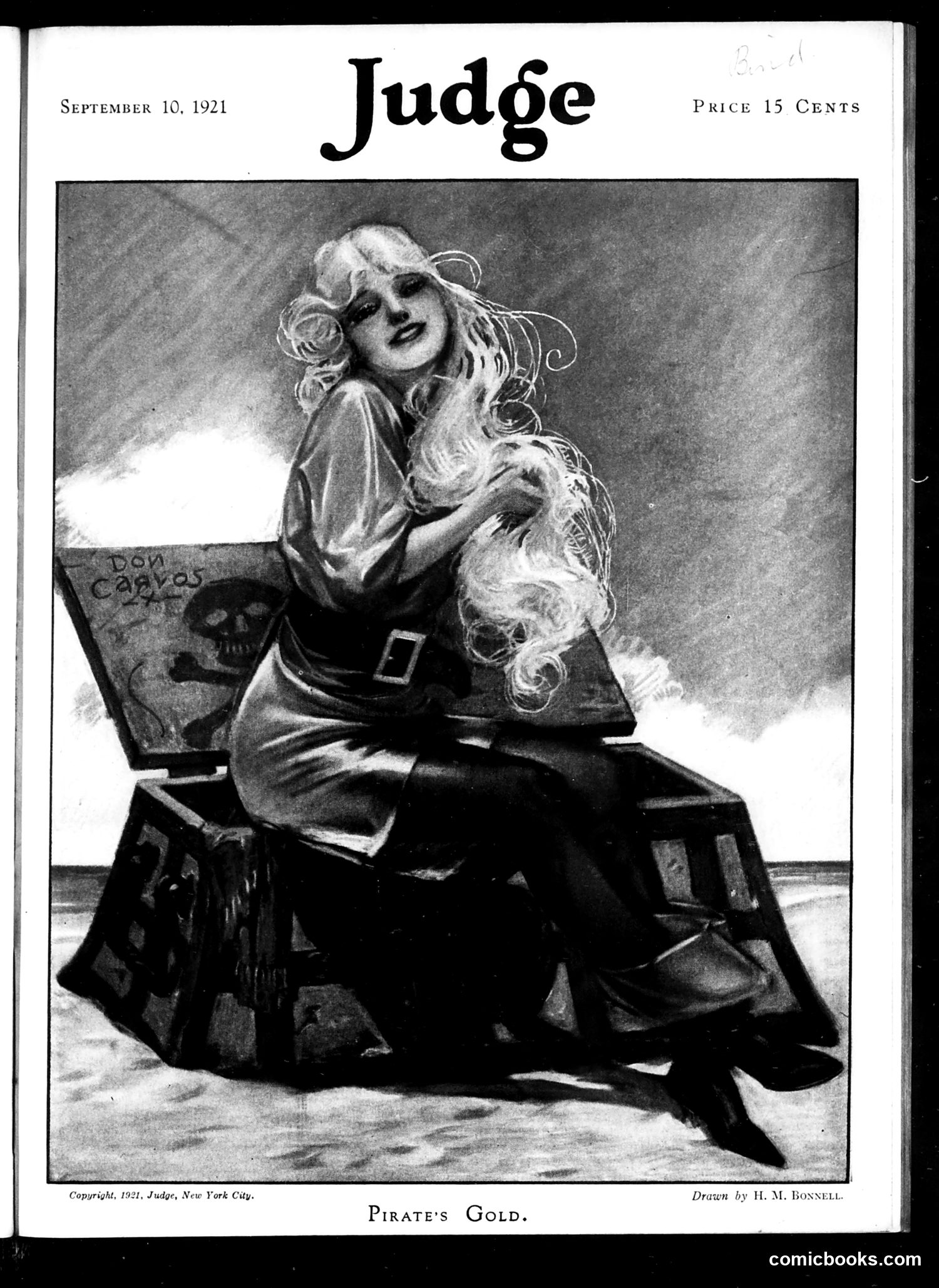
This illustration by H.M. Bonnell depicts a woman with blonde curled hair sitting at a vanity table, admiring herself. The title "Pirate's Gold" appears to be a satirical commentary on the commercialization of feminine beauty during the 1920s. The "pirate" reference likely suggests that beauty product manufacturers were "stealing" women's money through cosmetics sales—a common satirical critique of the cosmetics industry in this era. The woman's theatrical pose and elaborate styling exemplify the flapper aesthetic of the early 1920s, while the satire mocks how women were targeted as consumers for beauty products marketed as essential to their value and attractiveness. This reflects broader 1920s anxieties about consumerism, advertising, and changing gender roles.
This page is **entirely an advertisement** for Leslie's, described as "the oldest, and aims to be the best, illustrated weekly newspaper in the United States." The ad uses food metaphor to pitch the magazine's content: just as one needs nutritious meals for physical health, one needs quality reading ("mental food") for intellectual health. Leslie's claims to offer a balanced "ration of reading" with fresh, timely, and entertaining articles by popular American writers and artists. The slogan "BETTER EACH WEEK" emphasizes continuous improvement. The final pitch—"It Is Interesting!"—serves as the magazine's core selling point to readers seeking quality weekly illustrated journalism in 1921.
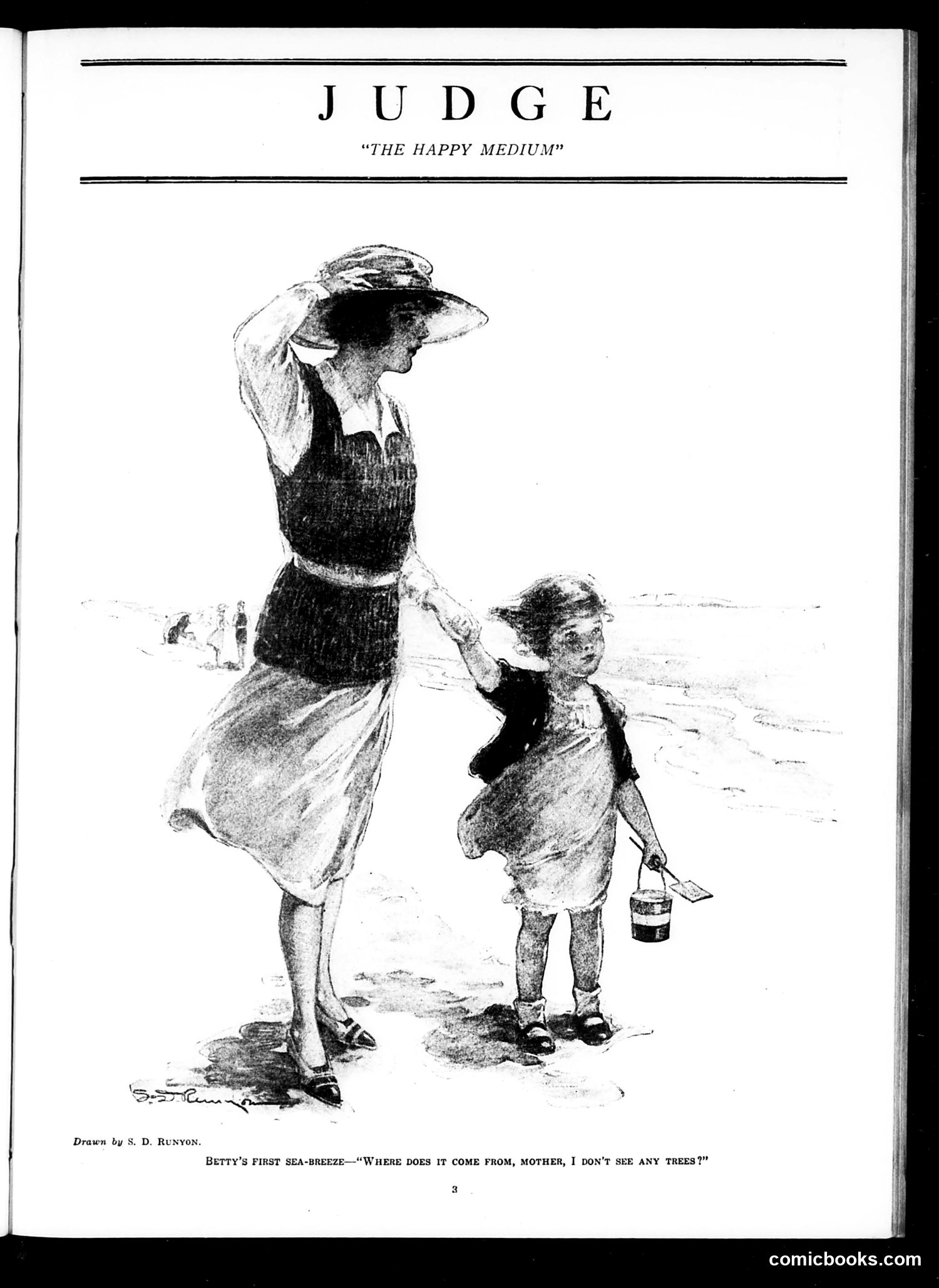
This page from *Judge* magazine features a single cartoon titled "Betty's First Sea-Breeze" drawn by S.D. Runyon. The image shows a woman and child at the beach; the child asks their mother, "Where does it come from, mother, I don't see any trees?" The humor is a gentle domestic joke rather than political satire. The child's innocent question misunderstands the source of wind—apparently expecting it to originate from trees (as wind moves through foliage). The mother's fashionable beach attire and the seaside setting suggest this is early 20th-century leisure culture. This is a humorous anecdote about childhood logic, typical of *Judge*'s lighter satirical content, rather than commentary on contemporary political events.
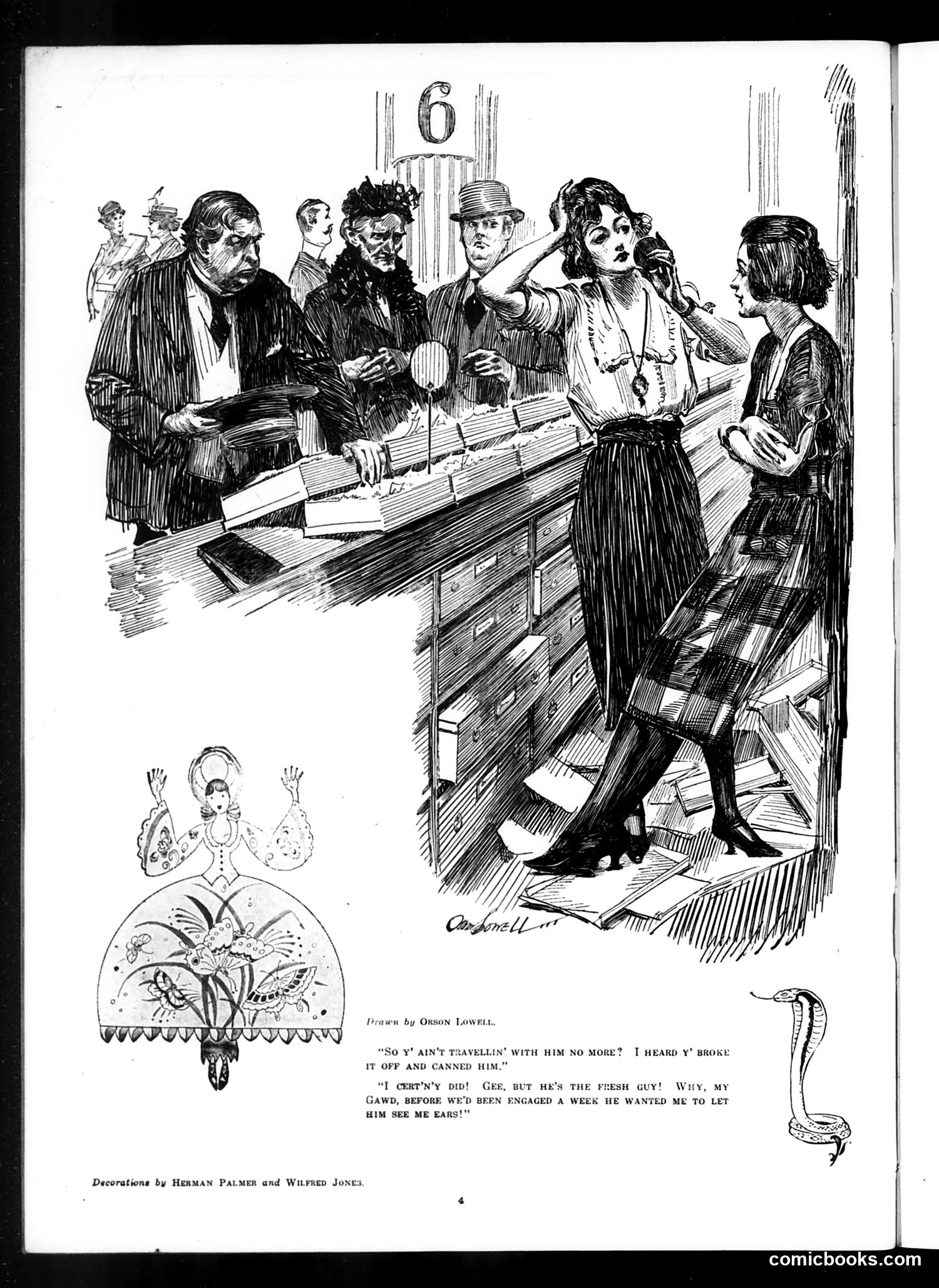
This illustration depicts a domestic dispute at what appears to be a counter or shop. The dialogue suggests a woman confronting a man about his infidelity—she accuses him of traveling with another woman ("So y' ain't travellin' with him no more?") and references his recent engagement ("before we'd been engaged a week he wanted me to let him see me ears!"). The cartoon satirizes early 20th-century courtship customs and male behavior. The woman's complaint about the man's inappropriate requests during courtship reflects period anxieties about propriety and acceptable conduct between engaged couples. The phrase "fresh guy" (meaning forward or disrespectful) captures contemporary slang for men who overstepped social boundaries. The satire targets male presumption and changing social dynamics around romance and engagement.
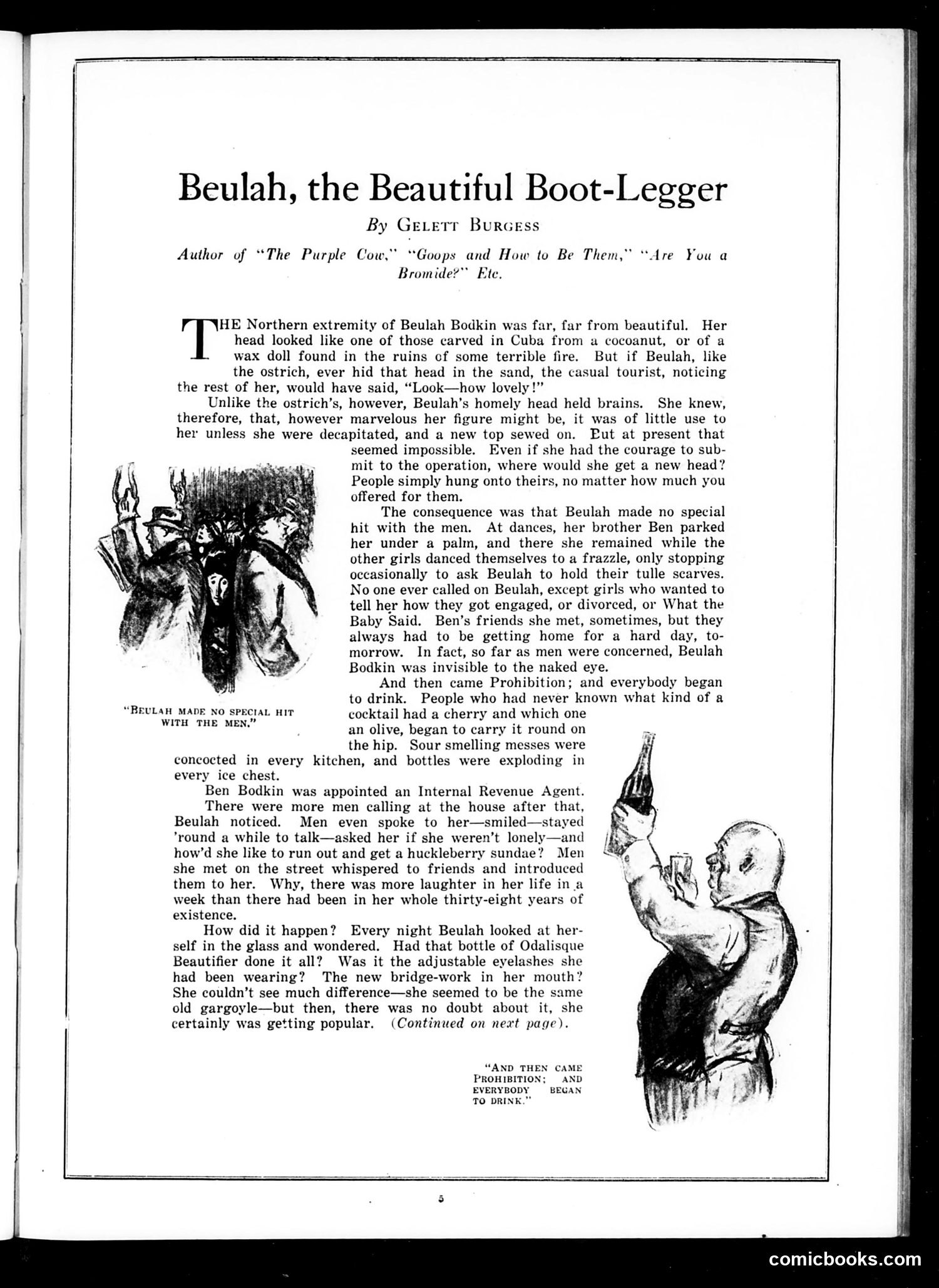
This page from *Judge* magazine features a short story titled "Beulah, the Beautiful Boot-Legger" by Gelett Burgess. The narrative satirizes Prohibition-era America (1920-1933), when alcohol sales were federally banned. The story's humor centers on Beulah Bodkin, an unattractive woman who becomes socially desirable after Prohibition begins—specifically because her brother Ben becomes an Internal Revenue Agent enforcing alcohol laws. Men suddenly court her, hoping to access illegal liquor through family connections. The accompanying illustrations show the bootlegging trade: one depicts Beulah with alcohol, another shows a man smuggling a bottle. The satire mocks how Prohibition created unexpected social opportunities and how citizens circumvented unpopular laws through personal connections and corruption.
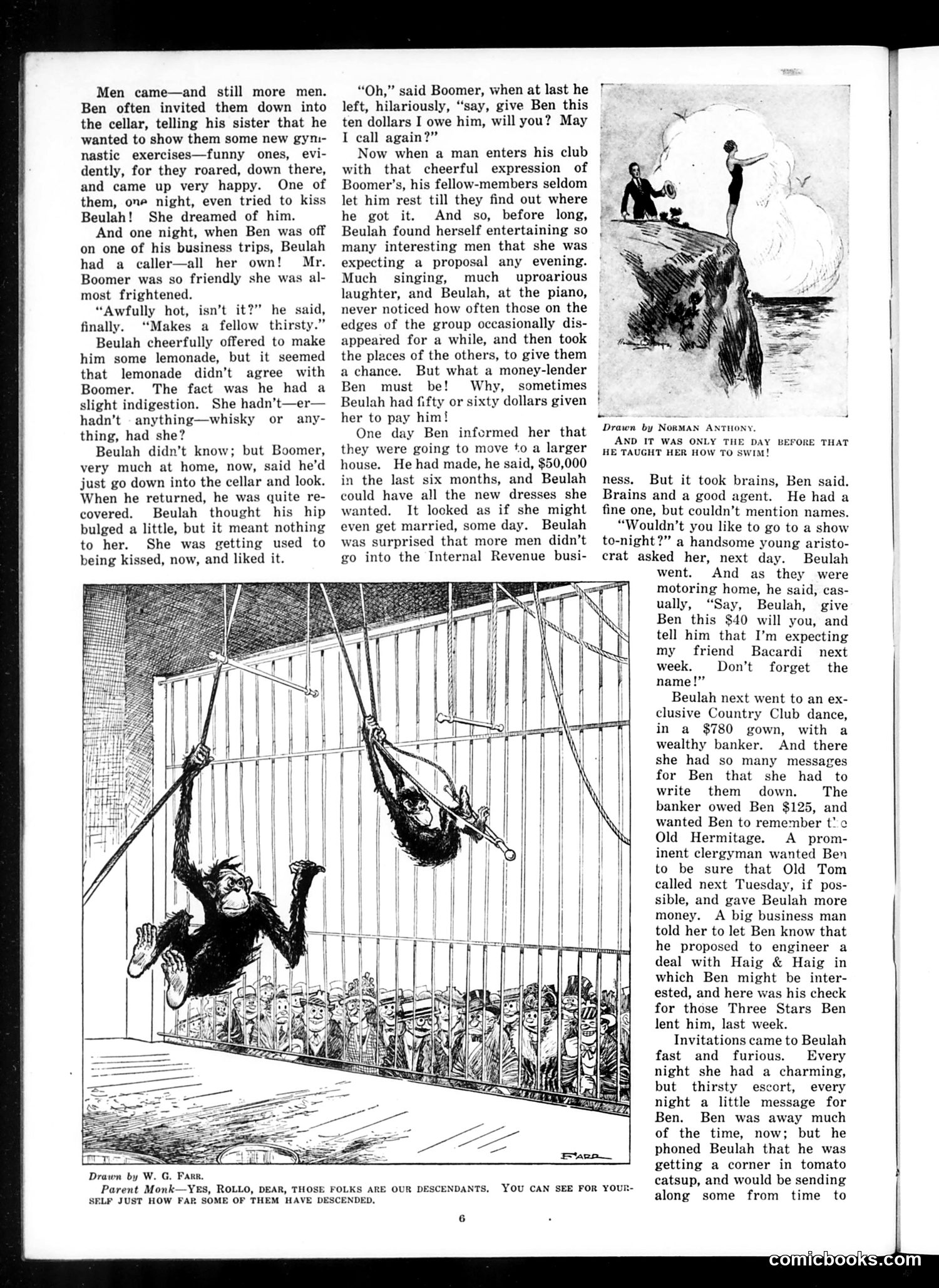
This page contains a satirical story about "Beulah," a woman who becomes financially successful through entertaining wealthy men at her home. The narrative mocks the social climbing and materialism of the era. The two illustrations depict: 1. **Top right**: Beulah teaching a man to swim—a reference to her newfound influence and leisure activities among the wealthy. 2. **Bottom**: A monkey in a cage labeled with a caption about "descendants," likely satirizing evolutionary theory debates popular in the early 20th century, though its connection to the Beulah story is unclear. The humor targets the nouveau riche and women who leverage social connections for financial gain, reflecting period anxieties about class mobility and changing gender roles. The exact date and specific references remain uncertain without additional context.
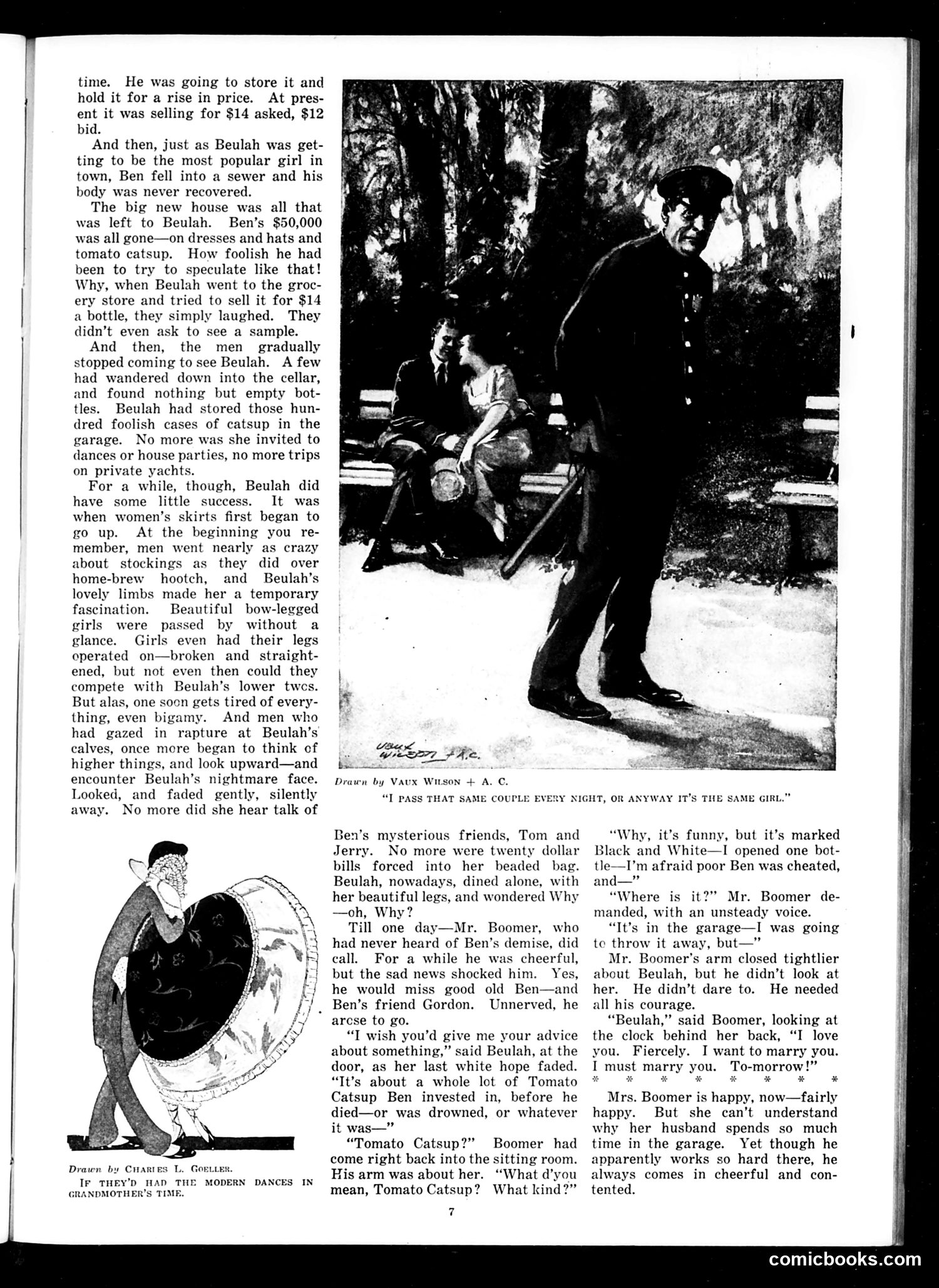
This satirical tale mocks both speculation and superficial morality during the Prohibition era (likely 1920s, given references to "home-brew hootch" and women's hemlines rising). **The Setup:** Ben dies, leaving his gold-digger girlfriend Beulah a house and $50,000—which she squanders on clothes and tomato catsup Ben was hoarding to resell at inflated prices. The joke: his speculation fails spectacularly; grocery stores won't buy catsup back. **The Satire:** Beulah briefly attracts men through her legs (mocking the era's obsession with newly visible female stockings), then fades when they look at her face. When wealthy Mr. Boomer learns she has "Black and White" catsup—clearly code for bootleg whiskey—he abruptly proposes and spends suspicious time in "the garage." **The Moral:** The story ridicules get-rich-quick schemes, Prohibition-era hypocrisy (respectable men desperately seeking illegal alcohol), and the commodification of women. Boomer's sudden devotion exposes how economic desperation (accessing forbidden liquor) trumps actual attraction—a cynical commentary on both Prohibition and marriage.
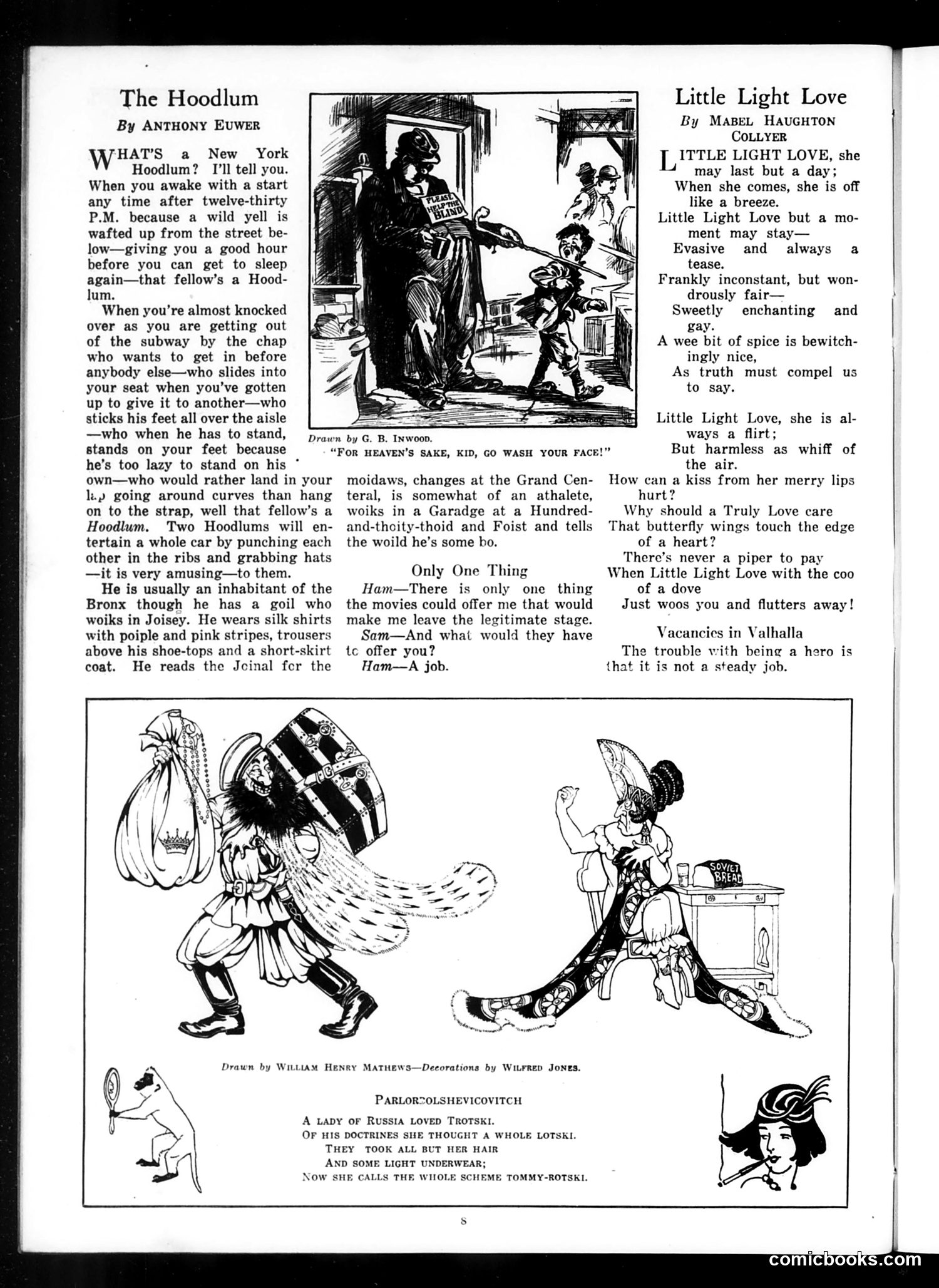
This page from Judge contains three distinct pieces of satirical content: **"The Hoodlum"** by Anthony Euwer satirizes working-class ruffians—likely Irish or Italian immigrants—who disrupt New York City life through aggressive, inconsiderate behavior on subways and streets. The piece mocks their speech patterns ("goil," "woiks," "Joisey"), cheap flashy clothing, and general rowdiness. It's a class-based social critique typical of early-20th-century publications. **The middle cartoon section** features decorative illustrations including Russian Bolshevik satire ("Parlortolshevicovitch") mocking the 1917 Russian Revolution and Trotsky, alongside theatrical humor. **"Little Light Love"** is a romantic poem celebrating fleeting, inconsequential affairs. **"Vacancies in Valhalla"** is a brief joke about how heroism isn't a sustainable profession. The page reflects Judge's focus on urban social commentary, immigrant stereotyping, anti-Communist sentiment (timely post-1917), and lighthearted domestic humor aimed at middle-class readers.
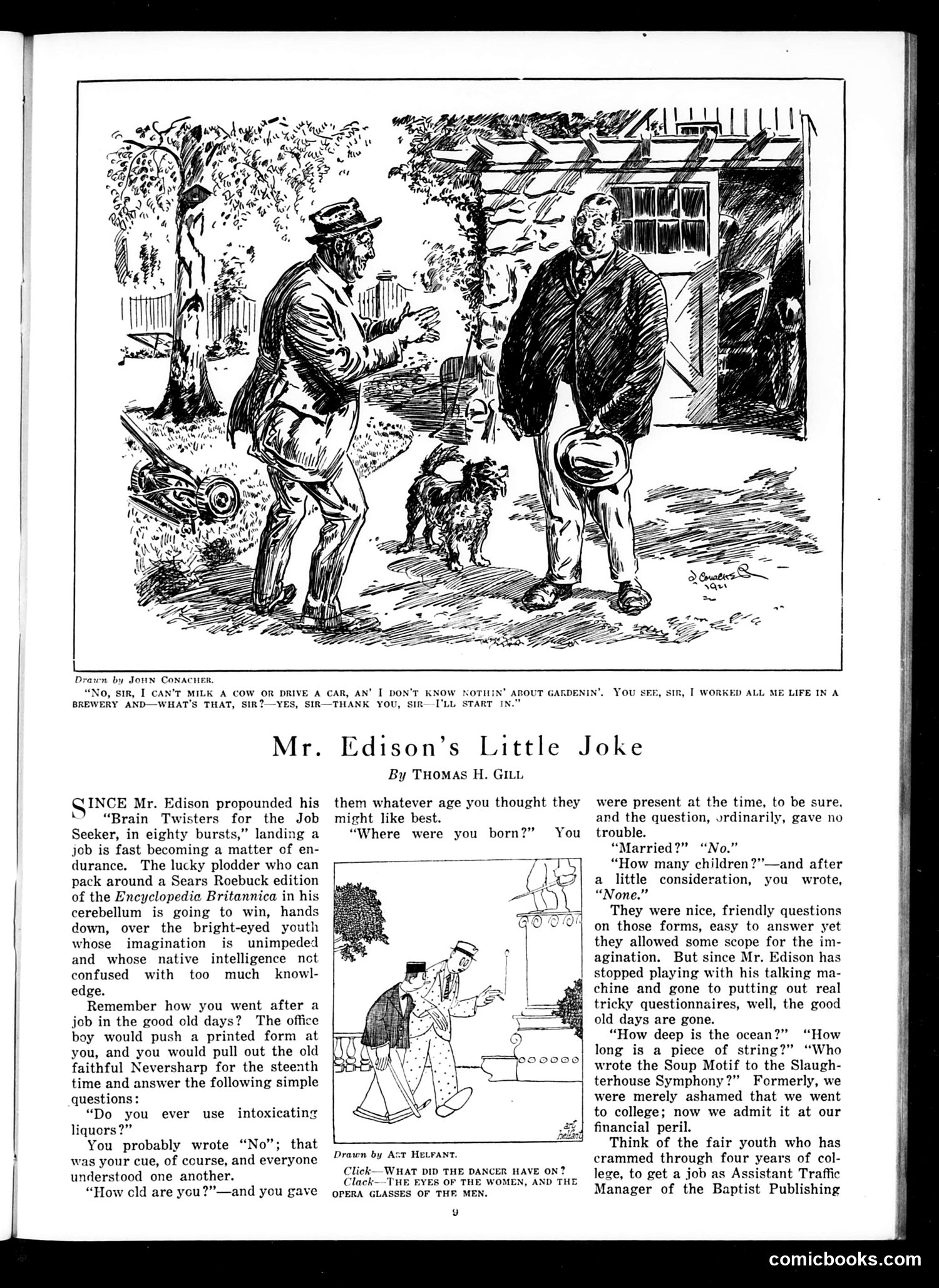
The article satirizes Thomas Edison's "Brain Twisters for the Job Seeker" — actual riddle-based job application tests Edison created. The author argues that modern job applications have become absurdly difficult and knowledge-obsessed, replacing simpler, more honest hiring practices. The opening cartoon shows a worker admitting he can only do brewery work—honest but unemployable under Edison's new system. The article contrasts the old interview process (simple questions like "Where were you born?") with Edison's current nonsense riddles ("How deep is the ocean?" "How long is a piece of string?"). The satire's point: excessive testing penalizes practical workers and ironically disadvantages educated candidates (the college graduate becomes an "Assistant Traffic Manager"). This reflects early 20th-century anxieties about mechanization, changing workplace standards, and whether intelligence tests actually identified good workers or merely created bureaucratic obstacles.
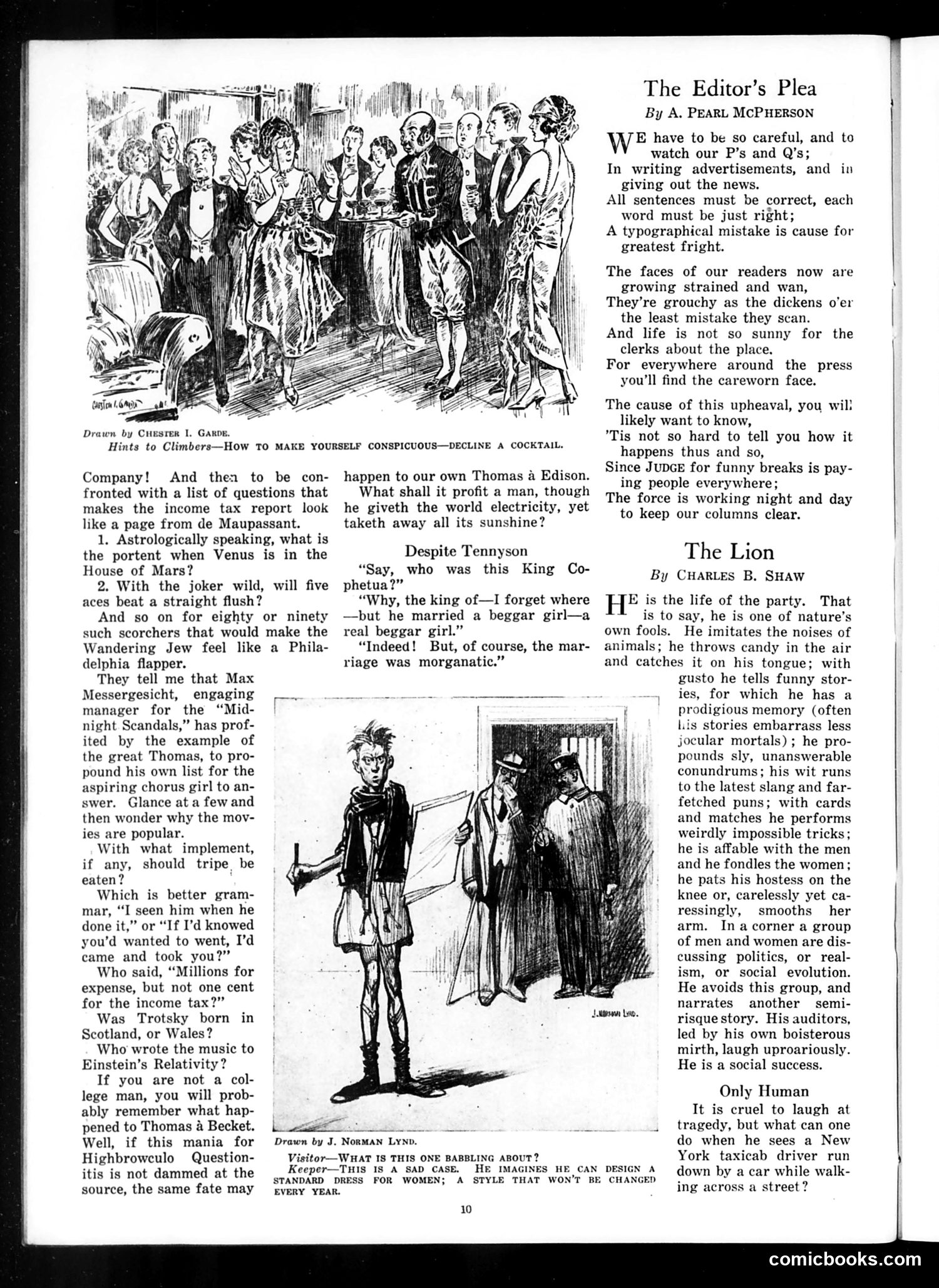
## "Hints to Climbers" Cartoon This cartoon satirizes the "highbrow question" fad—pretentious intellectuals asking absurdly difficult trivia at social gatherings to appear cultured. The joke: declining a cocktail makes you conspicuous because you seem like a show-off trying to seem superior. The text references Thomas Edison being pestered with impossible questions (astrological, mathematical, literary) and warns this "mania" could drive even great minds to despair like Thomas à Becket. ## "Visitor" Cartoon A man in an asylum imagines he can design a standardized dress for women that won't change yearly. The satire: this is treated as delusional because women's fashion constantly changes—the very premise is impossibly naive. ## "The Editor's Plea" and "The Lion" These are unrelated: a poem about Judge's editorial struggles with accuracy, and an essay describing a social type—the "Lion," a gregarious fool who entertains through impressions, jokes, and physical tricks rather than serious conversation.
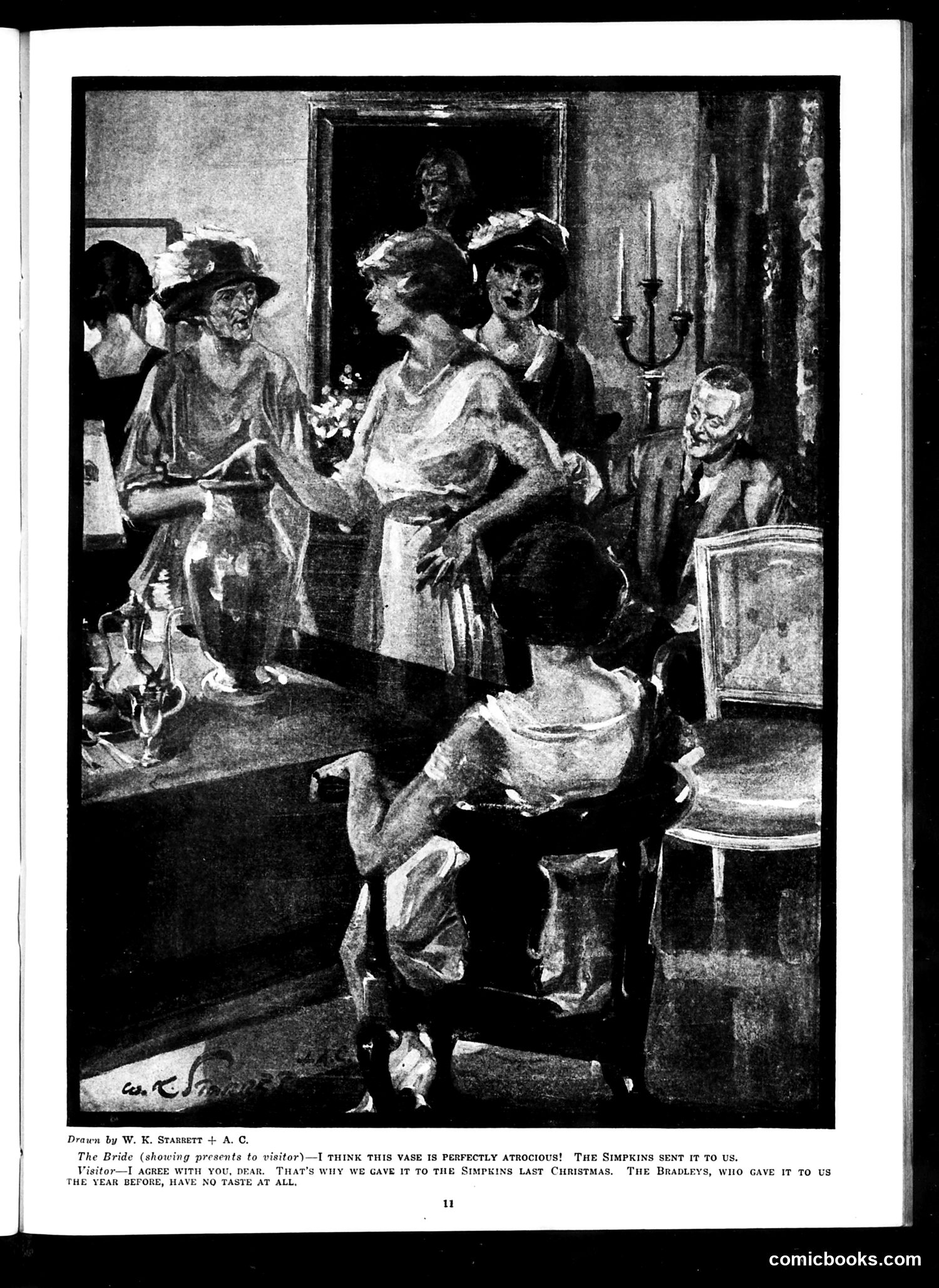
This is a domestic humor cartoon about unwanted wedding gifts. A new bride shows a visitor an ugly vase, complaining the Simpkins family gave it to them. The visitor reveals an awkward truth: the Bradleys gave the same vase to the Simpkins last Christmas, and now the Simpkins have regifted it to the bride and groom this year. The satire targets the social embarrassment and etiquette violations of re-gifting—passing along unwanted presents rather than purchasing new ones. It exposes the hypocrisy of gift-giving: people pretending generosity while actually disposing of items they don't want. The cartoon mocks both the tackiness of re-gifting and the mutual awkwardness this creates among friends when the scheme gets discovered.
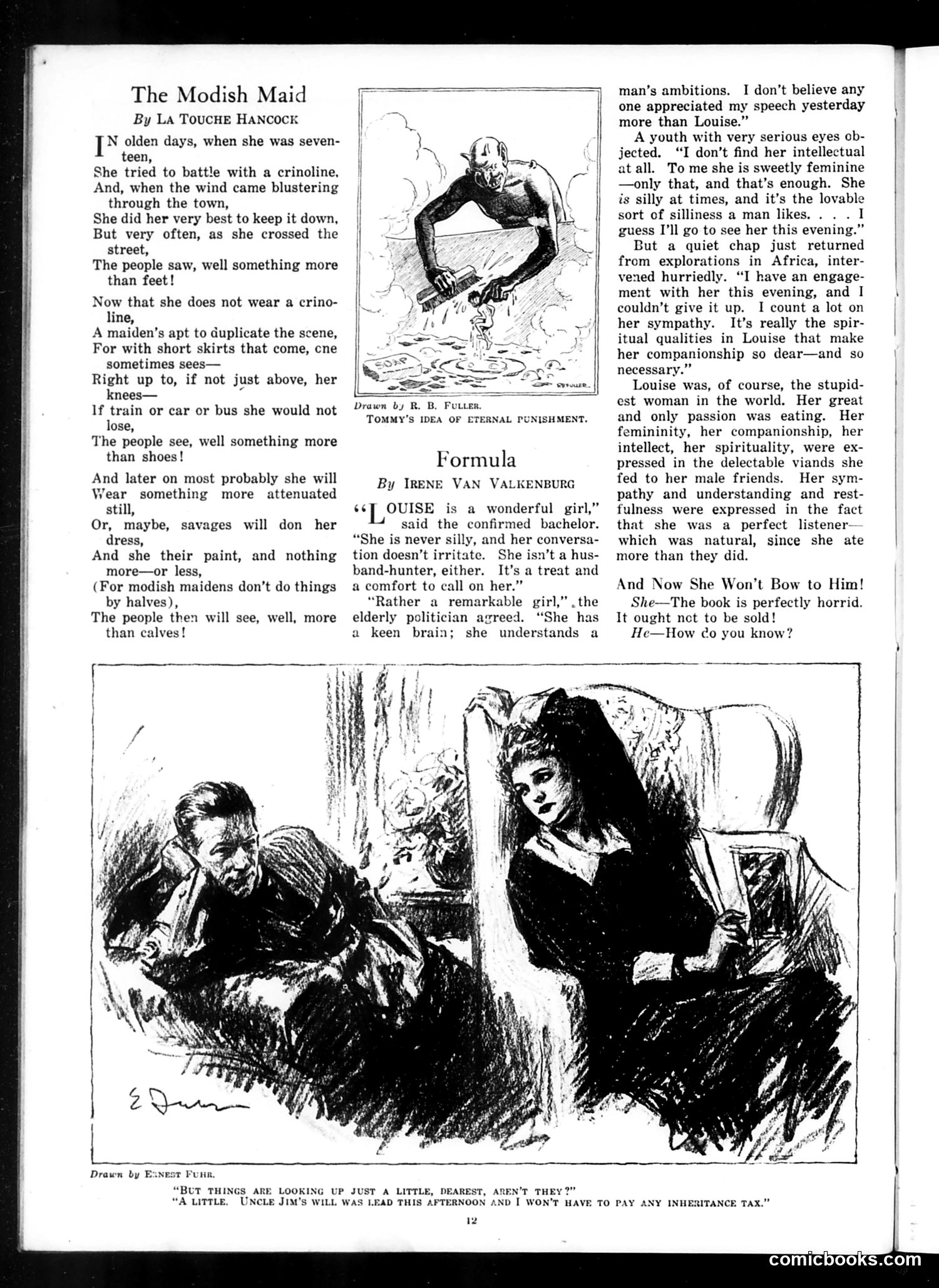
**"The Modish Maid"** by La Touche Hancock satirizes changing women's fashion and social anxieties about exposed legs. The poem traces the progression from crinolines (which paradoxically exposed limbs when wind caught them) through modern short skirts, predicting an absurd future where women wear nothing but "paint" like "savages." The humor targets both women's fashion choices and male anxiety about female leg visibility—a contemporary concern in the early 20th century when hemlines were rising. **"Formula"** by Irene Van Valkenburg mocks how men romanticize different qualities in the same woman (Louise). A bachelor finds her charming, a politician appreciates her intellect, a youth loves her femininity, and an explorer values her spirituality. The twist reveals Louise is actually unintelligent and her only genuine passion is eating—she's simply a good listener because her mouth is full. The satire exposes male self-deception and projection onto women. Both pieces critique gender relations and changing social norms of their era through exaggeration and ironic commentary.
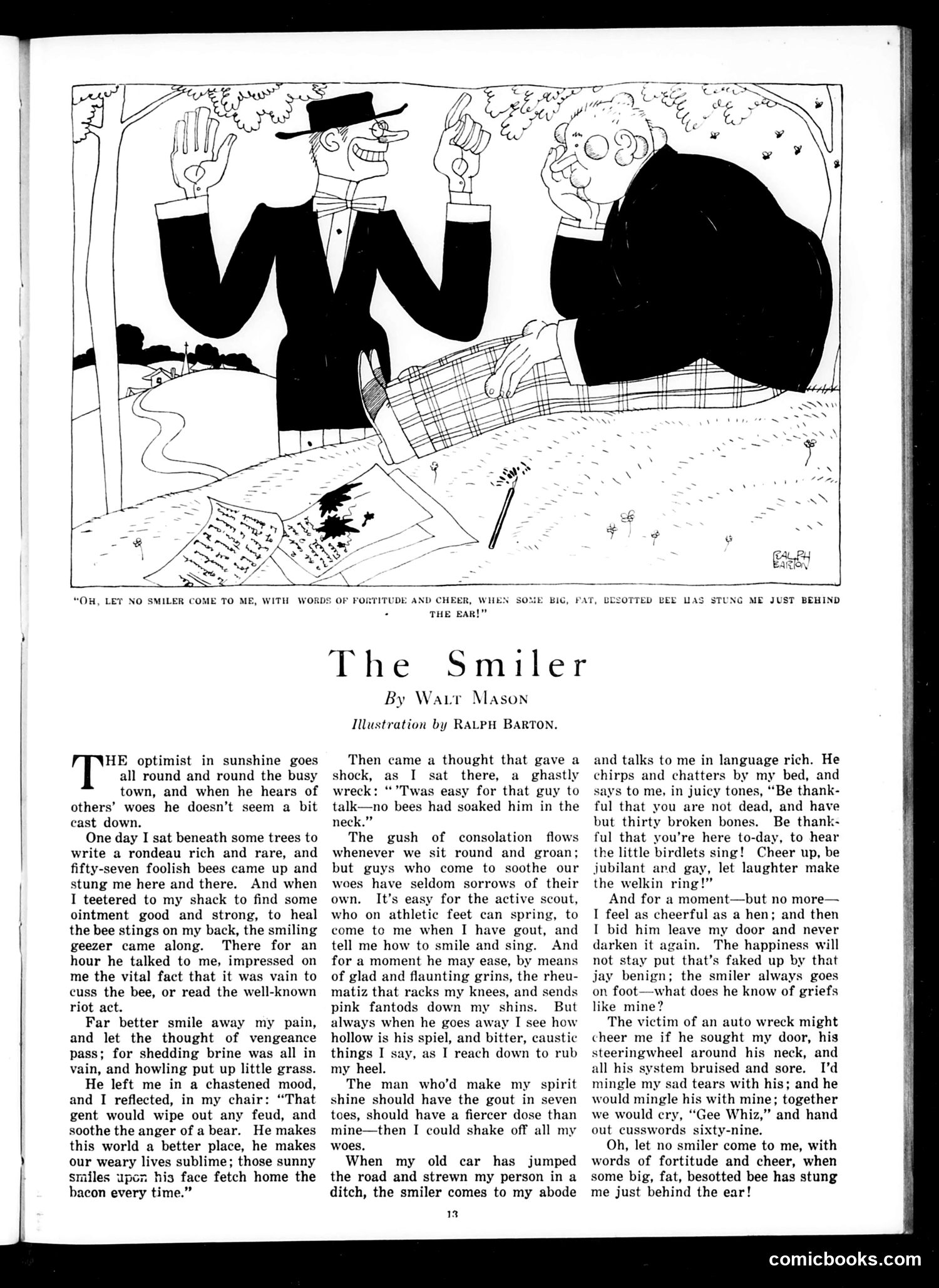
This is a humorous essay-poem satirizing well-meaning optimists who offer cheerful advice to people suffering genuine misfortune. The narrator gets stung by fifty-seven bees, then a perpetually smiling man visits and insists that smiling away pain is better than complaining. The satire's point: **the smiler has never experienced real suffering himself**. He lectures about staying cheerful from a position of comfort and good health. The narrator realizes this is hollow—the smiler's advice only works if you've never had gout, a car accident, or bee stings. The cartoon illustrates the disconnect: the well-dressed, cheerful "smiler" (holding symbols of optimism) stands before the narrator, who sits injured and frustrated. The satire mocks superficial positivity and suggests genuine empathy requires shared hardship, not platitudes. It's a critique of toxic positivity—the modern reader would recognize this immediately.
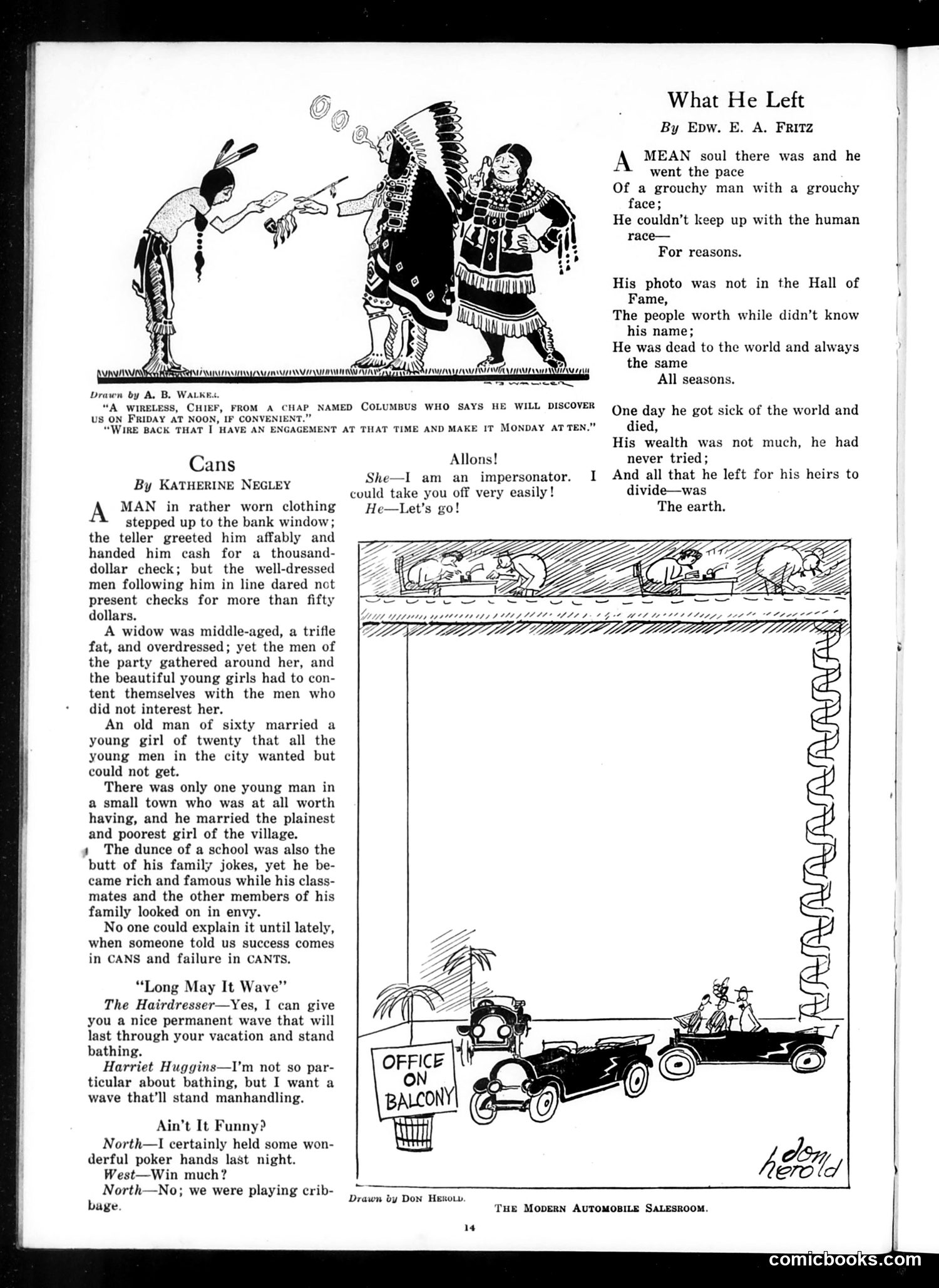
**"Cans" (by Katherine Negley):** This story uses "cans" and "cants" as a pun to explain social paradoxes—why an unkempt man cashes large checks while well-dressed men can't, why plain girls marry desirable men. The joke's conclusion: success comes from actual ability ("cans"—can do), while failure results from pretense ("cants"—cannot do). It's satirizing how appearance deceives in evaluating character and capability. **"What He Left" (by Edw. E. A. Fritz):** A morality poem about a mean-spirited, lazy man whose only inheritance to his heirs is "the earth"—suggesting he accomplished nothing of value. The satire criticizes wasted potential and greed. **"The Modern Automobile Salesroom" (cartoon by Don Herold):** Shows early 1920s cars stacked vertically in a tall office building, satirizing cramped urban space and the explosive growth of automobile sales/parking challenges in modernizing cities. The page contains light social satire typical of Judge's era—wordplay humor and gentle critiques of character, social mobility, and contemporary urban problems.
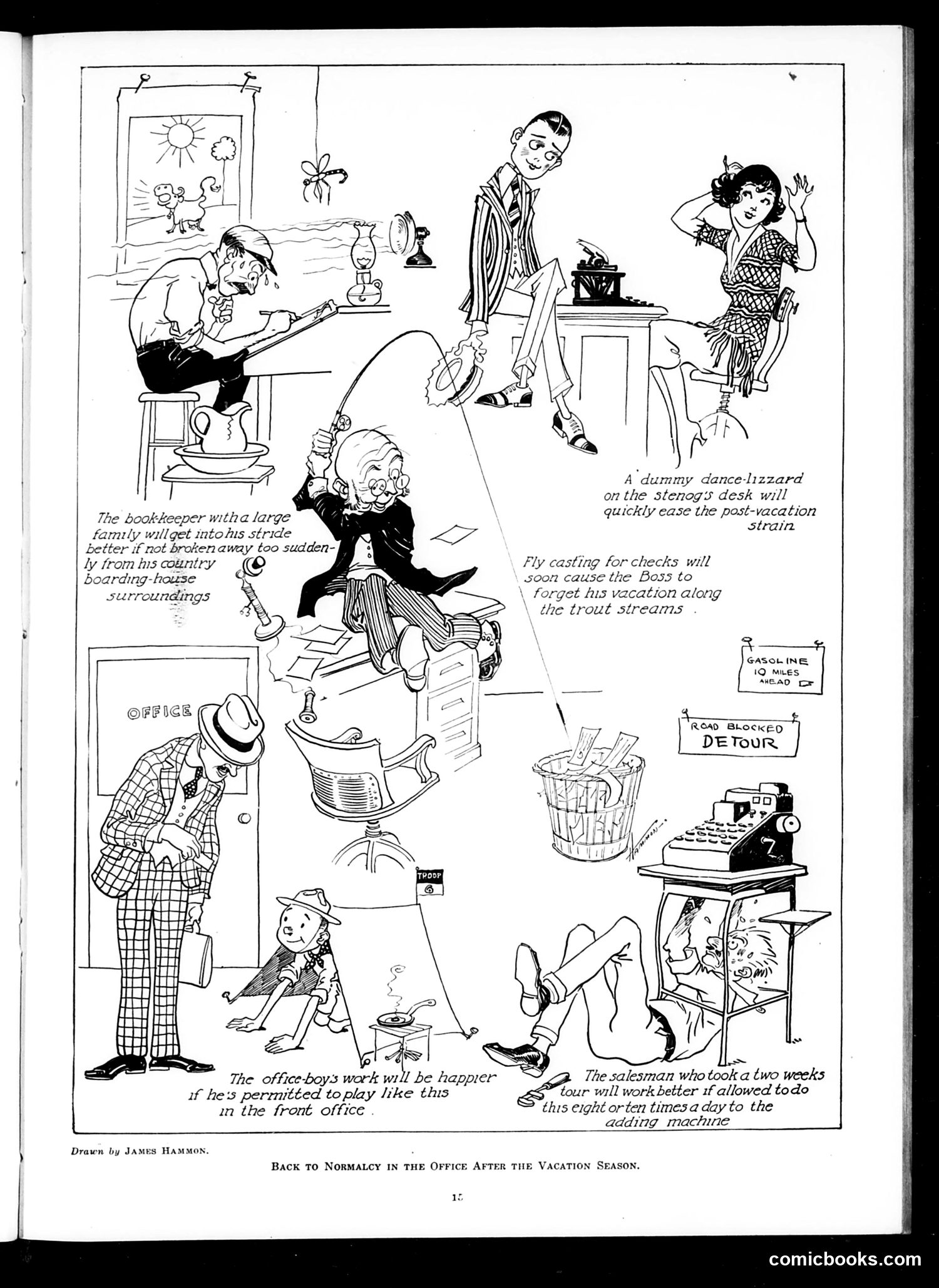
This 1920s office satire by James Hammon uses multiple vignettes to joke about post-vacation adjustment for different workplace employees. Each caption offers tongue-in-cheek "solutions" to boost morale: - A bookkeeper should maintain home comforts to ease back into work - A stenographer needs a "dummy dance-lizard" (dummy/doll) distraction on her desk - The boss will forget vacation by fly-fishing for expense checks instead of trout - Office boys should play freely in front offices - Salesmen should use adding machines as foot-massagers The cartoon satirizes how modern offices operated and the stress of returning from vacation. The title references "normalcy"—likely alluding to President Harding's 1920 "return to normalcy" campaign. The humor lies in absurd, impractical "remedies" that exaggerate rather than solve workplace tedium and post-vacation readjustment.
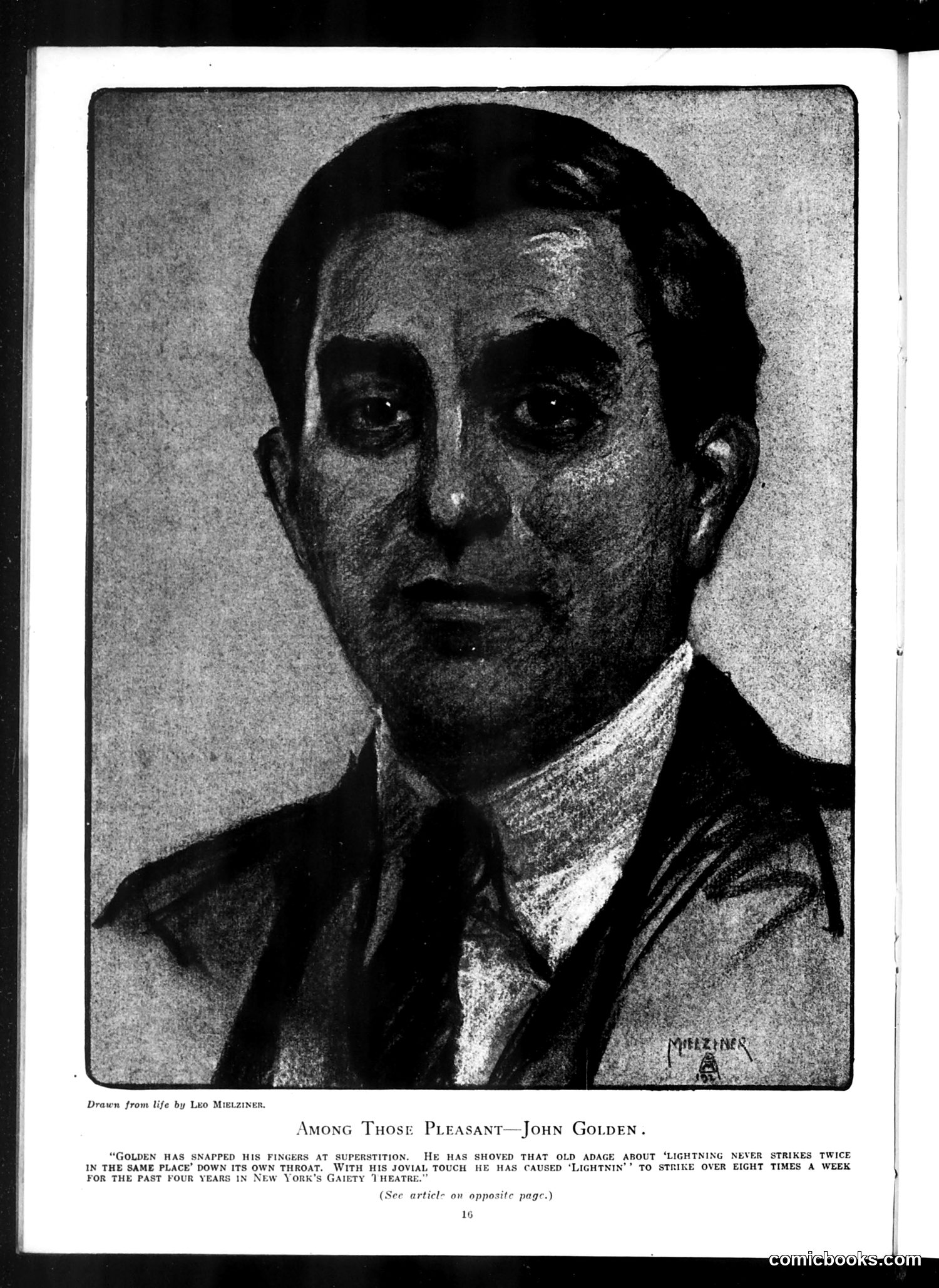
This page features a portrait labeled "Among Those Pleasant—John Golden" drawn from life by Leo Mielziner. The accompanying text references Golden's superstitions, particularly about lightning never striking twice in the same place. It mentions he has "caused 'Lightnin'" to strike over eight times a week for four years at New York's Gaiety Theatre. This appears to be a humorous profile of theatrical producer/playwright John Golden, playing on the irony that despite his superstitions about lightning, his production "Lightnin'" achieved remarkable longevity and frequent performances. The satire mocks both Golden's superstitious beliefs and celebrates his theatrical success. The reference directs readers to an article on the opposite page for full context.
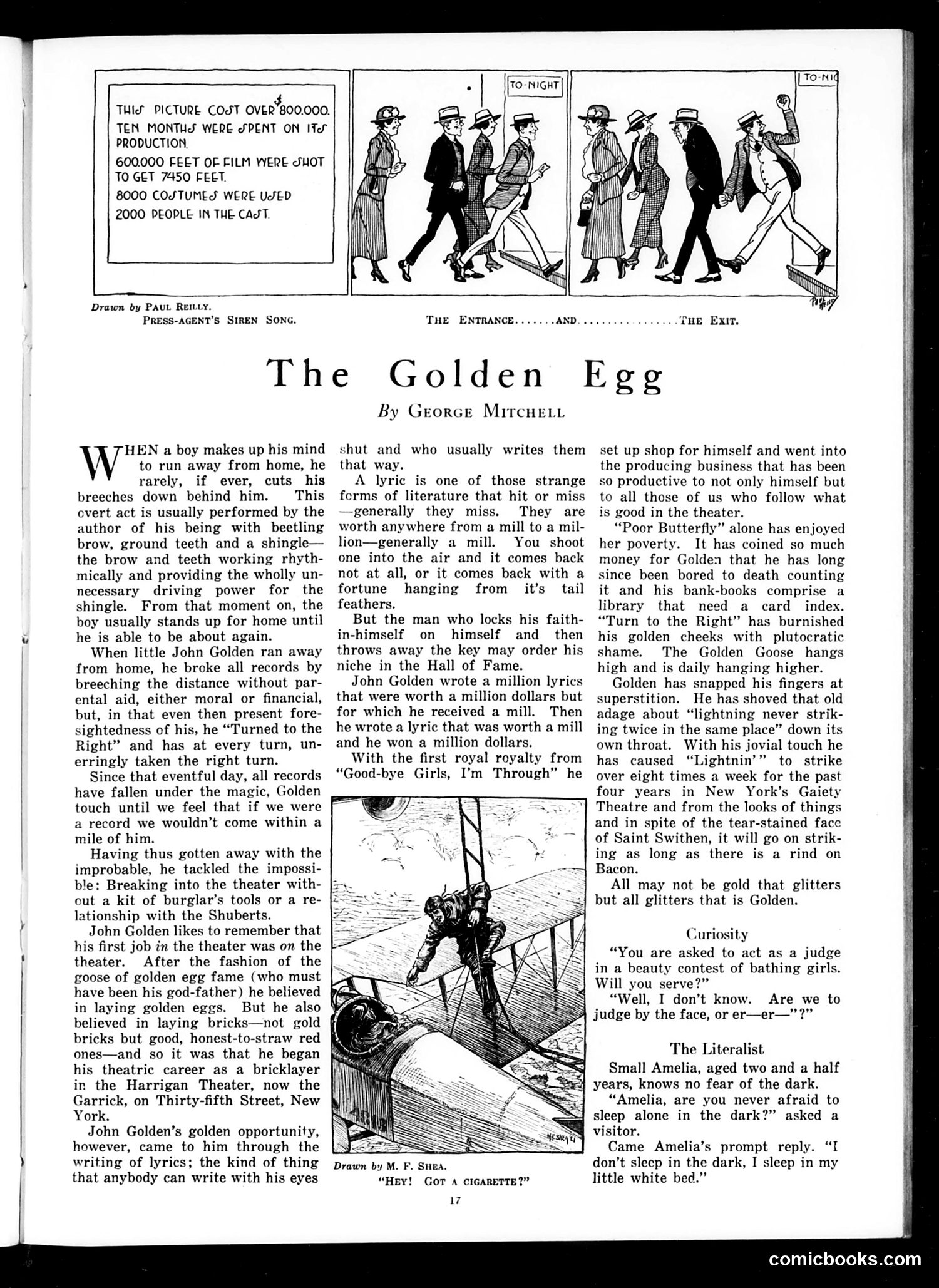
This page celebrates theatrical producer **John Golden**, using the mythological "golden goose" metaphor to satirize show-business success. The top cartoon mocks inflated film production claims—a "press-agent's siren song"—showing industry hype about enormous budgets, footage shot, and cast sizes used to promote pictures. The main article traces Golden's rags-to-riches narrative: a boy who "runs away from home" and succeeds through determination, starting as a theater bricklayer, then writing lyrics for musicals. His early lyrics earned modest returns until "Good-bye Girls, I'm Through" and especially "Poor Butterfly" and "Turn to the Right" generated enormous profits—so much wealth he's "bored to death counting it." The piece satirizes both Golden's success and the theatrical establishment's obsession with money and prestige. The "golden egg" metaphor suggests Golden is the goose that keeps laying profitable hits, while also implying he's become so wealthy the metaphor itself grows absurd. The shorter anecdotes ("Curiosity," "The Literalist") offer palate-cleansing humor typical of Judge's format.
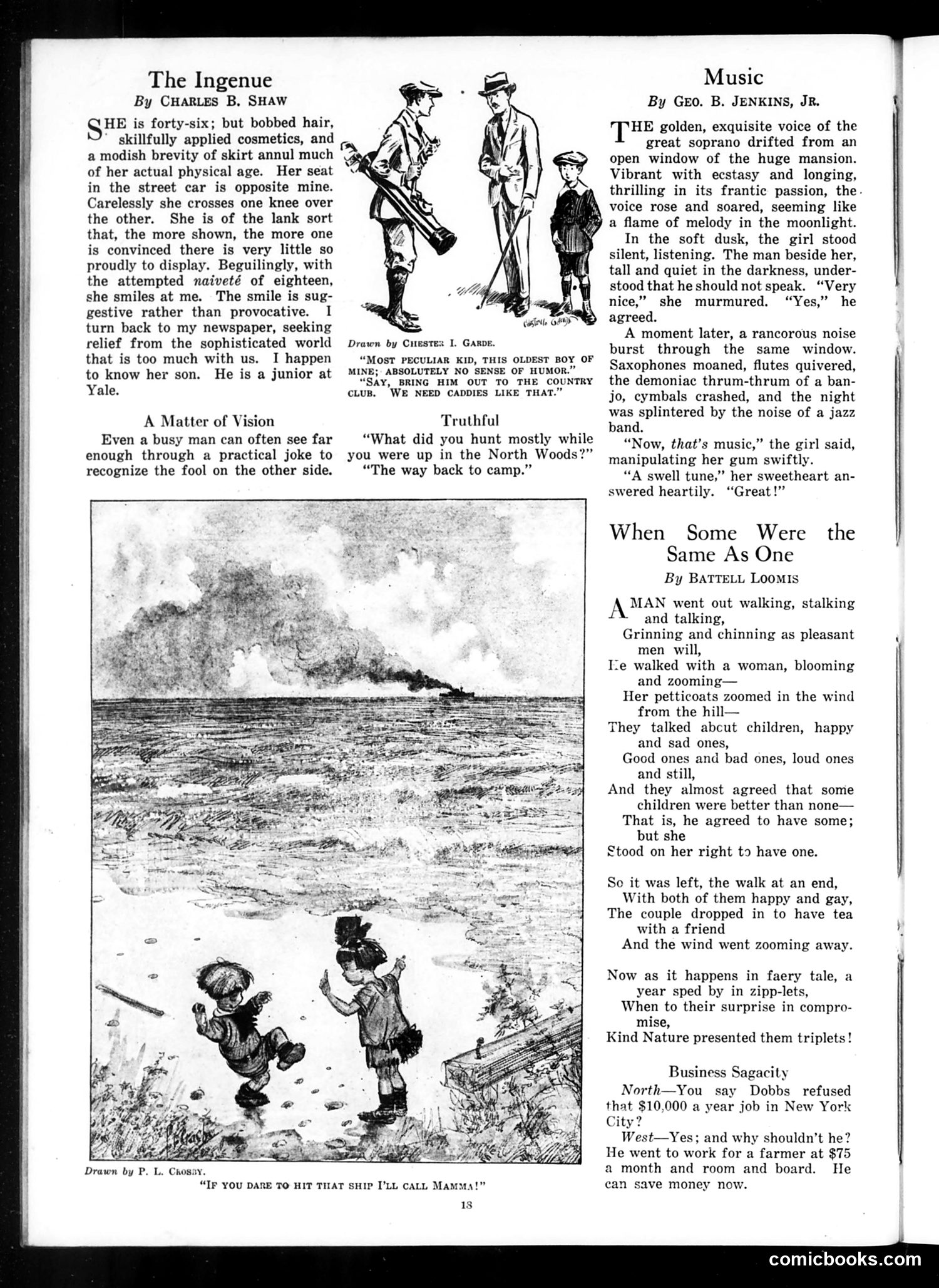
This page contains three distinct pieces of social satire typical of Judge's humor: **"The Ingenue"** mocks an aging woman (46) attempting to appear youthful through cosmetics, bobbed hair, and a short skirt—fashionable 1920s markers. The satire: her flirtatiousness with the narrator is undermined by the fact that he knows her adult son attends Yale, exposing the gap between her performed youth and actual age. **"A Matter of Vision"** presents two single-panel gags about foolishness and perspective. **"When Some Were the Same As One"** humorously depicts a couple's disagreement over children—he wants some, she wants only one—until Nature intervenes with triplets, a "compromise" that satisfies neither. The cartoons reflect 1920s preoccupations: women's fashion and aging anxieties, gender conflict over family planning, and generational attitudes. The drawing styles and typography are period-typical for Judge's satirical commentary on American social life.
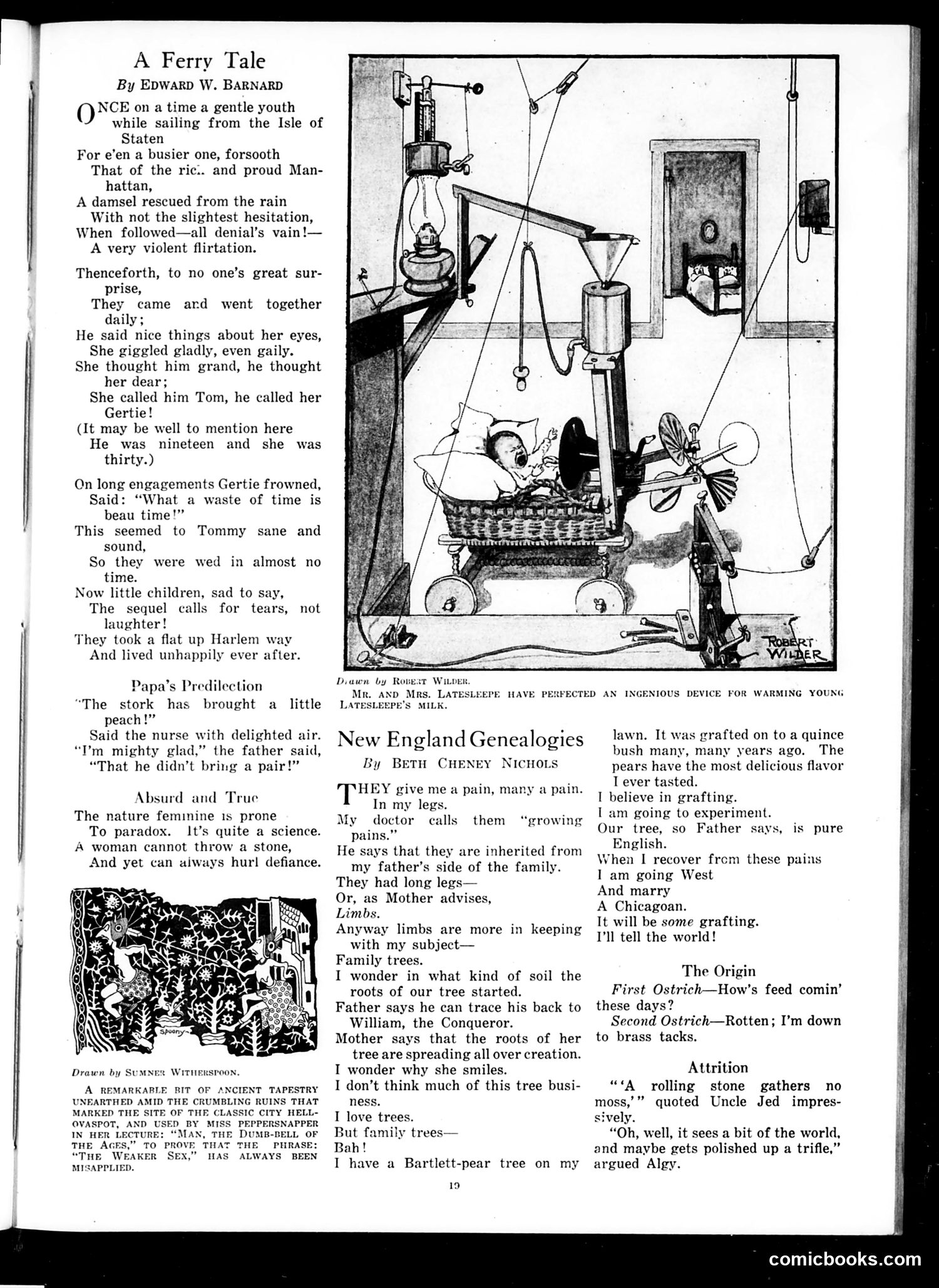
This page contains multiple satirical pieces typical of early 20th-century Judge magazine: **"A Ferry Tale"** is a humorous poem mocking May-December romance and hasty marriage. The joke: a 19-year-old man courts and marries a 30-year-old woman, yet they end up "unhappy ever after"—satirizing both the absurdity of their age gap and contemporary assumptions that quick marriages lead to disaster. **"Papa's Predilection"** is a brief joke about a father relieved the stork didn't bring twins—poking fun at large families and financial anxiety. **"Absurd and True"** mocks feminine contradictions: women supposedly can't throw stones but always "hurl defiance." **"New England Genealogies"** satirizes genealogy obsession and social climbing—the speaker's father traces ancestry to William the Conqueror (a common pretense among Americans seeking noble lineage), while the mother's family tree "spreads all over creation" (implying questionable ancestry or illegitimacy). The Robert Wilder illustration depicts an elaborate Victorian contraption for warming milk—typical Judge satire of overly complex modern inventions.
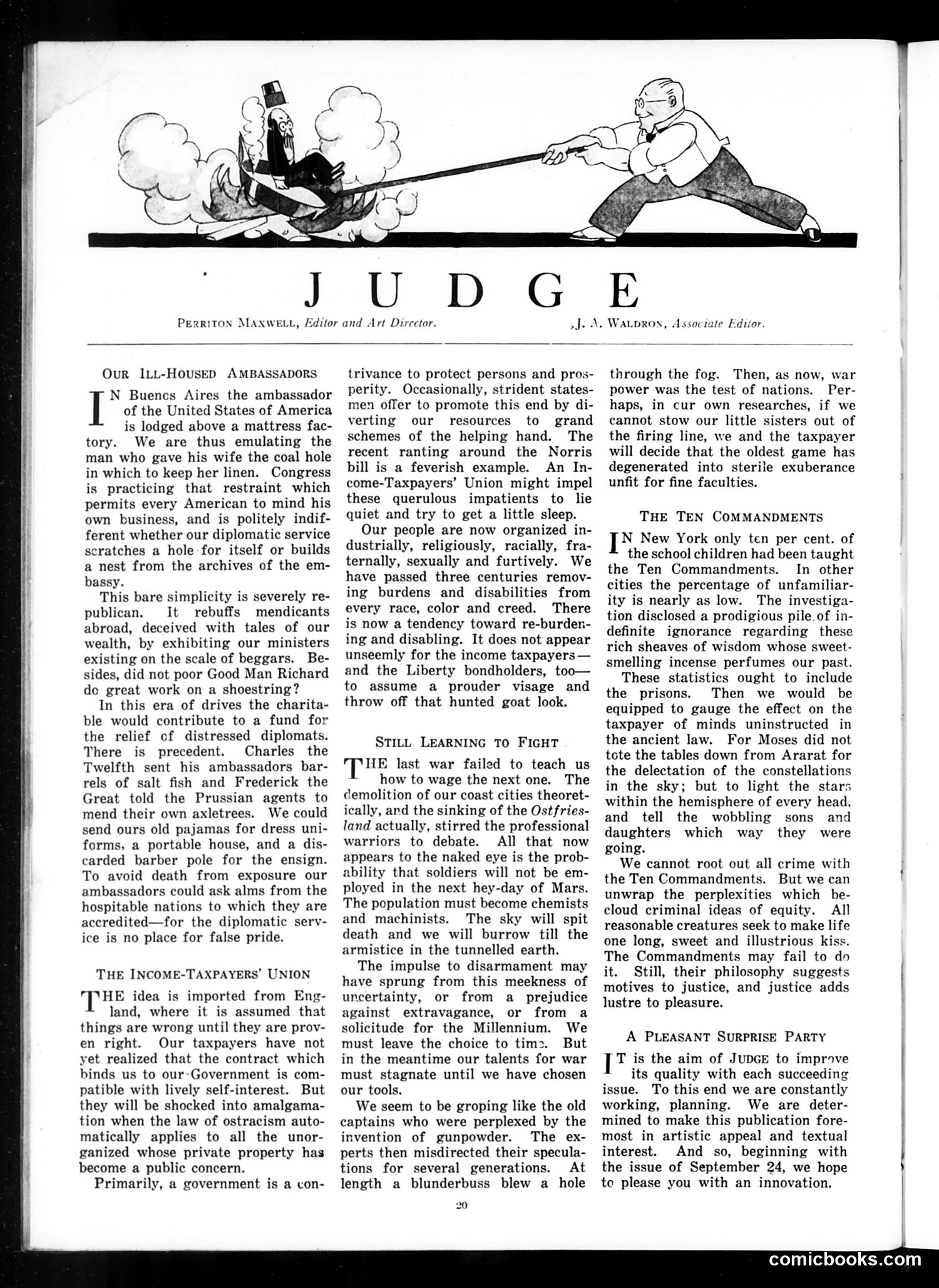
**The Cartoon (top):** Depicts a figure being pulled through explosive clouds by a rope—likely representing diplomats or the State Department being dragged through scandal or inefficiency. **"Our Ill-Housed Ambassadors":** Mocks Congress's extreme parsimony in housing U.S. ambassadors abroad. The U.S. ambassador in Buenos Aires is literally lodged above a mattress factory. The article sarcastically compares this to historical precedents (Frederick the Great making ambassadors mend their own tools) while questioning whether this "republican simplicity" genuinely reflects American values or merely humiliates American diplomacy. **"The Income-Taxpayers' Union":** Advocates for organizing taxpayers into a political force to resist government spending programs—specifically referencing the Norris bill as wasteful. The author argues taxpayers should unionize to combat what he views as excessive government intervention and redistributive schemes. **"Still Learning to Fight":** Discusses post-WWI military unpreparedness, suggesting warfare technology has evolved unpredictably (mentioning the sinking of the *Ostfriesland*), leaving military strategists confused about future combat, particularly regarding air power and chemical warfare.
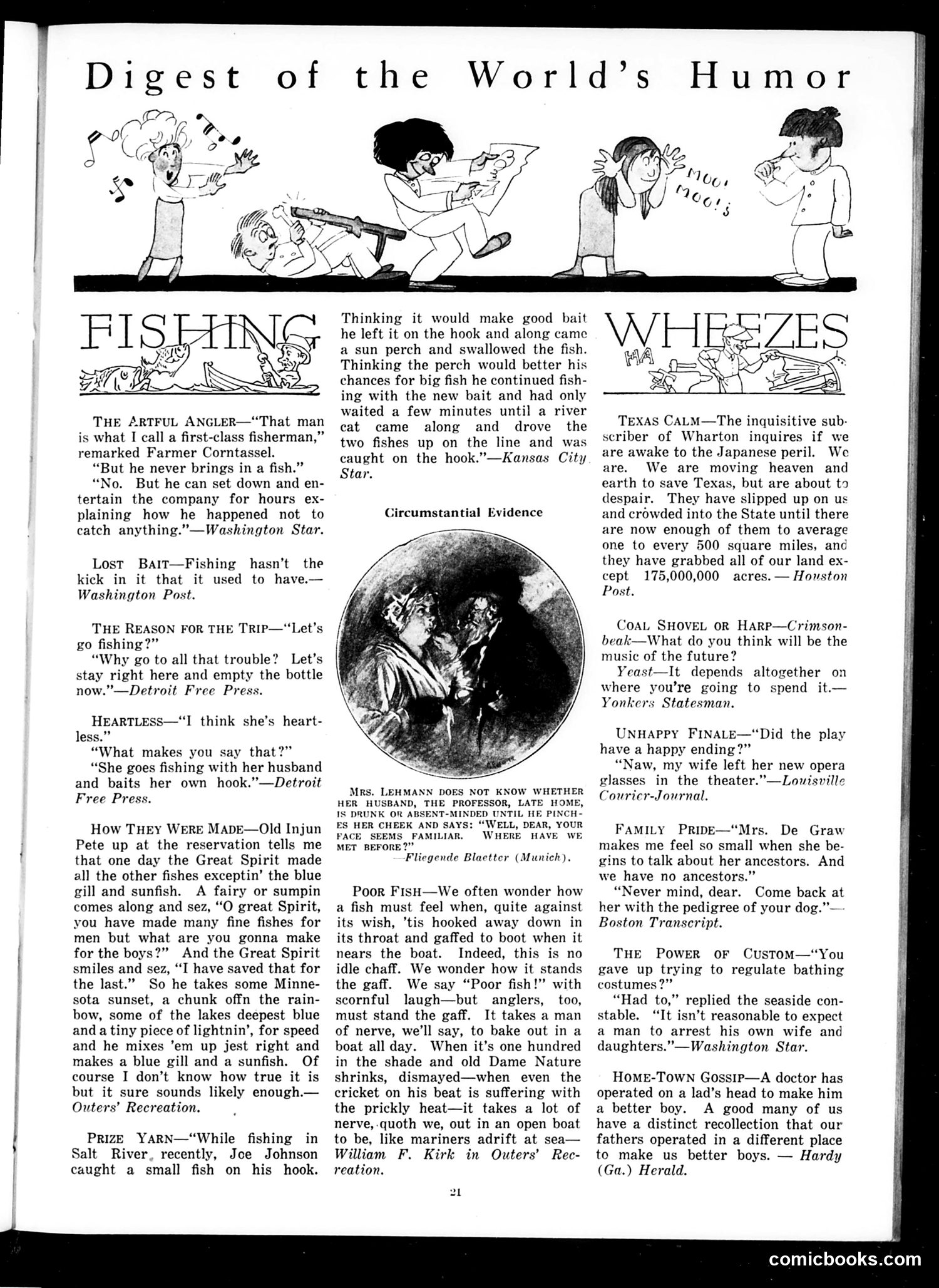
This page collects fishing-themed jokes and humorous anecdotes from various newspapers. The top cartoon depicts children playing—one making music, another with a telescope, others making noise—illustrating various forms of childhood mischief. The jokes mock fishing culture and human nature: incompetent anglers who catch nothing but talk endlessly; wives practical enough to bait their own hooks (considered unladylike); tall tales of fish eating smaller fish on the line; and the physical suffering of anglers in summer heat. One piece sardonically notes "Poor Fish" while sympathizing with anglers, reversing expected sentiment. Interspersed are unrelated jokes about Japanese immigration to Texas (presented as an invasion), opera-goers, family snobbery, and changing social customs around bathing suits. The page reflects early 20th-century attitudes—casual xenophobia, gender roles, and class commentary typical of Judge magazine's satirical approach to contemporary American life.
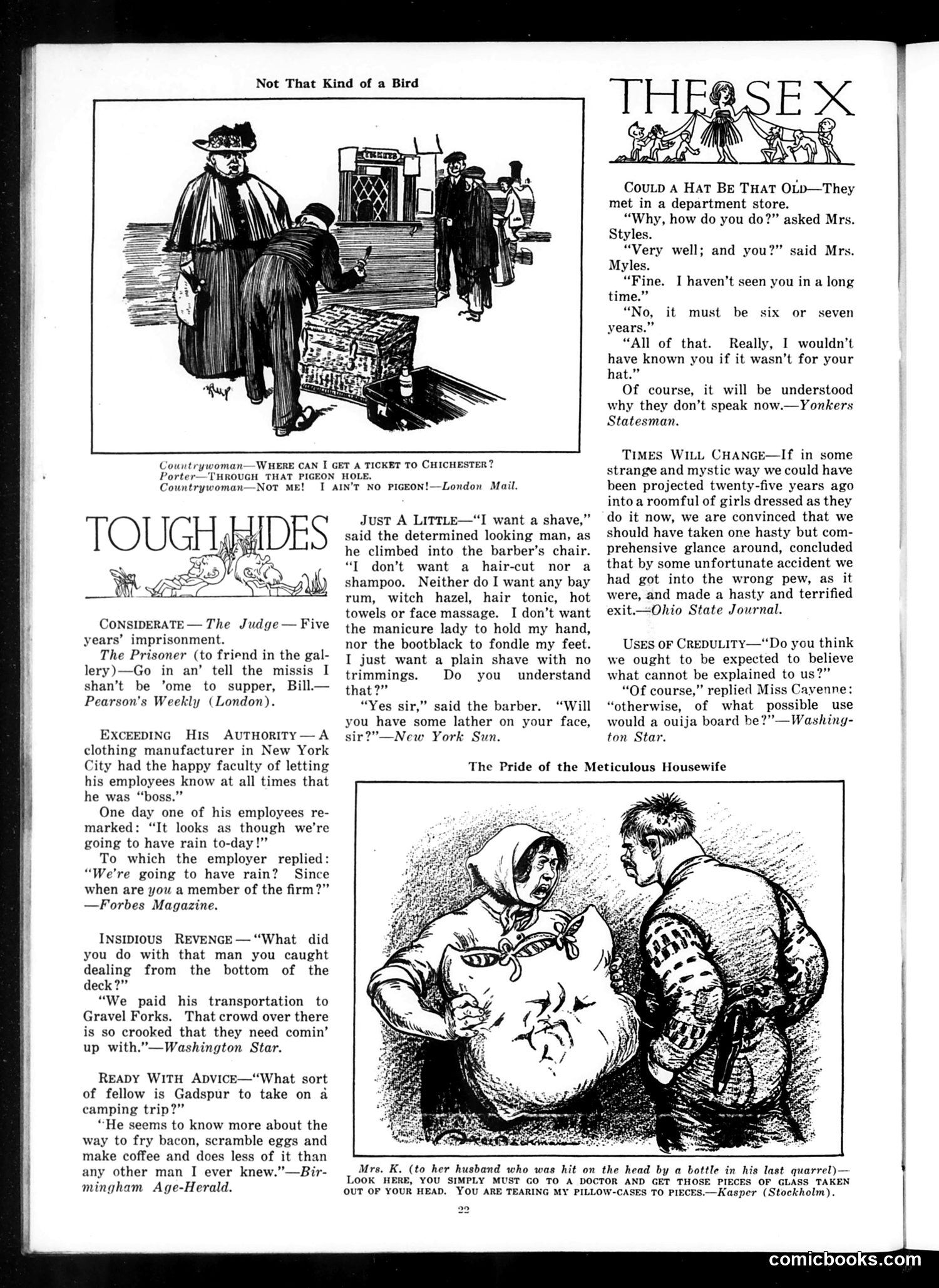
This page contains multiple brief satirical anecdotes and two illustrated cartoons, typical of Judge magazine's humor format. **"Not That Kind of a Bird"** (top cartoon): A countryman asks a porter about train tickets through a "pigeon hole" window, then indignantly refuses when called a pigeon—wordplay on the literal vs. figurative meaning of "pigeon hole." **Other anecdotes** mock human foibles: a bossy New York manufacturer who claims ownership of weather; a barber who interprets "just a shave" as requiring upselling; two women who haven't spoken in years because they only recognized each other by an old hat; and a meticulous housewife more concerned about torn pillowcases than her husband's head injury from a bottle fight. **"The Pride of the Meticulous Housewife"** (bottom): The illustration reinforces the final anecdote's joke about misplaced domestic priorities—the housewife's obsession with material possessions over her husband's wellbeing. The humor relies on exaggeration of character flaws and situational irony typical of early 20th-century American comic journalism.
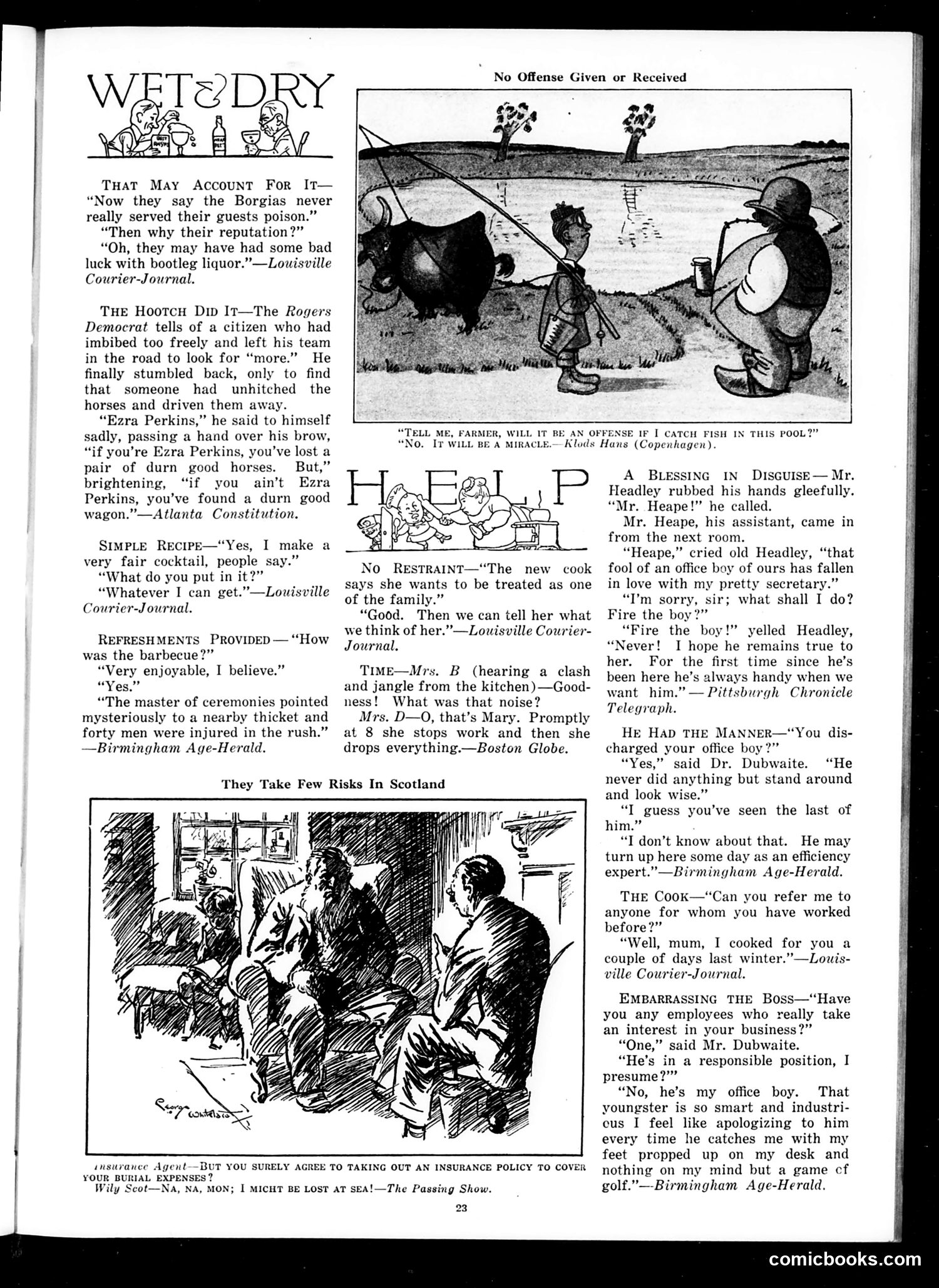
This Judge magazine page satirizes **Prohibition-era America** through multiple short jokes and cartoons. The overarching theme is alcohol consumption and its consequences during the "dry" (alcohol-banned) period. Key jokes mock: - **Bootleg liquor quality** (Borgias joke—suggesting homemade alcohol is dangerously bad) - **Drunk behavior** (the man who loses his horses while intoxicated) - **Cocktail-making** (whatever ingredients one can find, implying scarcity) - **Scottish thriftiness** (the insurance agent refusing burial coverage, unwilling to spend money) The illustrations depict workplace scenes and fishing. The "Blessing in Disguise" and office boy anecdotes are unrelated domestic humor. **Context for moderns**: These jokes assume readers understand Prohibition's impact—illegal alcohol production, widespread drunkenness, and the humor of people trying to navigate a "dry" nation. The magazine treats this as socially acceptable subject matter for satire.
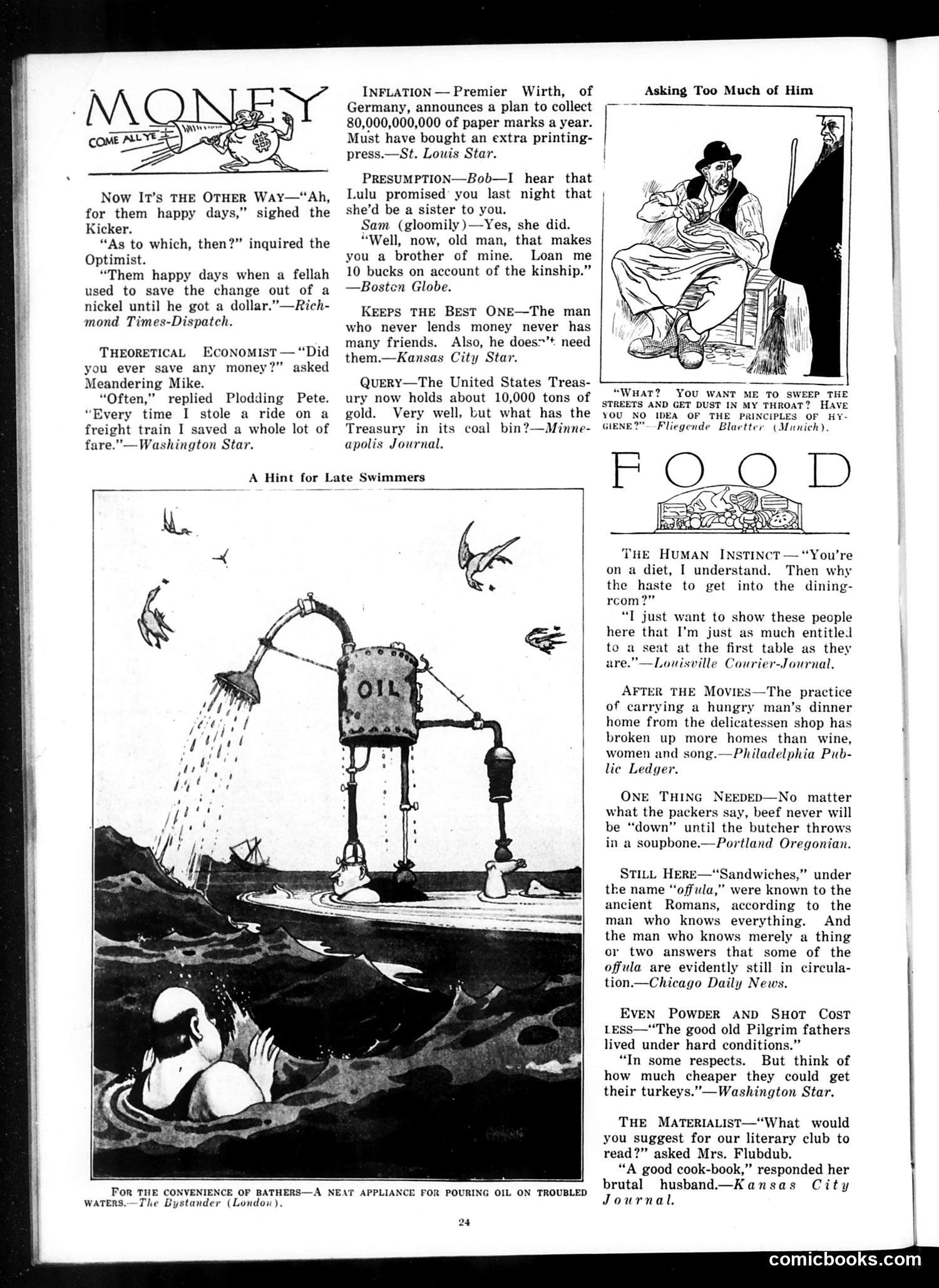
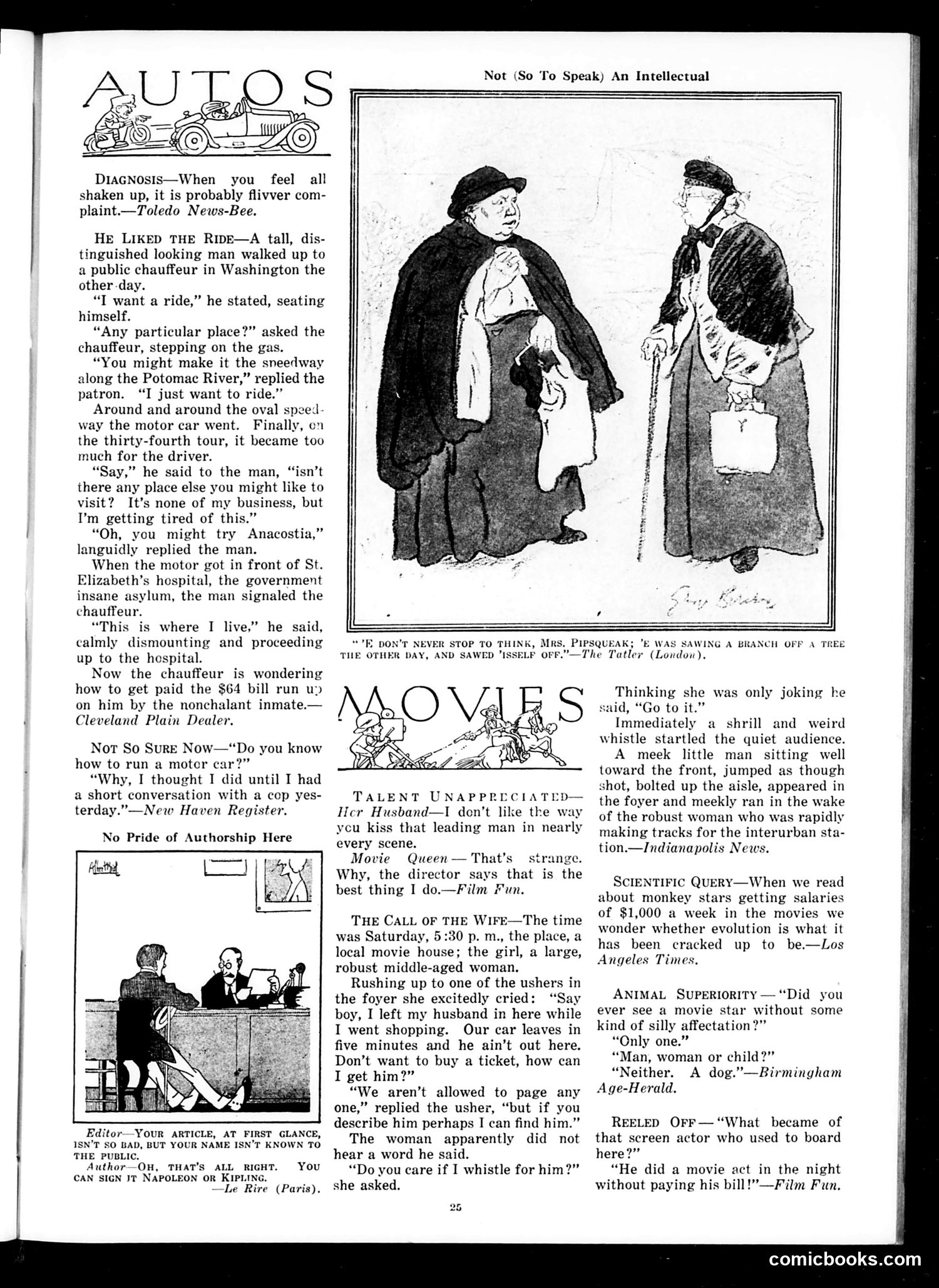
This page contains several short satirical pieces about early automobile culture and movie theaters, reflecting 1910s-1920s American life. **"He Liked the Ride"**: A Washington man hires a taxi for endless loops around the Potomac River's speedway, exhausting the driver. When finally directed to a destination, he calmly exits at St. Elizabeth's Hospital—the government insane asylum. The joke: his behavior (senseless, repetitive touring) suggests mental illness, and the chauffeur faces an unpaid $64 bill. **Other sketches** mock moviegoing habits: a wife whistling in a theater to summon her husband; a director praising an actress's kissing scenes to her jealous husband; queries about whether movie stars' high salaries disprove evolution. The humor targets emerging automobile culture's absurdities and the era's fascination with cinema as a social institution. These are reprinted jokes from various sources (Toledo News-Bee, Film Fun, etc.), typical of Judge's format.
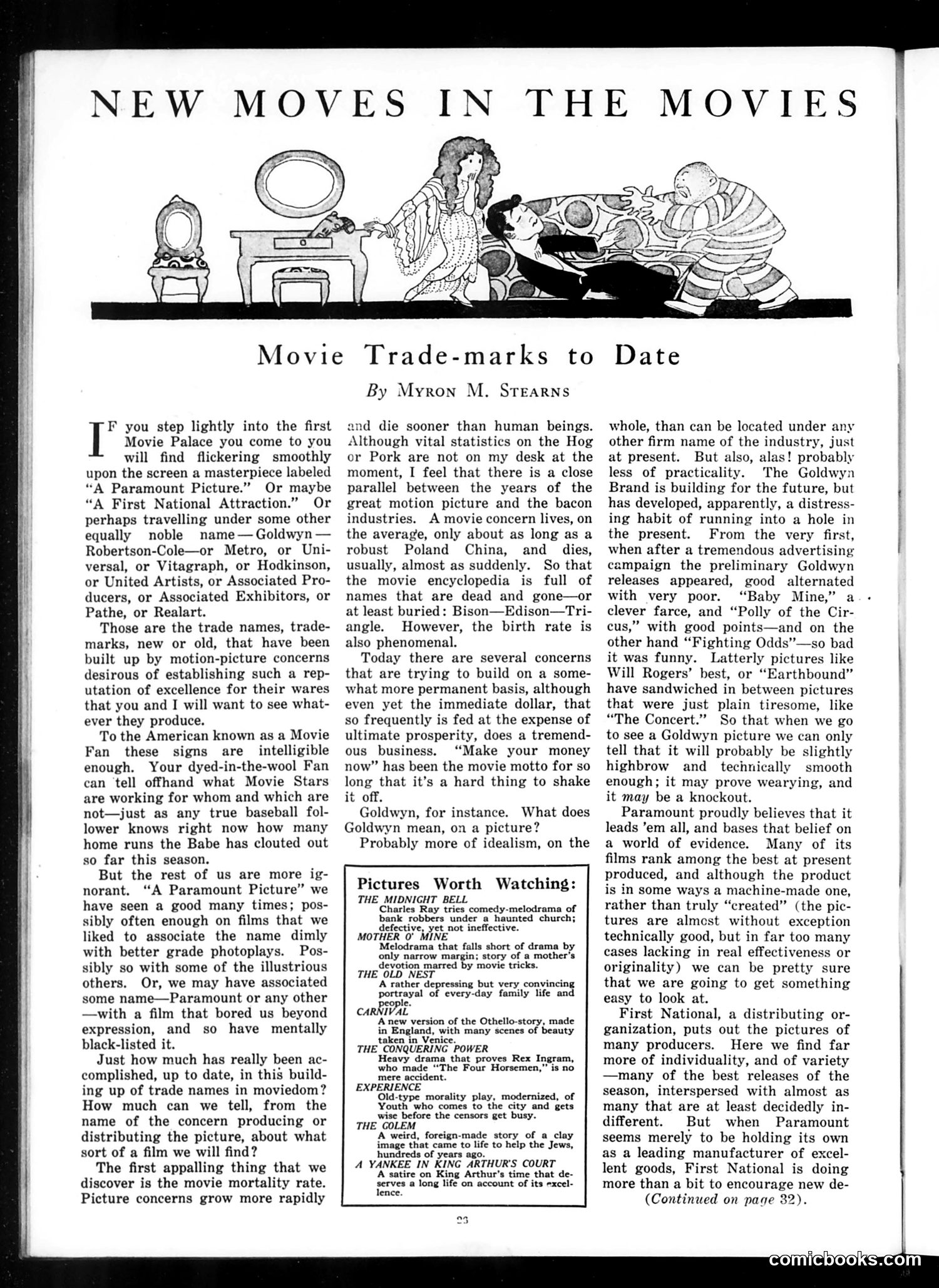
This article by Myron M. Stearns examines how effectively movie studio trade-names (Paramount, Goldwyn, Metro, Universal, etc.) signal quality to audiences. The illustration shows figures examining various studio logos and products. Stearns argues that while devoted "Movie Fans" recognize studio names like baseball fans know player statistics, general audiences gain little reliable information from them. He notes the film industry's alarming "mortality rate"—studios appear and vanish as rapidly as livestock, with names like Bison, Edison, and Triangle already defunct. The article questions whether studio branding actually predicts film quality, suggesting the industry prioritizes immediate profit ("Make your money now") over long-term reputation-building. Goldwyn, he argues, stands apart by emphasizing idealism over pure commercialism. The accompanying "Pictures Worth Watching" section reviews current films, evaluating their merit independent of studio names—implicitly supporting Stearns' point that viewers cannot reliably judge films by trade-mark alone.
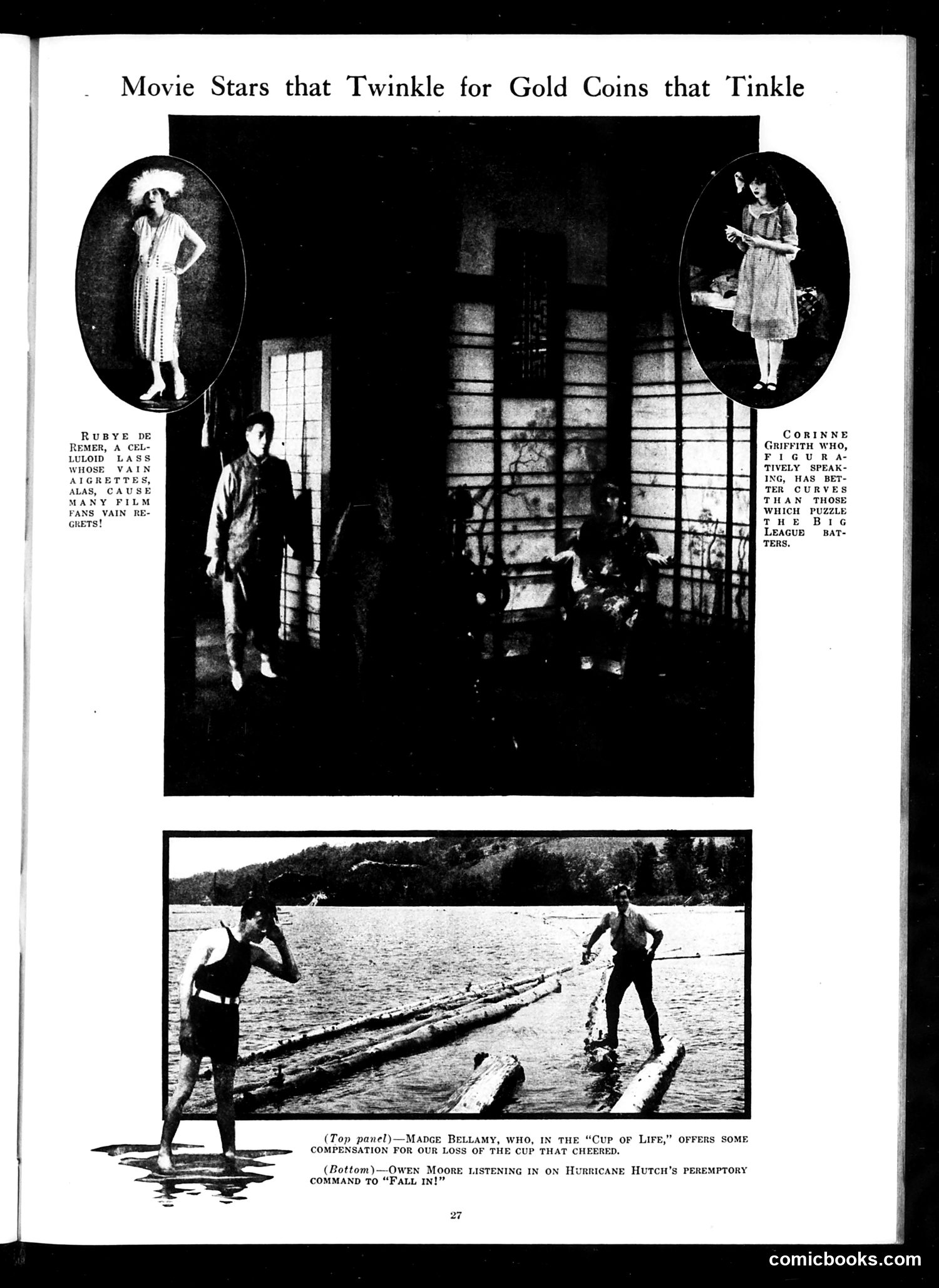
This satirical page mocks movie stars for their greed and mercenary nature. The headline "Movie Stars that Twinkle for Gold Coins that Tinkle" suggests these celebrities shine only for money. The top panel features actresses Rubye de Remer and Corinne Griffith in an indoor scene, captioned with complaints about their financial demands and vanity. The bottom panel references "The Cup of Life" (apparently a film starring Madeleine Bellamy) and "Hurricane Hutch" (likely a serial or action picture with Owen Moore). The satire appears to mock the melodramatic, overwrought nature of silent film plots alongside the stars' perceived greed. The overall message: Hollywood performers are vain, expensive, and care only about money rather than artistry—a common anti-celebrity sentiment of the silent film era.
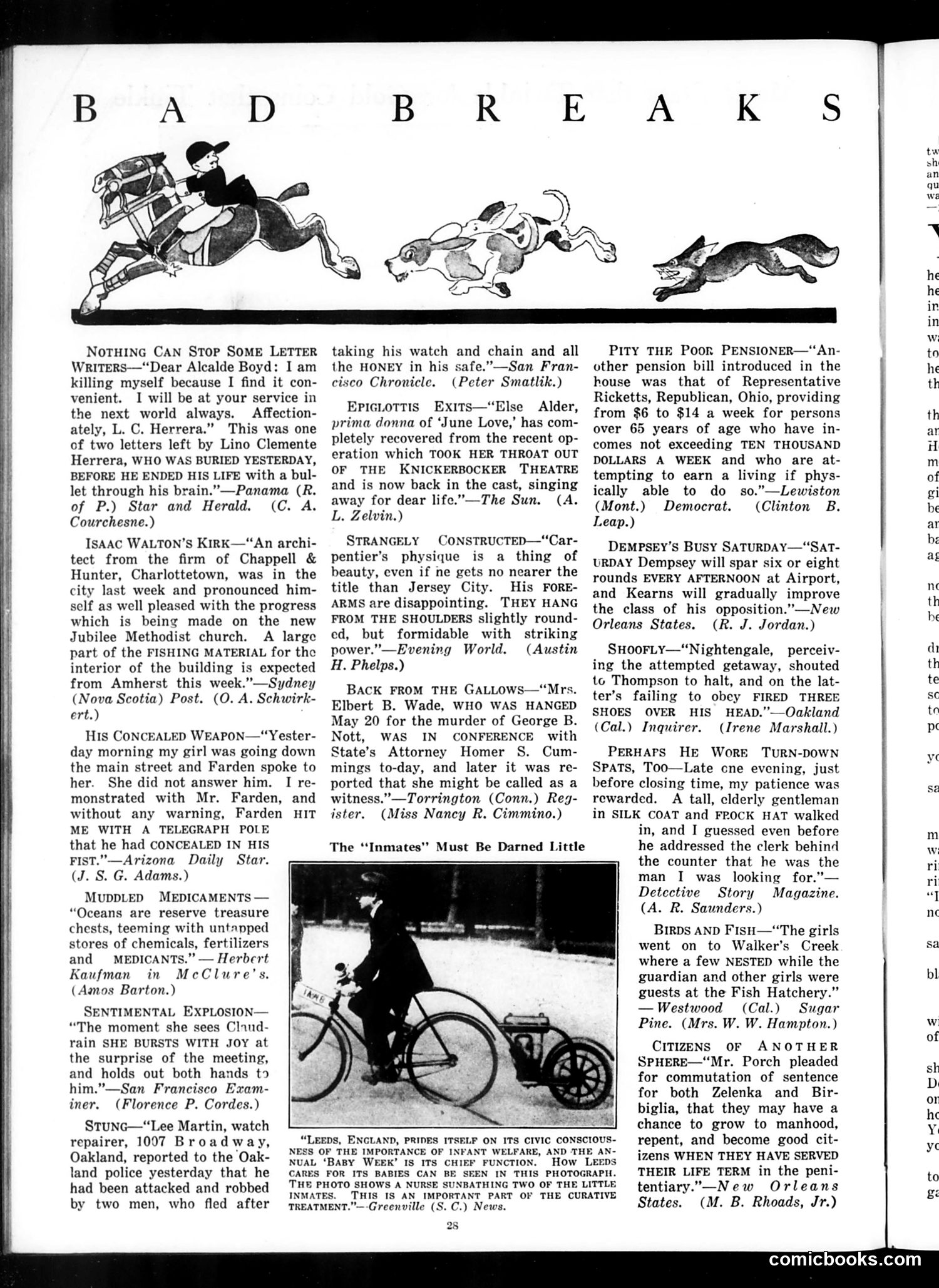
This page collects humorous newspaper excerpts highlighting **absurdities and logical contradictions in published news reports**. The title "Bad Breaks" refers to badly-written or logically impossible journalism. Examples of the satire include: - A man killing himself but promising to serve someone "in the next world" - A church using "fishing material" in its interior construction - A man concealing a telegraph pole in his fist as a weapon - A woman who was hanged being alive to testify in court The accompanying illustrations show people or animals in exaggerated states of falling or chaos, reinforcing the comedic theme that these news stories depict impossible or absurd situations. **The satire's point**: Judge mocked contemporary newspapers for publishing poorly-edited or logically incoherent stories. By excerpting these without commentary, the magazine let the absurdities speak for themselves—satirizing both careless journalism and the gullibility of readers who might not notice such contradictions.
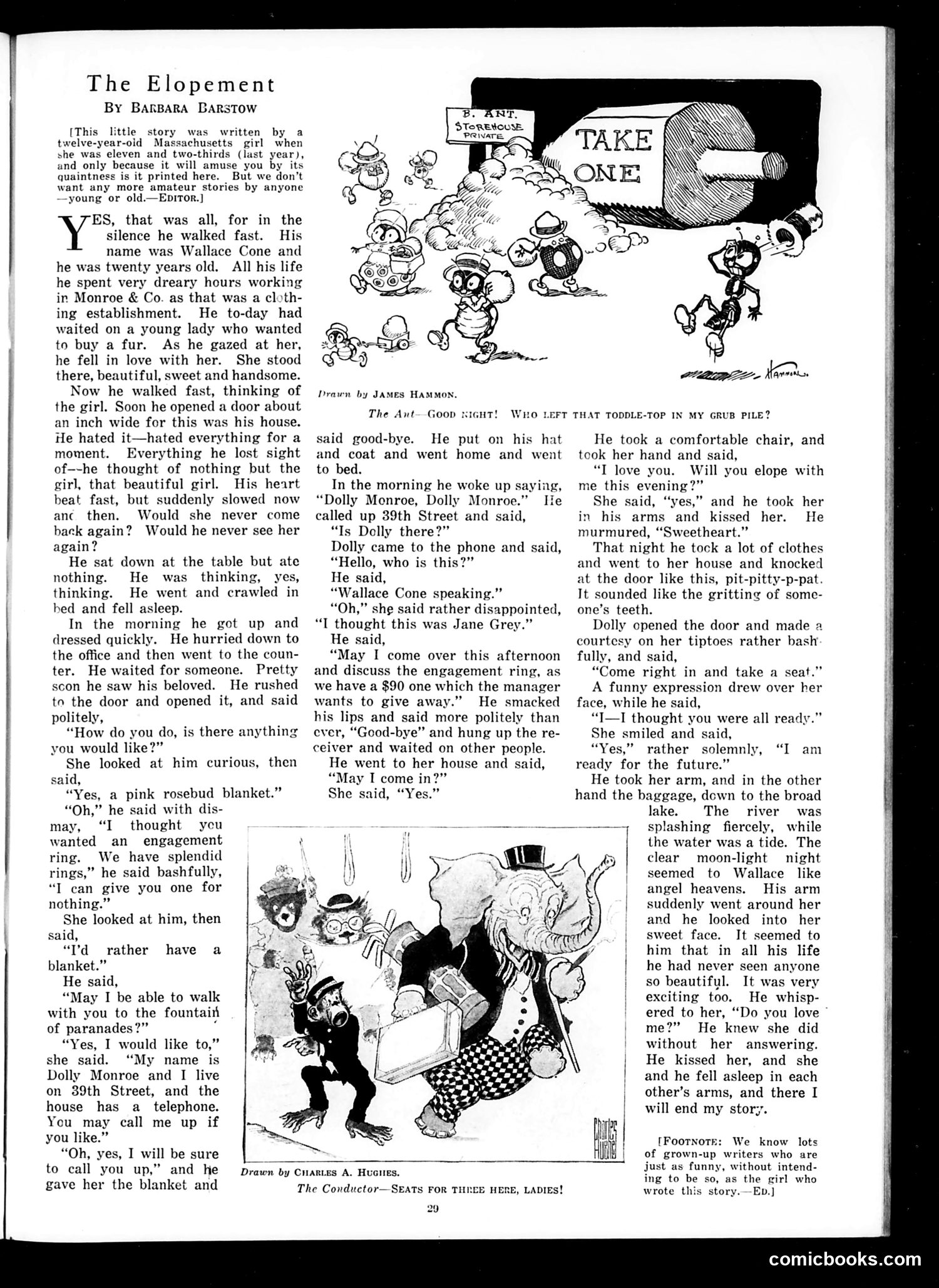
This page presents a sentimental short story written by a twelve-year-old Massachusetts girl, published in *Judge* magazine with editorial amusement at its "quaintness." The narrative follows Wallace Cone, a clothier employee, who impulsively falls in love with a customer (Dolly Monroe) and quickly proposes elopement. The satire targets not the story's plot but its naive earnestness—the editor's footnote explicitly mocks amateur writers attempting sentimentality. The humor derives from the girl-author's innocent dramatic flourishes (the protagonist's emotional turmoil, the rushed romance, the melodramatic finale by the lake) treated as charming rather than ridiculous. Two accompanying cartoons by James Hammon and Charles A. Hughes provide comedic relief: ants quarreling over food supplies, and animals crowding onto a streetcar. These are thematically unrelated humor fillers typical of *Judge*'s mixed-content format. The page exemplifies early 20th-century magazine culture where children's creative writing was published as curiosities for adult amusement.
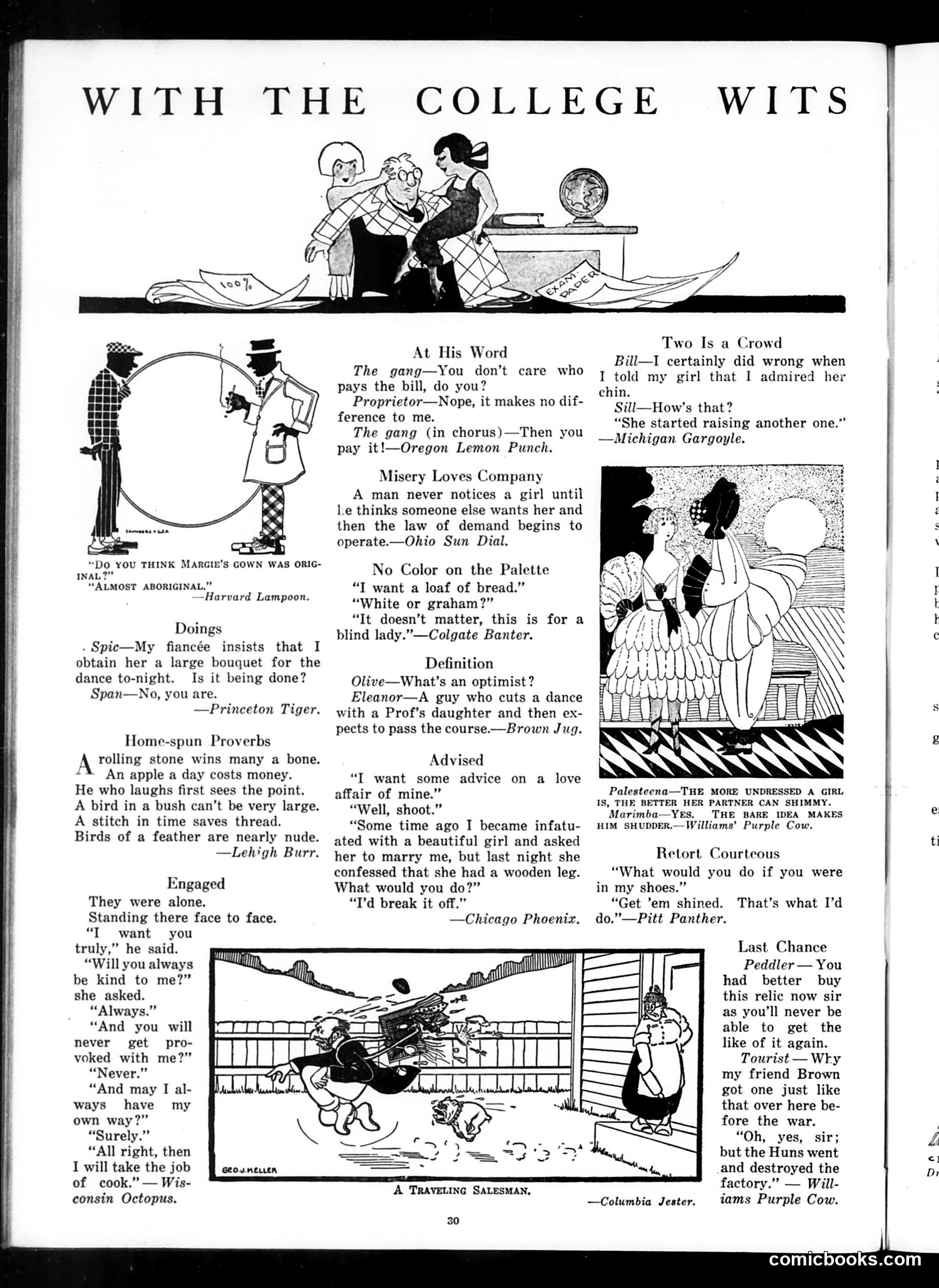
This page from **Judge** (a satirical weekly magazine) collects short humorous jokes and cartoons typical of early 20th-century college humor. The content includes: **Major cartoon**: "A Traveling Salesman" depicts a traveling salesman (a stock comedic figure of the era) playing guitar while dogs react—likely referencing the clichéd "traveling salesman" joke format popular at the time. **Recurring themes**: - College romance and courtship anxieties - Gender dynamics (women's appearance, dating expectations) - Economic humor (buying/selling, costs) - Wordplay and puns **Notable jokes reflect period attitudes**: References to "wooden legs," "shimmy" dancing (a 1920s fad), and casual sexism toward women's appearance are presented without irony—standard for the era. **"Last Chance" cartoon**: References WWI ("before the war," "the Huns"), suggesting this is post-WWI material. The joke about a destroyed factory relies on readers' knowledge of wartime destruction. The page is primarily **collegiate humor** (credits cite Harvard Lampoon, Princeton Tiger, etc.)—content by and for college students reflecting their social world.
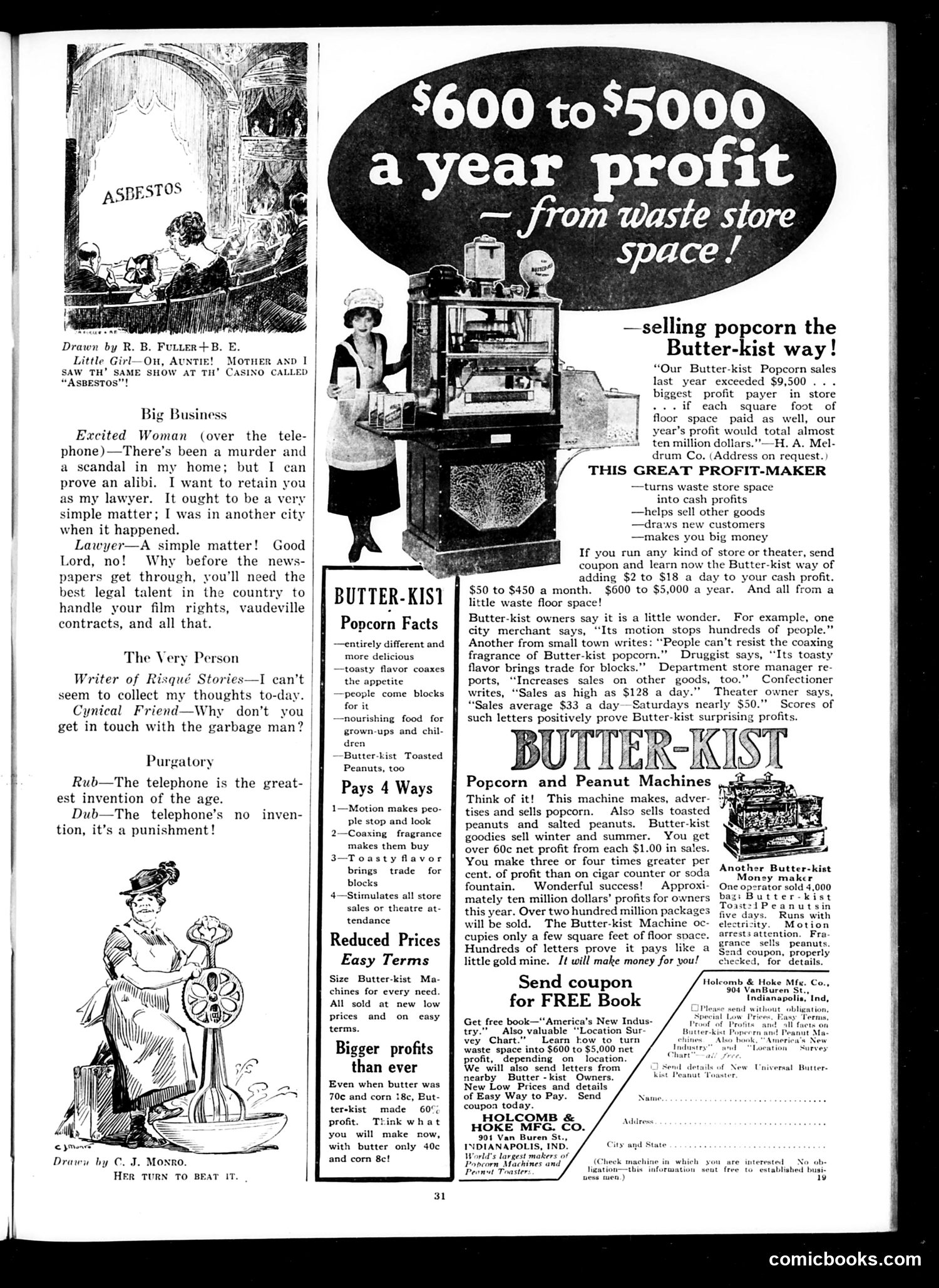
This page contains **mostly advertising** for the Butter-kist popcorn machine, interspersed with brief satirical humor pieces. The cartoons present **social commentary on early 20th-century life**: 1. **"Big Business"**: Satirizes how media sensationalism transforms private scandals into profitable entertainment—a woman's home crime becomes valuable for "film rights, vaudeville contracts," suggesting how newspapers exploit tragedy for profit. 2. **"The Very Person"**: A cynical joke about a writer of risqué stories needing inspiration from a garbage man—likely mocking lowbrow popular literature and its sources. 3. **"Purgatory"**: A brief joke about telephones being a punishment rather than invention, reflecting early skepticism about this new technology's invasiveness. The **dominant content is the Butter-kist advertisement**, promoting popcorn machines as profitable small business ventures for store owners, with testimonials claiming $600-$5,000 annual profit from "waste floor space."
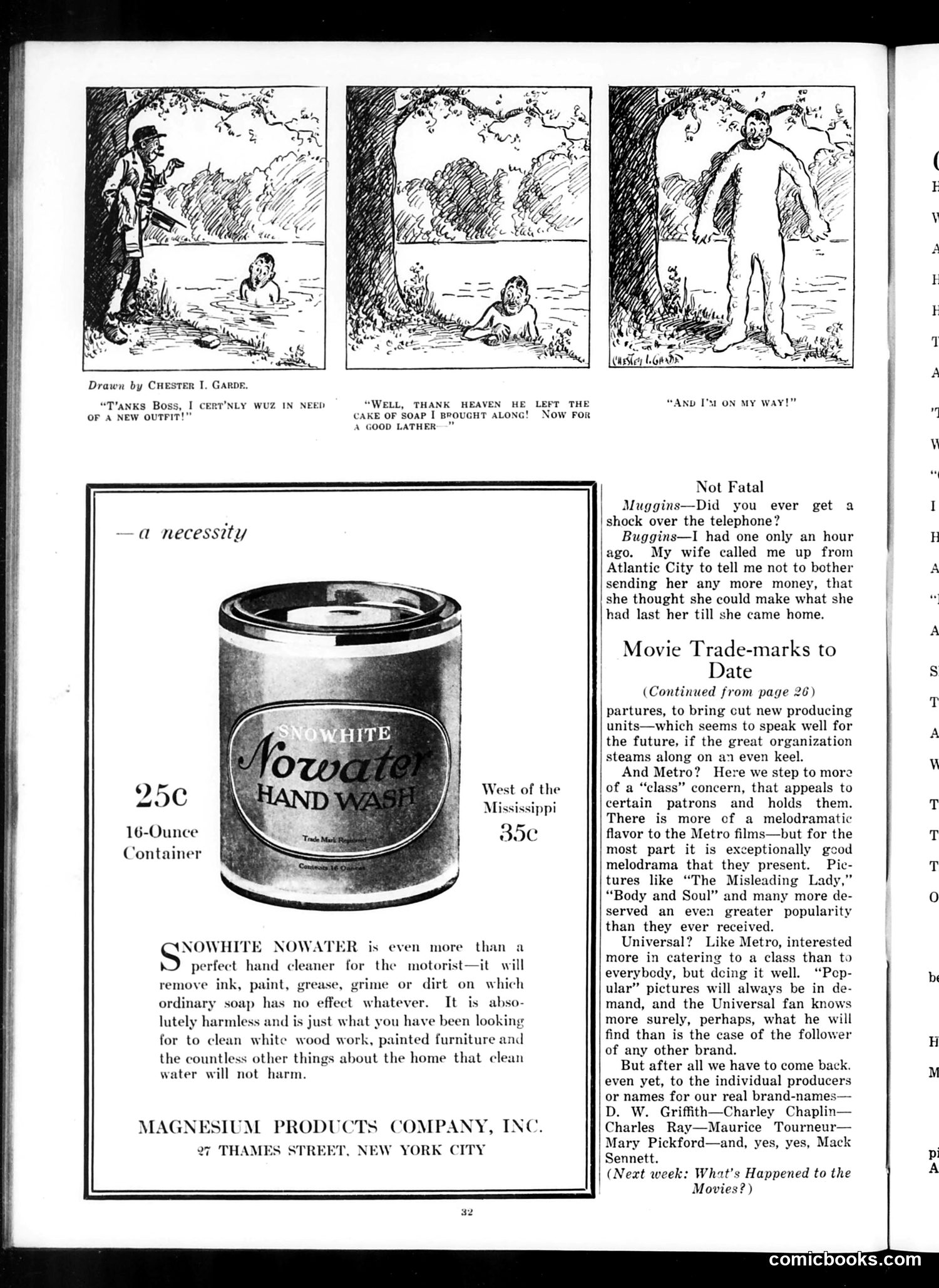
This page contains a three-panel cartoon by Chester I. Garde depicting a poor man's encounter with bathing. In the first panel, a shabby figure tells his boss he needs new clothes. By the second panel, he's in a body of water with soap, grateful to have cleaning supplies. In the third, he emerges—now appearing as a respectable, well-dressed gentleman, transformed by basic hygiene. The satire targets the "rags to respectability" mythology: the cartoon suggests that poverty and uncleanliness are linked, and that soap alone can restore social standing. This reflects early 20th-century attitudes about cleanliness correlating with class and morality. The page also includes a Nowhite Nowater hand soap advertisement and a brief humor item about a wife threatening economic independence through long-distance telephone—a still-novel technology. The "Movie Trade-marks" article discusses early film studios' brand identities.
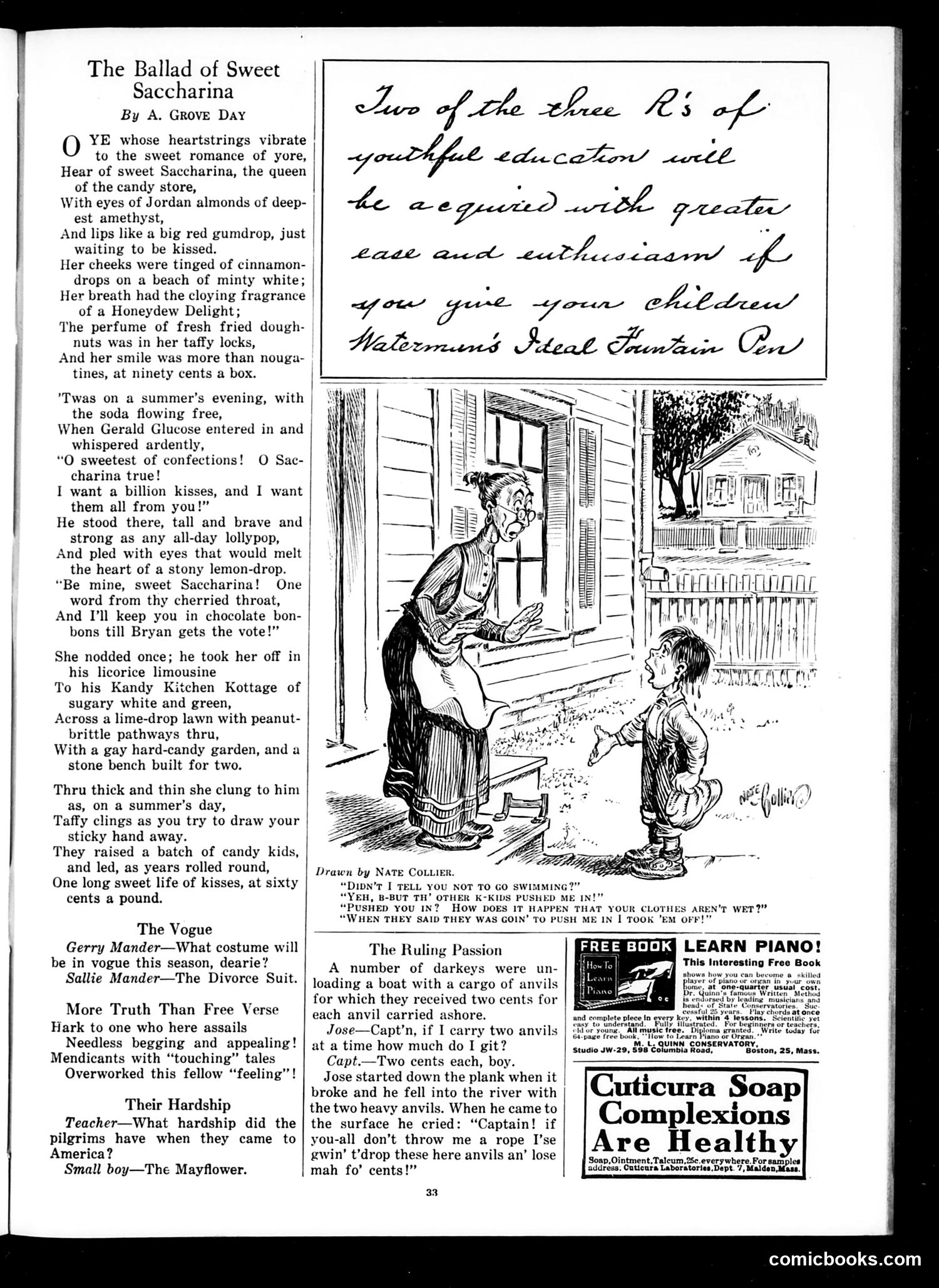
This page contains light satirical humor typical of early 20th-century Judge magazine: **"The Ballad of Sweet Saccharina"** is a whimsical poem personifying candy products as romantic characters—Gerald Glucose courts Saccharina in a candy-themed courtship. The humor lies in the extended metaphor treating confections as people. The reference to "till Bryan gets the vote" alludes to William Jennings Bryan's presidential campaigns, dating this around 1900-1908. **The remaining shorts** are brief joke items: "The Vogue" quips that divorce suits are fashionable; "More Truth Than Free Verse" mocks beggars; "Their Hardship" presents a child's humorous answer about pilgrims; and **"The Ruling Passion"** uses a racist dialect joke about enslaved workers prioritizing payment over survival, reflecting deeply offensive period attitudes. The page also includes advertisements and an illustration of an adult and child by a window. The content represents typical Judge humor: light social commentary mixed with crude ethnic stereotypes and casual racism now considered repugnant.
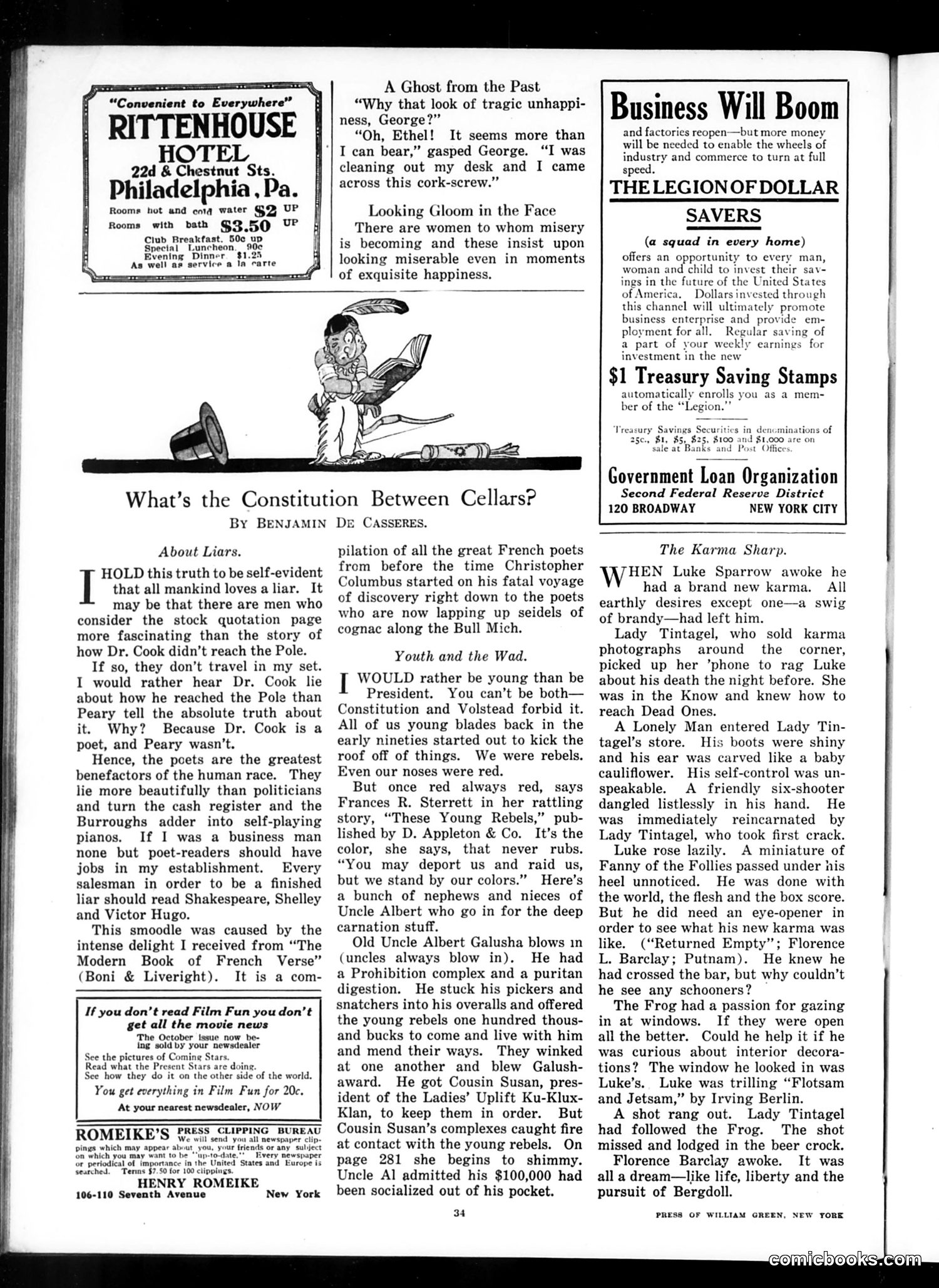
**The Main Cartoon:** The illustration titled "What's the Constitution Between Cellars?" depicts a disheveled figure reading by candlelight in what appears to be a basement or cellar, with a cork-screw visible. This accompanies Benjamin De Casseres' essay contrasting poets' beautiful lies with politicians' boring truths—suggesting creative people are superior to bureaucrats. **The Satire:** De Casseres humorously argues that poets are "the greatest benefactors of the human race" because they lie artfully, making them better employees than truth-telling businessmen. He cites fascination with explorer Dr. Cook's fabricated North Pole account over Robert Peary's factual version. The "Constitution Between Cellars" title likely references Prohibition's constraints on personal freedom. **Historical Context:** This appears to be from the Prohibition era (the text mentions "Volstead," the law enforcing Prohibition). The piece satirizes both Prohibition's restrictions and American reverence for poetic/romantic narratives over harsh reality. The page also contains typical period advertisements and society gossip items about movie stars and romantic entanglements.
This is not a cartoon but an **advertisement for advertisements themselves** — a meta-promotional editorial. It's a full-page argument *selling* readers on the value of reading ads. The piece references **Davy Crockett's** famous motto ("Be sure you're right, then go ahead") to frame advertising as trustworthy guidance for consumers. The implicit argument: ads help you make informed purchasing decisions by providing price transparency, quality assurance, and product information. For modern readers, the notable aspect is the **unironic celebration of advertising as a public service**. The text claims advertisers have "stabilized prices" and that their reputations depend on honest claims—presenting advertising as fundamentally consumer-protective rather than manipulative. This reflects **early-20th-century attitudes** when advertising was still establishing itself as a legitimate institution. The earnest tone and appeals to duty and wisdom suggest advertising industry self-promotion at a time when public skepticism may have been higher. The piece ultimately urges: read advertisements carefully to avoid mistakes and get fair deals.
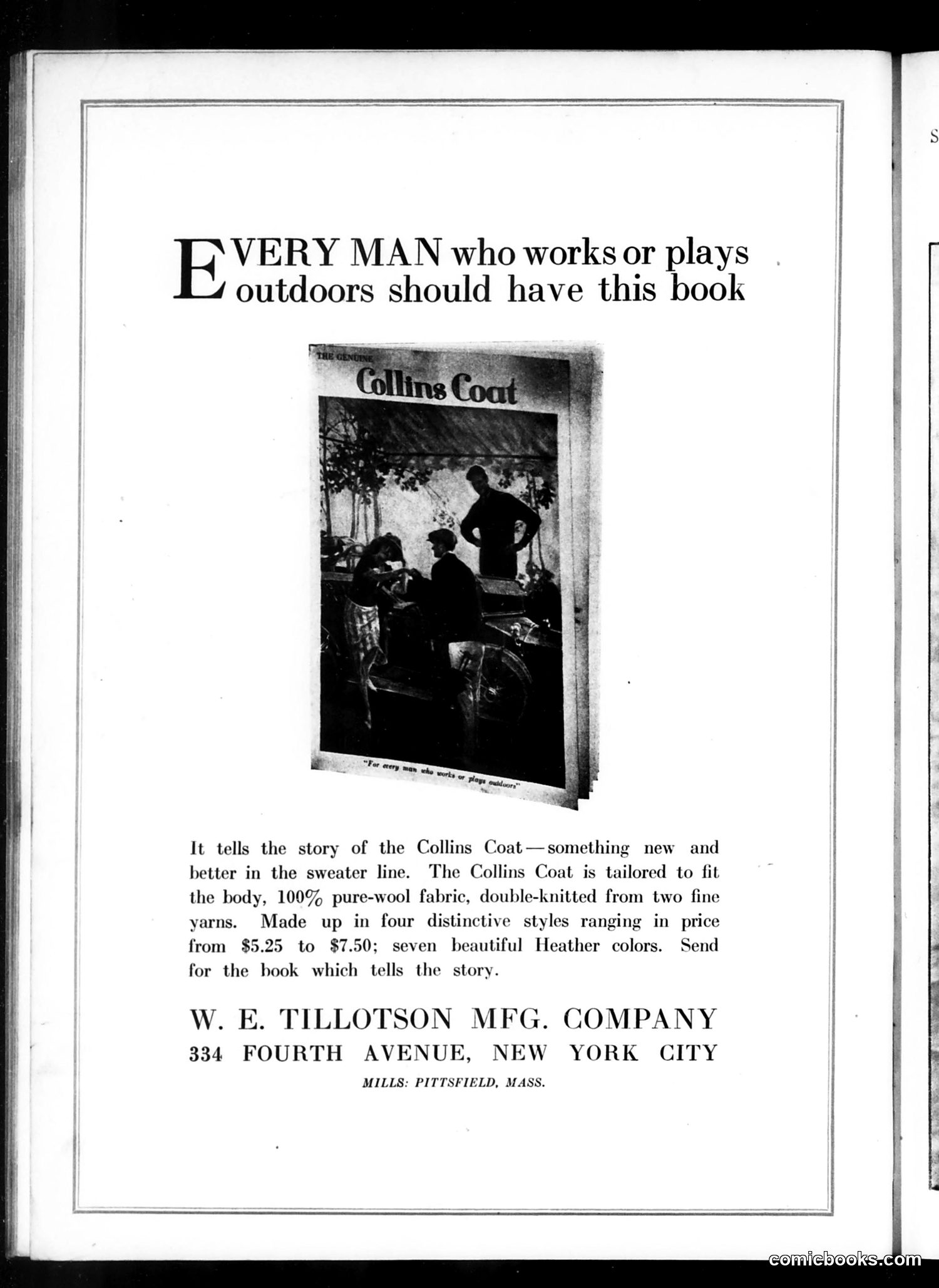
This is **not a cartoon or satire**—it's a straightforward product advertisement placed in Judge magazine. The page promotes the "Collins Coat," a wool sweater marketed to outdoor workers and sportsmen. The image shows three men in what appears to be an outdoor or work setting, presumably modeling or demonstrating the coat. The ad emphasizes practical features: tailored fit, 100% pure wool, double-knitted construction, four styles, and seven color options, with prices ranging from $5.25 to $7.50. The W.E. Tillotson Manufacturing Company placed this ad in Judge to reach the magazine's male readership. The opening line—"Every man who works or plays outdoors should have this book"—uses Judge's platform to advertise a mail-order catalog. This represents typical early 20th-century magazine advertising strategy: product companies bought space in popular publications to promote goods and distribute promotional literature.