
Judge, 1921-09-10 · page 10 of 36
Judge — September 10, 1921 — page 10: what you’re looking at
What you’re looking at
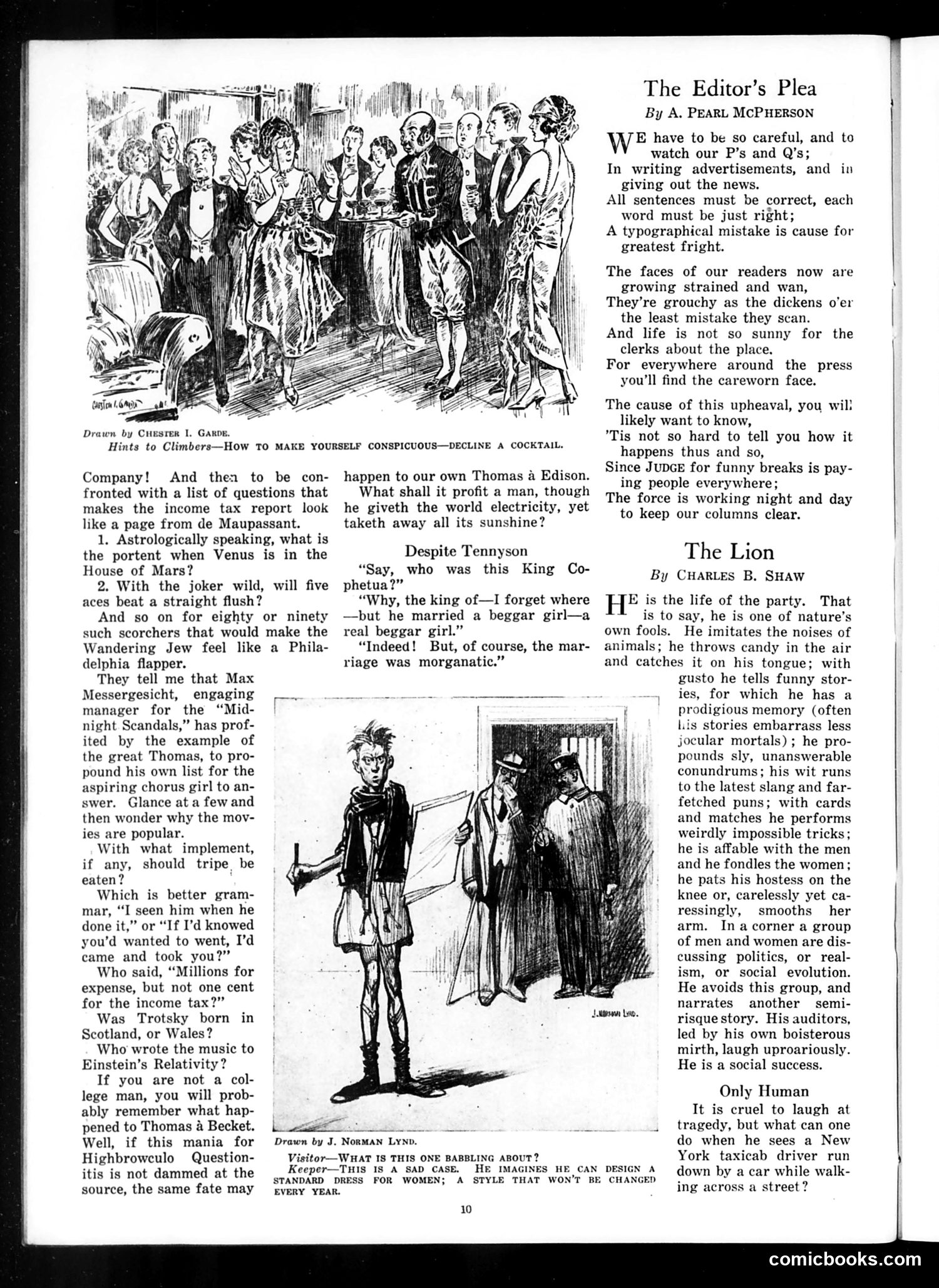
## "Hints to Climbers" Cartoon This cartoon satirizes the "highbrow question" fad—pretentious intellectuals asking absurdly difficult trivia at social gatherings to appear cultured. The joke: declining a cocktail makes you conspicuous because you seem like a show-off trying to seem superior. The text references Thomas Edison being pestered with impossible questions (astrological, mathematical, literary) and warns this "mania" could drive even great minds to despair like Thomas à Becket. ## "Visitor" Cartoon A man in an asylum imagines he can design a standardized dress for women that won't change yearly. The satire: this is treated as delusional because women's fashion constantly changes—the very premise is impossibly naive. ## "The Editor's Plea" and "The Lion" These are unrelated: a poem about Judge's editorial struggles with accuracy, and an essay describing a social type—the "Lion," a gregarious fool who entertains through impressions, jokes, and physical tricks rather than serious conversation.
📄 Transcribed text from this page (OCR, searchable)
Machine-transcribed from the original scan — historical spelling and the odd misread are preserved.
Drawn by Cuesrer I. Gare. Hints to Climbers—How TO MAKE YOURSELF CONSPICUOUS—DECLINE A COCKTAIL. Company! And then to be con- fronted with a list of questions that makes the income tax report look like a page from de Maupassant. 1. Astrologically speaking, what is the portent when Venus is in the House of Mars? 2. With the joker wild, will five aces beat a straight flush? And so on for eighty or ninety such scorchers that would make the Wandering Jew feel like a Phila- delphia flapper. They tell me that Max Messergesicht, engaging manager for the “Mid- night Scandals,” has prof- ited by the example of the great Thomas, to pro- pound his own list for the aspiring chorus girl to an- swer. Glance at a few and then wonder why the mov- ies are popular. With what implement, if any, should tripe be eaten? Which is better gram- mar, “I seen him when he done it,” or “If I’d knowed you’d wanted to went, I’d came and took you?” Who said, “Millions for expense, but not one cent for the income tax?” Was Trotsky born Scotland, or Wales? Who wrote the music to Einstein’s Relativity? If you are not a col- lege man, you will prob- ably remember what hap- pened to Thomas a Becket. Well, if this mania for Highbrowculo Question- itis is not dammed at the source, the same fate may in EVERY YEAR. happen to our own Thomas a Edison. What shall it profit a man, though he giveth the world electricity, yet taketh away all its sunshine? Despite Tennyson “Say, who was this King Co- phetua?” “Why, the king of—I forget where —but he married a beggar girl—a real beggar girl.” “Indeed! But, of course, the mar- riage was morganatic.” [YR 5S Tae ee i Drawn by J. NorMAN LYNb. Visitor—WHAT IS THIS ONE BABBLING ABOUT? Keeper—THIs 18 A SAD CASE. 10 HE IMAGINES HE CAN DESIGN A STANDARD DRESS FOR WOMEN; A STYLE THAT WON’T BE CHANGED The Editor’s Plea By A. PEARL MCPHERSON E have to be so careful, and to watch our P’s and Q’s; In writing advertisements, and in giving out the news. All sentences must be correct, each word must be just right; A typographical mistake is cause for greatest fright. The faces of our readers now are growing strained and wan, They’re grouchy as the dickens o'er the least mistake they scan. And life is not so sunny for the clerks about the place. For everywhere around the press you’ll find the careworn face. The cause of this upheaval, you wil! likely want to know, ’Tis not so hard to tell you how it happens thus and so, Since JupcE for funny breaks is pay- ing people everywhere; The force is working night and day to keep our columns clear. The Lion By CHaRLes B. SHAW E is the life of the party. That is to say, he is one of nature’s own fools. He imitates the noises of animals; he throws candy in the air and catches it on his tongue; with gusto he tells funny stor- ies, for which he has a prodigious memory (often lis stories embarrass less jocular mortals) ; he pro- pounds sly, unanswerable conundrums; his wit runs to the latest slang and far- fetched puns; with cards and matches he performs weirdly impossible tricks; he is affable with the men and he fondles the women ; he pats his hostess on the knee or, carelessly yet ca- ressingly, smooths her arm. Ina corner a group of men and women are dis- cussing politics, or real- ism, or social evolution. He avoids this group, and narrates another semi- risque story. His auditors, led by his own boisterous mirth, laugh uproariously. He is a social success. Only Human It is cruel to laugh at tragedy, but what can one do when he sees a New York taxicab driver run down by a car while walk- ing across a street? comicbooks.com