
Judge, 1921-09-10 · page 14 of 36
Judge — September 10, 1921 — page 14: what you’re looking at
What you’re looking at
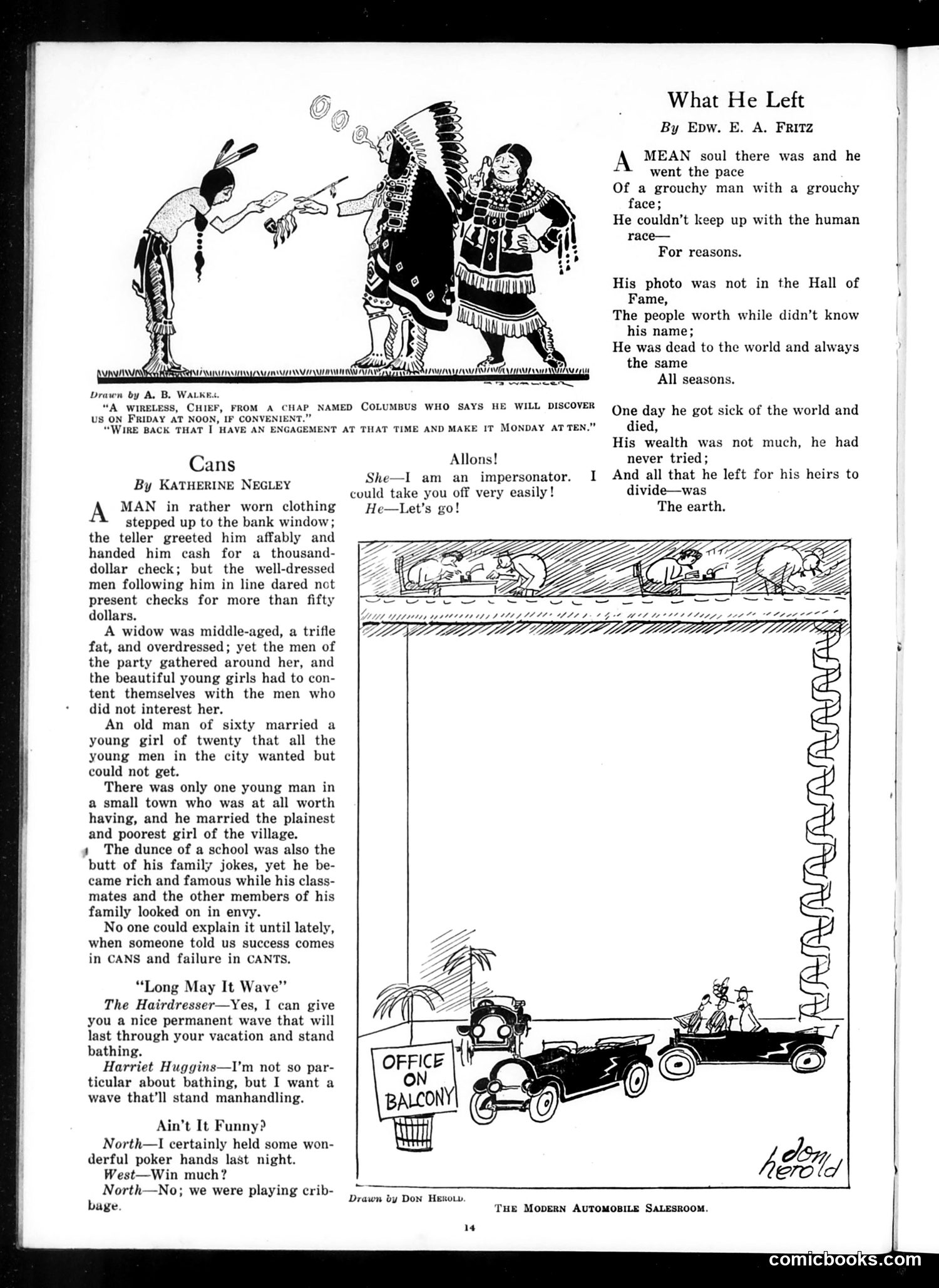
**"Cans" (by Katherine Negley):** This story uses "cans" and "cants" as a pun to explain social paradoxes—why an unkempt man cashes large checks while well-dressed men can't, why plain girls marry desirable men. The joke's conclusion: success comes from actual ability ("cans"—can do), while failure results from pretense ("cants"—cannot do). It's satirizing how appearance deceives in evaluating character and capability. **"What He Left" (by Edw. E. A. Fritz):** A morality poem about a mean-spirited, lazy man whose only inheritance to his heirs is "the earth"—suggesting he accomplished nothing of value. The satire criticizes wasted potential and greed. **"The Modern Automobile Salesroom" (cartoon by Don Herold):** Shows early 1920s cars stacked vertically in a tall office building, satirizing cramped urban space and the explosive growth of automobile sales/parking challenges in modernizing cities. The page contains light social satire typical of Judge's era—wordplay humor and gentle critiques of character, social mobility, and contemporary urban problems.
📄 Transcribed text from this page (OCR, searchable)
Machine-transcribed from the original scan — historical spelling and the odd misread are preserved.
Drawn by A, B. Wai “A WIRELESS, CH US ON FRIDAY AT NOON, IF CONV. “WIRE BACK THAT I HAVE AN Cans By KATHERINE NEGLEY A MAN in rather worn clothing stepped up to the bank window; the teller greeted him affably and handed him cash for a thousand- dollar check; but the well-dressed men following him in line dared not present checks for more than fifty dollars. A widow was middle-aged, a trifle fat, and overdressed; yet the men of the party gathered around her, and the beautiful young girls had to con- tent themselves with the men who did not interest her. An old man of sixty married a young girl of twenty that all the young men in the city wanted but could not get. There was only one young man in a small town who was at all worth having, and he married the plainest and poorest girl of the village. The dunce of a school was also the butt of his family jokes, yet he be- came rich and famous while his class- mates and the other members of his family looked on in envy. No one could explain it until lately, when someone told us success comes in CANS and failure in CANTS, “Long May It Wave” The Hairdresser—Yes, I can give you a nice permanent wave that will last through your vacation and stand bathing. Harriet Huggins—I’m not so par- ticular about bathing, but I want a wave that’ll stand manhandling. Ain’t It Funny? North—I certainly held some won- derful poker hands last night. West—Win much? North—No; we were playing crib- bage Allons! She—I am an impersonator. could take you off very easily! He—Let’s go! FROM A CHAP NAMED COLUMBUS WHO SAYS HE WILL DISCOVER 3AGEMENT AT THAT TIME AND MAKE IT MONDAY ATTEN,” 1 What He Left By Epw. E. A. FRITZ A MEAN soul there was and he me went the pace Of a grouchy man with a grouchy face; He couldn’t keep up with the human race— For reasons. His photo was not in the Hall of Fame, The people worth while didn’t know his name; He was dead to the world and always the same All seasons. One day he got sick of the world and died, His wealth was not much, he had never tried; And all that he left for his heirs to divide—was The earth. Drawn by Don Henovy. THE MODERN AUTOMOBILE SALESROOM.