
Judge, 1921-09-10 · page 9 of 36
Judge — September 10, 1921 — page 9: what you’re looking at
What you’re looking at
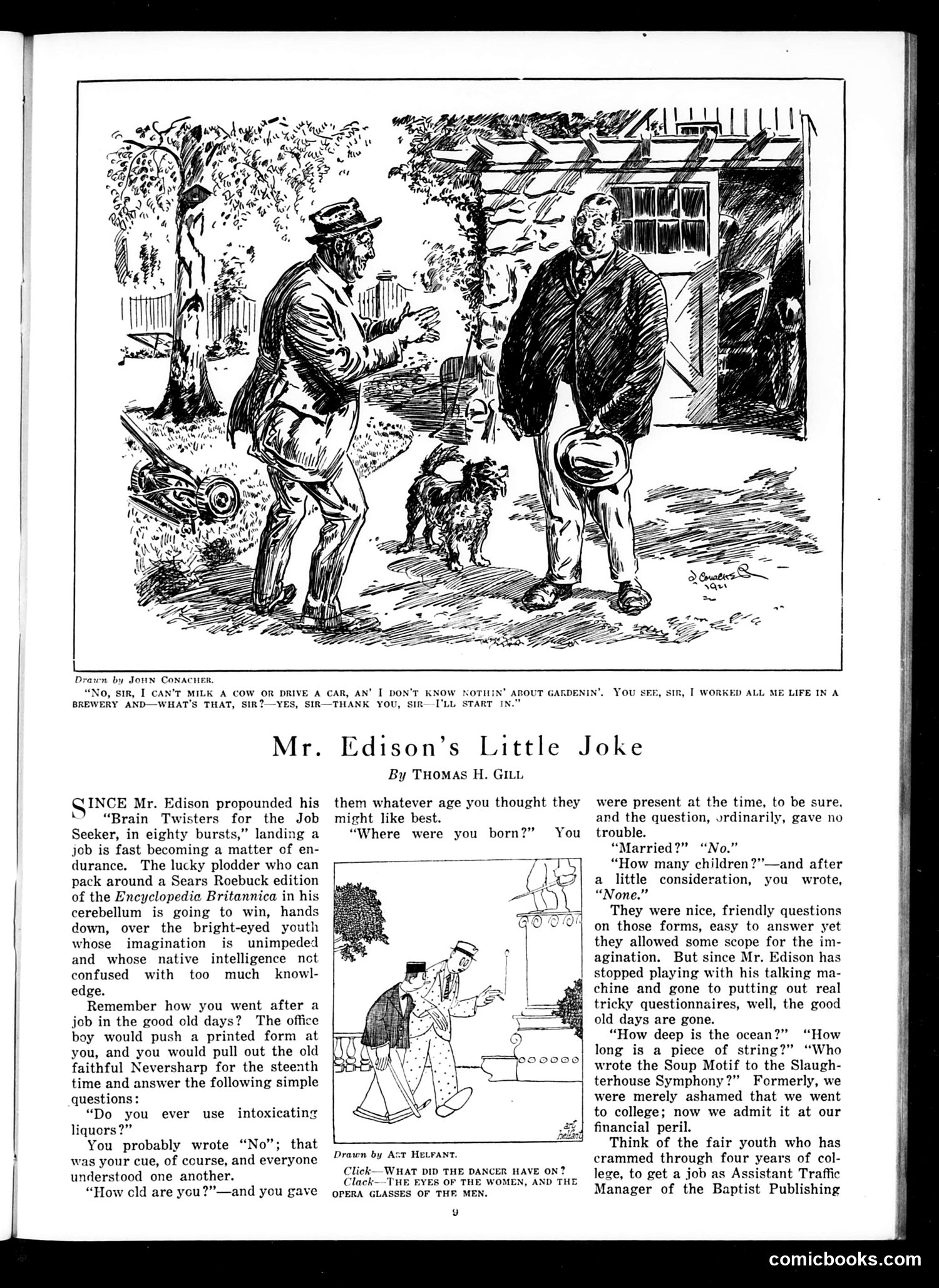
The article satirizes Thomas Edison's "Brain Twisters for the Job Seeker" — actual riddle-based job application tests Edison created. The author argues that modern job applications have become absurdly difficult and knowledge-obsessed, replacing simpler, more honest hiring practices. The opening cartoon shows a worker admitting he can only do brewery work—honest but unemployable under Edison's new system. The article contrasts the old interview process (simple questions like "Where were you born?") with Edison's current nonsense riddles ("How deep is the ocean?" "How long is a piece of string?"). The satire's point: excessive testing penalizes practical workers and ironically disadvantages educated candidates (the college graduate becomes an "Assistant Traffic Manager"). This reflects early 20th-century anxieties about mechanization, changing workplace standards, and whether intelligence tests actually identified good workers or merely created bureaucratic obstacles.
📄 Transcribed text from this page (OCR, searchable)
Machine-transcribed from the original scan — historical spelling and the odd misread are preserved.
Drawn by JouN CoNACHER. “No, sir, I CAN’T MILK A COW OR DRIVE A CAR, AN’ I DON’T KNOW NOTHIN’ ABOUT GARDENIN’. BREWERY AND—WHAT'S THAT, SIR?—YES, SIR Mr. SINCE Mr. Edison propounded his \” “Brain Twisters for the Job Seeker, in eighty bursts,” landing a job is fast becoming a matter of en- durance. The lucky plodder who can pack around a Sears Roebuck edition of the Encyclopedia Britannica in his cerebellum is going to win, hands down, over the bright-eyed youth whose imagination is unimpeded and whose native intelligence net confused with too much knowl- edge. Remember how you went after a job in the good old days? The office boy would push a printed form at you, and you would pull out the old faithful Neversharp for the steenth time and answer the following simple questions: “Do you ever use liquors?” You probably wrote “No”; that was your cue, of course, and everyone understood one another. “How cld are you?”—and you gave intoxicating —THANK YOU, SIR—-I'LL START IN.” Edison’s Little J By THOMAS H. GILL them whatever age you thought they might like best. “Where were you born?” You Drawn by Ant HELFANT. Click—WHAT DID THE DANCER HAVE ON? Clack—-THE EYES OF THE WOMEN, AND THE OPERA GLASSES OF THR MEN. 9 You SEE, sin, | WORKED ALL ME LIFE IN A were present at the time, to be sure. and the question, ordinarily, gave no trouble. “Married?” “No.” “How many children?”—and after a little consideration, you wrote, “None.” They were nice, friendly questions on those forms, easy to answer yet they allowed some scope for the im- agination. But since Mr. Edison has stopped playing with his talking ma- chine and gone to putting out real tricky questionnaires, well, the good old days are gone. “How deep is the ocean?” “How long is a piece of string?” “Who wrote the Soup Motif to the Slaugh- terhouse Symphony?” Formerly, we were merely ashamed that we went to college; now we admit it at our financial peril. Think of the fair youth who has crammed through four years of col- lege, to get a job as Assistant Traffic Manager of the Baptist Publishing comicbooks.com