
Judge, 1921-09-10 · page 20 of 36
Judge — September 10, 1921 — page 20: what you’re looking at
What you’re looking at
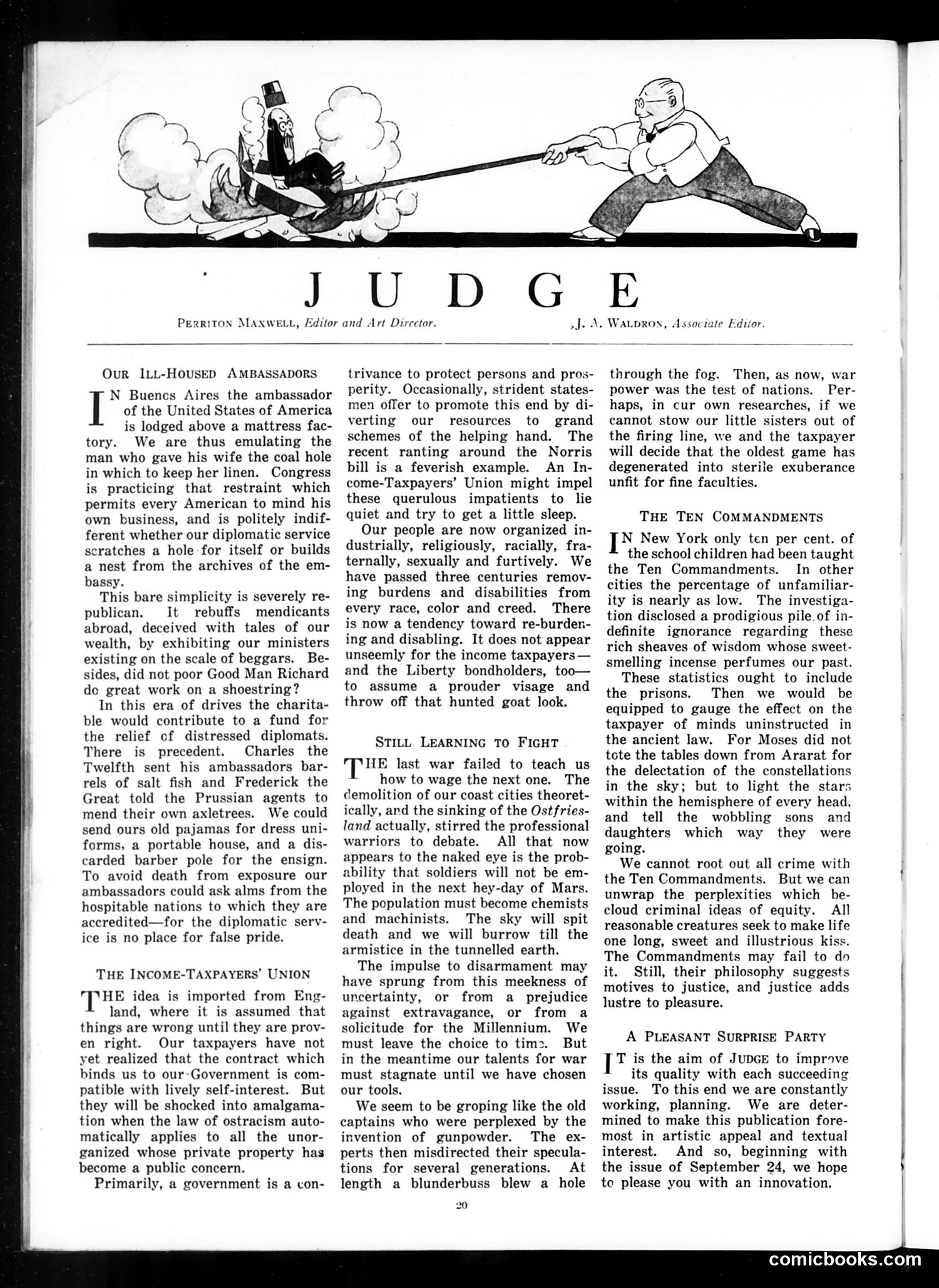
**The Cartoon (top):** Depicts a figure being pulled through explosive clouds by a rope—likely representing diplomats or the State Department being dragged through scandal or inefficiency. **"Our Ill-Housed Ambassadors":** Mocks Congress's extreme parsimony in housing U.S. ambassadors abroad. The U.S. ambassador in Buenos Aires is literally lodged above a mattress factory. The article sarcastically compares this to historical precedents (Frederick the Great making ambassadors mend their own tools) while questioning whether this "republican simplicity" genuinely reflects American values or merely humiliates American diplomacy. **"The Income-Taxpayers' Union":** Advocates for organizing taxpayers into a political force to resist government spending programs—specifically referencing the Norris bill as wasteful. The author argues taxpayers should unionize to combat what he views as excessive government intervention and redistributive schemes. **"Still Learning to Fight":** Discusses post-WWI military unpreparedness, suggesting warfare technology has evolved unpredictably (mentioning the sinking of the *Ostfriesland*), leaving military strategists confused about future combat, particularly regarding air power and chemical warfare.
📄 Transcribed text from this page (OCR, searchable)
Machine-transcribed from the original scan — historical spelling and the odd misread are preserved.
PERRITON MAXWELL, Editor and Art Director. + WaLpron, Associate Editor. Our ILL-HouSED AMBASSADORS N Buencs Aires the ambassador I of the United States of America is lodged above a mattress fac- tory. We are thus emulating the man who gave his wife the coal hole in which to keep her linen. Congress is practicing that restraint which permits every American to mind his own business, and is politely indif- ferent whether our diplomatic service scratches a hole for itself or builds a nest from the archives of the em- bassy. This bare simplicity is severely re- publican, It rebuffs mendicants abroad, deceived with tales of our wealth, by exhibiting our ministers existing on the scale of beggars. Be- sides, did not poor Good Man Richard de great work on a shoestring? In this era of drives the charita- ble would contribute to a fund for the relief of distressed diplomats. There is precedent. Charles the Twelfth sent his ambassadors bar- rels of salt fish and Frederick the Great told the Prussian agents to mend their own axletrees. We could send ours old pajamas for dress uni- forms, a portable house, and a dis- carded barber pole for the ensign. To avoid death from exposure our ambassadors could ask alms from the hospitable nations to which they are accredited—for the diplomatic serv- ice is no place for false pride. THE INCOME-TAXPAYERS’ UNION [THE idea is imported from Eng- land, where it is assumed that things are wrong until they are prov- en right. Our taxpayers have not yet realized that the contract which binds us to our-Government is com- patible with lively self-interest. But they will be shocked into amalgama- tion when the law of ostracism auto- matically applies to all the unor- ganized whose private property has become a public concern. Primarily, a government is a con- trivance to protect persons and pros- perity. Occasionally, strident states- men offer to promote this end by di- verting our resources to grand schemes of the helping hand. The recent ranting around the Norris bill is a feverish example. An In- come-Taxpayers’ Union might impel these querulous impatients to lie quiet and try to get a little sleep. Our people are now organized in- dustrially, religiously, racially, fra- ternally, sexually and furtively. We have passed three centuries remov- ing burdens and disabilities from every race, color and creed. There is now a tendency toward re-burden- ing and disabling. It does not appear unseemly for the income taxpayers — and the Liberty bondholders, too— to assume a prouder visage and throw off that hunted goat look. STILL LEARNING TO FIGHT I{E last war failed to teach us how to wage the next one. The cemolition of our coast cities theoret- ically, ard the sinking of the Ostfries- land actually, stirred the professional warriors to debate. All that now appears to the naked eye is the prob- ability that soldiers will not be em- ployed in the next hey-day of Mars. The population must become chemists and machinists. The sky will spit death and we will burrow till the armistice in the tunnelled earth. The impulse to disarmament may have sprung from this meekness of uncertainty, or from a_ prejudice against extravagance, or from a solicitude for the Millennium. We must leave the choice to tim>. But in the meantime our talents for war must stagnate until we have chosen our tools. We seem to be groping like the old captains who were perplexed by the invention of gunpowder. The ex- perts then misdirected their specula- tions for several generations. At length a blunderbuss blew a hole 20 through the fog. Then, as now, war power was the test of nations. Per- haps, in cur own researches, if we cannot stow our little sisters out of the firing line, we and the taxpayer will decide that the oldest game has degenerated into sterile exuberance unfit for fine faculties. THE TEN COMMANDMENTS [* New York only ten per cent. of the school children had been taught the Ten Commandments. In other cities the percentage of unfamiliar- ity is nearly as low. The investiga- tion disclosed a prodigious pile.of in- definite ignorance regarding these rich sheaves of wisdom whose sweet- smelling incense perfumes our past. These statistics ought to include the prisons. Then we would be equipped to gauge the effect on the taxpayer of minds uninstructed in the ancient law. For Moses did not tote the tables down from Ararat for the delectation of the constellations in the sky; but to light the stars within the hemisphere of every head, and tell the wobbling sons and daughters which way they were going. We cannot root out all crime with the Ten Commandments. But we can unwrap the perplexities which be- cloud criminal ideas of equity. All reasonable creatures seek to make life one long, sweet and illustrious kiss. The Commandments may fail to do it. Still, their philosophy suggests motives to justice, and justice adds lustre to pleasure. A PLEASANT SURPRISE PARTY [* is the aim of JuDGE to improve its quality with each succeeding issue. To this end we are constantly working, planning. We are deter- mined to make this publication fore- most in artistic appeal and textual interest. And so, beginning with the issue of September 24, we hope to please you with an innovation. comicbooks.com