
A complete issue · 36 pages · 1921
Judge — August 13, 1921
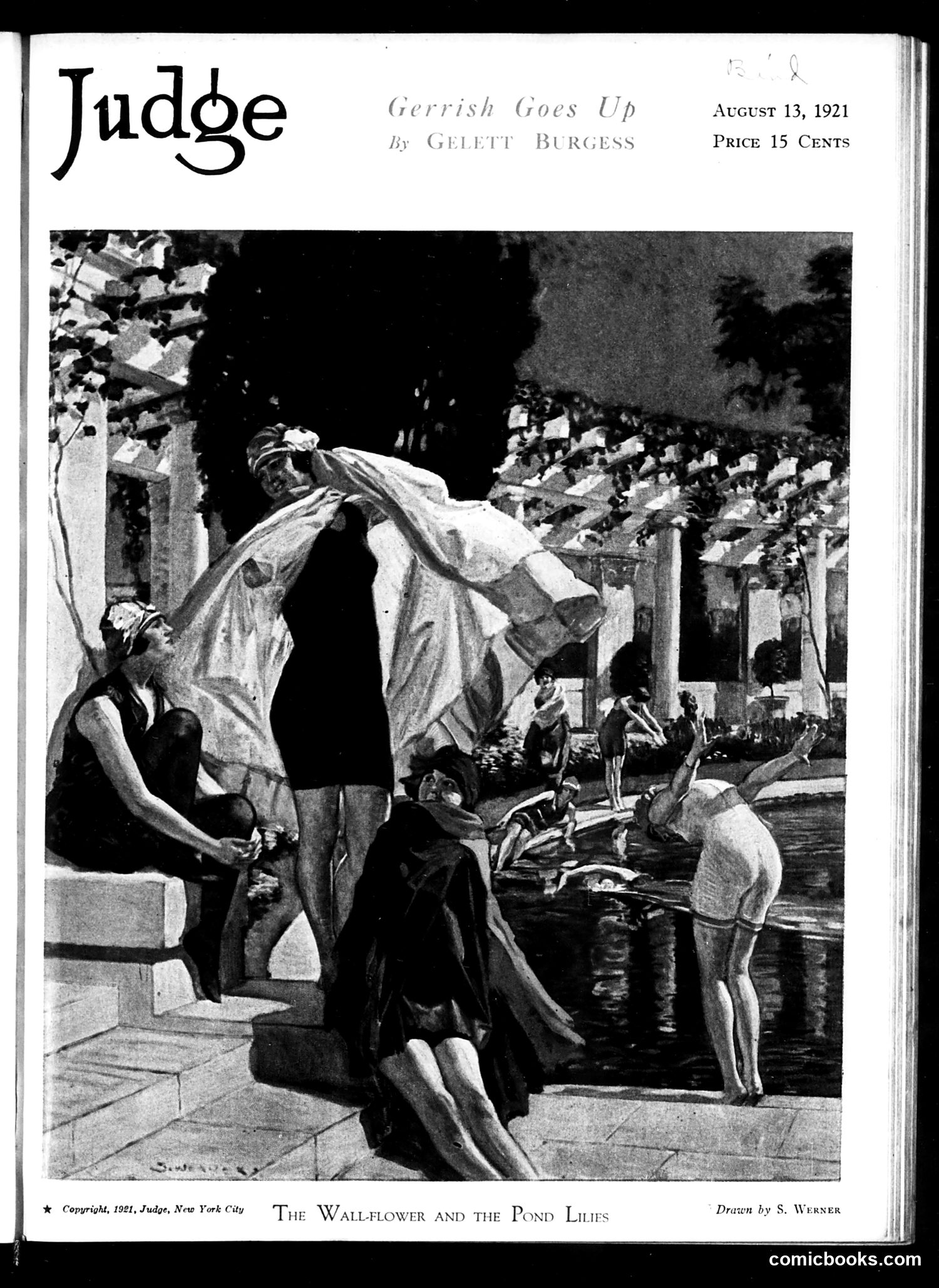
This illustration by S. Werner depicts a poolside social scene from summer 1921. A woman in an elegant dress stands prominently, displaying her outfit to observers at what appears to be a fashionable resort or bathing establishment. The title suggests social commentary on courtship dynamics: the "wallflower" (a woman without a dance partner, implying social rejection) contrasts with "pond lilies," likely referring to women actively enjoying attention at the water's edge. The cartoon satirizes 1920s dating culture and the anxieties surrounding female social status during the Jazz Age, when swimming and resort culture became increasingly popular leisure activities. The emphasis on display and observation critiques the competitive social hierarchies women navigated in this era.
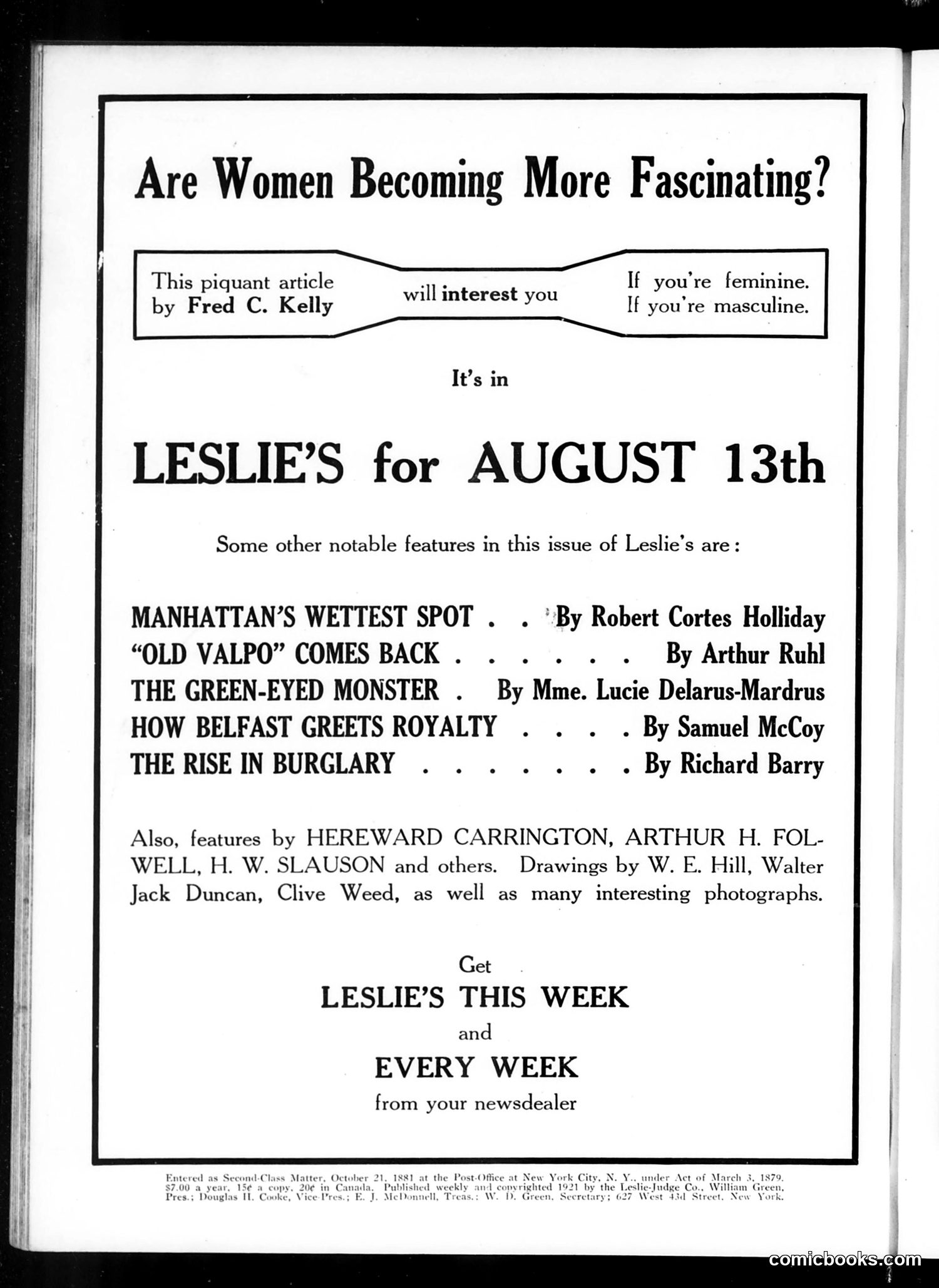
This page is primarily an **advertisement for Leslie's Weekly magazine**, not a political cartoon or satirical content itself. The ad's main headline—"Are Women Becoming More Fascinating?"—uses a somewhat patronizing appeal typical of early 20th-century advertising, suggesting the article by Fred C. Kelly will interest both "feminine" and "masculine" readers. The gendered language reflects period attitudes about gender roles. The ad lists various article topics: "Manhattan's Wettest Spot," "Old Valpo Comes Back," and "The Rise in Burglary," authored by established writers of the era. These appear to be typical magazine fare covering urban life, nostalgia, and crime—common subjects for illustrated weeklies of this period. The page essentially promotes Leslie's as essential weekly reading for a general audience.
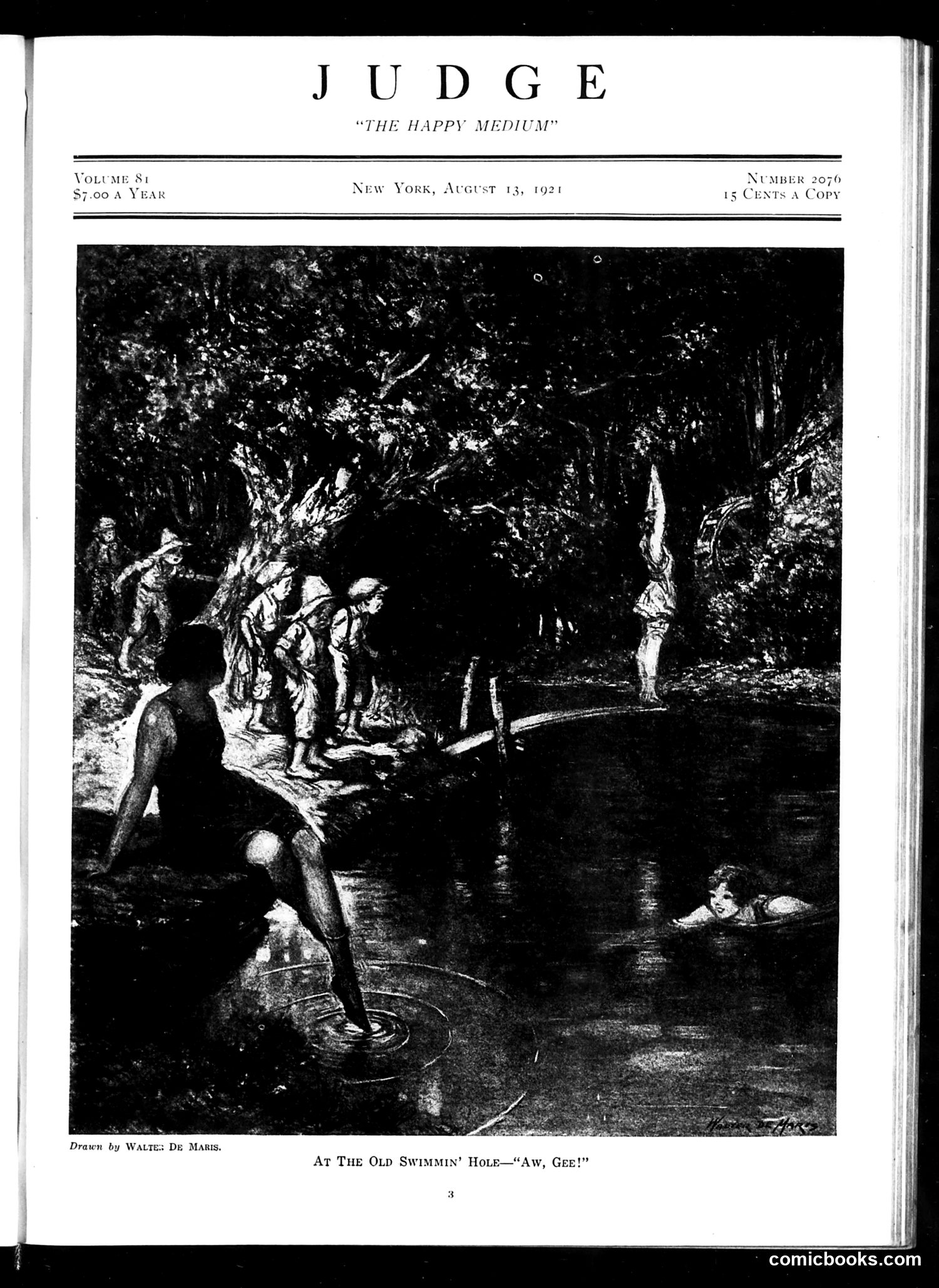
This illustration by Walter De Maris depicts a nostalgic, rural American swimming scene. A group of children and young people enjoy a natural swimming hole surrounded by trees, with some swimming and others standing on the bank. The caption "Aw, Gee!" suggests mild disappointment or surprise. Without additional context from the article text, the cartoon's specific satirical point is unclear. It may comment on simpler, innocent childhood pleasures, or possibly contrast rural versus urban life—common Judge magazine themes in 1921. The illustration's sentimental tone indicates this is likely a humorous or whimsical piece rather than sharp political satire, possibly nostalgic commentary on American rural life during the increasingly urbanized 1920s.
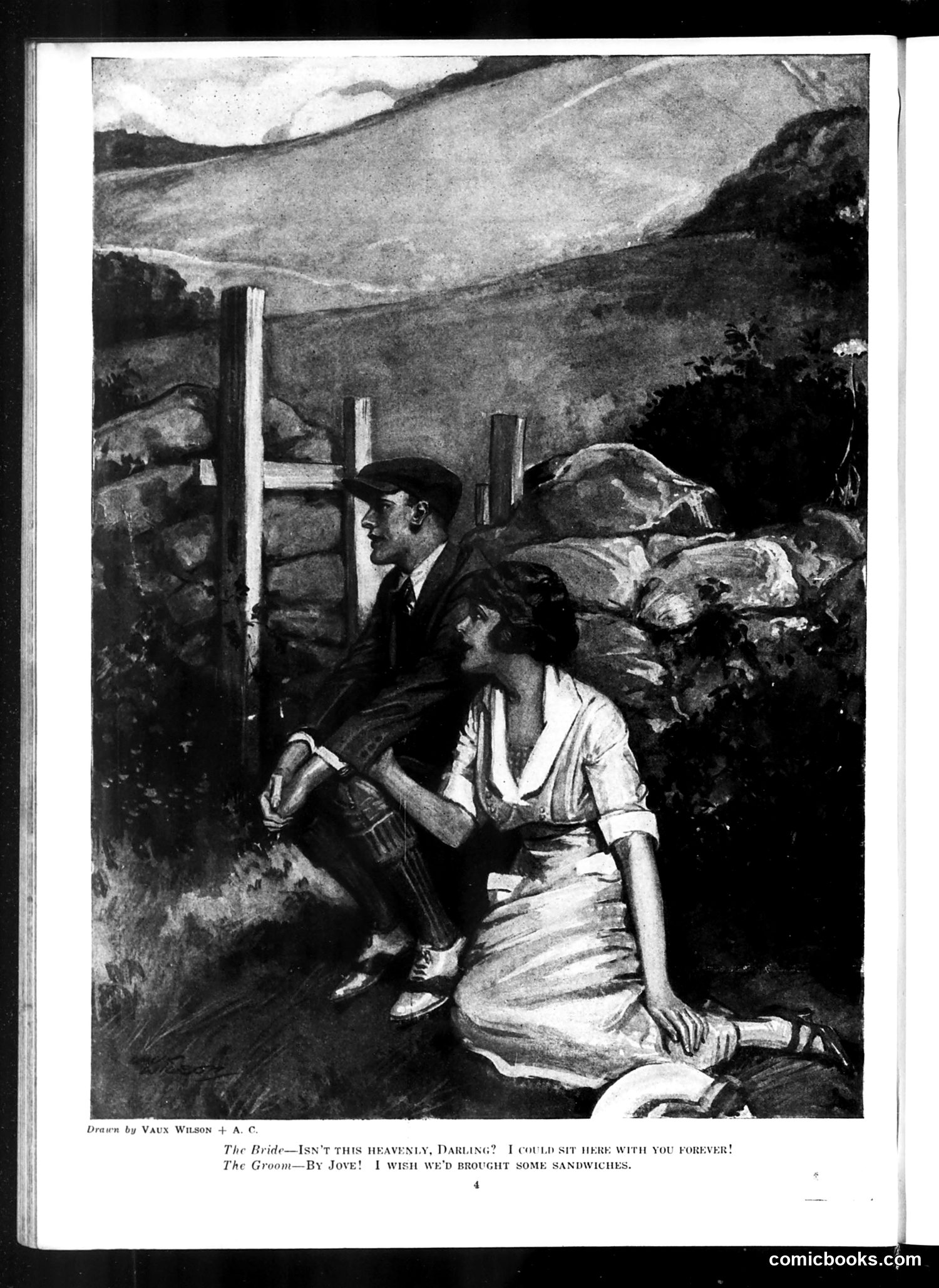
This illustration by Vaux Wilson depicts a romantic scene between a bride and groom in a rural, mountainous setting. The groom, dressed formally in a dark suit and hat, sits beside the bride in her white dress near a wooden gate with stacked rocks nearby. The dialogue reveals the joke's point: the bride romanticizes their pastoral location ("Isn't this heavenly, darling?"), while the groom pragmatically responds with hunger, wishing they'd brought sandwiches instead. The satire mocks the contrast between idealized honeymoon expectations and practical reality—a common theme in early-20th-century humor magazines like *Judge*. The groom's mundane concern undercuts the bride's romantic sentiment, suggesting that even newlyweds face ordinary hardships like hunger during their supposedly idyllic getaway.
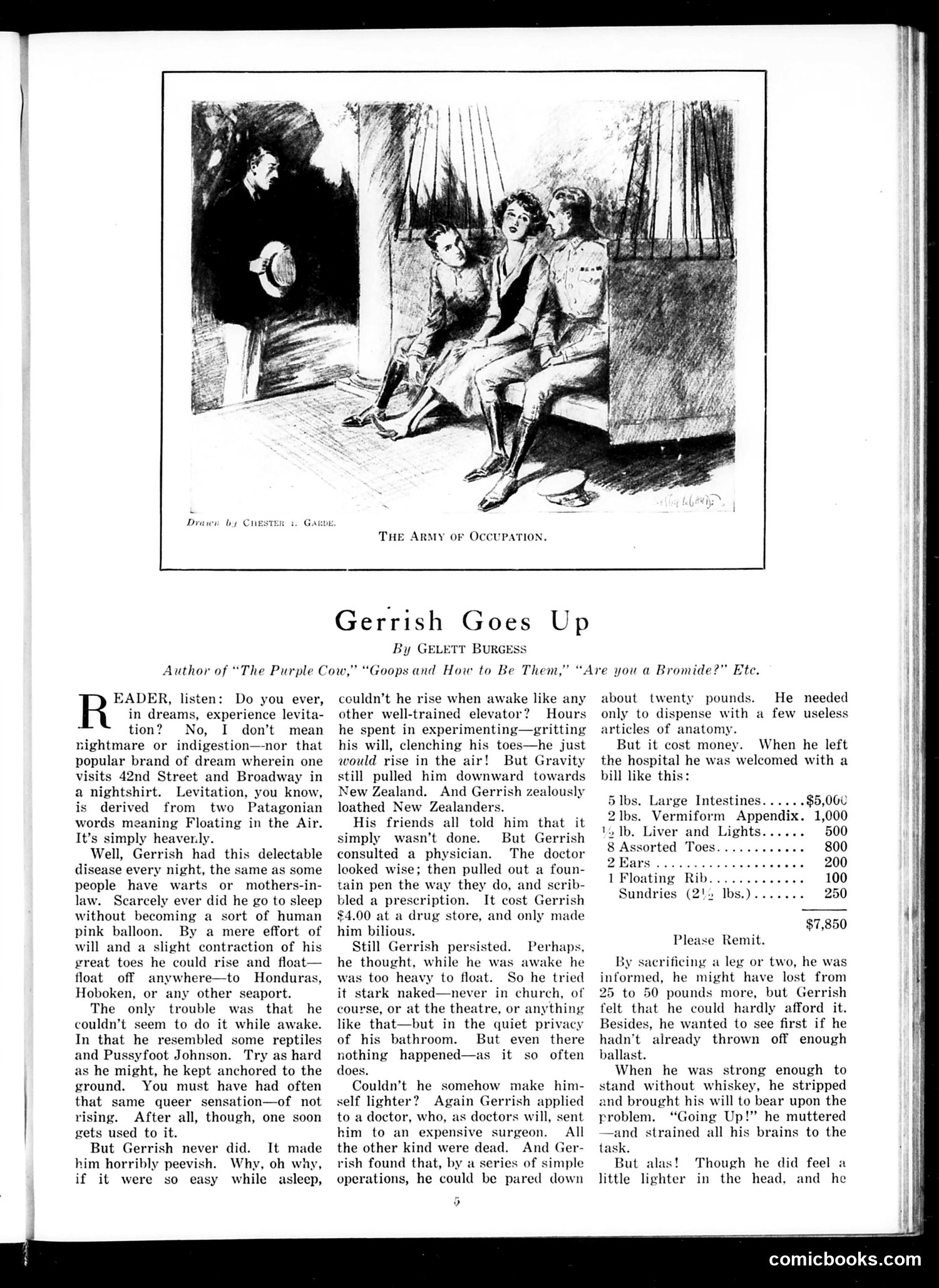
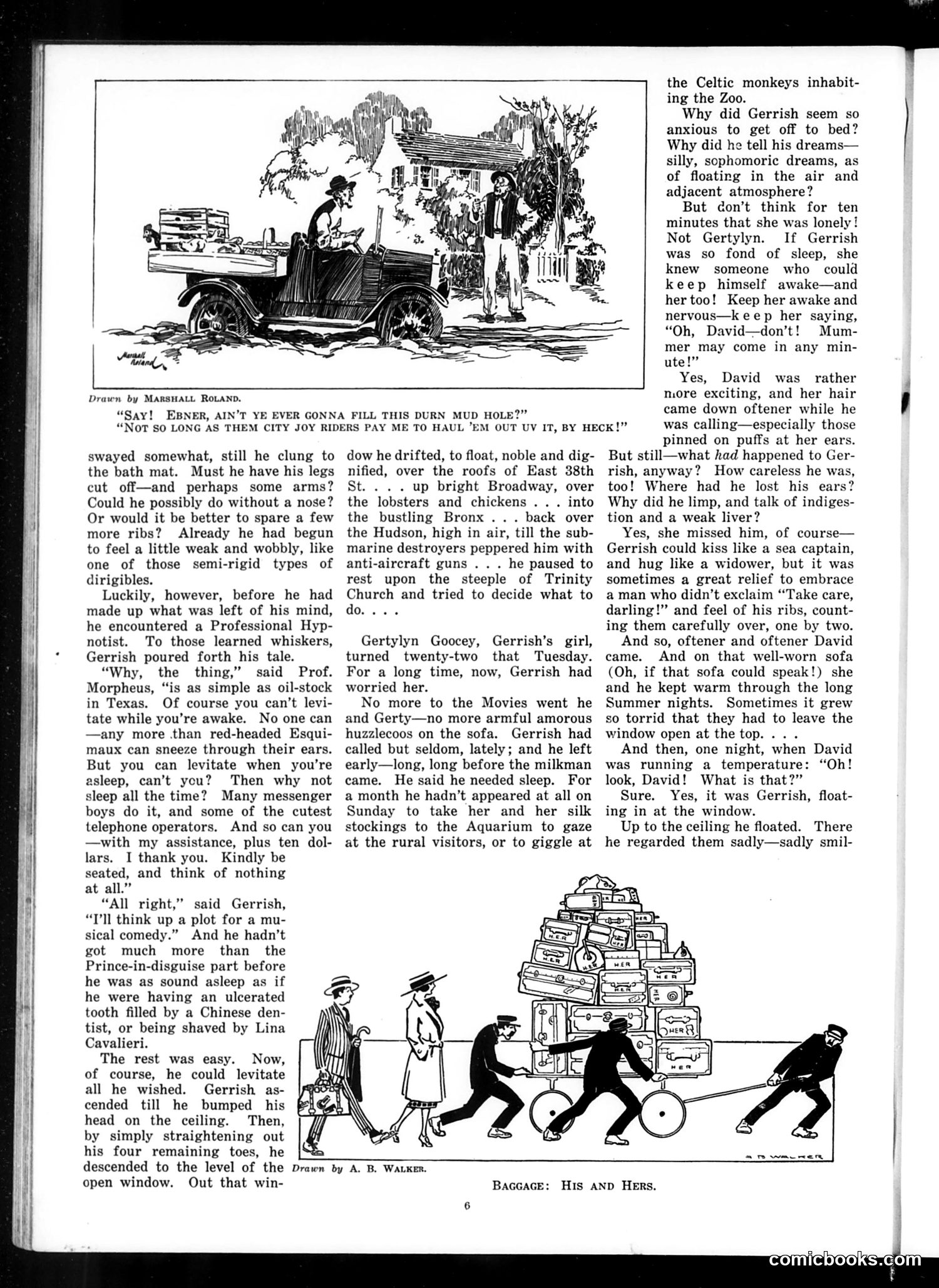
This page contains two illustrations satirizing early 20th-century urban life and travel: **Top illustration** ("Say! Enter, ye ever gonna fill this burn mud hole?"): Depicts a car stuck in muddy road conditions while passengers complain. The joke mocks the poor state of American roads despite the automobile age—a common complaint of the era when cars were becoming popular but infrastructure lagged. **Bottom illustration** ("Baggage: His and Hers"): Shows men struggling to transport an enormous stack of luggage, apparently belonging to a woman. This satirizes the era's stereotype about women's excessive travel baggage and shopping habits—a recurring theme in period humor about gender differences and consumerism. Both cartoons humorously critique the tensions between modern conveniences and their practical complications.
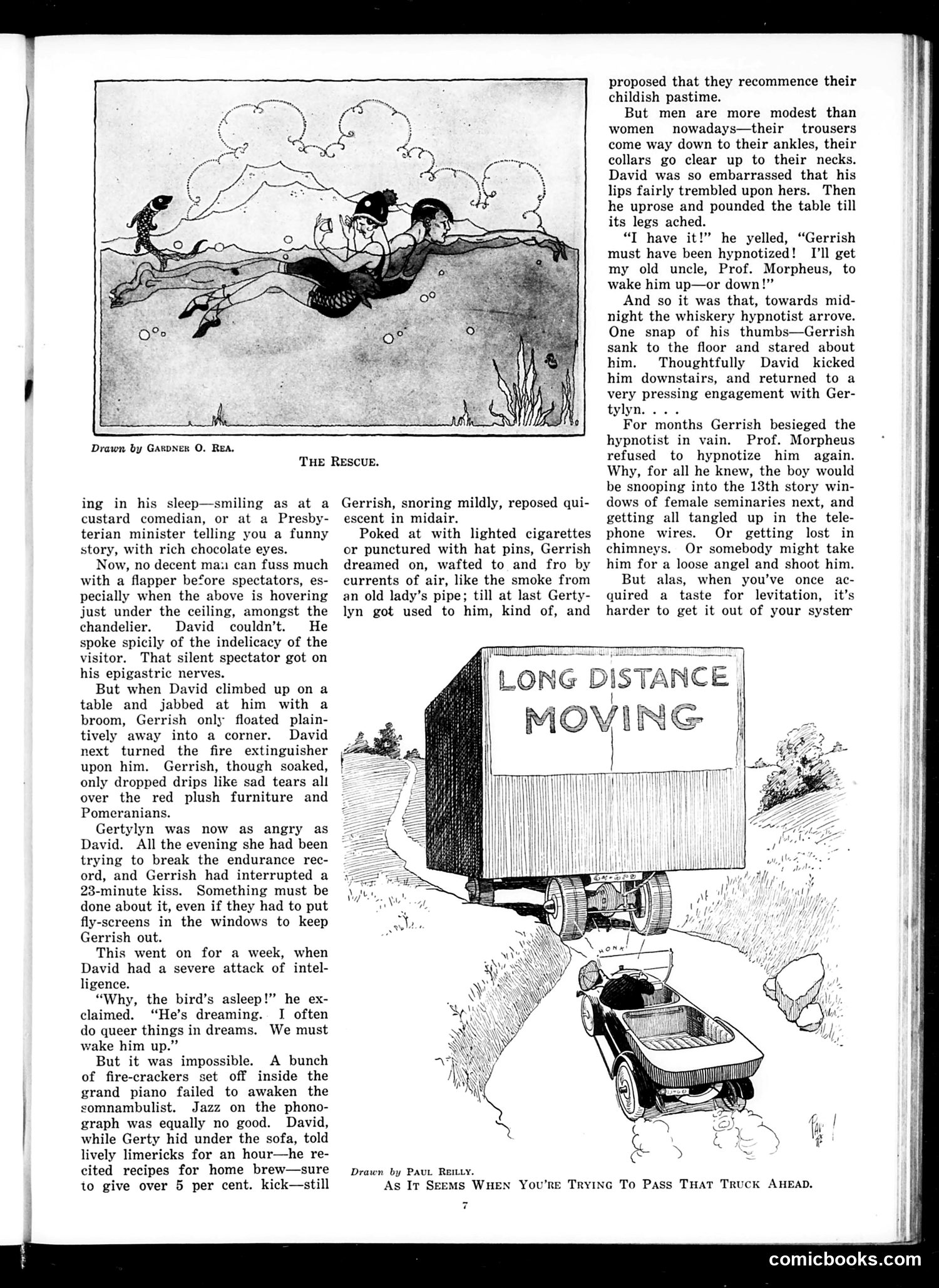
**"The Rescue"** (top): A humorous story about a young couple, David and Gertylyn, whose romantic encounter is interrupted by Gerrish, a man apparently under hypnosis who floats in the air. The satire mocks early 20th-century courtship etiquette—David is embarrassed by his own passion (modest men wore high collars and long trousers), while the persistent floating intruder becomes an absurd obstacle. The joke satirizes both romantic propriety and the era's fascination with mesmerism/hypnotism as a pseudo-scientific phenomenon. Eventually they solve the problem by hiring Prof. Morpheus (a pun on Morpheus, god of sleep) to wake him. **"Long Distance Moving"** (bottom): A cartoon by Paul Reilly showing a tiny car attempting to pass a large moving truck, appearing impossibly small by comparison. This is visual humor about the frustration of highway driving—the optical illusion makes passing feel impossible and absurd.
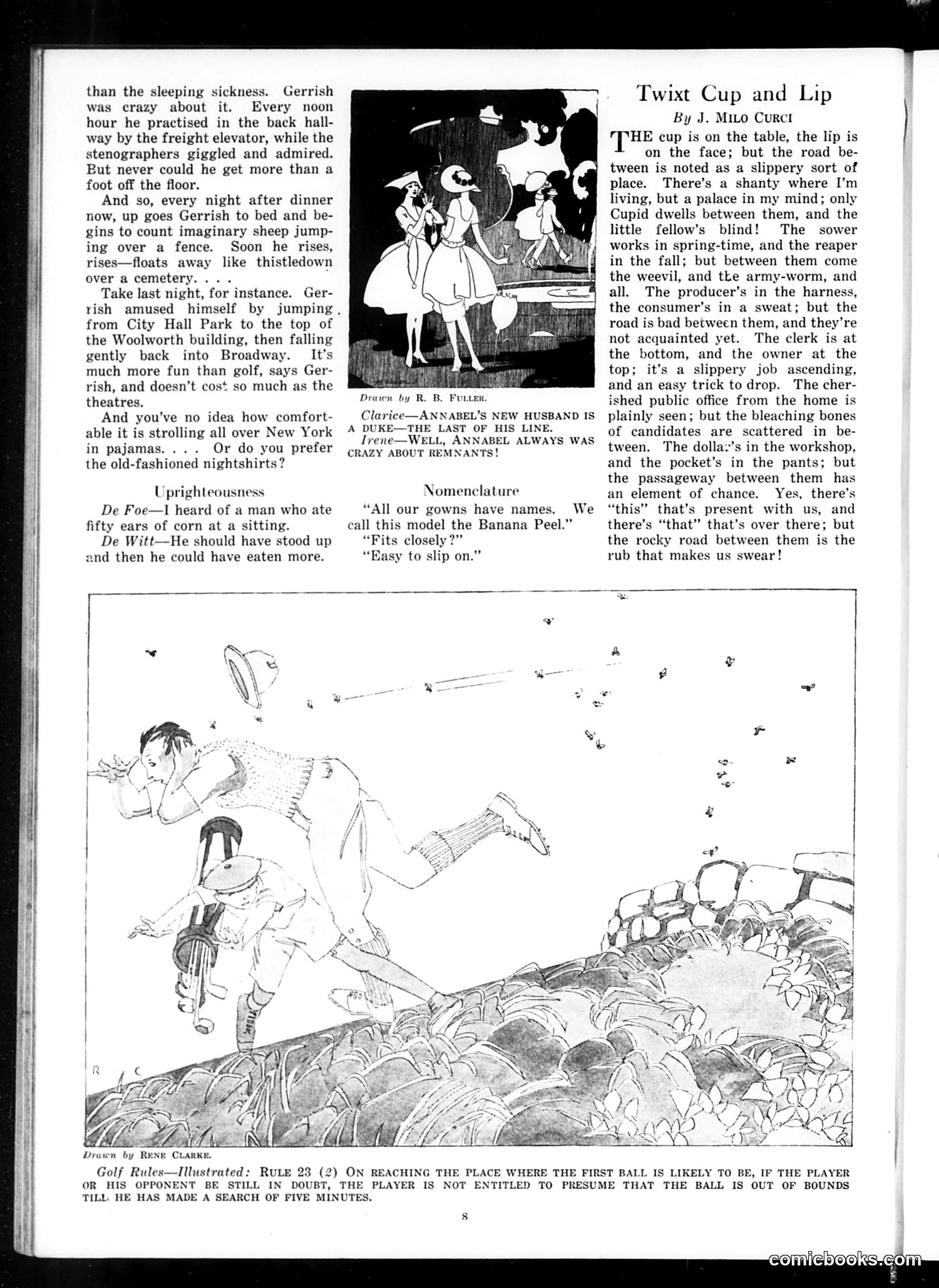
This page contains three distinct pieces of humor typical of early 20th-century Judge magazine: **"Uprightousness"** (top left): A brief joke about a man eating fifty ears of corn—the humor relies on the pun that standing up would allow him to eat more, playing on "uprighteous" (upright/righteous). **"Nomenclature"** (center): A fashion industry joke where dress names like "Banana Peel" are absurdly literal descriptions rather than elegant designations. The satire mocks commercial fashion marketing. **"Twixt Cup and Lip"** (right): A philosophical poem by J. Milo Curci exploring the gap between desire and achievement—between having something (the cup) and enjoying it (the lip). Uses farming, business, and social metaphors to illustrate how plans fail between conception and completion. **Golf cartoon** (bottom): An illustrated golf rule explaining that players cannot assume a ball is out of bounds without a five-minute search—satirizing golf's obsessive rule-consciousness and the sport's genteel pretension to precision. The page represents Judge's blend of social satire, wordplay, and contemporary cultural commentary.
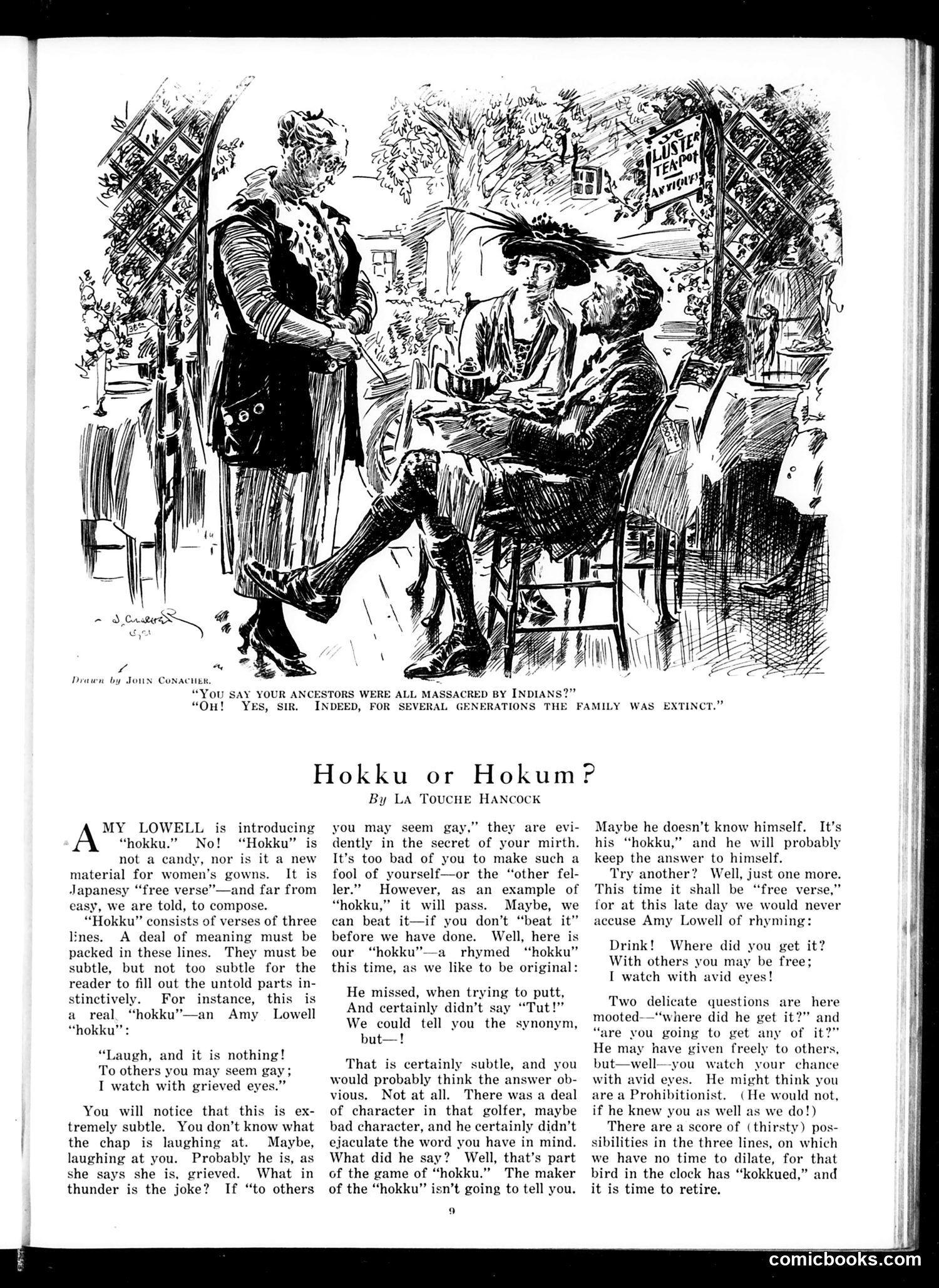
This article mocks the literary trend of "hokku" (Japanese free verse poetry), particularly as championed by Amy Lowell, a prominent modernist poet of the early 20th century. **The Satire:** The author argues that hokku is deliberately obscure and pretentious—verses packed with hidden meaning that readers must guess at, while the poet refuses to explain the point. The cartoon above illustrates this absurdity: a person boasts about ancestors massacred by Native Americans, a ridiculous "tragic" claim meant to exemplify the kind of vague, confusing subject matter hokku celebrates. **The Point:** Judge ridicules modernist poetry as meaningless obscurity masquerading as art. The author demonstrates this by composing deliberately cryptic hokku examples (about a golfer cursing, someone hiding alcohol) that are intentionally nonsensical—proving the form rewards confusion over genuine meaning. This reflects broader early-20th-century American skepticism toward avant-garde literary movements among mainstream audiences.
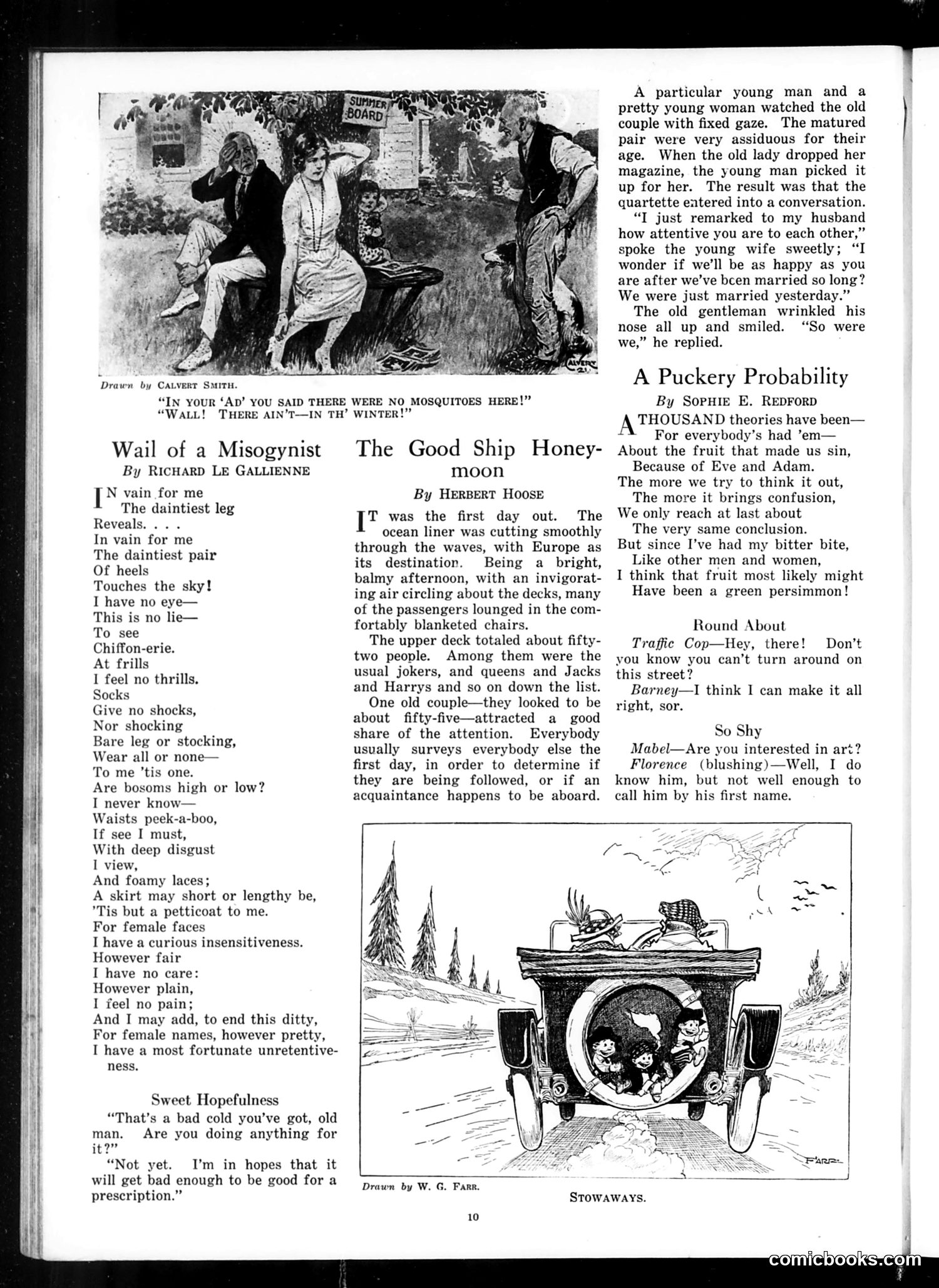
This page contains several satirical pieces typical of early 20th-century humor: **"Wail of a Misogynist"** presents a poem by a man claiming complete indifference to women's physical attributes—legs, clothing, faces, bosoms—framed as a virtue. The satire mocks misogynistic attitudes by having the speaker boast about his inability to appreciate or be affected by feminine appeal, suggesting such indifference is actually a character flaw dressed up as principle. **"The Good Ship Honeymoon"** depicts newlyweds observing an elderly couple on a ship and asking if they'll remain happy after decades of marriage. The joke's punchline—the old couple reveals they're also newlyweds—subverts expectations while gently suggesting marriage's honeymoon phase is brief. **"A Puckery Probability"** offers humorous theories about the forbidden fruit from Genesis, concluding it was likely a "green persimmon" (an astringent, unpleasant fruit), playing on the idea that sin tastes bitter. The page also includes brief comic exchanges about mosquitoes, colds, traffic violations, and shy romance—typical light social satire of the era.
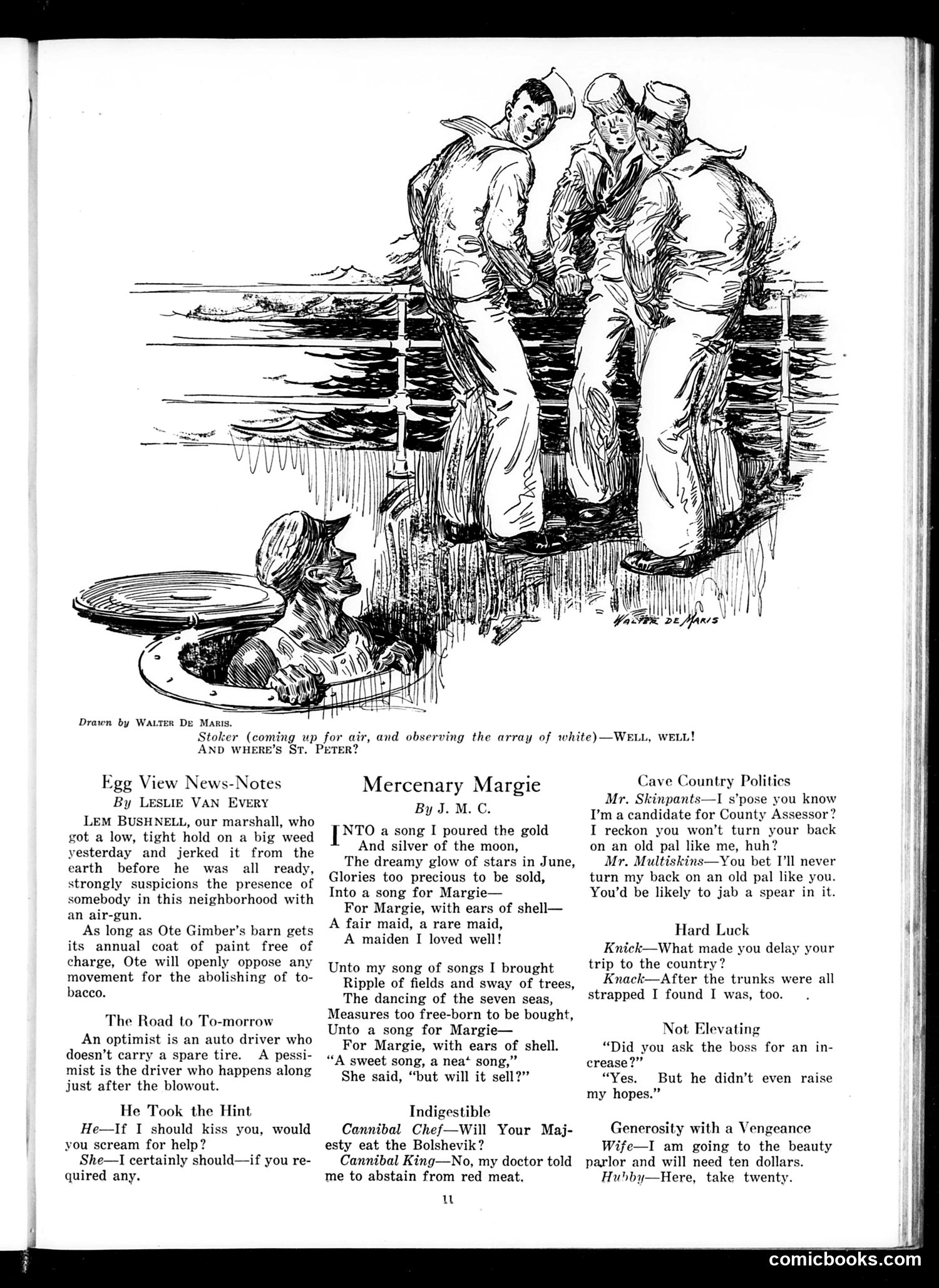
**Main Cartoon (top):** A stoker (ship's furnace worker) emerges from below deck surrounded by officers in white uniforms, quipping "Well, well! And where's St. Peter?" The joke satirizes the contrast between the grimy, hellish conditions of lower-deck workers versus the pristine upper ranks—suggesting the stoker has literally emerged from hell while the officers inhabit a heavenly realm. It's social commentary on class hierarchy and working conditions. **Text Content:** The page contains various short humorous pieces typical of Judge's satirical format: - "Mercenary Margie" mocks a woman who values commercial viability over romantic poetry - "Indigestible" satirizes Bolsheviks (Russian communists) through a cannibal allegory—coded as dangerous/unpalatable - "Cave Country Politics" jokes about rural political corruption and distrust - Other brief quips about optimism, romance, and labor relations **Overall:** This represents Judge's characteristic blend of class commentary, anti-communist sentiment (timely for the 1920s Red Scare era), and gentle social satire targeting American types and behaviors.
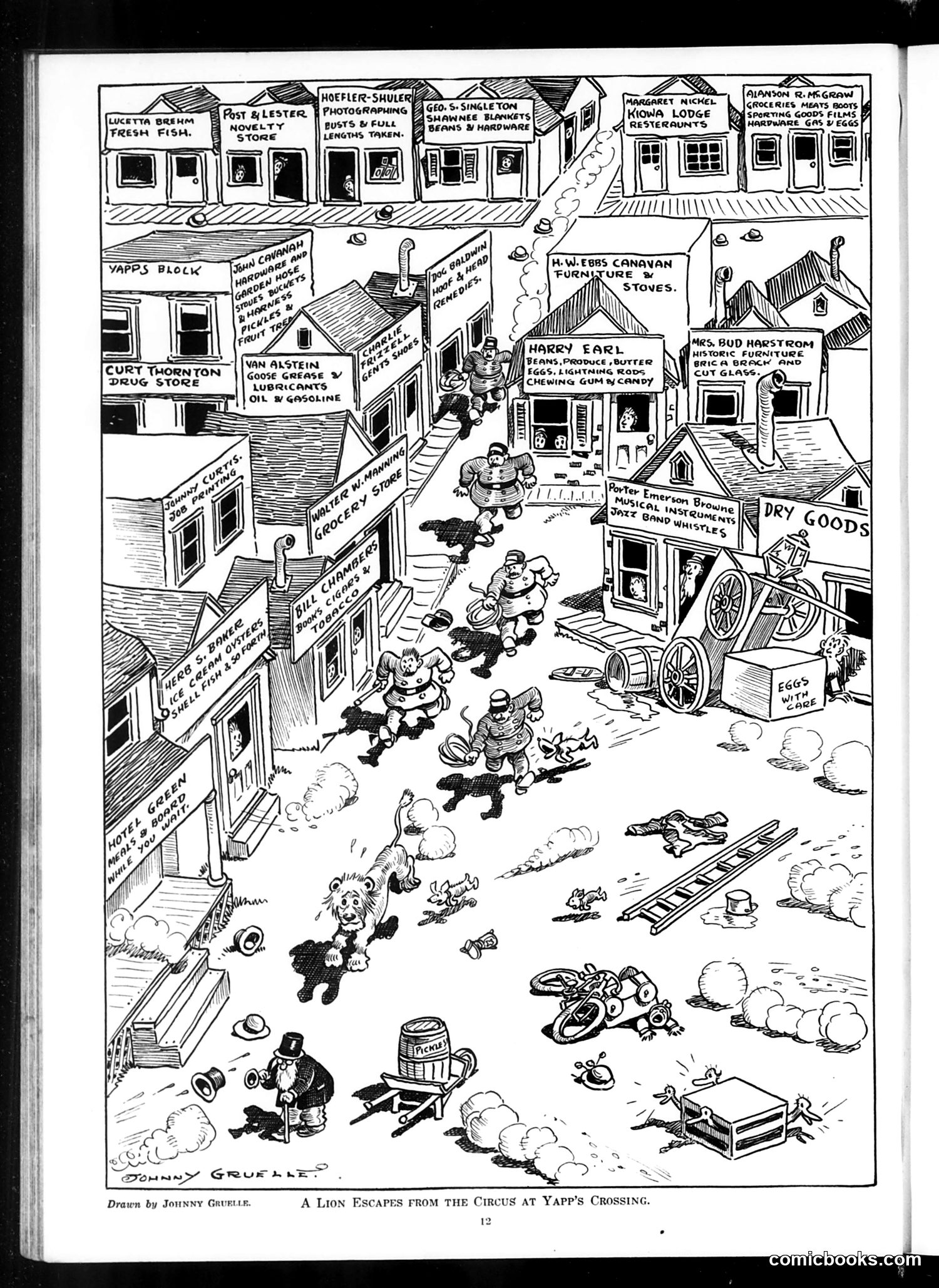
This is a humorous illustration by Johnny Gruelle depicting chaos in a small town when a circus lion escapes. The cartoon shows a street lined with local businesses (drug store, grocery, furniture shop, etc.) and townspeople—appearing to be children or simple folk—fleeing in panic as the lion roams the street. The satire likely mocks small-town life and its vulnerability to disruption, playing on the contrast between the ordinariness of local commerce and the exotic danger of circus wildlife invading this mundane space. The scattered debris, overturned carts, and frantic figures suggest slapstick comedy at the expense of rural communities. The specific shops and names visible appear to be references to actual Yapp's Crossing businesses, suggesting this may target a real location known to Judge's readers, adding a local mockery element to the humor.
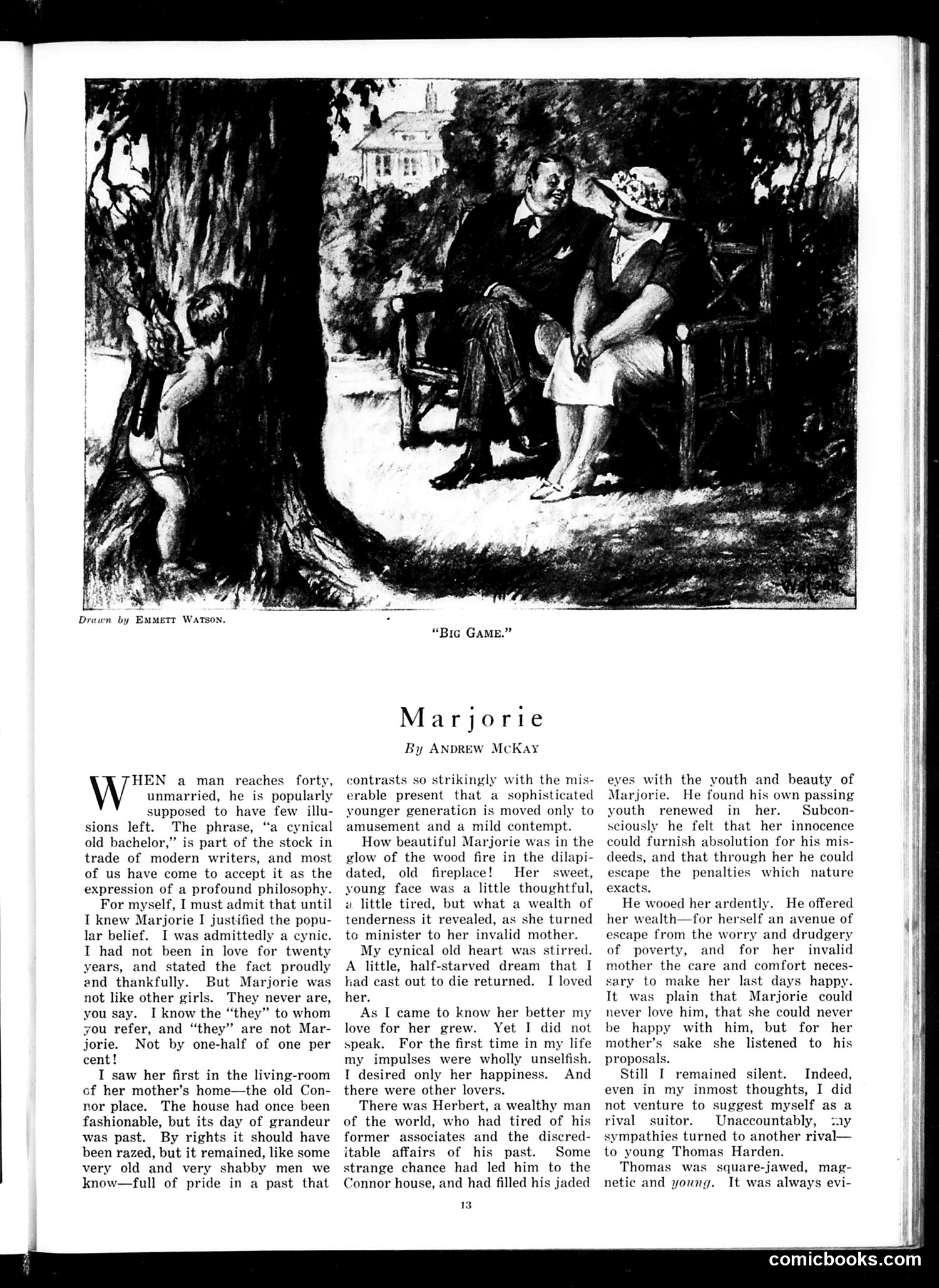
The page contains two unrelated items: an illustration titled "Big Game" drawn by Emmett Watson, and the opening of a serialized short story by Andrew McKay. **The Illustration:** Shows figures in a park or wooded setting with a Capitol building visible in the background. Without clearer detail, the specific satirical reference is unclear, though the Capitol suggests political content. **The Story:** A sentimental narrative about a cynical 40-year-old bachelor who falls in love with Marjorie, a poor but virtuous young woman from a once-fashionable family in decline. The story establishes a romantic triangle: wealthy suitor Herbert seeks to marry her (offering escape from poverty), while the narrator silently loves her, and a third rival—young Thomas Harden—also competes for her affection. The narrator renounces his own claims to her happiness, a typical Victorian sentiment about selfless love.
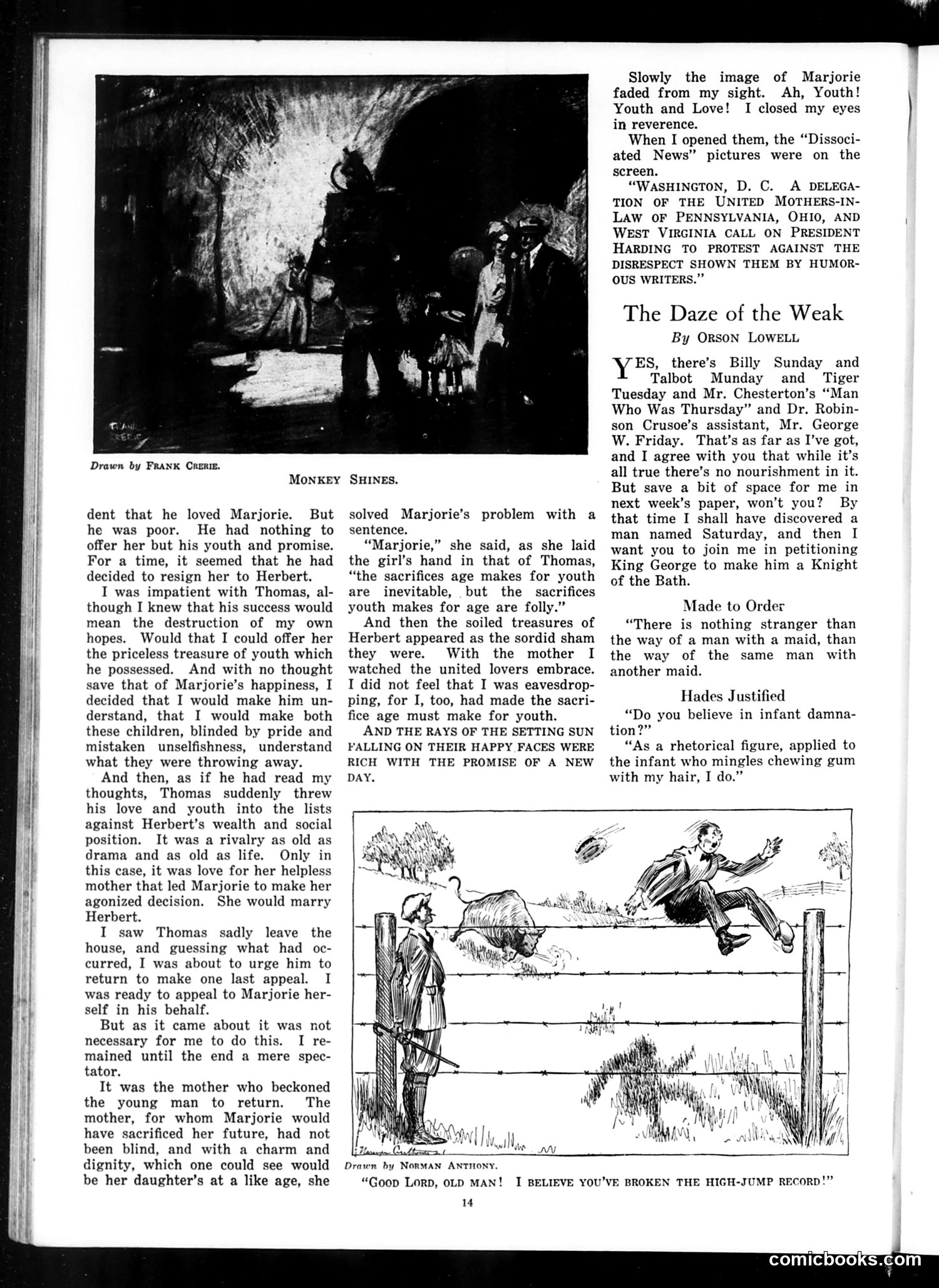
This page contains two distinct pieces of satirical content: **"Monkey Shines"** is a sentimental short story about young love versus financial security, where a poor man (Thomas) wins over a wealthy rival (Herbert) for Marjorie's hand, aided by her wise mother. The story celebrates youth and love over material wealth—typical melodramatic fare for the era. **"The Daze of the Weak"** by Orson Lowell is a humorous column that sarcastizes the sentimental story above. It mocks the overwrought sentimentality by referencing other popular literary works with days-of-the-week names (Billy Sunday, etc.), poking fun at the magazine's own earnest content. The political cartoon caption mentions President Harding and mothers-in-law from Pennsylvania, Ohio, and West Virginia protesting disrespect from "humorous writers"—likely a self-referential joke about Judge's own satirical approach. The bottom cartoon by Norman Anthony shows a man breaking a high-jump record, an absurdist sports gag unrelated to the page's other content.
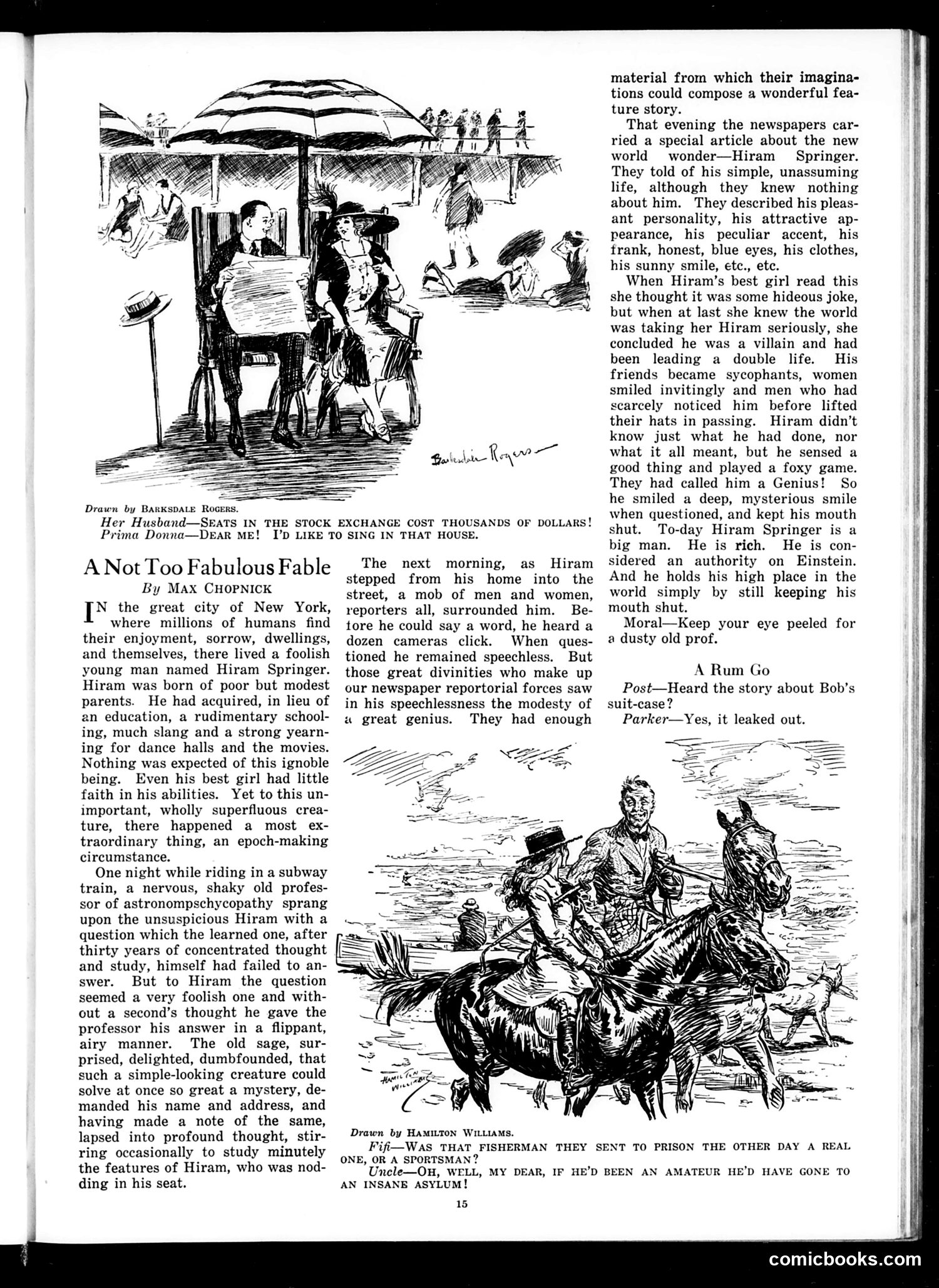
**Main Story: "A Not Too Fabulous Fable"** This satirical tale mocks both media sensationalism and public gullibility. Hiram Springer, an ordinary, uneducated young man, casually answers an obscure question from a professsor. Newspapers, misinterpreting his silence as mysterious genius, fabricate an elaborate false biography—inventing details about his personality, appearance, and intellect without knowing anything real about him. The satire targets press irresponsibility: reporters deliberately construct false narratives to create a compelling story. Society's response satirizes celebrity worship—friends become sycophants, strangers offer respect, all based on pure fabrication. Hiram profits by maintaining silence, implying that success often requires nothing but keeping quiet and letting others project greatness onto you. The moral warns readers to scrutinize authority figures who may be "dusty old prof[essionals]"—seemingly credible but actually unreliable sources. **Secondary Cartoons**: The top cartoon jokes about Stock Exchange seat costs versus opera house grandeur. The bottom cartoon presents a mild joke about a fisherman's leaked lawsuit (suit-case pun).
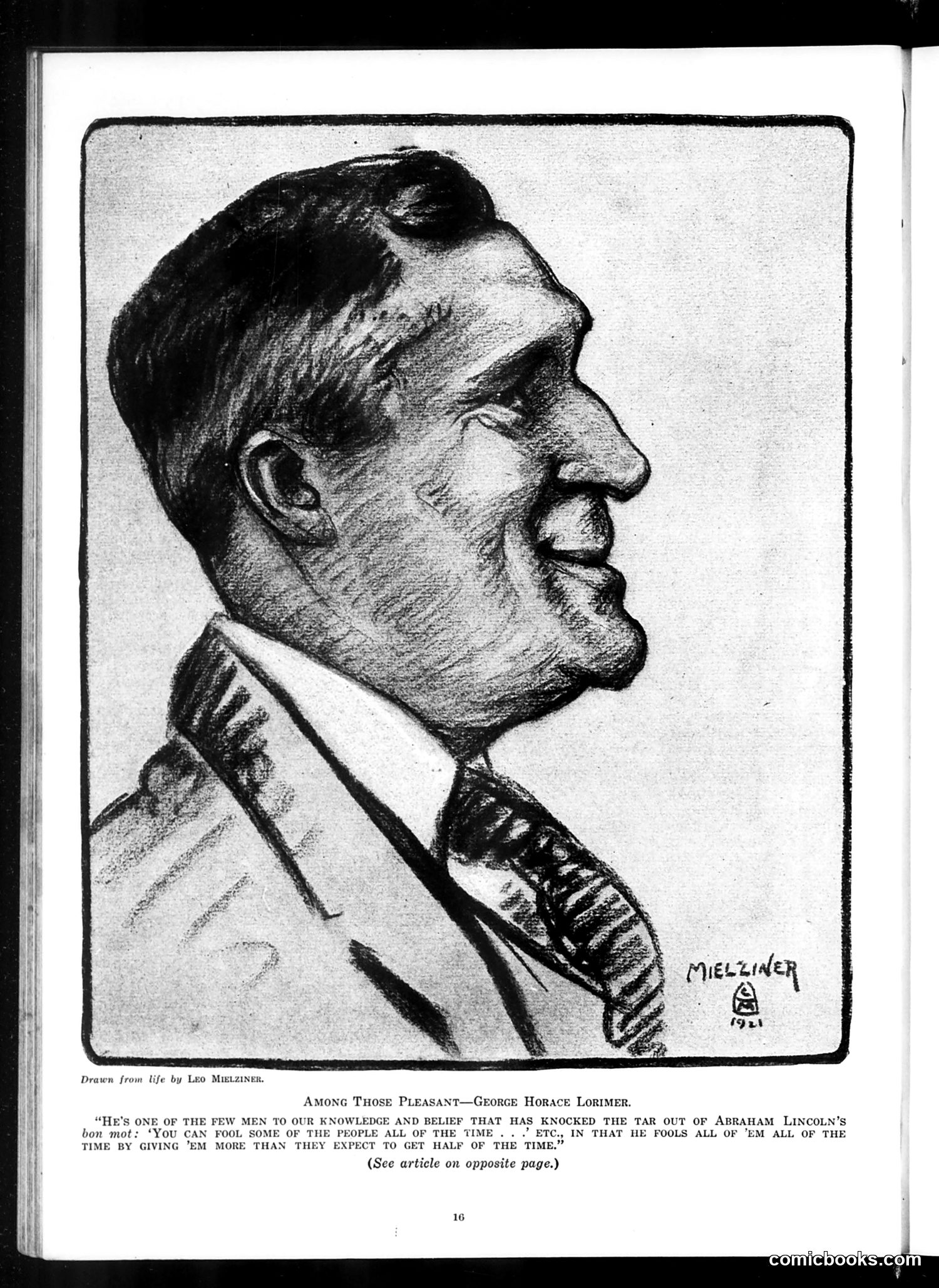
This is a portrait caricature of **George Horace Lorimer**, drawn by Leo Mielziner for *Judge* magazine. The accompanying text satirizes Lorimer by comparing him to Abraham Lincoln's famous quote about fooling people ("You can fool all of the people some of the time..."). The satire suggests Lorimer is one of those rare men who has "knocked the tar out of" Lincoln's bon mot—meaning he successfully contradicts it. The incomplete text implies Lorimer fools people by giving them "less than they expect" while getting more time/success than warranted. Lorimer appears to have been a public figure of some prominence (likely connected to publishing or journalism based on *Judge's* context), and this cartoon mocks his manipulative or deceptive nature. Without seeing the full article referenced on the opposite page, the precise complaint remains unclear, but the satire centers on his alleged duplicity.
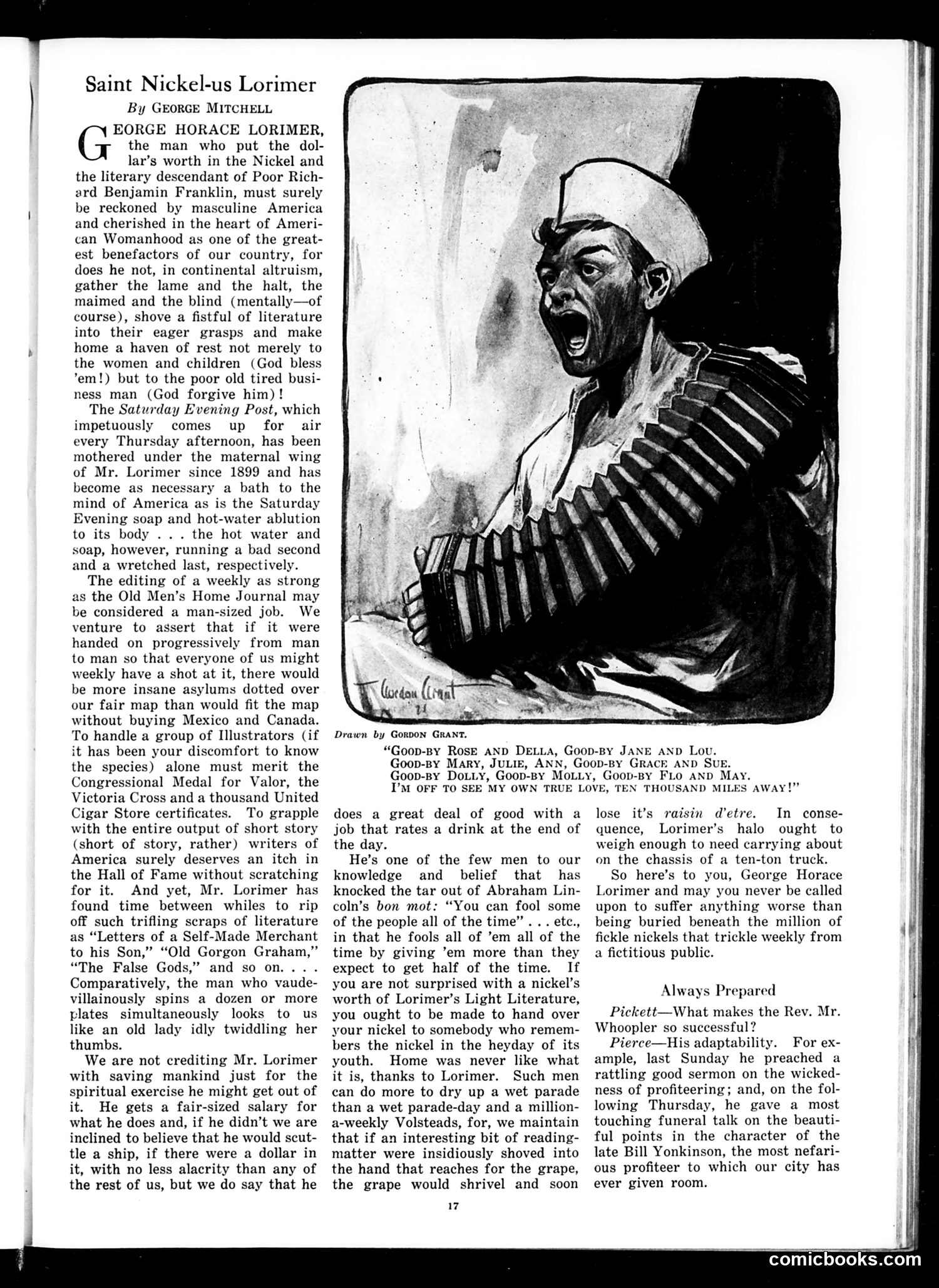
This page satirizes **George Horace Lorimer**, editor of the *Saturday Evening Post* since 1899, praising him as a public benefactor who provides quality literature cheaply (for a nickel) to ordinary Americans—particularly tired businessmen and families. The accompanying illustration by Gordon Grant depicts a man (likely representing the idealized working-class reader) joyfully departing on a romantic journey, singing about leaving to see his "true love, ten thousand miles away." The caption lists female names—Rose, Della, Jane, Mary, Julie, Ann, Grace, Sue, Dolly, Molly, and May—suggesting the Post's sentimental stories appeal to romantic fantasies. The satire works on two levels: Mitchell's text genuinely praises Lorimer's editorial accomplishment as nearly miraculous (comparing managing illustrators and writers to performing impossible feats), while the illustration mocks the escapist, sentimental content the Post actually peddles—offering working people romantic fantasies rather than substantive literature. The "nickel's worth" becomes both genuine value and modest escape fiction.
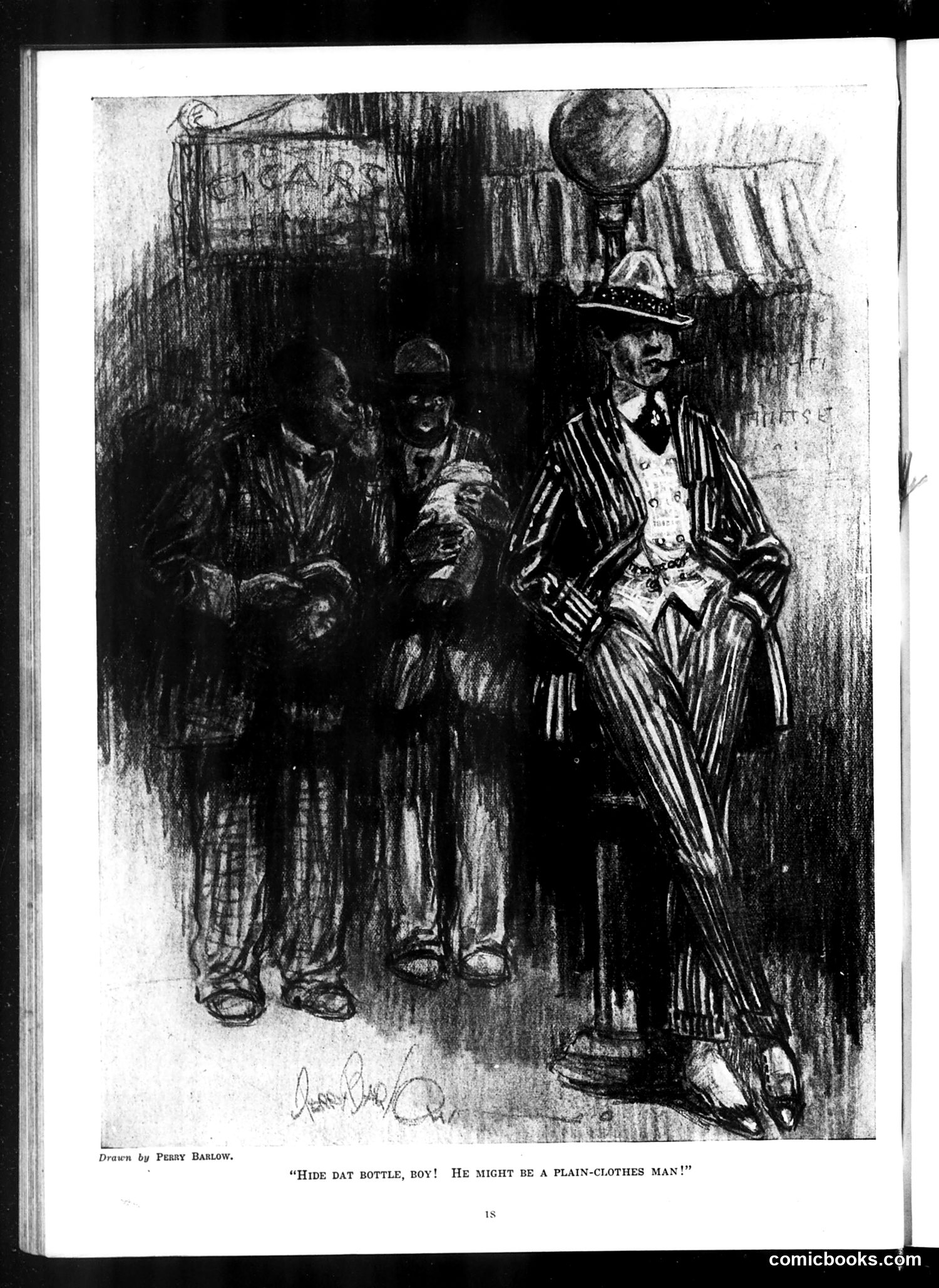
This 1890s-era Judge cartoon depicts a racial stereotype scene with three figures in lower-class dress encountering a well-dressed man in a pinstriped suit and hat. The caption warns one character to hide a bottle because the stranger might be a plainclothes police officer. The satire targets Prohibition-era enforcement and working-class evasion of alcohol laws. The caricatured figures appear to represent Irish or immigrant laborers—common subjects of Judge's often crude humor. The joke relies on depicting poor communities as lawbreakers habitually concealing illegal liquor from undercover law enforcement. The cartoon reflects both Gilded Age class attitudes and the social tensions around Prohibition, though its racial characterizations are offensive by modern standards.
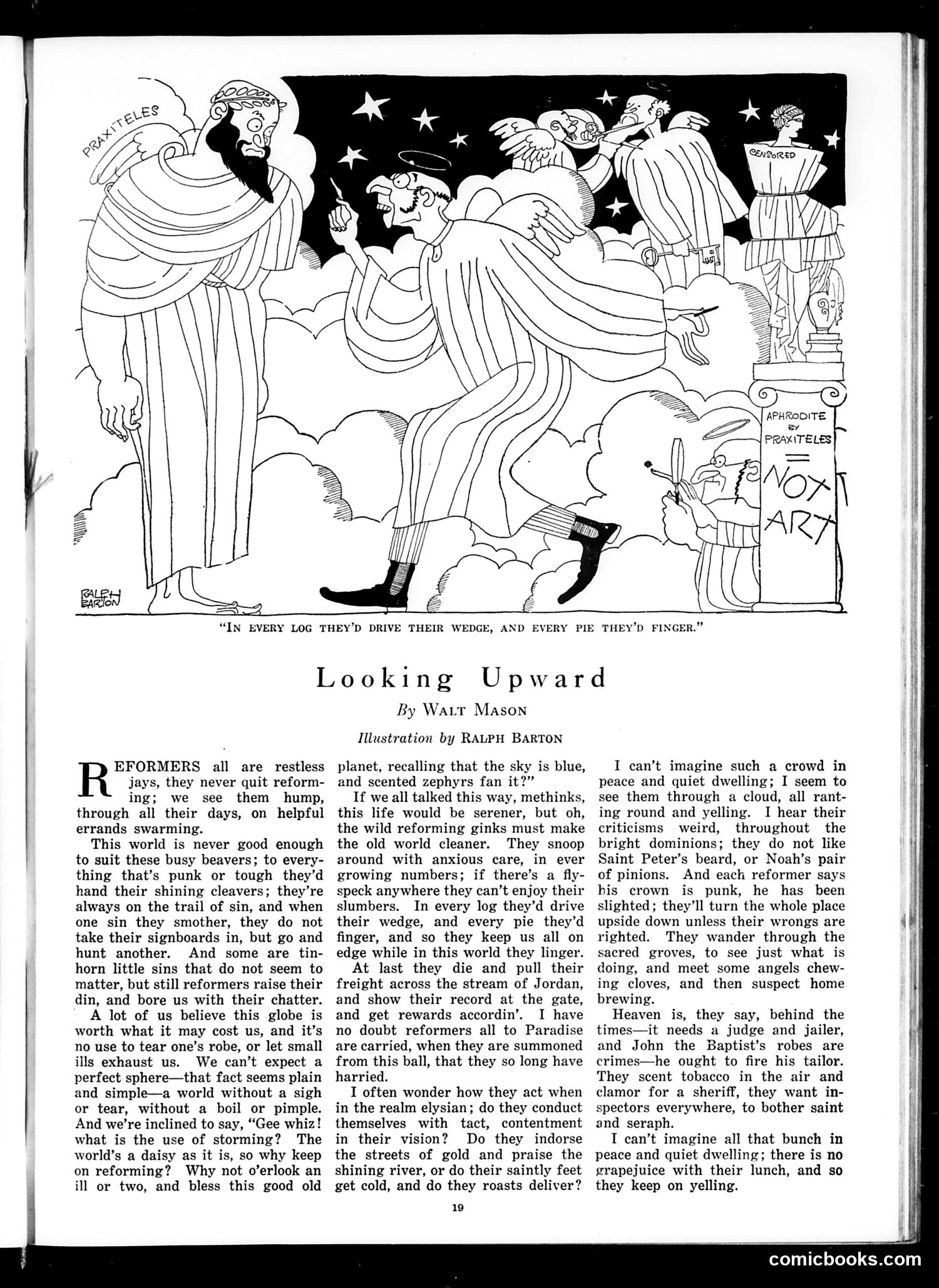
This page satirizes **social reformers and crusaders** through both visual and textual mockery. The illustration depicts classical and biblical figures in heaven—identifiable by references to Aphrodite, Praxiteles, and religious imagery—alongside modern figures, suggesting reformers invade even paradise with their complaints. Walt Mason's poem ridicules the relentless activism of his era's reform movements (Progressive Era crusades against vice, labor issues, etc.). The satire argues reformers are never satisfied—they obsess over trivial grievances ("tin-horn little sins"), remain perpetually agitated, and would complain even in heaven itself, criticizing Saint Peter's appearance and demanding inspectors and sheriffs among the angels. The cartoonist (Ralph Barton) visualizes this by showing the heavenly realm disrupted by arguing, gesticulating figures—implying reformers' inability to ever find peace. The humor targets what conservatives viewed as the self-righteous sanctimoniousness and exhausting perpetual activism of Progressive reformers.
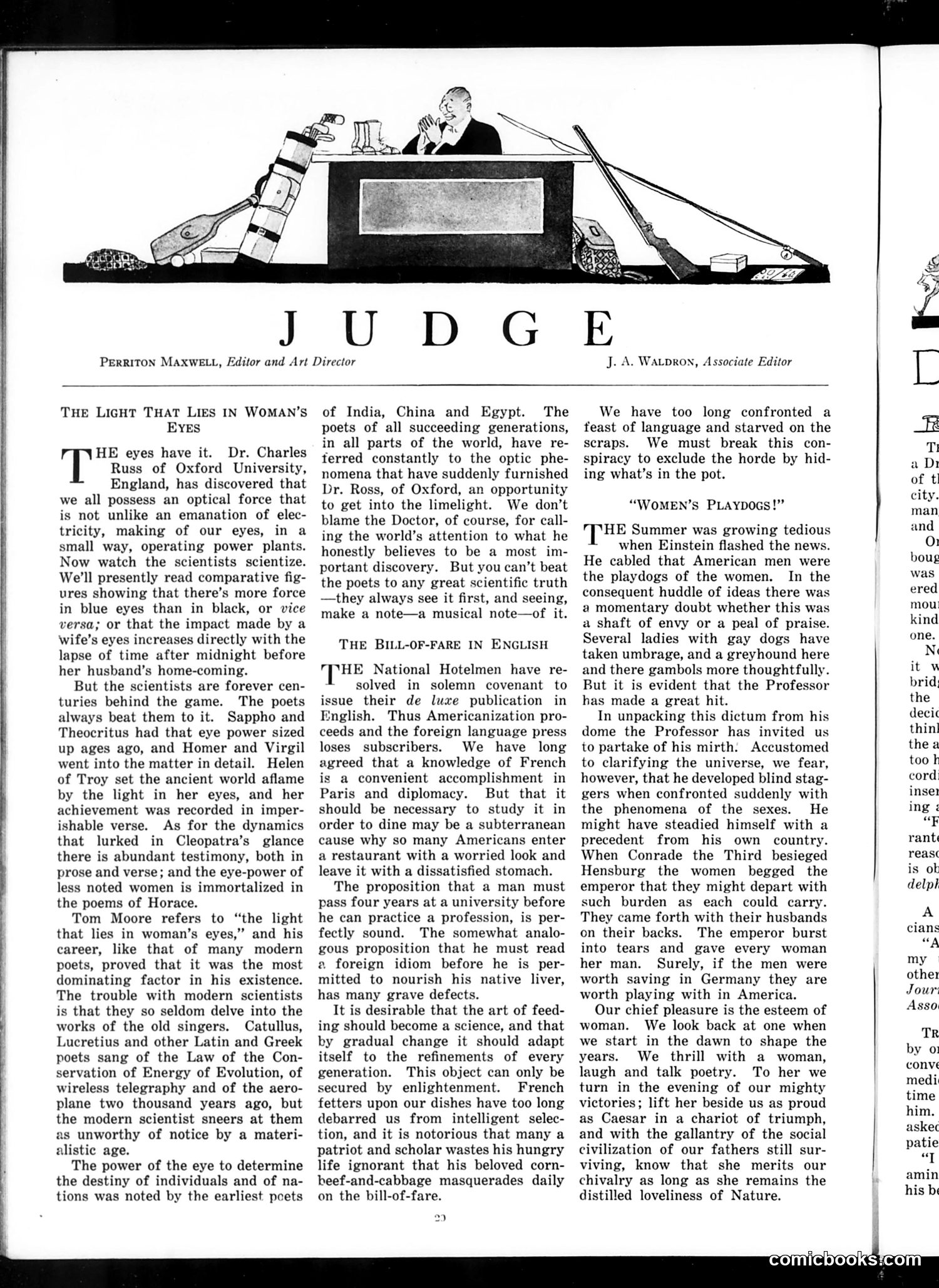
The page contains three distinct editorial pieces satirizing contemporary issues: **"The Light That Lies in Woman's Eyes"** mocks modern scientists for claiming to have "discovered" that eyes emit electrical force—a concept poets have understood for millennia. The author argues classical poets (Homer, Virgil, Sappho) already documented female ocular power through Helen of Troy and Cleopatra, yet modern materialistic science dismisses ancient wisdom. This critiques scientific arrogance and materialism. **"The Bill-of-Fare in English"** satirizes American hotel restaurants' decision to publish menus in English rather than French. Judge argues that while French knowledge suits Paris diplomacy, forcing American diners to study foreign languages before eating is absurd. The piece mocks the pretension of French cuisine terminology while championing American practicality and patriotism. **The masthead illustration** depicts a judge at his bench—standard Judge magazine branding. Both pieces represent early 20th-century American cultural anxieties: defending classical learning against scientific materialism, and asserting American independence from European cultural pretension.
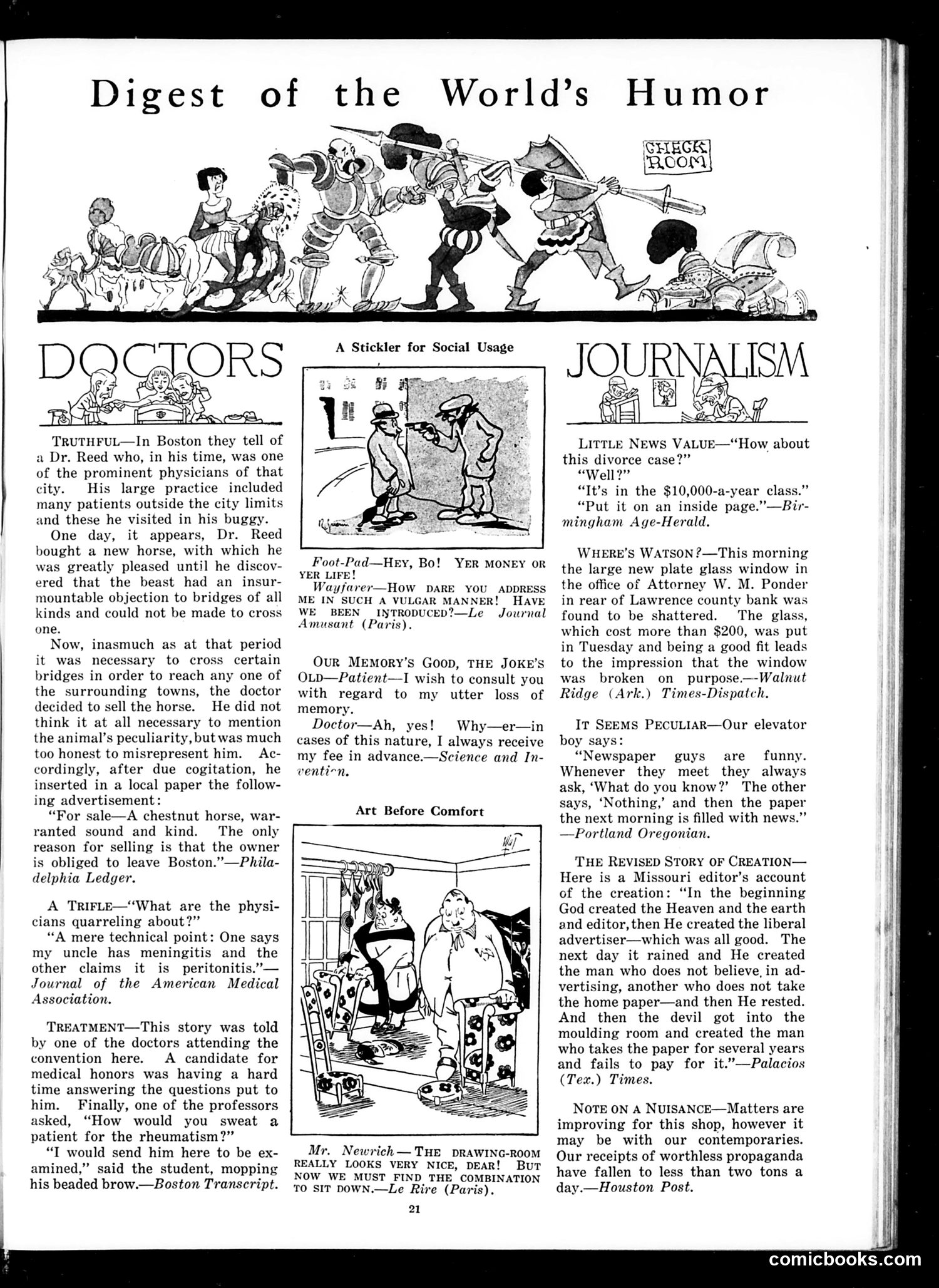
This is a humor compilation page mixing jokes and satirical observations about professional life and social behavior circa early 20th century. **Key content:** The "Doctors" section mocks medical professionals—one story ridicules a Boston physician's deceptive horse sale (withholding its bridge-phobia), another jokes about doctors' technical jargon and mercenary fee-collection. **"Journalism"** satirizes newspaper priorities: editors bury a $10,000 divorce case as "little news value," and a glass-window sabotage becomes notable only because journalists themselves find it interesting. An elevator boy observes that reporters constantly ask "What do you know?" then publish "nothing" as news—mocking journalists' pretense of always having information. **"Art Before Comfort"** features a wealthy parvenu ("Mr. Newrich") who buys fashionable but unusable furniture, unable to sit. The page also includes international humor translations, suggesting Judge presented cosmopolitan satire. Overall, it targets professional pomposity, journalistic superficiality, and nouveau-riche pretension.
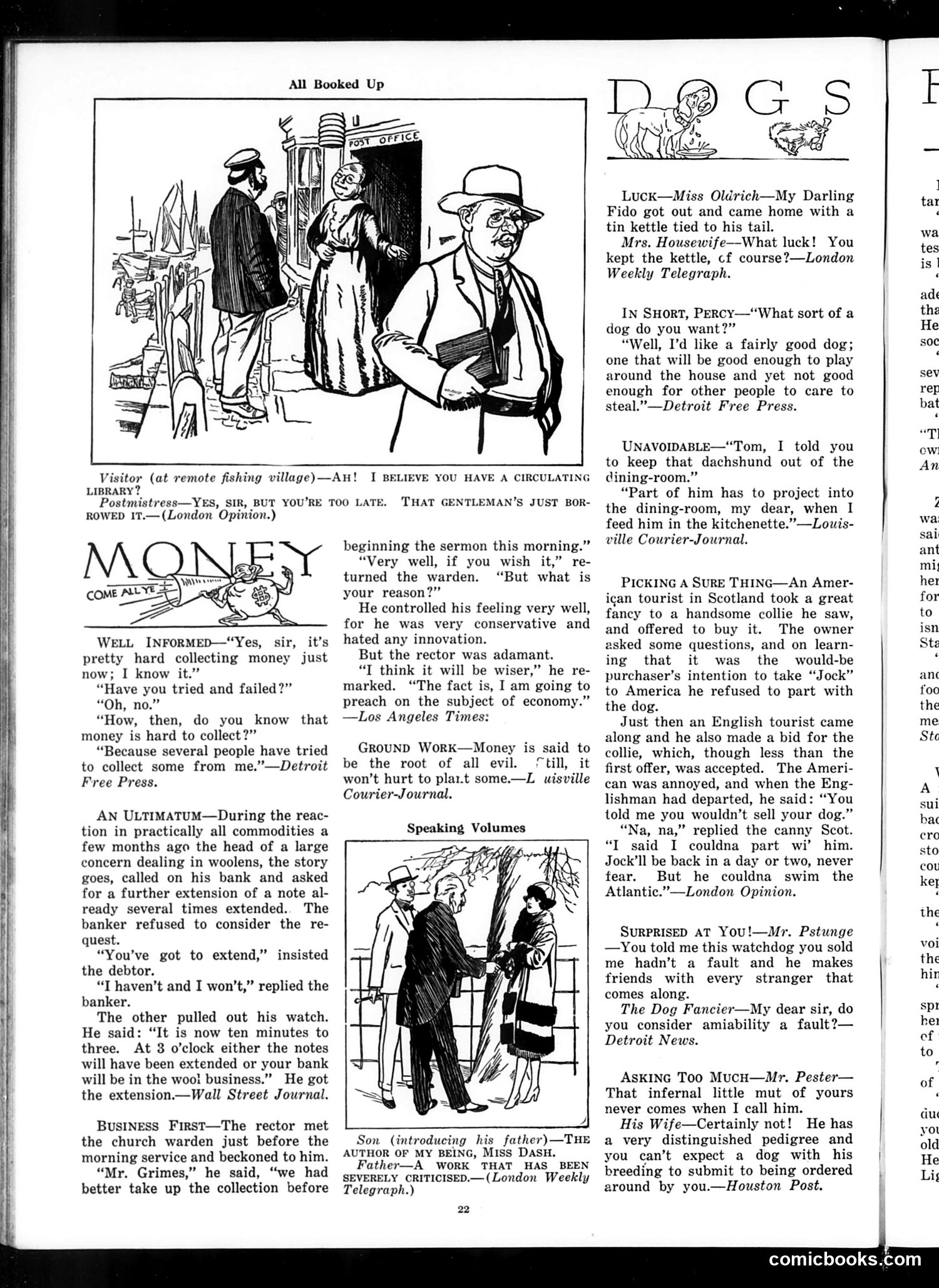
This page contains multiple short humorous anecdotes and jokes typical of Judge magazine's satirical format, rather than a single political cartoon. The main cartoon ("All Booked Up") depicts a library patron at a remote fishing village post office, discovering a circulating library has already closed—a joke about rural isolation and limited access to cultural resources. The page's humor focuses on **economic anxieties of the era** (likely early 1900s): debt collection difficulties, bank extensions during commodity price fluctuations, and financial pressure. The "Ultimatum" anecdote shows a debtor threatening bankruptcy to force loan extension—dark humor about economic desperation. Other jokes address **domestic life and class concerns**: servants' behavior, dog ownership among different social classes, Scottish frugality, and the rector's ironic sermon on economy before collection. The humor is genteel and conservative, targeting pretension, poor planning, and social ambition rather than political figures. These are relatable everyday frustrations for Judge's middle-class audience.
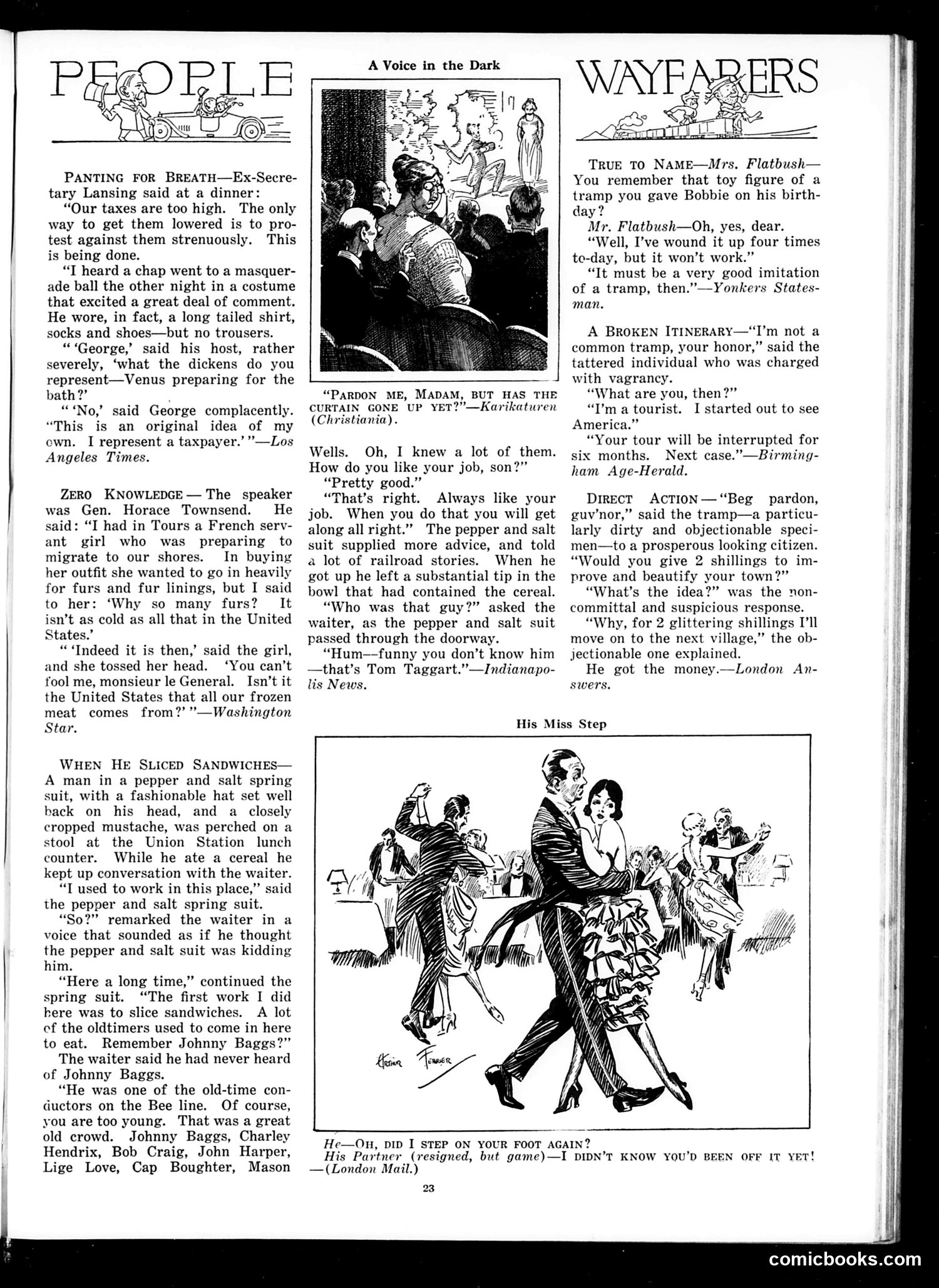
This page contains several satirical anecdotes targeting **high taxes** and **social types** common in early 20th-century America. **"Panting for Breath"** jokes about tax burden by describing a man at a masquerade dressed only in a long shirt—representing a "taxpayer" stripped of everything. The humor relies on the absurdity of minimal dress as metaphor for financial depletion. **Other pieces mock various character types**: a French servant girl's ignorance about American climate, nostalgic railroad workers, and particularly **tramps**—a recurring target. Multiple anecdotes portray tramps as con artists or vagrants (one claims to be a "tourist," another extorts money through threatened vagrancy). **"His Miss Step"** cartoon (bottom) depicts a couple dancing, with the caption suggesting the man has stepped on his partner's foot repeatedly. The **"Voice in the Dark"** illustration shows a theater audience, with someone asking if the curtain has risen—likely satirizing theater-goers' inattention or confusion. The overall tone reflects Gilded Age anxieties: tax complaints, labor nostalgia, and class anxiety about vagrants and social disorder.
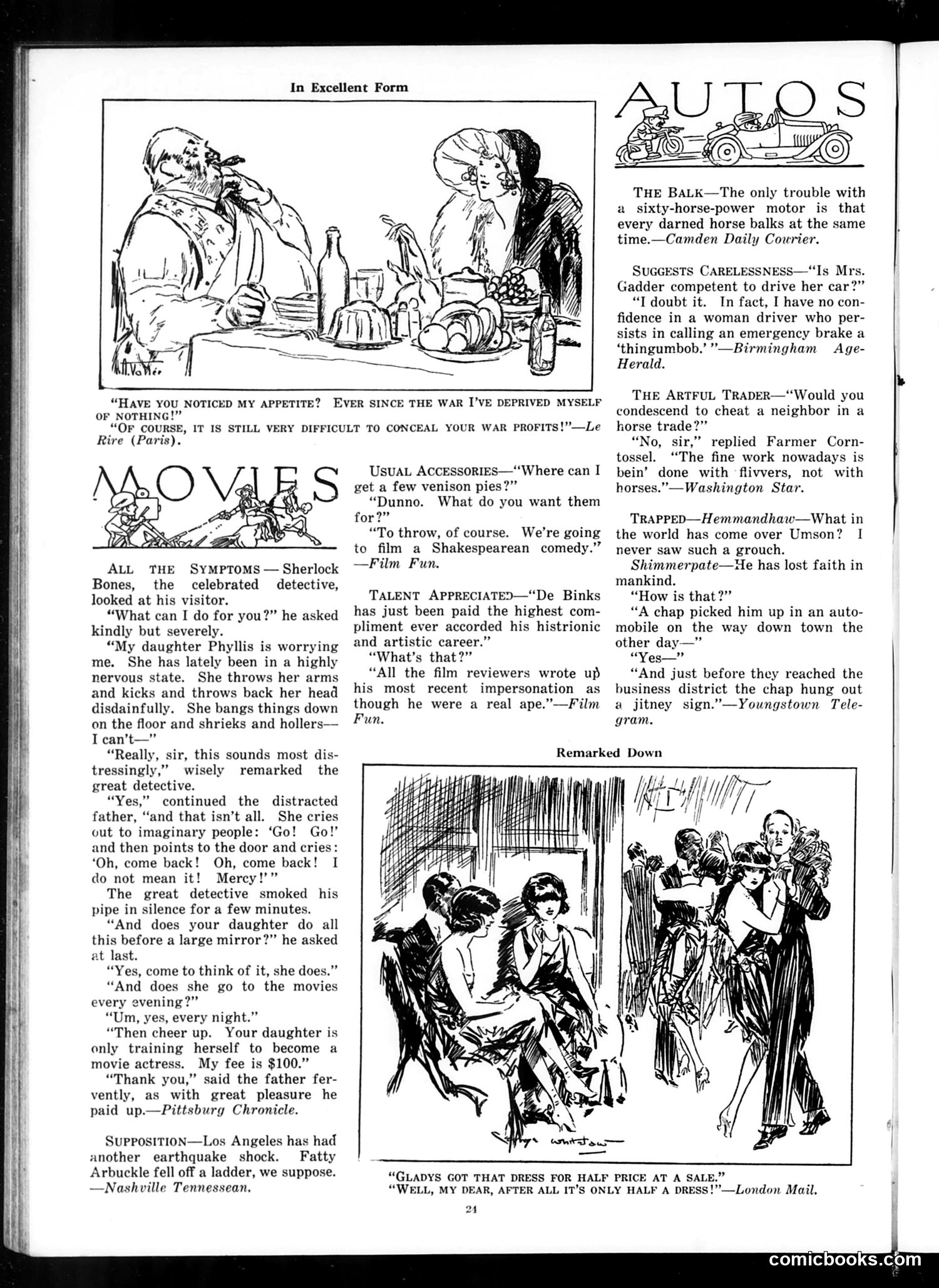
This page from Judge magazine contains several satirical pieces reflecting early 20th-century American social concerns: **Opening cartoon**: A wealthy person boasts about appetite while a companion notes it's "very difficult to conceal your war profits"—satirizing profiteers who grew rich during World War I while others sacrificed. **"All the Symptoms"**: A humorous piece where Sherlock Holmes diagnoses a young woman's erratic behavior (dramatic gestures, emotional outbursts, mimicking) as simply training to become a movie actress—mocking both cinema culture and its perceived artificiality. **Other brief jokes** target: woman drivers (portrayed as incompetent), automobile mishaps, film reviewers, and consumer culture (a woman buying a dress on sale that's "only half a dress"—implying skimpy wartime fashions). The overall tone ridicules post-WWI society: war profiteering, the movie industry's growing influence, changing gender roles, and automotive culture—capturing Jazz Age anxieties through lighthearted satire.
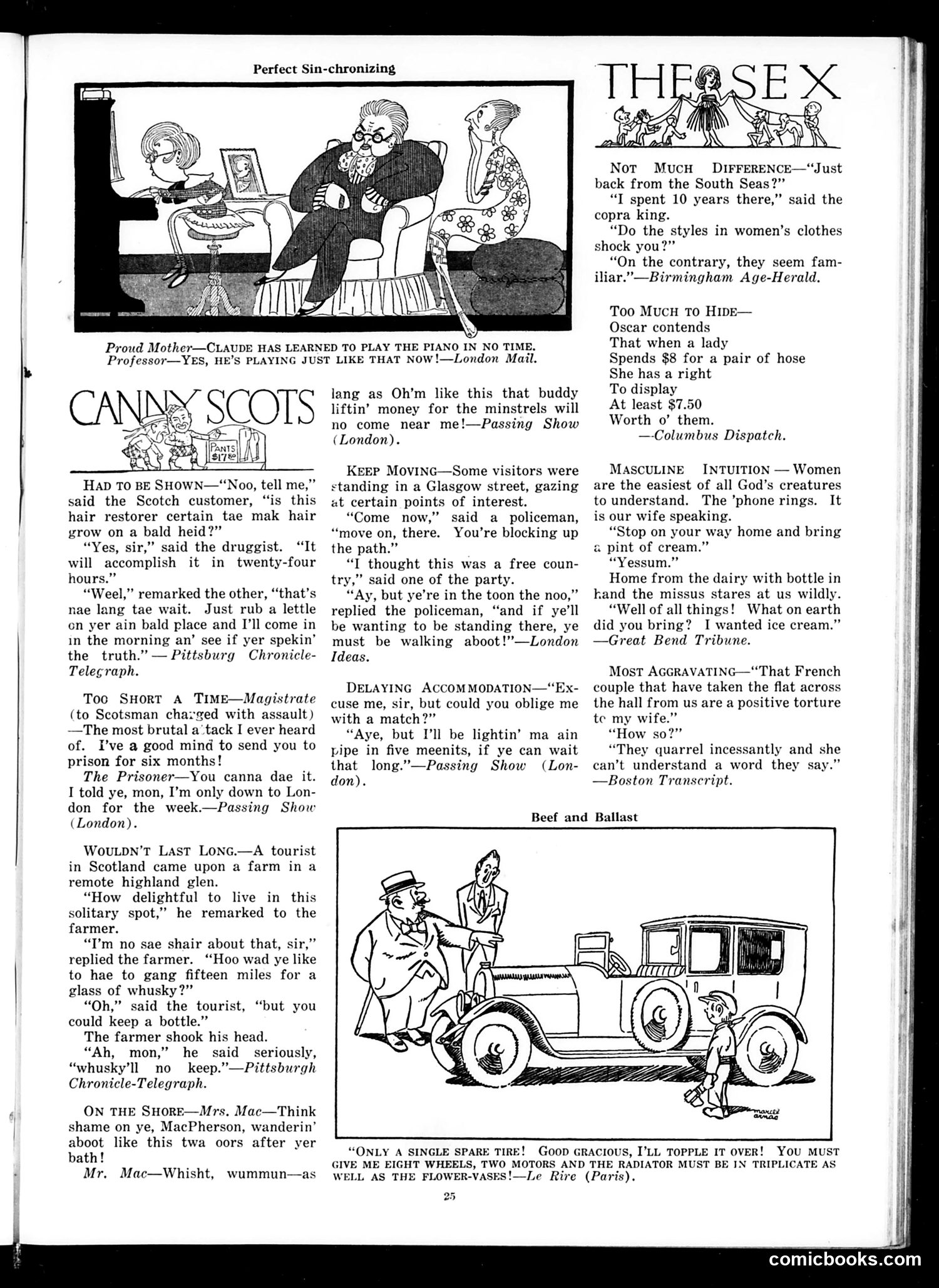
This Judge magazine page contains humorous vignettes and cartoons satirizing early 20th-century life. **Top cartoon**: A "Proud Mother" boasts her son Claude learned piano quickly; the Professor's deadpan reply ("he's playing just like that now") sarcastically implies he plays badly—the humor lies in the mother's obliviousness to the insult. **"Canny Scots" section**: Multiple jokes exploit Scottish dialect and stereotypes about thriftiness and stubbornness. A druggist's hair-restorer claim, a prisoner's excuse about leaving London, a farmer's skepticism about whisky storage—all rely on exaggerated Scottish speech patterns and perceived national character traits. **"Beef and Ballast" cartoon**: A wealthy woman makes absurdly extravagant demands for her car (eight wheels, dual motors, triple radiators, flower vases), satirizing nouveau-riche excess and materialism. The caption notes it's from a French publication. Overall, the page mixes ethnic/regional stereotyping with observational humor about class, consumerism, and human foibles typical of early 20th-century humor magazines.
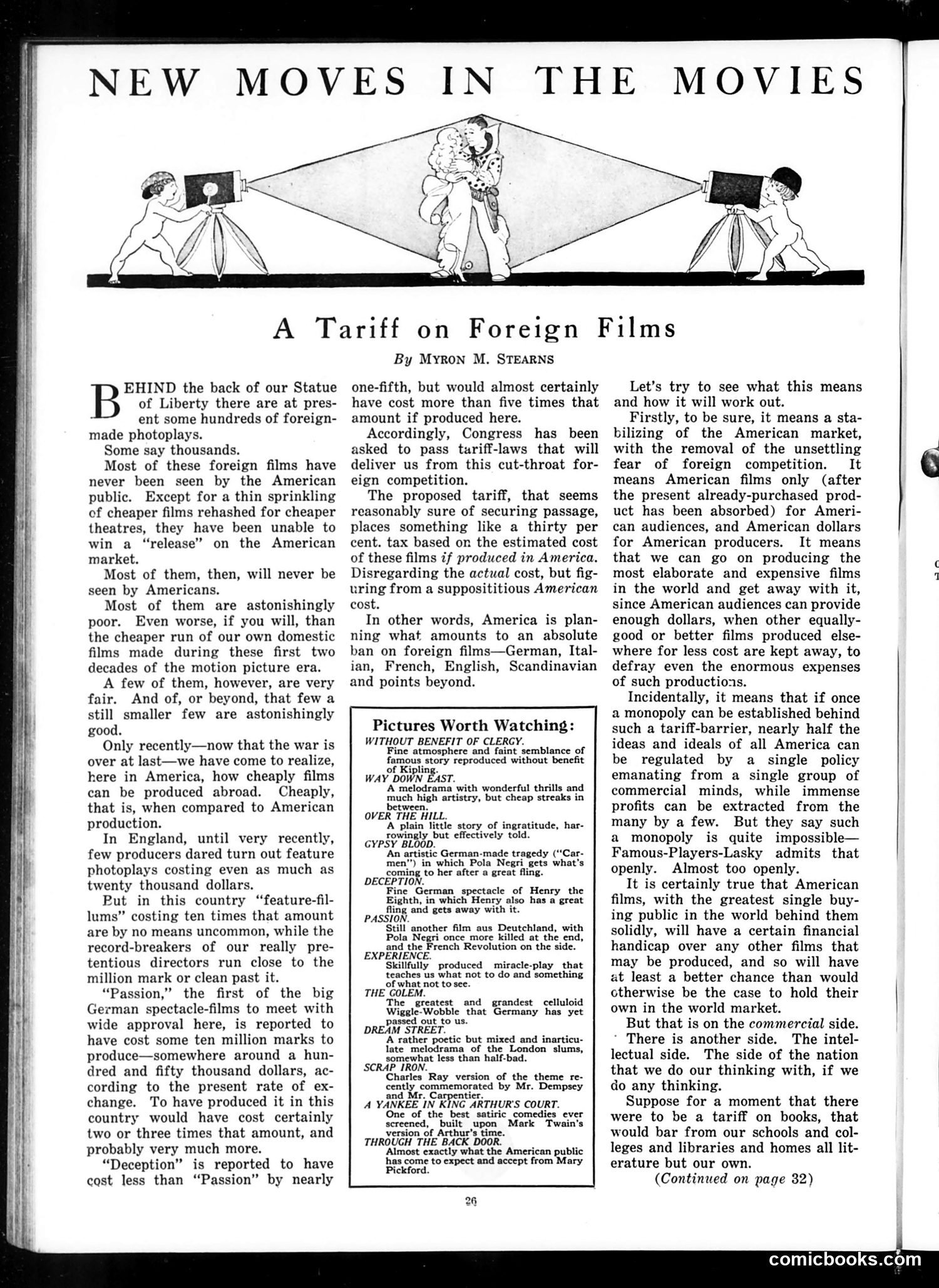
This article and header illustration advocate for protective tariffs against foreign films, particularly German productions flooding the post-WWI American market cheaply. **The Image:** Two cherub-like figures operate film cameras, training beams on a woman in the center—likely representing "American cinema" or the industry itself—suggesting foreign competition is targeting and threatening domestic production. **The Context:** Post-WWI, German films (notably "Passion" and "Deception") were produced far more cheaply than American equivalents, undercutting American studios. Congress proposed a 30% tariff based on hypothetical American production costs—essentially an import ban. **The Satire's Point:** Stearns argues this monopolistic protectionism, while seemingly pro-American, is actually dangerous. He warns that restricting competition and sheltering expensive domestic production will ultimately harm both American consumers and filmmakers by eliminating incentives for efficiency and quality. The article presents itself as nationalist but advocates for *free* markets over protectionism—an economic argument dressed in patriotic language.
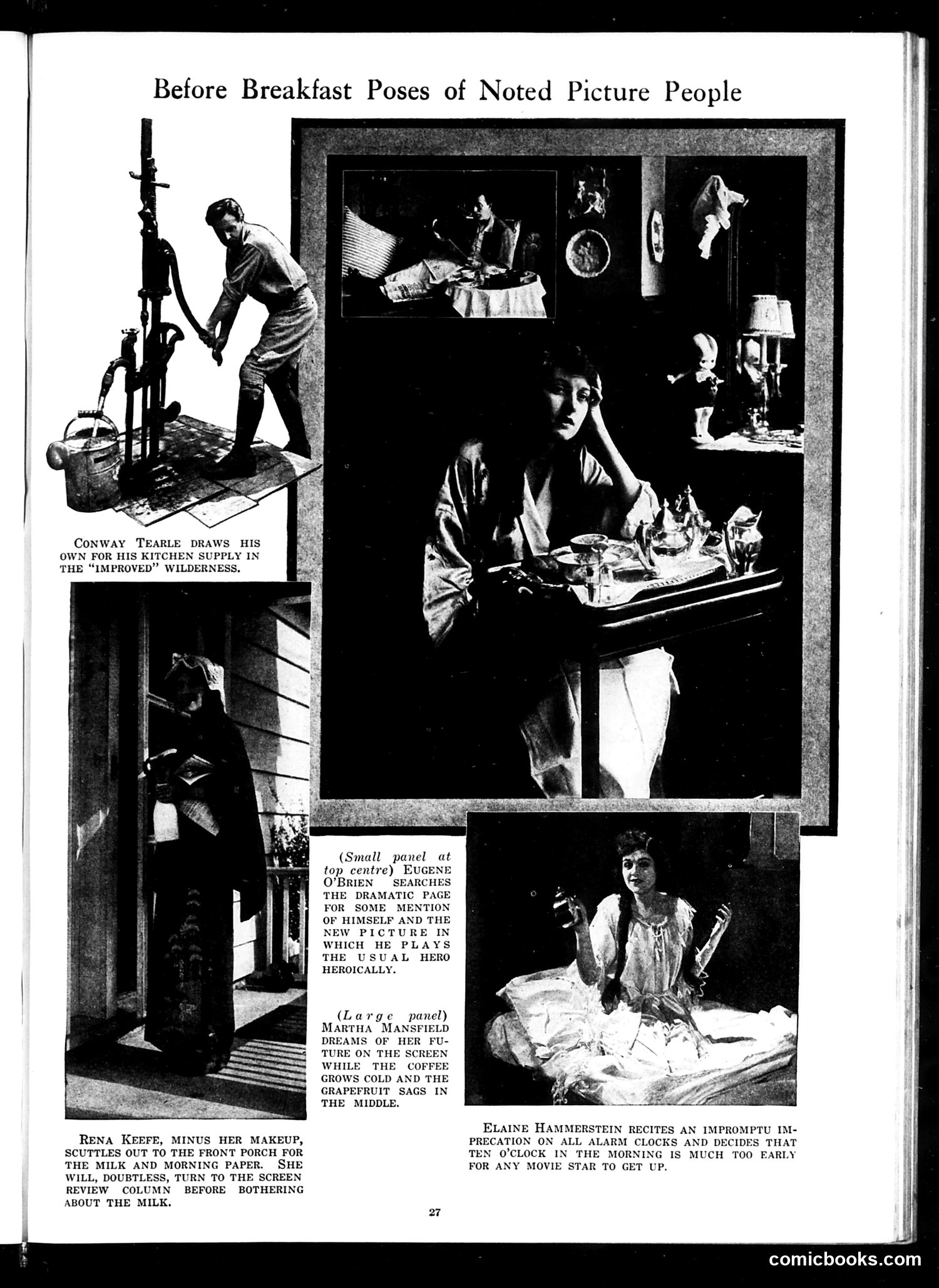
This page satirizes silent-film celebrities' morning routines. The feature presents five Hollywood actors in exaggerated "before breakfast" scenarios, poking fun at their vanity and self-absorption. Conway Tearle is shown drawing his own water supply in "improved wilderness" — mocking his pretensions. Eugene O'Brien obsessively searches for mentions of himself in the dramatic page. Martha Mansfield dreams of her movie roles while her coffee grows cold. Elaine Hammerstein complains about early alarm clocks. Rena Keefe, still in makeup, rushes for the milk and paper, likely to read film reviews about herself. The satire suggests these celebrities are self-centered and vain, unable to focus on ordinary morning tasks without relating everything back to their movie careers and public image. It's characteristic 1920s Judge magazine humor targeting Hollywood culture.
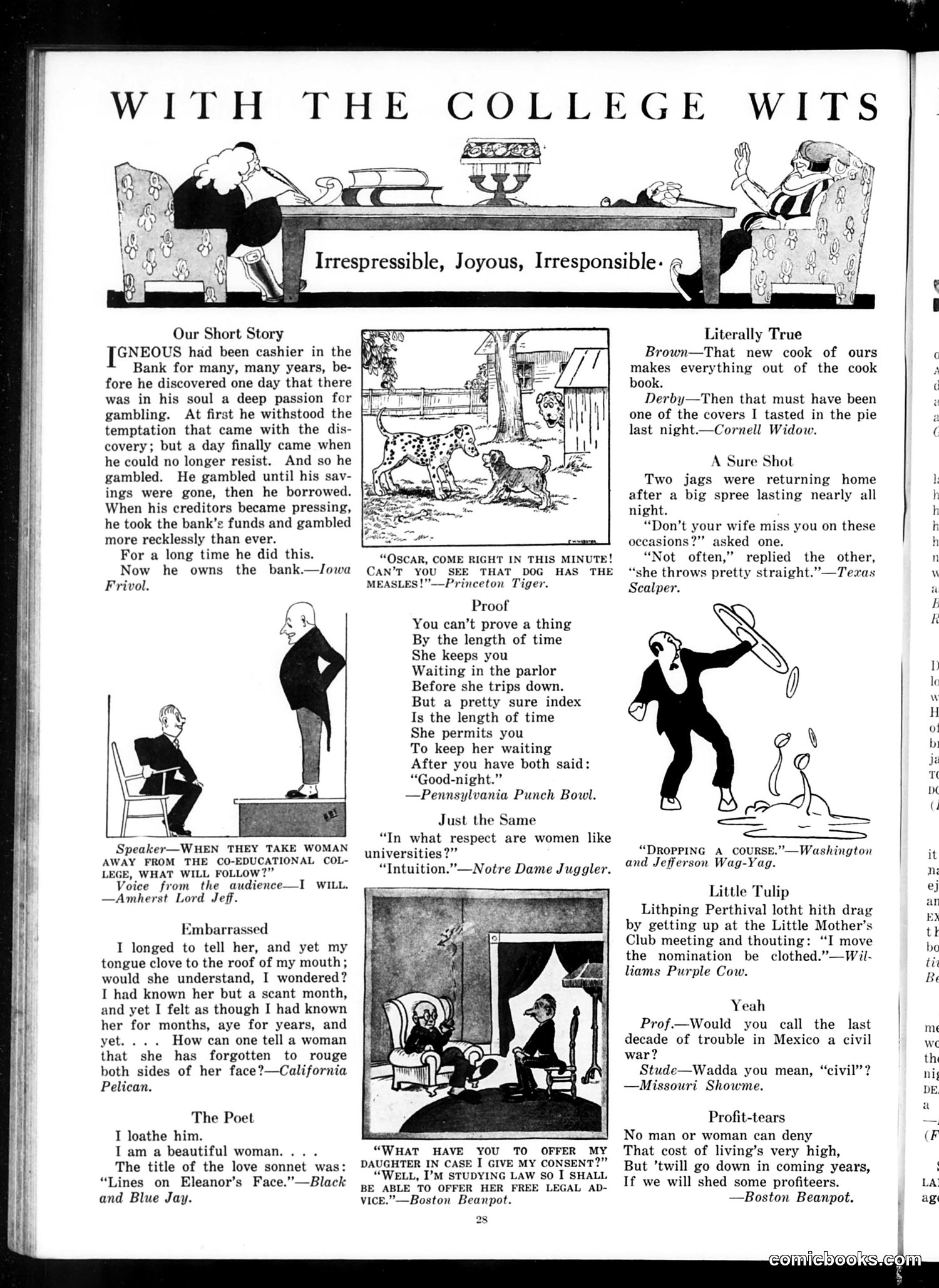
This page collects humorous short pieces from college humor magazines, satirizing early 20th-century social life and attitudes. Key content includes: **"Our Short Story"**: A banker's moral comeuppance—he gambles away depositors' funds, then the bank's own money, yet somehow ends up owning the bank anyway. The satire mocks financial corruption and ironic injustice. **Gender/Dating humor**: Multiple jokes mock women's vanity (forgetting to rouge both cheeks), dating protocol (how long women keep men waiting), and marital discord (wives who "throw straight" when throwing objects at drunk husbands). **Academic satire**: A law student offers "free legal advice" as courtship currency; jokes about co-education and women's supposed inferior logic ("intuition"). **Cost-of-living commentary**: One poem criticizes war profiteers amid post-WWI inflation concerns. The overall tone reflects college-era sexism and cynicism typical of 1920s satirical publications—mocking both social pretension and serious issues through irreverent wordplay and caricature.
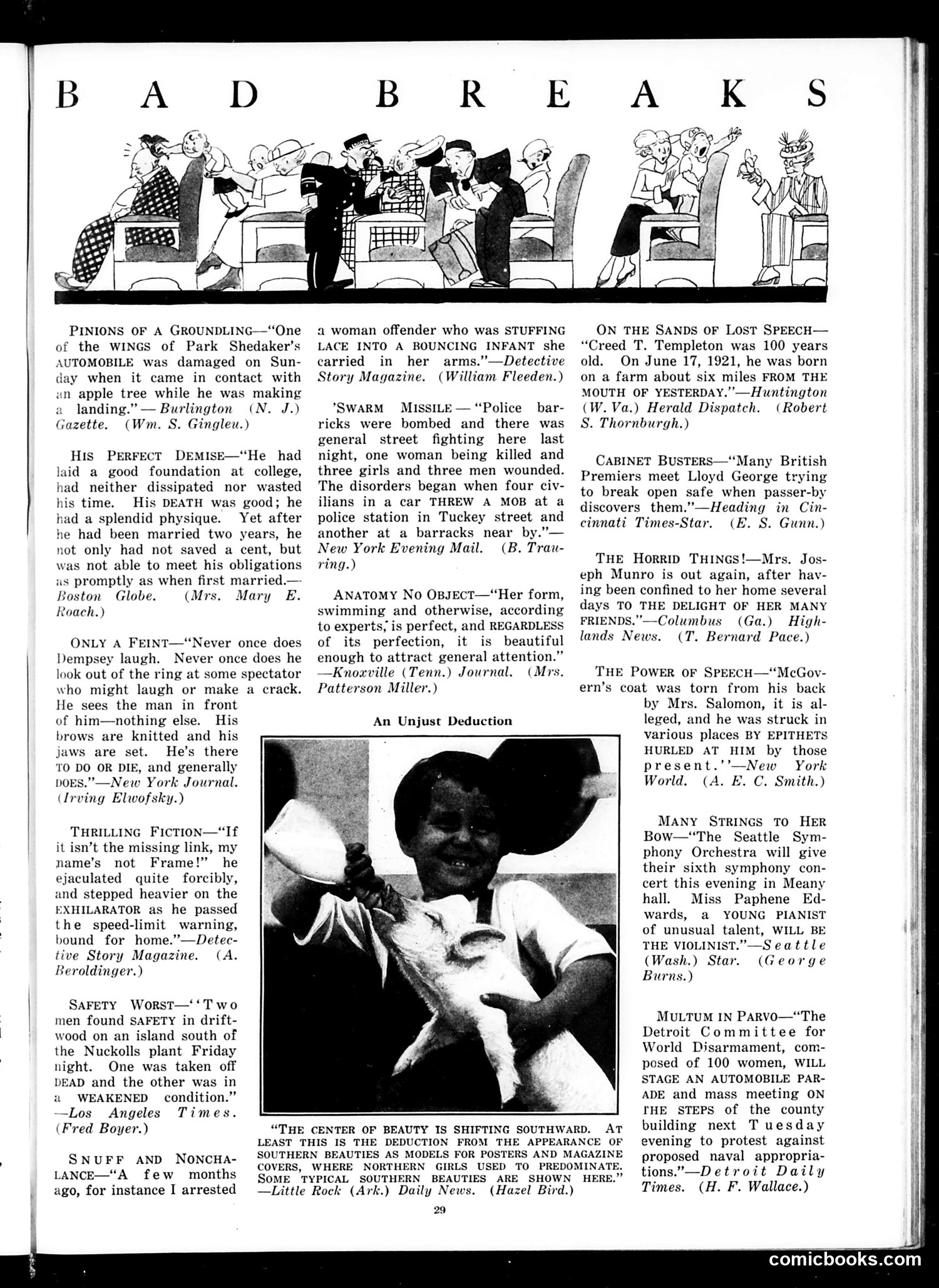
This page collects humorous newspaper printing errors and unintentionally absurd passages under the title "Bad Breaks." The cartoon at top shows people on what appears to be a train or public vehicle commenting on the errors being read aloud. The humor comes from typographical mistakes that create nonsensical or darkly comic meanings. Examples include: - An automobile "wing" damaged (likely meant "fender") - A man's "death was good" after marriage (meant his prospects) - A woman stuffing lace into a "bouncing infant" (meant "bouncing infants"—stolen goods) - A 100-year-old man born "from the mouth of yesterday" (meant distance measurement) - Someone struck by "epithets hurled" rather than objects The photograph shows a woman posing, illustrating the accompanying text about shifting beauty standards and Southern women becoming preferred models. This was a recurring Judge feature highlighting journalism's humorous production errors—satisfying readers' sense of superiority while mocking careless editing.
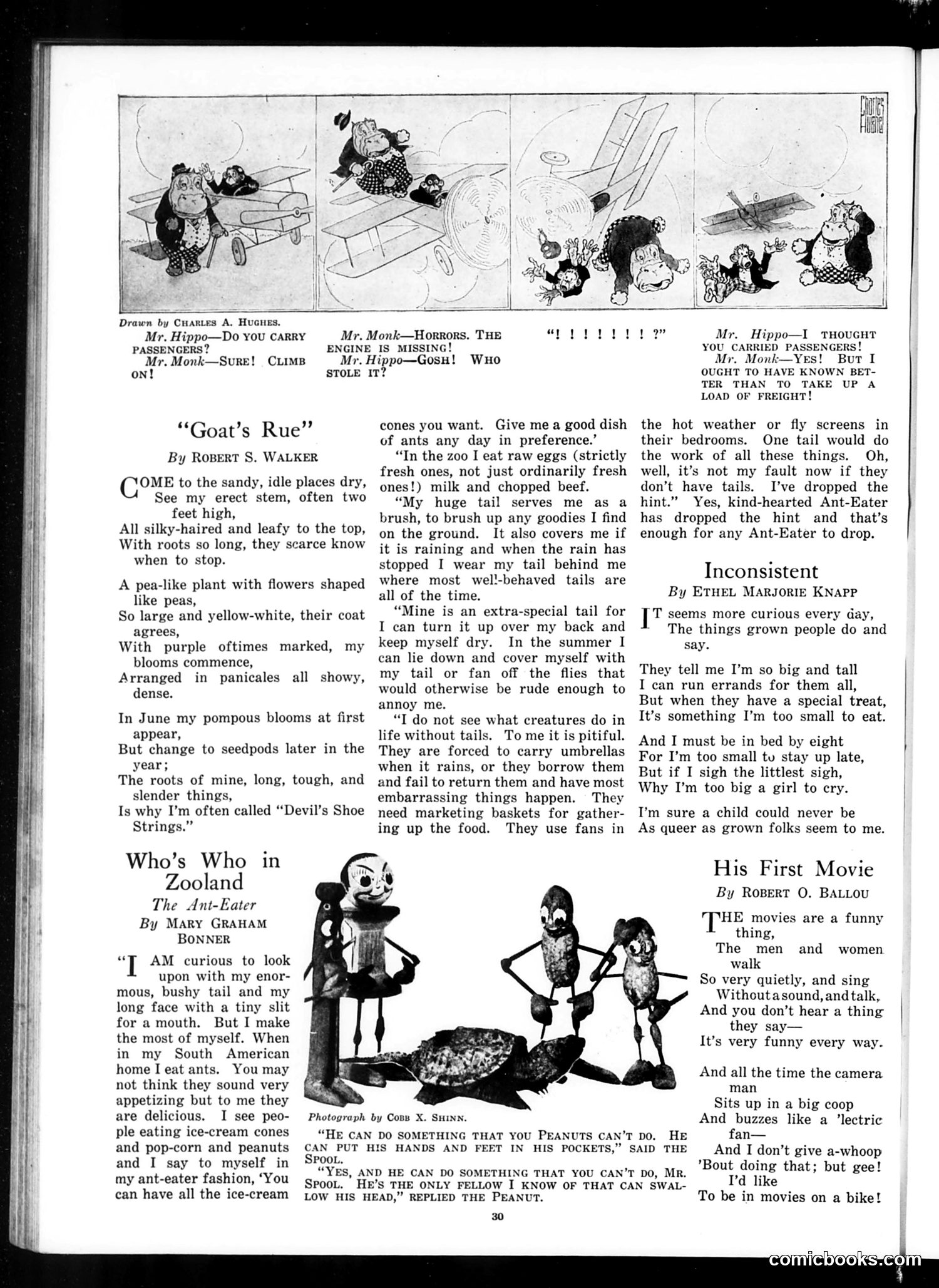
The top cartoon by Charles A. Hughes depicts a simple visual gag: a hippopotamus and a monk (animal characters) negotiate passage. Mr. Hippo agrees to carry passengers, but when Mr. Monk boards with freight, the engine mysteriously disappears—stolen, apparently. The joke's punchline reveals Mr. Hippo's complaint: he should have known better than to accept a "load of freight" from a monk, likely playing on a stereotype about monks or religious figures being untrustworthy or problematic passengers. The humor relies on wordplay and unexpected character behavior rather than political satire. It's a lighthearted animal fable-style joke typical of Judge's miscellaneous comic content, without reference to specific historical events or figures.
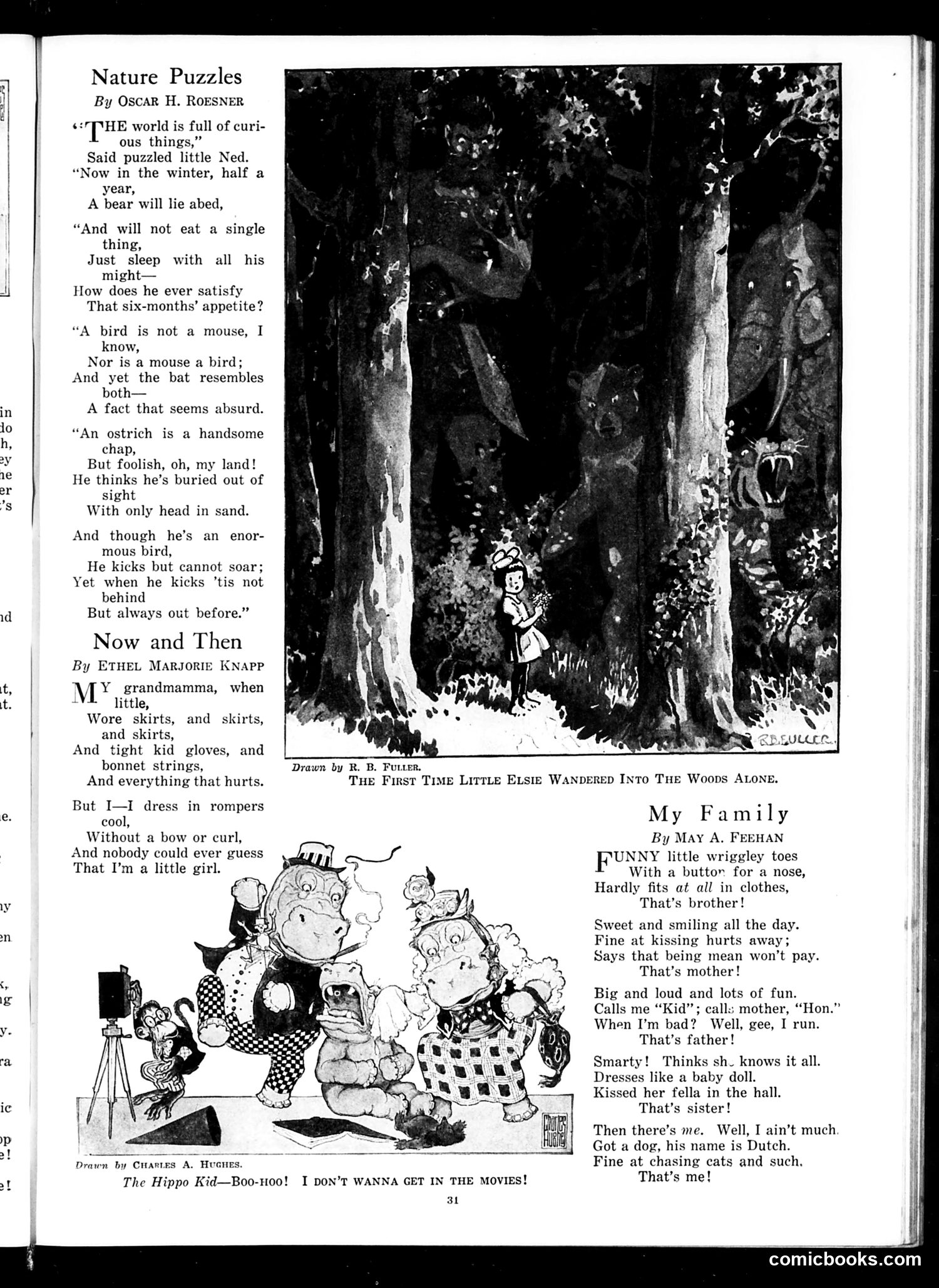
This page contains three separate children's poems/verses with accompanying illustrations, typical of early 20th-century family magazines: **"Nature Puzzles"** presents a child's curious observations about animal behavior—bears hibernating without eating, bats resembling both birds and mice, ostriches burying their heads. It's gentle educational verse teaching natural facts through whimsical questions. **"Now and Then"** contrasts old and new fashions for girls. The grandmother wore restrictive clothing (multiple skirts, tight gloves, bonnets), while the modern girl wears practical rompers without ornamentation. This reflects early 20th-century women's liberation and changing fashion norms. **"My Family"** humorously catalogs family members through a child's perspective—a baby brother, smiling mother, loud father, vain sister, and the narrator with a dog named Dutch. The illustration showing "The Hippo Kid" at movies appears to show an animal character resistant to appearing on film—likely satirizing either children's reluctance or the growing film industry's attempt to capitalize on youth appeal.
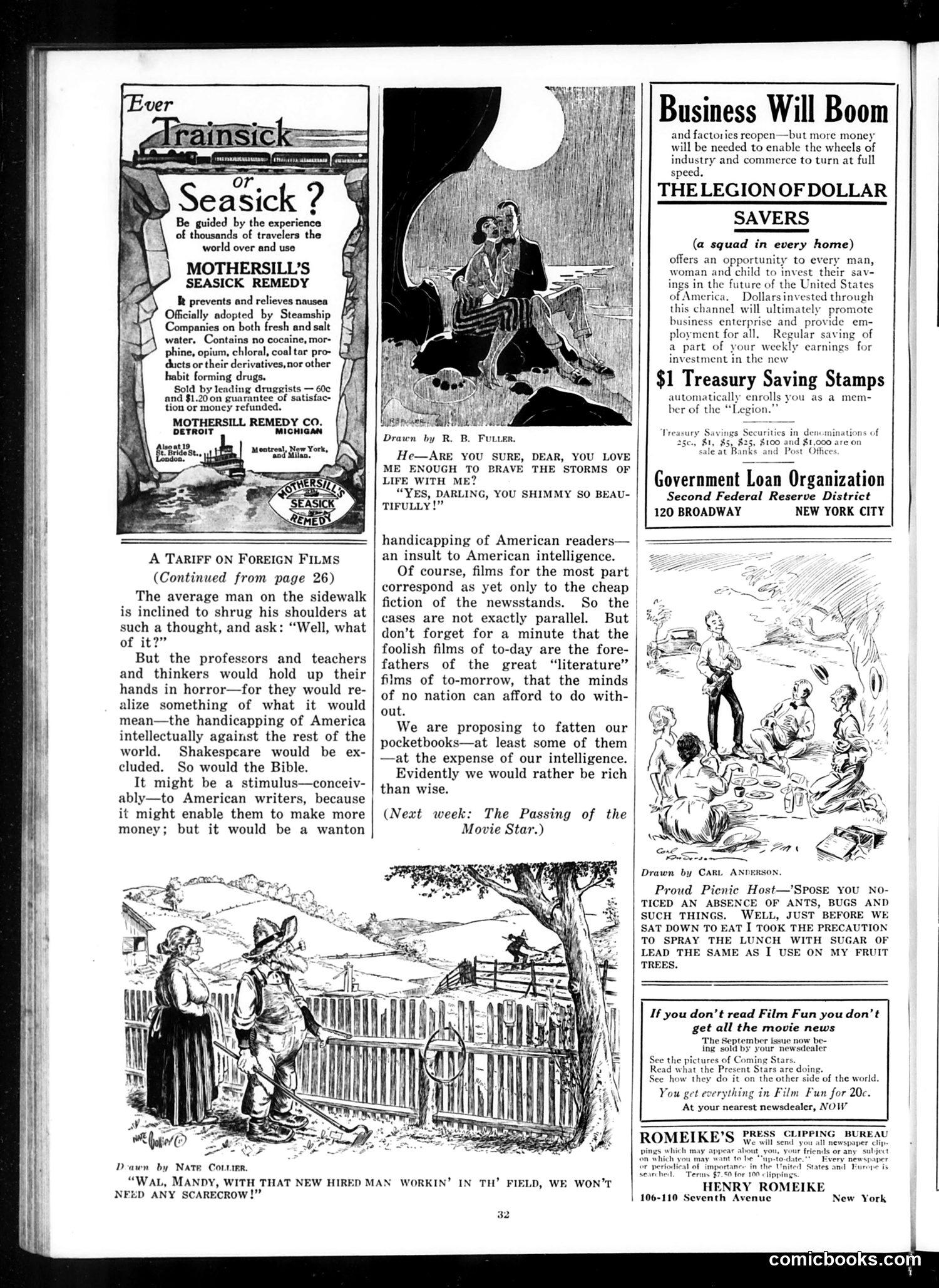
This page mixes advertisements with editorial content critiquing proposed tariffs on foreign films. **Main Editorial Argument ("A Tariff on Foreign Films"):** The author opposes trade restrictions that would exclude foreign cinema from America. The piece argues this would intellectually handicap the nation—comparing it to banning Shakespeare and the Bible. While acknowledging that today's films are often cheap entertainment (like pulp fiction), the author contends they represent the "forefathers" of tomorrow's serious art. The satirical conclusion: Americans would rather "be rich than wise" if they prioritize protecting domestic film profits over cultural access. **Cartoons:** Two rural/domestic humor pieces depict slapstick scenarios—a scarecrow joke and a woman praising her suitor's dancing ability—typical of the era's lowbrow comedy. **Context:** This likely dates to the 1920s post-WWI period when protectionist trade policies were debated. The piece sarcastically suggests Americans are willing to sacrifice intellectual development for economic self-interest.
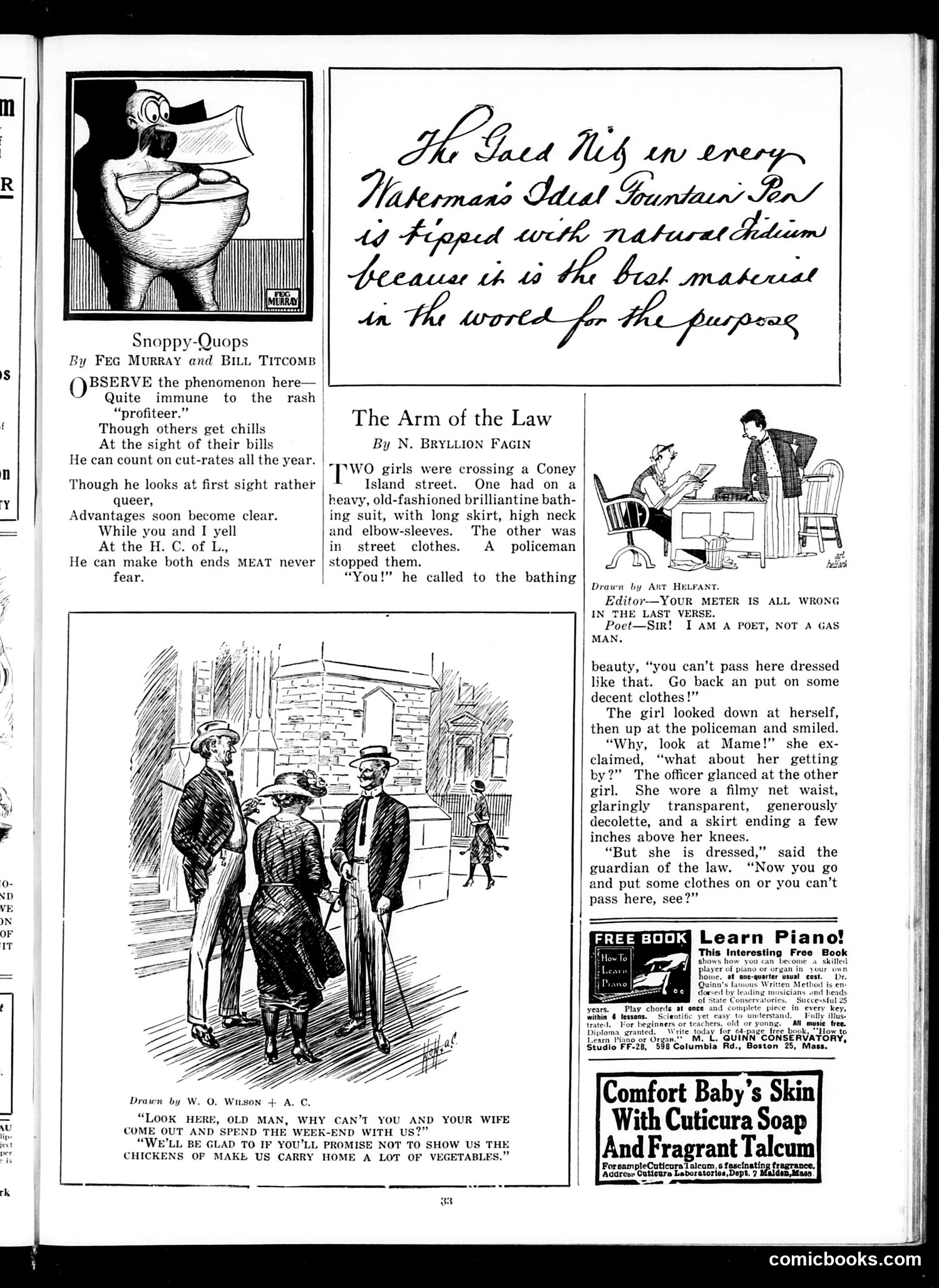
**"Snoopy-Quops"** satirizes wartime profiteers—those who exploit shortages for profit. The cartoon celebrates someone immune to accusations of profiteering, contrasting with ordinary citizens facing inflated "H.C. of L." (High Cost of Living) prices. The joke is that this person succeeds financially while others struggle. **"The Arm of the Law"** mocks inconsistent enforcement of public decency standards, likely referencing 1920s bathing suit controversies. A policeman stops a modestly-dressed girl in old-fashioned swimwear but permits another girl wearing transparent, revealing garments. The satire highlights arbitrary moral policing—the officer enforces outdated standards while ignoring actual indecency, suggesting authorities either don't understand modernity or apply rules hypocritically. Both pieces reflect post-WWI social tensions: inflation, changing fashion norms, and questions about who sets community standards.
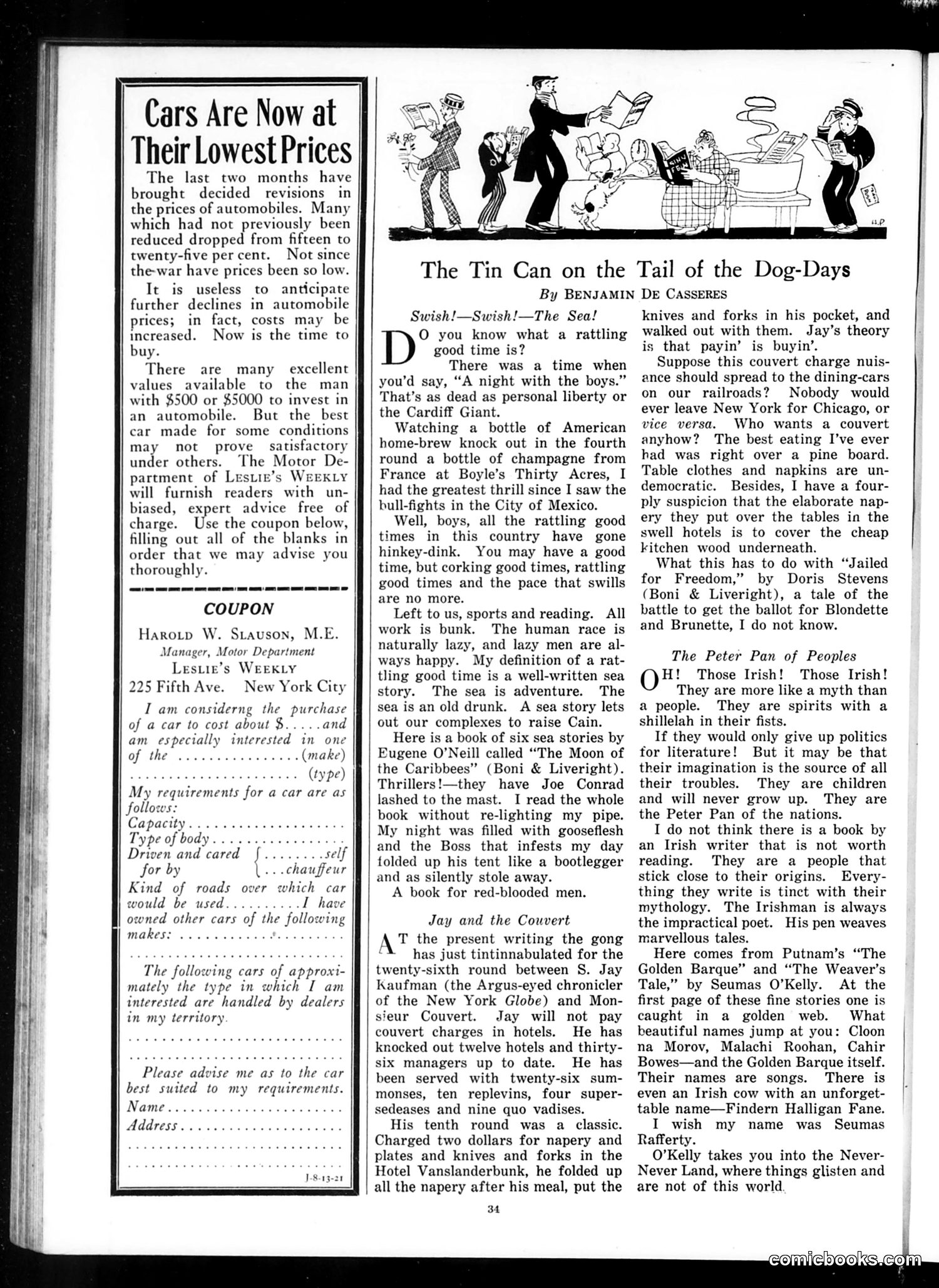
This page contains satirical commentary on 1920s American life. The main cartoon strip depicts people engaged in frivolous activities—a visual critique of post-war social behavior during the era of Prohibition ("tin can on the tail"). **Key content:** 1. **Auto advertisement**: A serious business section promoting cars at Depression-era low prices, targeting potential buyers with $500-$5000. 2. **"Tin Can on the Tail of the Dog-Days"**: Benjamin De Casseres's essay laments the death of "rattling good times" in America, blaming Prohibition and modern constraints on leisure. He contrasts thrilling experiences (bull-fights, sea stories) with contemporary dullness, suggesting Americans now only have "sports and reading" left. 3. **Jay and the Couvert**: A humorous anecdote about a man (S. Jay Kaufman, a real New York Globe columnist) who refuses to pay hotel "couvert" charges (table linens/service fees) by stealing the napery and cutlery. The satire mocks both excessive hotel charges and democratic ideals. The page critiques post-war American culture as simultaneously materialistic (car sales) and spiritually depleted by Prohibition and commercialization.
This page contains **no cartoon or comic content**—it is purely **advertising or editorial material** promoting the value of reading advertisements. The piece argues that rapid commercial and technological change requires consumers to stay informed through ads. It frames advertisements as "messages from the business world" communicating innovations in labor-saving devices, home comfort, and consumer goods. The rhetoric celebrates modern invention while subtly suggesting that reading ads is the civic duty necessary to navigate contemporary life intelligently. This reflects **early 20th-century advertising philosophy**: positioning advertisements not as persuasion but as essential consumer education. The tone is earnest rather than satirical—this appears to be a house ad or editorial promoting *Judge* magazine's advertising content itself, leveraging contemporary enthusiasm for technological progress to justify the advertising industry's growing cultural role.
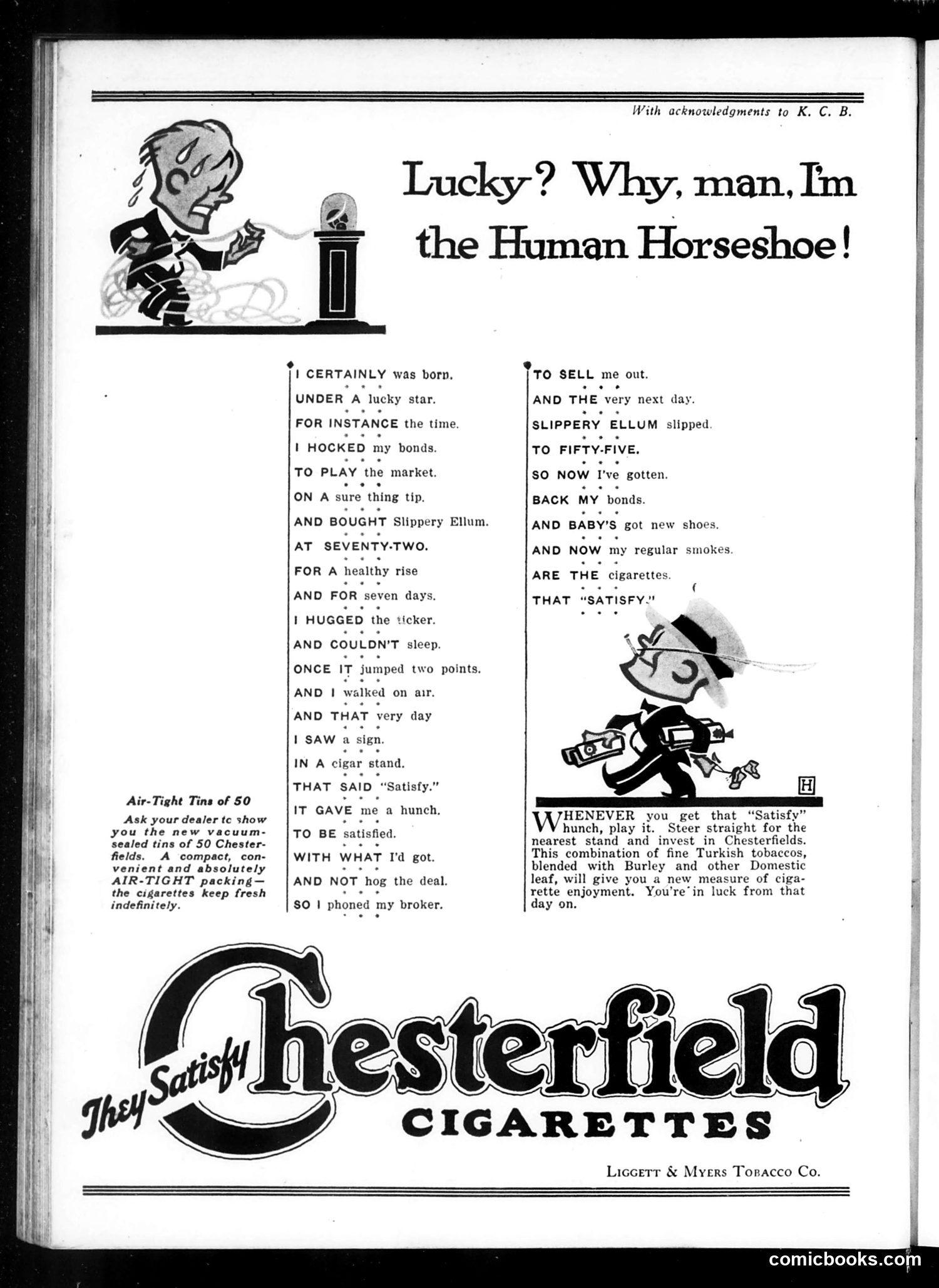
This is primarily a **Chesterfield cigarettes advertisement** disguised as satirical humor, not a political cartoon. The joke mocks a stock-market speculator's blind luck during what appears to be the 1920s bull market. The unnamed narrator claims supernatural good fortune: he bought stock tips at "seventy-two," saw a ticker jump, and—crucially—spotted a "Satisfy" advertisement in a cigar stand, which he interprets as a lucky sign. He phones his broker and makes money. The satire targets **get-rich-quick market gambling** and superstitious thinking. The phrase "Slippery Ellum" (likely "Slippery Elm," a folk remedy) suggests dubious financial advice. His winnings fund trivial purchases: baby's shoes, cigarettes. The ad's punchline redirects this "luck" toward Chesterfield cigarettes themselves—"you're in luck from that day on" if you buy them. It's a cynical marketing strategy: commodify the character's irrational faith in lucky signs by making the cigarettes *the* lucky charm. The cartoon style and verse narrative are typical Judge advertising fare of the era.