
Judge, 1921-08-13 · page 13 of 36
Judge — August 13, 1921 — page 13: what you’re looking at
What you’re looking at
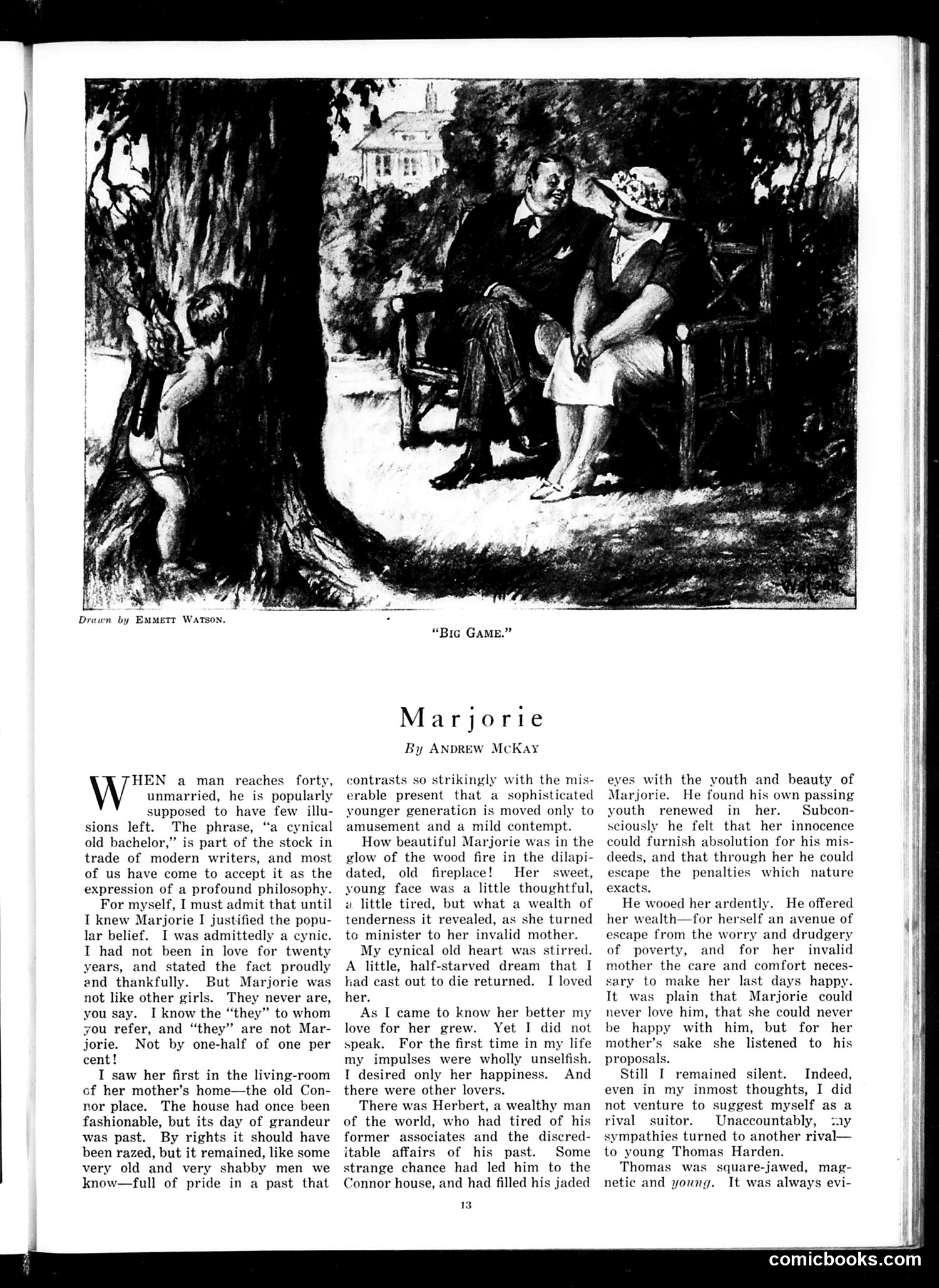
The page contains two unrelated items: an illustration titled "Big Game" drawn by Emmett Watson, and the opening of a serialized short story by Andrew McKay. **The Illustration:** Shows figures in a park or wooded setting with a Capitol building visible in the background. Without clearer detail, the specific satirical reference is unclear, though the Capitol suggests political content. **The Story:** A sentimental narrative about a cynical 40-year-old bachelor who falls in love with Marjorie, a poor but virtuous young woman from a once-fashionable family in decline. The story establishes a romantic triangle: wealthy suitor Herbert seeks to marry her (offering escape from poverty), while the narrator silently loves her, and a third rival—young Thomas Harden—also competes for her affection. The narrator renounces his own claims to her happiness, a typical Victorian sentiment about selfless love.
📄 Transcribed text from this page (OCR, searchable)
Machine-transcribed from the original scan — historical spelling and the odd misread are preserved.
Drawn by EMMETT WATSON. HEN a man reaches forty, unmarried, he is popularly supposed to have few illu- sions left. The phrase, “a cynical old bachelor,” is part of the stock in trade of modern writers, and most of us have come to accept it as the expression of a profound philosophy. For myself, I must admit that until I knew Marjorie I justified the popu- lar belief. I was admittedly a cynic. I had not been in love for twenty years, and stated the fact proudly and thankfully. But Marjorie was not like other girls. They never are, you say. I know the “they” to whom you refer, and “they” are not Mar- jorie. Not by one-half of one per cent! I saw her first in the living-room of her mother’s home—the old Con- nor place. The house had once been fashionable, but its day of grandeur was past. By rights it should have been razed, but it remained, like some very old and very shabby men we know—full of pride in a past that “Bic GAME.” Marjorie By ANDREW McKay contrasts so strikingly with the mis- erable present that a sophisticated younger generation is moved only to amusement and a mild contempt. How beautiful Marjorie was in the glow of the wood fire in the dilapi- dated, old fireplace! Her sweet, young face was a little thoughtful, v little tired, but what a wealth of tenderness it revealed, as she turned to minister to her invalid mother. My cynical old heart was stirred. A little, half-starved dream that I had cast out to die returned. I loved her. As I came to know her better my love for her grew. Yet I did not speak. For the first time in my life my impulses were wholly unselfish. I desired only her happiness. And there were other lovers. There was Herbert, a wealthy man of the world, who had tired of his former associates and the discred- itable affairs of his past. Some strange chance had led him to the Connor house, and had filled his jaded 13 eyes with the youth and beauty of Marjorie. He found his own passing youth renewed in her. Subcon- sciously he felt that her innocence could furnish absolution for his mis- deeds, and that through her he could escape the penalties which nature exacts. He wooed her ardently. He offered her wealth—for herself an avenue of escape from the worry and drudgery of poverty, and for her invalid mother the care and comfort neces- sary to make her last days happy. It was plain that Marjorie could never love him, that she could never be y with him, but for her ake she listened to his remained silent. Indeed, Still I even in my inmost thoughts, I did not venture to suggest myself as a rival suitor. Unaccountably, zay sympathies turned to another rival— to young Thomas Harden. Thomas was square-jawed, mag- netic and young. It was always evi- comicbooks.com