
Judge, 1921-08-13 · page 34 of 36
Judge — August 13, 1921 — page 34: what you’re looking at
What you’re looking at
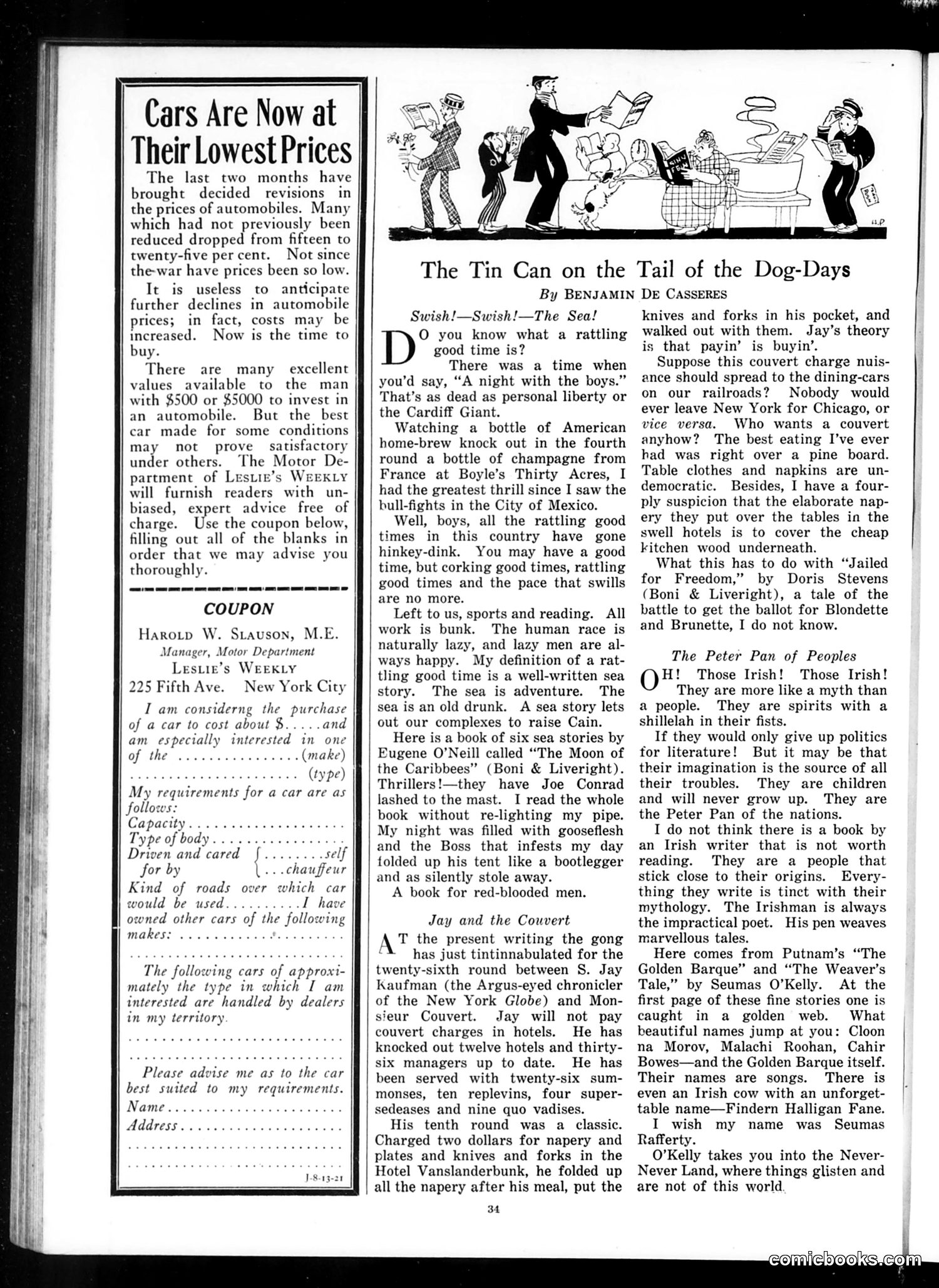
This page contains satirical commentary on 1920s American life. The main cartoon strip depicts people engaged in frivolous activities—a visual critique of post-war social behavior during the era of Prohibition ("tin can on the tail"). **Key content:** 1. **Auto advertisement**: A serious business section promoting cars at Depression-era low prices, targeting potential buyers with $500-$5000. 2. **"Tin Can on the Tail of the Dog-Days"**: Benjamin De Casseres's essay laments the death of "rattling good times" in America, blaming Prohibition and modern constraints on leisure. He contrasts thrilling experiences (bull-fights, sea stories) with contemporary dullness, suggesting Americans now only have "sports and reading" left. 3. **Jay and the Couvert**: A humorous anecdote about a man (S. Jay Kaufman, a real New York Globe columnist) who refuses to pay hotel "couvert" charges (table linens/service fees) by stealing the napery and cutlery. The satire mocks both excessive hotel charges and democratic ideals. The page critiques post-war American culture as simultaneously materialistic (car sales) and spiritually depleted by Prohibition and commercialization.
📄 Transcribed text from this page (OCR, searchable)
Machine-transcribed from the original scan — historical spelling and the odd misread are preserved.
Cars Are Now at Their Lowest Prices the prices of automobiles. Many which had not previously been reduced dropped from fifteen to twenty-five per cent. the-war have prices been so low. to anticipate in automobile further declines Now is the time to with $500 or $5000 to invest in an automobile. car made for some conditions The Motor De- partment of Lestiz’s WEEKLY will furnish readers with under others. Use the coupon below, filling out all of the blanks in order that we may advise you Haro.tpv W. Stauson, M.E. Manager, Motor Department Lestiz’s WEEKLY New York City I am considerng the purchase of acar to cost about $ am especially interested in one 225 Fifth Ave. My requirements for a car are as Driven and cared Kind of roads would be used....... owned other cars of the mately the type in which I am interested are handled by dealers in my territory best suited to my requirements. The Tin Can on the Tail of the Dog-Days By BENJAMIN DE CASSERES Swish!—Swish!—The Sea! O you know what a rattling D good time is? There was a time when you'd say, “A night with the boys.” That’s as dead as personal liberty or the Cardiff Giant. Watching a bottle of American home-brew knock out in the fourth round a bottle of champagne from France at Boyle’s Thirty Acres, I had the greatest thrill since I saw the bull-fights in the City of Mexico. Well, boys, all the rattling good times in this country have gone hinkey-dink. You may have a good time, but corking good times, rattling good times and the pace that swills are no more. Left to us, sports and reading. All work is bunk. The human race is naturally lazy, and lazy men are al- ways happy. My definition of a rat- tling good time is a well-written sea story. The sea is adventure. The sea is an old drunk. A sea story lets out our complexes to raise Cain. Here is a book of six sea stories by Eugene O’Neill called “The Moon of the Caribbees” (Boni & Liveright). Thrillers!—they have Joe Conrad lashed to the mast. I read the whole book without re-lighting my pipe. My night was filled with gooseflesh and the Boss that infests my day folded up his tent like a bootlegger and as silently stole away. A book for red-blooded men. Jay and the Couvert AT the present writing the gong ‘ as just tintinnabulated for the twenty-sixth round between S. Jay Kaufman (the Argus-eyed chronicler of the New York Globe) and Mon- sieur Couvert. Jay will not pay couvert charges in hotels. He has knocked out twelve hotels and thirty- six managers up to date. He has been served with twenty-six sum- monses, ten replevins, four super- sedeases and nine quo vadises. His tenth round was a classic. Charged two dollars for napery and plates and knives and forks in the Hotel Vanslanderbunk, he folded up all the napery after his meal, put the 34 knives and forks in his pocket, and walked out with them. Jay’s theory is that payin’ is buyin’. Suppose this couvert charge nuis- ance should spread to the dining-cars on our railroads? Nobody would ever leave New York for Chicago, or vice versa. Who wants a couvert anyhow? The best eating I’ve ever had was right over a pine board. Table clothes and napkins are un- democratic. Besides, I have a four- ply suspicion that the elaborate nap- ery they put over the tables in the swell hotels is to cover the cheap kitchen wood underneath. What this has to do with “Jailed for Freedom,” by Doris Stevens (Boni & Liveright), a tale of the battle to get the ballot for Blondette and Brunette, I do not know. The Peter Pan of Peoples H! Those Irish! Those Irish! They are more like a myth than a people. They are spirits with a shillelah in their fists. If they would only give up politics tor literature! But it may be that their imagination is the source of all their troubles. They are children and will never grow up. They are the Peter Pan of the nations. I do not think there is a book by an Irish writer that is not worth reading. They are a people that stick close to their origins. Every- thing they write is tinct with their mythology. The Irishman is always the impractical poet. His pen weaves marvellous tales. Here comes from Putnam’s “The Golden Barque” and “The Weaver's Tale,” by Seumas O’Kelly. At the first page of these fine stories one is caught in a golden web. What beautiful names jump at you: Cloon na Morov, Malachi Roohan, Cahir Bowes—and the Golden Barque itself. Their names are songs. There is even an Irish cow with an unforget- table name—Findern Halligan Fane. I wish my name was Seumas Rafferty. O’Kelly takes you into the Never- Never Land, where things glisten and are not of this world