
Judge, 1921-08-13 · page 20 of 36
Judge — August 13, 1921 — page 20: what you’re looking at
What you’re looking at
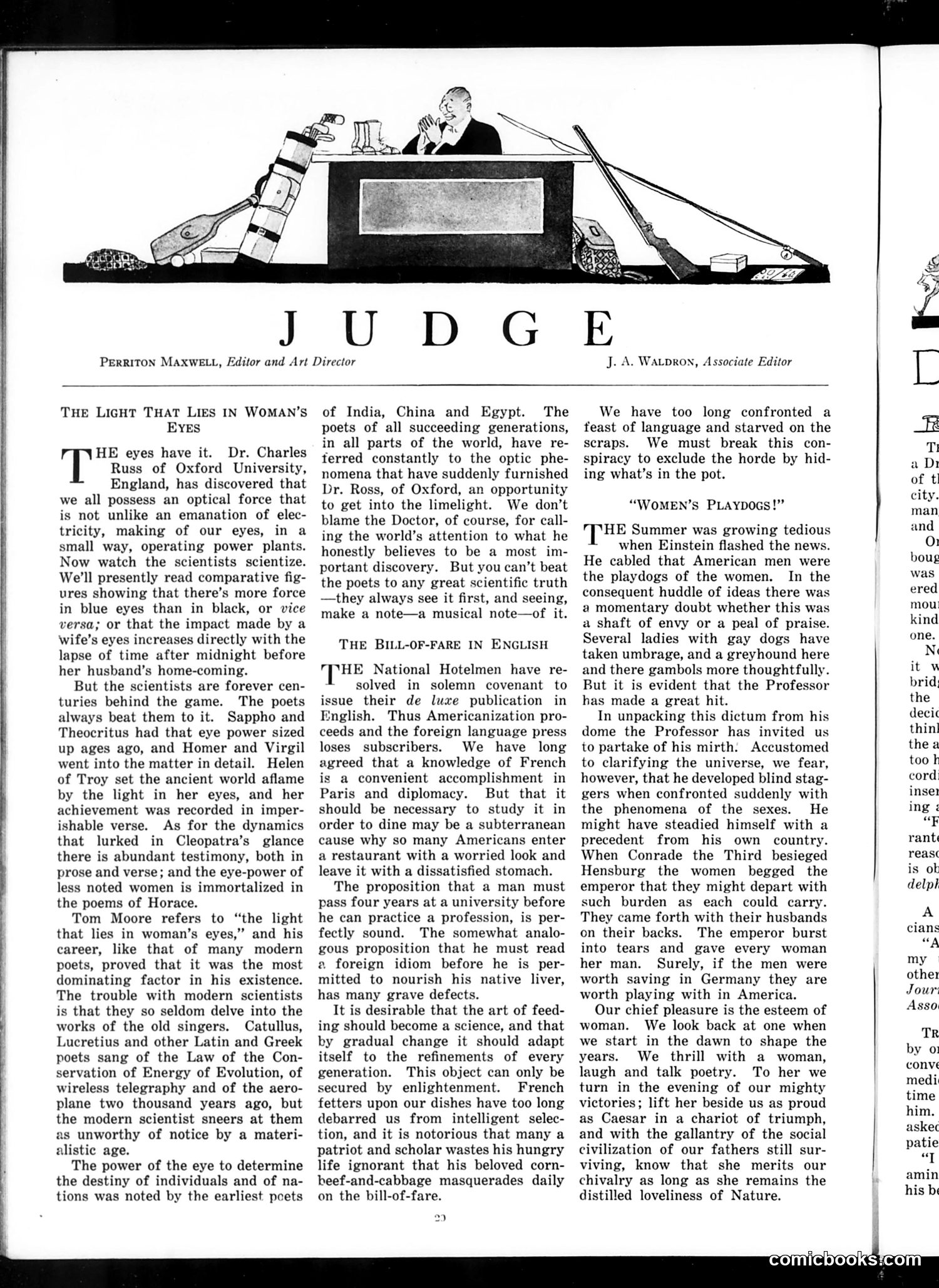
The page contains three distinct editorial pieces satirizing contemporary issues: **"The Light That Lies in Woman's Eyes"** mocks modern scientists for claiming to have "discovered" that eyes emit electrical force—a concept poets have understood for millennia. The author argues classical poets (Homer, Virgil, Sappho) already documented female ocular power through Helen of Troy and Cleopatra, yet modern materialistic science dismisses ancient wisdom. This critiques scientific arrogance and materialism. **"The Bill-of-Fare in English"** satirizes American hotel restaurants' decision to publish menus in English rather than French. Judge argues that while French knowledge suits Paris diplomacy, forcing American diners to study foreign languages before eating is absurd. The piece mocks the pretension of French cuisine terminology while championing American practicality and patriotism. **The masthead illustration** depicts a judge at his bench—standard Judge magazine branding. Both pieces represent early 20th-century American cultural anxieties: defending classical learning against scientific materialism, and asserting American independence from European cultural pretension.
📄 Transcribed text from this page (OCR, searchable)
Machine-transcribed from the original scan — historical spelling and the odd misread are preserved.
JUDGE J. A. Watpron, Associate Editor PERRITON MAXWELL, Editor and Art Director THE LIGHT THAT LIES IN WOMAN’S EYES HE eyes have it. Dr. Charles T Russ of Oxford University, England, has discovered that we all possess an optical force that is not unlike an emanation of elec- tricity, making of our eyes, in a small way, operating power plants. Now watch the scientists scientize. We'll presently read comparative fig- ures showing that there’s more force in blue eyes than in black, or vice versa; or that the impact made by a wife’s eyes increases directly with the lapse of time after midnight before her husband’s home-coming. But the scientists are forever cen- turies behind the game. The poets always beat them to it. Sappho and Theocritus had that eye power sized up ages ago, and Homer and Virgil went into the matter in detail. Helen of Troy set the ancient world aflame by the light in her eyes, and her achievement was recorded in imper- ishable verse. As for the dynamics that lurked in Cleopatra’s glance there is abundant testimony, both in prose and verse; and the eye-power of less noted women is immortalized in the poems of Horace. Tom Moore refers to “the light that lies in woman’s eyes,” and his career, like that of many modern poets, proved that it was the most dominating factor in his existence. The trouble with modern scientists is that they so seldom delve into the works of the old singers. Catullus, Lucretius and other Latin and Greek poets sang of the Law of the Con- servation of Energy of Evolution, of wireless telegraphy and of the aero- plane two thousand years ago, but the modern scientist sneers at them as unworthy of notice by a materi- alistic age. The power of the eye to determine the destiny of individuals and of na- tions was noted by the earliest pcets of India, China and Egypt. The poets of all succeeding generations, in all parts of the world, have re- ferred constantly to the optic phe- nomena that have suddenly furnished Dr. Ross, of Oxford, an opportunity to get into the limelight. We don’t blame the Doctor, of course, for call- ing the world’s attention to what he honestly believes to be a most im- portant discovery. But you can’t beat the poets to any great scientific truth —they always see it first, and seeing, make a note—a musical note—of it. THE BILL-OF-FARE IN ENGLISH [THE National Hotelmen have re- solved in solemn covenant to issue their de luxe publication in English. Thus Americanization pro- ceeds and the foreign language press loses subscribers. We have long agreed that a knowledge of French is a convenient accomplishment in Paris and diplomacy. But that it should be necessary to study it in order to dine may be a subterranean cause why so many Americans enter a restaurant with a worried look and leave it with a dissatisfied stomach. The proposition that a man must pass four years at a university before he can practice a profession, is per- fectly sound. The somewhat analo- gous proposition that he must read a foreign idiom before he is per- mitted to nourish his native liver, has many grave defects. It is desirable that the art of feed- ing should become a science, and that by gradual change it should adapt itself to the refinements of every generation. This object can only be secured by enlightenment. French fetters upon our dishes have too long debarred us from intelligent selec- tion, and it is notorious that many a patriot and scholar wastes his hungry life ignorant that his beloved corn- beef-and-cabbage masquerades daily on the bill-of-fare. an) We have too long confronted a feast of language and starved on the scraps. We must break this con- spiracy to exclude the horde by hid- ing what’s in the pot. “WOMEN’S PLAypoGs!” [HE Summer was growing tedious when Einstein flashed the news. He cabled that American men were the playdogs of the women. In the consequent huddle of ideas there was a momentary doubt whether this was a shaft of envy or a peal of praise. Several ladies with gay dogs have taken umbrage, and a greyhound here and there gambols more thoughtfully. But it is evident that the Professor has made a great hit. In unpacking this dictum from his dome the Professor has invited us to partake of his mirth. Accustomed to clarifying the universe, we fear, however, that he developed blind stag- gers when confronted suddenly with the phenomena of the sexes. He might have steadied himself with a precedent from his own country. When Conrade the Third besieged Hensburg the women begged the emperor that they might depart with such burden as each could carry. They came forth with their husbands on their backs. The emperor burst into tears and gave every woman her man. Surely, if the men were worth saving in Germany they are worth playing with in America. Our chief pleasure is the esteem of woman. We look back at one when we start in the dawn to shape the years. We thrill with a woman, laugh and talk poetry. To her we turn in the evening of our mighty victories; lift her beside us as proud as Caesar in a chariot of triumph, and with the gallantry of the social civilization of our fathers still sur- viving, know that she merits our chivalry as long as she remains the distilled loveliness of Nature. boug was ered mou kind one. Ni it w brid; the decic¢ thinl thea too h cord inse1 ing ¢ “F rant reas¢ is ok delpl A cians “A my other Jour Asso TR by 01 conve medi time him. askec patie “y amin his b