
Judge, 1921-08-13 · page 26 of 36
Judge — August 13, 1921 — page 26: what you’re looking at
What you’re looking at
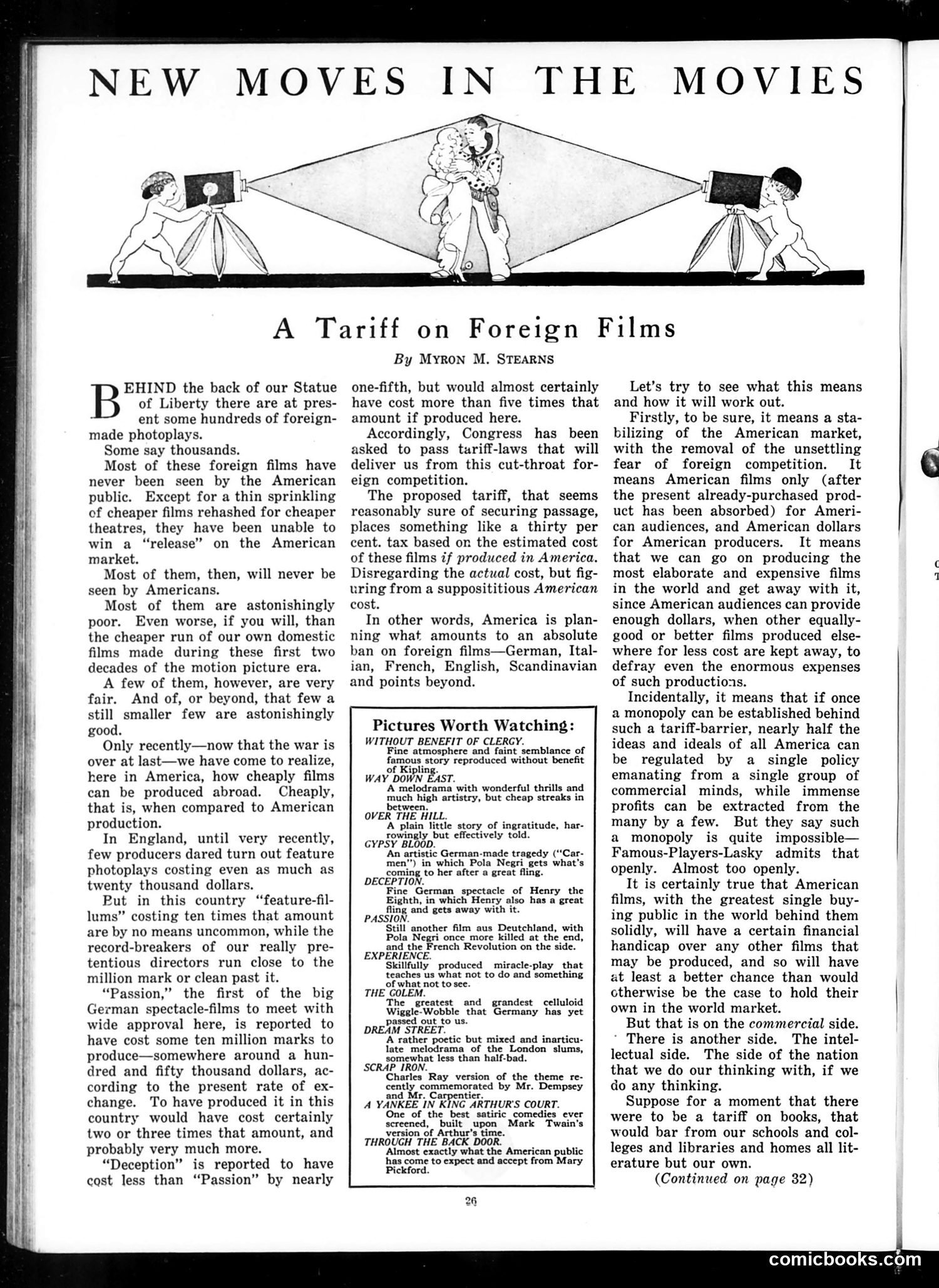
This article and header illustration advocate for protective tariffs against foreign films, particularly German productions flooding the post-WWI American market cheaply. **The Image:** Two cherub-like figures operate film cameras, training beams on a woman in the center—likely representing "American cinema" or the industry itself—suggesting foreign competition is targeting and threatening domestic production. **The Context:** Post-WWI, German films (notably "Passion" and "Deception") were produced far more cheaply than American equivalents, undercutting American studios. Congress proposed a 30% tariff based on hypothetical American production costs—essentially an import ban. **The Satire's Point:** Stearns argues this monopolistic protectionism, while seemingly pro-American, is actually dangerous. He warns that restricting competition and sheltering expensive domestic production will ultimately harm both American consumers and filmmakers by eliminating incentives for efficiency and quality. The article presents itself as nationalist but advocates for *free* markets over protectionism—an economic argument dressed in patriotic language.
📄 Transcribed text from this page (OCR, searchable)
Machine-transcribed from the original scan — historical spelling and the odd misread are preserved.
NEW MOVES IN THE MOVIES EHIND the back of our Statue B of Liberty there are at pres- ent some hundreds of foreign- made photoplays. Some say thousands. Most of these foreign films have never been seen by the American public. Except for a thin sprinkling of cheaper films rehashed for cheaper theatres, they have been unable to win a “release” on the American market. Most of them, then, will never be seen by Americans. Most of them are astonishingly poor. Even worse, if you will, than the cheaper run of our own domestic films made during these first two decades of the motion picture era. A few of them, however, are very fair. And of, or beyond, that few a still smaller few are astonishingly good. Only recently—now that the war is over at last—we have come to realize, here in America, how cheaply films can be produced abroad. Cheaply, that is, when compared to American production. In England, until very recently, few producers dared turn out feature photoplays costing even as much as twenty thousand dollars. Put in this country “feature-fil- lums” costing ten times that amount are by no means uncommon, while the record-breakers of our really pre- tentious directors run close to the million mark or clean past it. “Passion,” the first of the big German spectacle-films to meet with wide approval here, is reported to have cost some ten million marks to produce—somewhere around a hun- dred and fifty thousand dollars, ac- cording to the present rate of ex- change. To have produced it in this country would have cost certainly two or three times that amount, and probably very much more. “Deception” is reported to have cost less than “Passion” by nearly A Tariff on Foreign Films By Myron M. STEARNS one-fifth, but would almost certainly have cost more than five times that amount if produced here. Accordingly, Congress has been asked to pass turiff-laws that will deliver us from this cut-throat for- eign competition. The proposed tariff, that seems reasonably sure of securing passage, places something like a thirty per cent. tax based on the estimated cost of these films if produced in America, Disregarding the actual cost, but fig- uring from a supposititious American cost. In other words, America is plan- ning what amounts to an absolute ban on foreign films—German, Ital- ian, French, English, Scandinavian and points beyond. Pictures Worth Watching: WITHOUT BENEFIT OF CLERGY. Fine atmosphere and faint semblance of famous story reproduced without benefit of Kipling. WAY DOWN EAST. A melodrama with wonderful thrills and suc h high artistry, but cheap streaks in OVER THE HILL. A plain little story of ingratitude, har- rowingly but effectively told. GYPSY BLOOD. ‘An artistic German-made tragedy (‘Car- men”) in which Pola Negri gets what's coming to her after a great fling. DECEPTION. Fine German spectacle of Henry the Eighth, in which Henry also has a great fling and gets away with it. PASSION. Still another film aus Deutchland, with Pola Negri once more killed at the end, and the French Revolution on the side. EXPERIENCE. Skillfully produced miracle-play that teaches us what not to do and something of what not to see. THE GOLEM. The greatest and grandest celluloid Wigele- Wobble that Germany has yet ssed out to us. DREAM STREET. A rather poetic but mixed and inarticu- late melodrama of the London slums, somewhat less than half-bad. SCRAP IRON. Charles Ray version of the theme re- cently commemorated by Mr. Dempsey and Mr. Carpentier. 4 YANKEE IN KING ‘ARTHUR'S COURT. e of the best satiric comedies ever screened, built upon Mark Twain's version of Arthur's time. THROUGH THE BACK DOOR. Almost exactly what the American public has come to expect and accept from Mary Pickford. Let’s try to see what this means and how it will work out. Firstly, to be sure, it means a sta- bilizing of the American market, with the removal of the unsettling fear of foreign competition. It means American films only (after the present already-purchased prod- uct has been absorbed) for Ameri- can audiences, and American dollars for American producers. It means that we can go on producing the most elaborate and expensive films in the world and get away with it, since American audiences can provide enough dollars, when other equally- good or better films produced else- where for less cost are kept away, to defray even the enormous expenses of such productions. Incidentally, it means that if once a monopoly can be established behind such a tariff-barrier, nearly half the ideas and ideals of all America can be regulated by a single policy emanating from a single group of commercial minds, while immense profits can be extracted from the many by a few. But they say such a monopoly is quite impossible— Famous-Players-Lasky admits that openly. Almost too openly. It is certainly true that American films, with the greatest single buy- ing public in the world behind them solidly, will have a certain financial handicap over any other films that may be produced, and so will have at least a better chance than would otherwise be the case to hold their own in the world market. But that is on the commercial side. * There is another side. The intel- lectual side. The side of the nation that we do our thinking with, if we do any thinking. Suppose for a moment that there were to be a tariff on books, that would bar from our schools and col- leges and libraries and homes all lit- erature but our own. (Continued on page 32) comicbooks.com