
Judge, 1921-08-13 · page 14 of 36
Judge — August 13, 1921 — page 14: what you’re looking at
What you’re looking at
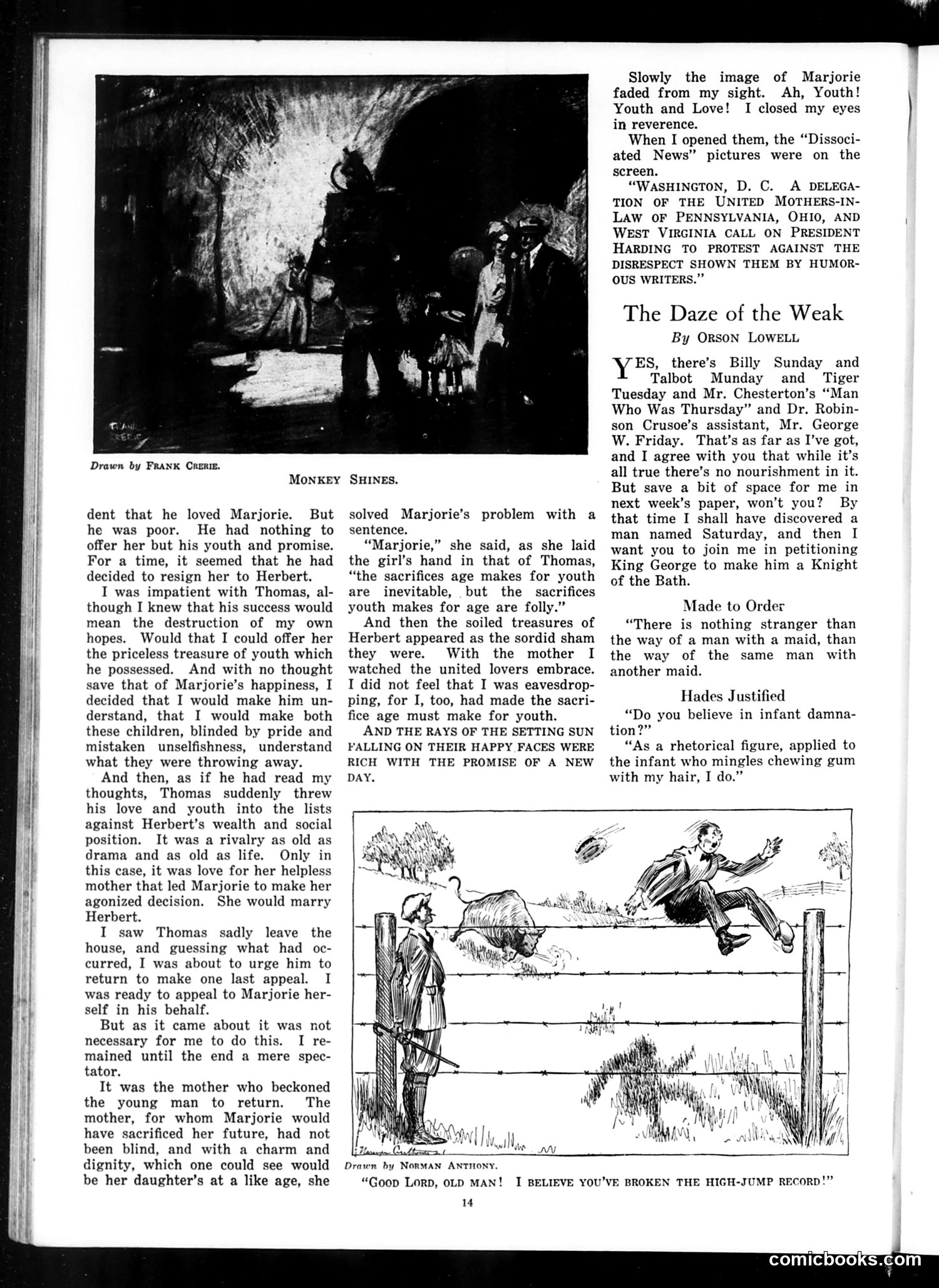
This page contains two distinct pieces of satirical content: **"Monkey Shines"** is a sentimental short story about young love versus financial security, where a poor man (Thomas) wins over a wealthy rival (Herbert) for Marjorie's hand, aided by her wise mother. The story celebrates youth and love over material wealth—typical melodramatic fare for the era. **"The Daze of the Weak"** by Orson Lowell is a humorous column that sarcastizes the sentimental story above. It mocks the overwrought sentimentality by referencing other popular literary works with days-of-the-week names (Billy Sunday, etc.), poking fun at the magazine's own earnest content. The political cartoon caption mentions President Harding and mothers-in-law from Pennsylvania, Ohio, and West Virginia protesting disrespect from "humorous writers"—likely a self-referential joke about Judge's own satirical approach. The bottom cartoon by Norman Anthony shows a man breaking a high-jump record, an absurdist sports gag unrelated to the page's other content.
📄 Transcribed text from this page (OCR, searchable)
Machine-transcribed from the original scan — historical spelling and the odd misread are preserved.
Drawn by FRANK CRERIE. MonkKEY SHINES. dent that he loved Marjorie. But he was poor. He had nothing to offer her but his youth and promise. For a time, it seemed that he had decided to resign her to Herbert. I was impatient with Thomas, al- though I knew that his success would mean the destruction of my own hopes. Would that I could offer her the priceless treasure of youth which he possessed. And with no thought save that of Marjorie’s happiness, I decided that I would make him un- derstand, that I would make both these children, blinded by pride and mistaken unselfishness, understand what they were throwing away. And then, as if he had read my thoughts, Thomas suddenly threw his love and youth into the lists against Herbert’s wealth and social position. It was a rivalry as old as drama and as old as life. Only in this case, it was love for her helpless mother that led Marjorie to make her agonized decision. She would marry Herbert. I saw Thomas sadly leave the house, and guessing what had oc- curred, I was about to urge him to return to make one last appeal. I was ready to appeal to Marjorie her- self in his behalf. But as it came about it was not necessary for me to do this. I re- mained until the end a mere spec- tator. It was the mother who beckoned the young man to return. The mother, for whom Marjorie would have sacrificed her future, had not been blind, and with a charm and dignity, which one could see would be her daughter’s at a like age, she solved Marjorie’s problem with a sentence. “Marjorie,” she said, as she laid the girl’s hand in that of Thomas, “the sacrifices age makes for youth are inevitable, but the sacrifices youth makes for age are folly.” And then the soiled treasures of Herbert appeared as the sordid sham they were. With the mother I watched the united lovers embrace. I did not feel that I was eavesdrop- ping, for I, too, had made the sacri- fice age must make for youth. AND THE RAYS OF THE SETTING SUN FALLING ON THEIR HAPPY FACES WERE RICH WITH THE PROMISE OF A NEW DAY. Slowly the image of Marjorie faded from my sight. Ah, Youth! Youth and Love! I closed my eyes in reverence. When I opened them, the “Dissoci- ated News” pictures were on the screen. “WASHINGTON, D. C. A DELEGA- TION OF THE UNITED MOTHERS-IN- Law OF PENNSYLVANIA, OHIO, AND WEST VIRGINIA CALL ON PRESIDENT HARDING TO PROTEST AGAINST THE DISRESPECT SHOWN THEM BY HUMOR- OUS WRITERS.” The Daze of the Weak By ORSON LOWELL Ys, there’s Billy Sunday and Talbot Munday and_ Tiger Tuesday and Mr. Chesterton’s “Man Who Was Thursday” and Dr. Robin- son Crusoe’s assistant, Mr. George W. Friday. That’s as far as I’ve got, and I agree with you that while it’s all true there’s no nourishment in it. But save a bit of space for me in next week’s paper, won’t you? By that time I shall have discovered a man named Saturday, and then I want you to join me in petitioning King George to make him a Knight of the Bath. Made to Order “There is nothing stranger than the way of a man with a maid, than the way of the same man with another maid. Hades Justified “Do you believe in infant damna- tion?” “As a rhetorical figure, applied to the infant who mingles chewing gum with my hair, I do.” Drawn by NoRMAN ANTHONY. “Goop Lor, OLD MAN! 14 I BELIEVE YOU’VE BROKEN THE HIGH-JUMP RECORD