
Judge, 1921-08-13 · page 9 of 36
Judge — August 13, 1921 — page 9: what you’re looking at
What you’re looking at
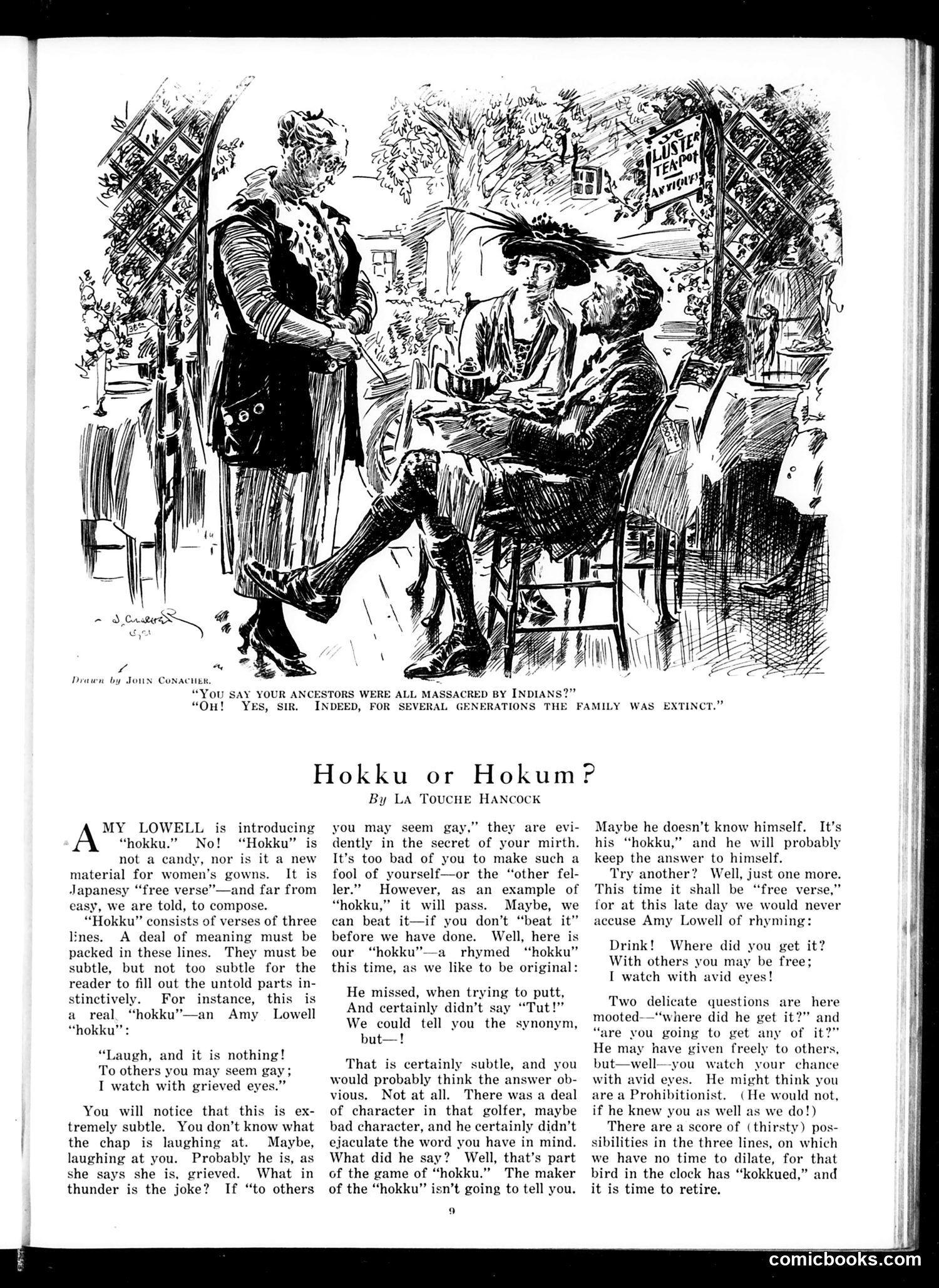
This article mocks the literary trend of "hokku" (Japanese free verse poetry), particularly as championed by Amy Lowell, a prominent modernist poet of the early 20th century. **The Satire:** The author argues that hokku is deliberately obscure and pretentious—verses packed with hidden meaning that readers must guess at, while the poet refuses to explain the point. The cartoon above illustrates this absurdity: a person boasts about ancestors massacred by Native Americans, a ridiculous "tragic" claim meant to exemplify the kind of vague, confusing subject matter hokku celebrates. **The Point:** Judge ridicules modernist poetry as meaningless obscurity masquerading as art. The author demonstrates this by composing deliberately cryptic hokku examples (about a golfer cursing, someone hiding alcohol) that are intentionally nonsensical—proving the form rewards confusion over genuine meaning. This reflects broader early-20th-century American skepticism toward avant-garde literary movements among mainstream audiences.
📄 Transcribed text from this page (OCR, searchable)
Machine-transcribed from the original scan — historical spelling and the odd misread are preserved.
Drawn by Joun Conacuer. “You SAY YOUR ANCESTORS WERE ALL MASSACRED BY INDIANS?” “On! YES, SIR. Hokku or Hokum? MY LOWELL is introducing A “hokku.” No! “Hokku” is not a candy, nor is it a new material for women’s gowns. It is Japanesy “free verse”—and far from we are told, to compose. okku” consists of verses of three A deal of meaning must be packed in these lines. They must be subtle, but not too subtle for the reader to fill out the untold parts in- stinetively. For instance, this is a real. “hokku”—an Amy Lowell “hokku”: “Laugh, and it is nothing! To others you may seem gay; I watch with grieved eyes.” lines. You will notice that this is ex- tremely subtle. You don’t know what the chap is laughing at. Maybe, laughing at you. Probably he is, as she says she is, grieved. What in thunder is the joke? If “to others By La ToucHE HANCOCK you may seem gay,” they are evi- dently in the secret of your mirth. It’s too bad of you to make such a fool of yourself—or the “other fel- ler.” However, as an example of “hokku,” it will pass. Maybe, we can beat it—if you don’t “beat it” before we have done. Well, here is our “hokku”’—a rhymed “hokku” this time, as we like to be original: He missed, when trying to putt, And certainly didn’t say “Tut!” We could tell you the synonym, but—! That is certainly subtle, and you would probably think the answer ob- vious. Not at all. There was a deal of character in that golfer, maybe bad character, and he certainly didn’t ejaculate the word you have in mind. What did he say? Well, that’s part of the game of “hokku.” The maker of the “hokku”’ isn’t going to tell you. INDEED, FOR SEVERAL GENERATIONS THE FAMILY WAS EXTINCT.” Maybe he doesn’t know himself. It’s his “hokku,” and he will probably keep the answer to himself. Try another? Well, just one more. This time it shall be ‘free verse,” for at this late day we would never accuse Amy Lowell of rhyming: Drink! Where did you get it? With others you may be free; I watch with avid eyes! Two delicate questions are here mooted-—“‘where did he get it?” and “are you going to get any of it?” He may have given freely to others, but—well—you watch your chance with avid eves. He might think you are a Prohibitionist. (He would not, if he knew you as well as we do!) There are a score of (thirsty) pos- sibilities in the three lines, on which we have no time to dilate, for that bird in the clock has “kokkued,” and it is time to retire.