
Judge, 1921-08-13 · page 6 of 36
Judge — August 13, 1921 — page 6: what you’re looking at
What you’re looking at
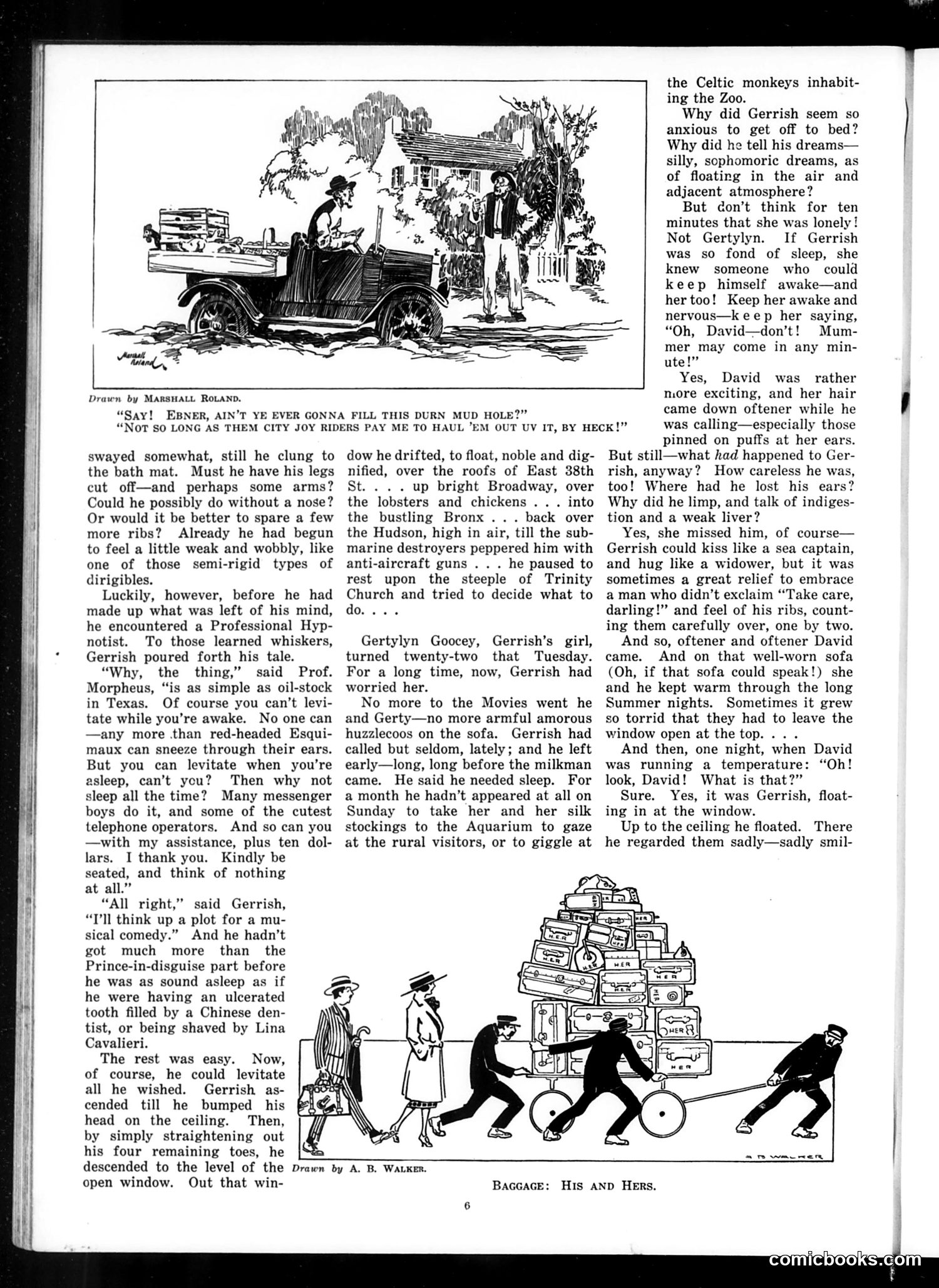
This page contains two illustrations satirizing early 20th-century urban life and travel: **Top illustration** ("Say! Enter, ye ever gonna fill this burn mud hole?"): Depicts a car stuck in muddy road conditions while passengers complain. The joke mocks the poor state of American roads despite the automobile age—a common complaint of the era when cars were becoming popular but infrastructure lagged. **Bottom illustration** ("Baggage: His and Hers"): Shows men struggling to transport an enormous stack of luggage, apparently belonging to a woman. This satirizes the era's stereotype about women's excessive travel baggage and shopping habits—a recurring theme in period humor about gender differences and consumerism. Both cartoons humorously critique the tensions between modern conveniences and their practical complications.
📄 Transcribed text from this page (OCR, searchable)
Machine-transcribed from the original scan — historical spelling and the odd misread are preserved.
Drawn by MARSHALL ROLAND. “Say! swayed somewhat, still he clung to the bath mat. Must he have his legs cut off—and perhaps some arms? Could he possibly do without a nose? Or would it be better to spare a few more ribs? Already he had begun to feel a little weak and wobbly, like one of those semi-rigid types of dirigibles. Luckily, however, before he had made up what was left of his mind, he encountered a Professional Hyp- notist. To those learned whiskers, Gerrish poured forth his tale. “Why, the thing,” said Prof. Morpheus, “is as simple as oil-stock in Texas. Of course you can’t levi- tate while you’re awake. No one can —any more than red-headed Esqui- maux can sneeze through their ears. But you can levitate when you're asleep, can’t yeu? Then why not sleep all the time? Many messenger boys do it, and some of the cutest telephone operators. And so can you —with my assistance, plus ten dol- lars. I thank you. Kindly be seated, and think of nothing at all.” “All right,” said Gerrish, “Tl think up a plot for a mu- sical comedy.” And he hadn’t got much more than the Prince-in-disguise part before he was as sound asleep as if he were having an ulcerated tooth filled by a Chinese den- tist, or being shaved by Lina Cavalieri. The rest was easy. Now, of course, he could levitate all he wished. Gerrish as- cended till he bumped his head on the ceiling. Then, by simply straightening out his four remaining toes, he EBNER, AIN’T YE EVER GONNA FILL THIS DURN MUD HOLE?” “NOT SO LONG AS THEM CITY JOY RIDERS PAY ME TO HAUL ’EM OUT UV IT, BY HECK!” dow he drifted, to float, noble and dig- nified, over the roofs of East 38th St... . up bright Broadway, over the lobsters and chickens . . . into the bustling Bronx ... back over the Hudson, high in air, till the sub- marine destroyers peppered him with anti-aircraft guns . . . he paused to rest upon the steeple of Trinity Church and tried to decide what to do... Gertylyn Goocey, Gerrish’s girl, turned twenty-two that Tuesday. For a long time, now, Gerrish had worried her. No more to the Movies went he and Gerty—no more armful amorous huzzlecoos on the sofa. Gerrish had called but seldom, lately; and he left early—long, long before the milkman came. He said he needed sleep. For a month he hadn’t appeared at all on Sunday to take her and her silk stockings to the Aquarium to gaze at the rural visitors, or to giggle at the Celtic monkeys inhabit- ing the Zoo. Why did Gerrish seem so anxious to get off to bed? Why did he tell his dreams— silly, sophomoric dreams, as of floating in the air and adjacent atmosphere? But don’t think for ten minutes that she was lonely! Not Gertylyn. If Gerrish was so fond of sleep, she knew someone who could keep himself awake—and her too! Keep her awake and nervous—k ee p her saying, “Oh, David—don’t! Mum- mer may come in any min- ute!” Yes, David was rather more exciting, and her hair came down oftener while he was calling—especially those pinned on puffs at her ears. But still—what had happened to Ger- rish, anyway? How careless he was, too! Where had he lost his ears? Why did he limp, and talk of indiges- tion and a weak liver? Yes, she missed him, of course— Gerrish could kiss like a sea captain, and hug like a widower, but it was sometimes a great relief to embrace aman who didn’t exclaim “Take care, darling!” and feel of his ribs, count- ing them carefully over, one by two. And so, oftener and oftener David came. And on that well-worn sofa (Oh, if that sofa could speak!) she and he kept warm through the long Summer nights. Sometimes it grew so torrid that they had to leave the window open at the top... . And then, one night, when David was running a temperature: “Oh! look, David! What is that?” Sure. Yes, it was Gerrish, float- ing in at the window. Up to the ceiling he floated. There he regarded them sadly—sadly smil- descended to the level of the Drawn by A. B. WALKER. open window. Out that win- BAGGAGE: His AND Hers.