
A complete issue · 36 pages · 1921
Judge — July 9, 1921
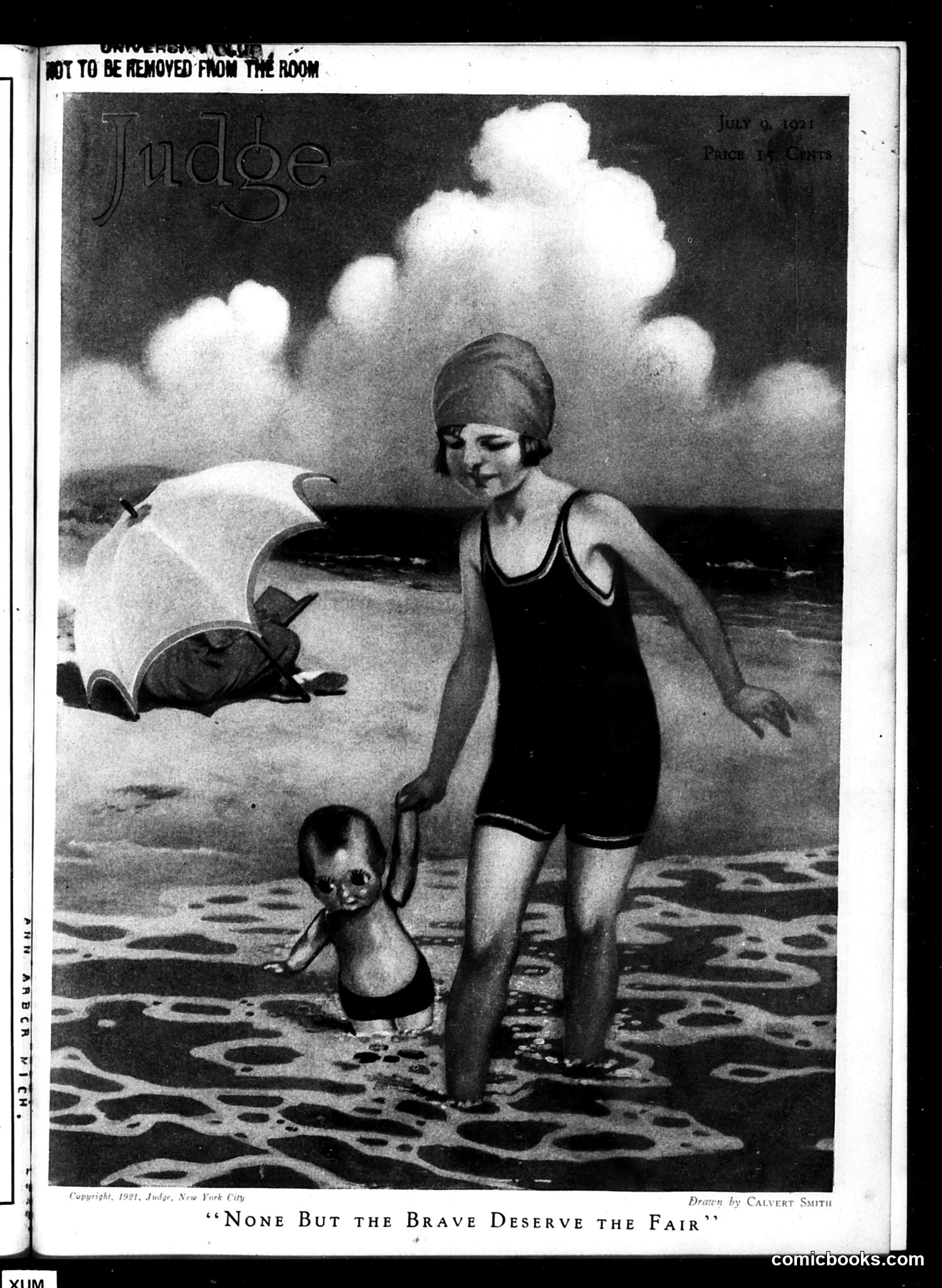
This is a beach scene illustration titled "None But the Brave Deserve the Fair," credited to artist Calvert Smith. It depicts a woman in a 1920s bathing costume with a head covering, standing with a small child in the shallow surf. An umbrella and what appears to be a companion sit on the beach behind them. The caption's reference to "the brave" likely satirizes social attitudes about women's beach fashion and swimming during the 1920s. At this era, women's bathing attire was becoming more revealing and practical, which scandalized conservative observers. The illustration appears to gently mock either the "bravery" required for women to adopt modern swimwear, or society's dramatic reactions to these changing fashion norms.
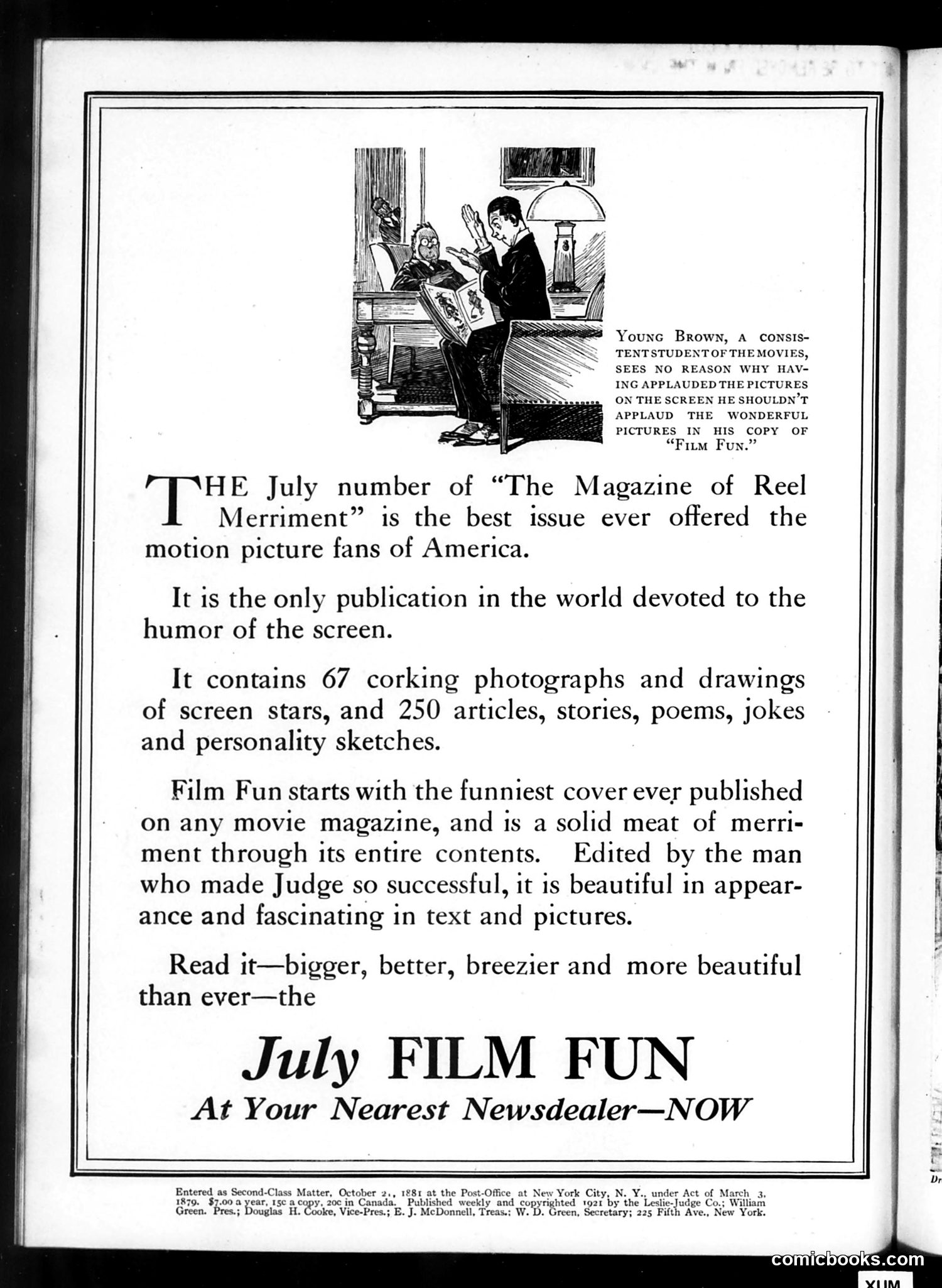
This page is primarily **advertising**, not political satire. It promotes the July issue of "The Magazine of Reel Merriment" and a publication called "Film Fun." The illustration shows a young man labeled "Young Brown, a consistent student of the movies" presenting a magazine to a woman at a desk. The joke is that Brown applauds pictures on screen but won't applaud the same pictures in his "Film Fun" magazine—a humorous contradiction about his inconsistent standards. The advertisement emphasizes "Film Fun" as "the only publication in the world devoted to the humor of the screen," containing 67 photographs of stars and 250 articles, jokes, and sketches. It notes the editor made "Judge" successful, positioning this as a comparable quality product for motion picture fans of the 1920s era.
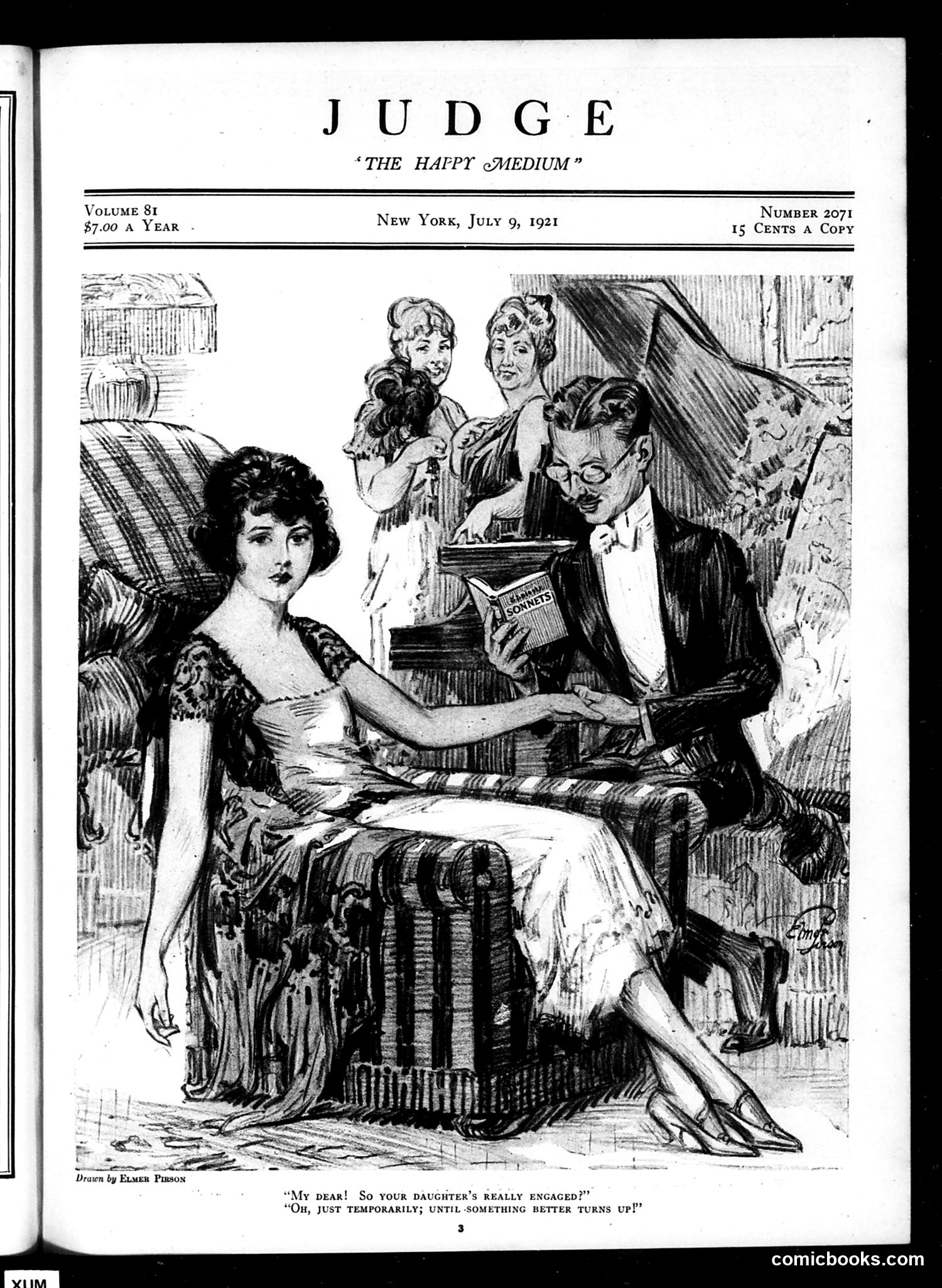
This cartoon illustrates a domestic comedy scenario about an engagement. A seated woman discusses her daughter's engagement with a man holding what appears to be a marriage contract or document. Two other women observe from behind. The humor relies on a common early 20th-century social anxiety: the precarious nature of engagements. The man's statement—"just temporarily; until something better turns up"—inverts typical marriage expectations. Rather than permanent commitment, he treats the engagement as temporary, suggesting he's keeping his romantic options open. This satirizes both male inconsistency in courtship and women's uncertain social standing, where an engagement might be broken if a "better" match appeared. The joke plays on period concerns about marriage security and masculine reliability.
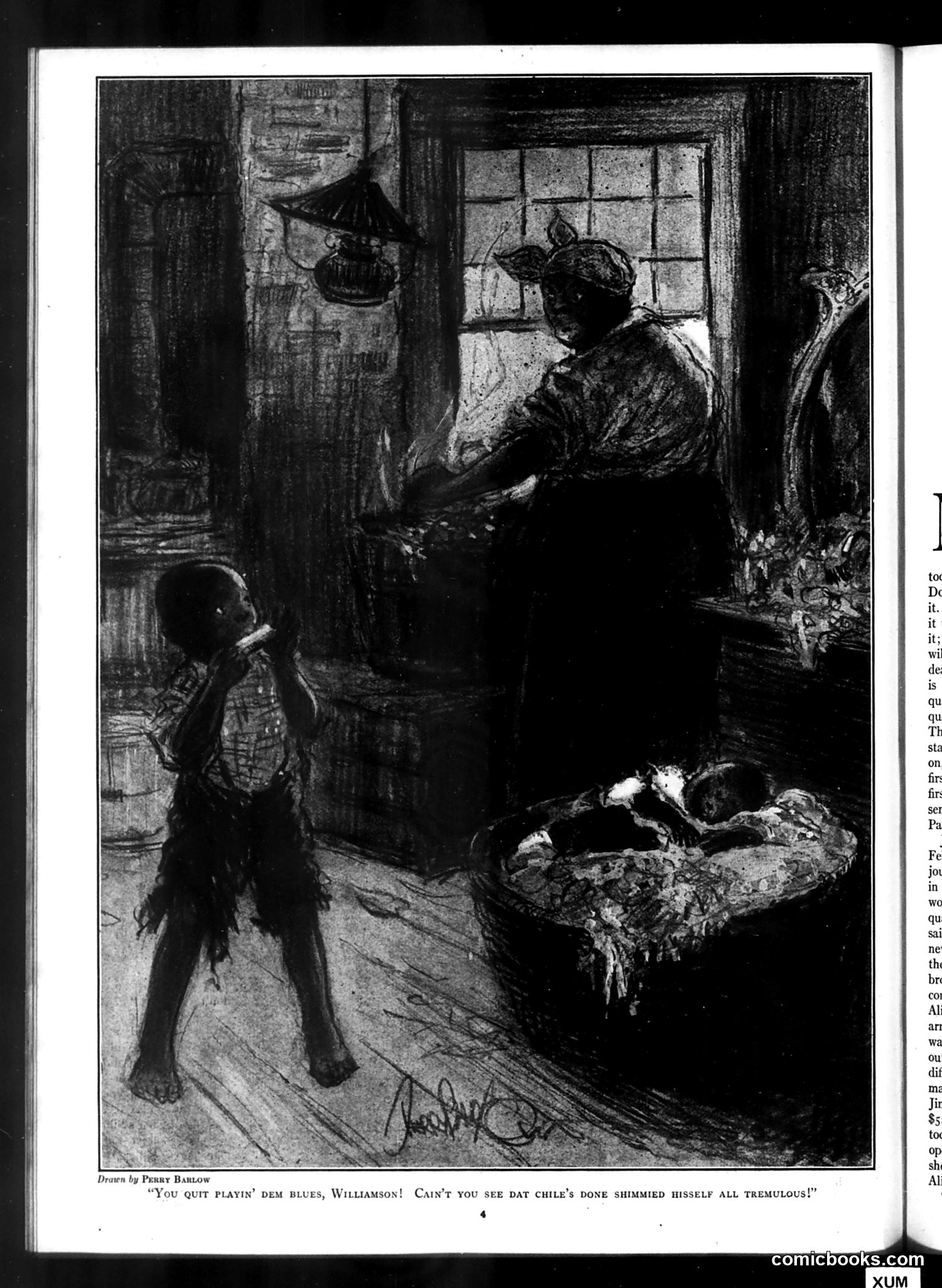
This illustration by Perry Barlow depicts a scene of poverty and hardship. The caption reads: "You quit playin' dem blues, Williamson! Cain't you see dat chile's done shimmied himself all tremulous!" The cartoon appears to satirize racial stereotypes prevalent in early 20th-century America. It shows a malnourished child and an adult in a sparse, run-down interior, suggesting economic desperation. The dialect-heavy caption mocks African American speech patterns while depicting poverty conditions. The reference to "blues" and "shimmy" (a dance style) alongside the child's emaciated condition creates social commentary—likely criticizing either frivolous entertainment amid poverty or commenting on social inequality. The artwork itself, rendered in stark blacks and grays, emphasizes the bleakness of the depicted circumstances. Without additional context about "Williamson," the specific satirical target remains unclear.
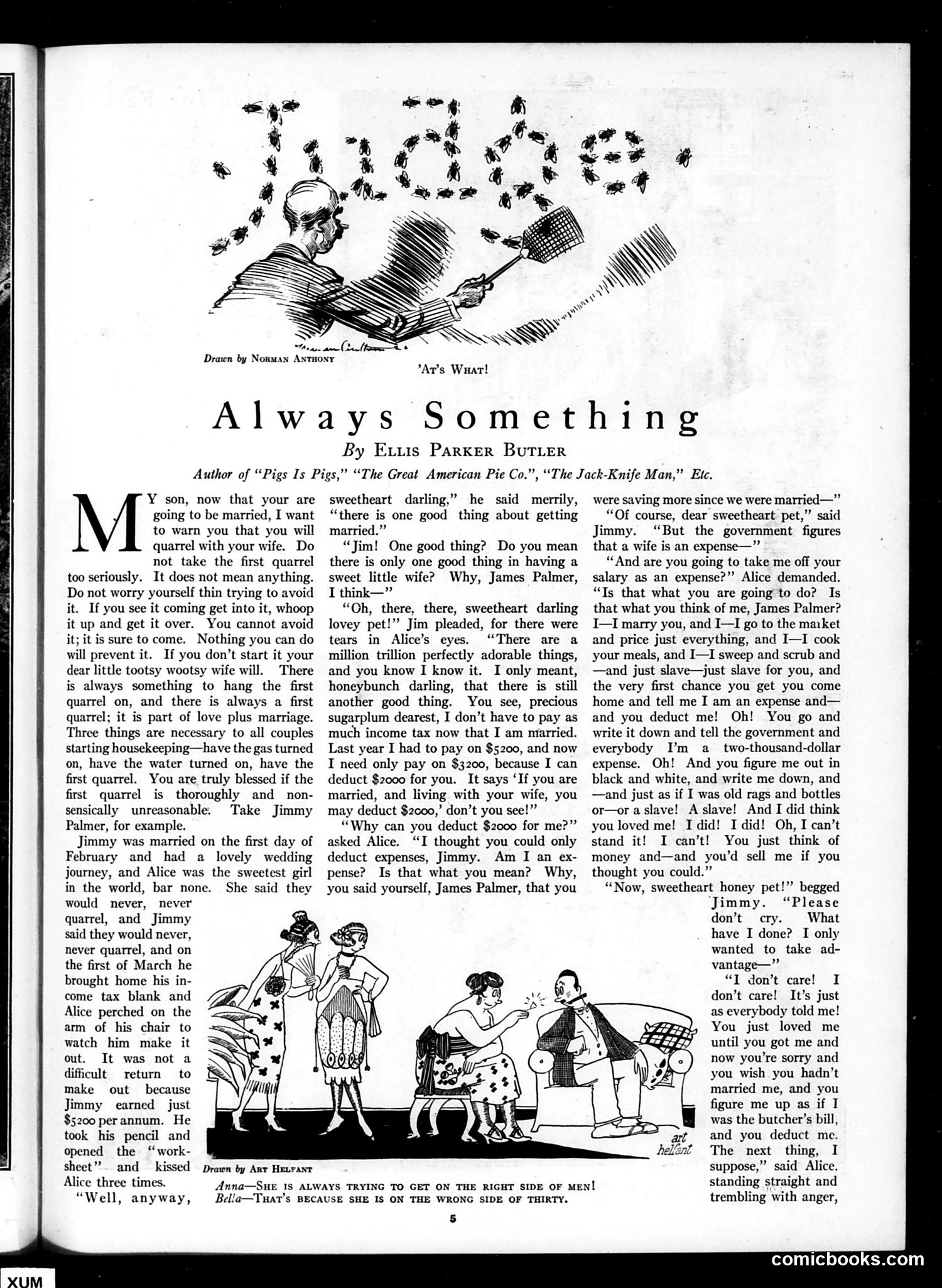
This is a humorous short story about newlyweds Jimmy and Alice, illustrated with domestic scenes. The top cartoon by Norman Anthony shows a figure swatting at flies arranged to spell "JUDGE"—a visual pun on the magazine's name. The story satirizes marriage through Jimmy's advice to avoid quarrels, which Alice systematically undermines. The bottom illustration by Art Halpain depicts a typical household scene with women and children, captioned about "getting on the right side of men" versus "the wrong side of thrifty." The satire targets early 20th-century gender dynamics: husbands' attempts to control household finances and marital peace, contrasted with wives' resourcefulness in circumventing such control. It reflects contemporary anxieties about marriage, domestic authority, and women's economic power.
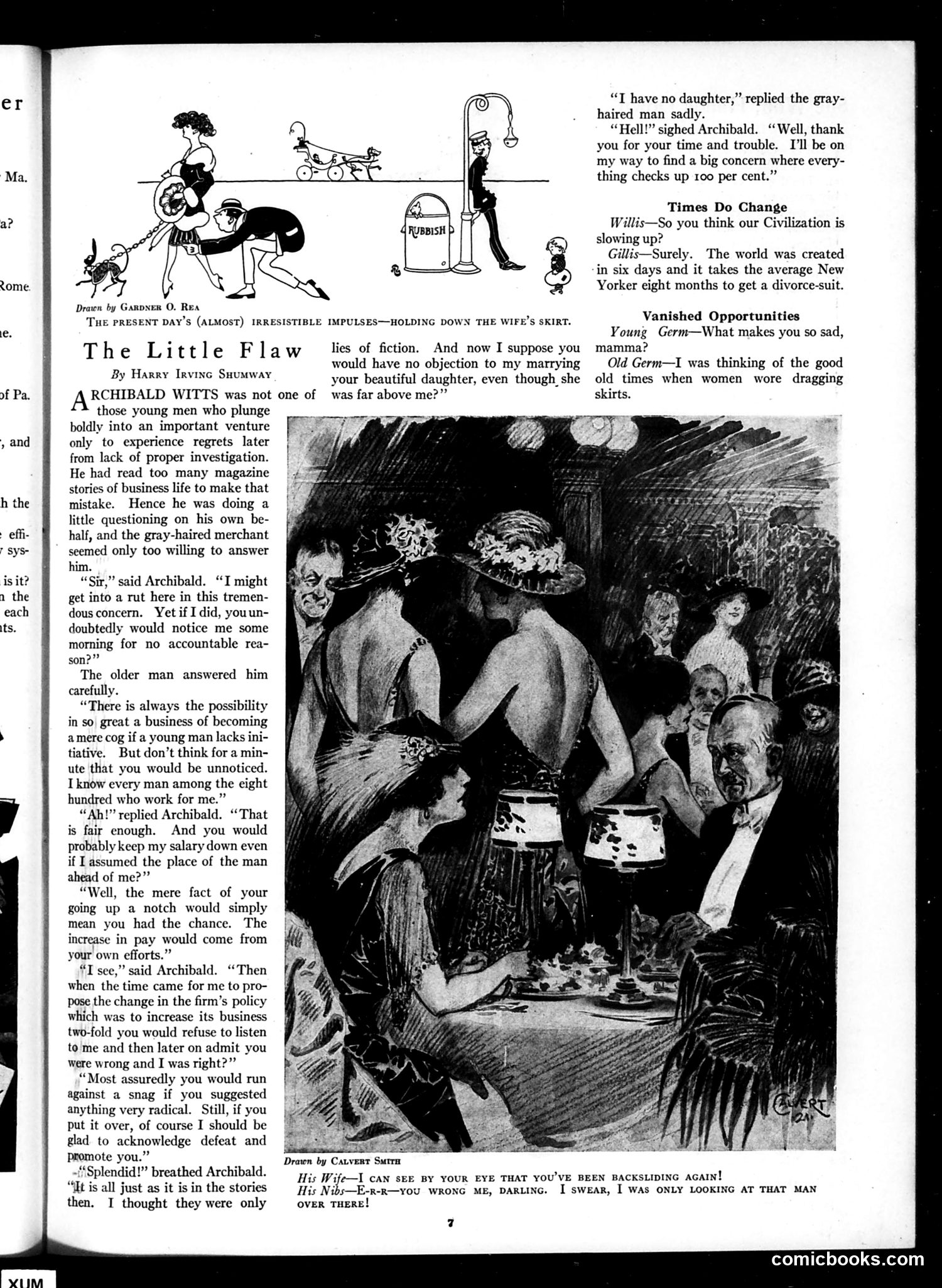
**Top Cartoon ("Irresistible Impulses"):** Satirizes the modern challenge of controlling women's fashion. Shows men struggling to hold down women's skirts, likely referencing the rising hemlines of the 1920s era. The joke mocks both women's fashion liberation and men's embarrassment or loss of control over social propriety. **"The Little Flaw" Story:** A young man (Archibald) interviews for a job and cynically confirms that business life matches magazine fiction—he'll be overlooked, underpaid, rejected if innovative, then later proven right and promoted. The punchline: when he asks to marry the boss's daughter, the boss has none. Archibald leaves, disappointed the fantasy is incomplete. The satire mocks both naive job-seekers and unrealistic business-magazine tropes. **Bottom Cartoon ("His Wife"):** A husband caught "backsliding" (likely drinking or misbehaving) tries to deny it, claiming he was "only looking at that man." His wife reads his guilty expression. Satirizes marital suspicion and male excuses. All content reflects post-WWI social anxieties about changing gender roles and workplace expectations.
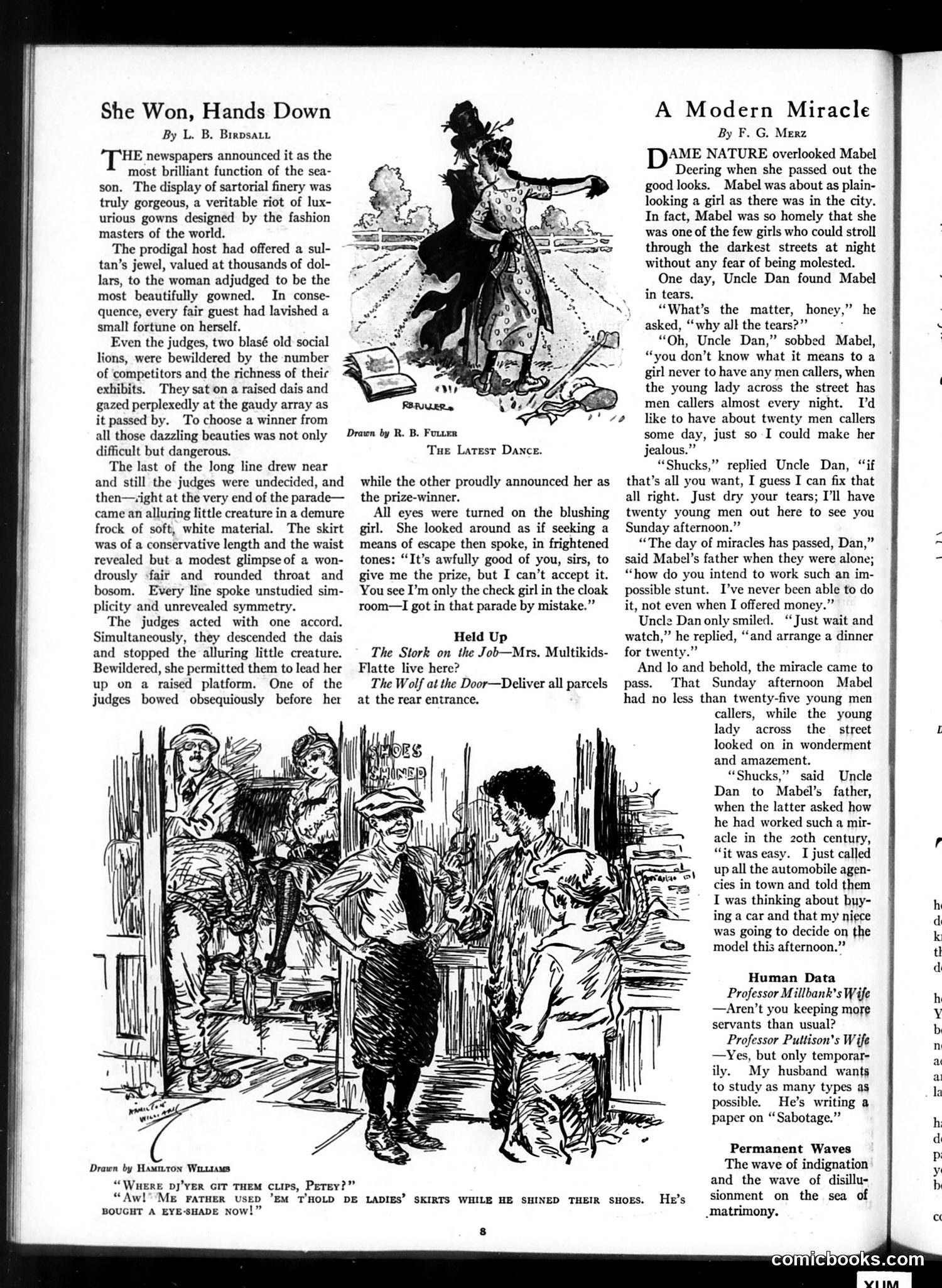
This page contains three satirical stories lampooning early 20th-century social conventions and gender dynamics. **"She Won, Hands Down"** mocks high society's obsession with fashion and appearance. At a competitive gown exhibition, judges award a valuable prize to the most elegantly dressed woman—only to discover she's actually the cloakroom attendant who accidentally joined the parade. The satire targets the superficiality of wealthy society's beauty standards and the irrelevance of actual identity to social judgment. **"The Latest Dance"** (illustrated by Hamilton Williams) appears to reference fashionable dancing, though specifics are unclear from the visible text. **"A Modern Miracle"** humorously depicts an "miracle" where an unattractive girl gains twenty-five male callers in one afternoon. The miracle's nature remains unspecified in visible text, but Uncle Dan apparently achieves it through some unorthodox method—likely satirizing dating conventions or male behavior. The page also includes brief quips about domestic life ("The Stork on the Job," "The Wolf at the Door") and a joke about working-class street vendors.
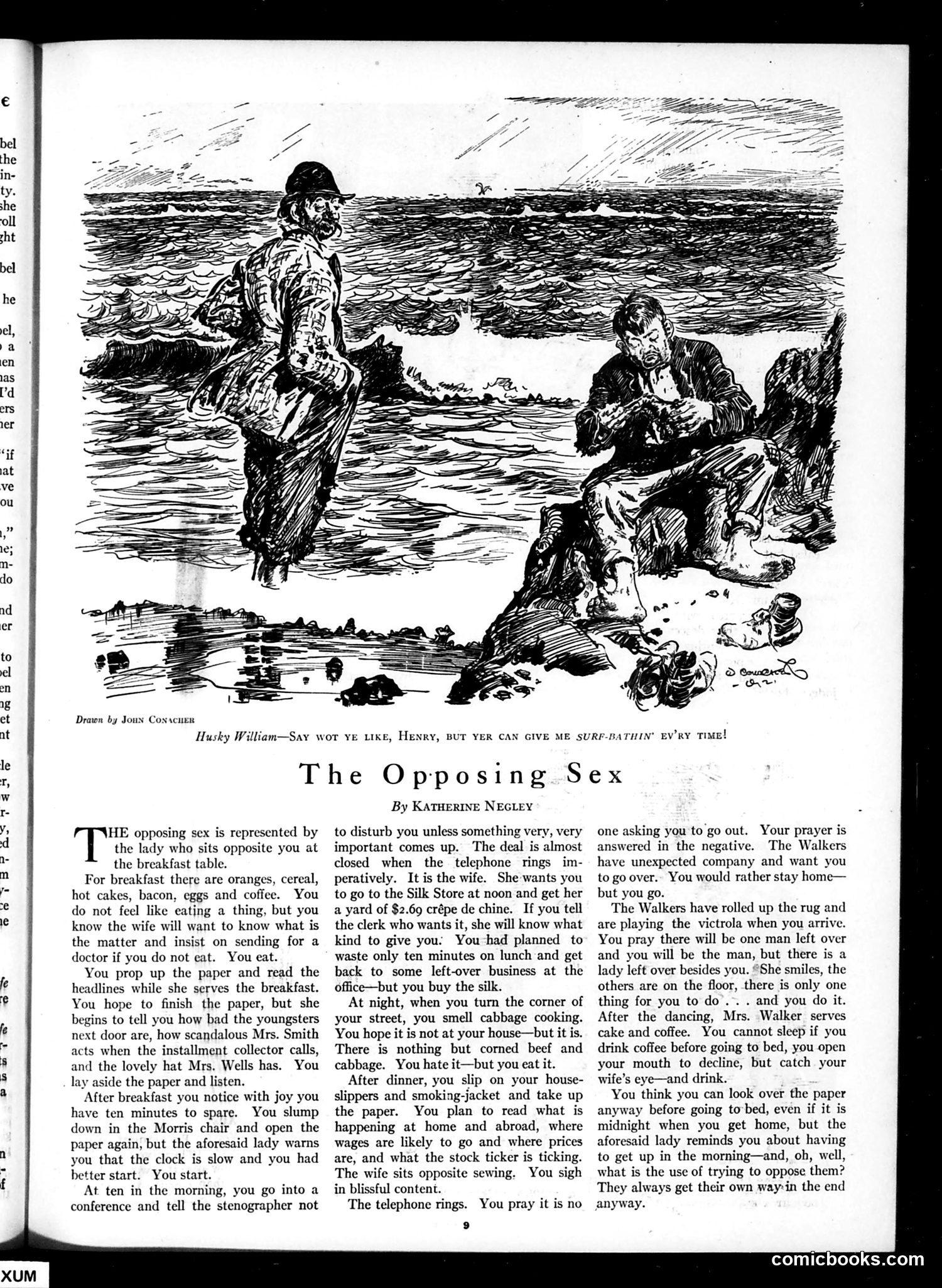
This satirical piece humorously depicts married life from a husband's perspective, portraying wives as controlling forces that thwart male autonomy and leisure. The narrative follows a typical day: the husband must eat breakfast despite lacking appetite to avoid his wife's concern; he's interrupted from reading the newspaper by her gossip; a business meeting is disrupted by his wife demanding he purchase expensive fabric; dinner is an unappetizing corned beef and cabbage; his evening plans are derailed by mandatory socializing; and he cannot even read the paper before bed due to her reminders about morning schedules. The opening cartoon shows "Husky William" preferring surfing to marital obligations, establishing the theme that men desire escape from domestic constraints. The satire reflects early-20th-century gender dynamics: wives as household managers wielding subtle but absolute control, husbands as reluctant participants in domestic and social obligations, and marriage as fundamentally about male surrender of independence. It's humorous precisely because it exaggerates this power imbalance for comic effect.
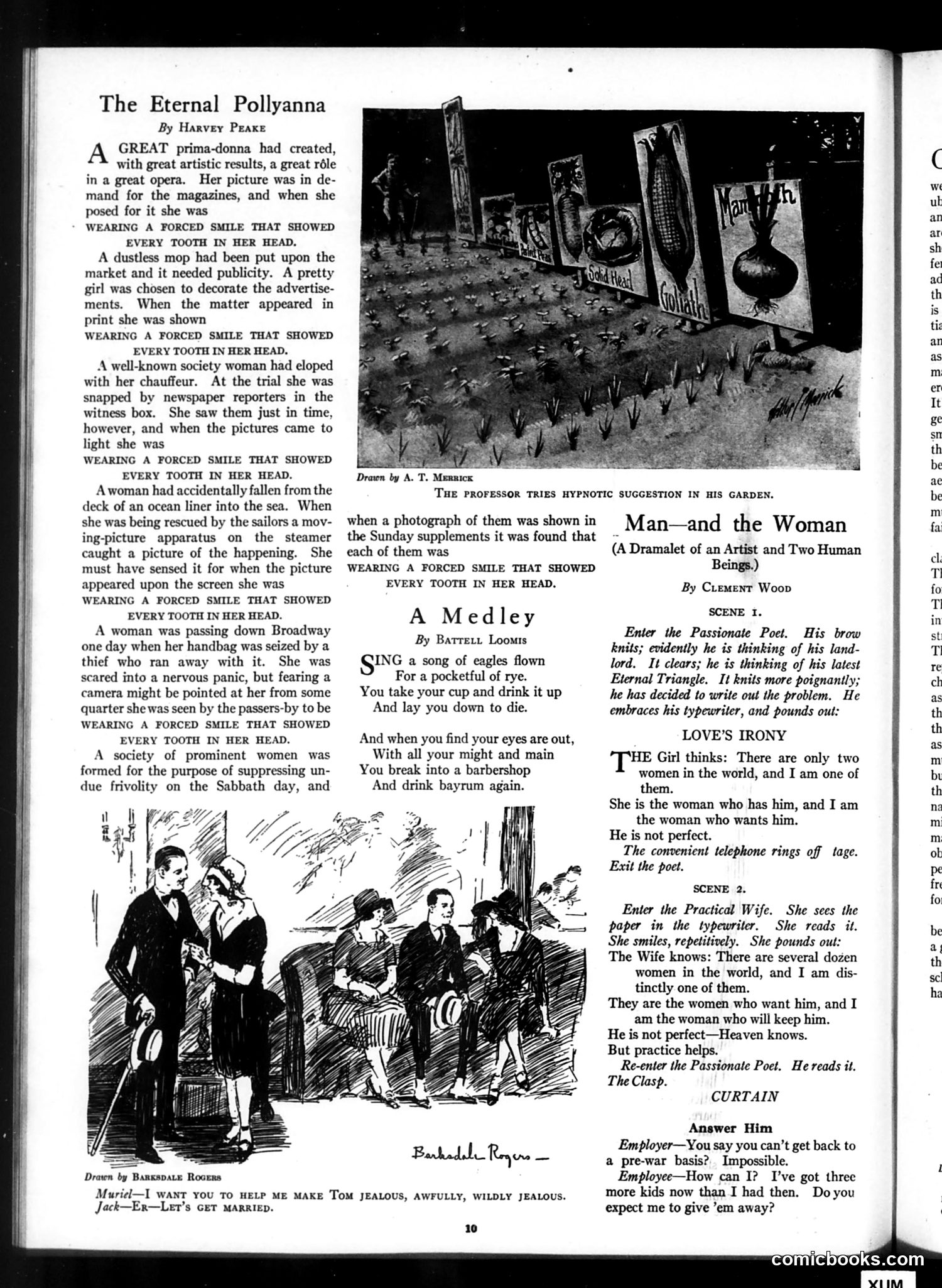
This page satirizes **forced optimism and artificial cheerfulness** in early 20th-century America. The main article mocks how women across all social situations—opera singers, advertisement models, society women in scandal, accident victims, even crime victims—are compelled to display identical forced smiles showing "every tooth in her head" for public photographs. The satire criticizes how women must perform artificial happiness regardless of circumstance, and how photography/publicity culture pressures them into this performative behavior. The accompanying cartoon and short plays explore related social absurdities: romantic jealousy as a marriage proposal tactic, and post-WWI labor disputes where employers demand returning to pre-war wage conditions despite workers' changed family circumstances. The overall tone suggests frustration with societal expectations of perpetual cheerfulness and the gap between internal reality and external presentation required by modern publicity and social convention.
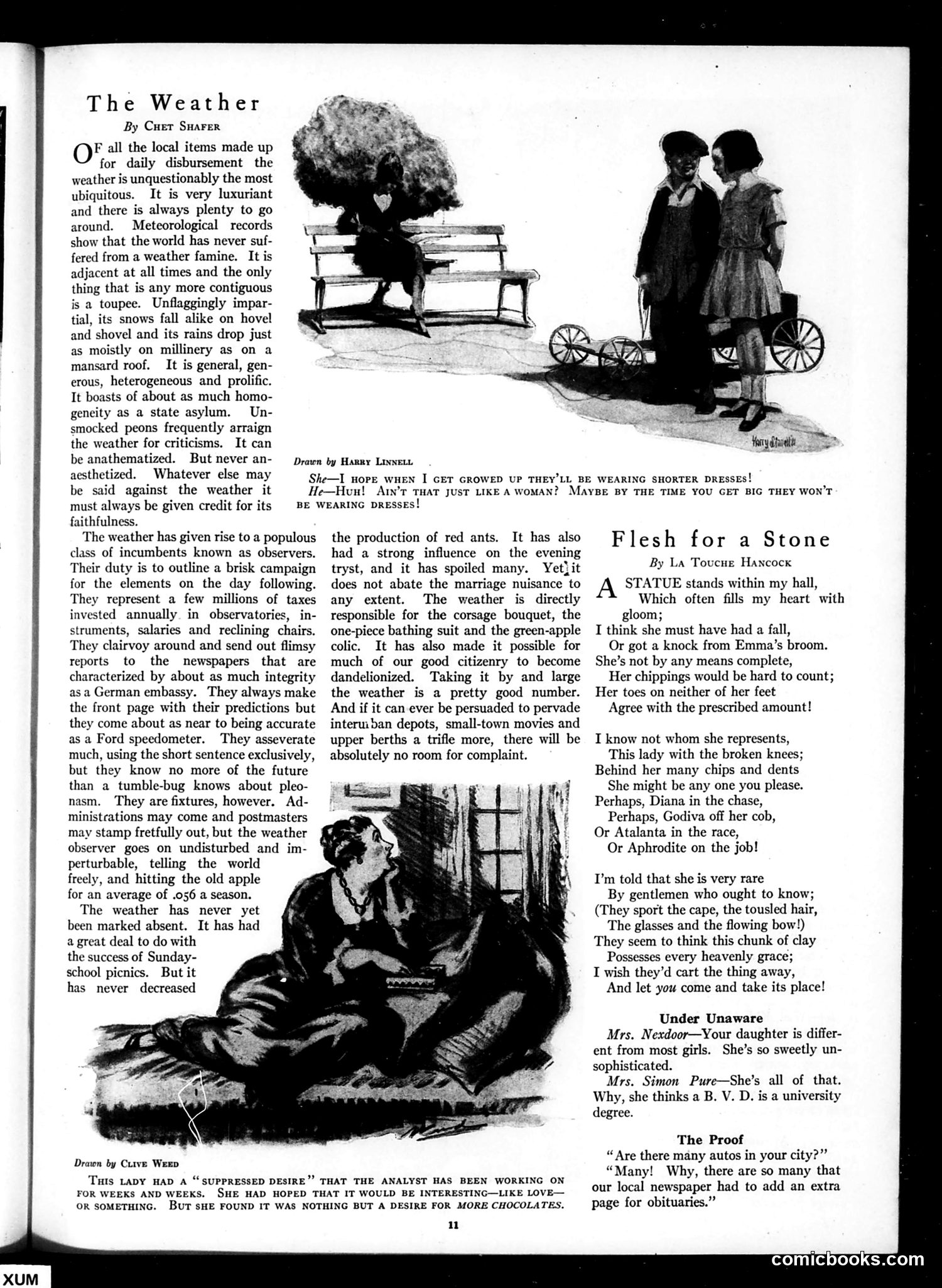
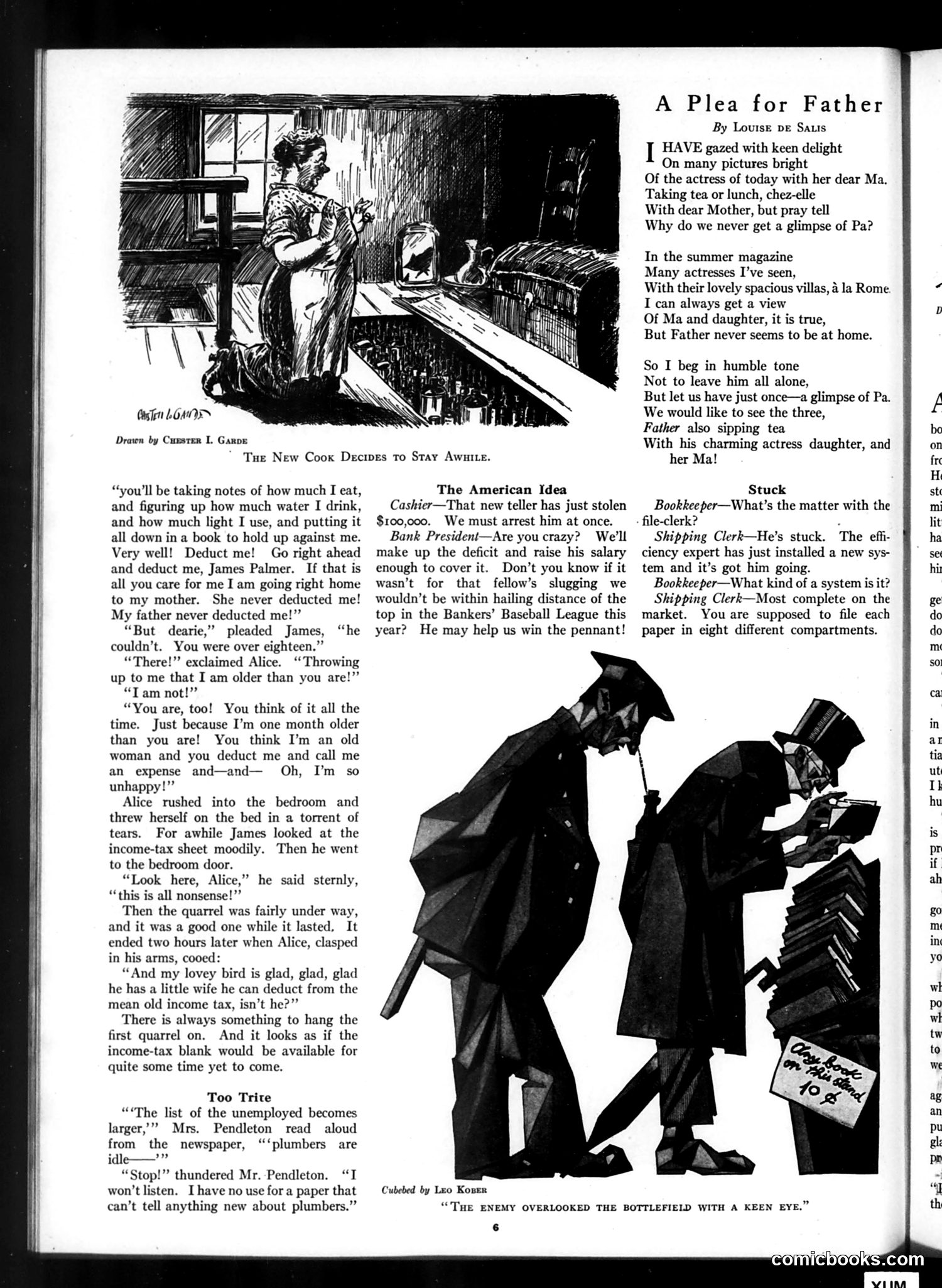
This satirical page contains three distinct pieces mocking early 20th-century American life: **"The Weather" by Chet Shafer** is a humorous essay ridiculing weather forecasters and meteorological observers. It satirizes their predictive failures (comparing accuracy to a Ford speedometer's reliability) while noting their secure government positions despite consistent inaccuracy. The tone is absurdist, treating weather reporting as an established bureaucratic fixture immune to accountability. **Two cartoons by Harry Linnell and Cuve Weed** depict gender and relationship dynamics. One features children discussing women's fashion; another shows a psychoanalyst discovering a woman's "suppressed desire" is merely wanting more chocolates—mocking both Freudian psychology trends and stereotypes about women's shallow desires. **"Flesh for a Stone" by La Touche Hancock** is a poem about a damaged statue in the speaker's home, whose identity remains unclear due to missing parts. It playfully catalogs possible identities (Diana, Godiva, Atalanta, Aphrodite), creating humor through the statue's ambiguous and deteriorated state. The page reflects Judge's satirical approach to contemporary social institutions, gender roles, and pseudo-scientific trends of the era.
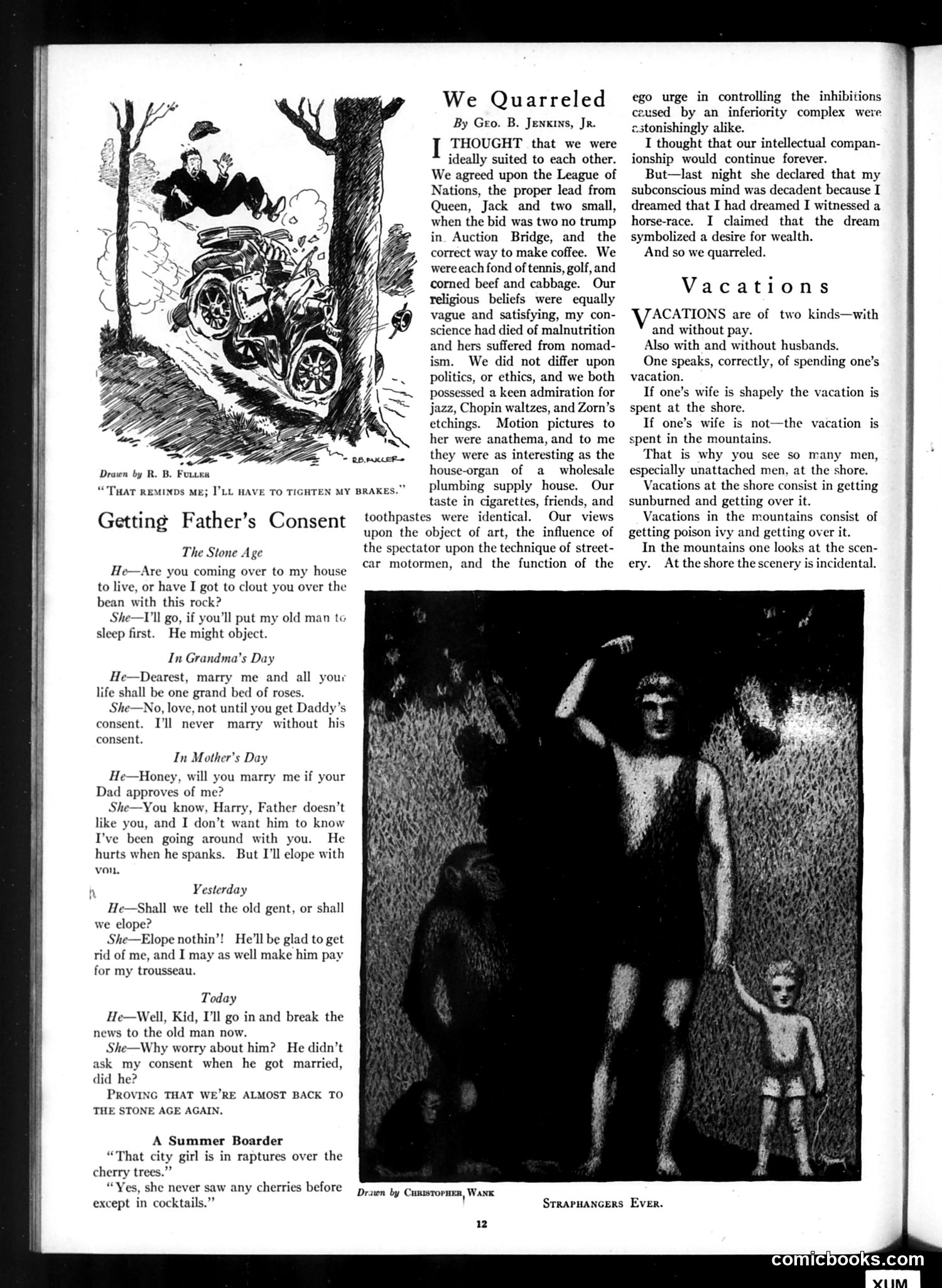
**"Getting Father's Consent"** (top left) is a four-panel comic satirizing changing courtship customs. It traces evolving male attitudes toward asking a woman's father for marriage permission—from Stone Age brutality (hitting her), to Victorian romance (respectful requests), to recent indifference (eloping without permission), to modern reversal where the woman dismisses paternal consent entirely. The punchline suggests gender roles have inverted to absurdity: she now treats her father's opinion as irrelevant, just as he once ignored her mother's wishes. The caption notes society has regressed "almost back to the Stone Age." **"We Quarreled"** (right column) humorously catalogs a couple's perfect compatibility—same card-game preferences, art tastes, even identical toothpaste brands—only to collapse over dream interpretation. She claims his dream of witnessing a horse-race reveals a "decadent subconscious mind"; he counters it symbolizes wealth-desire. The satire mocks Freudian psychology's then-fashionable dominance in relationship conflicts. **"Vacations"** (bottom right) uses witty parallel structure to joke that vacation quality depends on wives' appearance: attractive wives → beach vacations; unattractive wives → mountain vacations (where scenery distracts from them).
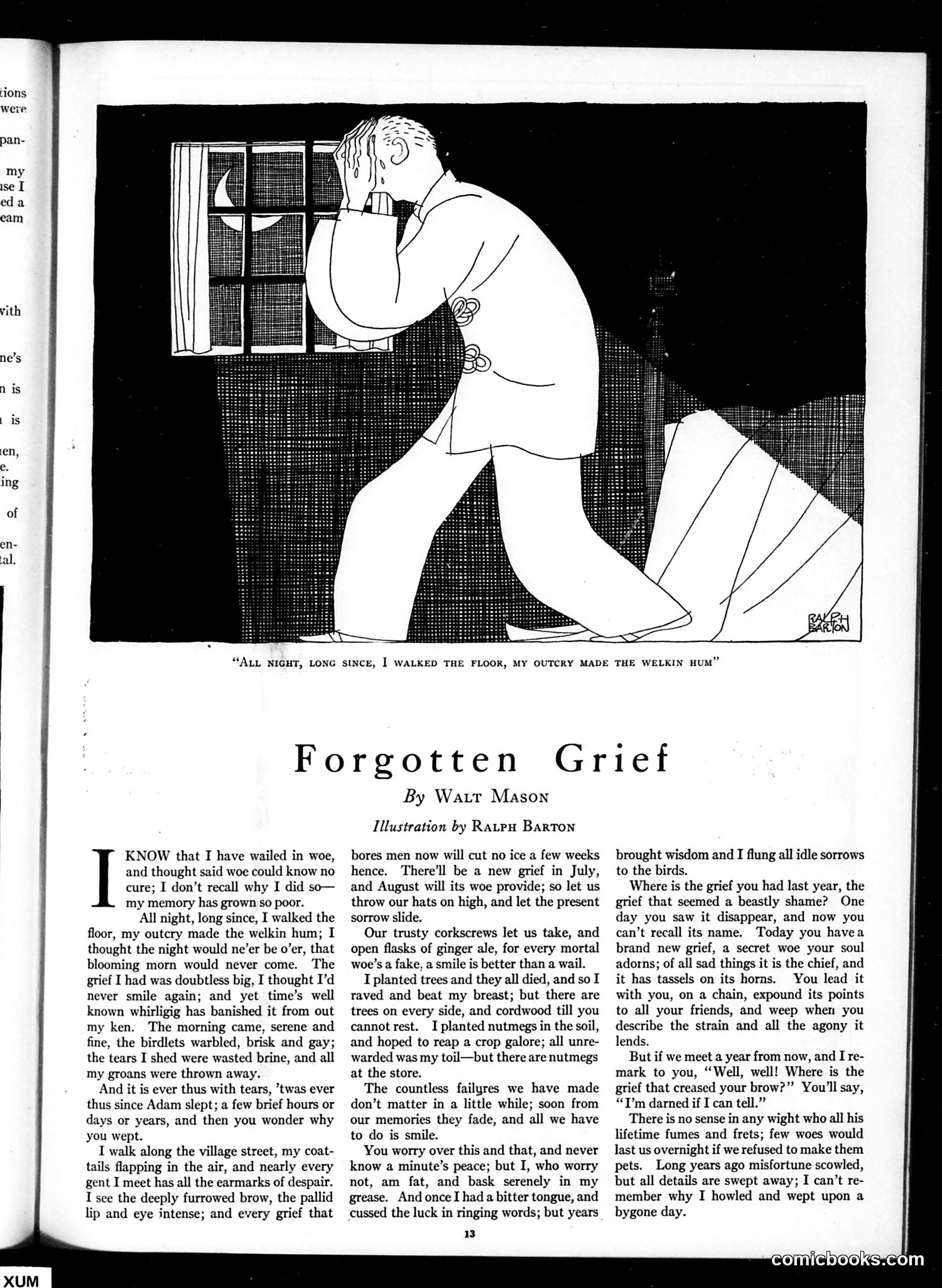
This is a humorous essay-poem by Walt Mason (illustrated by Ralph Barton) about how human grief and worry are temporary and ultimately forgotten—yet we treat them as permanent tragedies while experiencing them. **The satire:** Mason mocks people's tendency to agonize intensely over problems that vanish from memory within weeks or months. The cartoon depicts a man dramatically weeping at a window, embodying this overwrought response. **The point:** Mason argues that almost all worries are self-inflicted and short-lived. He uses concrete examples (planting trees that died, failed nutmeg crops) to show that disappointments naturally fade and become replaced by new ones. His advice: stop dramatizing current sorrows, enjoy life ("throw our hats on high"), and recognize that even today's supposedly devastating "grief...has tassels on its horns"—is just another temporary affliction. **The message for Judge's readers:** This reflects early-20th-century popular philosophy promoting emotional resilience and acceptance of life's inevitable ups and downs, rather than wallowing in self-pity.
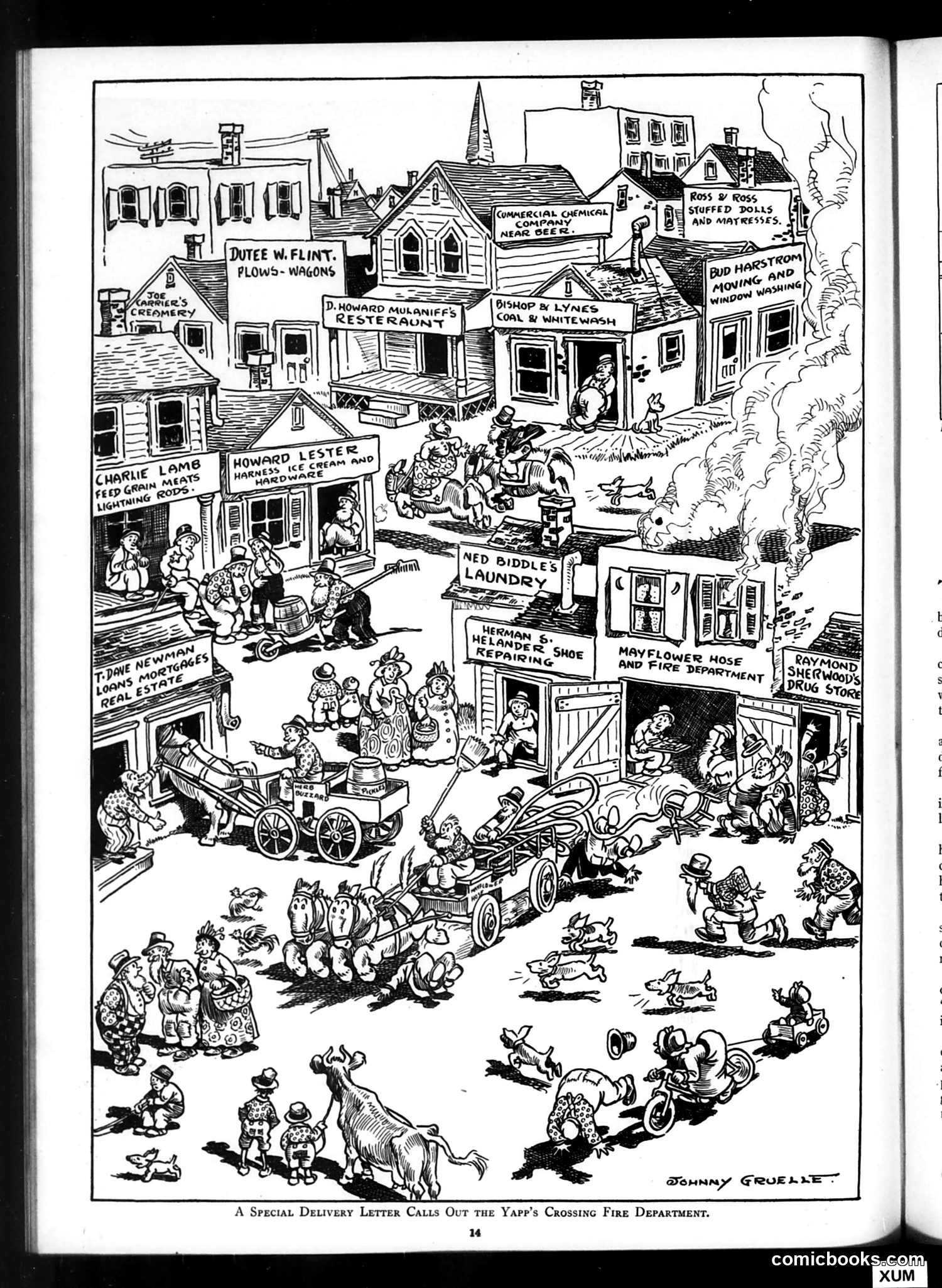
This is a humorous illustrated scene depicting a small-town fire department responding to an emergency. The cartoon shows the volunteer firefighters of "Yapp's Crossing" being summoned by what appears to be an urgent delivery letter, mobilizing the community in comical fashion. The joke satirizes small-town volunteer fire departments of the early 20th century—portraying them as chaotic, overeager, and somewhat disorganized, with various townspeople and makeshift vehicles scrambling in response. The labeled businesses (creamery, hardware store, laundry, etc.) establish this as a humble rural community where firefighting is a communal civic duty rather than a professional service. The cartoonist (signed "Johnny Gruelle") captures the contrast between the serious purpose (fire emergency response) and the absurd, slapstick reality of untrained volunteers mobilizing. This reflects contemporary attitudes toward rural infrastructure and volunteer services.
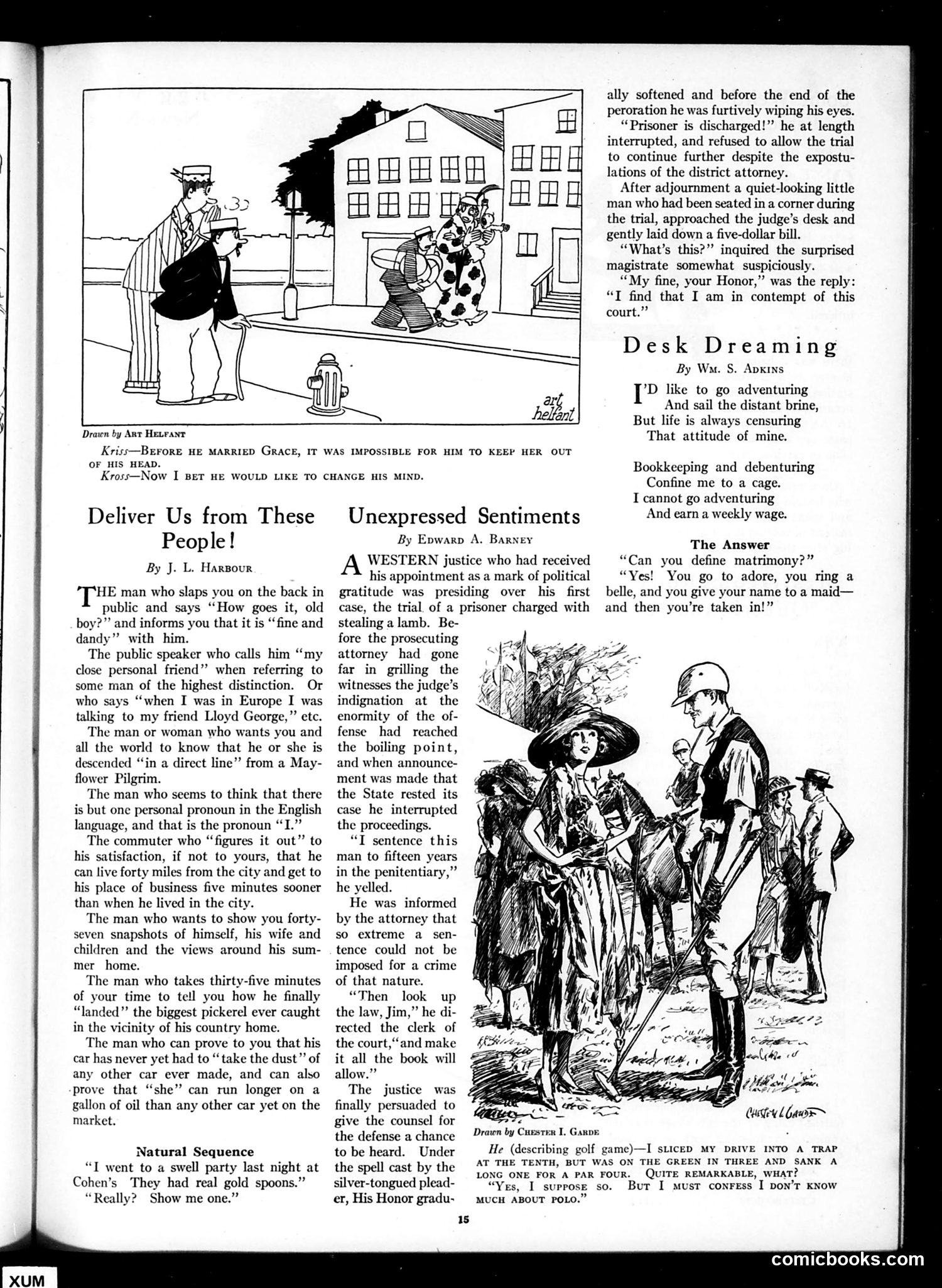
This page contains three satirical pieces typical of early 20th-century American humor: **"Deliver Us from These People!"** mocks annoying social types: the back-slapper, the name-dropper (referencing Lloyd George, likely British PM), the ancestry-obsessor, the self-centered bore, the photo-bore, the fishing-story-teller, and the car-braggartall recognizable character types meant to irritate readers. **"Unexpressed Sentiments"** satirizes judicial incompetence. A politically-appointed judge, ignorant of law, sentences a lamb-thief to fifteen years based on outrage before hearing the defense. A defense attorney's emotional speech makes him weep and discharge the prisoner instead—reversing his judgment through theatricality rather than justice. The final panel shows a spectator paying a $5 fine for contempt of court, suggesting the whole system is absurd. **"Desk Dreaming"** is light verse about office monotony crushing adventurous spirits. The cartoons mock corruption (political appointments to judgeships), legal incompetence, and social pretension—evergreen targets of satirical magazines.
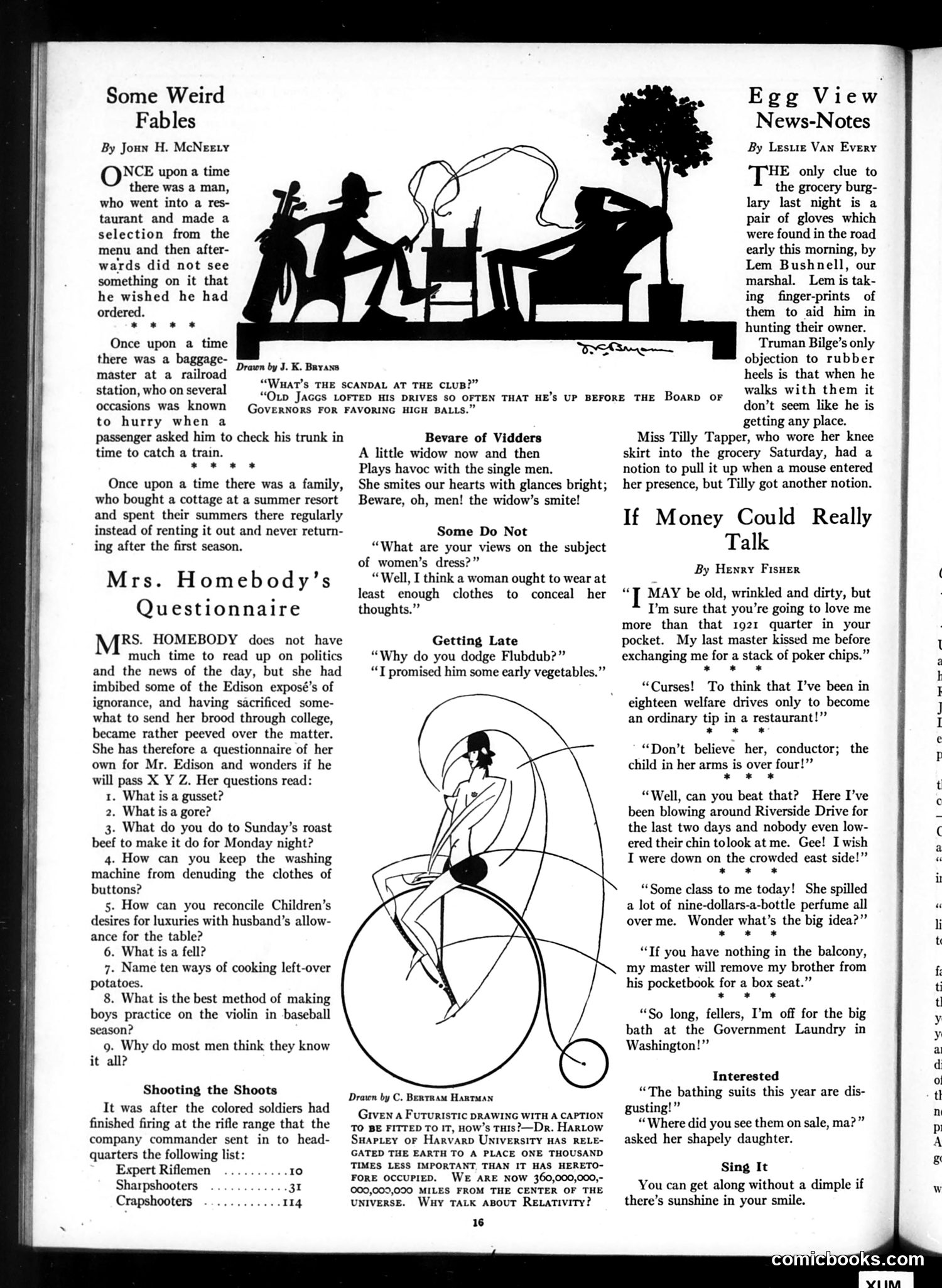
This page from *Judge* contains several satirical pieces mocking early 1920s American life: **"Some Weird Fables"** presents absurdist humor about mundane situations—a man regretting his restaurant order, a baggage master actually hurrying, a family keeping a cottage (all presented as impossibly rare occurrences). **"Mrs. Homebody's Questionnaire"** satirizes Thomas Edison's recent public criticism of Americans' ignorance. A housewife responds by questioning Edison's knowledge of domestic practicalities (gussets, cooking leftovers, managing household budgets)—suggesting his critique ignores the real expertise homemakers possess. **"Shooting the Shoots"** uses a racial stereotype joke about Black soldiers, with "crapshooters" listed alongside rifle expertise. **"Beware of Vidders"** warns about widow remarriage threatening single men's matrimonial prospects. **"If Money Could Really Talk"** features personified money lamenting its trajectory from valued possession to welfare-drive contributions to restaurant tips—commentary on post-WWI economic anxieties and social decline. The cartoons use exaggeration and personification to mock social pretensions and anxieties of the period.
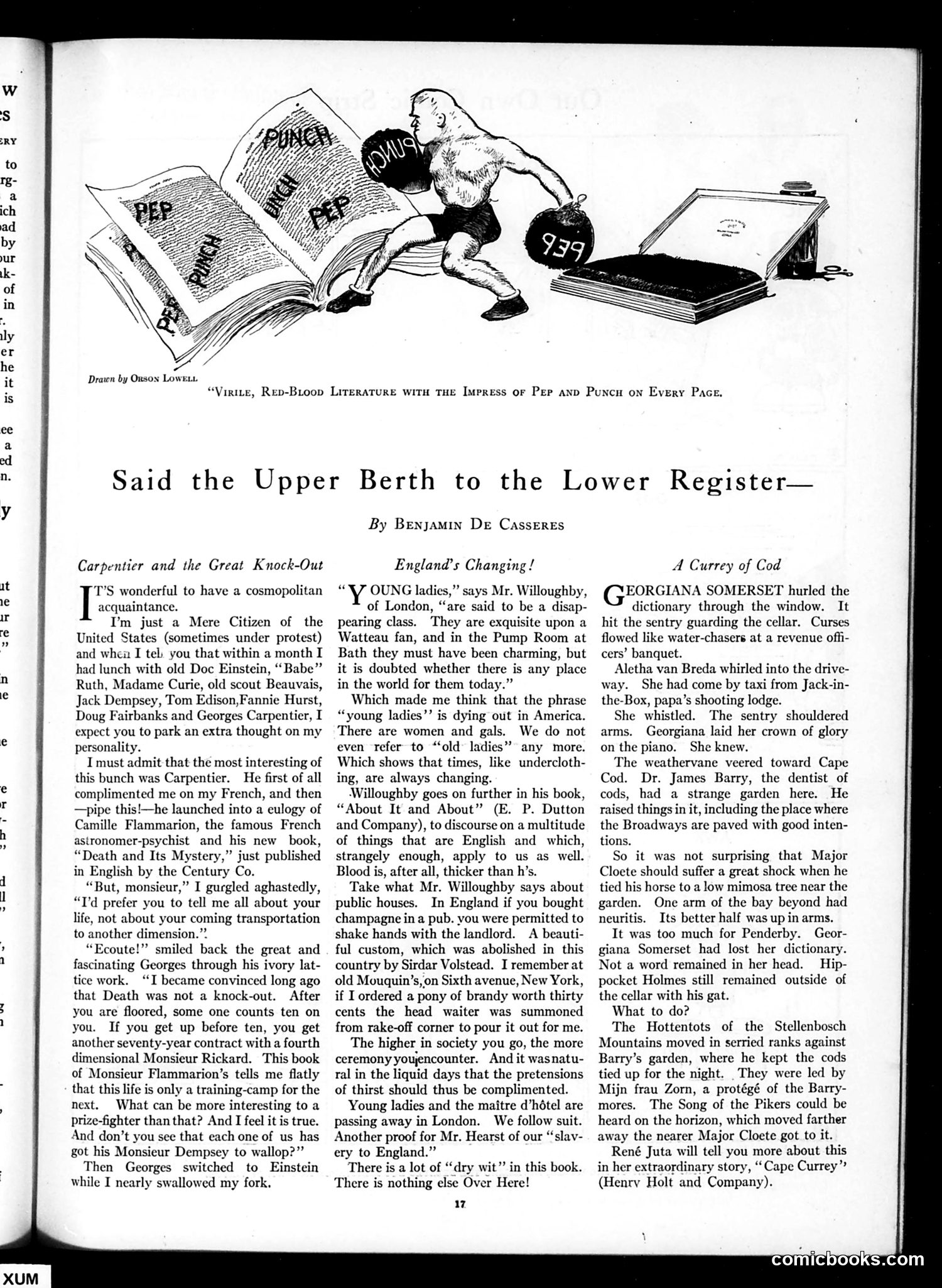
The cartoon depicts a boxer punching literature labeled "Pep" and "Punch" (magazines), with text volumes flying apart. It satirizes **virile, red-blooded literature**—likely criticizing overly aggressive or sensationalist writing styles popular in magazines like *Pep* and *Punch*. The article "Said the Upper Berth to the Lower Register" by Benjamin De Casseres discusses the boxer **Georges Carpentier**, then-famous for his 1921 heavyweight championship fight against Jack Dempsey. The narrator humorously claims familiarity with celebrities (Einstein, Babe Ruth, Dempsey) while Carpentier discusses French philosopher Camille Flammarion's book on the afterlife, using boxing metaphors for death and reincarnation. The secondary pieces mock changing social customs: "England's Changing!" critiques how terms like "young ladies" are disappearing, while "A Currey of Cod" appears to be a humorous society fiction piece. The overall page satirizes contemporary celebrity culture, European intellectualism, and social transformation in the early 1920s.
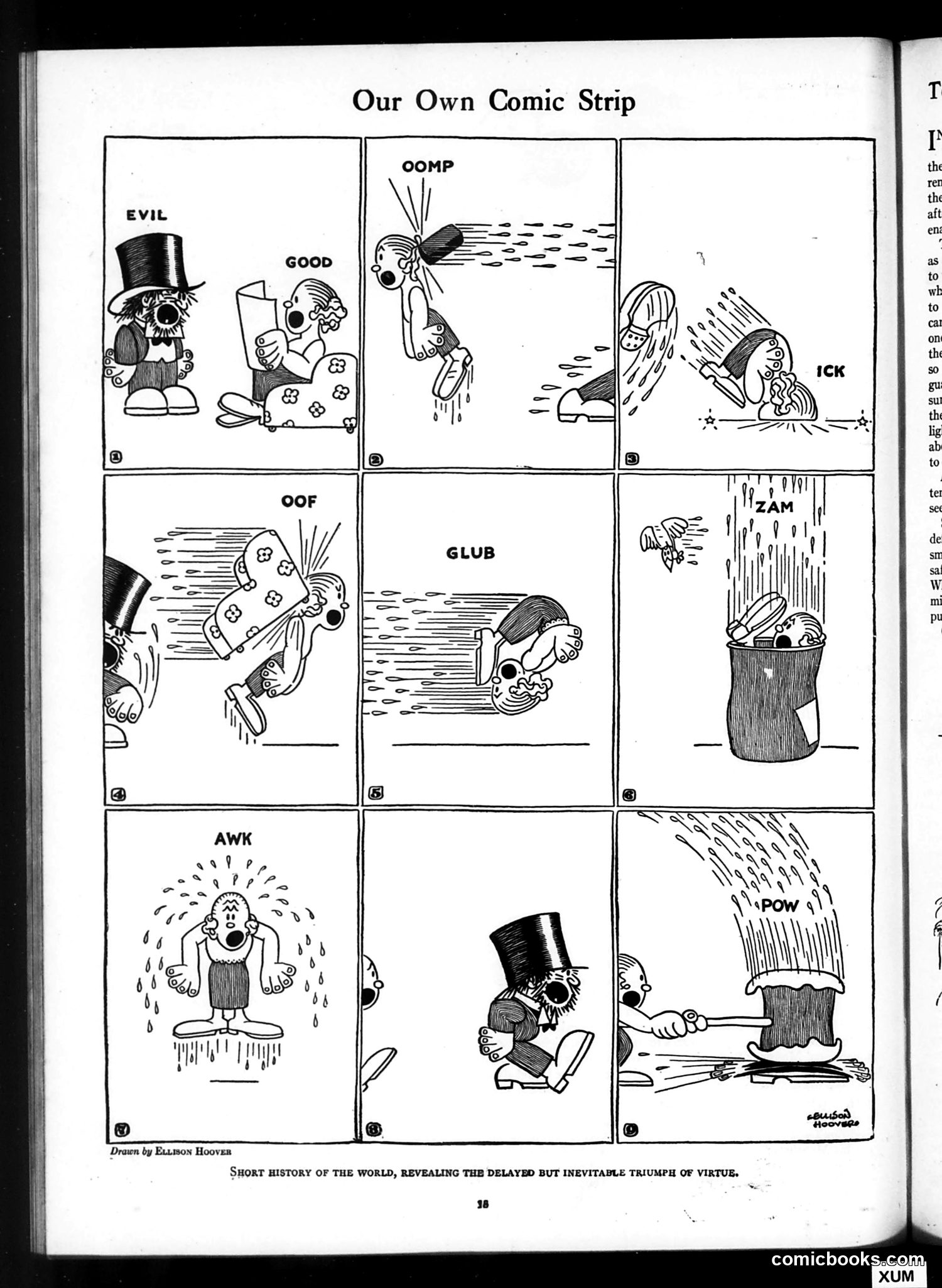
This is a nine-panel comic strip depicting a moral allegory where Good triumphs over Evil through various slapstick consequences. Panel 1 shows Evil (top hat) and Good (lighter clothing) as opposing forces. Subsequent panels show Evil repeatedly suffering mishaps—getting hit ("OOMP"), struck ("OOF"), clubbed ("GLUB"), and finally trapped in a barrel with explosives ("ZAM" and "POW")—while Good remains unharmed or victorious. The strip's subtitle declares it a "short history of the world, revealing the delayed but inevitable triumph of virtue," suggesting this is satirical commentary on morality and justice. The cartoonist (Ellison Hoover) uses physical comedy to reinforce a simplistic moral narrative popular in early 20th-century American culture—that good inevitably defeats evil, despite temporary setbacks.
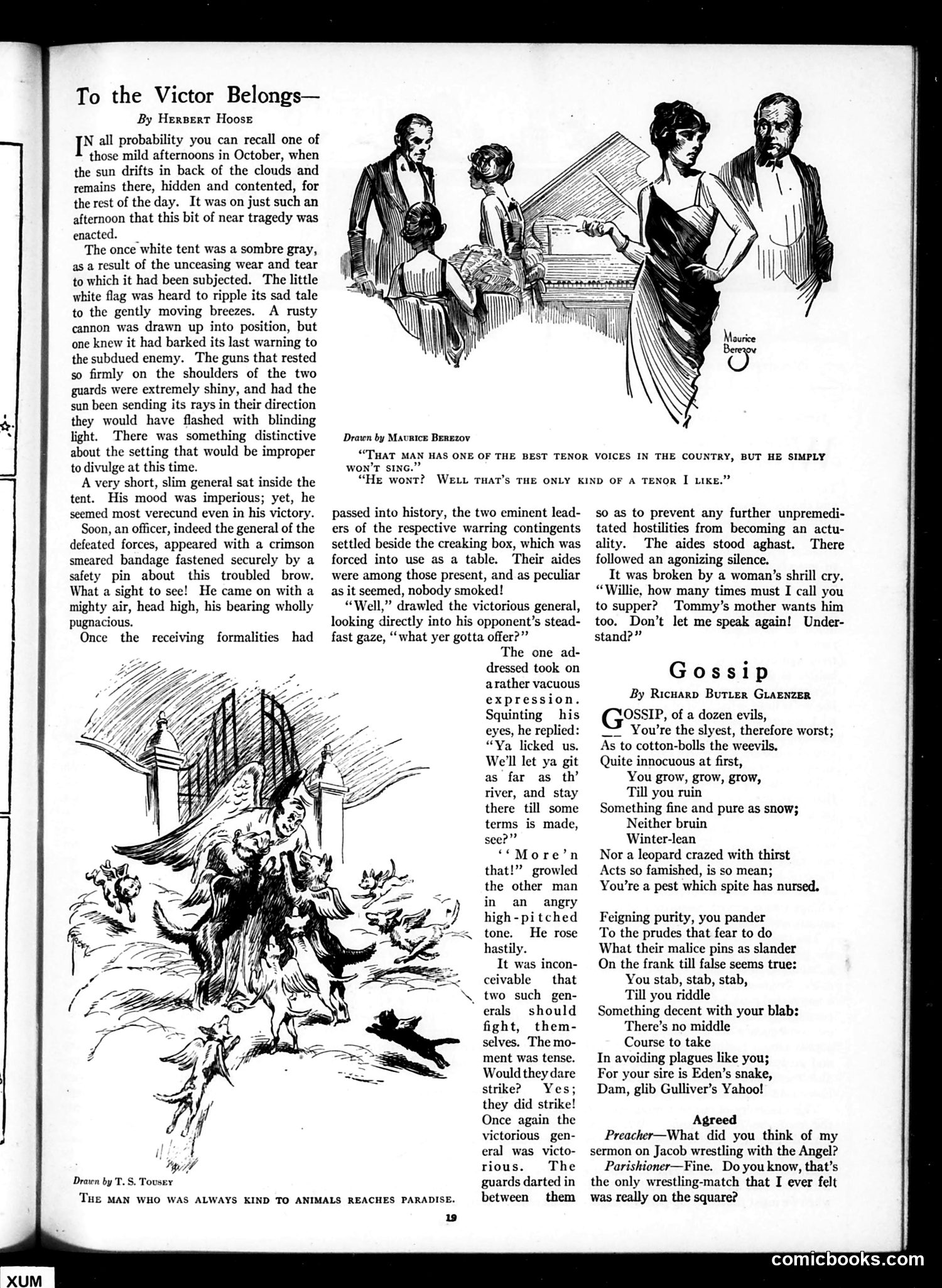
**"To the Victor Belongs"** depicts two military generals negotiating surrender terms after battle. The twist: this is children's play. The "battle" occurs in a decrepit tent with rusty cannons; the "generals" are actually boys engaged in mock combat. The story builds tension around their negotiation, only to reveal a woman (likely a mother) calling the children to supper, interrupting their game. The satire mocks the gravity adults assign to military conflict by presenting it through children's innocent recreation—suggesting warfare itself is childish. **Other content includes:** - A joke about a tenor singer who won't perform - A **T.S. Towsey cartoon** showing animals in paradise, captioned about kindness to animals - **Richard Butler Glaenzer's poem "Gossip,"** condemning gossip as society's worst evil, comparing it to pests and biblical serpents - A brief humorous exchange between preacher and parishioner about Jacob wrestling an angel The page emphasizes moral lessons through satire and verse.
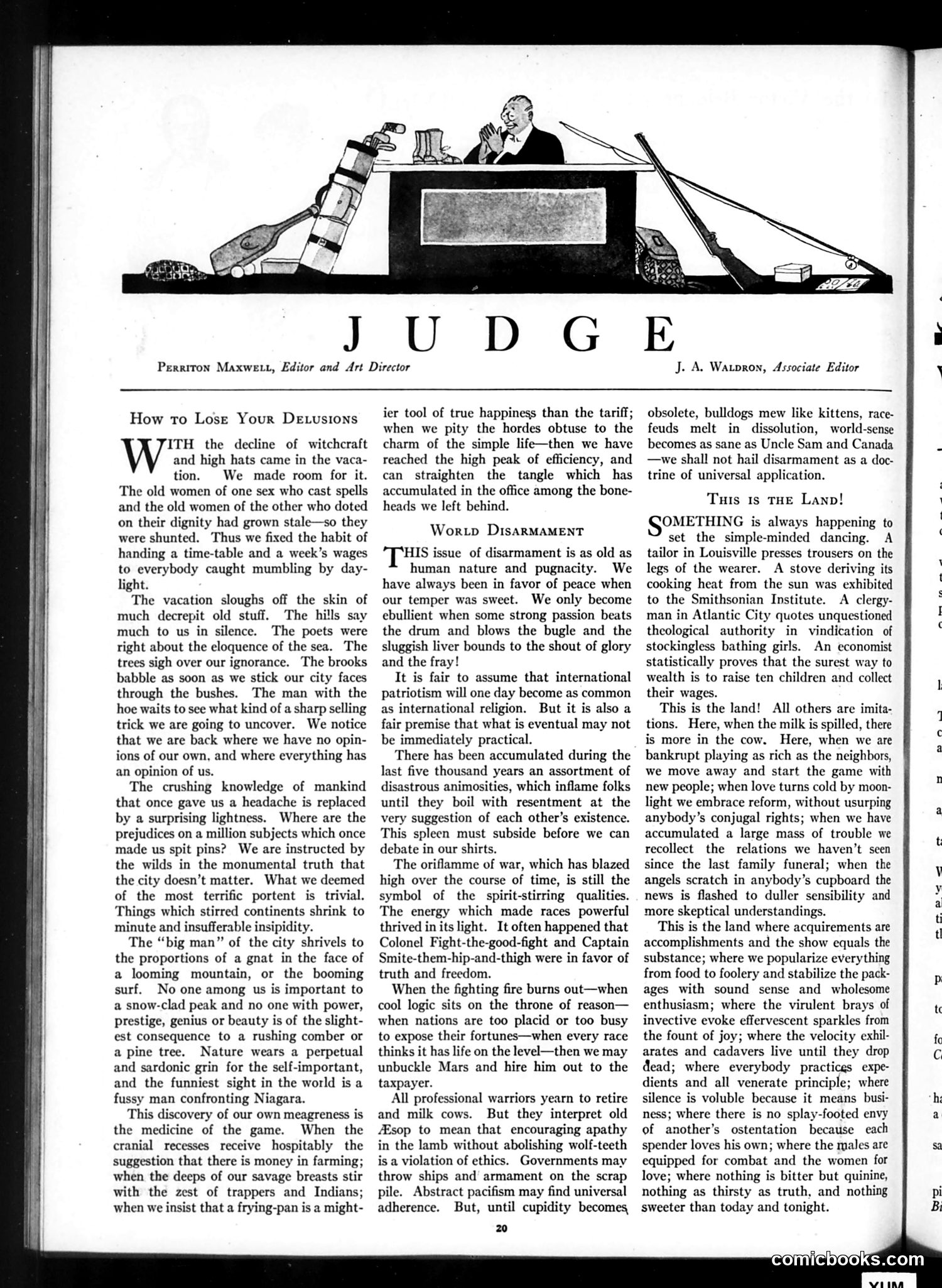
This page contains two editorial essays by the magazine's editors rather than traditional political cartoons. The **masthead illustration** shows a judge figure at a bench with various implements of law and disorder around him—establishing the magazine's satirical voice on public affairs. **"How to Lose Your Delusions"** celebrates vacations as mental therapy, arguing that nature and leisure strip away urban pretensions and manufactured anxieties. The piece mocks the "big man" of the city who shrinks to insignificance before natural forces like Niagara Falls—satire of American self-importance and materialism. **"World Disarmament"** discusses international peace efforts skeptically, acknowledging humans naturally tend toward conflict when passions run high. The editors argue that lasting disarmament remains impractical despite being theoretically desirable, since accumulated historical animosities between nations prevent genuine peaceful cooperation. This appears contemporary with early 20th-century peace movement debates. Both pieces employ Judge's characteristic blend of irony and social commentary on American life, leisure, and international affairs.
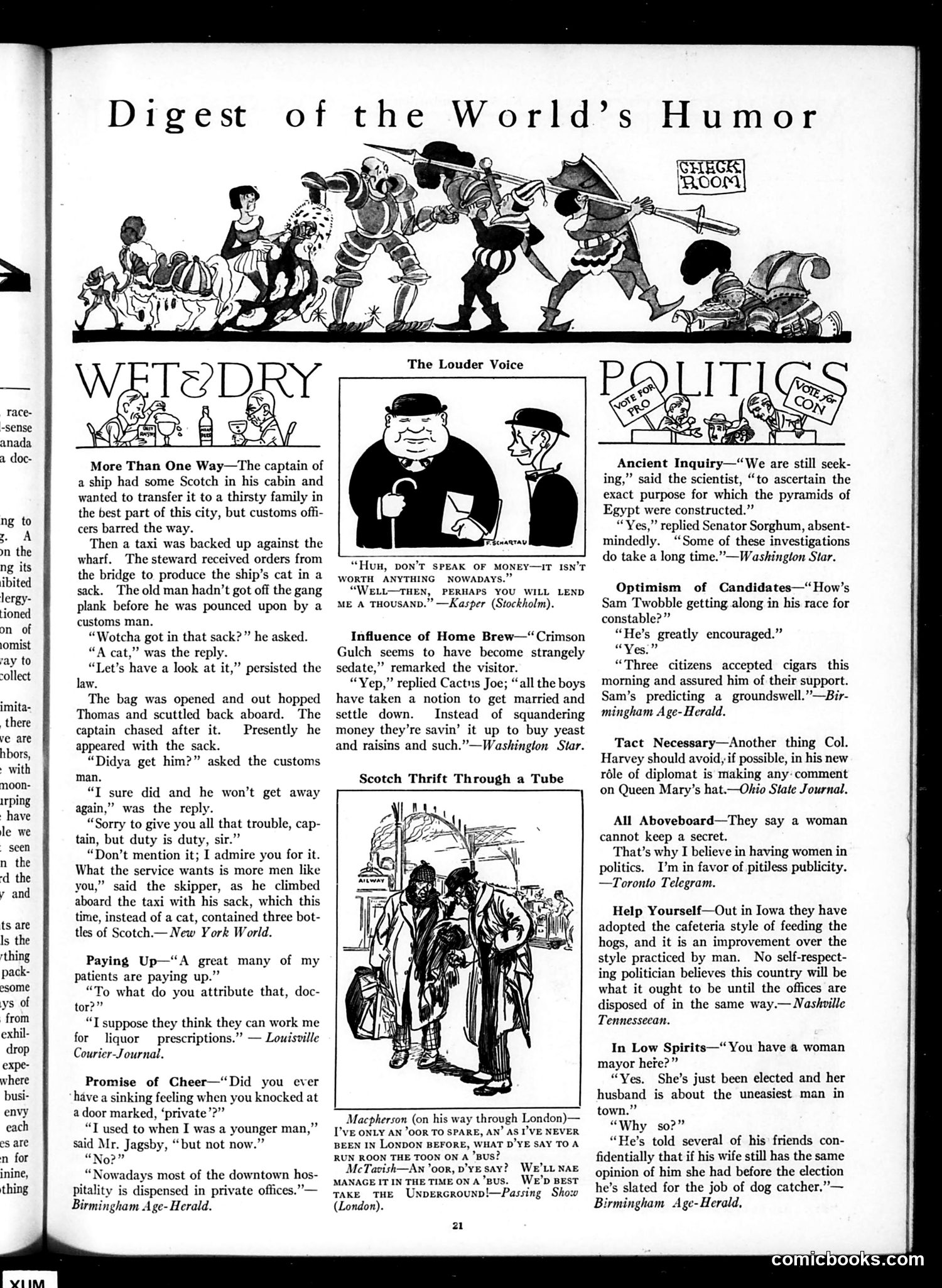
This humor digest page from *Judge* magazine satirizes early 20th-century American life, primarily through Prohibition-era jokes. **Key themes:** - **Alcohol smuggling**: Multiple jokes mock Prohibition enforcement. One story depicts a customs officer cleverly outwitted when Scotch is hidden in a taxi; another shows a doctor prescribing "liquor" as medicine. - **Economic hardship**: References to worthless currency ("money isn't worth anything") reflect post-WWI inflation concerns. - **Scottish stereotypes**: The "Scotch Thrift" cartoon and other jokes play on caricatures of Scottish frugality and accent. - **Politics**: Brief jabs at politicians (Senator Sorghum, Colonel Harvey, female politicians) employing typical period cynicism about corruption and incompetence. - **Gender**: A joke mocking women in politics by praising their inability to keep secrets. The humor relies on assumptions about readers' familiarity with current events, prohibition debates, and ethnic stereotyping now considered offensive.
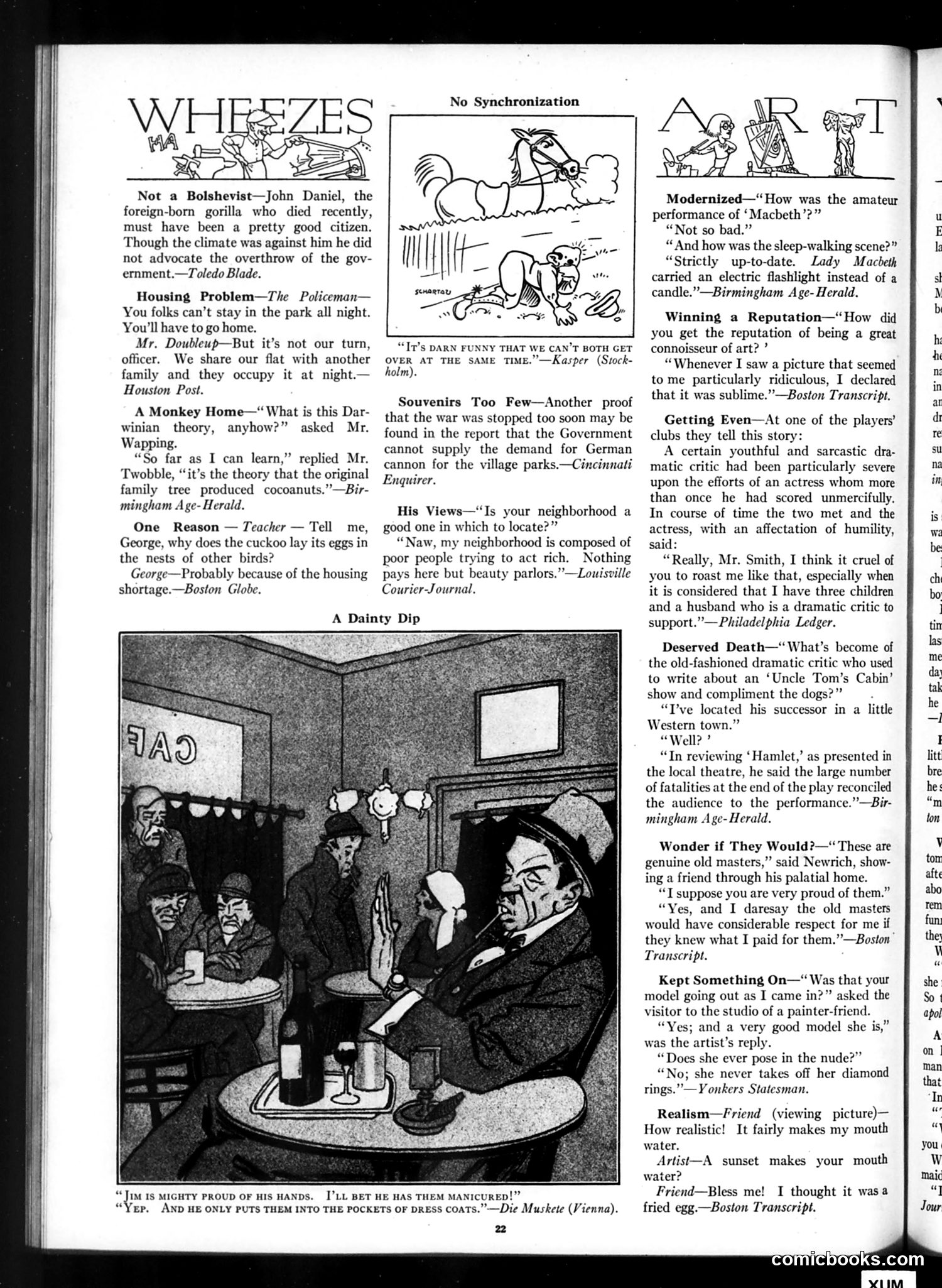
This page from Judge magazine contains satirical jokes and observations on post-WWI American life. The main cartoon, titled "A Dainty Dip," depicts a well-dressed man (likely a wealthy profiteer or businessman) at a café, with the caption joking that he's "mighty proud of his hands" and only puts them in dress coat pockets—implying he makes money dishonestly or through questionable means, keeping his hands clean of visible labor. The surrounding text consists of brief humorous anecdotes addressing contemporary concerns: housing shortages, inflation, wartime profiteering, theatrical criticism, and class pretension. References to German cannons as "souvenirs" mock excessive war memorabilia collecting. Several jokes target nouveau-riche social climbers and their affected sophistication. The overall tone satirizes post-war American society's materialism, housing crises, and social climbing while maintaining lighthearted cynicism about cultural and theatrical trends of the era.
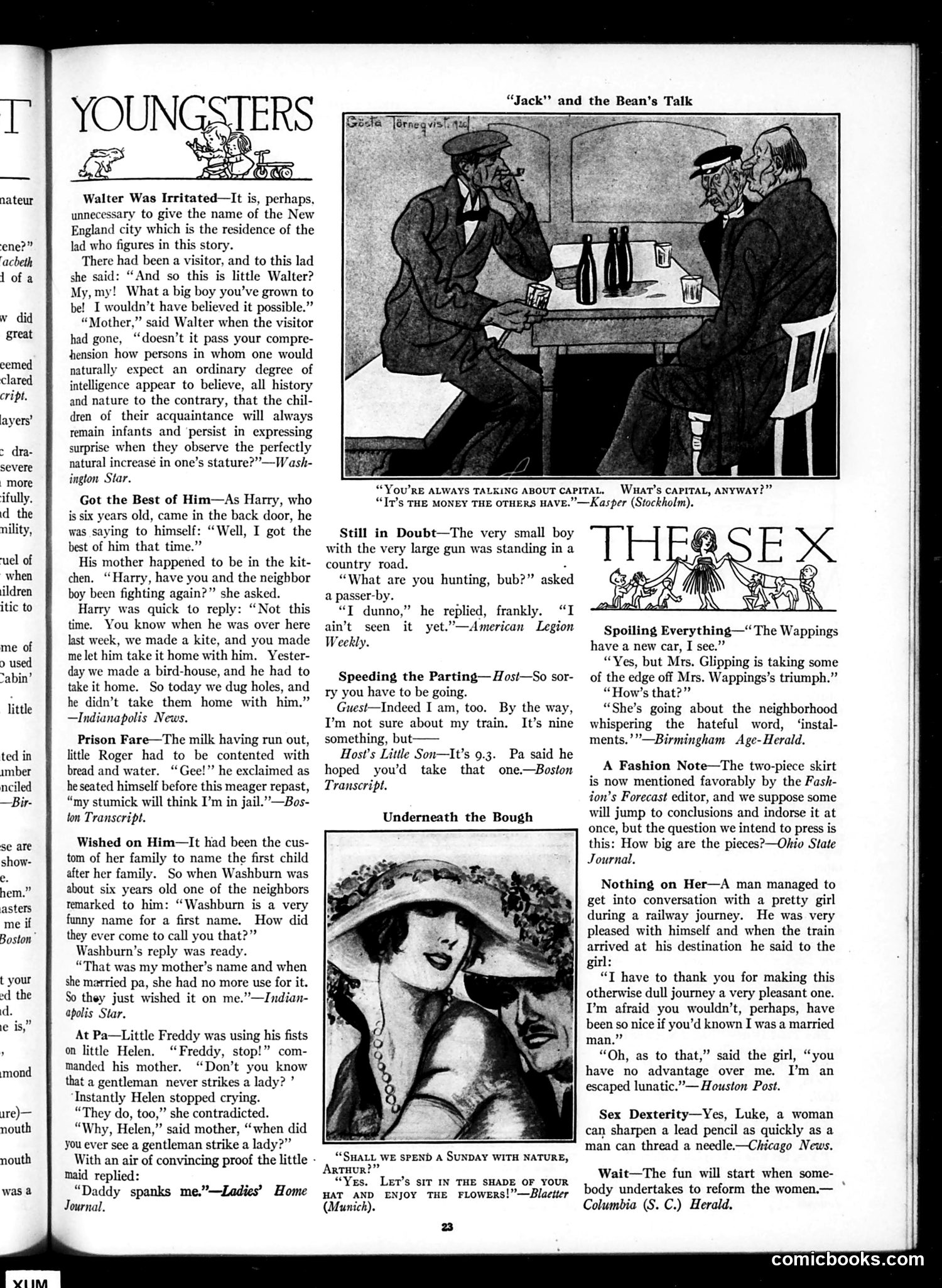
The main cartoon depicts three working-class men at a table with bottles, discussing economics. One says: "You're always talking about capital. What's capital, anyway?" The response: "It's the money the others have." This is satire on class inequality and how ordinary people understand capitalism—not as an abstract system, but as wealth that the wealthy possess and others lack. The crude characterization and bar-room setting suggest the joke targets both the working poor's simplified view of economics and implicitly critiques wealth disparity itself. The page also contains brief humorous anecdotes about children's logic and social pretense—typical Judge filler content mocking human nature rather than specific political figures. The "Underneath the Bough" illustration shows a couple in nature, likely illustrating romantic or domestic humor common to the era's light magazine fare.
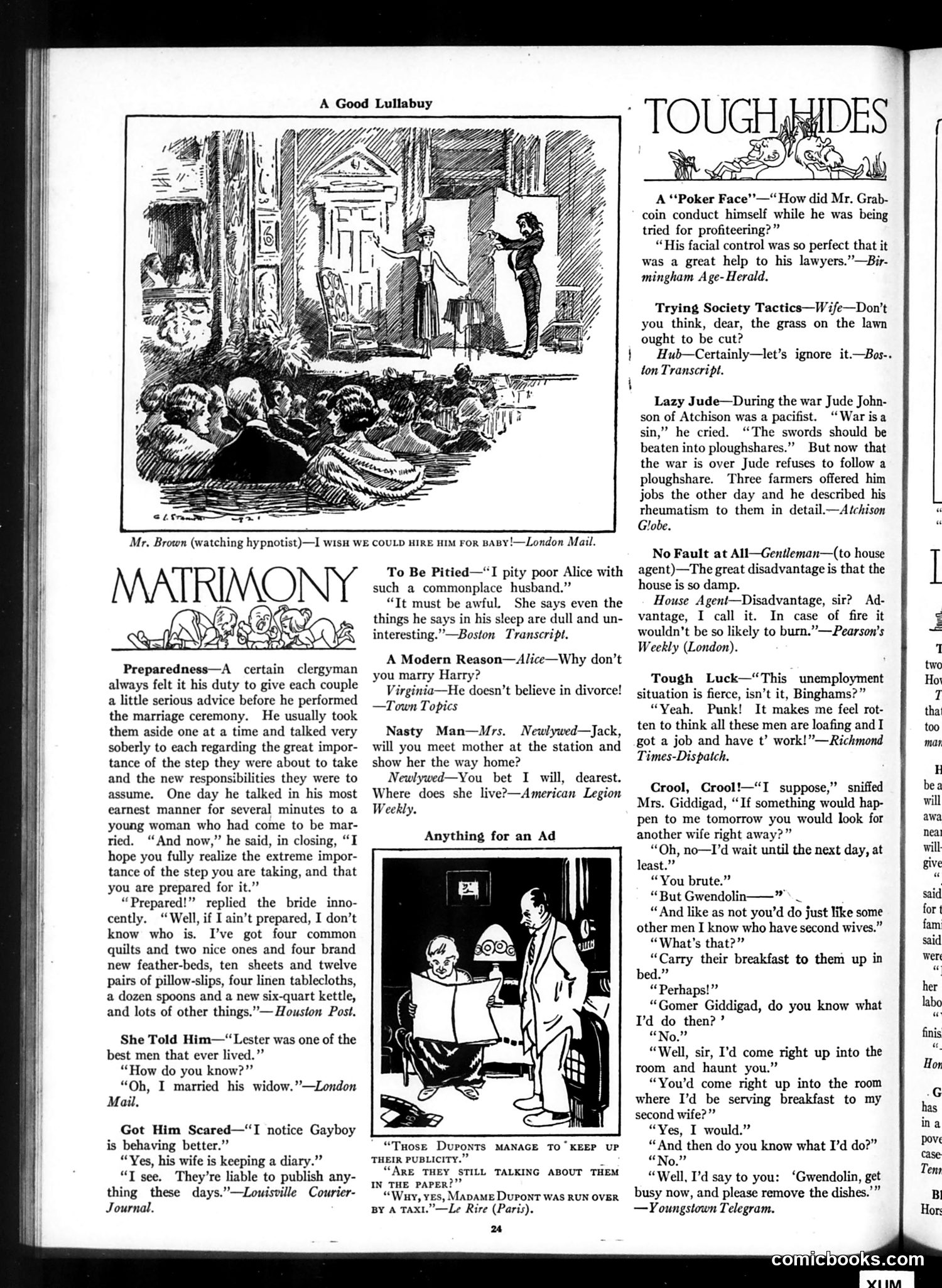
This page from *Judge* (a satirical weekly) contains a humor section mixing short jokes with social commentary typical of the early 20th century. **Main Cartoon**: "A Good Lullabuy" shows a hypnotist performing while an audience watches—the caption suggests hiring such a person to calm a baby, satirizing contemporary fascination with hypnotism as a quasi-scientific solution. **Content Themes**: The jokes mock post-WWI American society: - **"Lazy Jude"**: Mocks a former pacifist who now refuses work, claiming rheumatism—satirizing perceived hypocrisy of pacifists and post-war unemployment attitudes - **"Profiteering"**: References wartime profiteers facing trial, critiquing how lawyers exploit emotional control - **Marital humor**: Multiple jokes about marriage emphasize wives' materialism and nagging—reflecting period gender stereotypes - **"Unemployment"**: Shows tension between jobless men and employed workers, reflecting 1920s economic anxieties - **Housing/profiteering**: The "damp house" joke hints at landlord exploitation The humor reflects anxieties about war profiteering, unemployment, changing gender roles, and modern skepticism toward institutions—targeting educated, middle-class readers familiar with these social tensions.
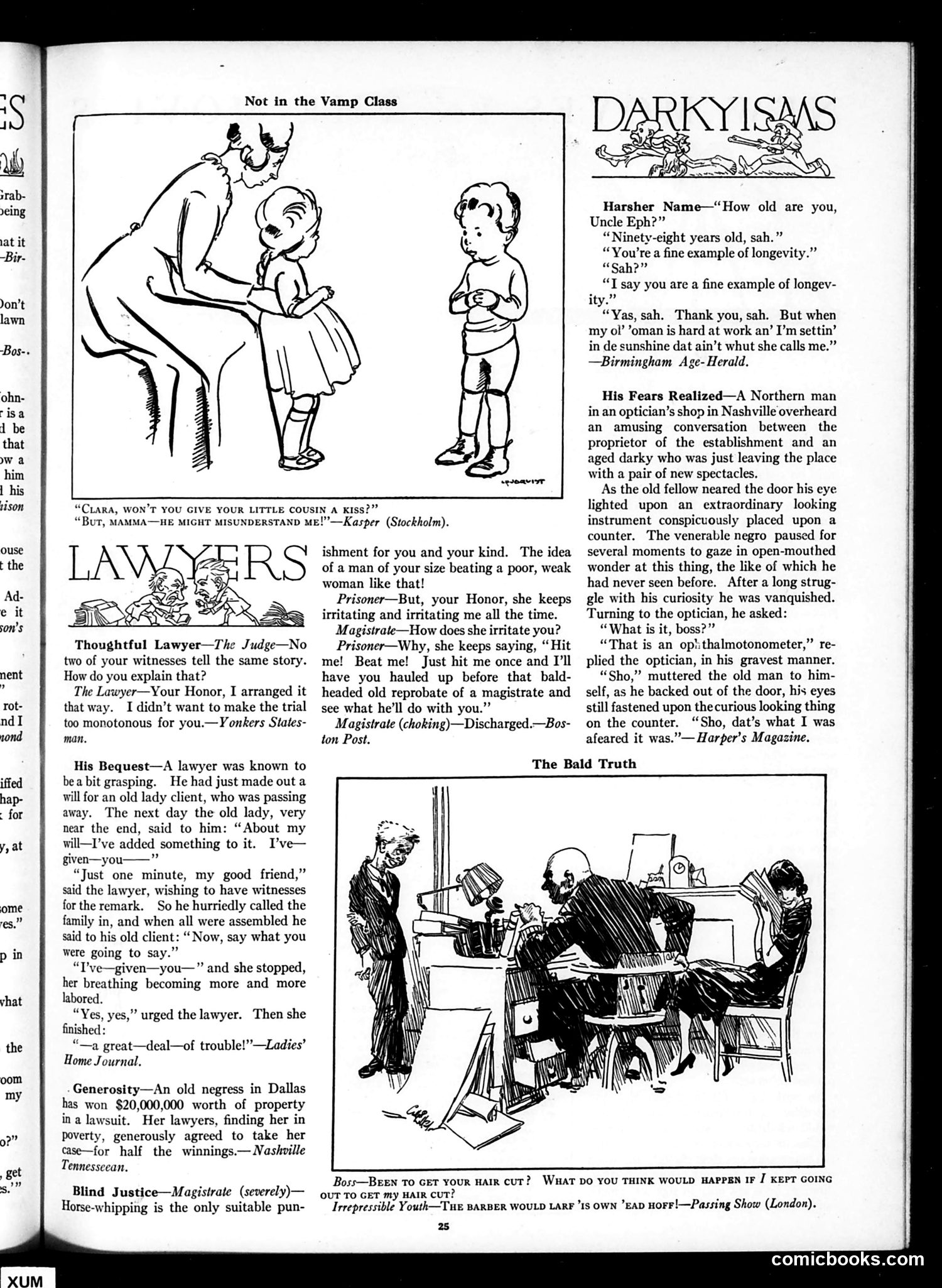
This page contains multiple short satirical jokes typical of early 20th-century American humor magazines. **"Not in the Vamp Class"** mocks the "vamp" archetype—the seductive woman—by showing a girl refusing her cousin's kiss, claiming he might misunderstand her intentions. The joke is her adolescent concern about being perceived as flirtatious. **The lawyer anecdotes** satirize the legal profession's greed and dishonesty: one arranges conflicting witness testimony for entertainment; another rushes to gather witnesses hoping for an inheritance bequest (only to be told he's given the widow "trouble"). **"The Bald Truth"** is a simple joke about male baldness—if the boss kept getting haircuts like his employee, he'd lose his hair entirely, making the barber laugh his head off. The remaining pieces use **racial stereotypes common to the era**, featuring dialect humor about elderly Black characters. These reflect period attitudes but are historically significant as documents of their time. Overall, the page exemplifies Judge's mix of observational humor, professional satire, and populist comedy aimed at early 1900s readers.
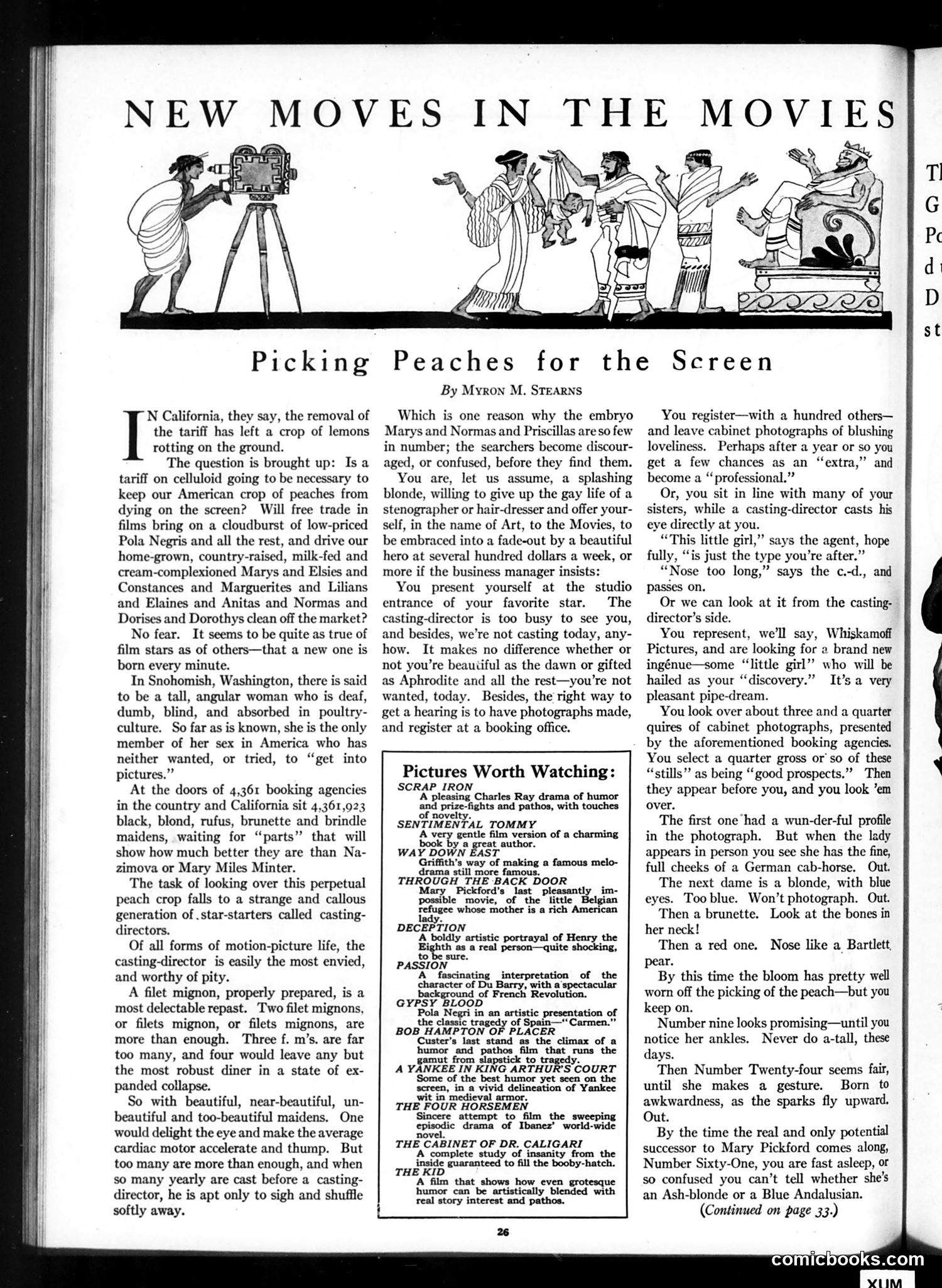
This article satirizes Hollywood's casting system and the endless supply of aspiring starlets. The "peaches" metaphor compares young women seeking film roles to a surplus agricultural crop—abundant, interchangeable, and often wasted. The piece mocks the casting-director's impossible task: evaluating thousands of nearly identical starlets ("beautiful, near-beautiful, unbeautiful") weekly. The author uses food imagery (filet mignon) to suggest that while one beautiful woman delights, excessive numbers numb and exhaust. The satire targets the film industry's dehumanizing system: women must register at booking agencies and obtain photographs rather than audition directly. Even stunning actresses are rejected simply because "we're not casting today." The cartoon header (showing film cameras and women in various poses) visualizes this mechanical, assembly-line approach to discovering talent. The underlying critique: Hollywood treats aspiring actresses as disposable commodities rather than artists, perpetually cycling through hopefuls while genuine talent remains undiscovered.
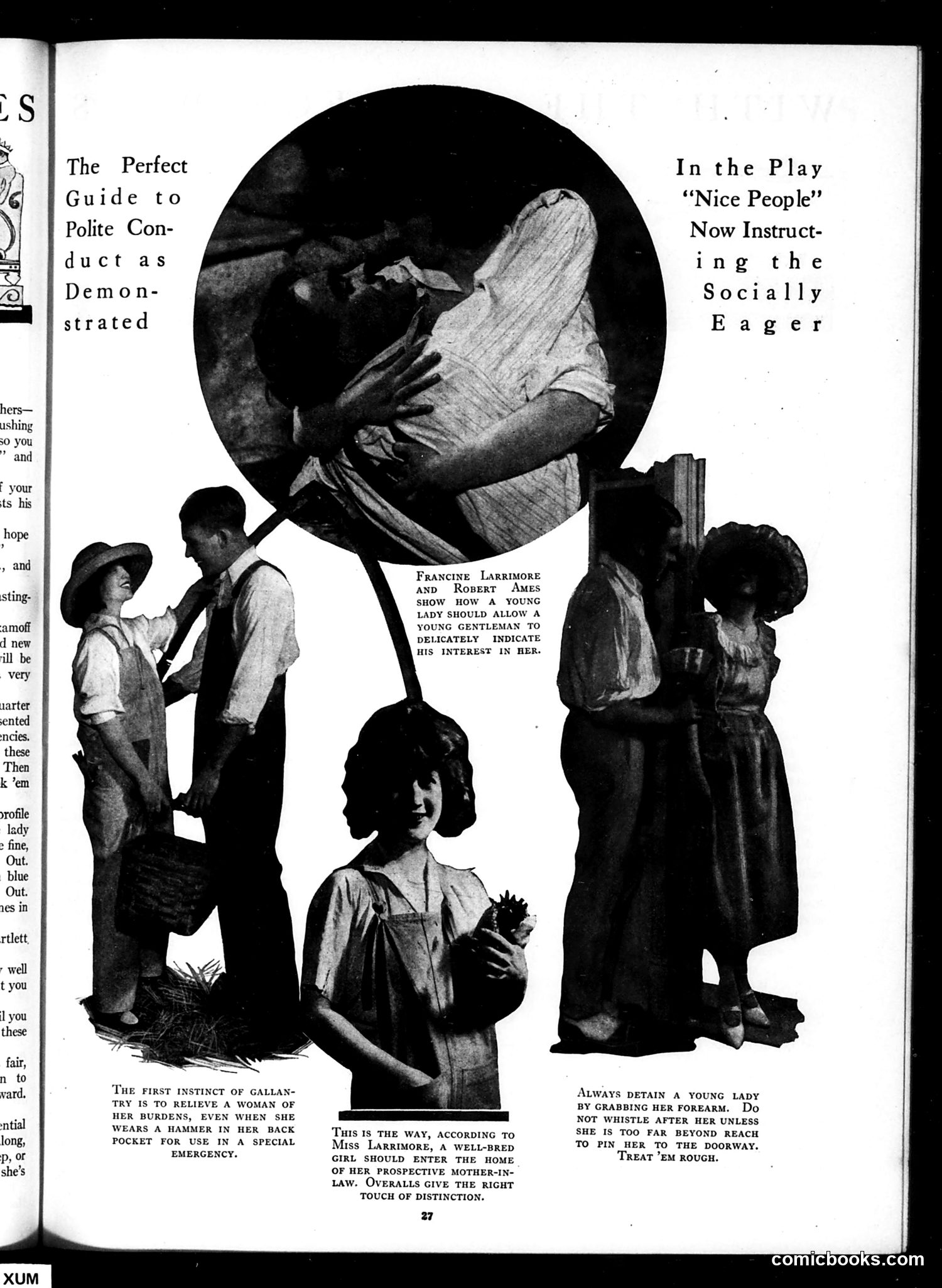
This page satirizes the 1920 play "Nice People," starring Francine Larrimmore and Robert Ames. The satire mocks the play's apparent message about modern courtship and etiquette for "socially eager" young people. The cartoon ridicules what the play presents as proper romantic conduct. The captions employ heavy irony—suggesting that "gallantry" involves relieving women of burdens (shown grabbing a woman), that overalls represent "distinction" in a prospective mother-in-law's home, and that physical restraint ("grabbing her forearm") or whistling after women represents acceptable behavior. The final caption's blunt "TREAT 'EM ROUGH" underscores the satire. The joke targets both the play itself and broader post-WWI anxieties about changing gender relations and "modern" youth behavior. By presenting crude, physically aggressive conduct as "polite," the cartoonist critiques what he views as the play's endorsement of coarse treatment of women under the guise of contemporary social progress.
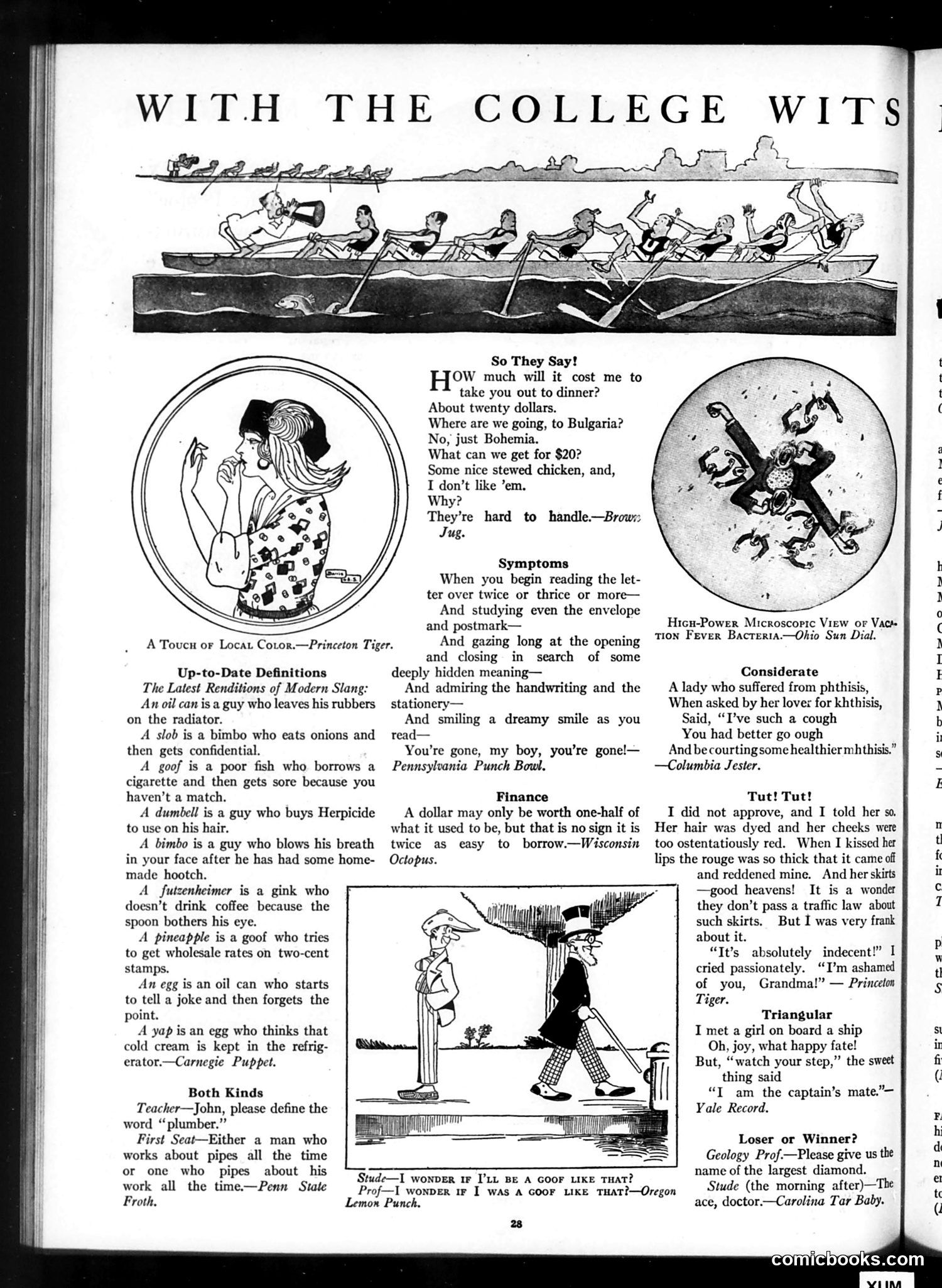
This page collects humorous content from college humor magazines of the 1920s era. The material reflects post-WWI college culture and slang of that period. **Main Content:** A series of jokes, definitions, and comic strips targeting college students and dating culture. The "Up-to-Date Definitions" mock contemporary slang terms like "oil can," "bimbo," and "goof"—words used to describe socially awkward or foolish young men. These definitions satirize both the slang itself and the behavior it describes. **Social Context:** The humor reveals attitudes toward prohibition-era drinking ("hootch"), dating rituals (expensive dinners, flirtation), female appearance (makeup, fashion), and academic pretense. References to "Bohemia" suggest bohemian/artistic affectations among young people. **Key Joke:** The "Symptoms" piece mocks lovesickness—reading a letter obsessively and admiring handwriting signals romantic infatuation. The baseball-themed bottom cartoon plays on double meanings. **Purpose:** These college magazine reprints provided satirical commentary on youth behavior, treating dating, spending money, and social posturing as worthy of mockery.
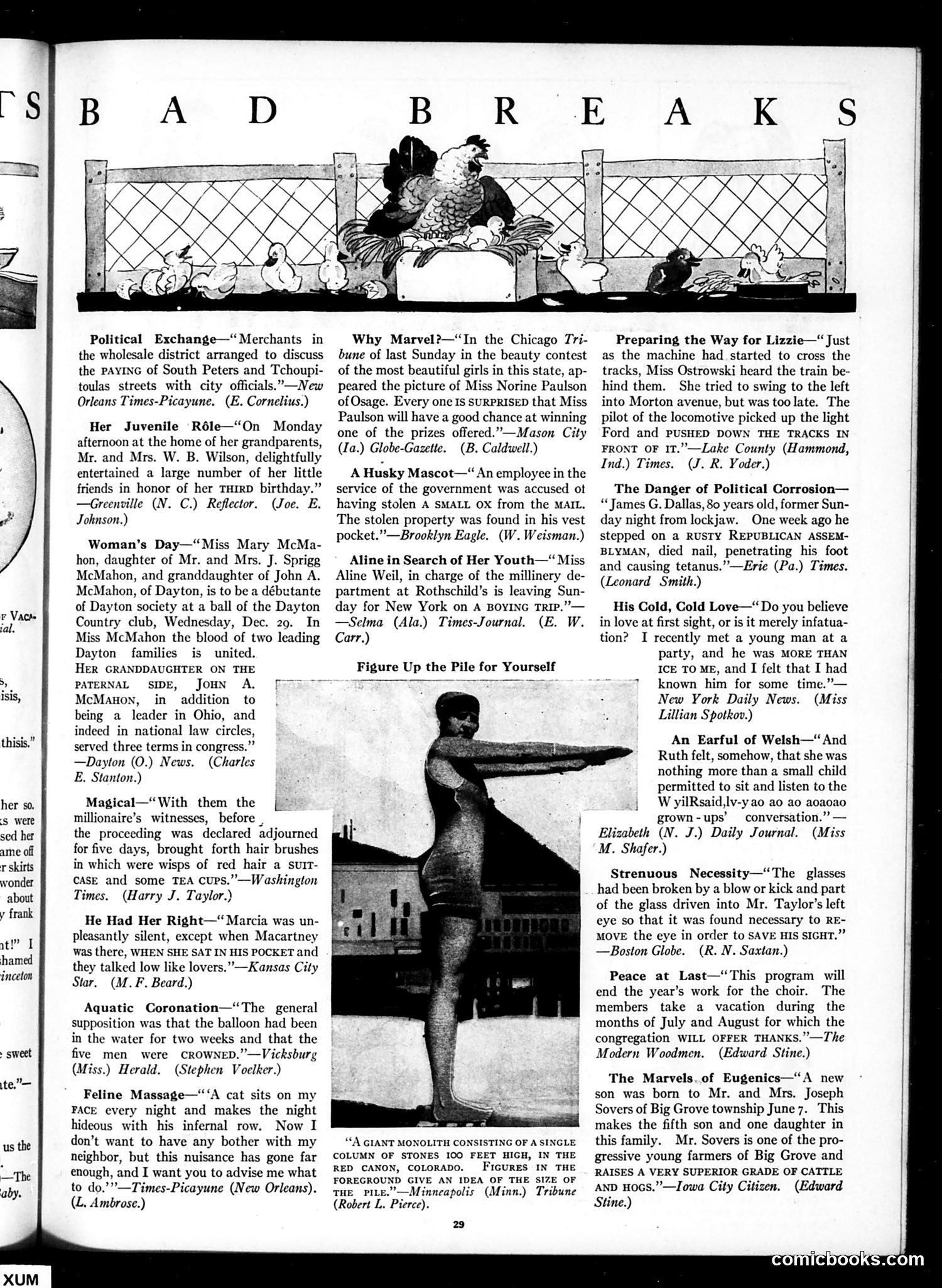
This page from Judge magazine (appears to be early 20th century) consists primarily of **brief satirical newspaper clippings** rather than traditional political cartoons. The format mocks absurd or poorly-worded local newspaper articles, with the humor deriving from unintended double meanings. Examples include: - **"Political Exchange"**: Merchants discussing "paying" streets (constructing them), making it sound like bribery - **"A Husky Mascot"**: An employee stealing a small ox hidden in mail - **"Aquatic Coronation"**: Men being "crowned" after emerging from water - **"The Danger of Political Corrosion"**: A man stepping on a "rusty Republican assemblyman" and dying from tetanus—crude political mockery One actual illustration shows **a giant monolith in Colorado** for scale comparison. The satire targets newspaper editors' careless wording and absurd local news rather than specific politicians or events. The **"Republican assemblyman" reference** is the only overt political jab, treated as a disposable punchline rather than serious commentary.
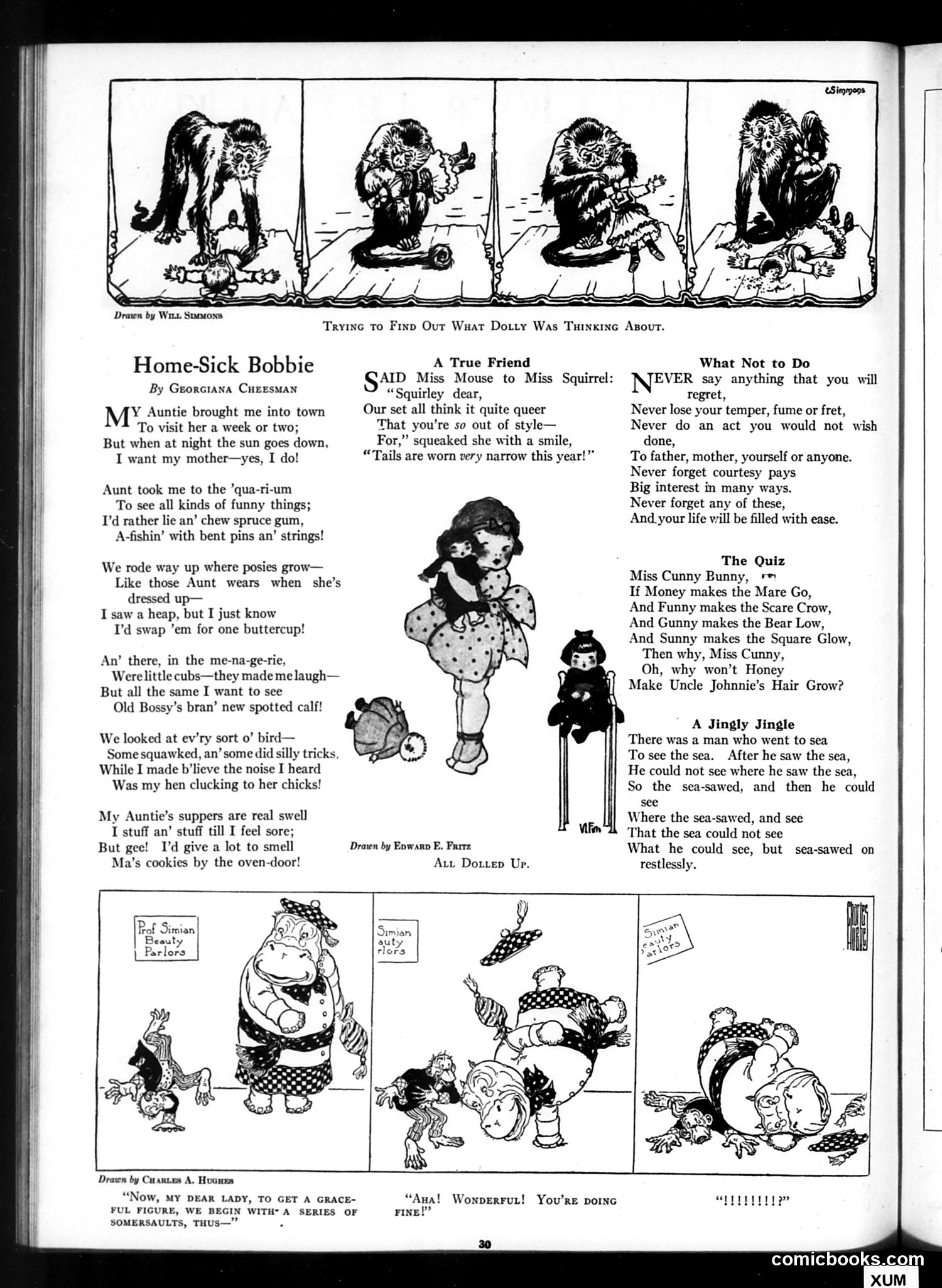
This page contains light humor and children's content typical of early 20th-century American magazines. **"Home-Sick Bobbie"** is a sentimental poem by Georgiana Cheesman about a child visiting the city with their aunt. Despite urban attractions (aquarium, menagerie, fancy dinners), the child yearns for home—rural pleasures like fishing and mother's cooking. It reflects common period anxieties about urbanization and nostalgia for simpler country life. **"A True Friend"** depicts fashion satire: Miss Mouse criticizes Miss Squirrel's outdated narrow tail, suggesting social pressure to follow trends even among animals. **"What Not to Do"** offers straightforward moral advice about temperance and courtesy—typical Victorian-era instruction. **Lower cartoons** by Charles A. Hughes show a "Prof. Simian Beauty Parlors" performing gymnastic exercises on a lady, likely satirizing dubious weight-loss fads popular with women. The page contains no apparent political satire, focusing instead on domestic humor, morality, and contemporary social anxieties about fashion and body image.
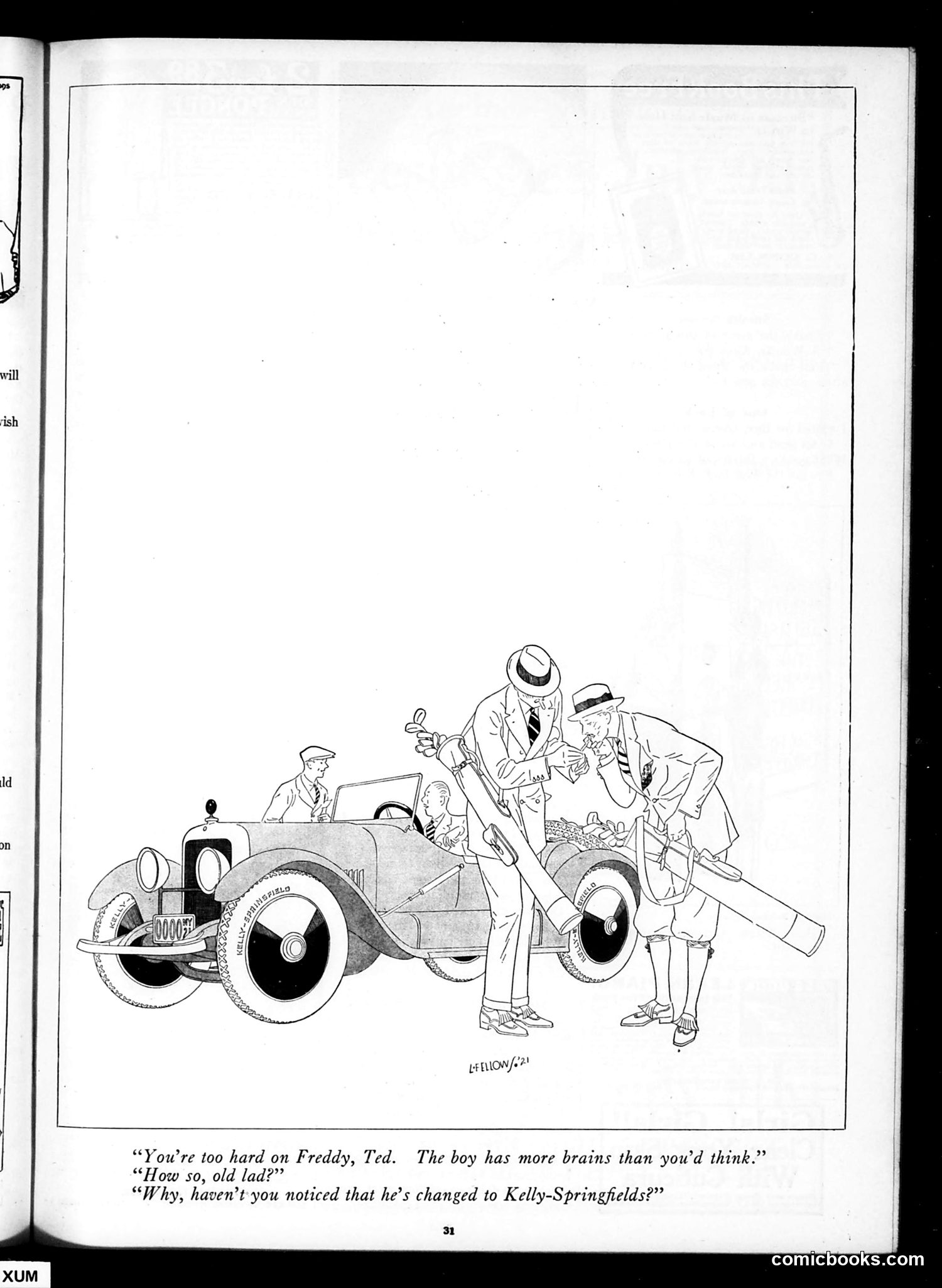
This cartoon satirizes automobile brand loyalty and marketing in the early 20th century. Two men in suits inspect a car with a young driver, discussing the boy "Freddy." The joke hinges on a product endorsement: one man defends Freddy's intelligence by pointing out he's switched to "Kelly-Springfields" tires—implying that choosing this particular brand demonstrates good judgment. The humor relies on the absurdity of equating tire selection with intelligence. This reflects the era's aggressive automobile advertising, where switching brands was presented as a sign of wisdom. Kelly-Springfields was a real tire manufacturer active during this period, making this a direct advertisement disguised as humor—a common Judge magazine practice.
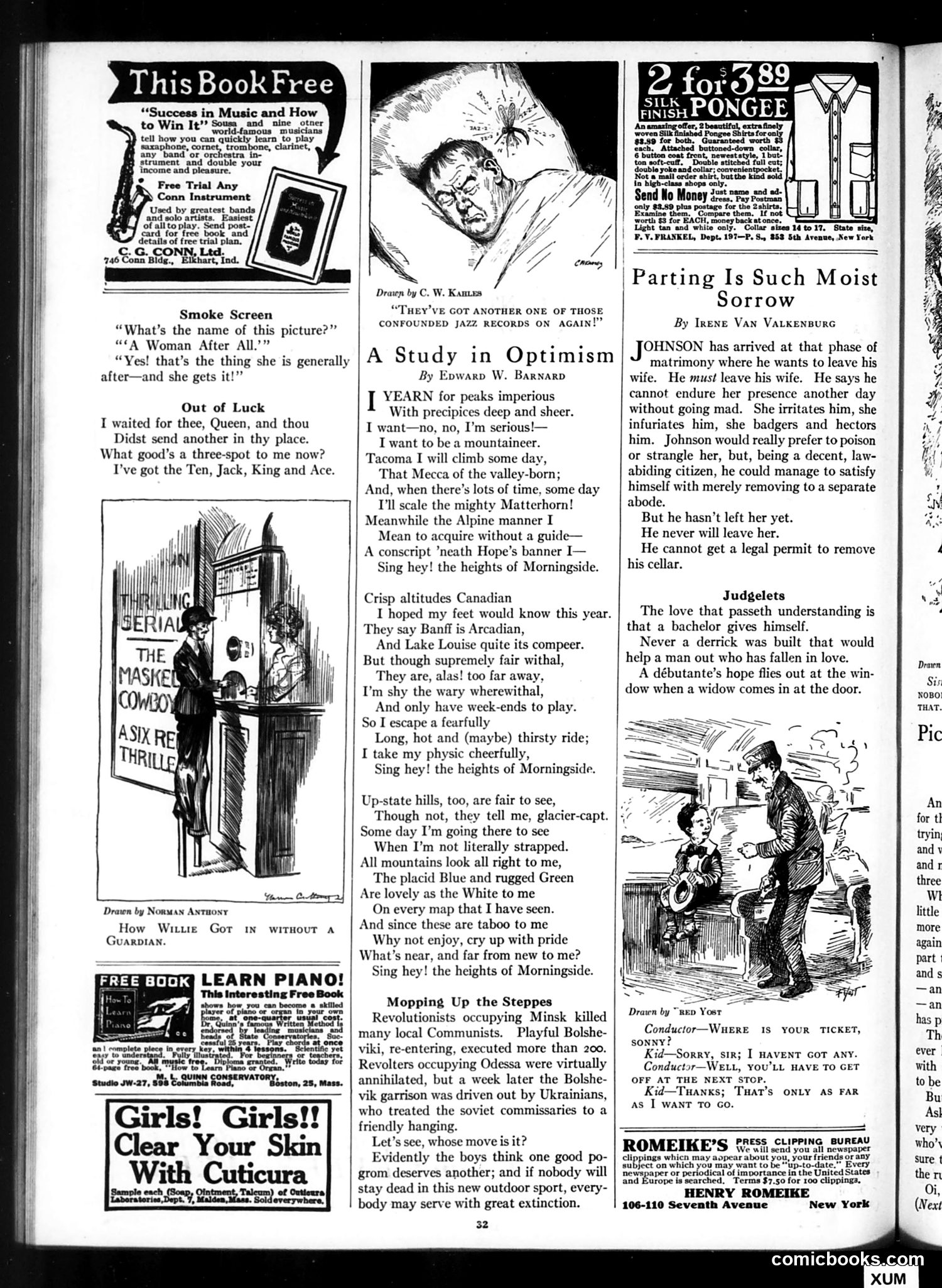
This page contains primarily **advertisements and light satirical humor pieces** rather than political cartoons. The notable content includes: **"A Study in Optimism"** (Edward W. Barnard): A poem mocking someone who dreams of climbing famous mountains (Tacoma, Matterhorn, Banff) but lacks money and time, settling instead for climbing Morningside Heights in New York City. The satire targets unfulfilled aspirations and settling for mediocrity. **"Mopping Up the Steppes"**: A brief dark commentary on post-Russian Revolution violence in Minsk and Odessa, where various factions (Bolsheviks, Ukrainians, Communists) cyclically kill each other. The cynical headline "Let's see, whose move is it?" suggests the violence is a meaningless, endless game. **"Parting Is Such Moist Sorrow"** (Irene Van Valkenburg): Satirizes a husband who wants to leave his wife but cannot—the twist being he's emotionally unwilling to remove his wine cellar, making his attachment materially rather than emotionally based. The remainder comprises ads for music lessons, piano instruction, and skincare products typical of 1920s magazine content.
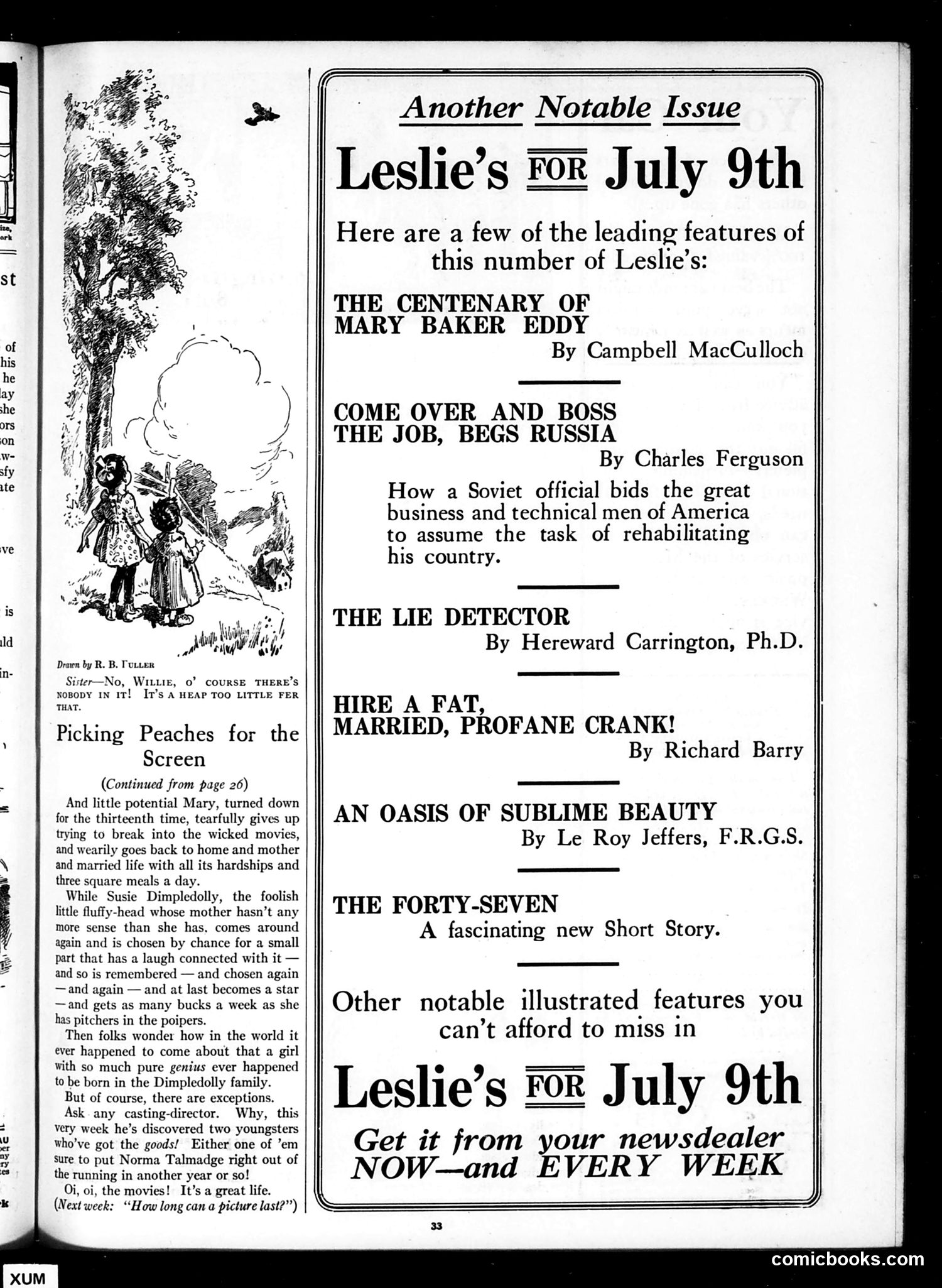
This is primarily an **advertisement for Leslie's Weekly magazine** (July 9th issue), not a political cartoon page. The small cartoon at left, by R.B. Fuller, is a Hollywood satire about aspiring actresses: a sister tells "Willie" there's "nobody in it" and "too little fer that"—mocking how hard it is to succeed in movies. The accompanying article "Picking Peaches for the Screen" criticizes the film industry's arbitrariness: talented Mary fails repeatedly while ditzy "Susie Dimpledolly" succeeds by pure luck and becomes a star earning huge money. The reference to **Norma Talmadge** (a famous 1920s silent film star) grounds this in contemporary Hollywood. The satire mocks both the unfairness of casting and the mystification audiences feel about how stardom actually happens. The Leslie's ad highlights era-relevant topics: Mary Baker Eddy's centenary, Soviet Russia seeking American business help (post-Revolution), and a "lie detector" technology article—reflecting 1920s-30s preoccupations.
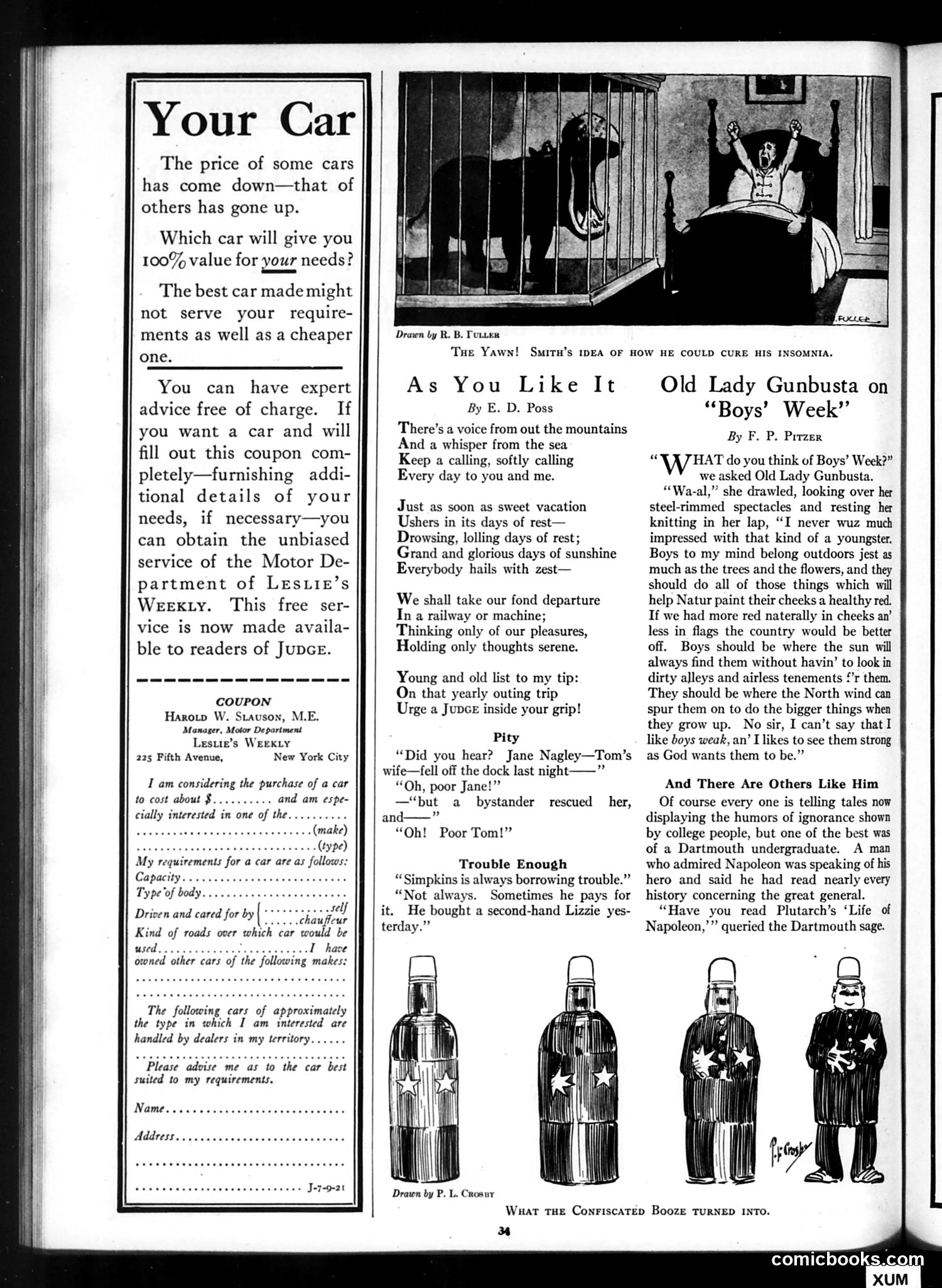
This page contains mostly **advertising and light humor** rather than political satire. The main content is a **car-buying service coupon** from Leslie's Weekly, offering free expert advice to help readers choose automobiles suited to their needs—reflecting post-WWI economic uncertainty when "some cars has come down...others has gone up." The illustrations are brief comedic sketches: - **"The Yawn"**: A man in bed uses a large steering wheel above his head as an insomnia cure—a visual pun on automobiles. - **"Old Lady Gunbusta on Boys' Week"**: Rural dialect humor about a woman advocating boys spend time outdoors rather than indoors, with patriotic references to "flags." - **"What the Confiscated Booze Turned Into"**: Four bottles transformed into suited figures—likely referencing Prohibition-era confiscated alcohol becoming something else (the specifics are unclear). The page's poetry and short humor pieces are genteel rather than cutting political commentary. This reflects Judge's evolution toward lighter, more commercial content by the 1920s.
This page is **not a cartoon but a government advertisement** from Judge magazine. It's a propaganda piece promoting Treasury Savings Securities during what appears to be the World War I era (the phrase "pressing Governmental and industrial needs" suggests wartime financing). The ad targets business owners ("Men of Affairs"), urging them to establish workplace savings associations among employees to fund government borrowing. The Niagara Falls metaphor—many small drops creating enormous power—illustrates how modest individual savings accumulate into billions for state needs. For modern readers: This reflects early 20th-century government financing strategy, before automated payroll deductions became standard. It assumes employers would actively organize workers' savings, presenting this as patriotic duty benefiting both employees and national interests. The rhetoric conflates personal and governmental financial health in ways contemporary readers might find propagandistic.
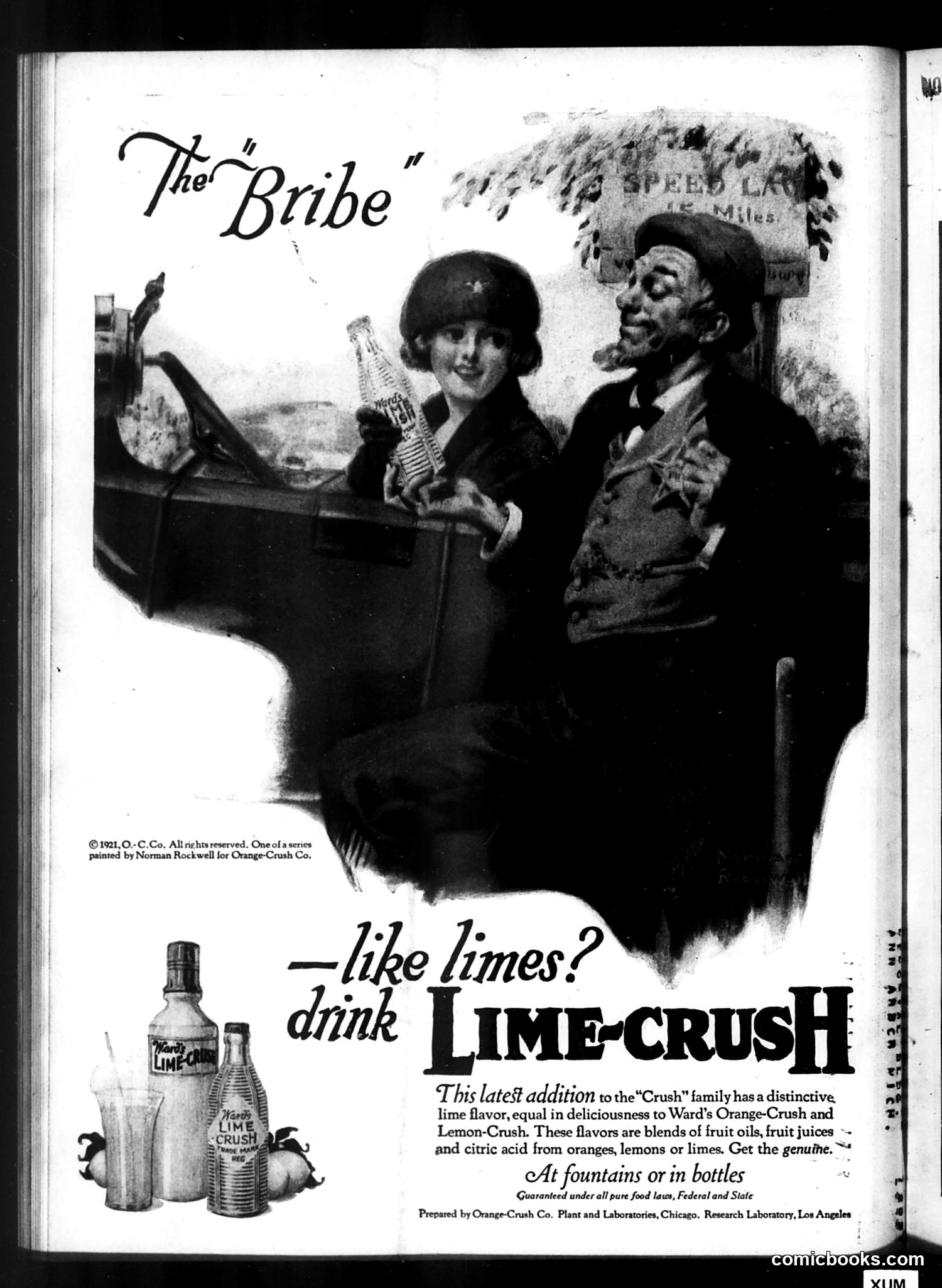
This is primarily a **product advertisement**, not political satire. It's a Lime-Crush soda ad from 1921, painted by Norman Rockwell. The "joke" in the headline "The Bribe—like limes? drink LIME-CRUSH" depicts two men attempting to bribe or persuade a woman (likely a store clerk or vendor) with a bottle of the new product. The cartoon plays on the idea that offering someone this beverage is so appealing it functions as an irresistible incentive. The reference to "bribe" reflects 1920s advertising conventions using mild, humorous scenarios to make products memorable. The illustration represents the product as socially desirable and attractive—something worth being "bribed" with. This is essentially a soda advertisement using flirtation and humor rather than substantive product claims, typical of early 20th-century consumer marketing.