
Judge, 1921-07-09 · page 20 of 36
Judge — July 9, 1921 — page 20: what you’re looking at
What you’re looking at
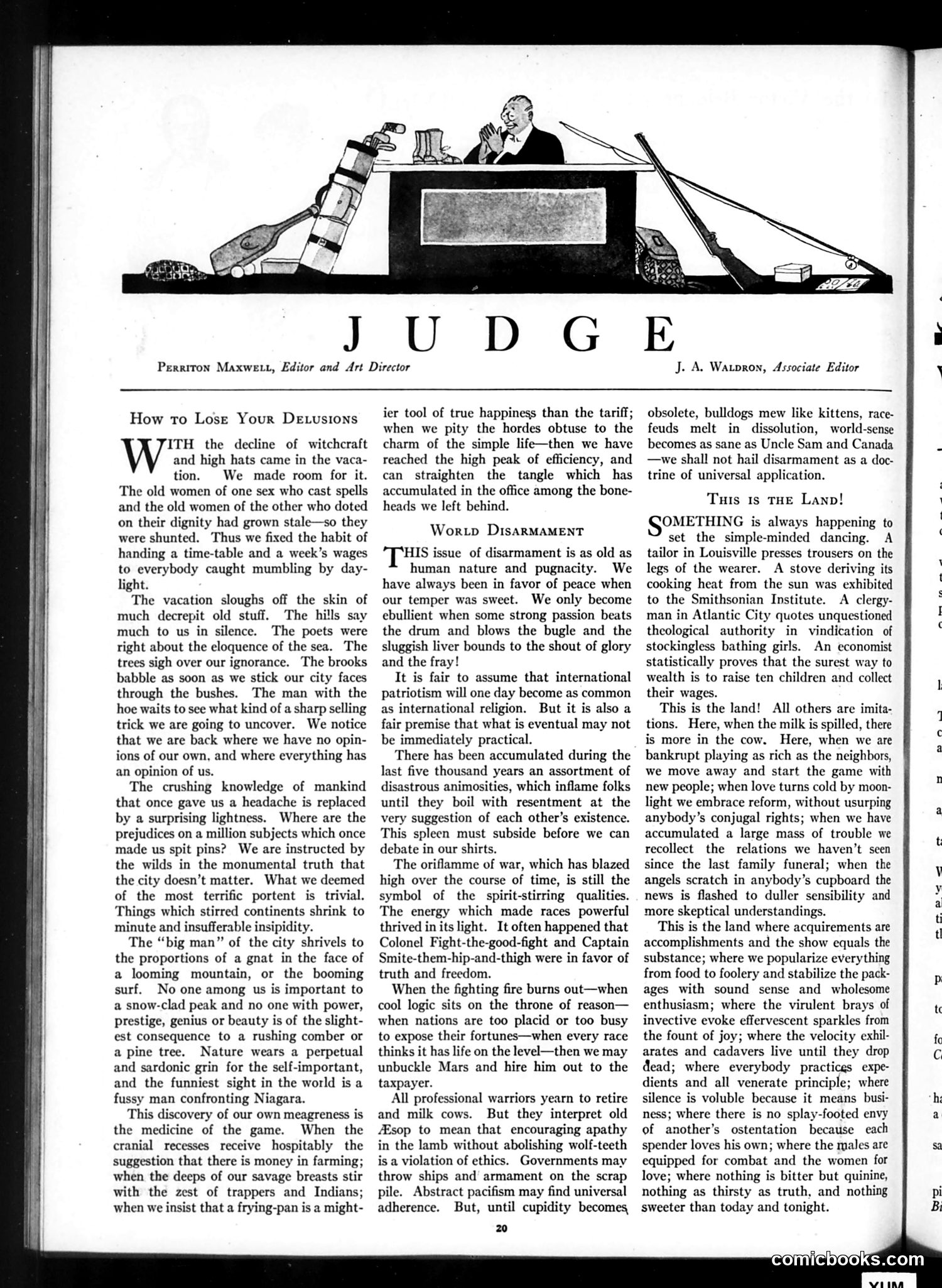
This page contains two editorial essays by the magazine's editors rather than traditional political cartoons. The **masthead illustration** shows a judge figure at a bench with various implements of law and disorder around him—establishing the magazine's satirical voice on public affairs. **"How to Lose Your Delusions"** celebrates vacations as mental therapy, arguing that nature and leisure strip away urban pretensions and manufactured anxieties. The piece mocks the "big man" of the city who shrinks to insignificance before natural forces like Niagara Falls—satire of American self-importance and materialism. **"World Disarmament"** discusses international peace efforts skeptically, acknowledging humans naturally tend toward conflict when passions run high. The editors argue that lasting disarmament remains impractical despite being theoretically desirable, since accumulated historical animosities between nations prevent genuine peaceful cooperation. This appears contemporary with early 20th-century peace movement debates. Both pieces employ Judge's characteristic blend of irony and social commentary on American life, leisure, and international affairs.
📄 Transcribed text from this page (OCR, searchable)
Machine-transcribed from the original scan — historical spelling and the odd misread are preserved.
Perriton Maxwett, Editor and Art Director J. A. Watpron, Associate Editor How to Lose Your Detusions ' K YITH the decline of witchcraft and high hats came in the vaca- tion. We made room for it. The old women of one sex who cast spells and the old women of the other who doted on their dignity had grown stale—so they were shunted. Thus we fixed the habit of handing a time-table and a week’s wages to everybody caught mumbling by day- light. The vacation sloughs off the skin of much decrepit old stuff. The hills say much to us in silence. The poets were right about the eloquence of the sea. The trees sigh over our ignorance. The brooks babble as soon as we stick our city faces through the bushes. The man with the hoe waits to see what kind of a sharp selling trick we are going to uncover. We notice that we are back where we have no opin- ions of our own, and where everything has an opinion of us. The crushing knowledge of mankind that once gave us a headache is replaced by a surprising lightness. Where are the prejudices on a million subjects which once made us spit pins? We are instructed by the wilds in the monumental truth that the city doesn’t matter. What we deemed of the most terrific portent is trivial. Things which stirred continents shrink to minute and insufferable insipidity. The “big man” of the city shrivels to the proportions of a gnat in the face of a looming mountain, or the booming surf. No one among us is important to a snow-clad peak and no one with power, prestige, genius or beauty is of the slight- est consequence to a rushing comber or a pine tree. Nature wears a perpetual and sardonic grin for the self-important, and the funniest sight in the world is a fussy man confronting Niagara. This discovery of our own meagreness is the medicine of the game. When the cranial recesses receive hospitably the suggestion that there is money in farming; when the deeps of our savage breasts stir with the zest of trappers and Indians; when we insist that a frying-pan is a might- ier tool of true happiness than the tariff; when we pity the hordes obtuse to the charm of the simple life—then we have reached the high peak of efficiency, and can straighten the tangle which has accumulated in the office among the bone- heads we left behind. Wor.tp DisAaRMAMENT 'HIS issue of disarmament is as old as human nature and pugnacity. We have always been in favor of peace when our temper was sweet. We only become ebullient when some strong passion beats the drum and blows the bugle and the sluggish liver bounds to the shout of glory and the fray! It is fair to assume that international patriotism will one day become as common as international religion. But it is also a fair premise that what is eventual may not be immediately practical. There has been accumulated during the last five thousand years an assortment of disastrous animosities, which inflame folks until they boil with resentment at the very suggestion of each other’s existence. This spleen must subside before we can debate in our shirts. The oriflamme of war, which has blazed high over the course of time, is still the symbol of the spirit-stirring qualities. The energy which made races powerful thrived in its light. It often happened that Colonel Fight-the-good-fight and Captain Smite-them-hip-and-thigh were in favor of truth and freedom. When the fighting fire burns out—when cool logic sits on the throne of reason— when nations are too placid or too busy to expose their fortunes—when every race thinks it has life on the level—then we may unbuckle Mars and hire him out to the taxpayer. All professional warriors yearn to retire and milk cows. But they interpret old sop to mean that encouraging apathy in the lamb without abolishing wolf-teeth is a violation of ethics. Governments may throw ships and armament on the scrap pile. Abstract pacifism may find universal adherence. But, until cupidity becomes 20 obsolete, bulldogs mew like kittens, race- feuds melt in dissolution, world-sense becomes as sane as Uncle Sam and Canada —we shall not hail disarmament as a doc- trine of universal application. Tus 1s THE Lanp! OMETHING is always happening to set the simple-minded dancing. A tailor in Louisville presses trousers on the legs of the wearer. A stove deriving its cooking heat from the sun was exhibited to the Smithsonian Institute. A clergy- man in Atlantic City quotes unquestioned theological authority in vindication of stockingless bathing girls. An economist statistically proves that the surest way to wealth is to raise ten children and collect their wages. This is the land! All others are imita- tions. Here, when the milk is spilled, there is more in the cow. Here, when we are bankrupt playing as rich as the neighbors, we move away and start the game with new people; when love turns cold by moon- light we embrace reform, without usurping anybody’s conjugal rights; when we have accumulated a large mass of trouble we recollect the relations we haven’t seen since the last family funeral; when the angels scratch in anybody’s cupboard the news is flashed to duller sensibility and more skeptical understandings. This is the land where acquirements are accomplishments and the show equals the substance; where we popularize everything from food to foolery and stabilize the pack- ages with sound sense and wholesome enthusiasm; where the virulent brays of invective evoke effervescent sparkles from the fount of joy; where the velocity exhil- arates and cadavers live until they drop dead; where everybody practices expe- dients and all venerate principle; where silence is voluble because it means busi- ness; where there is no splay-footed envy of another’s ostentation because each spender loves his own; where the males are equipped for combat and the women for love; where nothing is bitter but quinine, nothing as thirsty as truth, and nothing sweeter than today and tonight.