
Judge, 1921-07-09 · page 24 of 36
Judge — July 9, 1921 — page 24: what you’re looking at
What you’re looking at
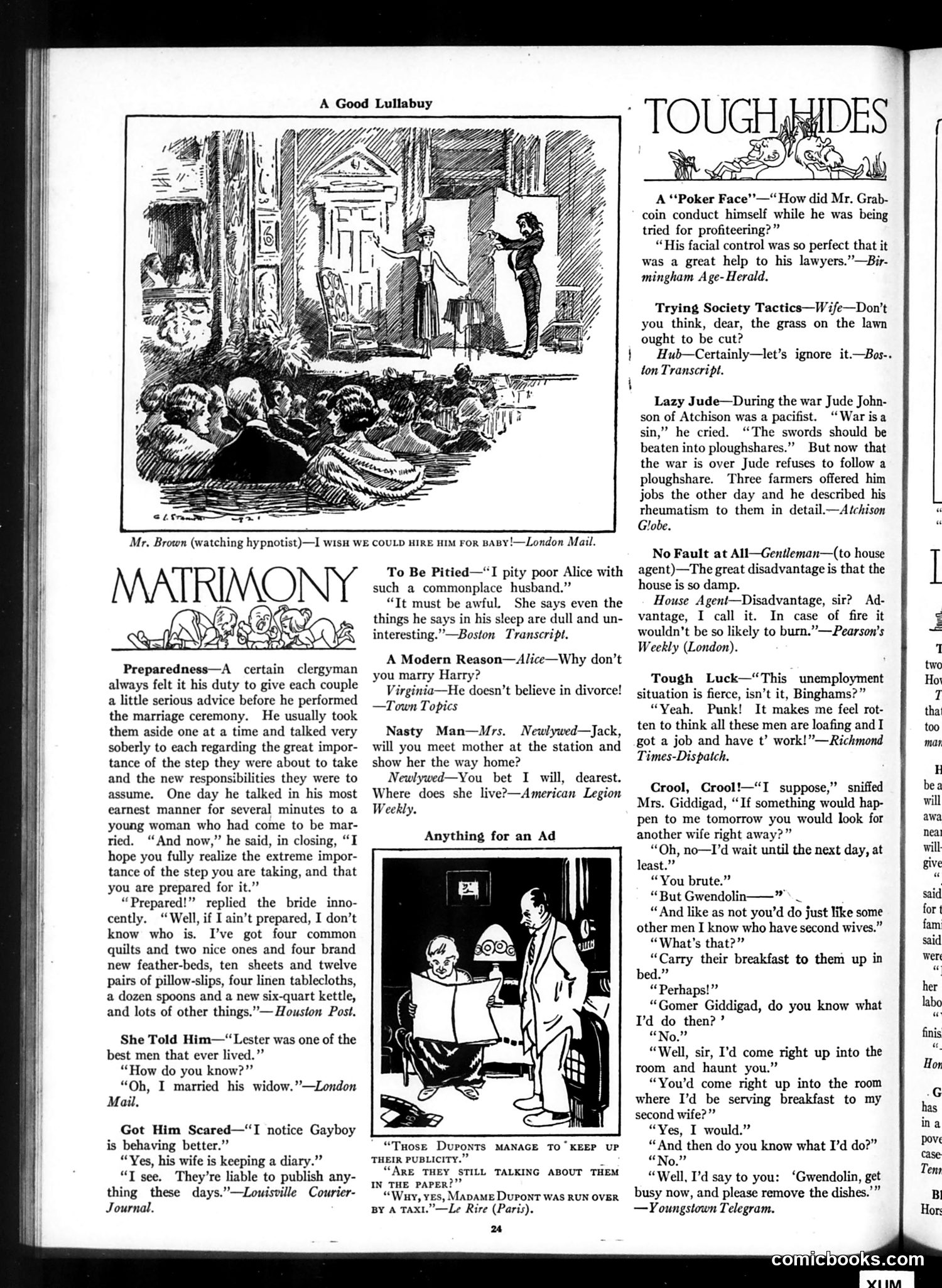
This page from *Judge* (a satirical weekly) contains a humor section mixing short jokes with social commentary typical of the early 20th century. **Main Cartoon**: "A Good Lullabuy" shows a hypnotist performing while an audience watches—the caption suggests hiring such a person to calm a baby, satirizing contemporary fascination with hypnotism as a quasi-scientific solution. **Content Themes**: The jokes mock post-WWI American society: - **"Lazy Jude"**: Mocks a former pacifist who now refuses work, claiming rheumatism—satirizing perceived hypocrisy of pacifists and post-war unemployment attitudes - **"Profiteering"**: References wartime profiteers facing trial, critiquing how lawyers exploit emotional control - **Marital humor**: Multiple jokes about marriage emphasize wives' materialism and nagging—reflecting period gender stereotypes - **"Unemployment"**: Shows tension between jobless men and employed workers, reflecting 1920s economic anxieties - **Housing/profiteering**: The "damp house" joke hints at landlord exploitation The humor reflects anxieties about war profiteering, unemployment, changing gender roles, and modern skepticism toward institutions—targeting educated, middle-class readers familiar with these social tensions.
📄 Transcribed text from this page (OCR, searchable)
Machine-transcribed from the original scan — historical spelling and the odd misread are preserved.
A Good Lullabuy Mr. Brown (watching hy pnotist)—I wisn we couLp mire wat FoR BABY!—London Mail. MATRIMONY Preparedness—A certain clergyman always felt it his duty to give each couple a little serious advice before he performed the marriage ceremony. He usually took them aside one at a time and talked very soberly to each regarding the great impor- tance of the step they were about to take and the new responsibilities they were to assume. One day he talked in his most earnest manner for several minutes to a young woman who had come to be mar- ried. “And now,” he said, in closing, “I hope you fully realize the extreme impor- tance of the step you are taking, and that you are prepared for it.” “Prepared!” replied the bride inno- cently. ‘Well, if I ain’t prepared, I don’t know who is. I’ve got four common quilts and two nice ones and four brand new feather-beds, ten sheets and twelve pairs of pillow-slips, four linen tablecloths, a dozen spoons and a new six-quart kettle, and lots of other things.” — Houston Post. She Told Him—“ Lester was one of the best men that ever lived.” “How do you know?” “Oh, I married his widow.”—London Mail. Got Him Scared—“I notice Gayboy is behaving better.” “Yes, his wife is keeping a diary.” “T see. They’re liable to publish any- thing these days.”—Louisville Courier- Journal. To Be Pitied—“I pity poor Alice with such a commonplace husband.” “It must be awful. She says even the things he says in his sleep are dull and un- interesting.” —Boston Transcript. A Modern Reason—Alice—Why don’t you marry Harry? Virginia—He doesn’t believe in divorce! —Town Topics Nasty Man—Mrs. Newlywed—Jack, will you meet mother at the station and show her the way home? Newlywed—You bet I will, dearest. Where does she live?—American Legion Weekly. Anything for an Ad “Tuose Duponts MANAGE TO “KEEP UP THEIR PUBLICITY.” . “ARE THEY STILL TALKING ABOUT THEM IN THE PAPER?” “Wuy, yes, Mapame Dupont WAS RUN OVER By a taxt.”—Le Rire (Paris). a“ A ‘Poker Face’”’—“ How did Mr. Grab- coin conduct himself while he was being tried for profiteering?” “His facial control was so perfect that it was a great help to his lawyers.”—Bir- mingham Age- Herald. Trying Society Tactics—Wife—Don’t you think, dear, the grass on the lawn ought to be cut? Hub—Certainly—let’s ignore it—Bos-. ton Transcript. Lazy Jude—During the war Jude John- son of Atchison was a pacifist. “War isa sin,” he cried. “The swords should be beaten into ploughshares.” But now that the war is over Jude refuses to follow a ploughshare. Three farmers offered him jobs the other day and he described his rheumatism to them in detail.—Atchison Globe. No Fault at All—Gentleman—(to house agent)—The great disadvantage is that the house is so damp. House Agent—Disadvantage, sir? Ad- vantage, I call it. In case of fire it wouldn’t be so likely to burn.” —Pearson’s Weekly (London). Tough Luck—“This unemployment situation is fierce, isn’t it, Binghams?” “Yeah. Punk! It makes me feel rot- ten to think all these men are loafing and I got a job and have t’ work!”—Richmond Times-Dispatch. Crool, Crool!—“I suppose,” sniffed Mrs. Giddigad, “If something would hap- pen to me tomorrow you would look for another wife right away?” “Oh, no—I’d wait until the next day, at least.” “You brute.” “But Gwendolin——” * _ “And like as not you’d do just like some other men I know who have second wives.” “What's that?” “Carry their breakfast to them up in bed.” “Perhaps!” “Gomer Giddigad, do you know what T’d do then?’ “No.” “Well, sir, I'd come right up into the room and haunt you.” “You’d come right up into the room where I’d be serving breakfast to my second wife?” “Yes, I would.” “And then do you know what I’d do?” “No.” “Well, I’d say to you: ‘Gwendolin, get busy now, and please remove the dishes.’” —Youngstown Telegram.