
Judge, 1921-07-09 · page 17 of 36
Judge — July 9, 1921 — page 17: what you’re looking at
What you’re looking at
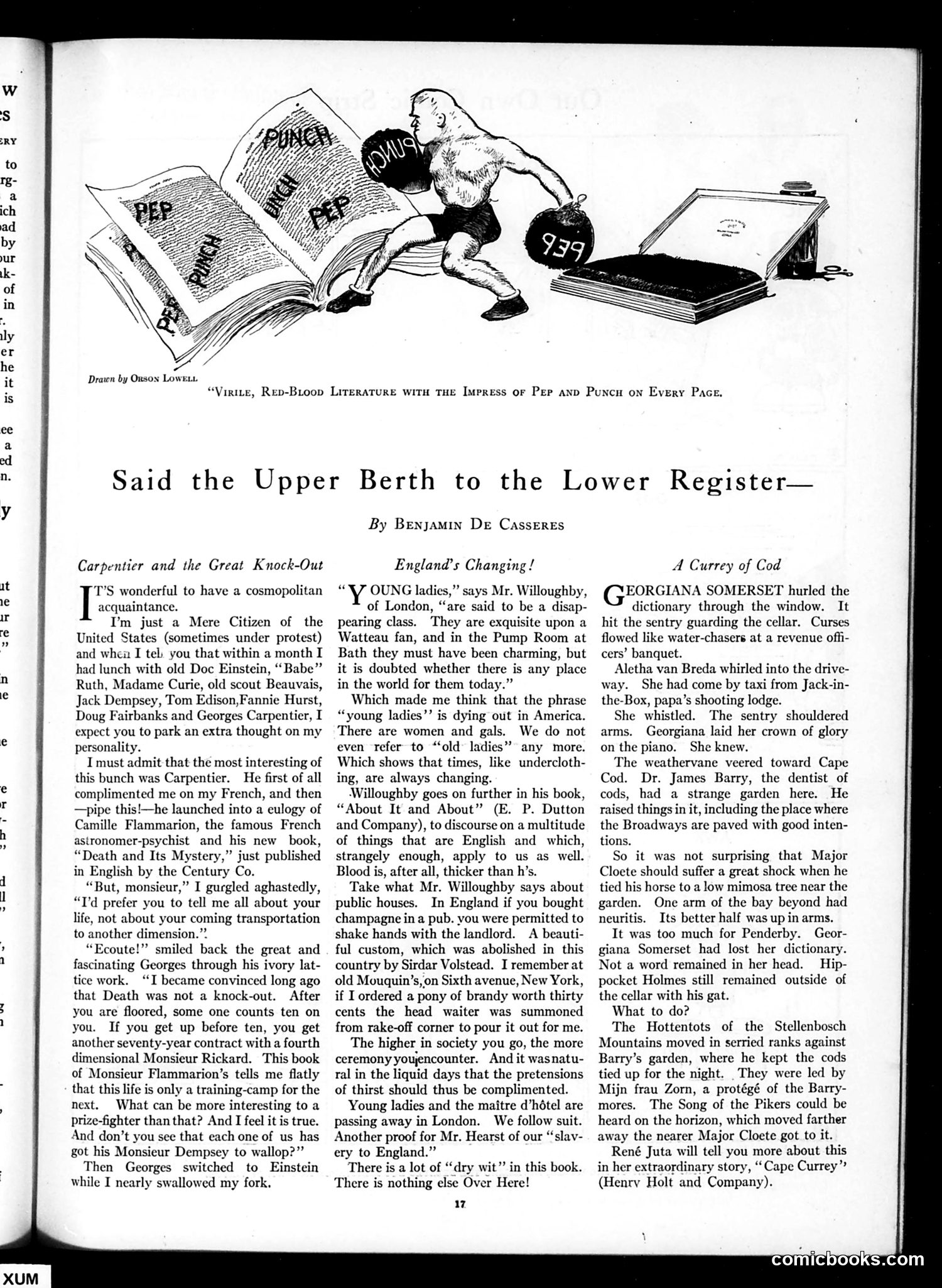
The cartoon depicts a boxer punching literature labeled "Pep" and "Punch" (magazines), with text volumes flying apart. It satirizes **virile, red-blooded literature**—likely criticizing overly aggressive or sensationalist writing styles popular in magazines like *Pep* and *Punch*. The article "Said the Upper Berth to the Lower Register" by Benjamin De Casseres discusses the boxer **Georges Carpentier**, then-famous for his 1921 heavyweight championship fight against Jack Dempsey. The narrator humorously claims familiarity with celebrities (Einstein, Babe Ruth, Dempsey) while Carpentier discusses French philosopher Camille Flammarion's book on the afterlife, using boxing metaphors for death and reincarnation. The secondary pieces mock changing social customs: "England's Changing!" critiques how terms like "young ladies" are disappearing, while "A Currey of Cod" appears to be a humorous society fiction piece. The overall page satirizes contemporary celebrity culture, European intellectualism, and social transformation in the early 1920s.
📄 Transcribed text from this page (OCR, searchable)
Machine-transcribed from the original scan — historical spelling and the odd misread are preserved.
Drawn by Onsox Lowen. “Virite, Rep-Bioop LireraTuRE WITH THE Impress oF Pep anp Puncu on Every Pace. Said the Upper Berth to the Lower Register— Carpentier and the Great Knock-Out T’S wonderful to have a cosmopolitan I acquaintance. I’m just a Mere Citizen of the United States (sometimes under protest) and whe I tel you that within a month I had lunch with old Doc Einstein, “Babe” Ruth, Madame Curie, old scout Beauvais, Jack Dempsey, Tom Edison,Fannie Hurst, Doug Fairbanks and Georges Carpentier, I expect you to park an extra thought on my personality. I must admit that the most interesting of this bunch was Carpentier. He first of all complimented me on my French, and then —pipe this!—he launched into a eulogy of Camille Flammarion, the famous French astronomer-psychist and his new book, “Death and Its Mystery,” just published in English by the Century Co. “But, monsieur,” I gurgled aghastedly, “T’d prefer you to tell me all about your life, not about your coming transportation to another dimension.” “Ecoute!”” smiled back the great and fascinating Georges through his ivory lat- tice work. “I became convinced long ago that Death was not a knock-out. After you are floored, some one counts ten on you. If you get up before ten, you get another seventy-year contract with a fourth dimensional Monsieur Rickard. This book of Monsieur Flammarion’s tells me flatly that this life is only a training-camp for the next. What can be more interesting to a prize-fighter than that? And I feel it is true. And don’t you see that each one of us has got his Monsieur Dempsey to wallop?” Then Georges switched to Einstein while I nearly swallowed my fork. By Benjamin De Casseres England’s Changing! “7 OUNG ladies,” says Mr. Willoughby, of London, “are said to be a disap- pearing class. They are exquisite upon a Watteau fan, and in the Pump Room at Bath they must have been charming, but it is doubted whether there is any place in the world for them today.” Which made me think that the phrase “young ladies’’ is dying out in America. There are women and gals. We do not even refer to “‘old ladies” any more. Which shows that times, like undercloth- ing, are always changing. Willoughby goes on further in his book, “About It and About” (E. P. Dutton and Company), to discourse on a multitude of things that are English and which, strangely enough, apply to us as well. Blood is, after all, thicker than h’s. Take what Mr. Willoughby says about public houses. In England if you bought champagne in a pub. vou were permitted to shake hands with the landlord. A beauti- ful custom, which was abolished in this country by Sirdar Volstead. I remember at old Mouquin’s, on Sixth avenue, New York, if I ordered a pony of brandy worth thirty cents the head waiter was summoned from rake-off corner to pour it out for me. The higher in society you go, the more ceremony youjencounter. And it wasnatu- ral in the liquid days that the pretensions of thirst should thus be complimented. Young ladies and the maitre d’hétel are passing away in London. We follow suit. Another proof for Mr. Hearst of our “slav- ery to England.” There is a lot of “dry wit” in this book. There is nothing else Over Here! 17 A Currey of Cod EORGIANA SOMERSET hurled the dictionary through the window. It hit the sentry guarding the cellar. Curses flowed like water-chasers at a revenue offi- cers’ banquet. Aletha van Breda whirled into the drive- way. She had come by taxi from Jack-in- the-Box, papa’s shooting lodge. She whistled. The sentry shouldered arms. Georgiana laid her crown of glory on the piano. She knew. The weathervane veered toward Cape Cod. Dr. James Barry, the dentist of cods, had a strange garden here. He raised things in it, including the place where the Broadways are paved with good inten- tions. So it was not surprising that Major Cloete should suffer a great shock when he tied his horse to a low mimosa tree near the garden. One arm of the bay beyond had neuritis. Its better half was up in arms. It was too much for Penderby. Geor- giana Somerset had lost her dictionary. Not a word remained in her head. Hip- pocket Holmes still remained outside of the cellar with his gat. What to do? The Hottentots of the Stellenbosch Mountains moved in serried ranks against Barry’s garden, where he kept the cods tied up for the night. _They were led by Mijn frau Zorn, a protégé of the Barry- mores. The Song of the Pikers could be heard on the horizon, which moved farther away the nearer Major Cloete got to it. René Juta will tell you more about this in her extraordinary story, “Cape Currey”” (Henry Holt and Company).