
Judge, 1921-07-09 · page 11 of 36
Judge — July 9, 1921 — page 11: what you’re looking at
What you’re looking at
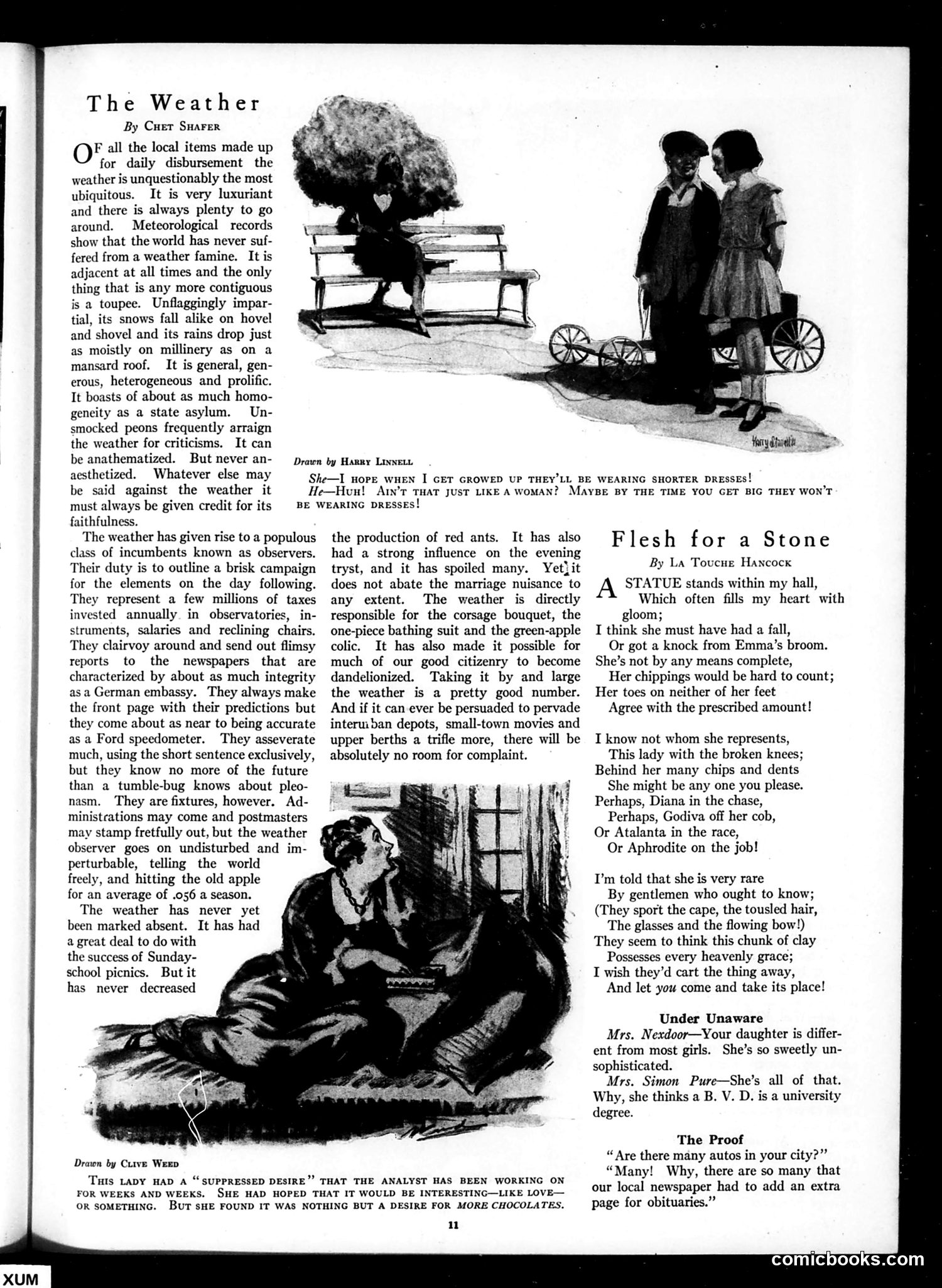
This satirical page contains three distinct pieces mocking early 20th-century American life: **"The Weather" by Chet Shafer** is a humorous essay ridiculing weather forecasters and meteorological observers. It satirizes their predictive failures (comparing accuracy to a Ford speedometer's reliability) while noting their secure government positions despite consistent inaccuracy. The tone is absurdist, treating weather reporting as an established bureaucratic fixture immune to accountability. **Two cartoons by Harry Linnell and Cuve Weed** depict gender and relationship dynamics. One features children discussing women's fashion; another shows a psychoanalyst discovering a woman's "suppressed desire" is merely wanting more chocolates—mocking both Freudian psychology trends and stereotypes about women's shallow desires. **"Flesh for a Stone" by La Touche Hancock** is a poem about a damaged statue in the speaker's home, whose identity remains unclear due to missing parts. It playfully catalogs possible identities (Diana, Godiva, Atalanta, Aphrodite), creating humor through the statue's ambiguous and deteriorated state. The page reflects Judge's satirical approach to contemporary social institutions, gender roles, and pseudo-scientific trends of the era.
📄 Transcribed text from this page (OCR, searchable)
Machine-transcribed from the original scan — historical spelling and the odd misread are preserved.
The Weather By Cuet Suarer F all the local items made up for daily disbursement the weather is unquestionably the most ubiquitous. It is very luxuriant and there is always plenty to go around. Meteorological records show that the world has never suf- fered from a weather famine. It is adjacent at all times and the only thing that is any more contiguous is a toupee. Unflaggingly impar- tial, its snows fall alike on hovel and shovel and its rains drop just as moistly on millinery as on a mansard roof. It is general, gen- erous, heterogeneous and prolific. It boasts of about as much homo- geneity as a state asylum. Un- smocked peons frequently arraign the weather for criticisms. It can be anathematized. But never an- aesthetized. Whatever else may be said against the weather it must always be given credit for its faithfulness. The weather has given rise to a populous class of incumbents known as observers. Their duty is to outline a brisk campaign for the elements on the day following. They represent a few millions of taxes invested annually in observatories, in- struments, salaries and reclining chairs. They clairvoy around and send out flimsy reports to the newspapers that are characterized by about as much integrity asa German embassy. They always make the front page with their predictions but they come about as near to being accurate as a Ford speedometer. They asseverate much, using the short sentence exclusively, but they know no more of the future than a tumble-bug knows about pleo- nasm. They are fixtures, however. Ad- ministcations may come and postmasters may stamp fretfully out, but the weather observer goes on undisturbed and im- perturbable, telling the world freely, and hitting the old apple for an average of .056 a season. The weather has never yet been marked absent. It has had a great deal to do with the success of Sunday- school picnics. But it has never decreased Drawn by Cuve Weep He—Hun! BE WEARING DRESSES! Drawn by Harry Linen She—I wore wuen I GET GROWED UP THEY’LL BE WEARING SHORTER DRESSES! AIN’T THAT JUST LIKE A WoMAN? MayBE BY THE TIME YOU GET BIG THEY WON'T the production of red ants. It has also had a strong influence on the evening tryst, and it has spoiled many. Yetjit does not abate the marriage nuisance to any extent. The weather is directly responsible for the corsage bouquet, the one-piece bathing suit and the green-apple colic. It has also made it possible for much of our good citizenry to become dandelionized. Taking it by and large the weather is a pretty good number. And if it can ever be persuaded to pervade inter ban depots, small-town movies and upper berths a trifle more, there will be absolutely no room for complaint. THIs LADY HAD A “SUPPRESSED DESIRE” THAT THE ANALYST HAS BEEN WORKING ON FOR WEEKS AND WEEKS. OR SOMETHING. SHE HAD HOPED THAT IT WOULD BE INTERESTING—LIKE LOVE— But sHE FOUND IT WAS NOTHING BUT A DESIRE FOR MORE CHOCOLATES. il Flesh for a Stone By La Toucne Hancock STATUE stands within my hall, Which often fills my heart with gloom; I think she must have had a fall, Or got a knock from Emma’s broom. She’s not by any means complete, Her chippings would be hard to count; Her toes on neither of her feet Agree with the prescribed amount! I know not whom she represents, This lady with the broken knees; Behind her many chips and dents She might be any one you please. Perhaps, Diana in the chase, Perhaps, Godiva off her cob, Or Atalanta in the race, Or Aphrodite on the job! I’m told that she is very rare By gentlemen who ought to know; (They sport the cape, the tousled hair, The glasses and the flowing bow!) They seem to think this chunk of clay Possesses every heavenly grace; I wish they’d cart the thing away, And let you come and take its place! Under Unaware Mrs. Nexdoor—Your daughter is differ- ent from most girls. She’s so sweetly un- sophisticated. Mrs. Simon Pure—She’s all of that. Why, she thinks a B. V. D. is a university degree. The Proof “Are there many autos in your city?” “Many! Why, there are so many that our local newspaper had to add an extra page for obituaries.” comicbooks.com