
A complete issue · 32 pages · 1921
Judge — March 26, 1921
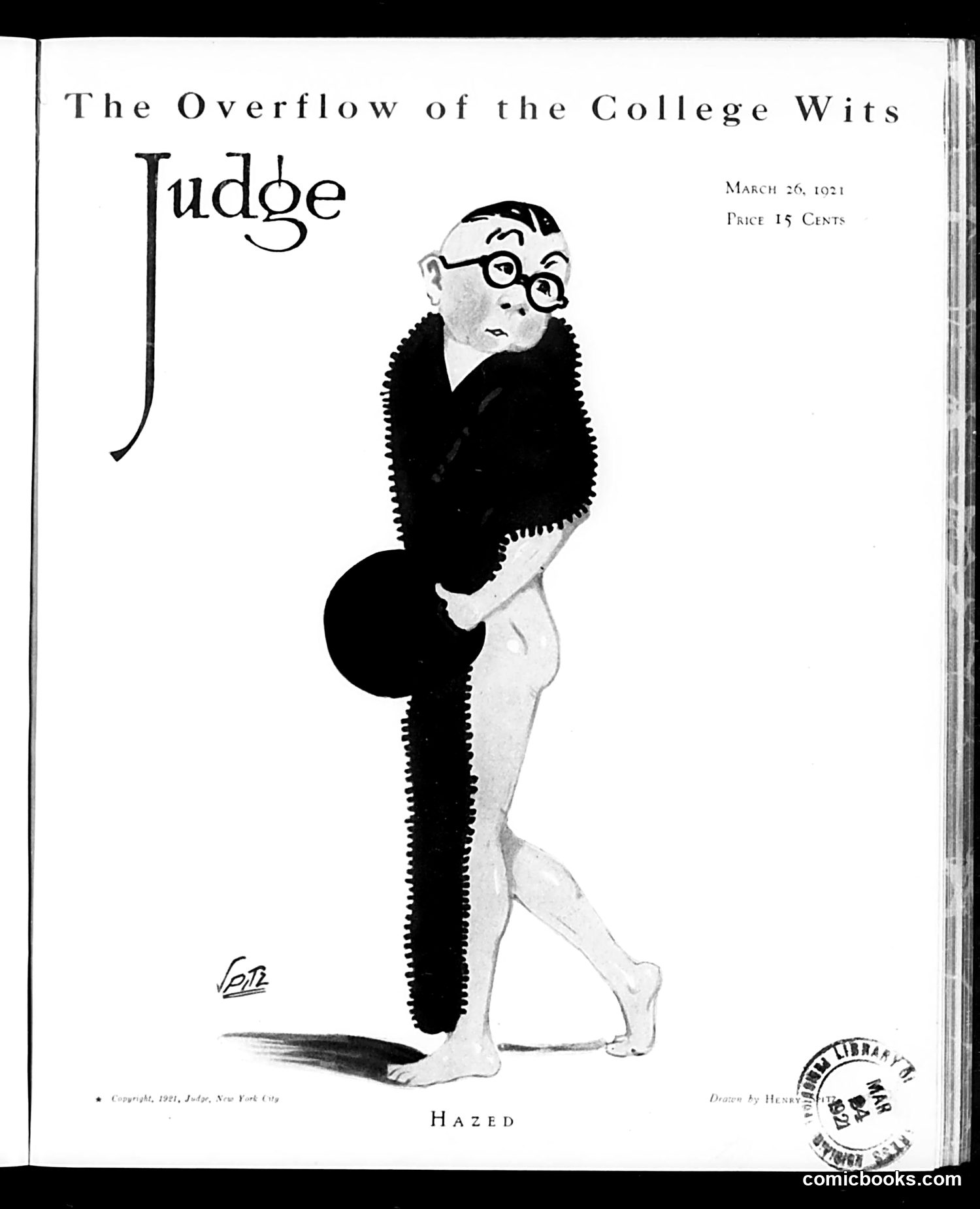
This cover satirizes college hazing practices through the figure labeled "Hazed." The illustration shows a thin, disheveled man wearing oversized glasses and a fur collar, appearing dazed and bewildered—visual indicators of someone mistreated. The title "The Overflow of the College Wits" suggests that college students' pranks and hazing rituals had become excessive or out of control. The subtitle "Hazed" explicitly identifies the subject as a victim of these practices. In 1921, hazing was a widespread college tradition involving often-brutal initiation rites for new students. Judge magazine used this cover to mock and criticize the practice, presenting the hazing victim as a pathetic figure—commentary on both hazing itself and the supposed "wit" of perpetrators.
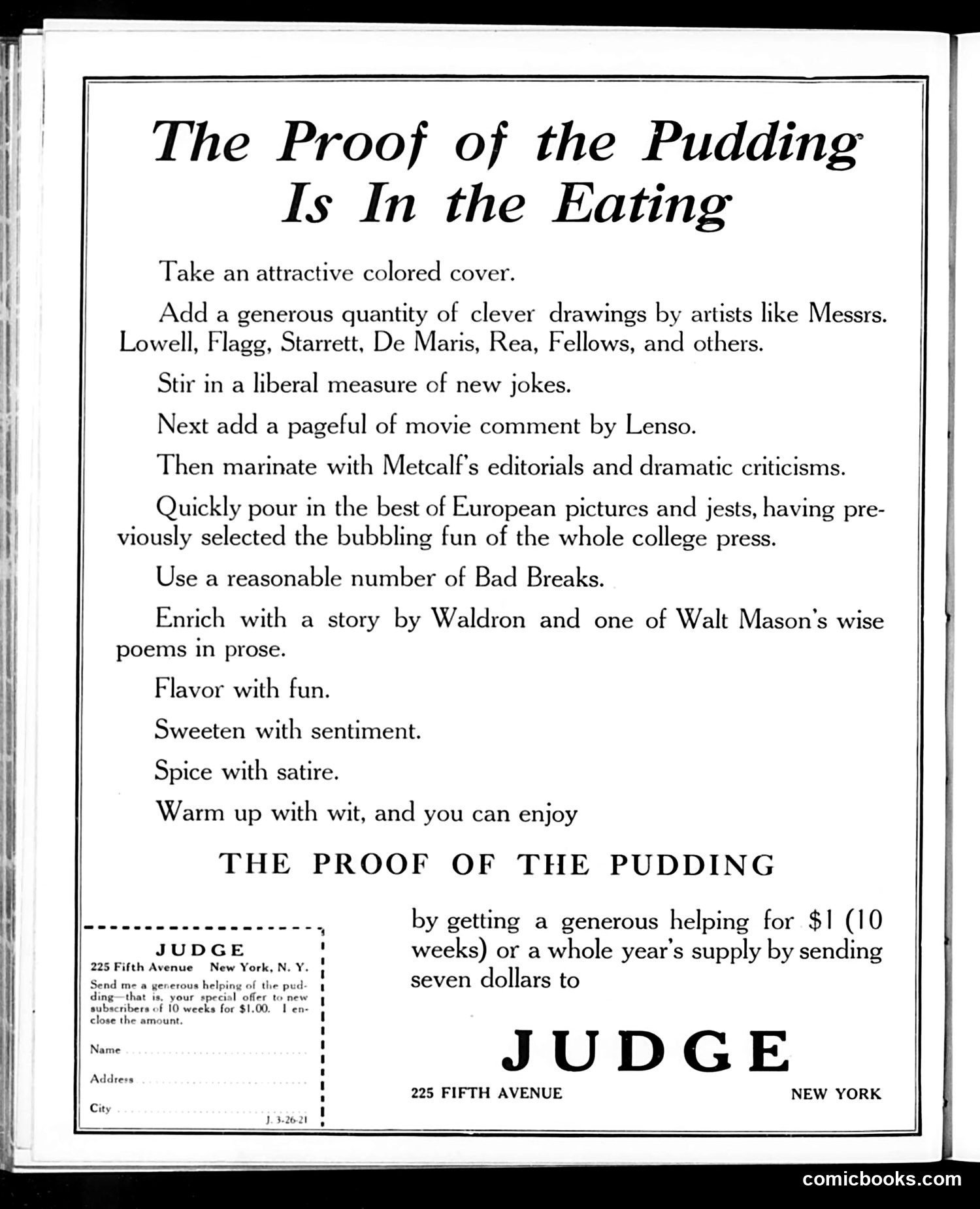
This is primarily an advertisement for *Judge* magazine itself, disguised as a humorous "recipe." The text uses cooking metaphors to describe the magazine's editorial formula: combining artwork by named cartoonists (Lowell, Flagg, Starrett, De Maris, Rea, Fellows), jokes, movie commentary by "Lenso," editorials by "Metcalf," European pictures, and features called "Bad Breaks." The satire targets the magazine's own commercial nature—it's essentially saying: "Here's what we mix together to make entertaining content." References to "Waldron" and "Walt Mason" appear to be contributing writers. The subscription pitch ($1 for 10 weeks, or $7 yearly) occupies the lower portion. This is self-promotional content typical of early 20th-century magazine advertising, using wordplay to encourage subscriptions.
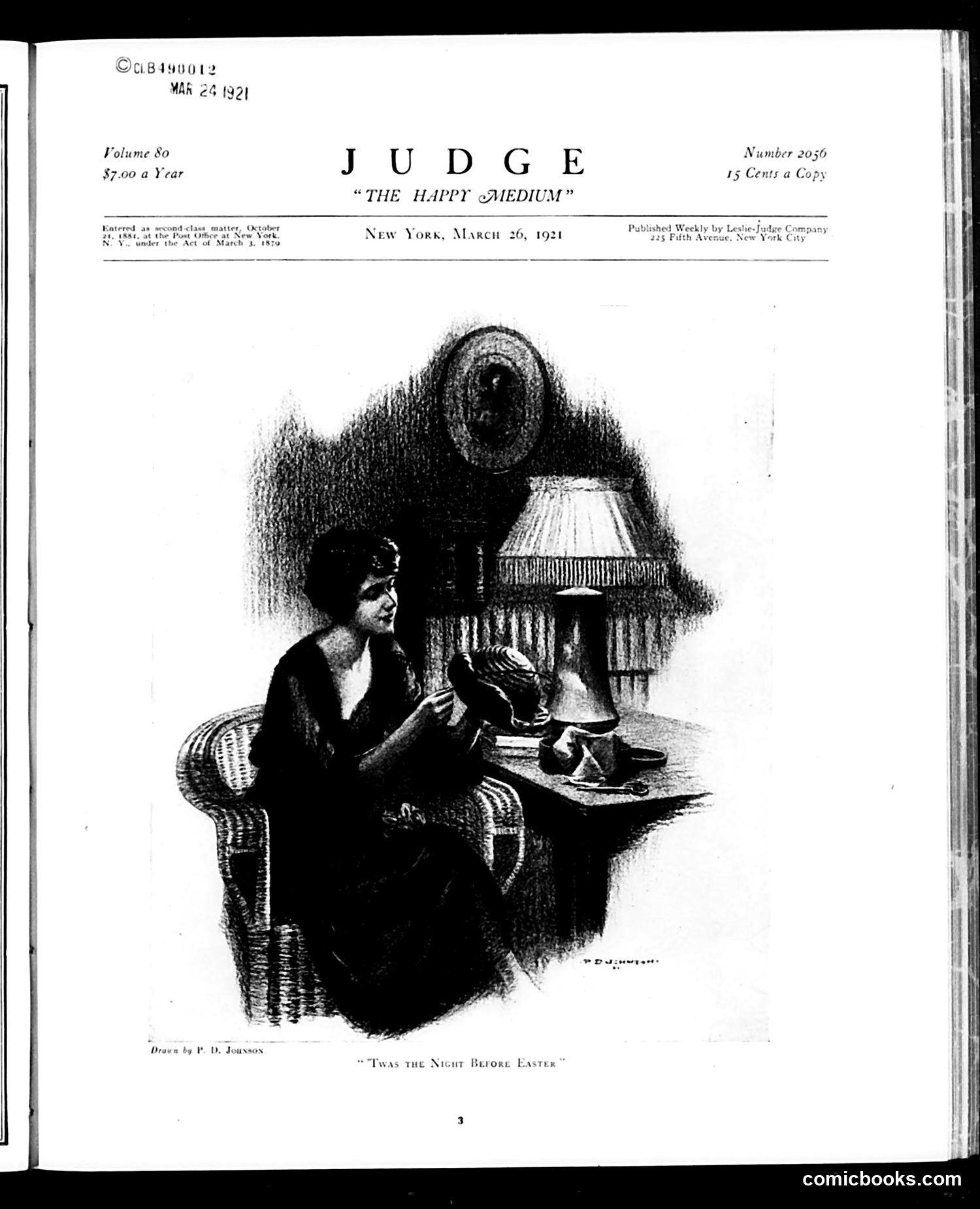
This cartoon, drawn by F. D. Johnson, depicts a woman in an interior setting holding what appears to be a bird (likely a chicken or Easter fowl). She sits before a table with a lamp, seemingly engaged in preparation work. The illustration is titled **"'Twas the Night Before Easter,"** a clear parody of "'Twas the Night Before Christmas." The satire likely comments on Easter preparations and domestic life in 1921. The mysterious shadowy figure looming above suggests either anticipation, supernatural elements playing into the Christmas-poem parody, or possibly commentary on household management and holiday stress. Without additional context from the full article, the precise social commentary remains unclear, though it appears to humorously address Easter traditions and domestic labor.
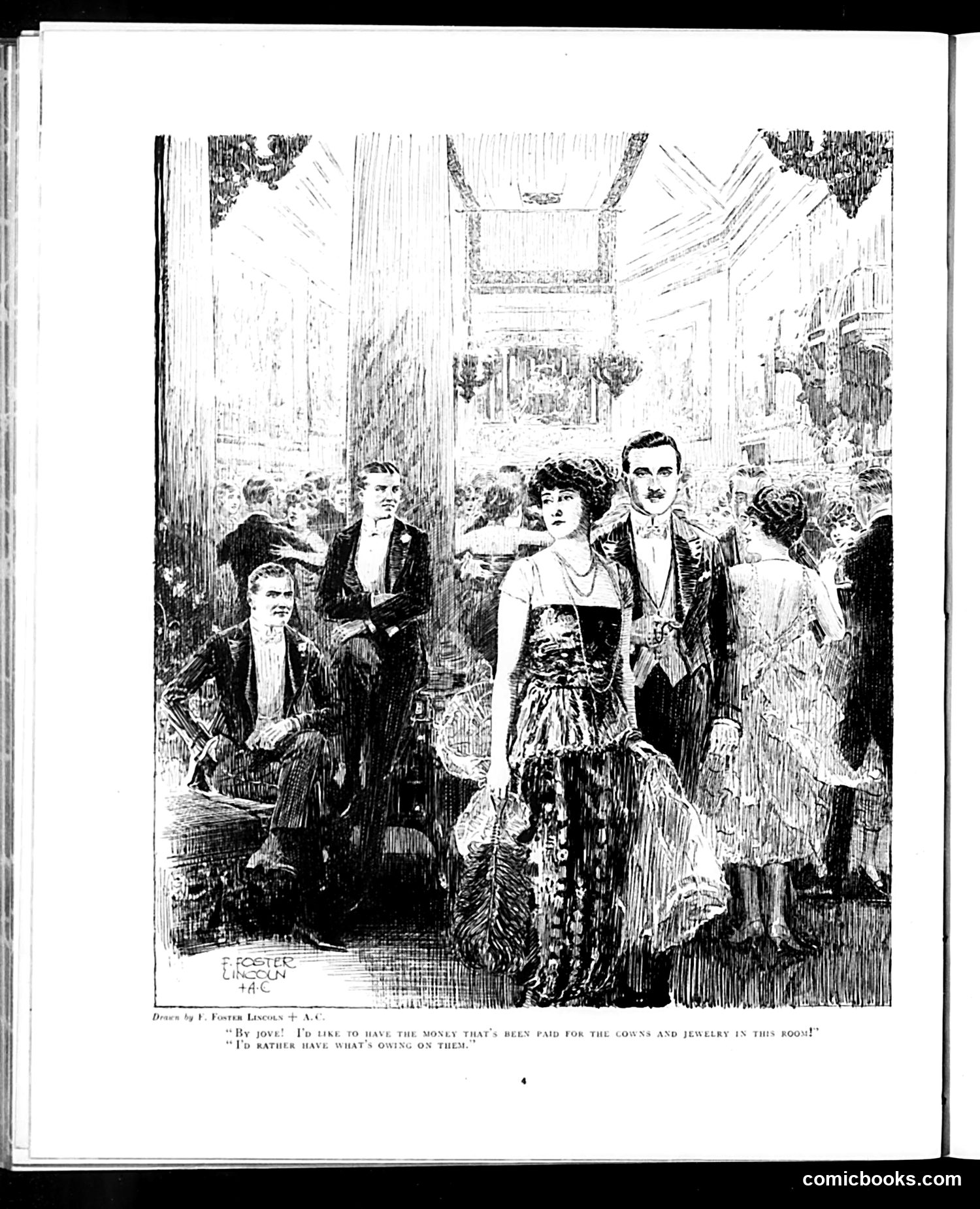
This cartoon by F. Foster Lincoln depicts a high-society ballroom scene. The caption reads: "By Jove! I'd like to have the money that's been paid for the gowns and jewelry in this room! It's rather have what's owing on them." The satire targets wealthy society's false appearance of prosperity. The elegantly dressed figures display expensive gowns and jewelry, but the joke reveals their financial reality: they're heavily in debt. This reflects early 20th-century anxieties about conspicuous consumption and the gap between appearances and actual wealth—particularly relevant during economic uncertainty. The cartoon mocks high-society pretension, suggesting that fashionable elites often live beyond their means to maintain social status, with unpaid bills hidden behind glamorous facades.
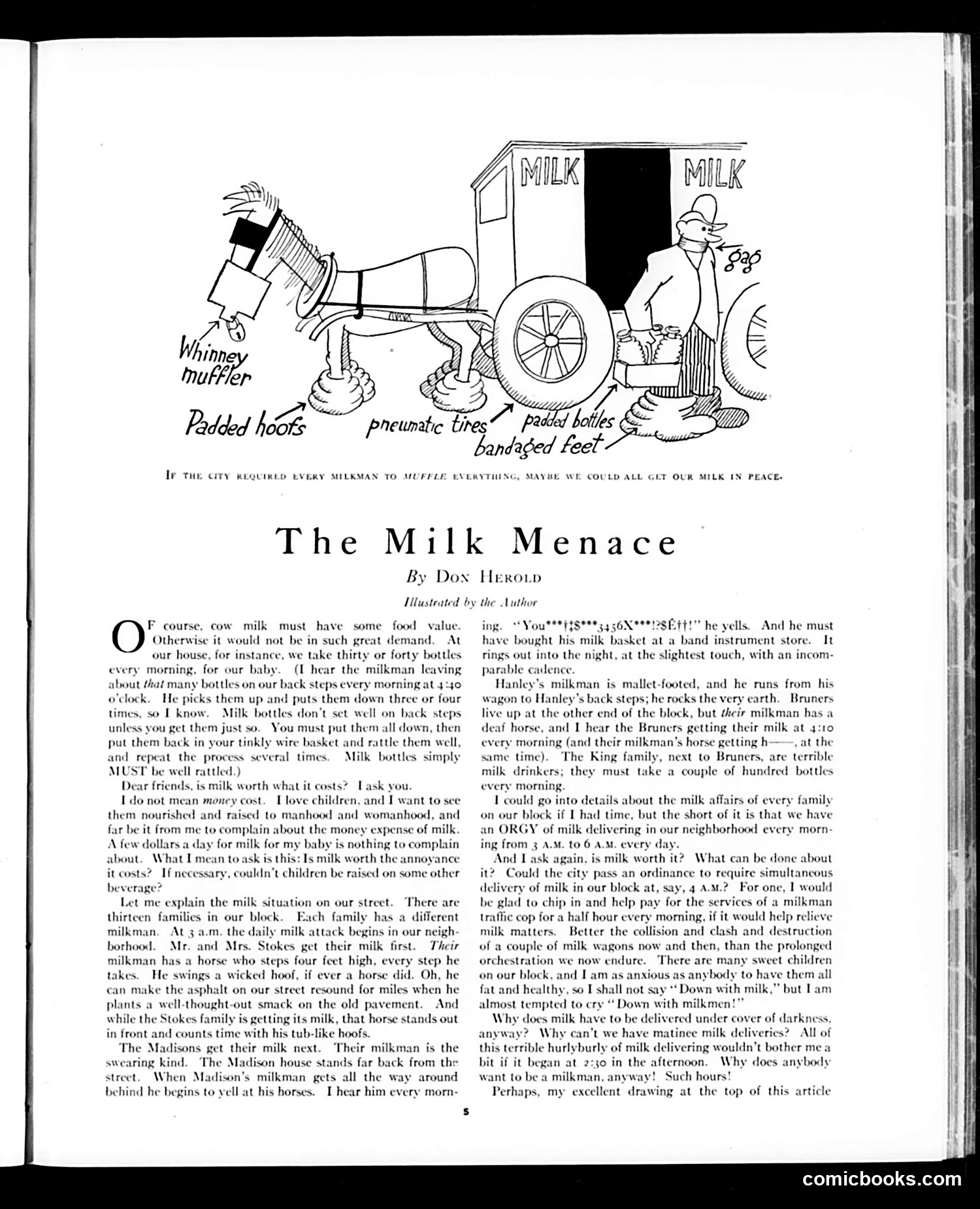
This satirical article critiques the chaos of urban milk delivery in the early 20th century. The cartoon depicts a milk wagon equipped with absurd noise-reduction devices—a "Whitney muffler," "padded hoofs," "pneumatic tires," "padded boilies," and "bandaged feet"—mocking the milkman's early-morning deliveries that woke neighborhoods. The author humorously explains the "milk situation" on city streets: thirteen families share one milkman making multiple daily rounds, with competing deliveries creating noise and congestion. Herald satirizes the impractical solution of silencing individual horses rather than addressing the underlying problem—the need for coordinated delivery schedules. The piece uses exaggeration to critique inefficient urban infrastructure and suggests city ordinances should require synchronized milk delivery instead of tolerating constant disruption.
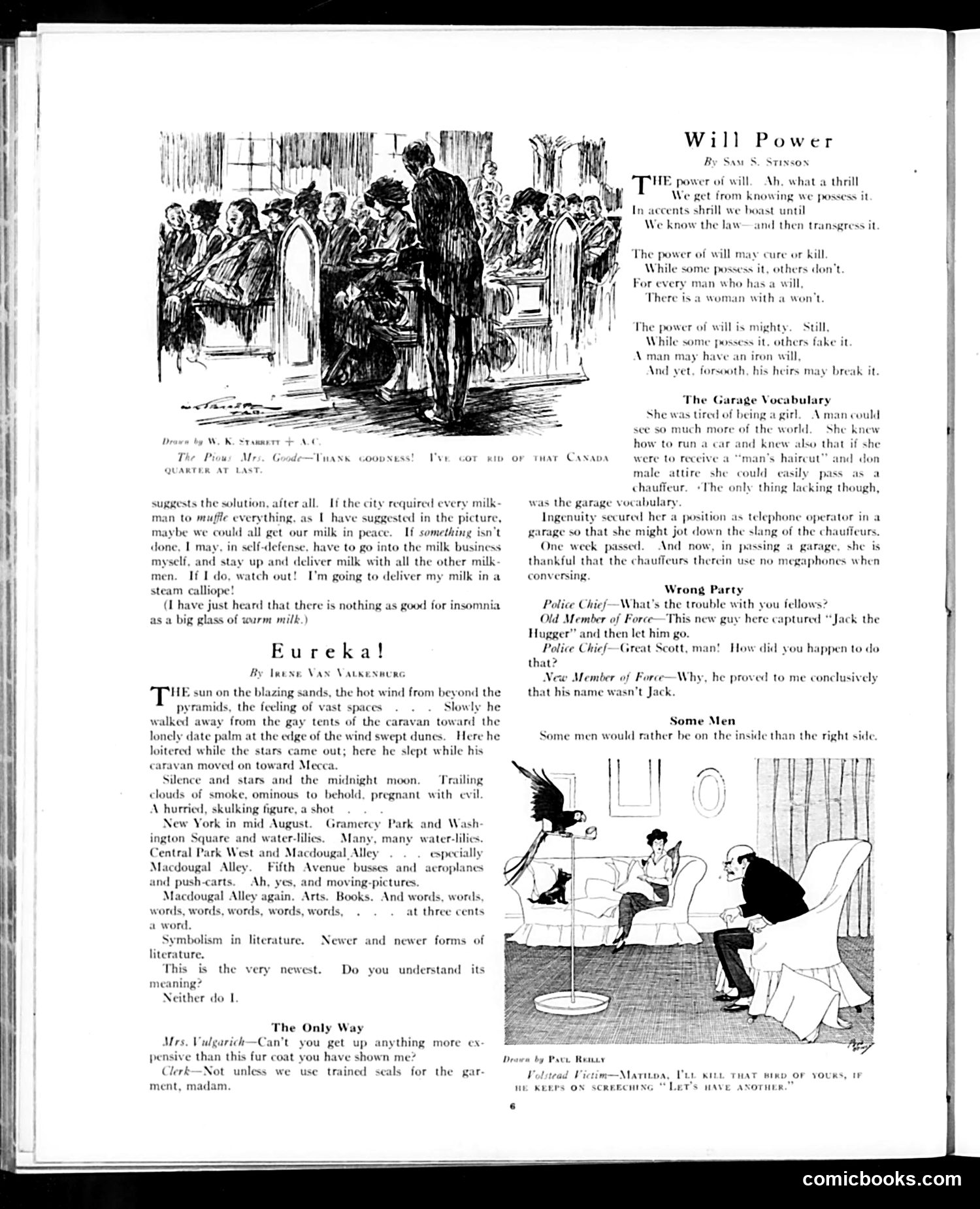
This page contains literary content rather than political cartoons. The main pieces are: **"Will Power"** by Sam S. Stinson—a poem about willpower's paradoxical nature (some possess it, others don't; it can be broken). **"Eureka!"** by Irene Van Valkenburg—a prose piece describing Egyptian/desert imagery, possibly symbolic. References to "Macdougal Alley" and New York neighborhoods suggest artistic or bohemian circles. **"Some Men"** cartoon by Paul Reblis—depicts men on a sofa, with caption about preferring "inside" to "right side," likely a mild joke about social positioning or conformity. The **"Garage Vocabulary"** and **"Wrong Party"** sections are brief humorous dialogues, apparently unrelated to major political events. This appears to be a lighter editorial page focused on general satire and social comedy rather than topical political commentary.
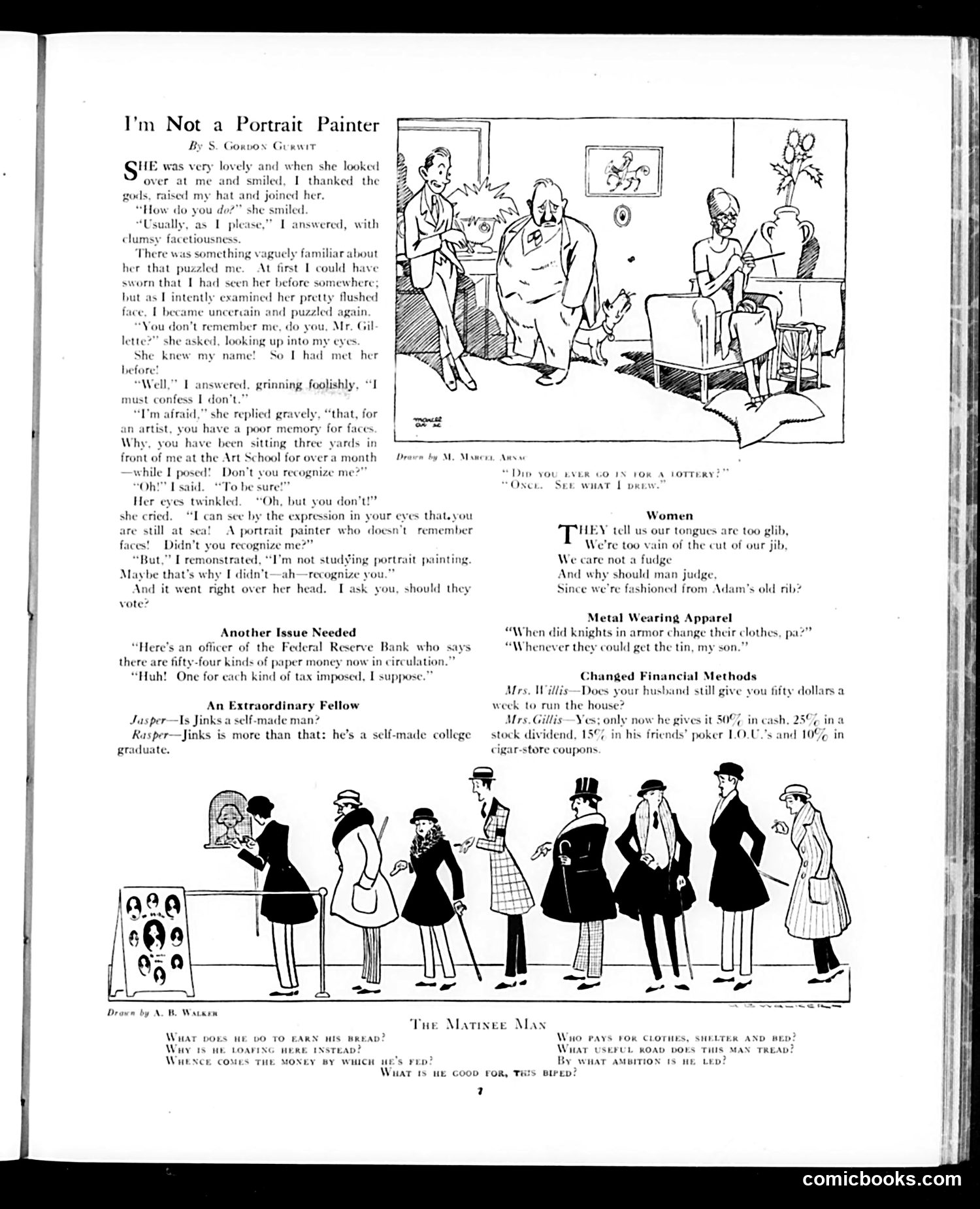
This page contains several satirical pieces targeting early 20th-century social issues: **"I'm Not a Portrait Painter"** (top): A humorous story about an artist who fails to recognize a woman who posed for him at art school for a month. The joke mocks the artist's absent-mindedness and lack of observational skills—ironic for someone whose profession requires studying faces. **"Another Issue Needed"**: Brief satire on currency inflation and excessive taxation during this period. **"An Extraordinary Fellow"**: Wordplay joke about a "self-made" college graduate who somehow exceeded normal self-improvement. **"Women"** (poem): Defensive satire responding to criticism of women's behavior and appearance, sarcastically citing Adam as their original template. **"The Matinee Man"** (bottom cartoon): Social criticism of unemployed men who frequent daytime theater performances. The questions mock this as parasitic behavior—asking who funds their leisure while they contribute nothing to society. These pieces reflect class anxieties and gender debates common to the 1920s-era satirical press.
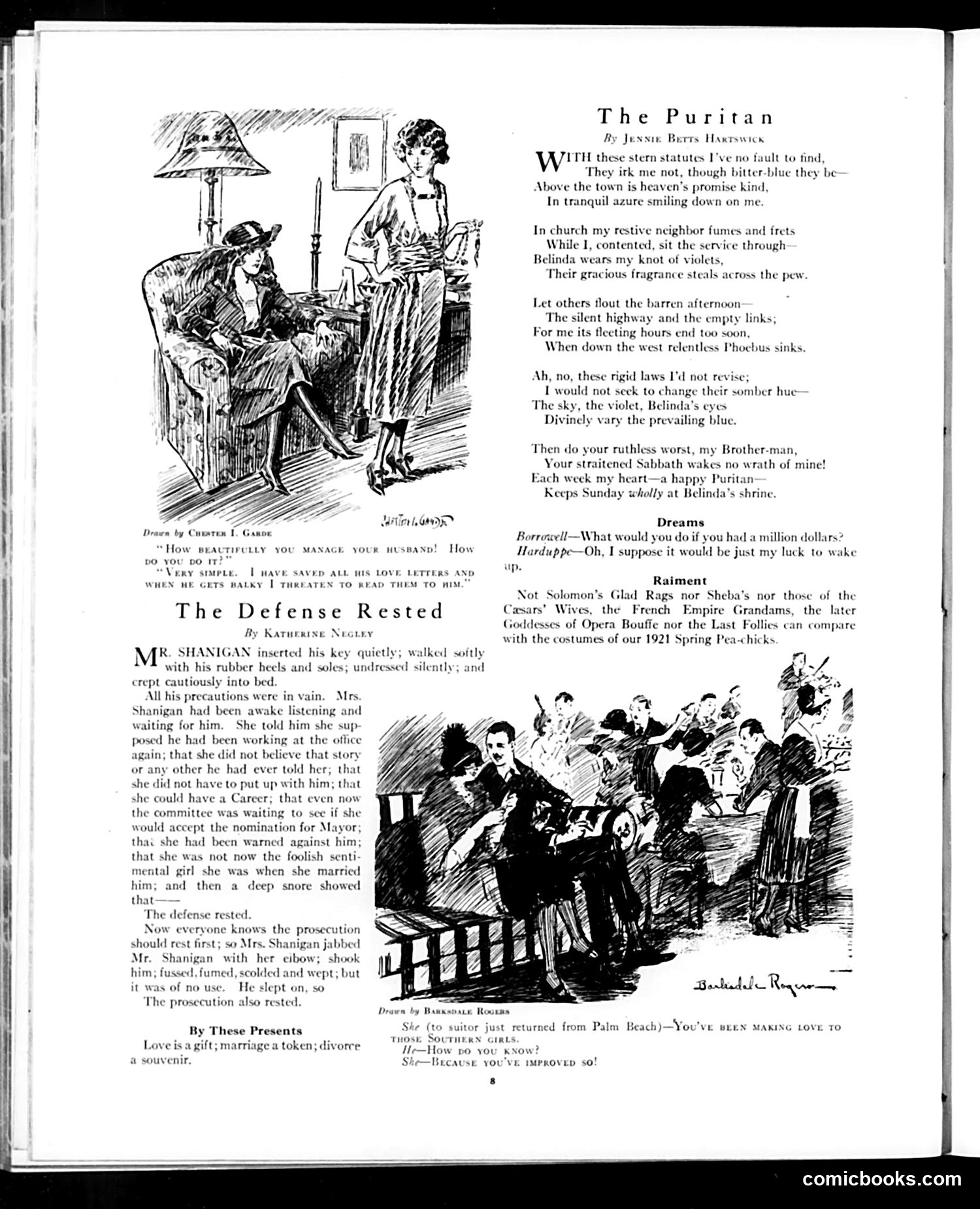
This page contains three distinct pieces satirizing 1920s American social life: **"The Defense Rested"** depicts marital dynamics—a wife ambushes her late-arriving husband with accusations and threats (including potential mayoral nomination), delivering a lengthy complaint before he simply falls asleep, rendering her "prosecution" moot. The satire targets nagging wives and the futility of domestic arguments. **"The Puritan"** is a poem celebrating austere morality and religious observance, paradoxically revealed as motivated by attraction to a woman named Belinda rather than genuine piety. It mocks self-righteous Puritanism as hypocritical cover for worldly desires. **"Dreams"** presents a brief joke about poverty: a poor man (Harduppe) wouldn't know what to do with a million dollars because his bad luck would prevent him from keeping it. **"Raiment"** praises 1921 Spring fashion, comparing contemporary women's costumes favorably to historical glamorous dress—a light fashion commentary. The cartoons reflect typical Judge content: domestic comedy, social hypocrisy, and fashion humor aimed at middle-class readers.
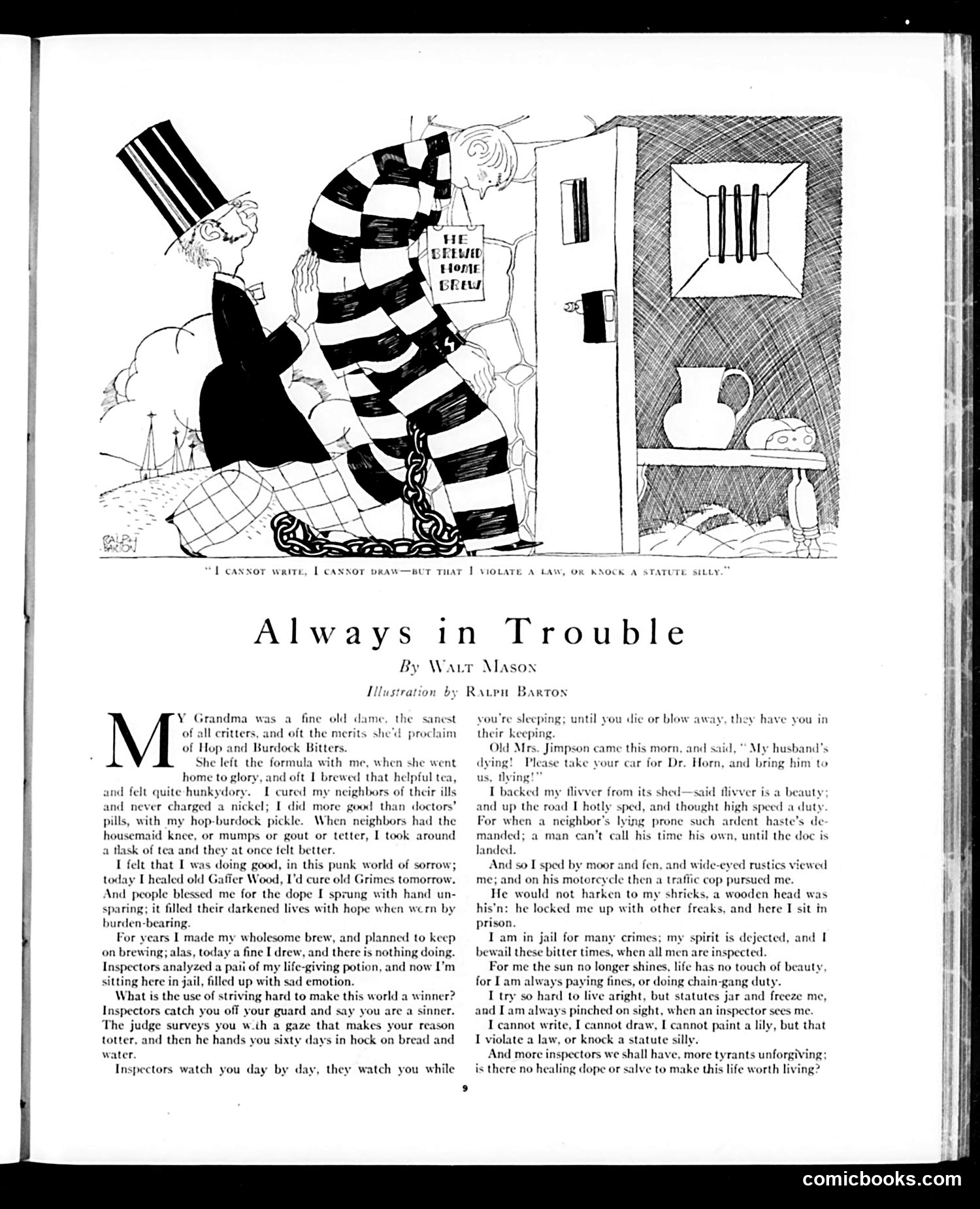
This story by Walt Mason satirizes excessive government regulation and the proliferation of inspectors in early 20th-century America. The protagonist describes his troubles: he's jailed for making homemade herbal remedies (once-legal folk medicine that now violates food and drug laws), imprisoned for speeding to help a dying neighbor, and constantly harassed by authorities for minor infractions. The cartoon's imprisoned figure in striped clothing represents the common citizen trapped by bureaucratic overreach. Mason's complaint is that modern life has become impossible—even well-intentioned actions (healing neighbors, rushing to medical emergencies) now violate some statute. The refrain "I cannot write, I cannot draw...but that I violate a law, or knock a statute silly" captures the frustration that ordinary life itself has become criminalized. This reflects Progressive Era anxieties about government expansion, food safety regulations (following the 1906 Pure Food and Drug Act), and traffic enforcement—seen here as intrusive rather than protective.
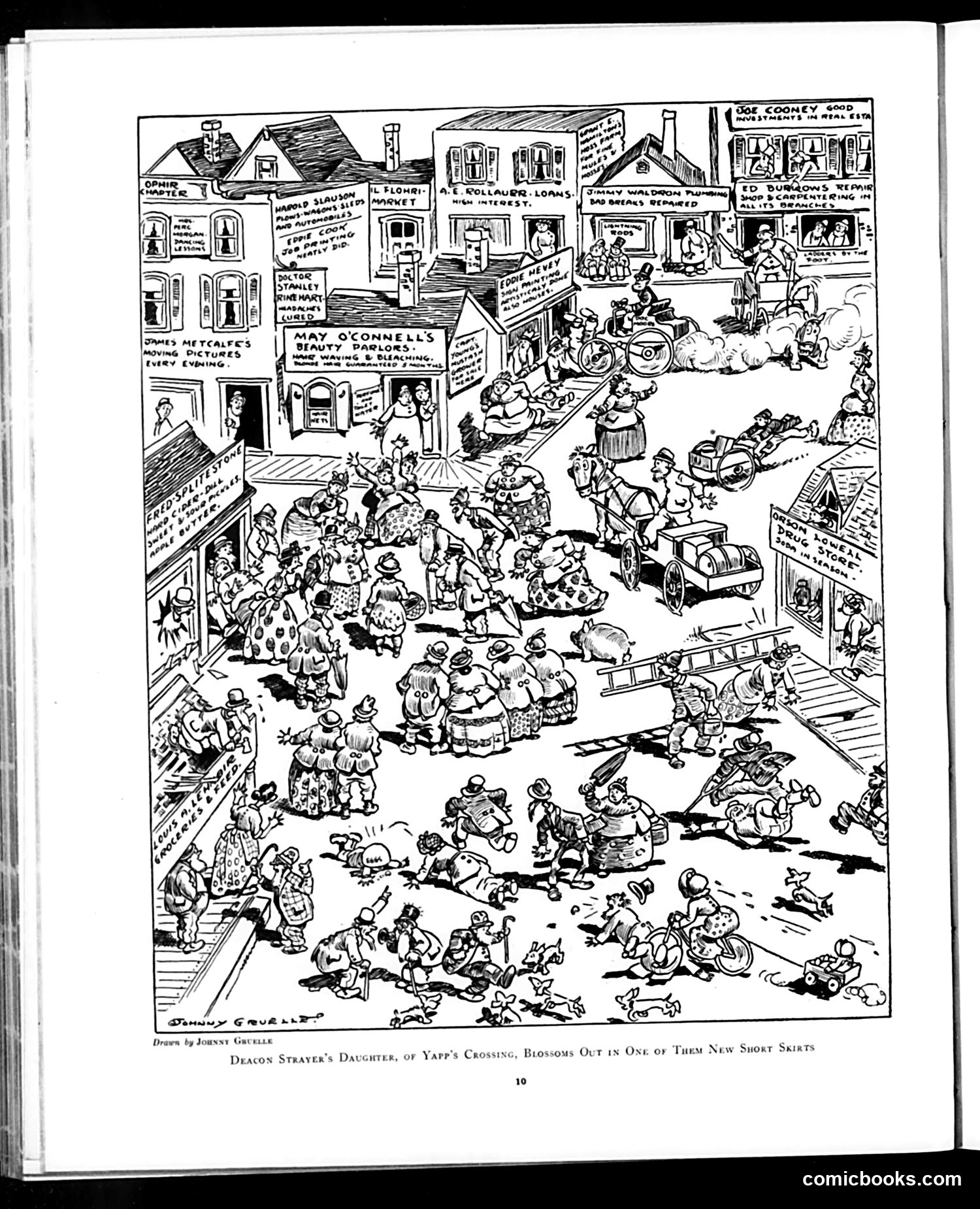
This is a densely packed satirical cartoon depicting a chaotic street scene, drawn by Johnny Gruelle for *Judge* magazine. The caption references "Deacon Strayer's Daughter" and "Yapp's Crossing," suggesting it satirizes small-town American life and social pretensions. The scene shows numerous townspeople, children, and businesses in apparent disorder. Visible storefronts include real estate offices, beauty parlors (advertising "waving & bleaching"), and loan companies—suggesting satire on commercialism and get-rich-quick schemes targeting ordinary citizens. The "short skirts" reference in the caption indicates contemporary anxiety about changing women's fashion and social norms of the era. The cartoon likely mocks small-town society's simultaneous embrace of modern commercial ventures and moral anxieties about changing social values, particularly regarding women's appearance and independence. The crowded, frenetic composition emphasizes chaos masquerading as progress and respectability.
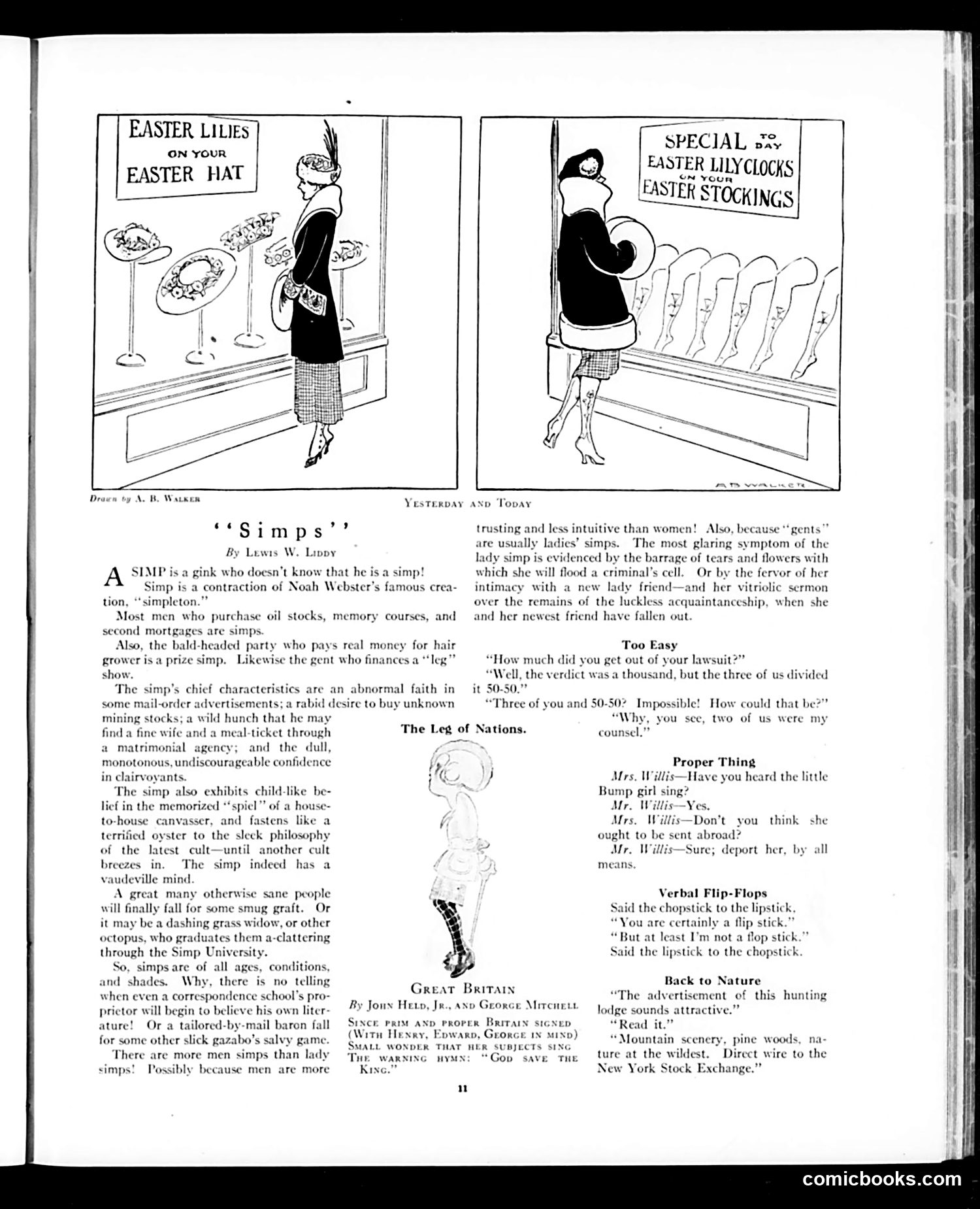
This page contains two Easter-themed cartoons (upper section) and several humorous columns about social types. **The Cartoons:** Two women window-shop at Easter displays—one admiring Easter lilies for hats, the other eyeing Easter clocks for stockings. The satire mocks consumerism and frivolous spring shopping among women. **"Simps" Column:** Defines a "simp" (simpleton) as a gullible person who falls for scams: oil stocks, mail-order schemes, hair-growth products, and matrimonial agencies. It satirizes both genders but claims men are more susceptible than women to fraud and dubious "cults." **Other Pieces:** Brief humor columns mock common social pretenses—a woman wanting to deport a bad singer, a lawsuit settlement joke, and an advertisement for a hunting lodge that advertises its proximity to the New York Stock Exchange (mocking the obsession with finance even in nature). The page satirizes early 20th-century consumer culture, financial schemes, and the era's gender stereotypes around shopping and gullibility.
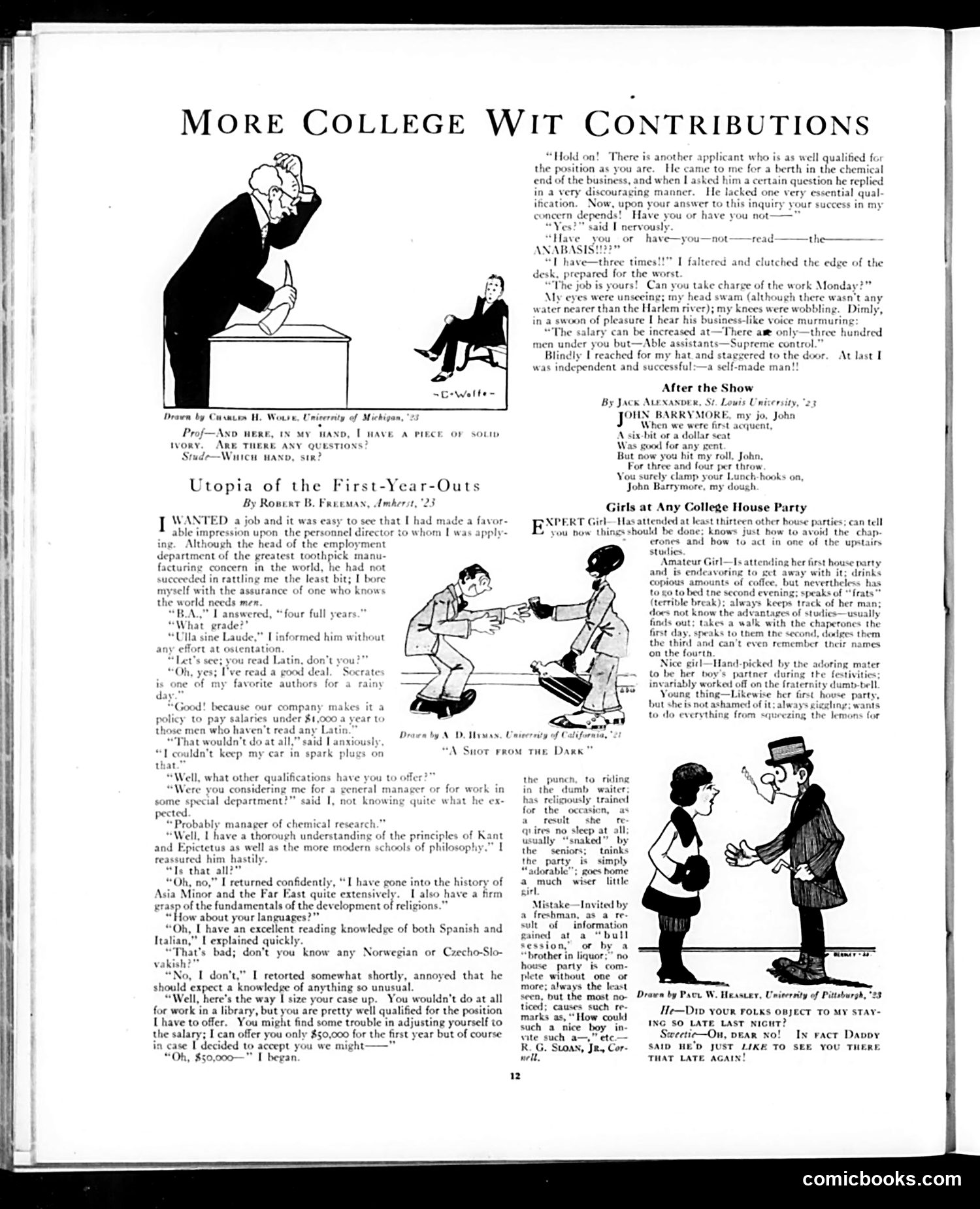
This page from *Judge* magazine satirizes college graduates entering the job market, likely from the 1920s. **"Utopia of the First-Year-Outs"** mocks overconfident, over-educated young men. The protagonist boasts of knowledge in Latin, philosophy, Asian history, and languages. The hiring manager tests him on increasingly irrelevant skills, ultimately offering him an absurdly high salary ($50,000) only because he has read Xenophon's *Anabasis*—a classical text with no practical business value. The satire: college education emphasizes impractical humanities while employers arbitrarily reward it. The young man's collapse into delighted shock at the "success" underscores the disconnect between education and actual workplace need. The cartoon above shows a professor asking which hand holds "solid ivory"—likely mocking academic pedantry or tricks. Other pieces reference college social life (parties, dating) and post-graduation experiences, maintaining the theme of young college graduates navigating early adulthood.
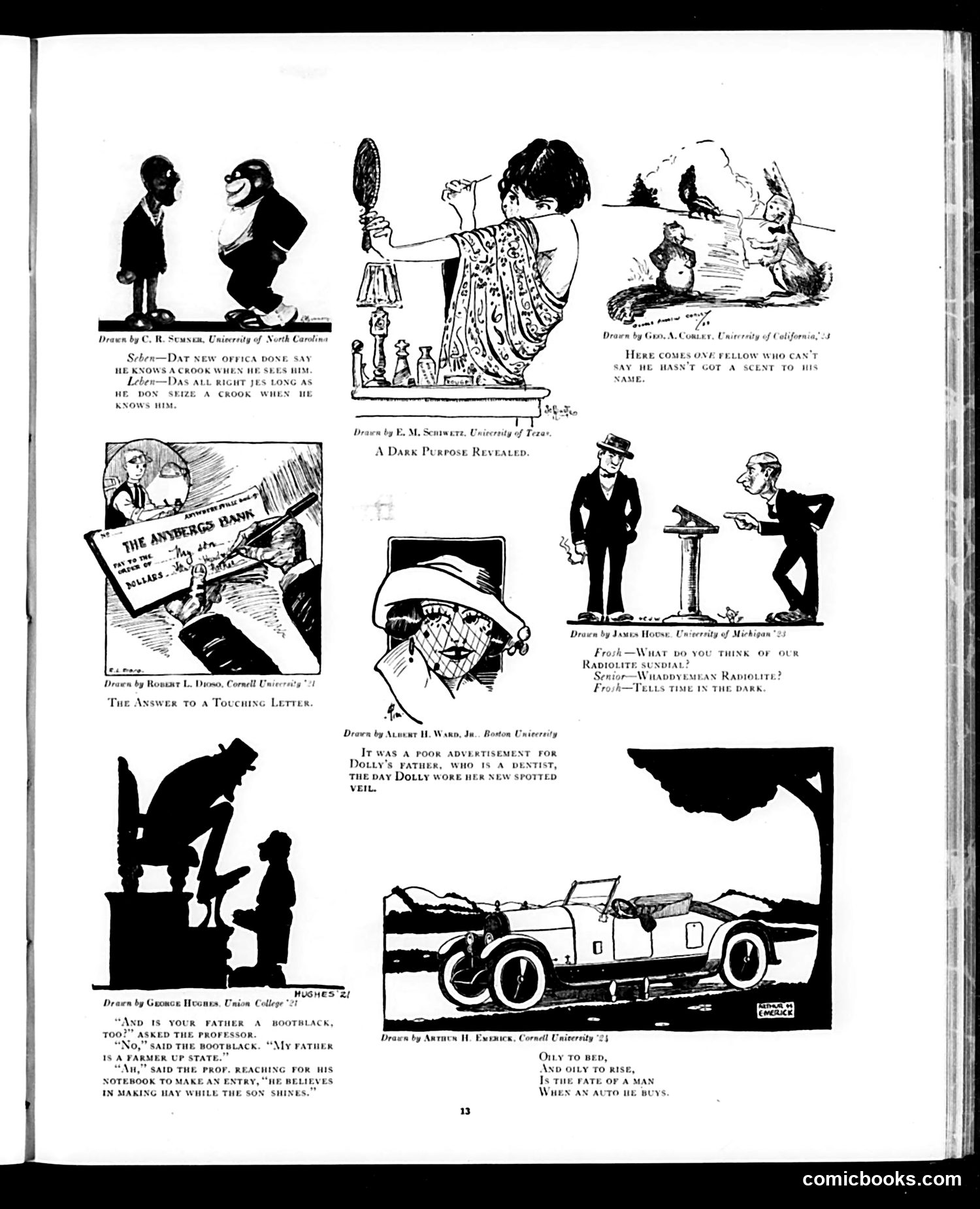
This page collects student-drawn satirical cartoons from American universities, typical of Judge's humor circa early 1900s. **Key cartoons:** 1. **Top left**: Police/detective joke—one officer claims he "knows a crook when he sees him," while the other notes he only recognizes crooks when actually catching them. Social commentary on police incompetence. 2. **Center**: Woman with mirror reflecting tiny figures—a "scent" pun suggesting someone lacks personality or presence worth remarking on. 3. **Bottom left**: "Touching Letter" cartoon with unclear reference but appears to satirize sentimental correspondence. 4. **Right side**: Two recurring joke types—one about a "radiolite" (early radiation-related gadget, likely satirizing pseudoscience fads), another about a dentist father whose daughter's spotted veil makes poor advertisement for his profession. 5. **Bottom**: Classic class-commentary joke—professor congratulates a bootblack's farmer father for "making hay while the son shines" (wordplay on "sun"). 6. **Final cartoon**: Automobile death joke—grim humor about car fatalities. The page reflects early 20th-century anxieties about technology, class, and social pretension.
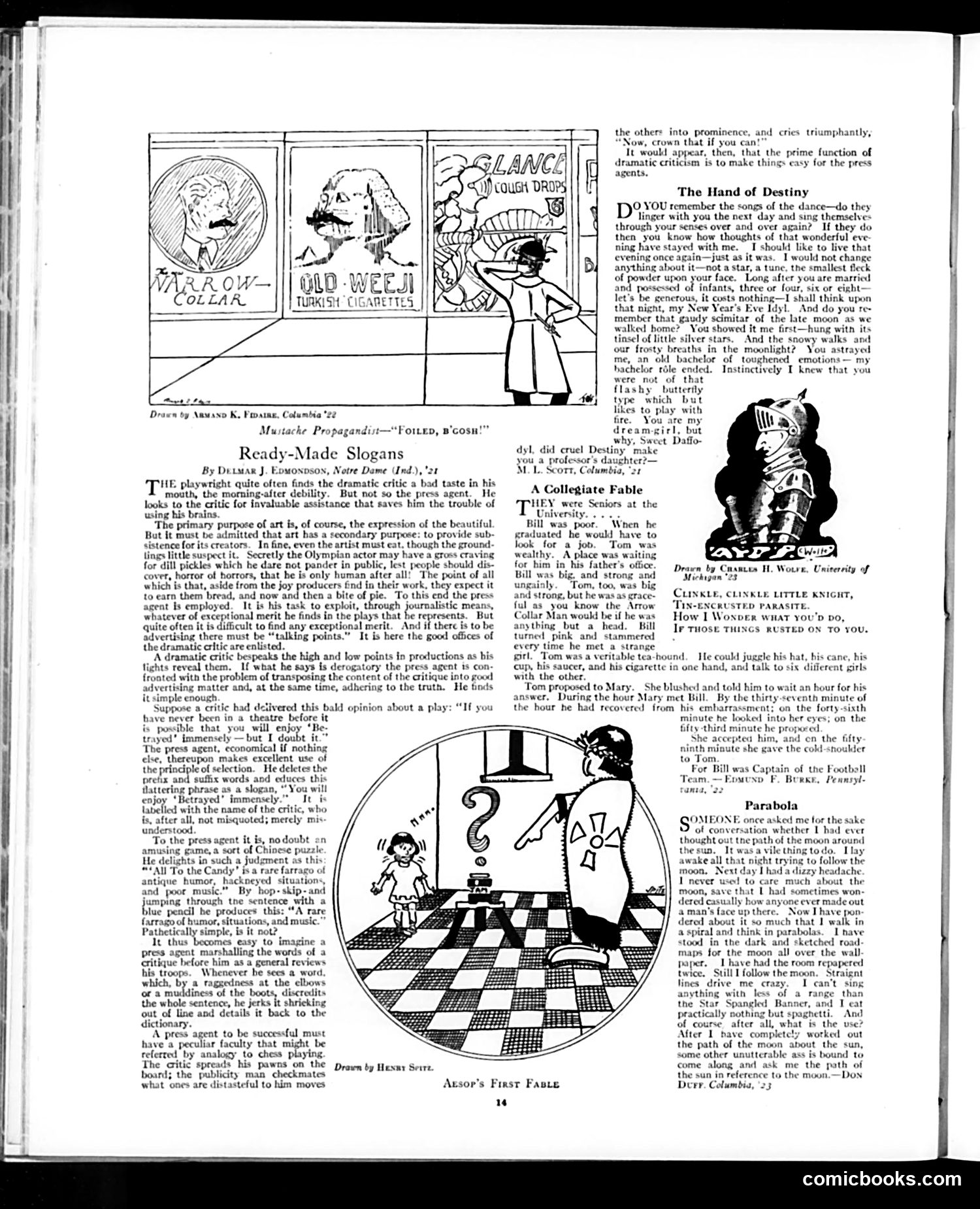
**Top Cartoon ("Mustache Propagandist")**: This appears to be satirizing cigarette advertising and propaganda. The panels show vintage Turkish cigarette brands ("Marrow Collar," "Old Weeji") with an exaggerated mustachioed figure. The satire mocks how advertising creates false impressions—suggesting that cigarette ads promise sophistication or masculinity through absurd visual claims. **Main Article ("Ready-Made Slogans")**: This is a commentary on press agents manipulating theater critics' reviews for advertising. The author explains how press agents quote critics selectively—removing negative qualifiers to make bad reviews sound positive. For example, a critic's "You will enjoy it, but I doubt it" becomes merely "You will enjoy it." It's satirizing the deception in theatrical promotion and how the press manufactures false endorsements through dishonest editing. The piece critiques both the theatrical establishment's promotional practices and suggests critics sometimes unknowingly enable this manipulation.
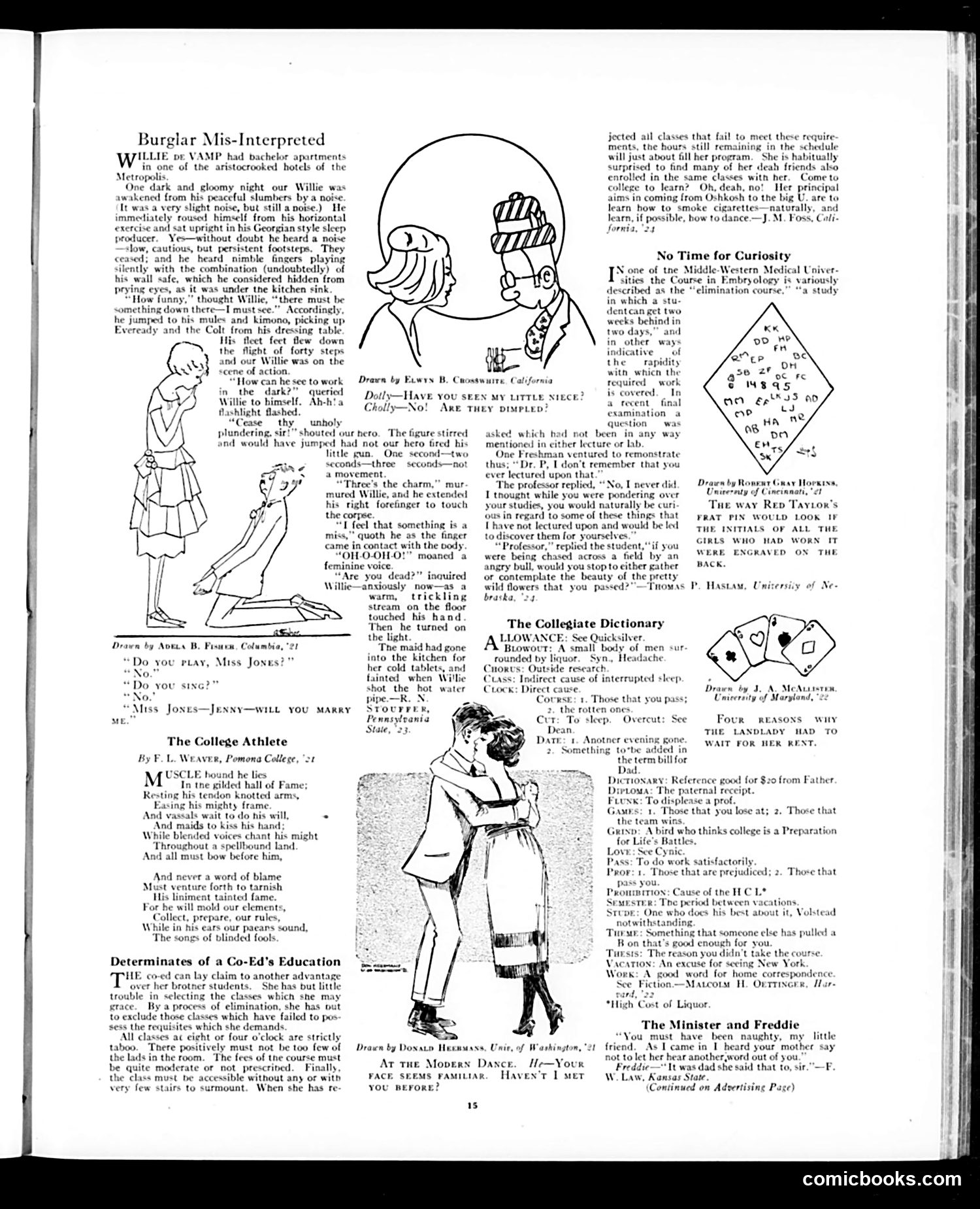
This page from *Judge* magazine contains satirical college humor pieces typical of the 1920s era. The main cartoon "Burglar Mis-Interpreted" depicts a young man named Willie who awakens to sounds of a break-in at his apartment. Armed with a flashlight and gun, he confronts an intruder at his wall safe (hidden "under the kitchen sink"). After firing three shots, Willie discovers his victim is actually the maid who fainted from the shock—he had shot the hot water pipe, not a person. The joke satirizes wealthy young men's overconfidence and poor judgment. Supporting pieces mock college life: "The College Athlete" celebrates muscular campus heroes, while "The Collegiate Dictionary" humorously defines college terms like "blowout" (drinking party), "crook" (interrupted sleep), and "cut" (sleeping). "Determinates of a Co-Ed's Education" satirizes how female students prioritize social activities (smoking, dancing, flirting) over academics. The humor reflects 1920s student culture and Jazz Age attitudes toward education and propriety.
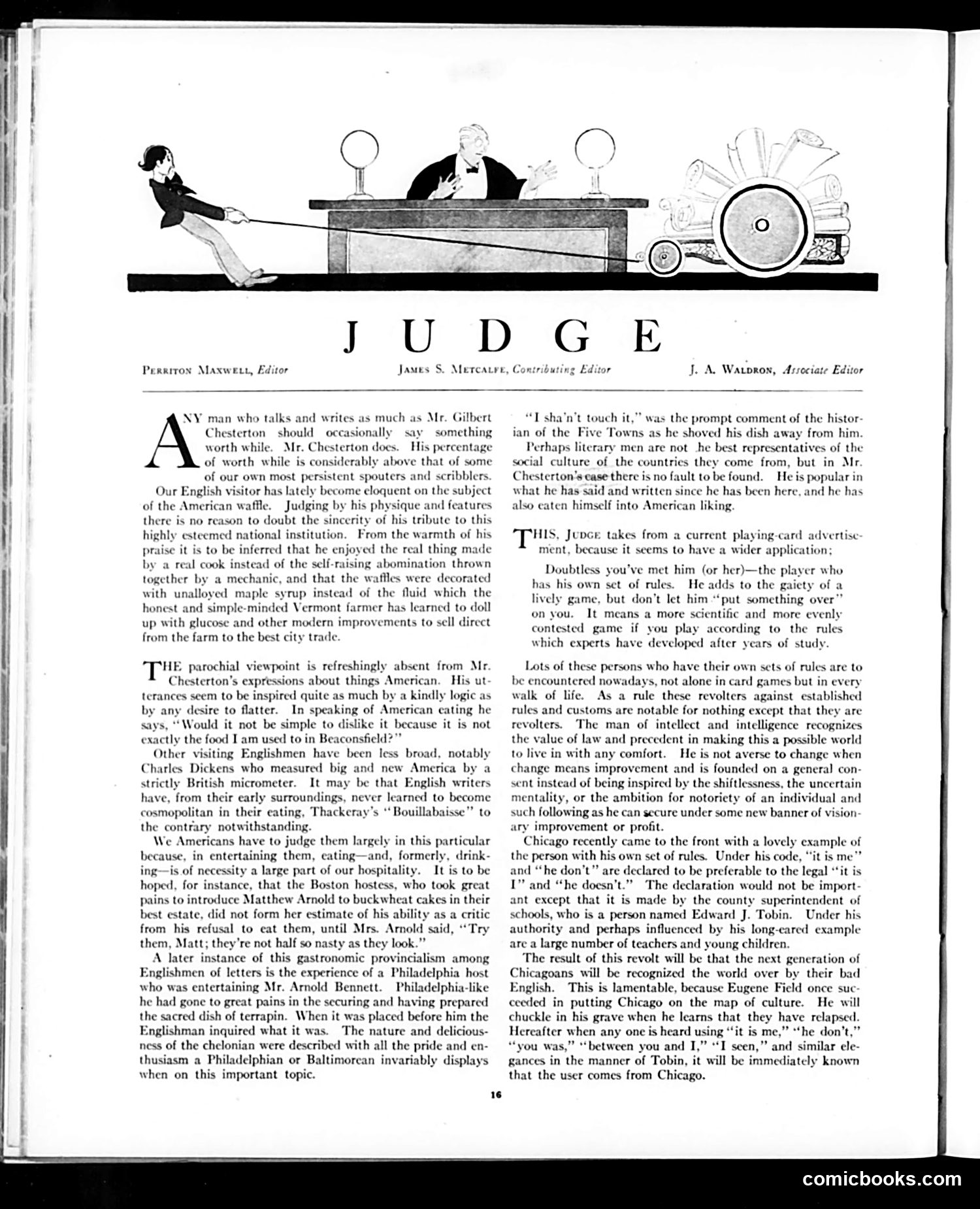
This page contains a text essay titled "Judge," not primarily a political cartoon. The masthead illustration shows a figure being pulled by another, metaphorically representing "judgment" as a force. The essay discusses **G.K. Chesterton**, the British writer visiting America. The author praises Chesterton for making fair observations about American culture (particularly American waffles and food) without the narrow-mindedness shown by previous English visitors like Charles Dickens and Arnold Bennett. The satire targets **provincial English intellectuals** who judge America by British standards and refuse unfamiliar foods—Bennett infamously rejected terrapin, a regional delicacy. Chesterton, by contrast, approached America with openness and "kindly logic," earning American appreciation. The secondary essay references a playing-card advertisement to satirize people who impose their own rules in games rather than following established expert guidelines—a metaphor for maintaining social standards. The page reflects early 20th-century transatlantic cultural tensions and American sensitivity to foreign criticism.
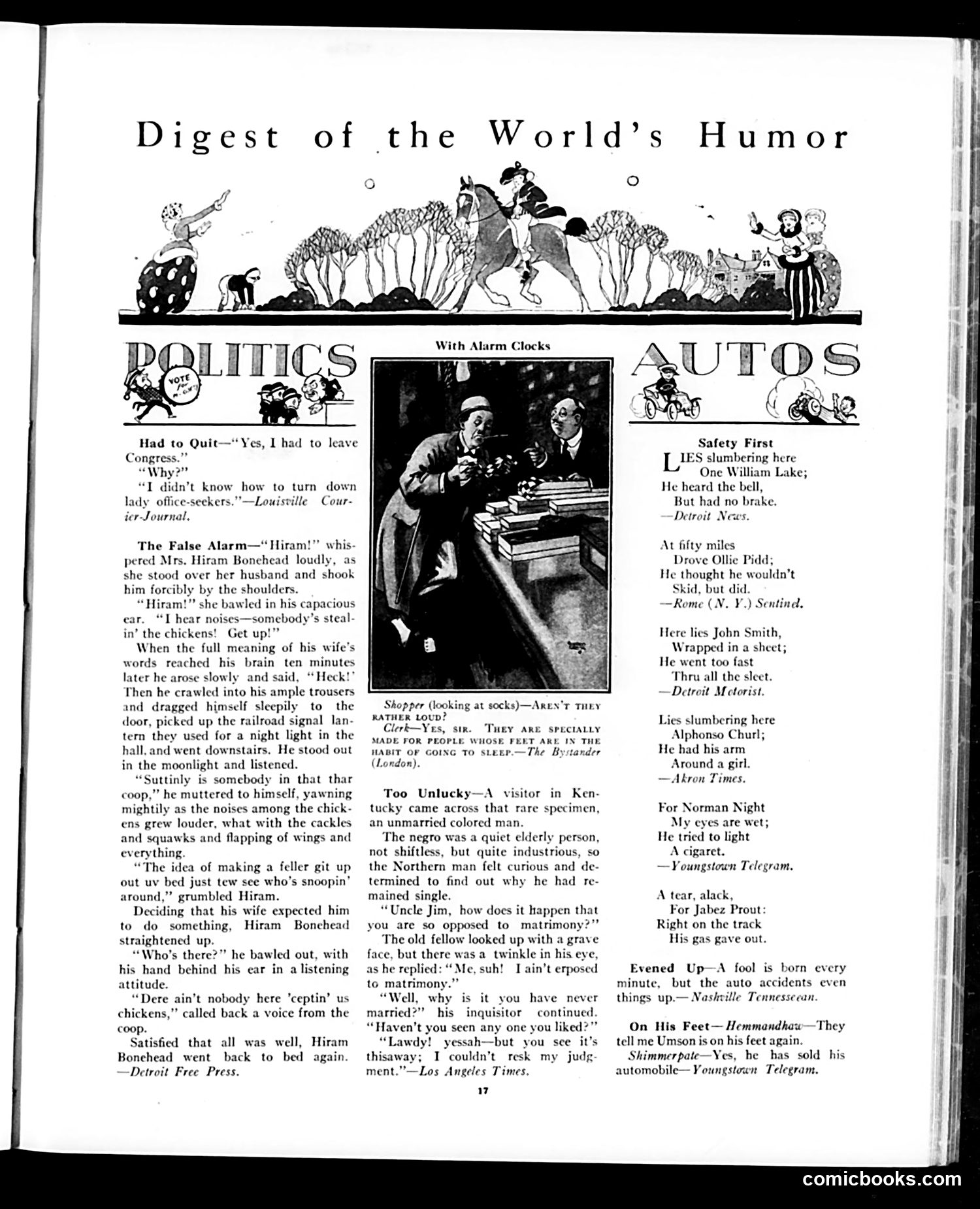
This page collects various humorous anecdotes and satirical pieces typical of early 20th-century Judge magazine. **"The False Alarm"** mocks rural/working-class characters through the bumbling Hiram Bonehead, who responds to his wife's chicken-theft alarm only to discover it's just the chickens themselves. The satire targets both rural dialect and the absurdity of the false panic. **"Politics"** references office-seekers (likely women seeking government positions), satirizing the speaker's inability to refuse them—a commentary on patronage and lobbying pressures. **"Autos"** section contains mock epitaphs for automobile accident victims, satirizing the danger and prevalence of early car crashes. These dark humor pieces mock both reckless drivers and the era's rapid motorization. **"Too Unlucky"** presents dialect humor involving a Black character explaining why he's never married, relying on period racial stereotypes common to the era's "humor." The page reflects Judge's focus on social commentary through gentle mockery of rural life, bureaucratic inefficiency, and modern technology's dangers.
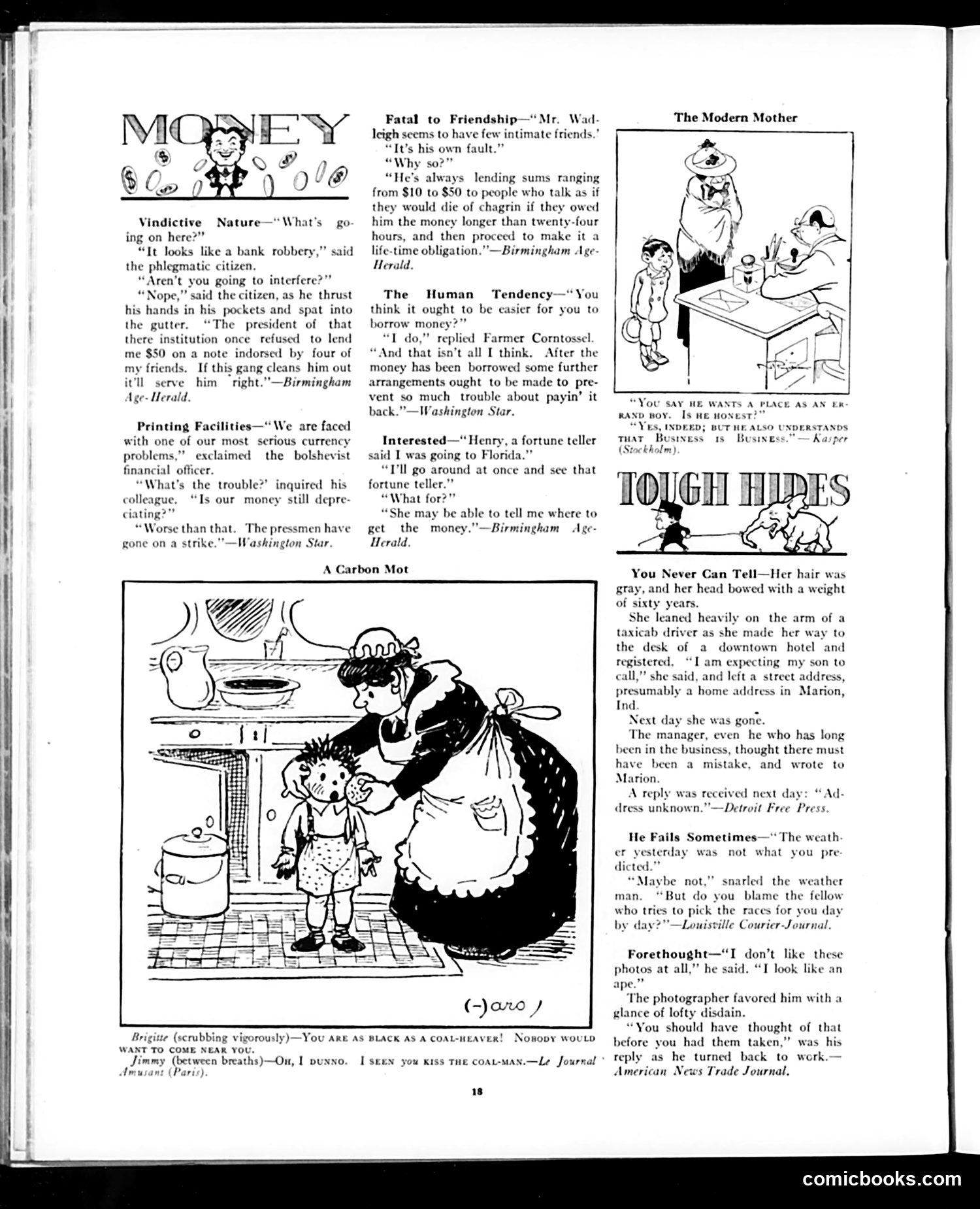
This page contains satirical commentary on early 20th-century American social and economic issues through short jokes and cartoons. **Key satirical targets include:** - **Banking and finance**: A man refuses to stop a bank robbery because the bank president previously denied him a loan—critiquing both personal grudges and financial institutions' indifference to ordinary citizens. - **Labor strikes**: A Bolshevik financial officer worries about currency depreciation caused by pressmen striking—mocking communist economic management and labor unrest. - **Personal finance**: Multiple jokes lampoon Americans' borrowing habits and attitudes toward debt repayment, suggesting widespread financial irresponsibility. - **Class attitudes**: "The Modern Mother" and related pieces satirize social pretense and business ethics among working and middle classes. The cartoons use working-class characters (a maid, farmers, hotel workers) to highlight everyday economic struggles and moral compromises of the era. The humor targets both ordinary citizens' financial desperation and institutional indifference.
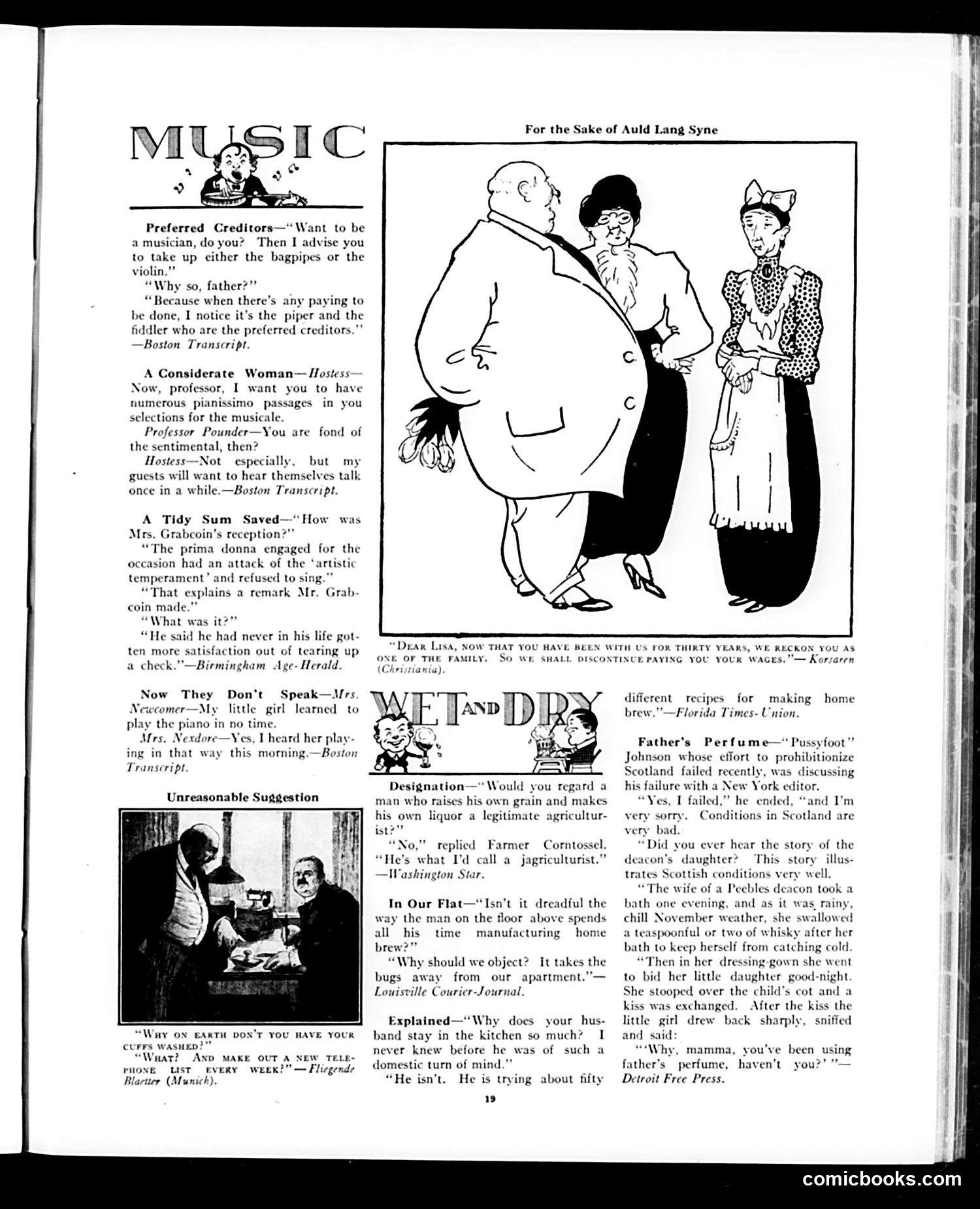
This page contains several short humorous anecdotes satirizing early 20th-century American social conventions and domestic life. **Key targets of satire:** 1. **Musicians as poor creditors**: The opening joke mocks musicians (pipers, fiddlers, violinists) as financially unreliable, suggesting they're preferred creditors only because they're owed so little money. 2. **Domestic musicales**: A hostess requests quiet piano passages—not for artistic reasons, but so guests can hear themselves gossip, satirizing the performative nature of upper-class social gatherings. 3. **Long-suffering servants**: The cartoon depicts a domestic worker told she won't be paid after 30 years of service, labeled "For the Sake of Auld Lang Syne"—a cutting critique of employer exploitation using sentimental language. 4. **Prohibition**: "Pussyfoot" Johnson (a real prohibition advocate) is mocked for his failed effort to prohibitionize Scotland, with a joke implying Scottish reliance on whisky as medicine. The page satirizes class relations, musical pretension, and prohibition-era attitudes.
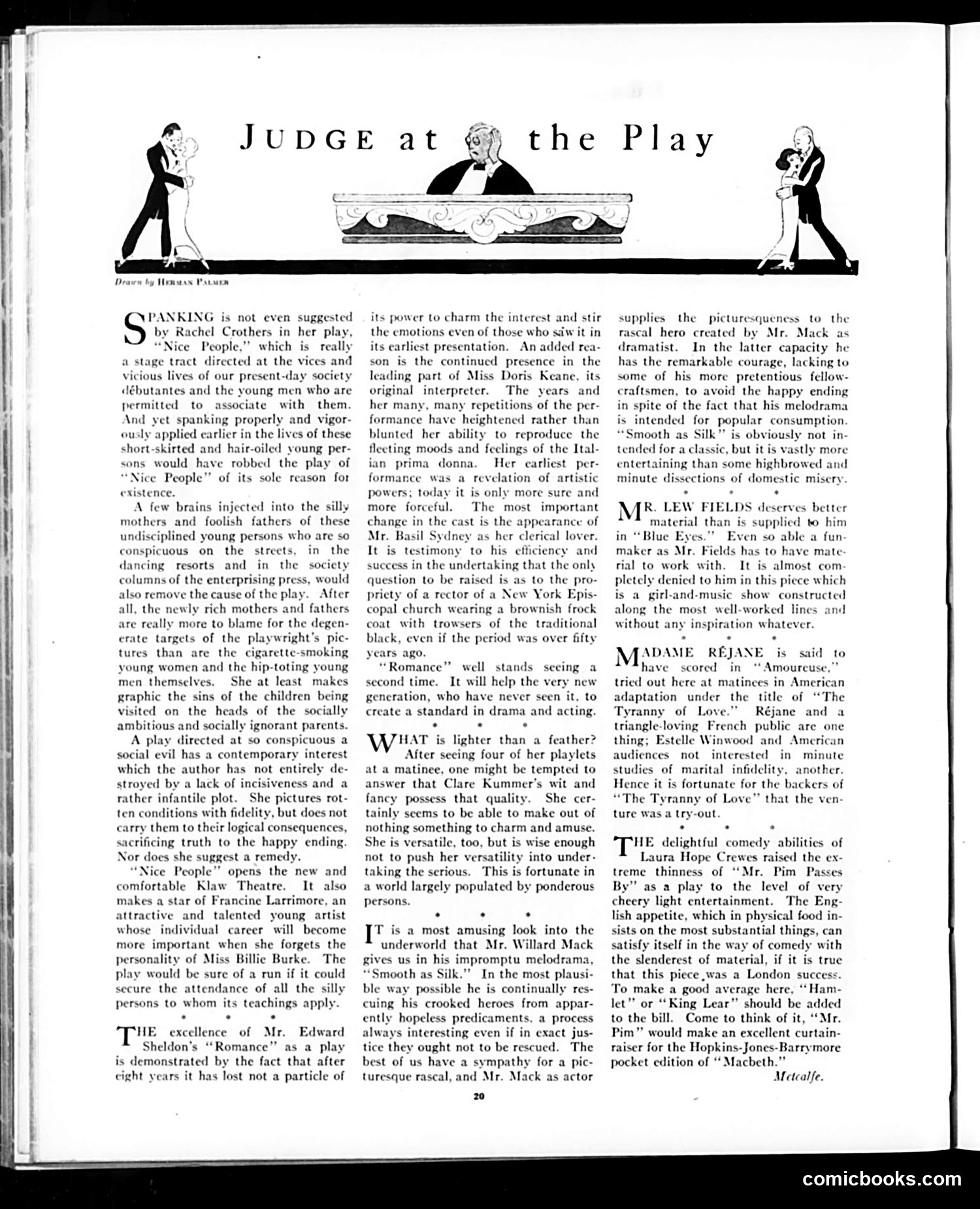
This page from *Judge* magazine contains theater reviews rather than political cartoons. The header illustration shows a "Judge at the Play"—a stern judicial figure evaluating theatrical productions. The reviews critique contemporary Broadway plays: Rachel Crothers's *"Nice People"* (criticized for depicting moral decay among wealthy young people and their negligent parents, yet offering no remedy); Edward Sheldon's *"Romance"* (praised for retaining power after eight years, particularly through Doris Keane's continued performance); and Clare Kummer's playlets (admired for witty charm). References to "short-skirted" young women and "hip-toting" men reflect 1920s concerns about Jazz Age morality. The reviews reveal *Judge's* conservative stance: blaming parental indulgence and "newly rich" social climbers for society's decay, while praising serious dramatic art that maintains standards.
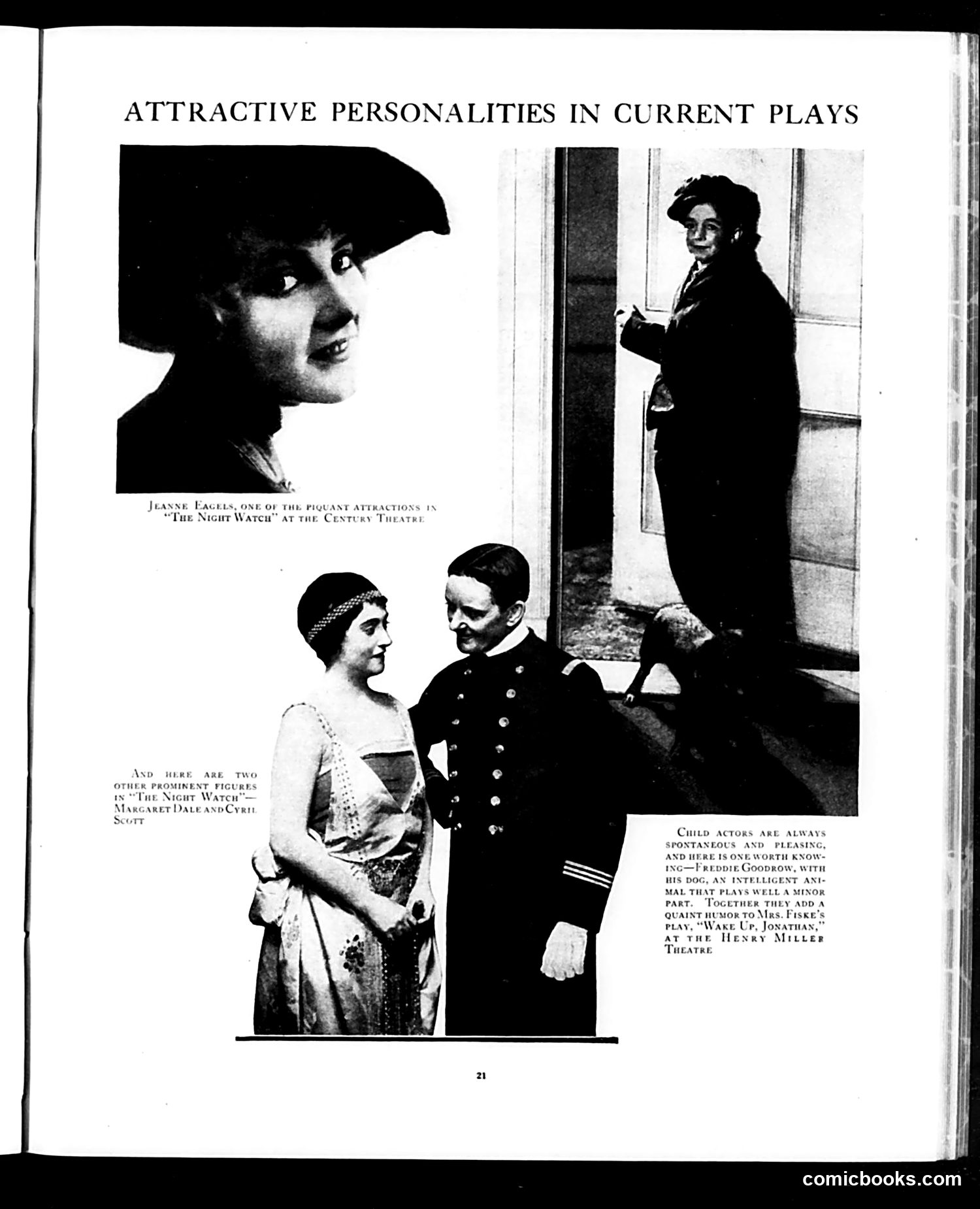
This is a theatrical feature page, not political satire. Judge magazine showcases Broadway performers from three productions: Jeanne Eagels from "The Night Watch" at the Century Theatre; Margaret Dale and Cyril Scott, also from "The Night Watch"; and child actor Freddie Goodrow with his dog from Mrs. Fiske's play "Wake Up, Jonathan" at the Henry Miller Theatre. The page celebrates these actors as entertainment personalities drawing audiences. The note about Goodrow emphasizes how child performers and animal actors add "quaint humor" to productions—reflecting early 20th-century theater's appeal. This is essentially theatrical promotion and celebrity coverage rather than satirical commentary.
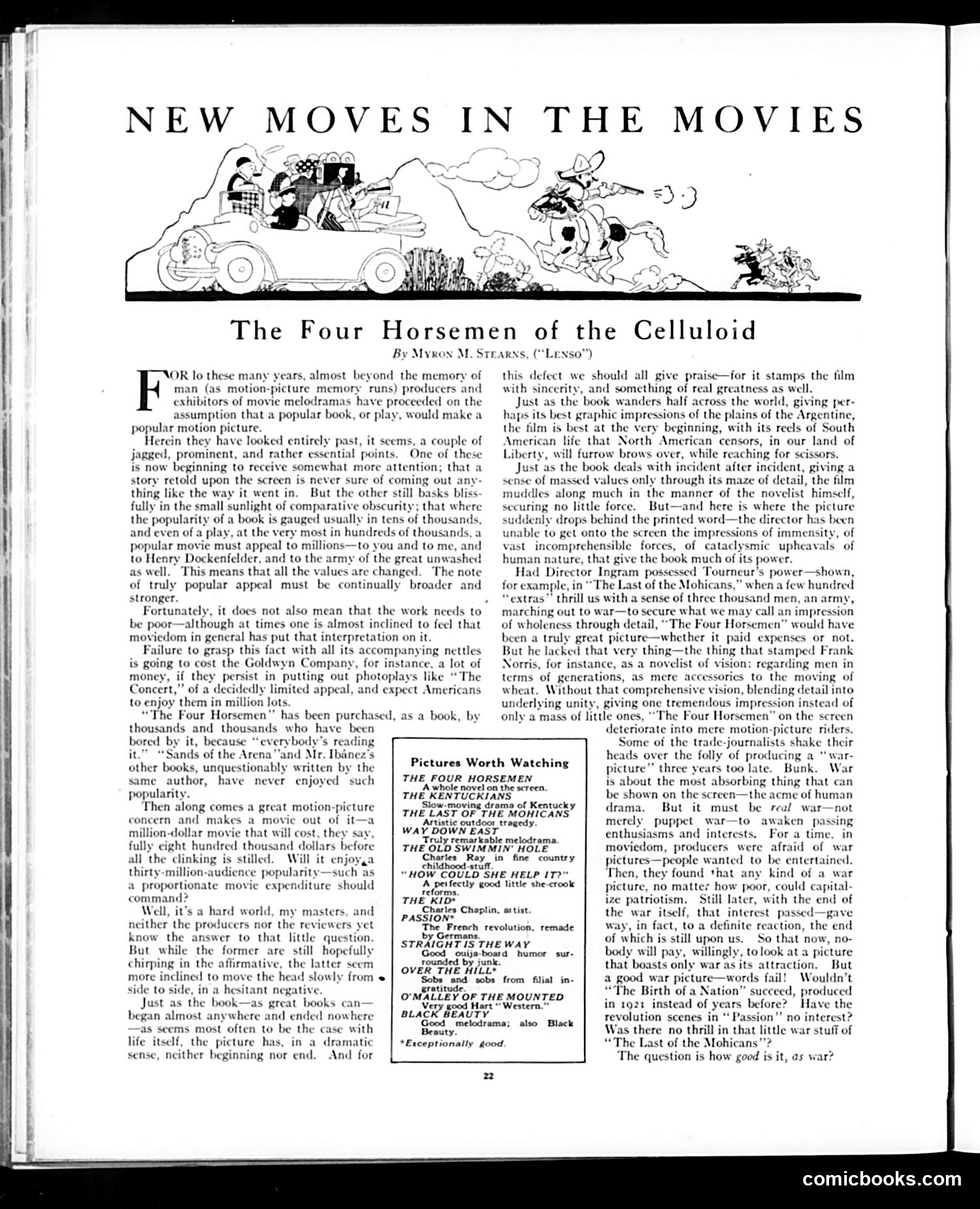
This is a lengthy film criticism essay, not a political cartoon. The author (Myrow M. Stearns) analyzes Hollywood's assumption that popular books automatically make popular movies. **Main argument:** The film industry fails to account for a crucial difference—books appeal to thousands, but movies must appeal to *millions*. This requires broader, stronger popular appeal, not just faithful adaptation. **Specific case study:** "The Four Horsemen" (likely the 1921 Valentino film), purchased as a book by thousands who found it boring but read it because "everybody's reading it." The studio spent $800,000 expecting massive box-office success, but the critic questions whether it will achieve the 30-million-person audience such expenditure warrants. **The critique:** The film, like the novel, lacks dramatic structure—no clear beginning or end. However, the critic praises its sincerity and occasional visual power, particularly early scenes depicting Argentine plains. The sidebar lists other contemporary films worth watching, using brief evaluative labels ("Exceptionally good," "Good melodrama," etc.).
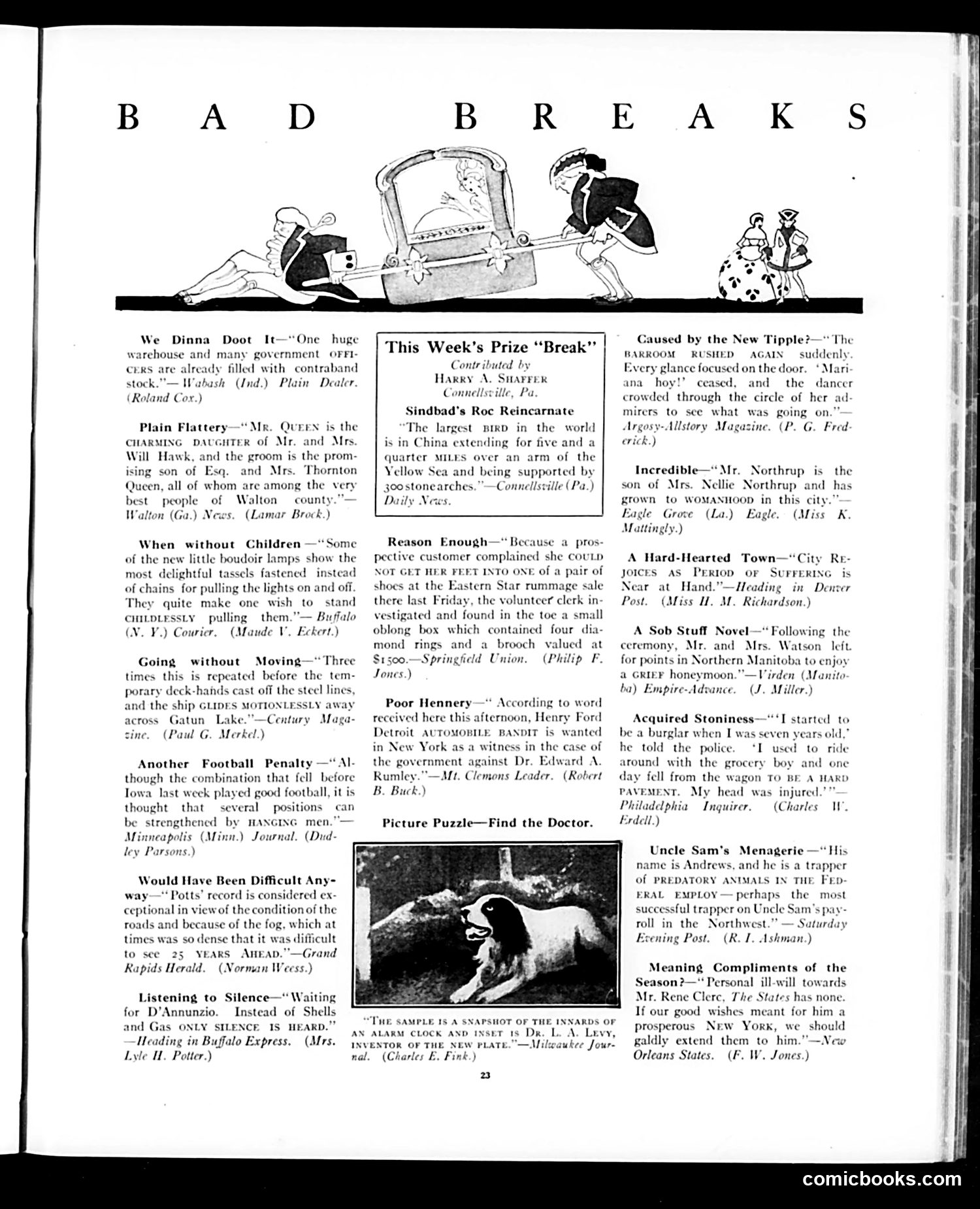
This is a humor page from *Judge* magazine featuring satirical "breaks"—embarrassing typographical or editorial errors from newspapers. The cartoons mock absurd phrasing that results from poor word placement or omission. The top illustration shows people comically struggling with a large trunk, visualizing the phrase "bad breaks." The entries are brief jokes highlighting unintentional humor. Examples include: - A piece about temporary dock workers that accidentally reads "the ship glides motionlessly away" (contradictory phrasing) - A football story suggesting players be "strengthened by hanging men" (darkly unintended) - A shoe sale story where someone couldn't fit her "feet into" a box, making it sound absurd - A honeymoon described as a "grief honeymoon" (tragic wordplay) These are contemporary American newspaper mistakes, likely from 1910s-1920s publications, where editors' carelessness created unintentionally funny or disturbing meanings. The satire targets poor proofreading and editorial oversight in daily journalism—a timeless source of amusement.
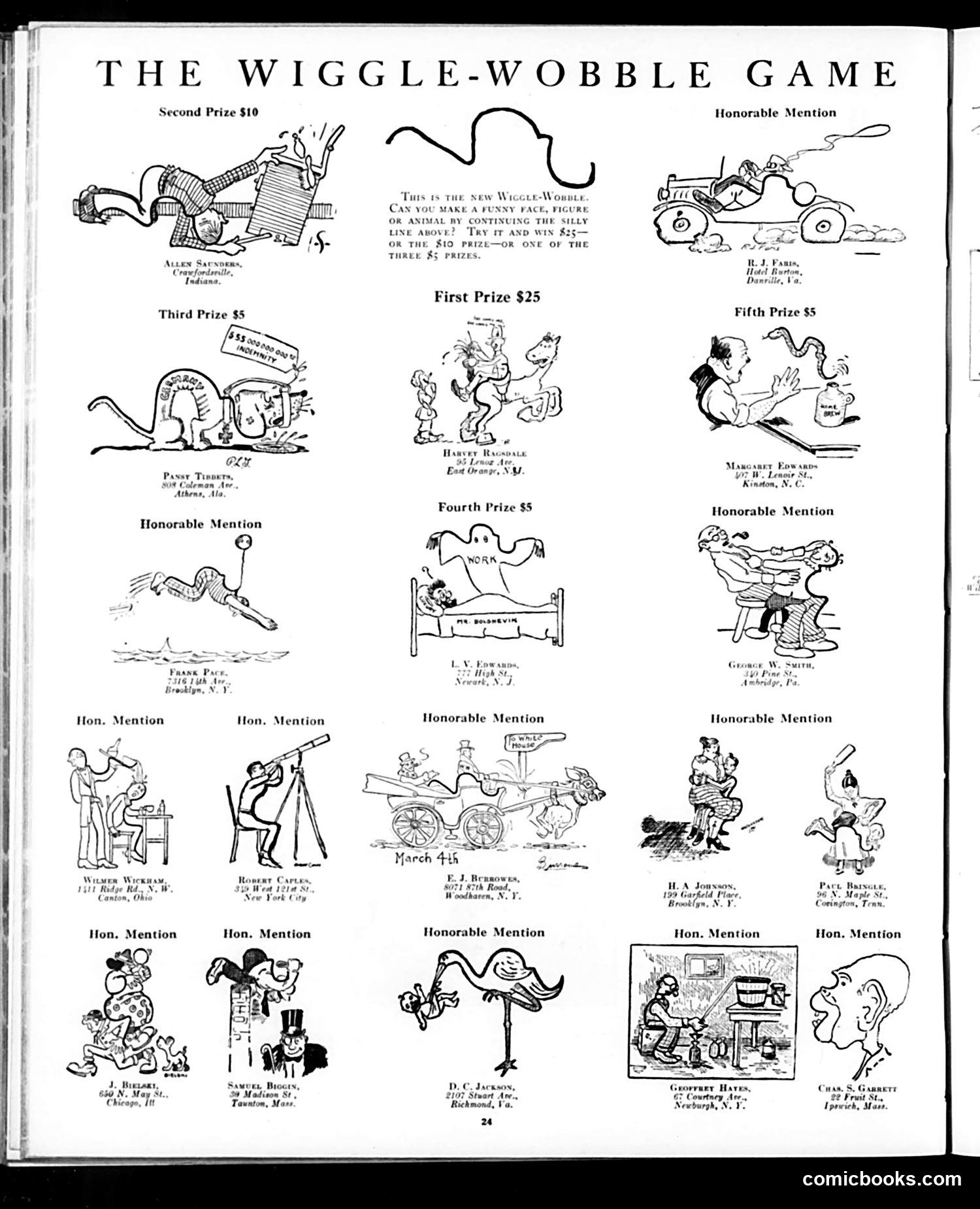
This page presents a drawing contest from *Judge* magazine where readers completed abstract squiggly lines to create funny faces, figures, or animals. Winners received cash prizes ($25 first prize, down to $5 honorable mentions). The page displays winning entries—cartoons completed by amateur artists from various American cities. The submissions show how readers transformed simple curved lines into humorous drawings: a person falling, animals, caricatured figures, and absurd scenarios. This was a popular participatory feature in early 20th-century magazines, engaging readers as amateur artists and allowing *Judge* to crowdsource entertaining content while building audience investment. The named winners suggest this was a genuine contest, not merely fictional, rewarding creative public participation in the magazine's satirical tradition.
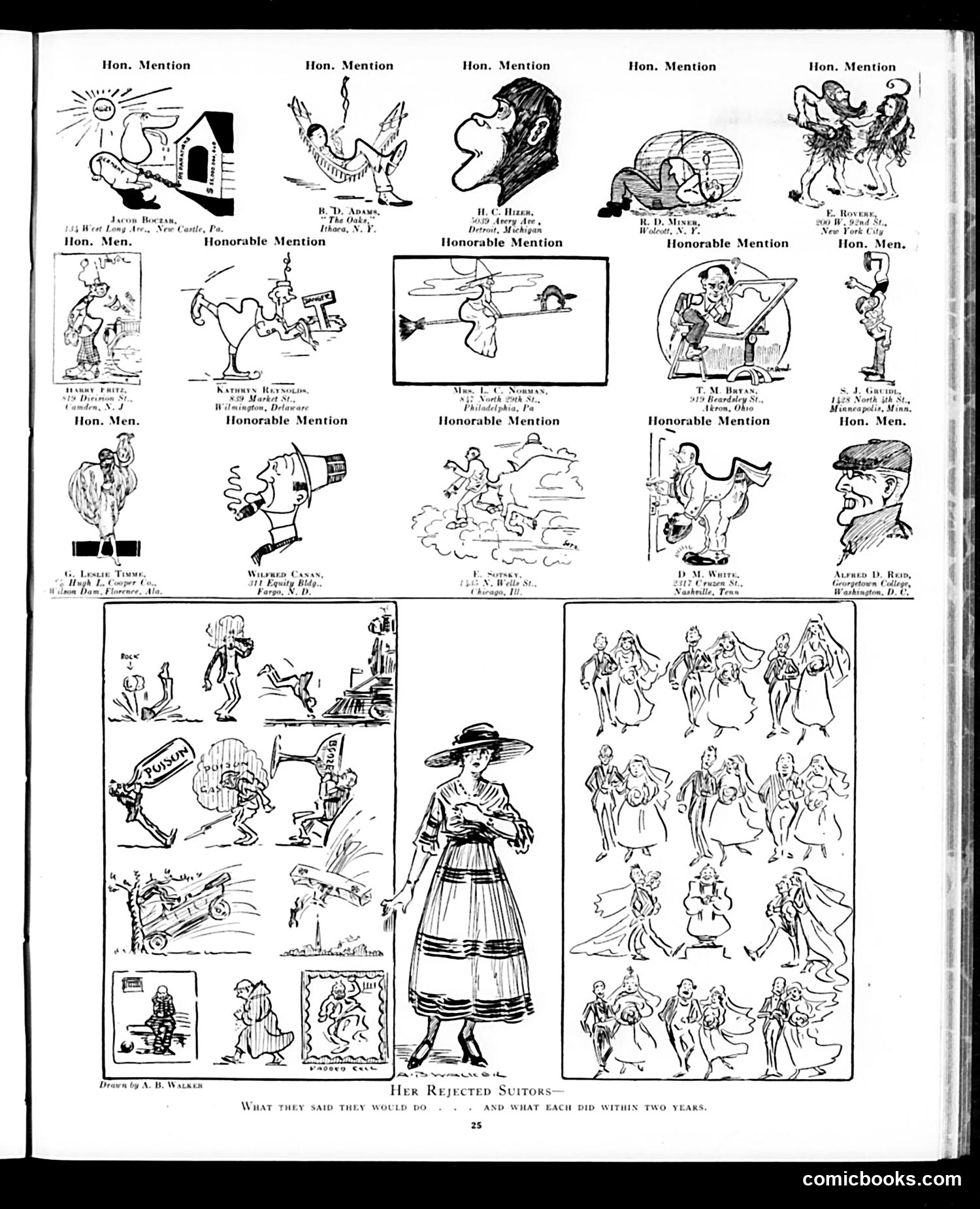
This page features "Honorable Mention" cartoons—entries in what appears to be a satirical contest about rejected suitors. The central illustration shows a woman in fashionable dress, surrounded by smaller sketches depicting men's broken promises. The satire mocks men who court women while making grand declarations about their future accomplishments, then fail to deliver within two years. The contrasting panels—labeled "What they said they would do" versus "what each did within two years"—reveal the gap between male boasting and actual achievement. This reflects early 20th-century social commentary about courtship expectations and male unreliability. The cartoons ridicule suitors' grandiose claims about becoming successful, wealthy, or accomplished, exposing how romantic promises often evaporate after marriage or rejection. The page contains multiple individual cartoons by various artists, all contributing to this theme of male pretension and disappointment.
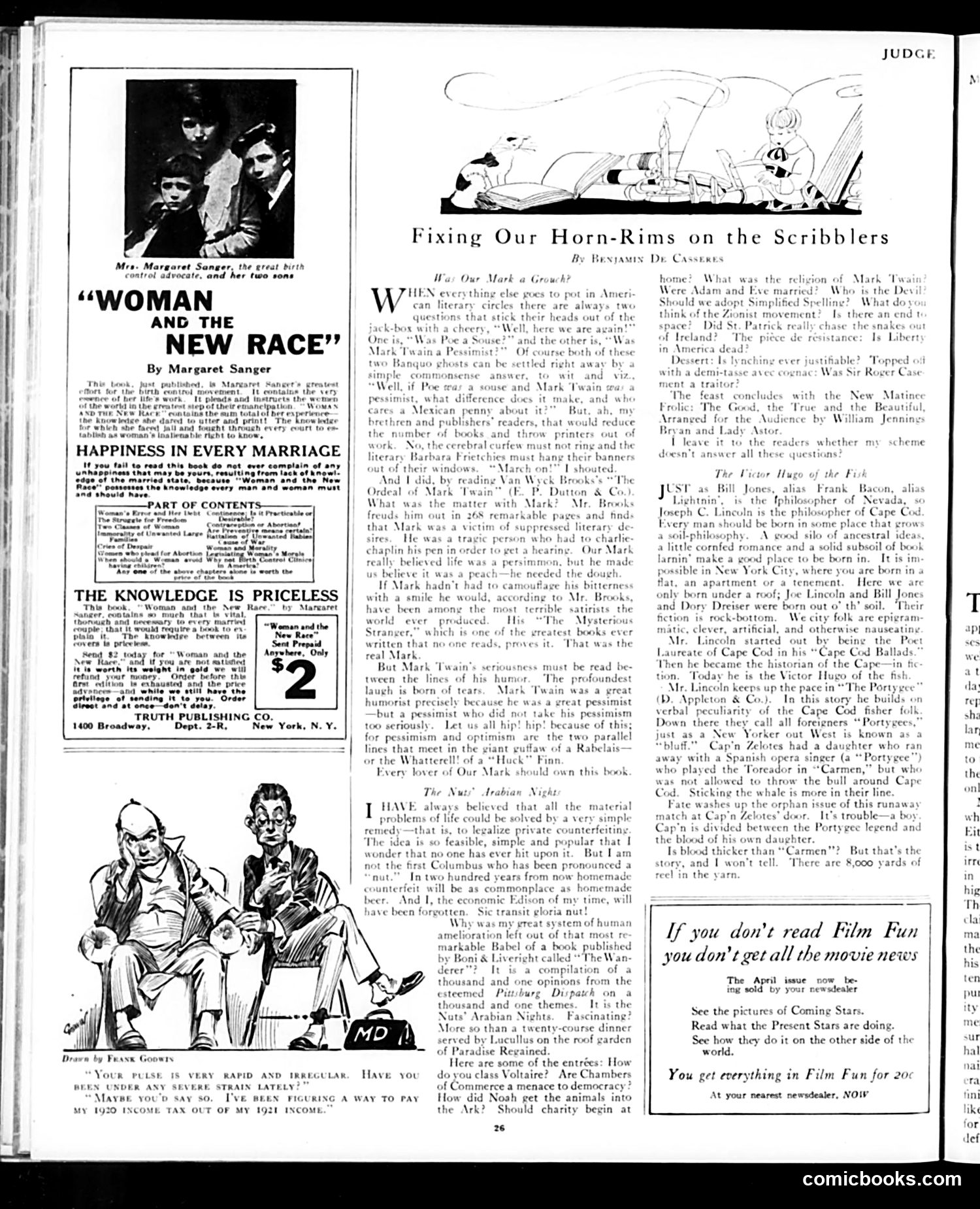
This page satirizes intellectuals and literary figures who pontificate about serious social questions. The main cartoon by Frank Goodwin depicts a doctor examining a patient with an irregular pulse. The patient explains he's been "figuring [his] 1920 income tax out of [his] 1921 income"—a joke about financial/bureaucratic confusion causing anxiety. The accompanying article "Fixing Our Horn-Rims on the Scribblers" mocks writers (particularly Mark Twain) who wade into complex debates: What caused World War I? Should charity exist? Was Voltaire a pessimist? The satire suggests these literary figures wear glasses ("horn-rims") metaphorically, examining society's problems with self-importance but little practical insight. The page also advertises Margaret Sanger's book "Woman and the New Race," promoting birth control—a progressive cause the magazine apparently endorsed. The overall message criticizes armchair philosophers while supporting practical social reform.
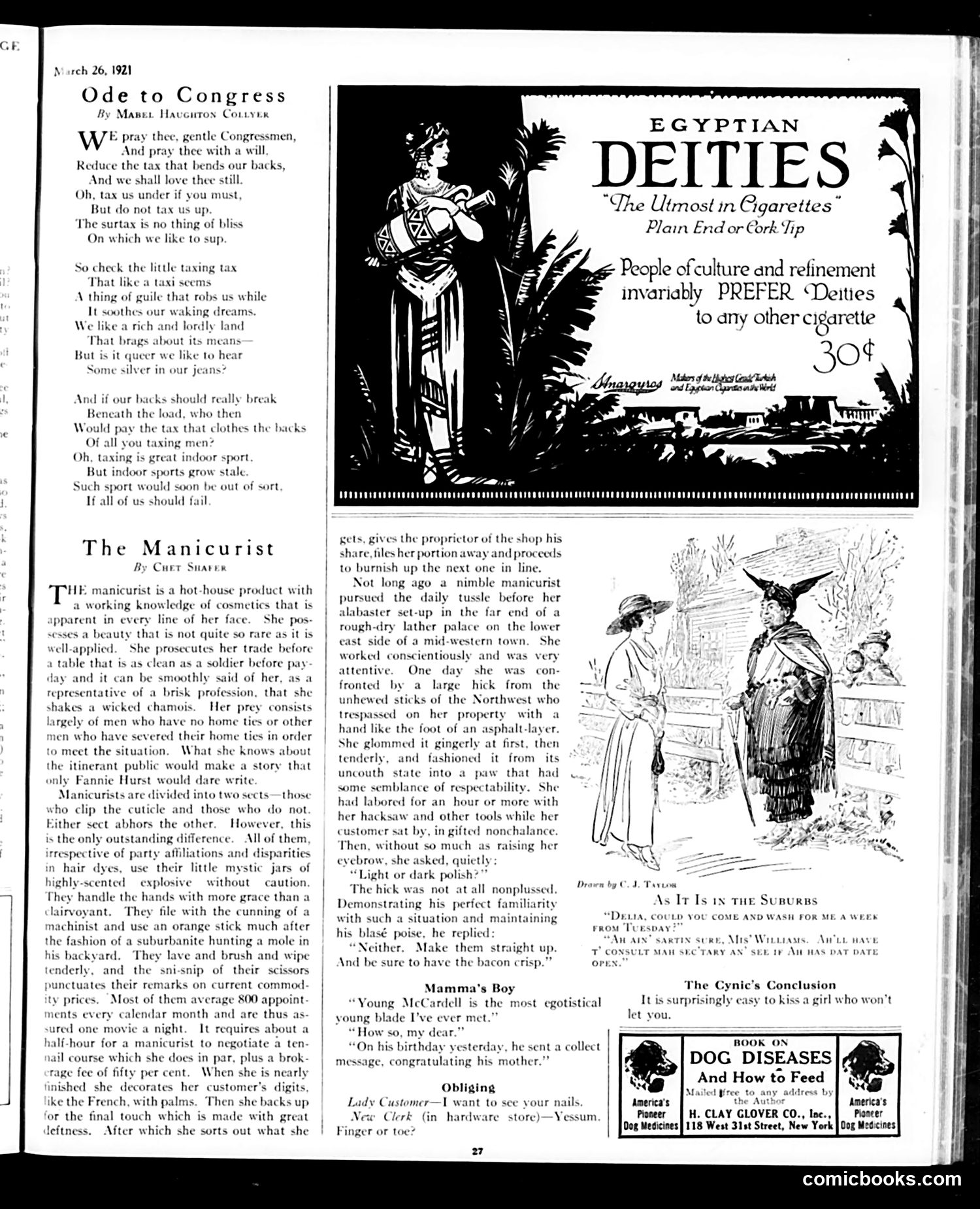
**"Ode to Congress"** is a satirical poem criticizing post-WWI tax burdens. The poet addresses Congress pleading for tax relief, comparing the "surtax" to a "taxi" that "robs us." The satire mocks both high taxation and Congress's indifference to public suffering—suggesting that if taxpayers collapse under the load, who will fund the government itself? The wordplay on "taxi/taxing" reflects frustration with what appears to be excessive wartime revenue policies. **"The Manicurist"** is a humorous short story satirizing 1920s urban culture. It depicts manicurists as sophisticated, entrepreneurial women who serve primarily unattached men. The story's punchline involves a rough "hick" farmer from the Northwest who, despite his crude appearance, responds to the manicurist's question about polish color with unexpected sophistication, deflating her assumptions about his rusticity. The **Egyptian Deities cigarette advertisement** is period product placement—typical for Judge's commercial content.
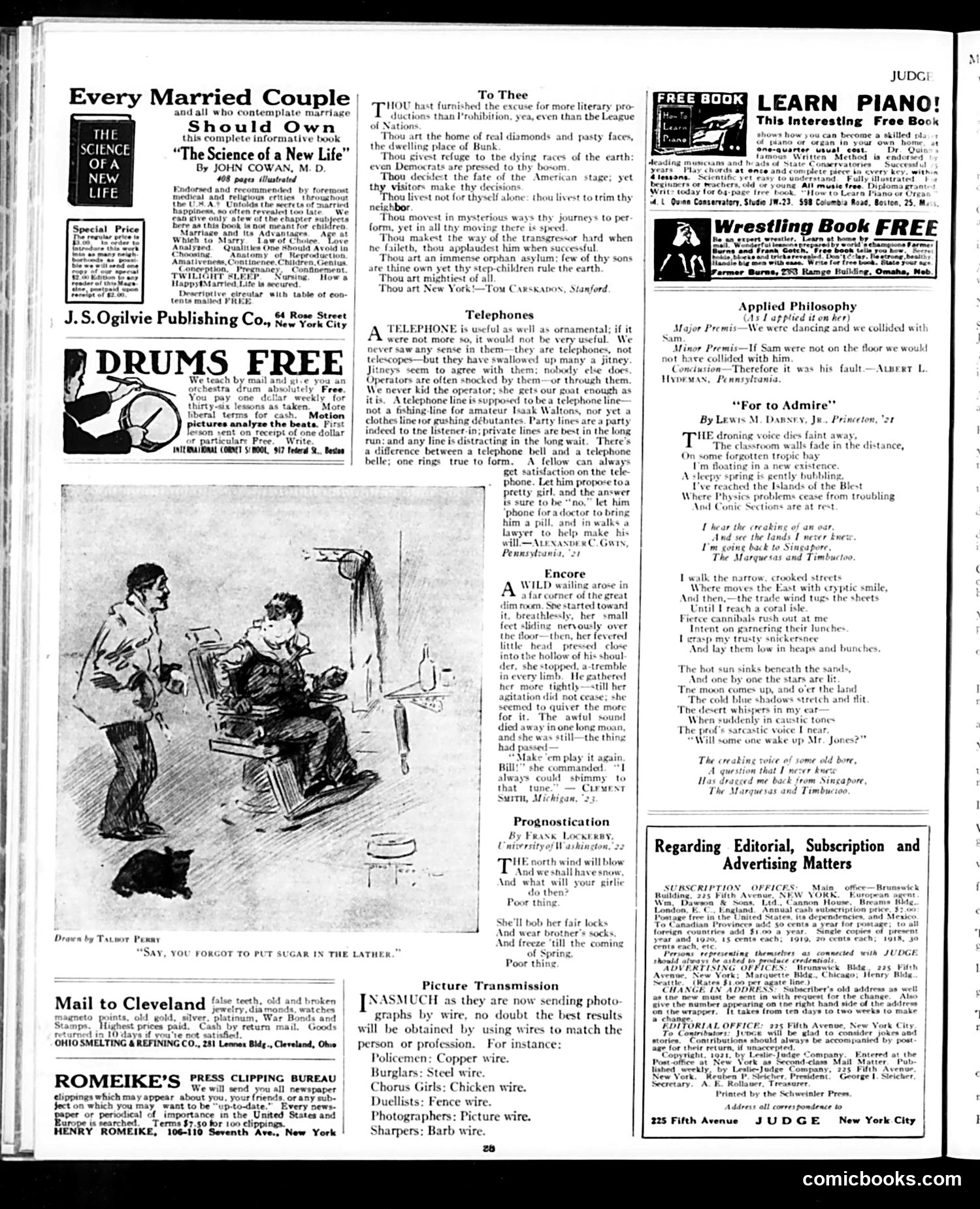
This page is primarily **advertising and miscellaneous editorial content**, not political satire. Judge magazine here features: **The main cartoon** (bottom left, captioned "SAY, YOU FORGOT TO PUT SUGAR IN THE LATHER") shows a domestic scene where a wife criticizes her husband's shaving preparation—a gentle domestic humor joke about household routines. **The page is dominated by advertisements** for: mail-order drum lessons, piano instruction, a wrestling book, and a marriage/sex education manual ("The Science of a New Life"). **Editorial content includes**: a romantic short story excerpt ("Encore"), sentimental poetry ("For to Admire"), and advice columns about telephones and photography techniques. There is **no significant political satire or social commentary** on this page—it's a typical period magazine combining light domestic humor, practical advice, and commercial advertisements aimed at middle-class readers.
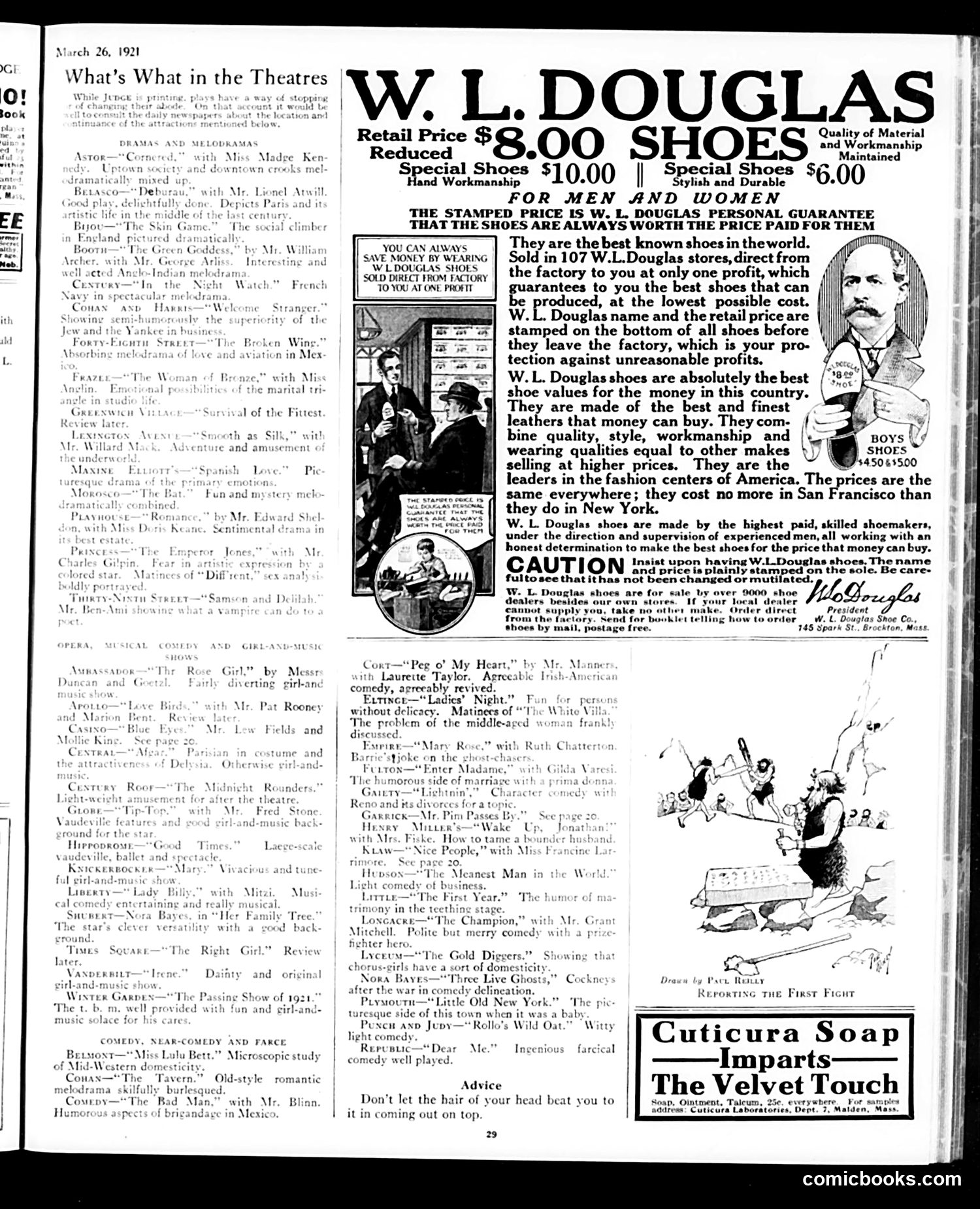
This page is primarily a **large shoe advertisement** for W.L. Douglas brand shoes, dominating the upper half. The ad features a portrait of the company founder/president and includes standard marketing claims: shoes sold "direct from factory" at low profit margins, stamped prices as a "personal guarantee," and competitive pricing across all locations. The lower portion contains a **theater listings section** ("What's What in the Theatres") reviewing Broadway productions from March 26, 1921—plays like "Peg o' My Heart," "Mary Rose," and "Rollo's Wild Oat." At bottom right is a small **Cuticura Soap advertisement** with the tagline "Don't let the hair of your head beat you to it in coming out on top"—likely a pun about hair loss remedies. There's a cartoon drawing by Paul Roulien titled "Reporting the First Fight" showing what appears to be sports reporting humor. The page reflects 1920s commercial publishing: mixing serious product marketing with entertainment coverage and minor humor—typical Judge magazine content of the era.
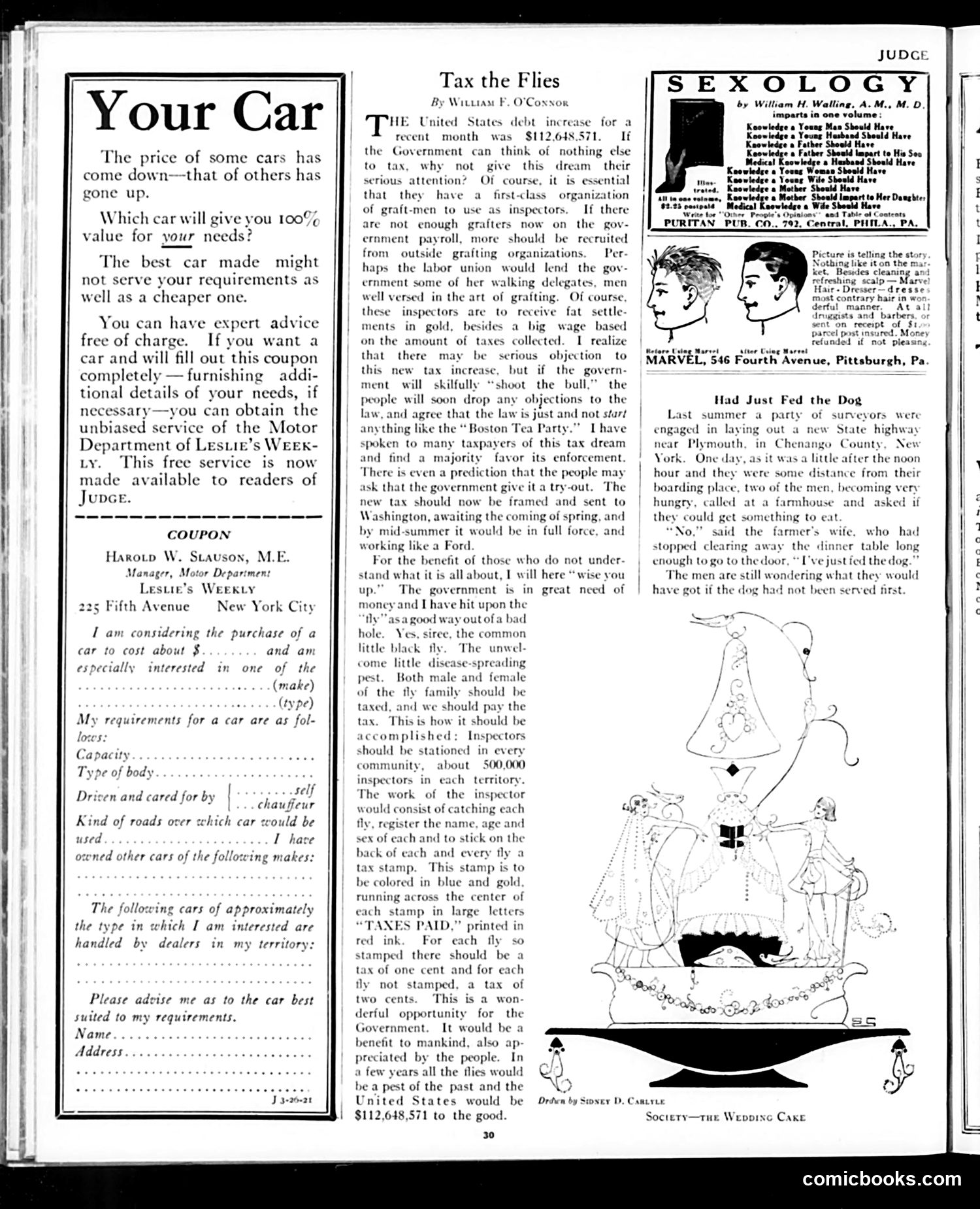
This page contains a **car-buying advice column** (left) and **political satire** (center-right). ## "Tax the Flies" Satire William F. O'Connor satirizes government waste and corruption. His absurd proposal: tax houseflies at 1 cent each (2 cents unstamped), requiring 500,000 inspectors nationwide to stamp each fly with "TAX PAID" labels. The satire targets: - **Bloated bureaucracy**: The massive inspector force needed for an impractical scheme - **Grafting**: He explicitly mentions corrupt officials ("grafters") receiving kickbacks - **Government incompetence**: The proposal is deliberately ridiculous, yet O'Connor claims taxpayers favor it—mocking public acceptance of wasteful spending - **The national debt crisis**: Referenced at the article's start ($112M monthly increase) The joke relies on readers recognizing this as exaggerated commentary on how the government invents unnecessary taxes and bureaucratic positions to fill budgetary gaps, while corrupt officials profit. ## Supporting Content The page also includes a Sexology advertisement and an illustration titled "Society—The Wedding Cake."
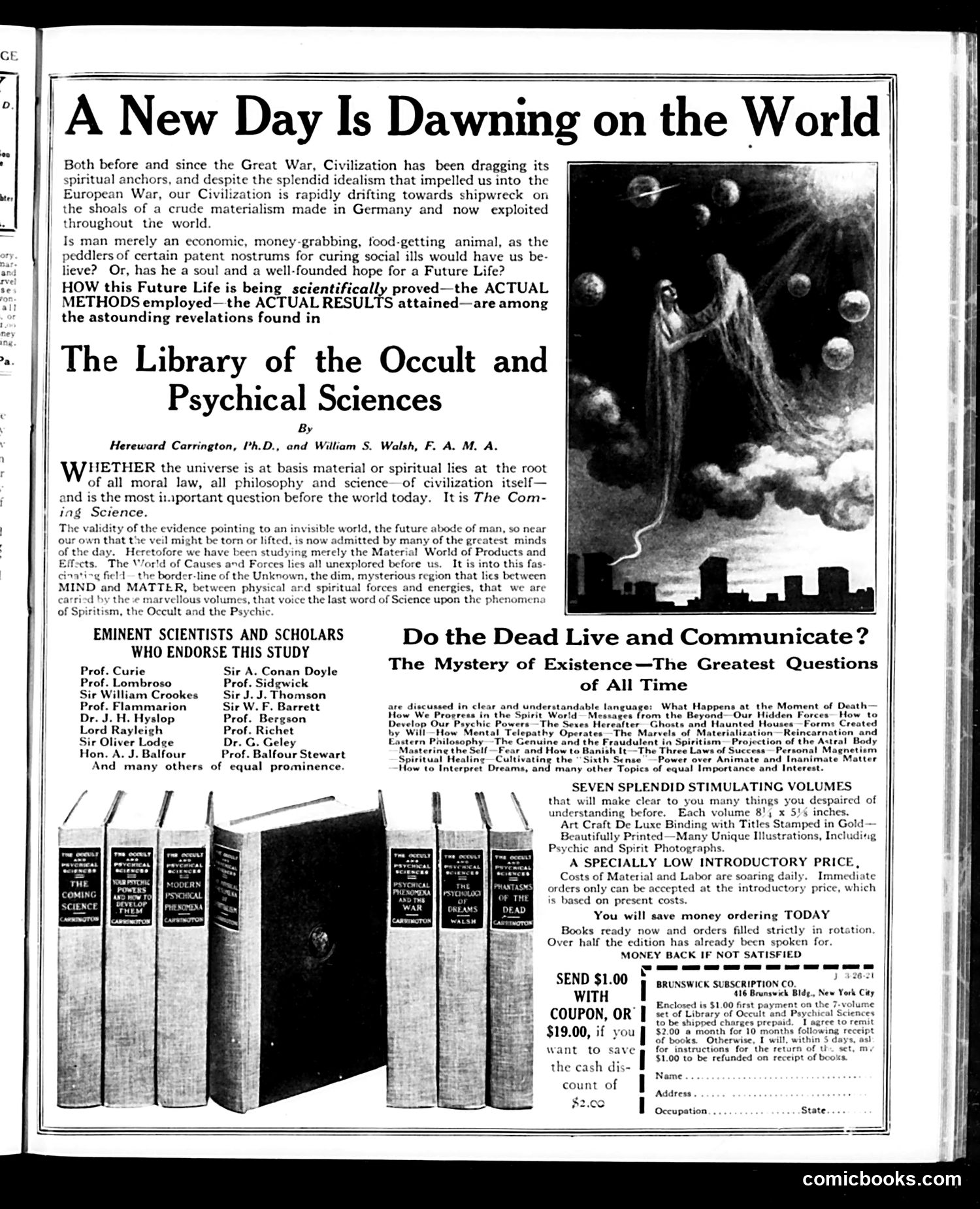
This is primarily a **full-page advertisement**, not a political cartoon. It promotes "The Library of the Occult and Psychical Sciences," a seven-volume set about spiritualism and the paranormal. The framing text ("A New Day Is Dawning on the World") reflects post-WWI anxieties: civilization faces spiritual crisis due to "crude materialism made in Germany." The ad positions occult study as a solution, offering scientific proof of an afterlife and spiritual forces. The endorsements list real figures—Sir Arthur Conan Doyle, Sir Oliver Lodge, Prof. Richet—who were genuinely interested in spiritualism and psychical research during this era. This lent credibility to what we'd now recognize as pseudoscience. The imagery shows ethereal spirits and planets, appealing to readers seeking meaning beyond materialism. The "specially low introductory price" and urgency ("over half the edition already spoken for") are classic sales tactics. This reflects the 1920s fascination with spiritualism as a response to post-war disillusionment.
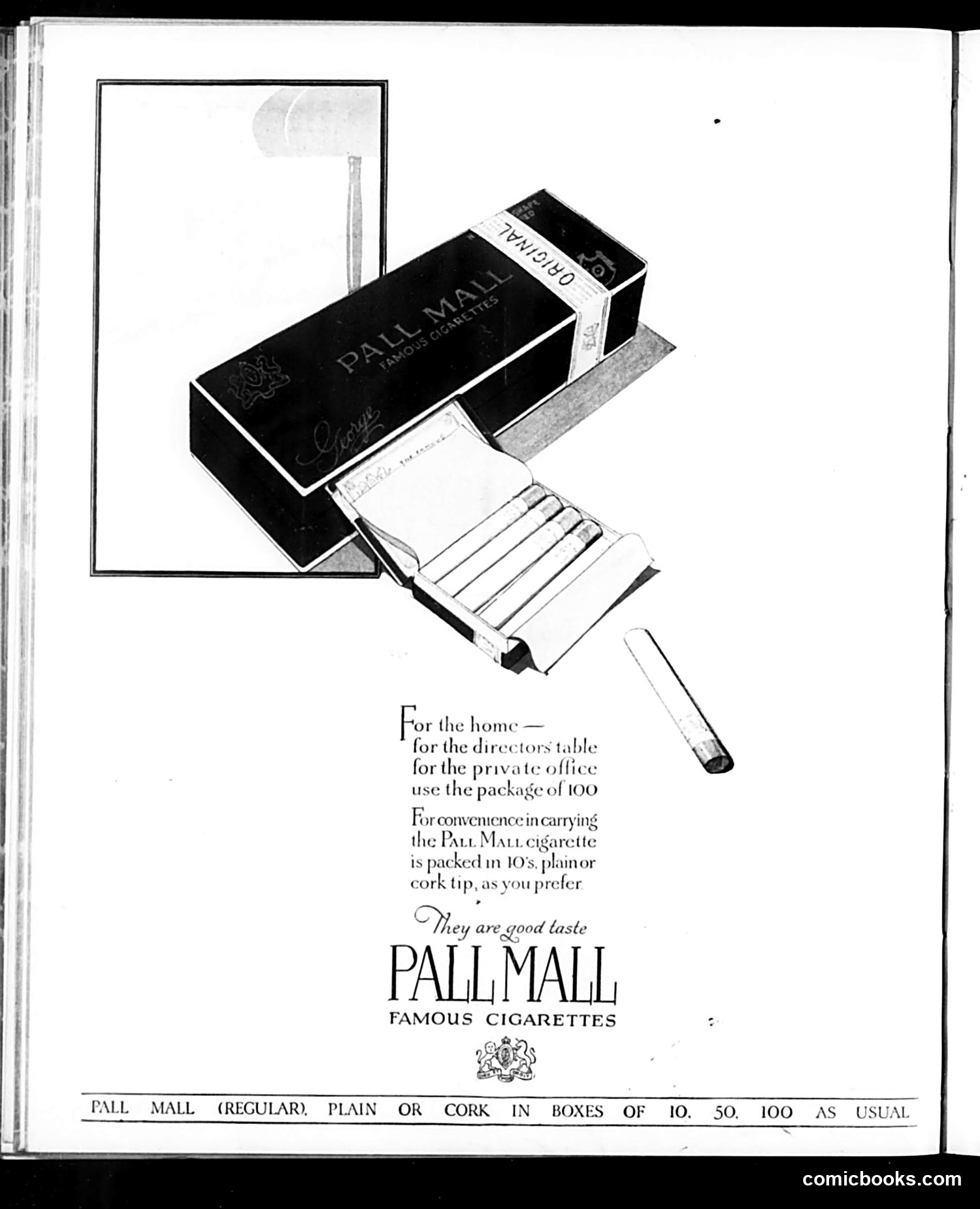
This page is **not a cartoon or satire** — it's a straightforward **cigarette advertisement** from Judge magazine. The image shows a package of Pall Mall cigarettes with individual cigarettes displayed, emphasizing the product's packaging options (boxes of 10, 50, or 100) and tip choices (plain or cork). The text promotes convenience and versatility: the cigarettes suit home, boardroom ("directors table"), and office use. The phrase "They are good taste" was a common advertising appeal of the era. This represents typical early-to-mid 20th century cigarette marketing before health warnings were required. It appears in Judge, a humor magazine, likely as paid advertising revenue rather than editorial content.