
Judge, 1921-03-26 · page 16 of 32
Judge — March 26, 1921 — page 16: what you’re looking at
What you’re looking at
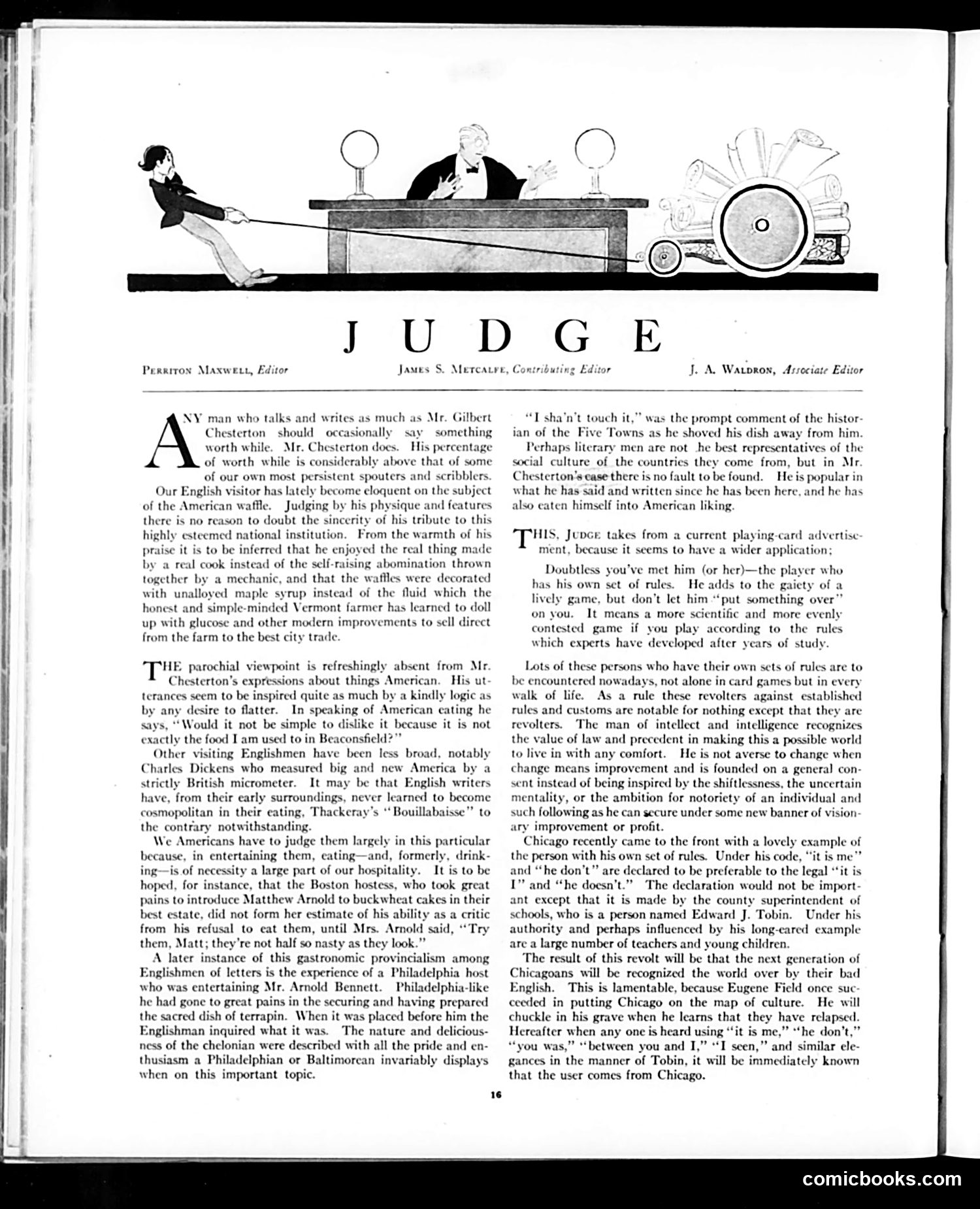
This page contains a text essay titled "Judge," not primarily a political cartoon. The masthead illustration shows a figure being pulled by another, metaphorically representing "judgment" as a force. The essay discusses **G.K. Chesterton**, the British writer visiting America. The author praises Chesterton for making fair observations about American culture (particularly American waffles and food) without the narrow-mindedness shown by previous English visitors like Charles Dickens and Arnold Bennett. The satire targets **provincial English intellectuals** who judge America by British standards and refuse unfamiliar foods—Bennett infamously rejected terrapin, a regional delicacy. Chesterton, by contrast, approached America with openness and "kindly logic," earning American appreciation. The secondary essay references a playing-card advertisement to satirize people who impose their own rules in games rather than following established expert guidelines—a metaphor for maintaining social standards. The page reflects early 20th-century transatlantic cultural tensions and American sensitivity to foreign criticism.
📄 Transcribed text from this page (OCR, searchable)
Machine-transcribed from the original scan — historical spelling and the odd misread are preserved.
SSS Se Perriron Maxwett, Editor James S. Mercatre, Contributing Editor J. A. Watprox, Associate Editor NY man who talks and writes as much as Mr. Gilbert Chesterton should occasionally say something worth while. Mr. Chesterton does. His percentage of worth while is considerably above that of some of our own most persistent spouters and scribblers. Our English visitor has lately become eloquent on the subject of the American waffle. Judging by his physique and features. there is no reason to doubt the sincerity of his tribute to this highly esteemed national institution. From the warmth of his praise it is to be inferred that he enjoyed the real thing made by a real cook instead of the self-raising abomination thrown together by a mechanic, and that the waffles were decorated with unalloyed maple syrup instead of the fluid which the honest and simple-minded Vermont farmer has learned to doll up with glucose and other modern improvements to sell direct from the farm to the best city trade. HE, parochial viewpoint is refreshingly absent from Mr. Chesterton’s expressions about things American. His ut terances seem to be inspired quite as much by a kindly logic as by any desire to flatter. In speaking of American eating he says, “Would it not be simple to dislike it because it is not exactly the food I am used to in Beaconsfield?” Other visiting Englishmen ha been less broad, notably Charles Dickens who measured big and new America by a strictly British micrometer. It may be that English writers have, from their early surroundings, never learned to become cosmopolitan in their eating, Thackeray's ‘ Bouillabaisse” to the contrary notwithstanding We Americans have to judge them largely in this particular because, in entertaining them, cating—and, formerly, drink- ing—is of necessity a large part of our hospitality. It is to be hoped, for instance, that the Boston hostess, who took great pains to introduce Matthew Arnold to buckwheat cakes in their best estate, did not form her estimate of his ability as a critic from his refusal to eat them, until Mrs. Arnold said, “Try them, Matt; they're not half so nasty as they look. A later instance of this gastronomic provincialism among Englishmen of letters is the experience of a Philadelphia host who was entertaining Mr. Arnold Bennett. Philadelphia-like he had gone to great pains in the securing and having prepared the sacred dish of terrapin. When it was placed before him the Englishman inquired what it was. The nature and delicious- ness of the chelonian were described with all the pride and en- thusiasm a Philadelphian or Baltimorean invariably displays when on this important topic. I sha‘n’t touch it,” was the prompt comment of the histor ian of the Towns as he shoved his dish away from him. Perhaps literary men are not he best representatives of the social culture of the countries they come from, but in Mr Chesterton's ease there is no fault to be found. He is popular in what he has said and written since he has been here, and he has also eaten himself into American liking. TIlls, Jepoe takes from a current playing-card advertise ment, because it seems to have a wider application; Doubtless you’ve met him (or her)—the player who has his own set of rules. He adds to the gaicty of a lively game, but don’t let him “‘put something over” on you. It means a more scientific and more evenly contested game if you play according to the rules which experts have developed after years of study. Lots of these persons who have their own scts of rules are to be encountered nowadays, not alone in card games but in every walk of life. As a rule these revolters against established rules and customs are notable for nothing except that they are revolters. The man of intellect and intelligence recognizes the value of law and precedent in making this a possible world to live in with any comfort. He is not averse to change when change means improvement and is founded on a general con- sent instead of being inspired by the shiftlessness, the uncertain mentality, or the ambition for notoriety of an individual and such following as he can secure under some new banner of vision ary improvement or profit. Chicago recently came to the front with a lovely example of the person with his own set of rules. Under his code, “it i and “he don’t” are declared to be preferable to the legal “it is I” and “he doesn’t.” The declaration would not be import- ant except that it is made by the county superintendent of schools, who is a person named Edward J. Tobin. Under his authority and perhaps influenced by his long-eared example are a large number of teachers and young children. The result of this revolt will be that the next generation of Chicagoans will be recognized the world over by their bad English. This is lamentable, because Eugene Field once suc ceeded in putting Chicago on the map of culture. He will chuckle in his grave when he learns that they have relapsed. Hereafter when any one is heard using “‘it is me,” “he don’t,” you was,” “between you and I,” “TI seen,” and similar ele- gances in the manner of Tobin, it will be immediately known that the user comes from Chicago. comicbooks.com