
Judge, 1921-03-26 · page 20 of 32
Judge — March 26, 1921 — page 20: what you’re looking at
What you’re looking at
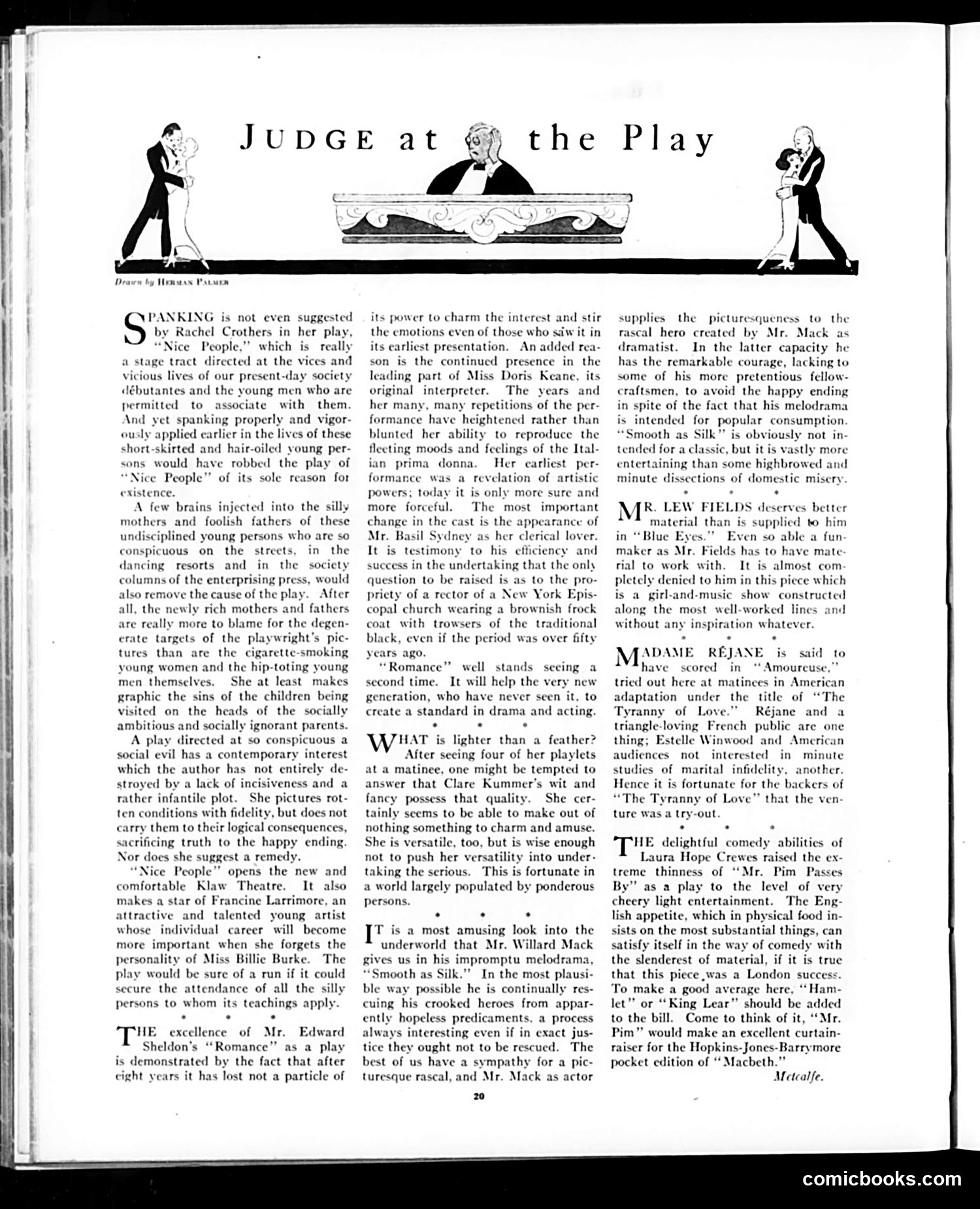
This page from *Judge* magazine contains theater reviews rather than political cartoons. The header illustration shows a "Judge at the Play"—a stern judicial figure evaluating theatrical productions. The reviews critique contemporary Broadway plays: Rachel Crothers's *"Nice People"* (criticized for depicting moral decay among wealthy young people and their negligent parents, yet offering no remedy); Edward Sheldon's *"Romance"* (praised for retaining power after eight years, particularly through Doris Keane's continued performance); and Clare Kummer's playlets (admired for witty charm). References to "short-skirted" young women and "hip-toting" men reflect 1920s concerns about Jazz Age morality. The reviews reveal *Judge's* conservative stance: blaming parental indulgence and "newly rich" social climbers for society's decay, while praising serious dramatic art that maintains standards.
📄 Transcribed text from this page (OCR, searchable)
Machine-transcribed from the original scan — historical spelling and the odd misread are preserved.
JUDGE at if) Drawn by Wenstas Poisen by Rachel Crothers in her play, “Nice People,”” which is really a stage tract directed at the vices and vicious lives of our present-day society ‘butantes and the young men who are permitted to associate with them. And yet spanking properly and vigor- usly applied earlier in the lives of these short-skirted and hair-oiled young per- sons would have robbed the play of “Nice People” of its sole reason for existence. A few brains injected into the silly mothers and foolish fathers of these undisciplined young persons who are so conspicuous on the streets, in the dancing resorts and in the society columns of the enterprising press, would also remove the cause of the play. After all, the newly rich mothers and fathers are really more to blame for the degen- targets of the playwright’s pic- than are the cigarette-smoking young women and the hip-toting young men themselves. She at least’ makes graphic the sins of the children being visited on the heads of the socially ambitious and socially ignorant parents. Ap irected at so conspicuous a social evil has a contemporary interest which the author has not entirely di stroyed by a lack of incisiveness and rather infantile plot. She pictures rot- ten conditions with fidelity, but does not carry them to their logical consequences, sacrificing truth to the happy ending. Nor does she suggest a remedy. Nice People” opens the new and comfortable Klaw Theatre. It also makes a star of Francine Larrimore, an attractive and talented young artist whose individual career will become more important when she forgets the personality of Miss Billie Burke. The play would be sure of a run if it could secure the attendance of all the silly persons to whom its teachings apply. HE excellence of Mr. Edward Sheldon’s “Romance” as a play is demonstrated by the fact that after eight years it has lost not a particle of Ge kaenal is not even sug erate tures the Play =e ee ee its power to charm the interest and stir the emotions even of those who siw it in its earliest presentation. An added rea- son is the continued presence in the leading part of Miss Doris Keane, its original interpreter. The years and her many, many repetitions of the per- formance have heightened rather than blunted her ability to reproduce the fleeting moods and feelings of the Ital- ian prima donna. Her earliest per- formance was a revelation of artistic powers; today it is only more sure and more forceful. The most important change in the cast is the appearance of Mr. Basil Sydney as her clerical lover. It is testimony to his efficiency and success in the undertaking that the only question to be raised is as to the pro- priety of a rector of a New York Epis- copal church wearing a brownish frock coat with trowsers of the traditional black, even if the period was over fifty years ago. “Romance” well stands seeing a second time. It will help the very new generation, who have never seen it, to create a standard in drama and acting. HAT is lighter than a feather? After secing four of her playlets at a matinee, one might be tempted to answer that Clare Kummer’s wit and fancy possess that quality. She cer- tainly seems to be able to make out of nothing something to charm and amuse. She is versatile, too, but is wise enough not to push her versatility into under- taking the serious. This is fortunate in a world largely populated by ponderous persons. . . . T is a most amusing look into the underworld that Mr. Willard Mack gives us in his impromptu melodrama, “Smooth as Silk.” In the most plausi ble way possible he is continually res cuing his crooked heroes from appar- ently hopeless predicaments, @ process interesting even if in exact jus- tice they ought not to be rescued. The best of us have a sympathy for a pic- turesque rascal, and Mr. Mack as actor 20 supplies the picturesqueness to the rascal hero created by Mr. Mack as dramatist. In the latter capacity he has the remarkable courage, lacking to some of his more pretentious fellow- craftsmen, to avoid the happy ending in spite of the fact that his melodrama is intended for popular consumption “Smooth as Silk” is obviously not in- tended for a classic, but it is vastly more entertaining than some highbrowed and minute dissections of domestic misery N R. LEW FIELDS deserves better material than is supplied to him in “Blue Eyes."’ Even so able a fun maker as Mr. Fields has to have mate rial to work with. It is almost com pletely denied to him in this piece which is a girl-and-music show constructed along the most well-worked lines and without any inspiration whatever. M ADAME REJANE_ is said to have scored in **Amourcuse,”” tried out here at matinces in America adaptation under the title of “The Tyranny of Love.” Réjane and a triangle-loving French public are one thing; Estelle Winwood and American audiences not interested in minute studies of marital infidelity, another. Hence it is fortunate for the backers of “The Tyranny of Love” that the ven- ture was a try-out. HE delightful comedy abilities of Laura Hope Crewes raised the ex- treme thinness of “‘Mr. Pim Passes By” as a play to the level of very cheery light entertainment. The Eng. lish appetite, which in physical food in- sists on the most substantial things, can satisfy itself in the way of comedy with the slenderest of material, if it is true that this piece was a London success. To make a good average here, “‘Ham- let” or “King Lear” should be added to the bill. Come to think of it, “Mr. Pim” would make an excellent curtain- raiser for the Hopkins-Jones-Barrymore pocket edition of ‘‘ Macbeth. Metcalfe. comicbooks.com