
Judge, 1921-03-26 · page 14 of 32
Judge — March 26, 1921 — page 14: what you’re looking at
What you’re looking at
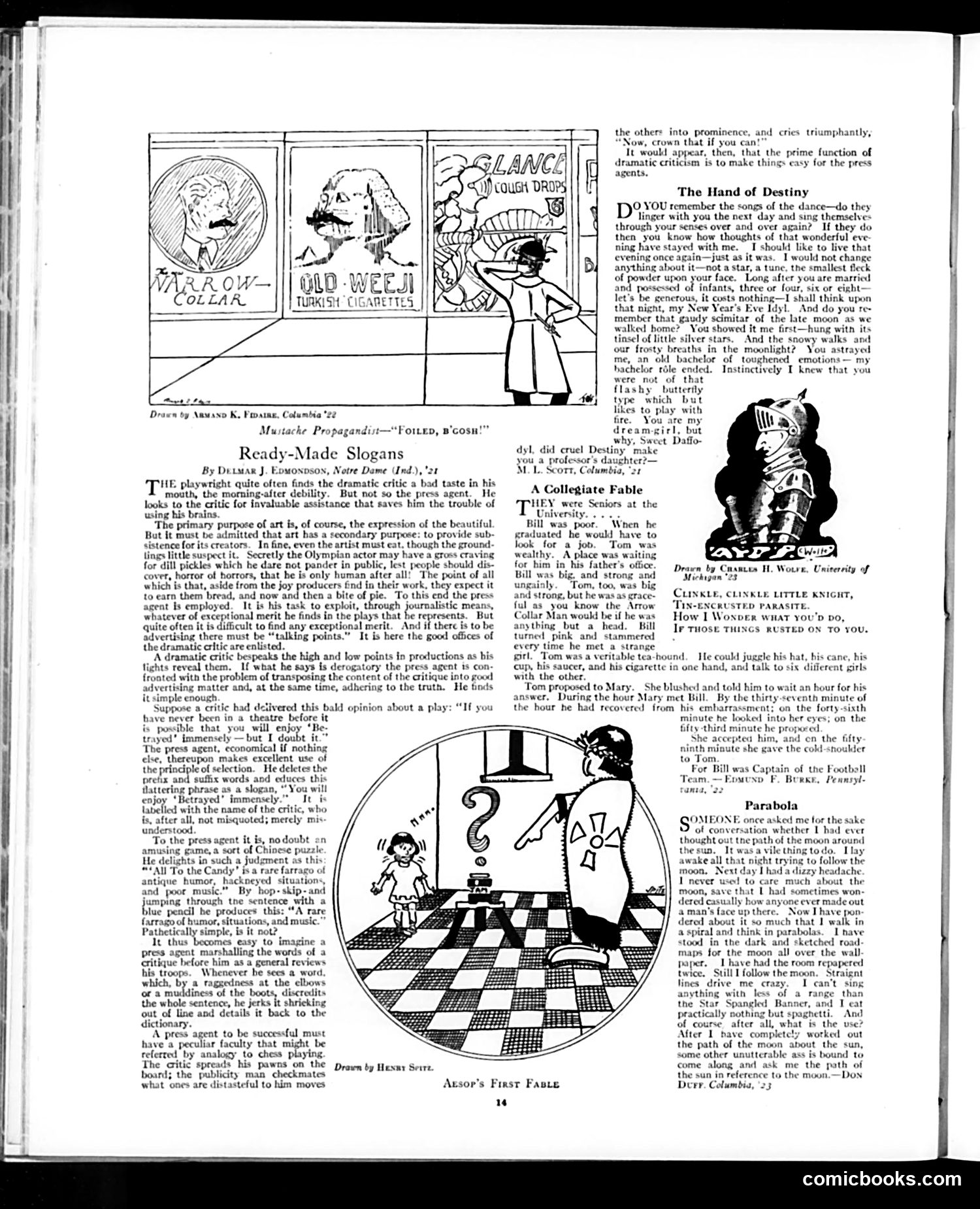
**Top Cartoon ("Mustache Propagandist")**: This appears to be satirizing cigarette advertising and propaganda. The panels show vintage Turkish cigarette brands ("Marrow Collar," "Old Weeji") with an exaggerated mustachioed figure. The satire mocks how advertising creates false impressions—suggesting that cigarette ads promise sophistication or masculinity through absurd visual claims. **Main Article ("Ready-Made Slogans")**: This is a commentary on press agents manipulating theater critics' reviews for advertising. The author explains how press agents quote critics selectively—removing negative qualifiers to make bad reviews sound positive. For example, a critic's "You will enjoy it, but I doubt it" becomes merely "You will enjoy it." It's satirizing the deception in theatrical promotion and how the press manufactures false endorsements through dishonest editing. The piece critiques both the theatrical establishment's promotional practices and suggests critics sometimes unknowingly enable this manipulation.
📄 Transcribed text from this page (OCR, searchable)
Machine-transcribed from the original scan — historical spelling and the odd misread are preserved.
others into prominence, and cries triumphantly, the ‘ow, crown that if you can! 6 , ESI || TURKISH “CIGARETTES Se 1) AC Ka nay SiS a7 prime function of It would appear, then, that t easy for the press dramatic criticism is to make thing agents. The Hand of Destiny [DO,X0U remember the songs of the dance—do they linger with you the next day and sing themselves through your senses over and over again? If they do then you know how thoughts of that wonderful eve ning have stayed with me. _ I should like to live that evening once again—just as it was. I would not change anything about it—not a star, a tune, the smallest fleck of powder upon your face. Long after you are married and possessed of infants, three or four, six or eight— let's be generous, it costs nothing—I shall think upon that night, my New Year's Eve Idyl. And do you re- member that gaudy scimitar of the late moon as we ven by Aawaxo K, Peoatne, Columbia "22 Mustache Propagandist—Foiren, B’cosn!” Ready-Made Slogans By Detatar J. Eowonnsos, Notre Dame Und.), "21 THe playwright quite often finds the dramatic critic a bad taste in his mouth, the morning-after debility. But not so the press agent. He looks to the critic for invaluable assistance that saves him the trouble of using his brains. . The primary purpose of art is, of course, the expression of the beautiful. But it must be admitted that art has a secondary purpose: to provide sub- sistence for its creators. In fine, even the artist must eat, though the ground. lings little suspect it. Secretly the Olympian actor may have a gross craving for dill pickles which be dare not pander in public, lest people should dis- cover, horror of horrors, that he is only human after all! The point of all which is that, aside from the joy producers find in their work, they expect it to earn them bread, and now and then a bite of pie. To this end the pre agent Is employed. It is his task to exploit, through journalistic means, whatever of exceptional merit he finds in the plays that he represents. But quite often it is difficult to find any exceptional merit. And if there is to be advertising there must be “talking points.” It is here the good offices of the dramatic critic are enlisted. A dramatic critic bespeaks the high and low points in productions as bis lights reveal them. If what he says is derogatory the press agent ts con- ‘ith the problem of transposing the content of the critique into good ing matter and, at the same time, adhering to the truth. He finds nple enough. Suppose a critic had deiivered this bald opinion about a play: “If you have never been in a theatre before it is possible that you will enkoy “Be- trayed’ immensely —but I doubt it The press agent, economical if nothing else, thereupon makes excellent use of the principle of selection. He deletes th prefix and suffix words and educes this flattering phrase as a slogan, “ You will enjoy ‘Betrayed’ immensely. It i labelled with the name of the critic, who is, after all, not misquoted; merely mi understood To the press agent it is, nodoubt en amusing game, a sort of Chinese puzzle He delights in such a judgment as t “*All To the Candy’ is a rare farrago of antique humor, hackneyed situ and poor music. jumping through tne sentence with a blue pencil be produces this: “A rare farrago of humor, i ind music." Pathetically simple, is it not? It thus becomes easy to imagine a press agent marshalling the words of a critique before him as a general reviews his troops. Whenever be sees a word, which, by a raggedness at the elbows or a muddiness of the boots, discredits the whole sentence, he jerks it shriek! out of line and details it back to the dictionary. A press agent to be successful must have a peculiar faculty that might be referred by analogy to chess playing The critic spreads his pawns on the board; the publicity man checkmates what ones are distasteful to him moves Drawn by Hexny Serre. Agsor’s First Fate “ walked home? You showed it me first—hung with its tinsel of little silver stars. And the snowy walks and our frosty breaths in the moonlight? You astrayed me, an oki bachelor of toughened emotions — my hachelor rile ended. Instinctively I knew that you were not of that flashy butterfly type which but fire. 3 dreamgirl, why, Svcet Daffo- dyl, did cruel Destiny you a professor's da M.L. Scott, Columbia, A Collegiate Fable HEY were Seniors at the University... .. Bill was poor. ‘When he graduated he would have to look for a job. Tom was wealthy. A place was waiting for him in his father’s office, Bill was big, and strong and ungainly. Tom, too, was big and strong, but he was as grace- ful as you know the Arrow Collar Man would be if he was anything but a head. Bill turned pink and stammered every time he met a strange girl, Tom was a veritable tea-hound. Ie could juggle his hat, his c cup, his saucer, and his cigarette in one hand, and talk to six differen with the other. Tom proposed to Mary. wer. During the hour Mary met Bill ye hour he had recovered from his embarr: minute he fifty third n proj od. She accepted him, and on the fifty ninth minute she gave the coki-snouk: to Tom For Bill was Captain of the Footbell Epuenp F. BurKe, Pennsyl- ewe A antes H. Woure, Uniterrity 3 Drawn by € Michigan "2 CUNKLE, CLINKLE LITTLE KNIGHT, ‘TIN-ENCRUSTED PARASITE. How I Woxper wnat you'p po, IF THOSE THINGS RUSTED ON TO YOU. his girls She blushed and told him to wait an hour for his By the thirty-seventh minute of on the forty-sixth her eyes; on the Parabola GOMEONE once asked me for the sake of conversation whether I had ever thought out the path of the moon around the sun. It was a vile thing tod awake all that night trying to fol moon, Next day I hada dizzy he I never used to care moon, save that L had dered casually how anyone ever made out a man’s face up there. Now I have pon dered about it so much that I walk in a spiral and think in parabolas. I have stood in the dark and sketched road. maps for the moon all over the paper, I have had the room repap twice. Still I follow the moon. lines drive me crazy. I can't sing anything with less of a range than the Star Spangled Banner, and I eat practically sothing but spaghetti. And of course after all, what is the use? After L have completely worked out the path of the moon about the sun, some other unutterable ass is bound to come along and ask me the path of the sun in reference to the moun.—Don Deer. Columbia, ‘23 sometimes won- comicbooks.com