
Judge, 1921-03-26 · page 22 of 32
Judge — March 26, 1921 — page 22: what you’re looking at
What you’re looking at
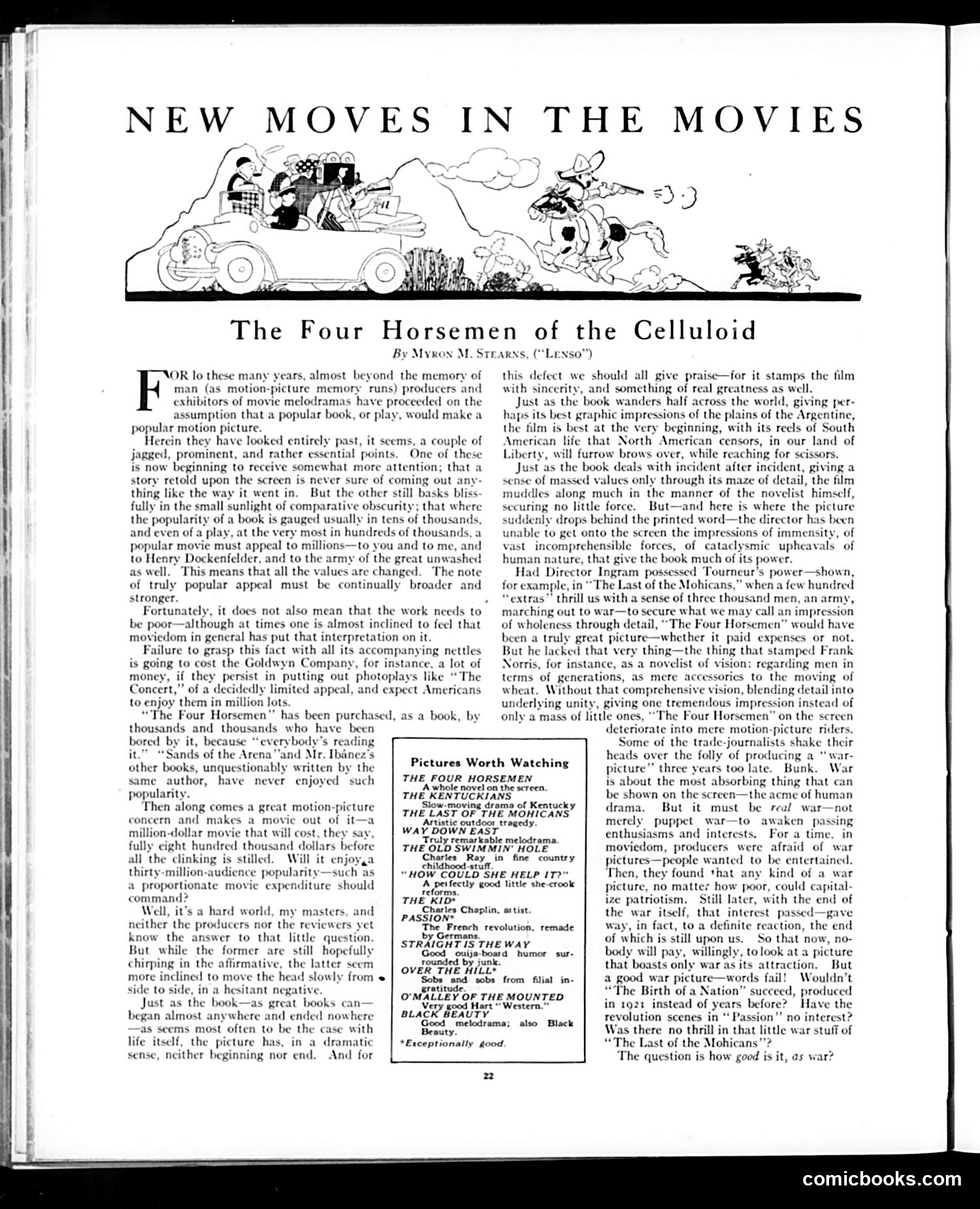
This is a lengthy film criticism essay, not a political cartoon. The author (Myrow M. Stearns) analyzes Hollywood's assumption that popular books automatically make popular movies. **Main argument:** The film industry fails to account for a crucial difference—books appeal to thousands, but movies must appeal to *millions*. This requires broader, stronger popular appeal, not just faithful adaptation. **Specific case study:** "The Four Horsemen" (likely the 1921 Valentino film), purchased as a book by thousands who found it boring but read it because "everybody's reading it." The studio spent $800,000 expecting massive box-office success, but the critic questions whether it will achieve the 30-million-person audience such expenditure warrants. **The critique:** The film, like the novel, lacks dramatic structure—no clear beginning or end. However, the critic praises its sincerity and occasional visual power, particularly early scenes depicting Argentine plains. The sidebar lists other contemporary films worth watching, using brief evaluative labels ("Exceptionally good," "Good melodrama," etc.).
📄 Transcribed text from this page (OCR, searchable)
Machine-transcribed from the original scan — historical spelling and the odd misread are preserved.
NEW MOVES IN THE MOVIES The Four Horseme By Myrow M. Ste OR lo these many years, almost beyond the memory of man (as motion-picture memory runs) producers and exhibitors of movie melodramas have proceeded on the assumption that a popular book, or play, would make a popular motion picture. Herein they have looked entirely past, it seems, a couple of jagged, prominent, and rather essential points. One of these is now beginning to receive somewhat more attention; that a story retold upon the screen is never sure of coming out any- thing like the way it went in. But the other still basks bliss fully in the small sunlight of comparative obscurity; that where the popularity of a book is gauged usually in tens of thousands, and even of a play, at the very most in hundreds of thousands, a popular movie must appeal to millions—to you and to me, and to Henry Dockenfelder, and to the army of the great unwashed as well. This means that all the values are changed. The note of truly popular appeal must be continually broader and stronger. ‘ Fortunately, it does not also mean that the work needs to be poor—although at times one is almost inclined to feel that moviedom in general has put that interpretation on it Failure to grasp this fact with all its accompanying nettles is going to cost the Goldwyn Company, for instance, a lot of money, if they persist in putting out photoplays like “The Concert,” of a decidedly limited appeal, and expect Americans joy them in million lots. ‘our Horsemen” has been purchased, as a book, by thousands and thousands who have been bored by it, because “everybody's reading it.” “Sands of the Arena”'and Mr, Ibine other books, unquestionably written by the same author, have never enjoyed such popularity. Then along comes a great motion-picture concern and makes a movie out of it—a million-dollar movie that will cost, they say fully eight hundred thousand dollars before all the clinking is stilled. Will it enjoy,a thirty-million-audience popularity—such as a proportionate movie expenditure should WAY DOWN EAST childhood -stuff. ‘A perfectly good reforms. commanc THE _KIiDb* it’s c Ci $s, anc Charles Chaplin, Well, it’s a hard world, my masters, and PASSIONS neither the producers nor the reviewers yet know the answer to that little question But while the former are still hopefully chirping in the affirmative, the latter seem more inclined to move the head slowly from « side to side, in a hesitant negative: Just as the book—as great books can— began almost anywhere and ended nowhere as seems most often to be the case with life itself, the picture has, in a dramatic sense, neither beginning nor end. And for by Germans. Good ouija-boar; rounded by junk. OVER THE HILL* Sobs and sobs gratitude. Very good Hart “ BLACK BEAUTY Good melodram: Beauty, Pictures Worth Watching THE FOUR HORSEMEN A whole novel on the screen. THE KENTUCKIANS Slow-moving drama of Kentucky THE LAST OF THE MOHICANS Artistic outdoor tragedy Truly remarkable melodrama. THE OLD SWIMMIN’ HOLE Charles Ray in fine country “HOW COULD SHE HELP IT?” ‘The French revolution, remade STRAIGHT IS THE WAY O'MALLEY OF THE MOUNTED *Exceptionally good. n of the Celluloid ARNS, ( NSO”) this defect we should all give praise—for it stamps the film with sincerity, and something of real greatness as well. Just as the book wanders half across the world, giving per- haps its best graphic impressions of the plains of the Argentine, the film is best at the very beginning, with its reels of South American life that North American censors, in our land of Liberty, will furrow brows over, while reaching for scissors. Just as the book deals with incident after incident, giving a sense of massed values only through its maze of detail, the film muddles along much in the manner of the novelist himself, securing no little force. But—and here is where the picture suddenly drops behind the printed word—the director has been unable to get onto the screen the impressions of immensity, of vast incomprehensible forces, of cataclysmic upheavals’ of human nature, that give the book much of its power. Had Director Ingram possessed Tourneur’s power—shown, for example, in “The Last of the Mohicans,” when a few hundred “extras” thrill us with a sense of three thousand men, an army, marching out to war—to secure what we may call an impression of wholeness through detail, “The Four Horsemen” would have been a truly great picture—whether it paid expenses or not. But he lacked that very thing—the thing that stamped Frank Norris, for instance, as a novelist of vision: regarding men in terms of generations, as mere accessories to the moving of wheat. Without that comprehensive vision, blending detail into underlying unity, giving one tremendous impression instead of only a mass of little ones, “The Four Horsemen” on the screen deteriorate into mere motion-picture riders. Some of the trade-journalists shake their heads over the folly of producing a * picture” three years too late. Bunk. is about the most absorbing thing that can be shown on the screen—the acme of human drama. But it must be real war—not merely puppet war—to awaken passing enthusiasms and interests. For a time, in moviedom, producers were afraid of war pictures—people wanted to be entertained. Then, they found that any kind of a war picture, no matter how poor, could capital- ize patriotism. Still later, with the end of axtist, the war itself, that interest: passed—gave way, in fact, to a definite reaction, the end of which is still upon us. So that now, no- body will pay, willingly, tolook at a picture that boasts only war as its attraction. But a good war picture—words fail! Wouldn't “The Birth of a Nation” succeed, produced in 1921 instead of years before? Have the revolution scenes in ‘* Passion”’ no interest? Was there no thrill in that little war stuff of “The Last of the Mohicans"? The question is how good is it, as war? little she-crook @ humor sur- from filial in- Western.” a; also Black comicbooks.com