
A complete issue · 36 pages · 1920
Judge — April 17, 1920
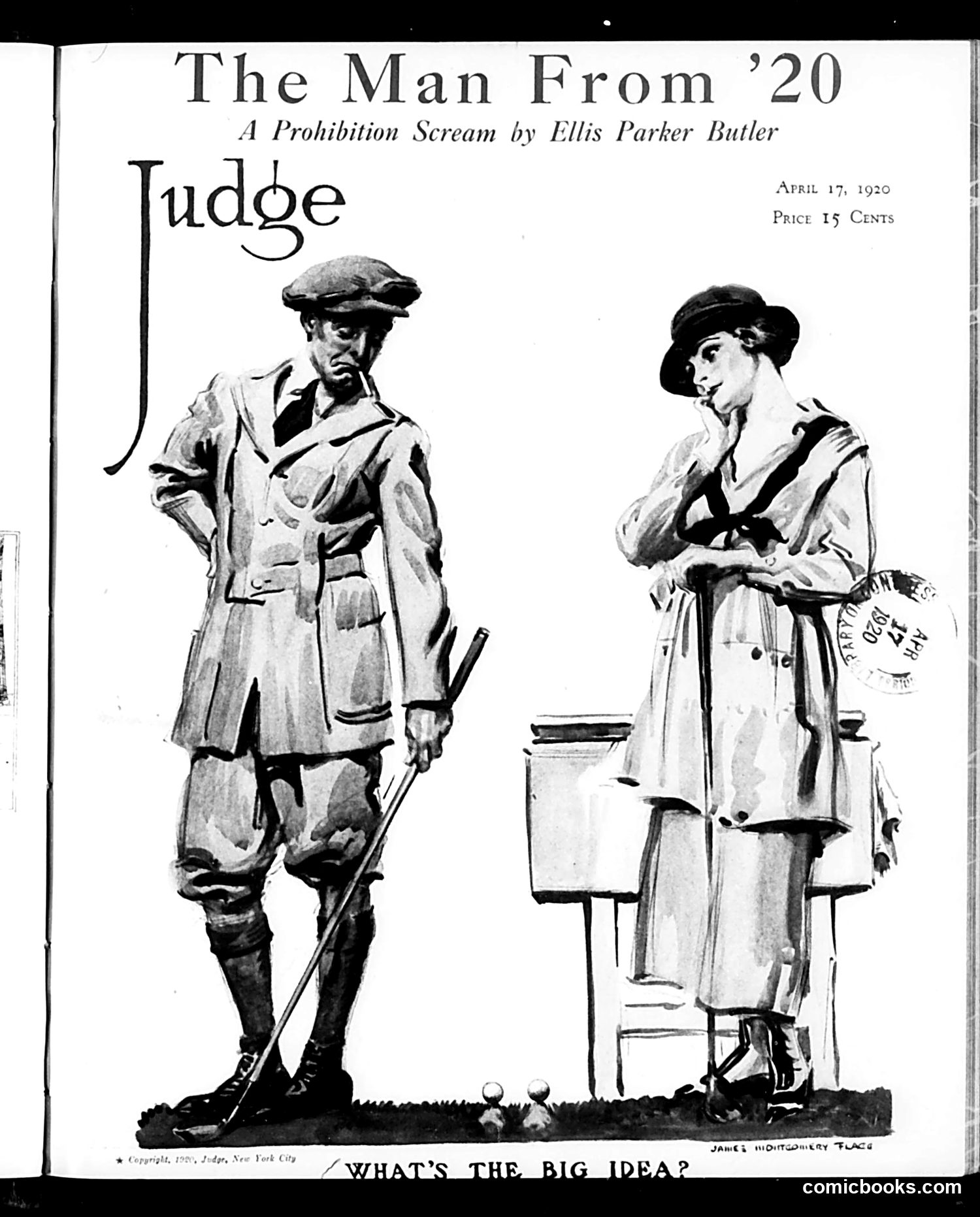
This *Judge* magazine cover from April 17, 1920, satirizes early Prohibition enforcement. The cartoon shows a stern judge or official confronting a woman with a large jug labeled "PROOF" — likely referring to alcoholic evidence or homemade liquor. The title "What's the Big Idea?" suggests the confrontation's tone. As a "Prohibition Scream by Ellis Parker Butler," the piece mocks the clash between enforcement authorities and ordinary citizens during Prohibition's first months (which began January 1920). The woman's defiant posture and the judge's stern bearing illustrate the social tension around Prohibition's implementation — the government's aggressive enforcement versus public resistance. The cartoon ridicules both the rigid moralism of Prohibition and the bootlegging culture it immediately spawned.
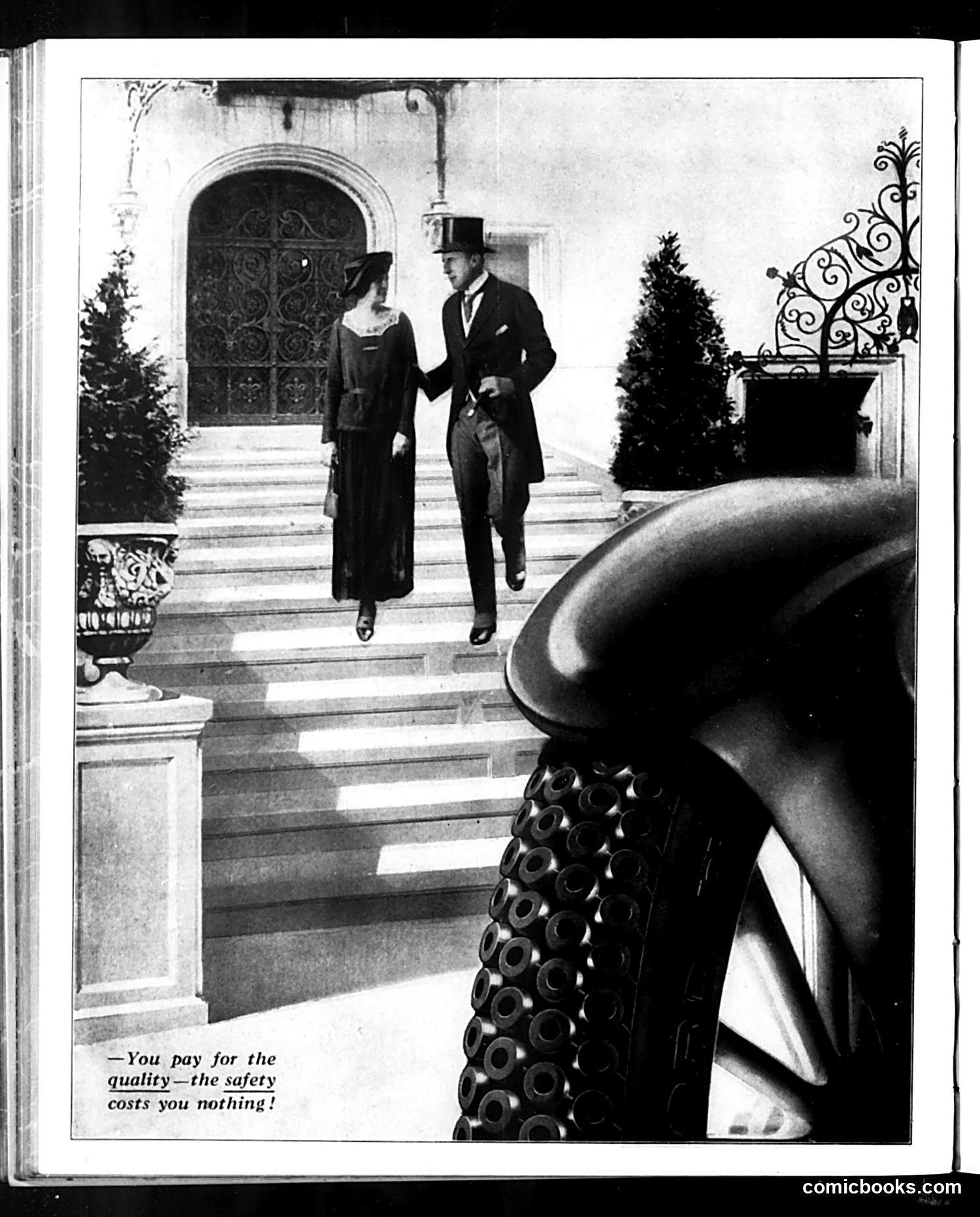
This appears to be a **tire advertisement** rather than political satire. The foreground shows a close-up of a tire tread with prominent grip patterns. The background depicts an elegantly dressed couple ascending steps toward an ornate doorway—a scene suggesting wealth and refinement. The caption reads: "You pay for the quality—the safety costs you nothing!" This is a marketing message claiming that the advertised tire brand offers superior safety features (the detailed tread design visible in the foreground) at no additional cost to consumers. The juxtaposition of luxury setting with practical tire safety suggests the brand positions itself as offering both quality and affordability to affluent buyers. This is product advertising, not political commentary.
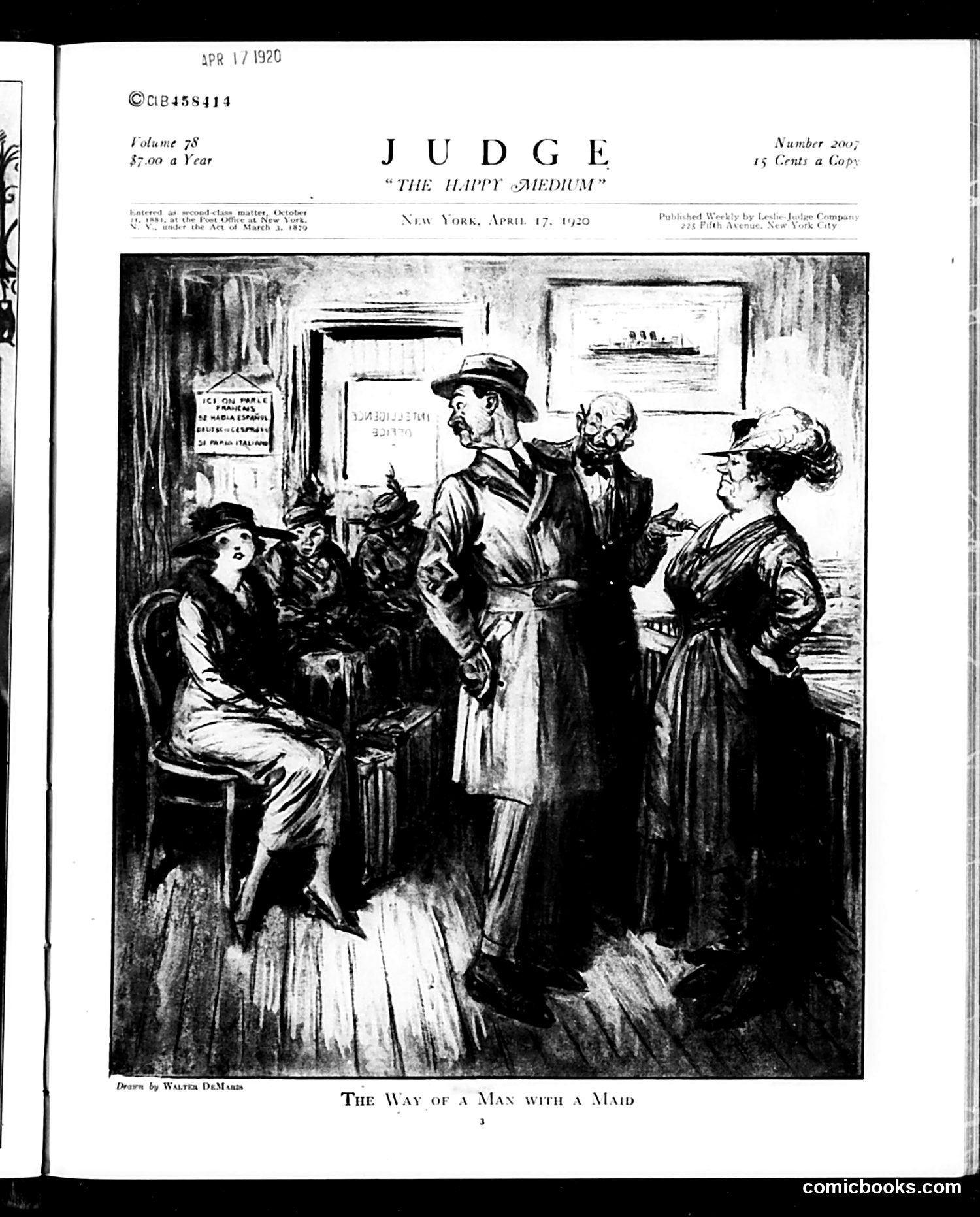
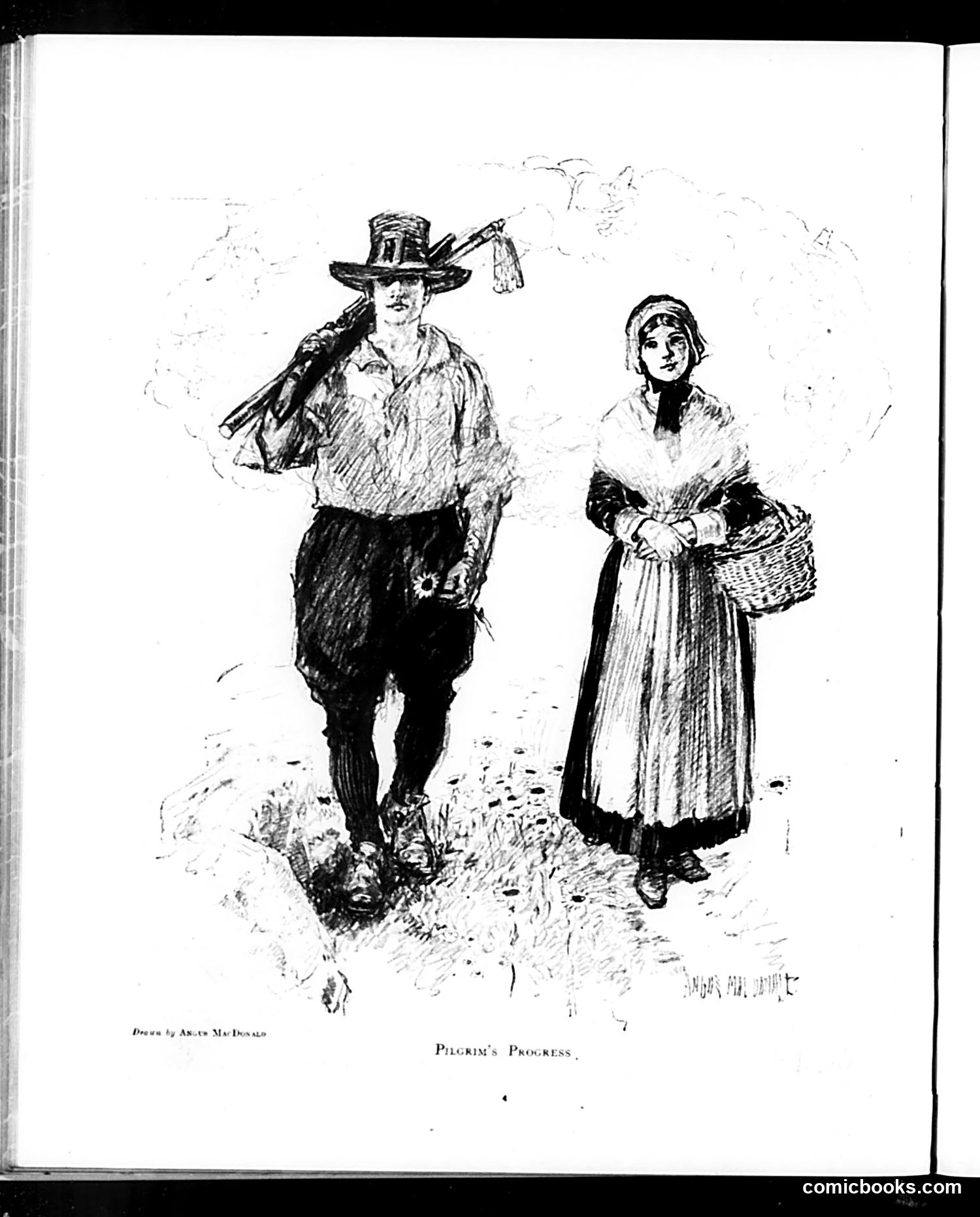
This illustration references John Bunyan's 17th-century religious allegory *The Pilgrim's Progress*, in which a character journeys toward spiritual salvation. The title suggests the two figures—a man and woman in period dress—represent pilgrims on a moral or spiritual journey. The man carries a rifle and appears rough or weathered, while the woman holds a basket, suggesting traditional gender roles. Given the publication in *Judge* (a satirical magazine), this likely satirizes contemporary social movements or reform efforts, possibly critiquing earnest progressives or religious movements of the era. The allegorical reference invites readers to question whether such "progress" represents genuine moral advancement or merely fashionable idealism. The artist credit reads "Drawn by A[?] MacDonald."
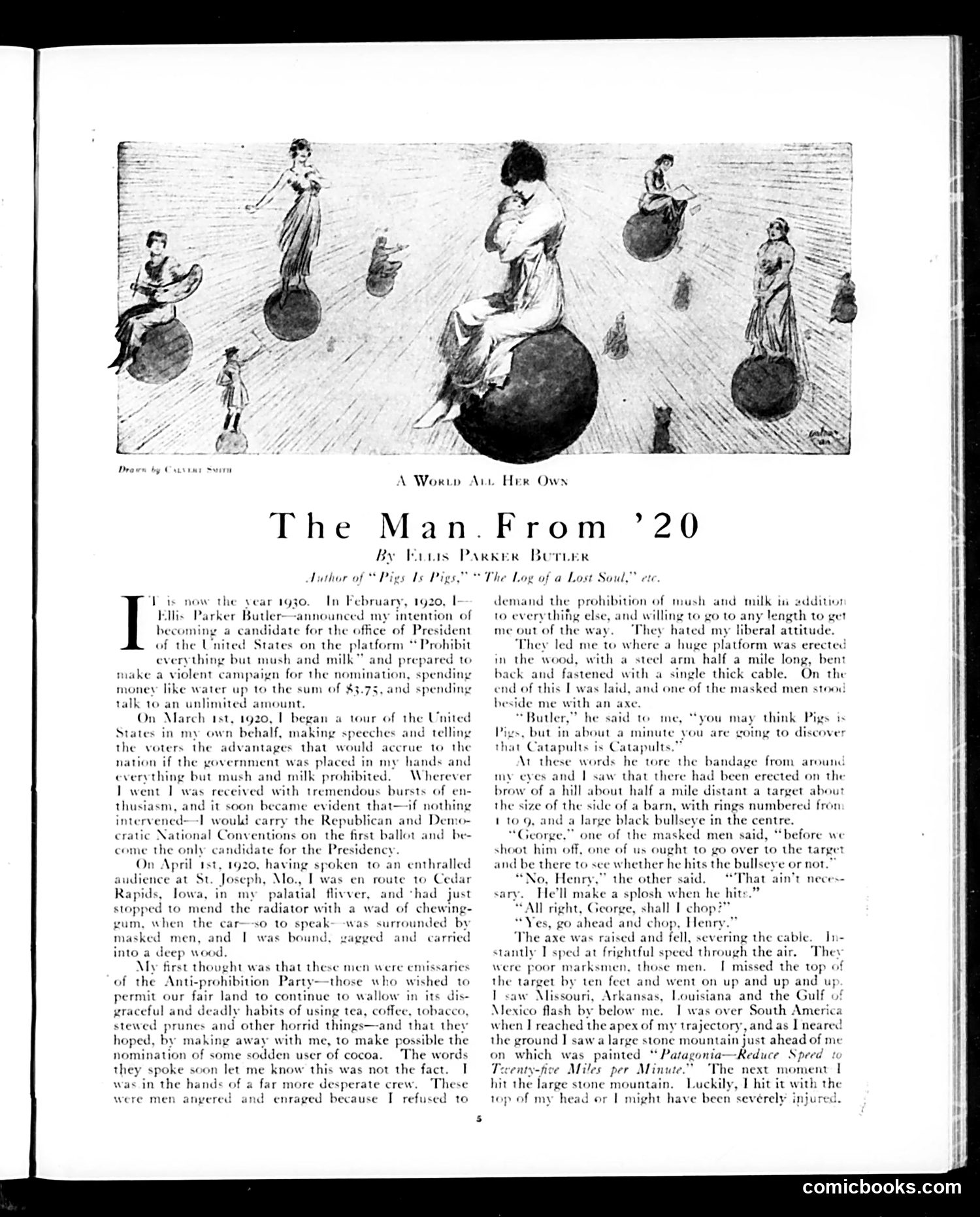
This satirical story accompanies a surreal illustration titled "A World All Her Own," depicting figures balanced on spheres in an impossible landscape. The narrative describes the author's 1920 presidential campaign as a Prohibition candidate, detailing absurd encounters—including masked men, an axe-severing a cable, and a target-shooting incident where the author apparently travels to "Patagonia" at tremendous speed. The satire mocks **Anti-Prohibition Party** operatives who wanted to block the nomination of a "sudden user of cocoa" as their candidate. The exaggerated, surreal events parody political desperation and the tactics employed during heated campaign competition. The illustration's dreamlike quality reinforces the story's absurdist humor about early 1920s political maneuvering.
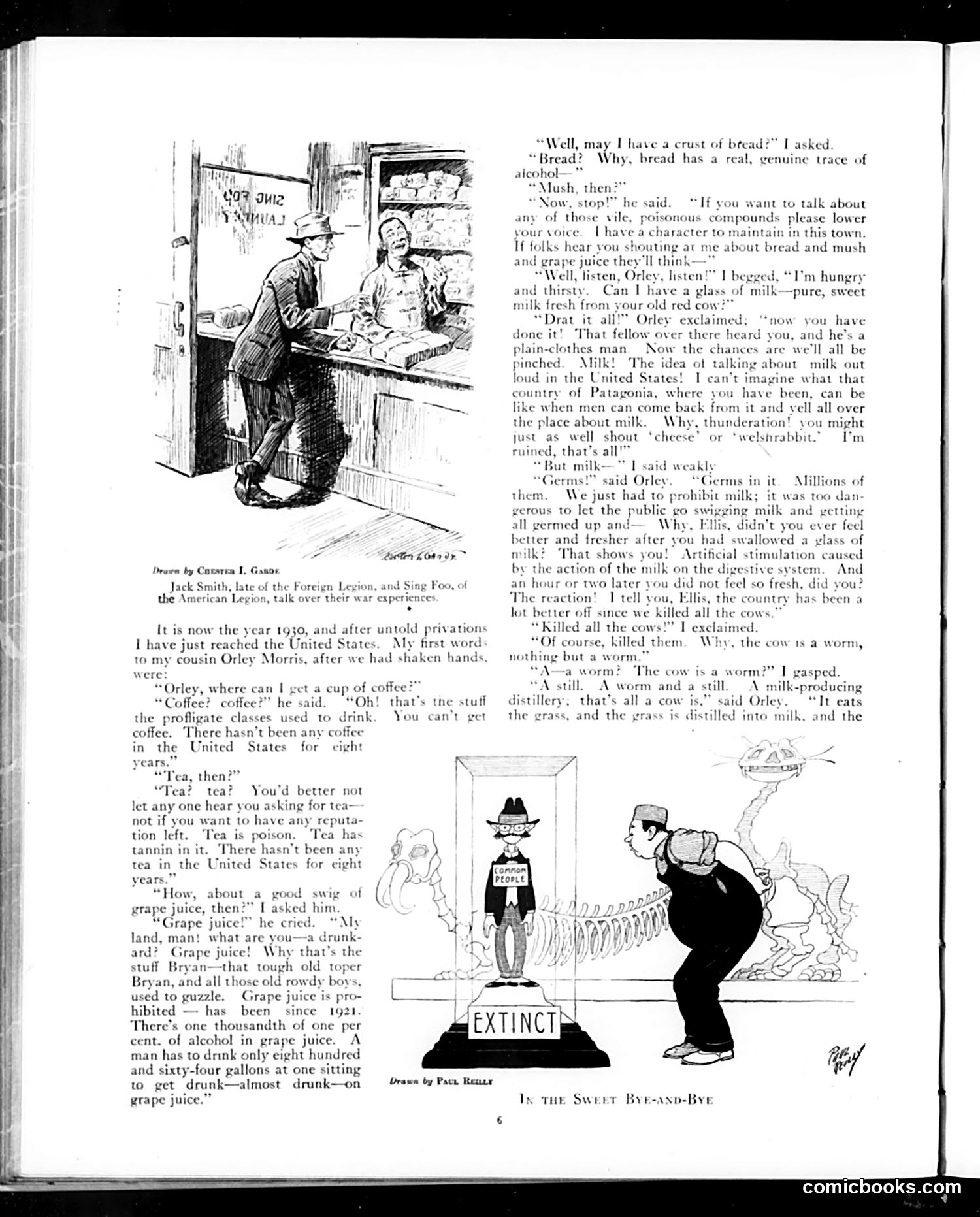
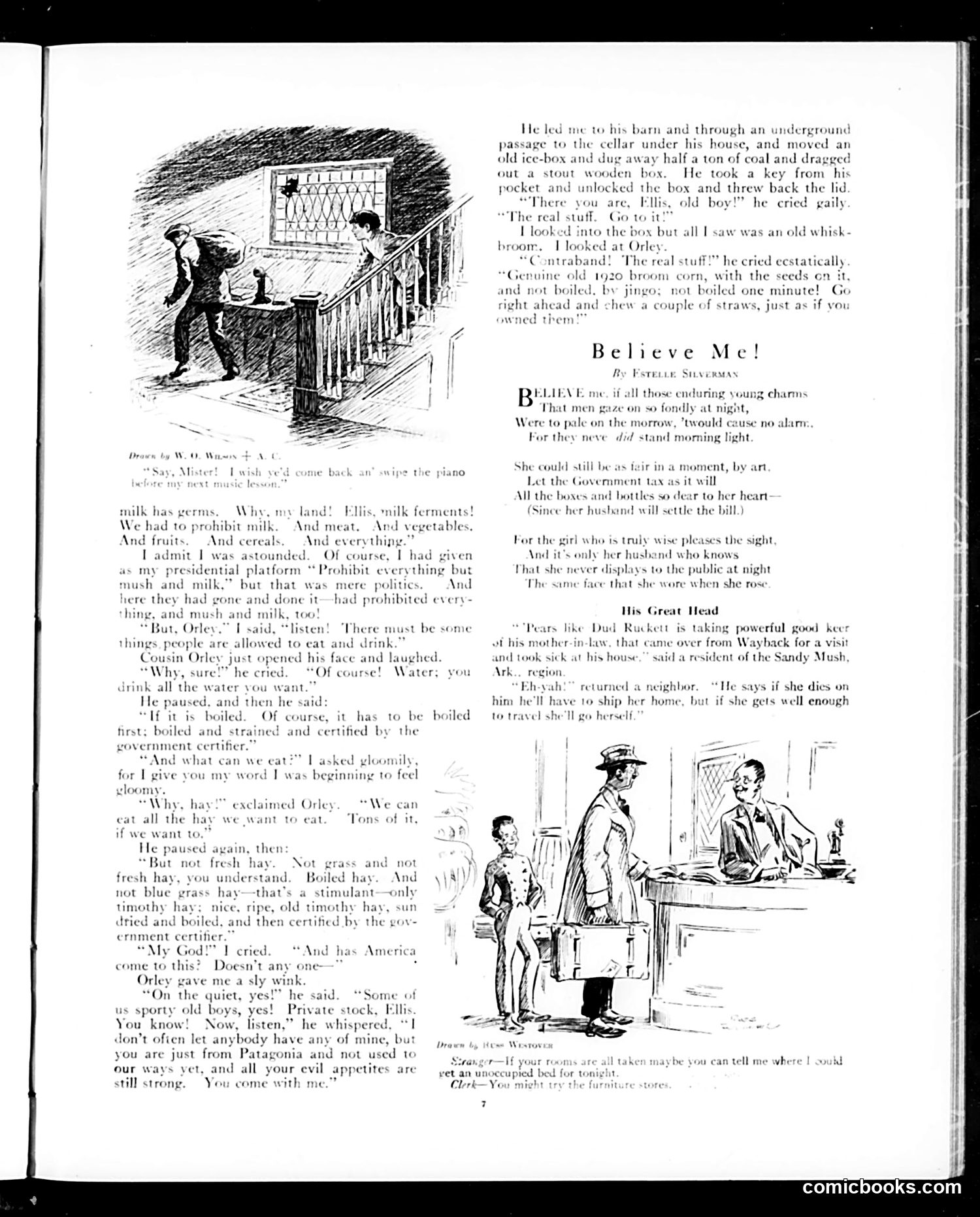
This page satirizes Prohibition-era enforcement and workarounds. The main narrative mocks a returning serviceman encountering strict American anti-alcohol laws (no coffee, tea, or alcohol in eight years). The top cartoon depicts a street vendor selling forbidden beverages. The dialogue highlights how Prohibition created absurd black-market substitutes—grape juice with minimal alcohol content that drinkers could consume in massive quantities to achieve intoxication. The bottom cartoon, titled "In the Sweet Bye-and-Bye," shows a man with an "EXTINCT" sign, likely representing either the alcohol industry or traditional drinking culture under Prohibition's enforcement. The satire mocks both Prohibition's severity and the ridiculous loopholes Americans exploited to circumvent it.
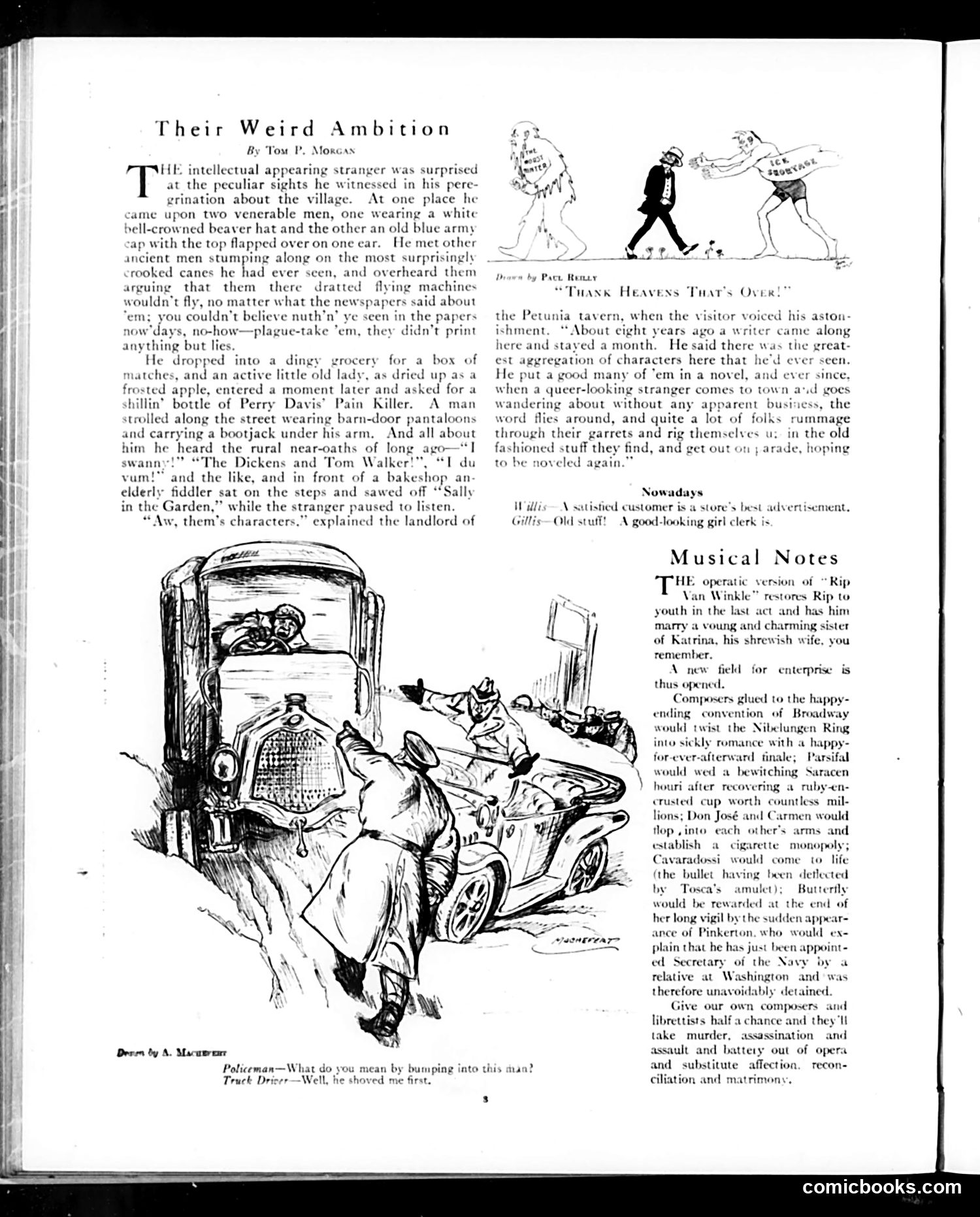
This satirical story mocks small-town nostalgia and literary pretension. An intellectual visitor observes rural characters dressed in old-fashioned clothing (beaver hats, barn-door trousers, carrying bootjacks) and speaking archaic rural dialect. The landlord explains that eight years prior, a writer stayed in town and novelized the locals. Now, whenever a stranger appears, the townspeople deliberately costume themselves in period attire and parade around, hoping to be "novelized again." The satire targets: (1) rural Americans' desire for literary fame, (2) their willingness to perform authenticity inauthentically, and (3) the writer's romanticization of rustic life. The joke is that the "characters" aren't genuine—they're manufactured performances designed to attract another novelist's attention. It's a commentary on how literary tourism and artistic interest can commodify and fabricate regional identity.
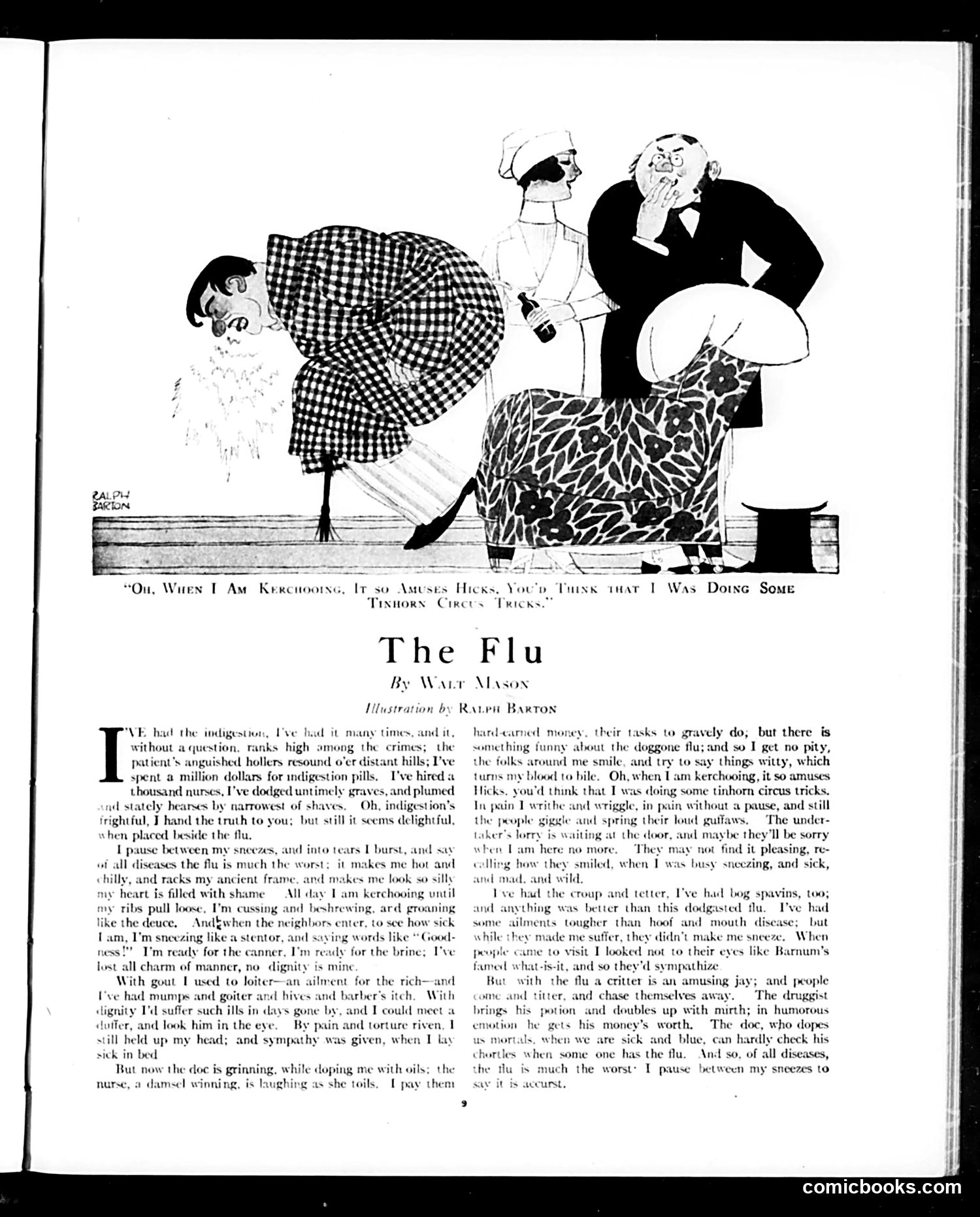
This is a humorous essay-poem lamenting the social indignity of having influenza, illustrated by Ralph Barton. The narrator compares the flu unfavorably to other serious ailments (gout, mumps, indigestion) he's previously endured with dignity. The satire targets how the flu strips away social standing: while serious diseases earned sympathy and respect, the flu—with its constant sneezing and pathetic appearance—becomes a source of ridicule. Neighbors and even medical professionals (the doctor, nurse, druggist) find his suffering amusing rather than pitiful. He's forced to squander "hard-earned money" on treatments while becoming a figure of comedy. The illustration shows well-dressed people laughing at a sneezing patient, emphasizing the social humiliation. Written during an era of influenza epidemics (likely post-WWI), Mason critiques how society treats flu victims as comic spectacles rather than genuinely ill people deserving compassion.
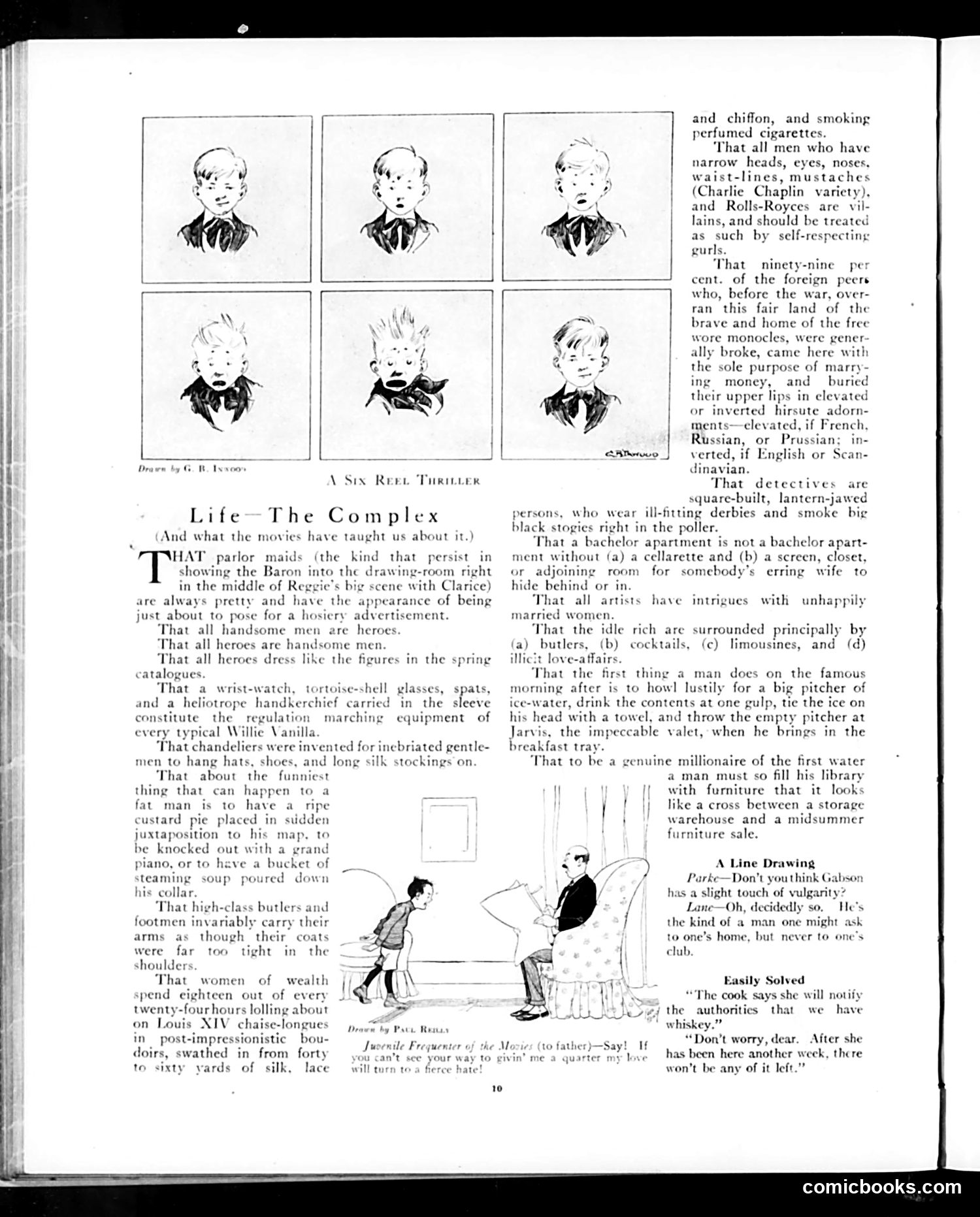
This page satirizes movie tropes and their influence on American attitudes. The top section—"A Six Reel Thriller"—shows six sketches of a man's face with varying expressions, illustrating how silent films exaggerated emotions for dramatic effect. The main article parodies what movies taught audiences to believe: that villains have narrow faces and Charlie Chaplin mustaches, that foreign aristocrats wore monocles and came to marry American heiresses, that detectives look square-jawed and crude, that rich women lounge constantly on Louis XIV furniture, and that millionaires' libraries resemble cluttered warehouses. The accompanying cartoons mock domestic absurdities—a butler's formality, a wife hiding from a boyfriend, a cook's whiskey theft. The satire targets how cinema created false stereotypes about class, nationality, and behavior that Americans uncritically accepted as reality.
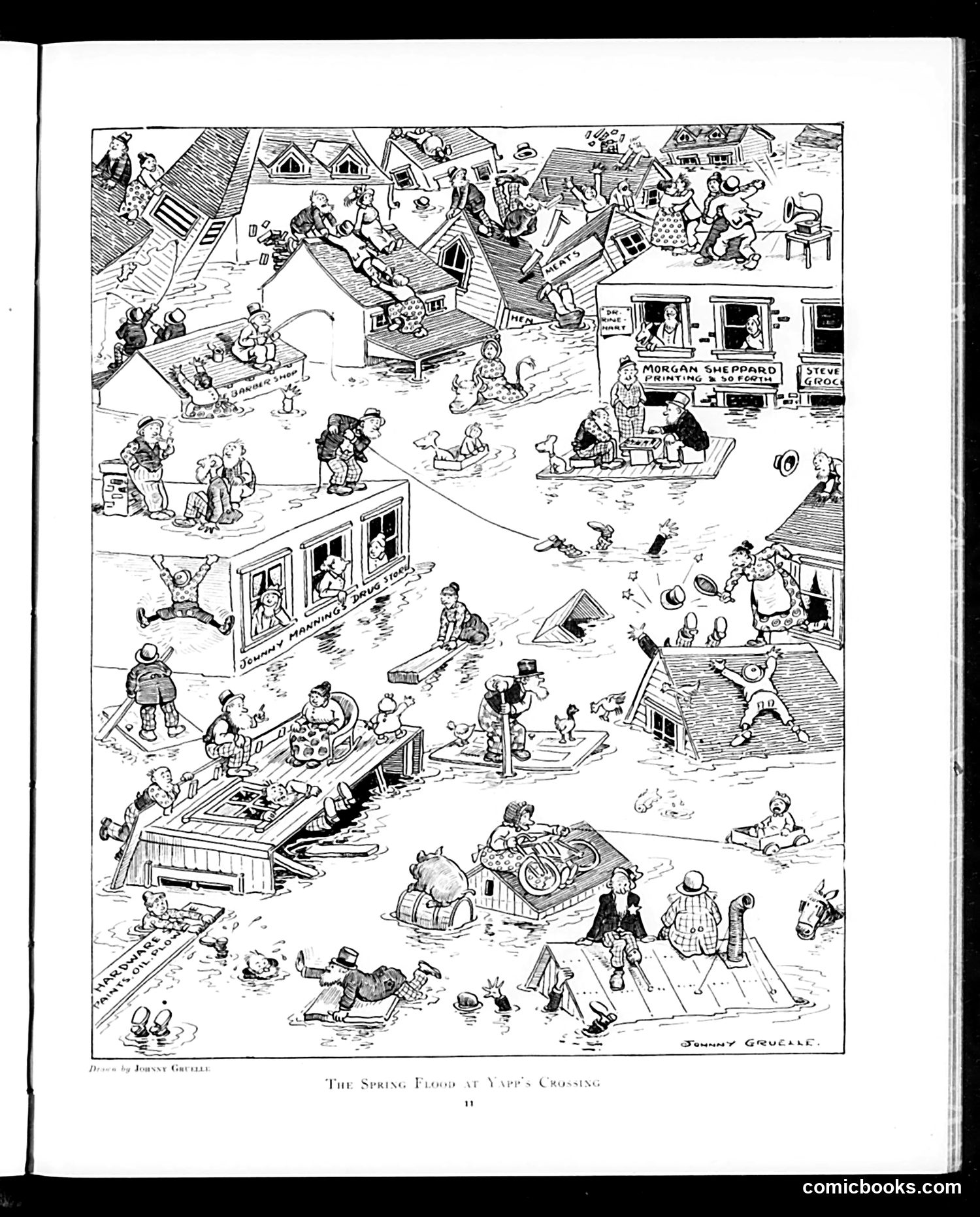
This is a single-panel cartoon by Johnny Gruelle depicting a chaotic spring flood scene at a rural crossing. The illustration shows widespread water damage affecting an entire community—houses partially submerged, possessions floating away, people in various states of distress attempting rescue efforts. The satire appears to target the vulnerability of riverside communities to seasonal flooding and the resulting social disorder. Various figures—including what appear to be shop owners (signs visible for "Morgan Sheppard" and "Steve Legg"), residents, and onlookers—scramble amid the disaster. The cartoon likely comments on inadequate infrastructure or preparedness for natural disasters, presenting the flood as both tragedy and dark comedy through Gruelle's exaggerated, crowded composition showing multiple simultaneous misfortunes.
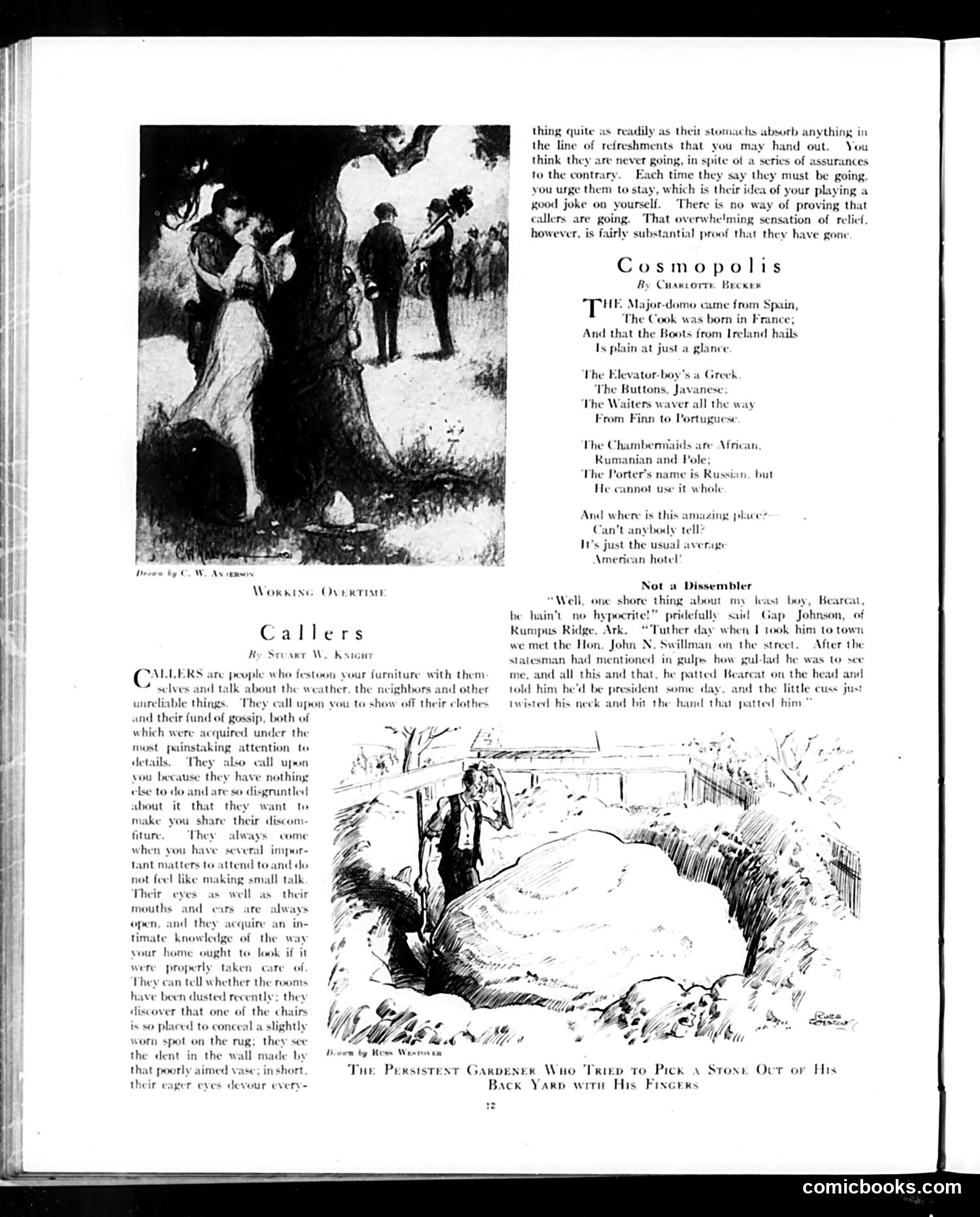
This page contains three satirical pieces from *Judge* magazine: **"Cosmopolis"** by Charlotte Becker mocks American hotels' international staffing. The poem catalogs employees from Spain, France, Ireland, Greece, Java, Portugal, Africa, Romania, Poland, and Russia—then reveals the punchline: it's "just the usual average American hotel." The satire criticizes how American establishments exotic-ize their workers while remaining fundamentally ordinary, playing on early 20th-century fascination with (and anxiety about) immigrant labor. **"Callers"** by Stuart W. Knight humorously describes unwanted social visitors who monopolize time, scrutinize homes, and overstay their welcome—a relatable complaint about intrusive etiquette callers common in that era. **"Not a Dissembler"** depicts rural character "Gap Johnson" proudly claiming his son has no hypocrisy, then immediately contradicting himself with an anecdote proving the boy is actually dishonest. The joke relies on backwoods dialect humor common to period satire.
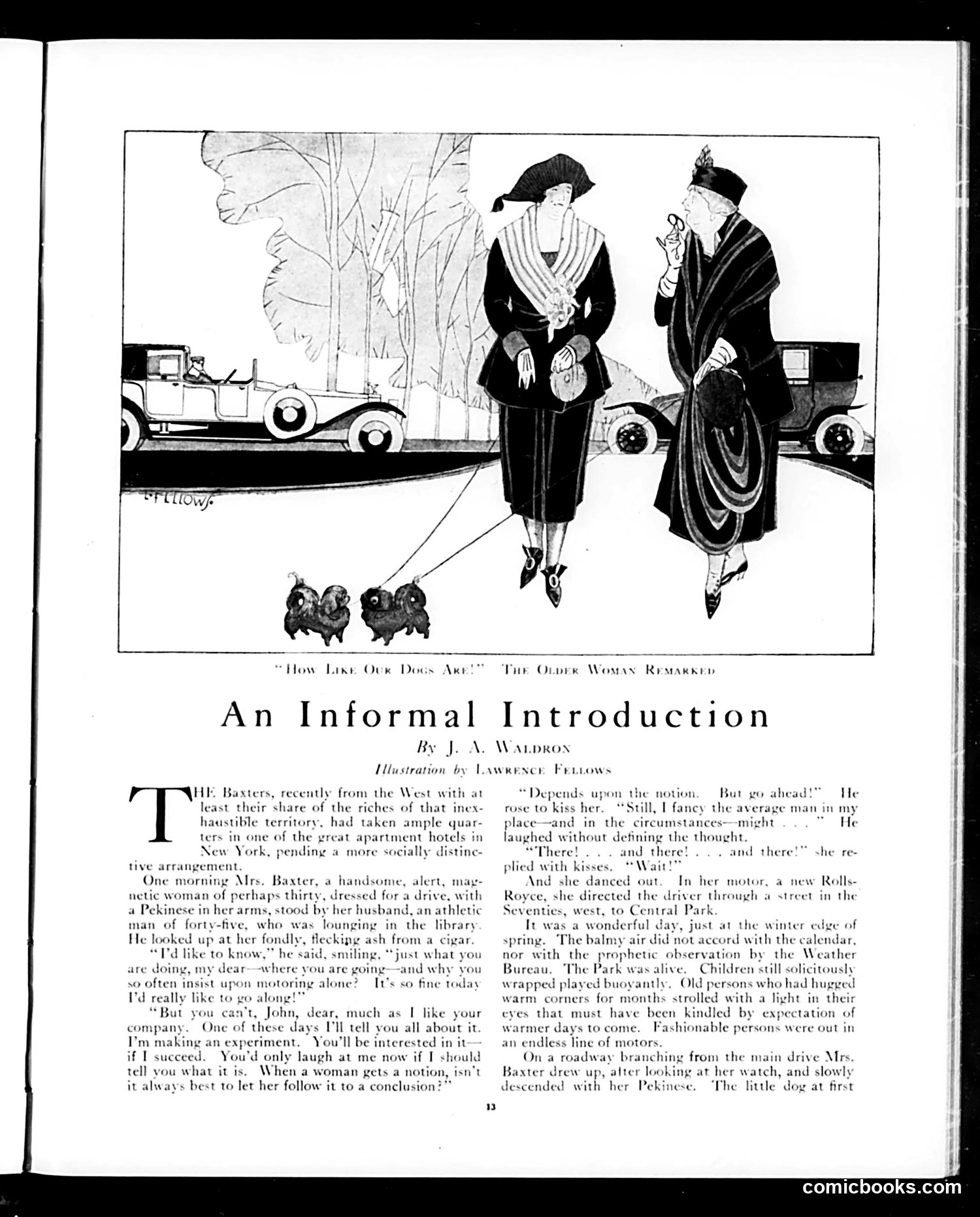
This is the opening of a short story titled "An Informal Introduction" by J.A. Waldron, illustrated by Lawrence Fellows. It's not primarily political satire, but rather social comedy about wealthy nouveau-riche characters. The narrative introduces the Baxters—recent Western wealth arrivals in New York seeking social legitimacy. Mrs. Baxter, a fashionable woman of thirty, is departing for a mysterious "experiment" by motor car with her Pekinese dog, while her indulgent but curious husband stays behind. The humor targets early 1920s upper-class pretension: the couple's conspicuous consumption (Rolls-Royce, apartment hotels), Mrs. Baxter's mysterious activities, and marital dynamics where husbands fund wives' unexplained outings. The illustration shows fashionably dressed women with small lap dogs—visual markers of wealth and leisure class status that readers would recognize as satirical targets of Judge magazine's middle-class perspective.
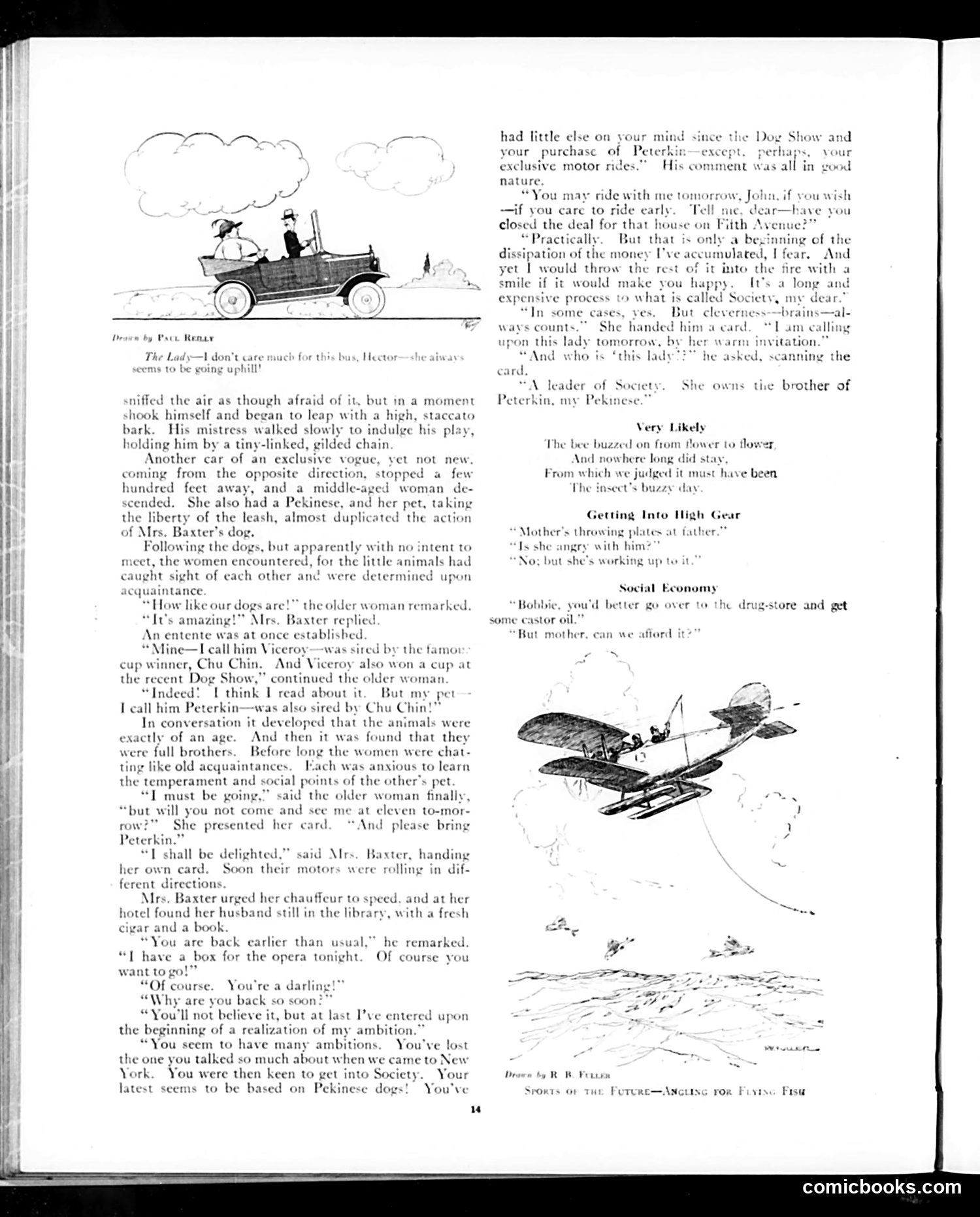
This satirical story mocks the shallow materialism of American high society. Two wealthy women meet when their Pekingese dogs (fashionable breed symbols of wealth) encounter each other. They quickly bond over dog pedigrees and show wins, discovering their pets are brothers—which becomes their basis for social connection. The husband's commentary exposes the satire: his wife previously obsessed over "getting into Society," now she pursues it through acquiring an expensive dog and befriending a society "leader" who owns the dog's brother. He sardonically notes she'll spend fortunes on this social-climbing scheme. **The joke:** Judge ridicules how arbitrarily wealthy people form social bonds—not through genuine compatibility or character, but through owning matching status symbols (here, purebred dogs). The absurdity is that a chance dog encounter becomes the basis for entering elite circles, revealing society's emptiness and the wife's easily redirected ambitions.
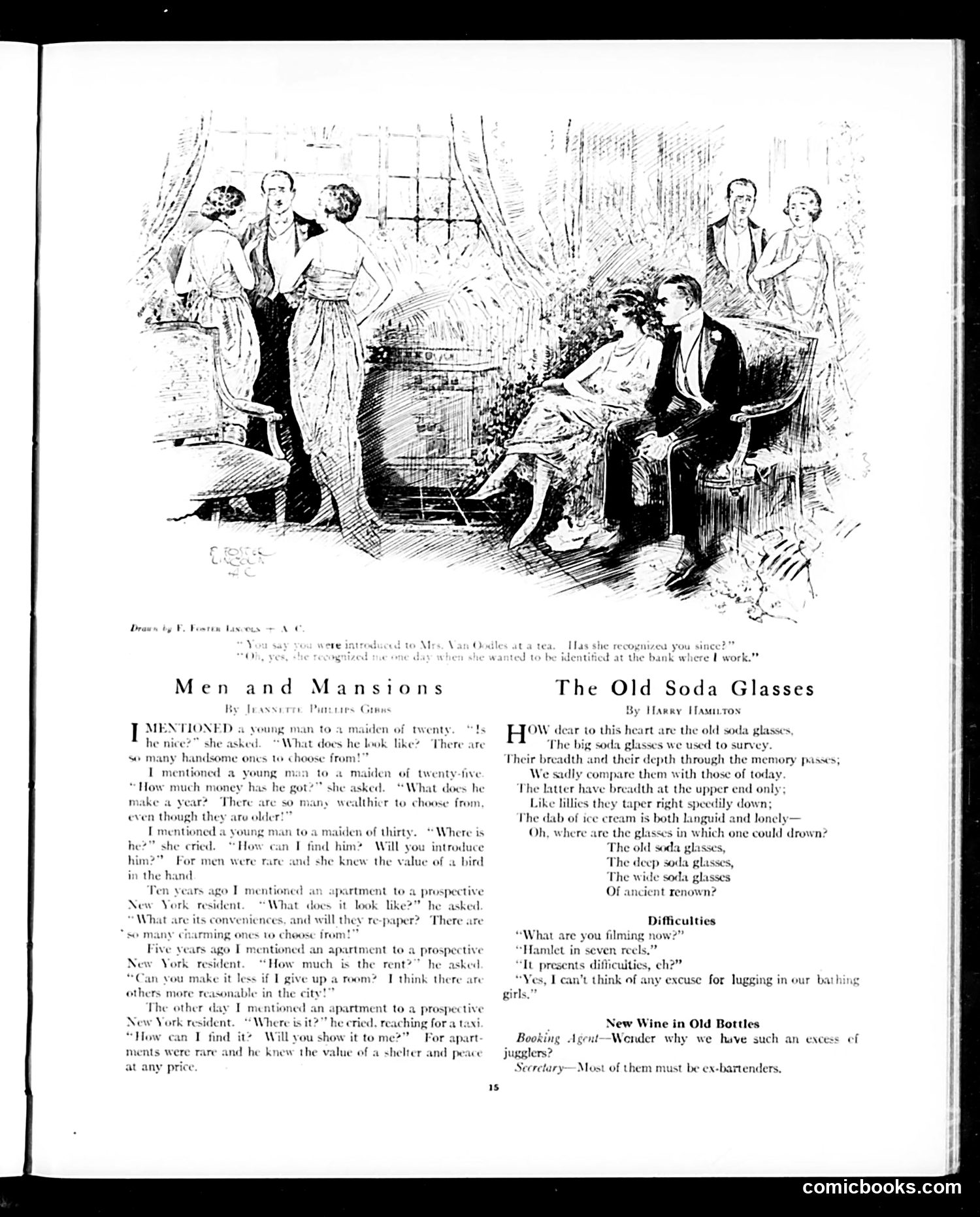
**"Men and Mansions"** satirizes changing American priorities across generations. The comic shows a narrator repeatedly trying to introduce eligible men to women of different ages—a 20-year-old asks "Is he nice?", a 25-year-old asks "What does he make a year?", and a 30-year-old demands "Where is he?"—implying women become increasingly mercenary with age. The parallel structure then applies this same progression to apartment-hunting: a prospective renter asks about amenities, then rental price, then simply *where* the apartment exists, willing to pay anything. The joke conflates marriage-seeking with real-estate desperation, suggesting both involve settling for less as options dwindle. **"The Old Soda Glasses"** is nostalgic verse lamenting that old-fashioned, wide soda glasses have been replaced by tapered modern ones, unable to hold satisfying portions of ice cream. It's a gentle complaint about declining quality and generosity in consumer goods. The page also contains brief comedic notes about film production excuses and a quip about unemployed bartenders becoming jugglers.
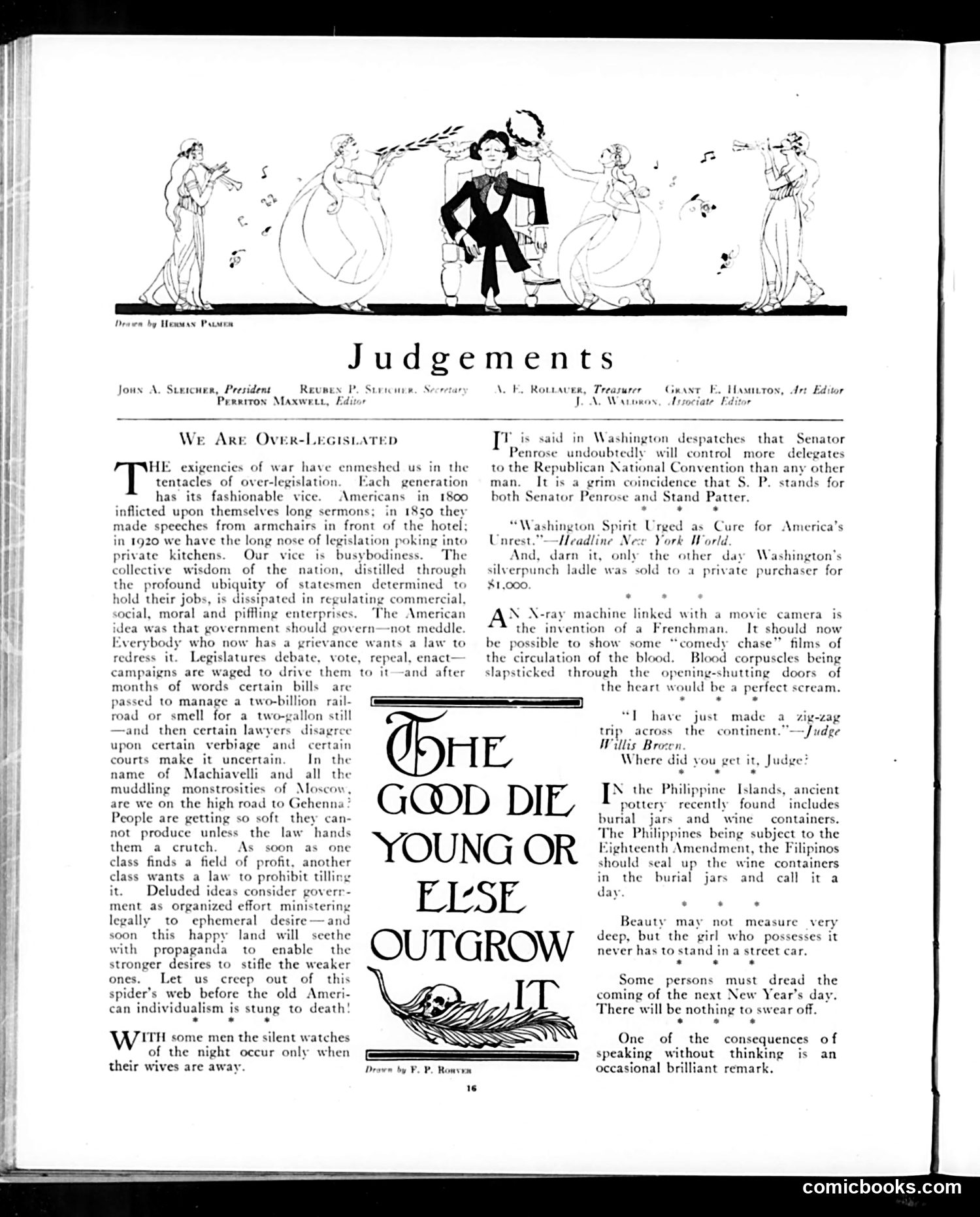
This 1920s satirical piece attacks excessive government regulation, a major conservative complaint of the post-WWI era. The main article argues that American legislative bodies have become busybodies meddling in private affairs—from kitchen regulations to railroad management to alcohol prohibition (the "two-gallon still" reference). The central irony: the article decries "over-legislation" while the page itself is titled "Judgements," suggesting the magazine's own moralizing commentary. Key targets include: - **Prohibition enforcement** (the illegal still reference) - **Government paternalism** replacing individual responsibility - **Class warfare** through legislation (one class prohibiting another's profits) - **Bureaucratic uncertainty** where lawyers and courts muddy legislative intent The smaller jokes mock contemporary absurdities: an X-ray machine showing blood circulation as entertainment, Philippine wine jars being sealed under the 18th Amendment, and social pretensions. The overall message: American individualism is dying under the weight of well-intentioned but suffocating government intervention.
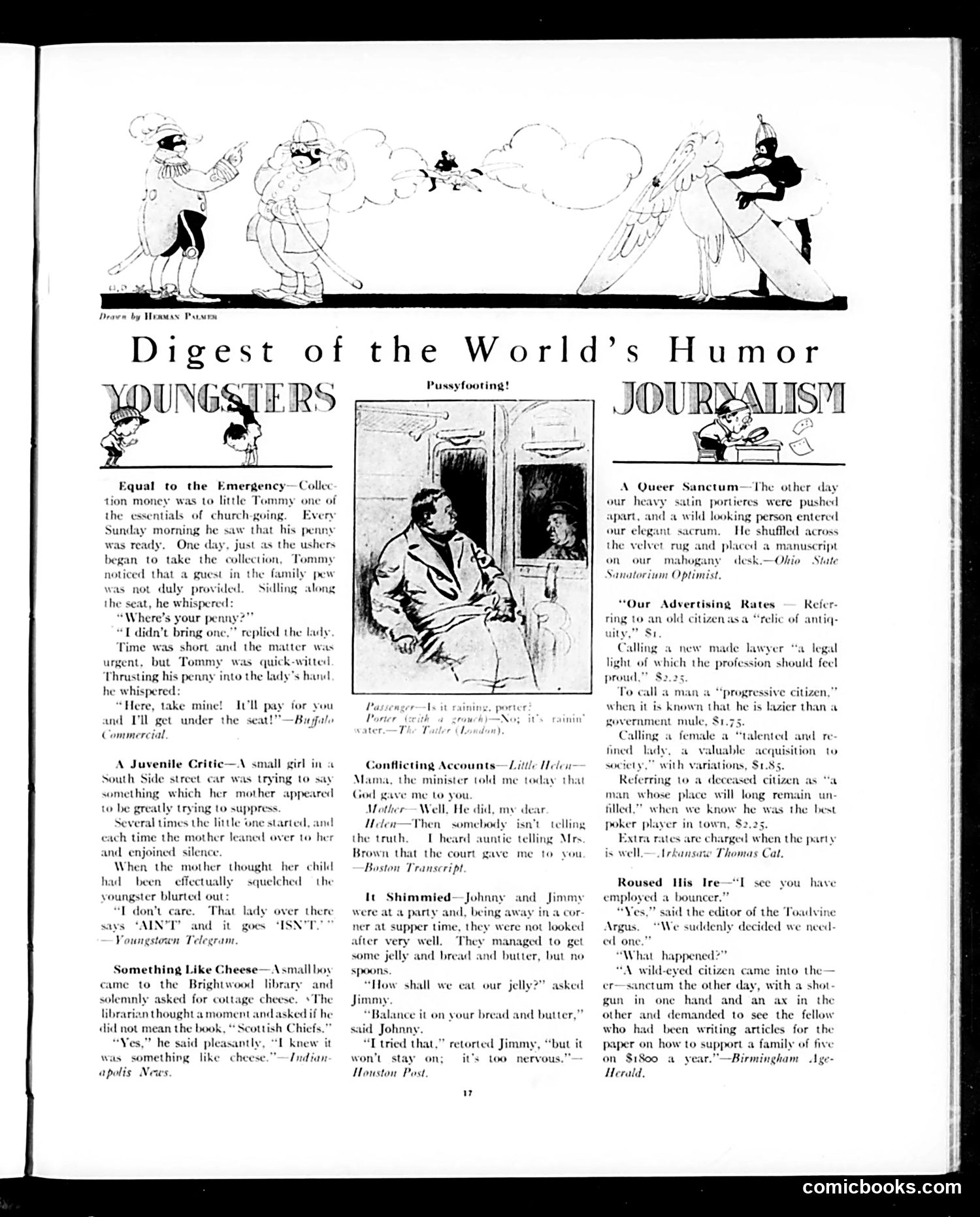
This is a humor digest page from *Judge* magazine, featuring short comedic anecdotes drawn from various American newspapers. The page contains no political cartoons—only satirical text jokes. The humor relies on children's innocent literalism and adult misunderstandings: - **"Equal to the Emergency"**: A boy offers his church collection penny to a guest, expecting to "get under the seat" instead—playing on the phrase "pay for." - **"A Juvenile Critic"**: A girl conflates "isn't" with "ain't," defying her mother's attempts at propriety. - **"Something Like Cheese"**: A boy confuses "cottage cheese" with the book *Scottish Chiefs*. - **Conflicting Accounts**: A child notes contradictions between religious instruction (God gave her to mother) and legal reality (court awarded custody). Other jokes mock journalism clichés (calling someone a "relic of antiquity") and social pretense. The "Roused His Ire" item satirizes newspaper advice columns—a man violently objects to financial guidance he deems unrealistic. The humor is genteel, family-oriented satire typical of early 20th-century American magazines.
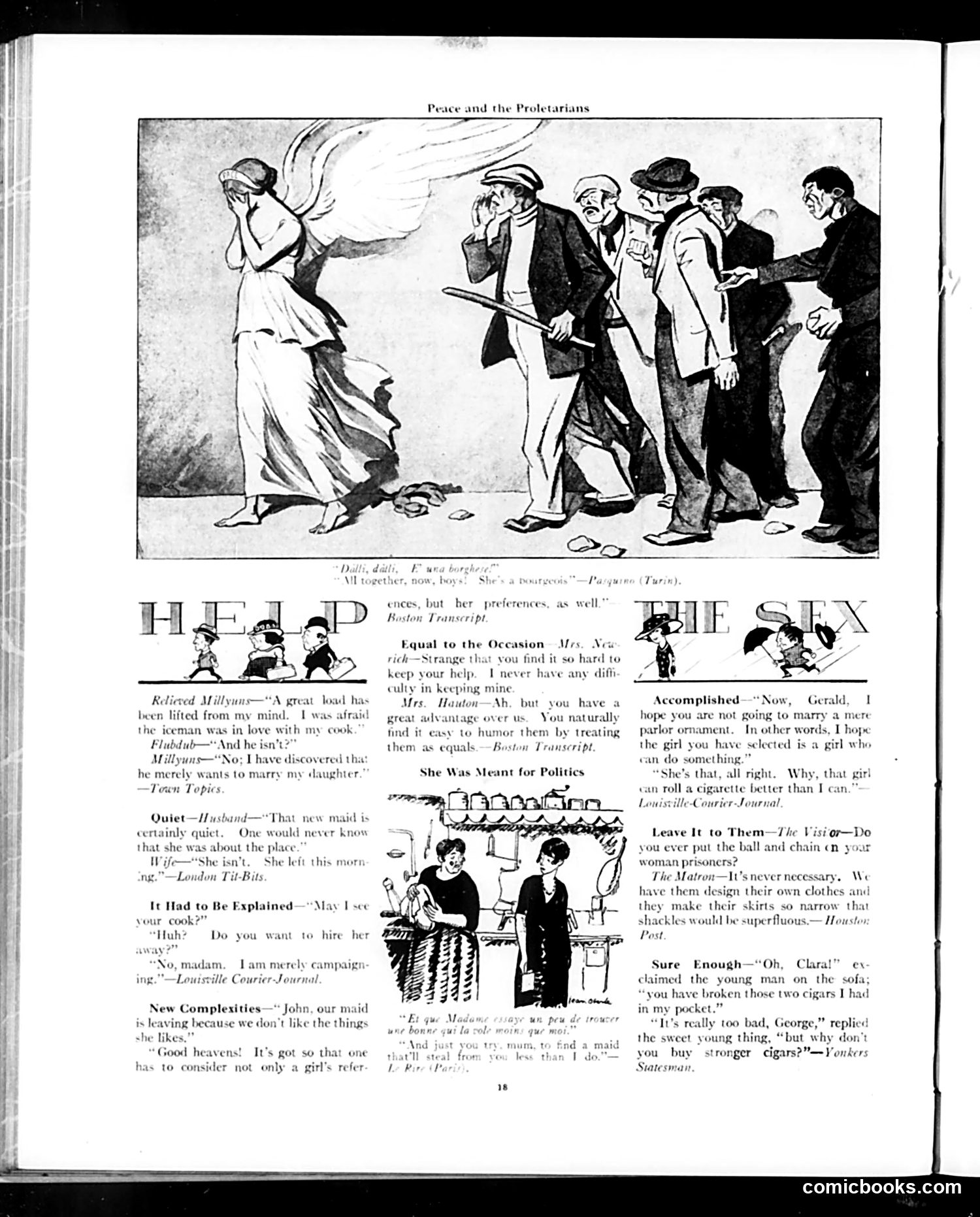
The top cartoon, titled "Peace and the Proletarians," depicts a winged Peace figure confronting working-class men (identifiable by their caps and rough clothing). The satire addresses labor unrest and class conflict—likely referring to early 20th-century socialist or labor movements. Peace appears to be pleading with or warning the "proletarians" (working class), suggesting contemporary anxieties that workers' political activism threatened social stability. The page's humor columns below mock domestic life, particularly servants and women. They trade on period anxieties: maids leaving employment, women's independence, and changing gender roles. The final joke about narrow skirts replacing shackles for female prisoners uses fashion as metaphor for female constraint—dark humor suggesting women's fashion itself imprisons them, while simultaneously mocking women's vanity. Overall, the page reflects early-1900s class tensions and shifting gender dynamics, presented through Judge magazine's satirical lens targeting both labor movements and modern women.
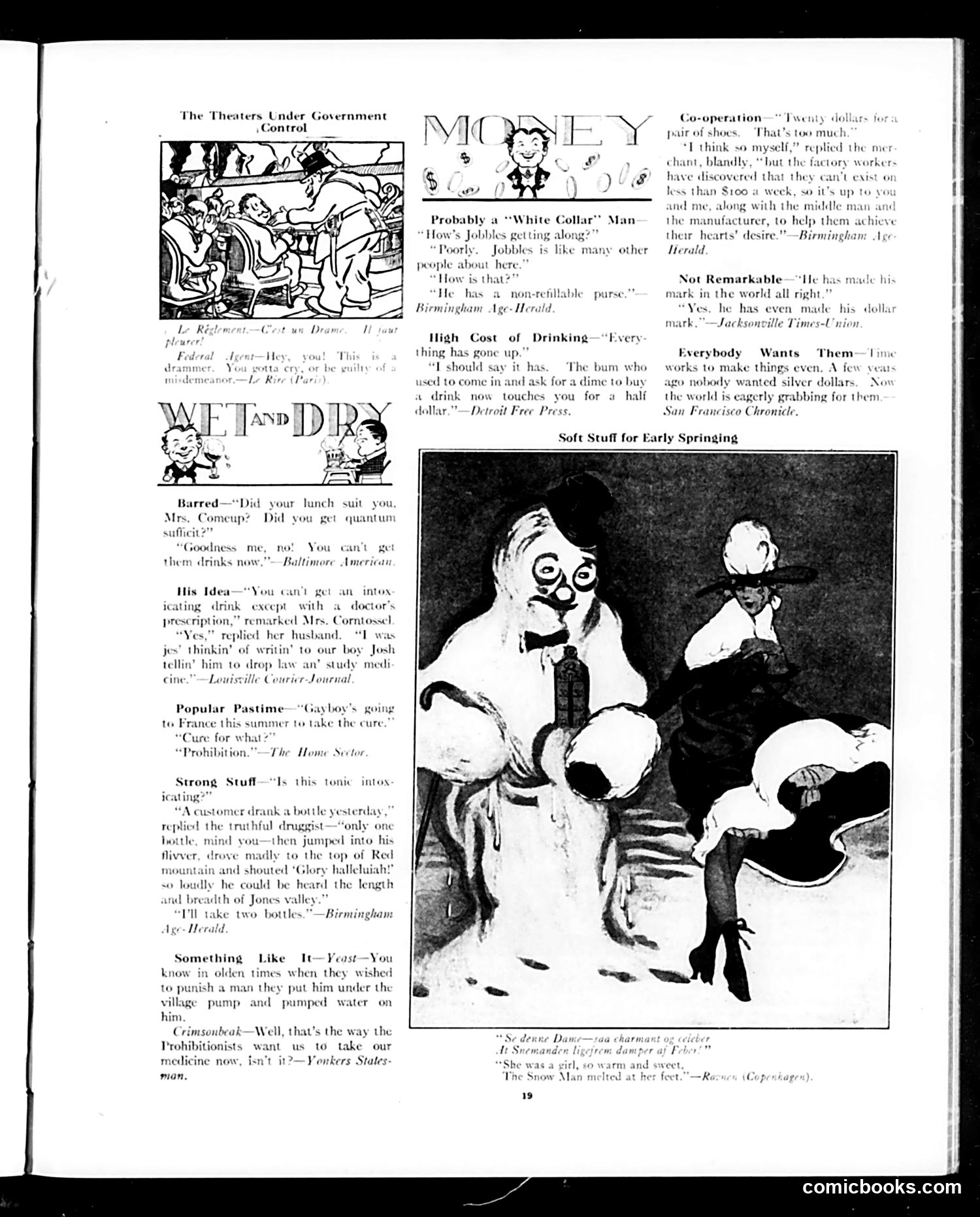
This page satirizes **Prohibition** and its economic/social consequences. The "Wet and Dry" section collects brief jokes mocking the alcohol ban: **Key targets:** - **Rising drink prices**: A beggar once asked for a dime; now he demands fifty cents—inflation driven by illegality - **Doctor's prescriptions loophole**: People now pretend to seek medical treatment to obtain alcohol legally - **Economic hardship**: Workers can't afford basics (shoes cost $100/week); the "bum" who once panhandled for drinks now demands money from middle-class patrons - **Widespread evasion**: Even druggists admit customers are getting intoxicated; people travel to France seeking "cures" (code for drinking) The cartoon at bottom shows "The Snow Man"—likely a whimsical winter character—presumably representing Prohibition's cold, joyless grip on American life. **Context**: Judge was anti-Prohibition, using humor to highlight how the ban created black markets, inflation, and hypocrisy while failing to stop drinking.
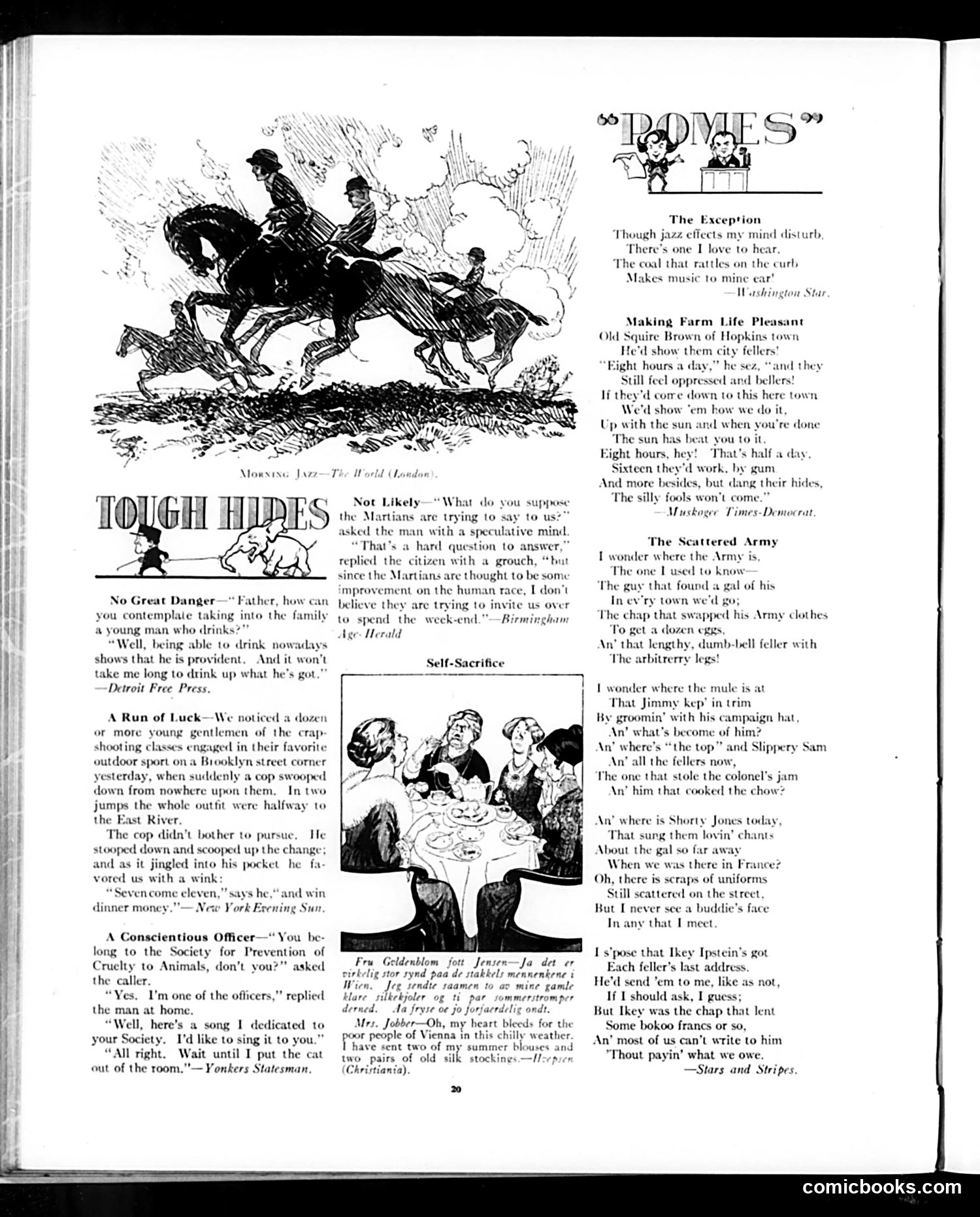
This page contains several brief satirical comics and poems reflecting early 20th-century American concerns: **"Tough Hides"** section presents cynical one-liners mocking social issues: Prohibition-era drinking, police corruption (a cop pocketing craps-game winnings), and animal welfare hypocrisy. **"Self-Sacrifice"** depicts wealthy people donating cast-offs to the poor—old silk stockings to Vienna's needy—presented as supposed charity while clearly self-serving. **Poetry section** includes farm-life humor, anti-jazz sentiment (with one exception), and notably "The Scattered Army"—nostalgic verse about WWI soldiers, reflecting post-war displacement and the difficulty soldiers faced reintegrating into civilian life. The overall tone is cynical about human nature: corruption, hypocrisy, class indifference, and the forgotten veteran. These were common Judge themes during the 1920s-era social upheaval.
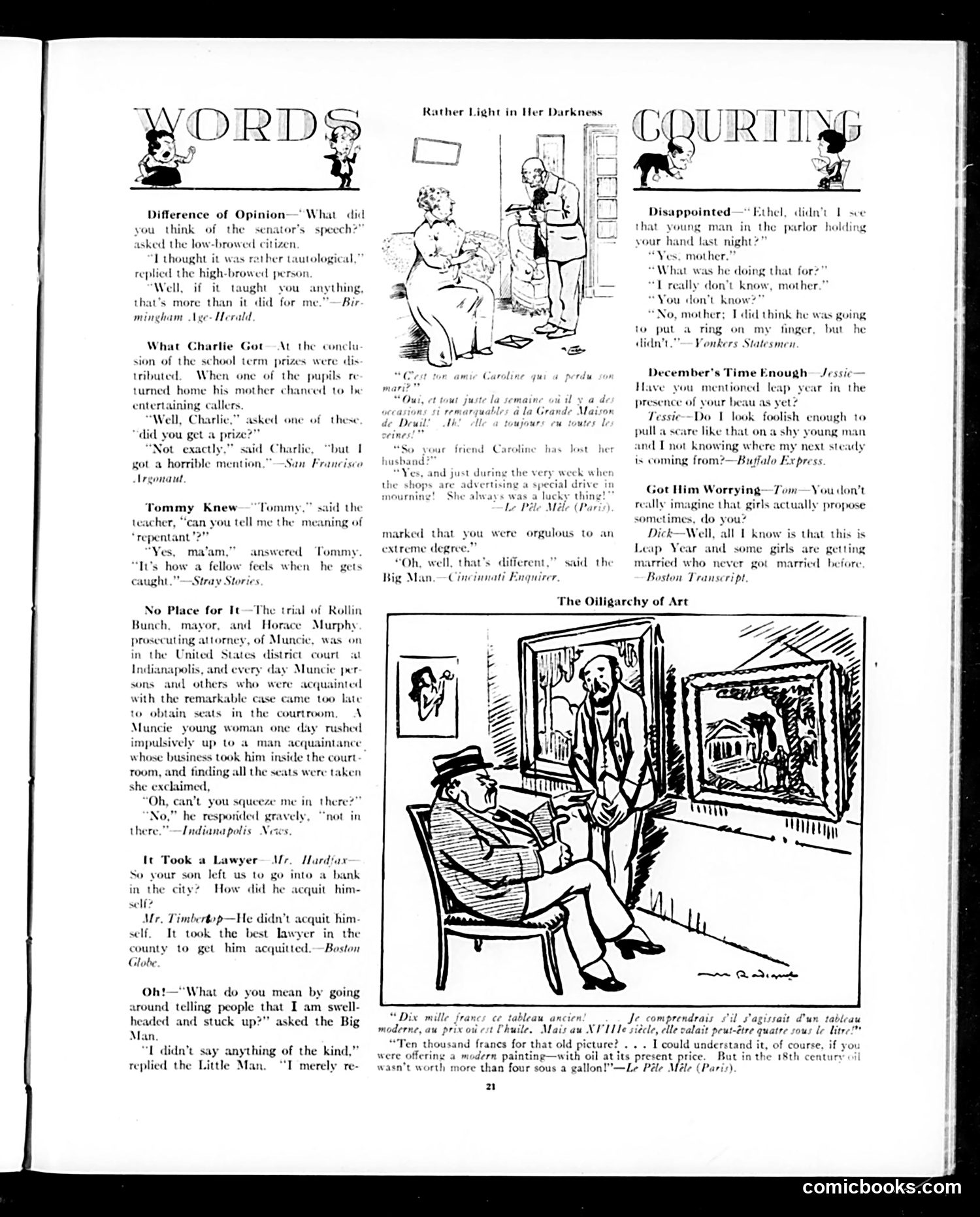
This page contains **short humorous anecdotes** rather than political cartoons, typical of Judge's format. The jokes satirize early 20th-century American social pretensions and gender dynamics: **Key satirical targets:** 1. **Intellectual pretension**: "Difference of Opinion" mocks high-minded language (calling a speech "tautological") as meaningless decoration. 2. **Academic mediocrity**: "What Charlie Got" jokes that a student received only "honorable mention"—a participation trophy of sorts. 3. **Gender roles**: Multiple items mock women's romantic behavior. "Disappointed" suggests women passively wait for men to propose during leap year (when tradition allowed women to propose). "December's Time Enough" implies women strategically date before leap year arrives. 4. **Class/legal commentary**: "No Place for It" and "It Took a Lawyer" reference a real Muncie, Indiana scandal, satirizing both courtroom spectacle and class access to justice. **The single cartoon** ("The Oilarchy of Art") depicts art dealer negotiations, with French captions mocking overpriced "old masters"—suggesting modern commercial art fraud. Overall, the page reflects genteel, turn-of-the-century American humor targeting social climbers and outdated gender conventions.
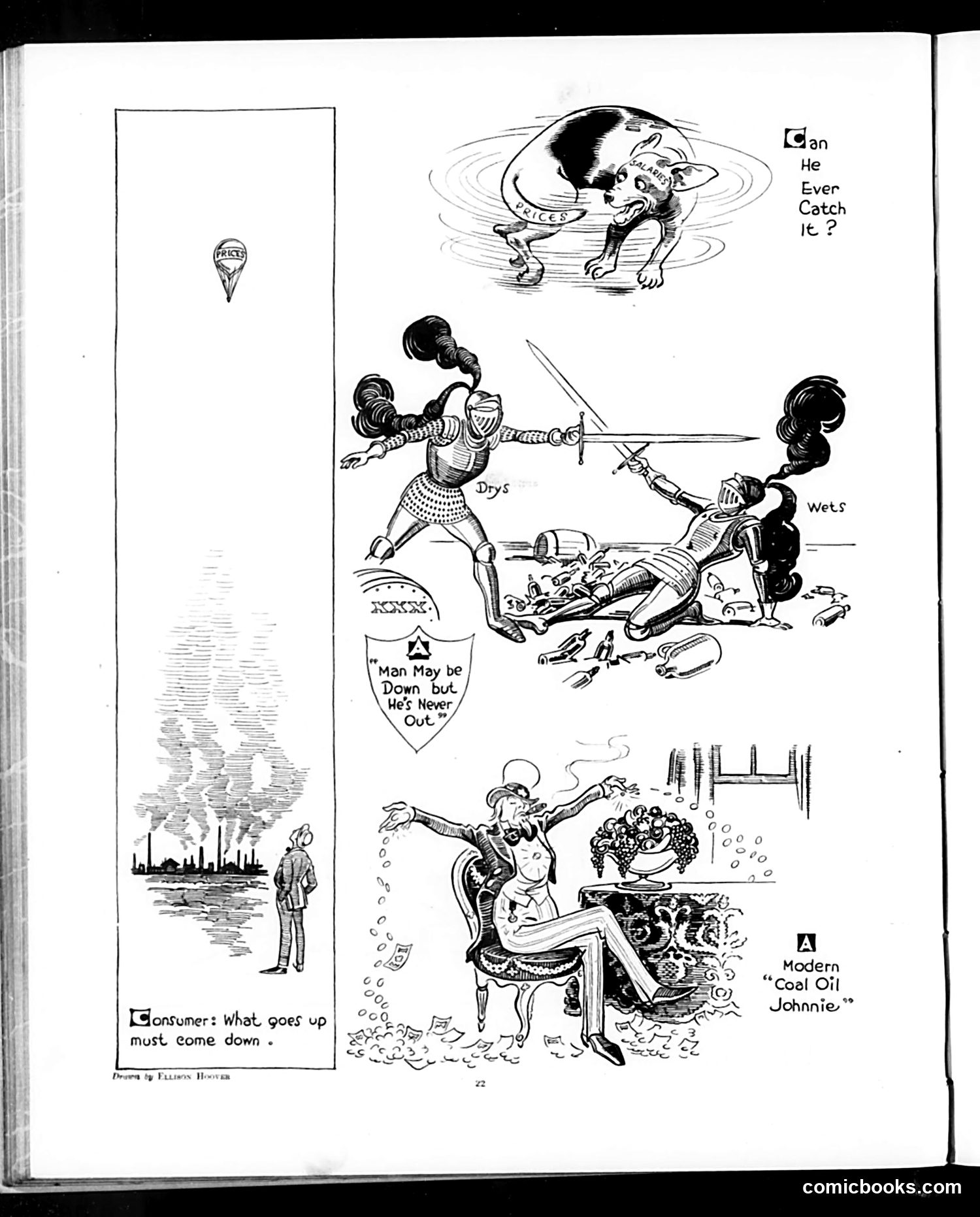
This page from *Judge* magazine contains satirical cartoons criticizing oil industry practices and wealth disparity. The left panel shows industrial smokestacks with the caption "Consumer: what goes up must come down"—likely critiquing how pollution and costs rise while profits descend to ordinary people. The right panel depicts "Cool Oil Johnnie" (a caricatured wealthy oil magnate) in various scenarios: juggling money while labeled "Drys" and "Wets" struggle below, and bathing in wealth. The figure represents excessive oil-industry riches amid economic hardship. The top vignette asking "Can He Ever Catch It?" appears to reference speculative bubbles or unsustainable wealth accumulation. Overall, the cartoons mock oil-industry excess and the disparity between corporate profits and consumer welfare during the early-to-mid 20th century energy sector debates.
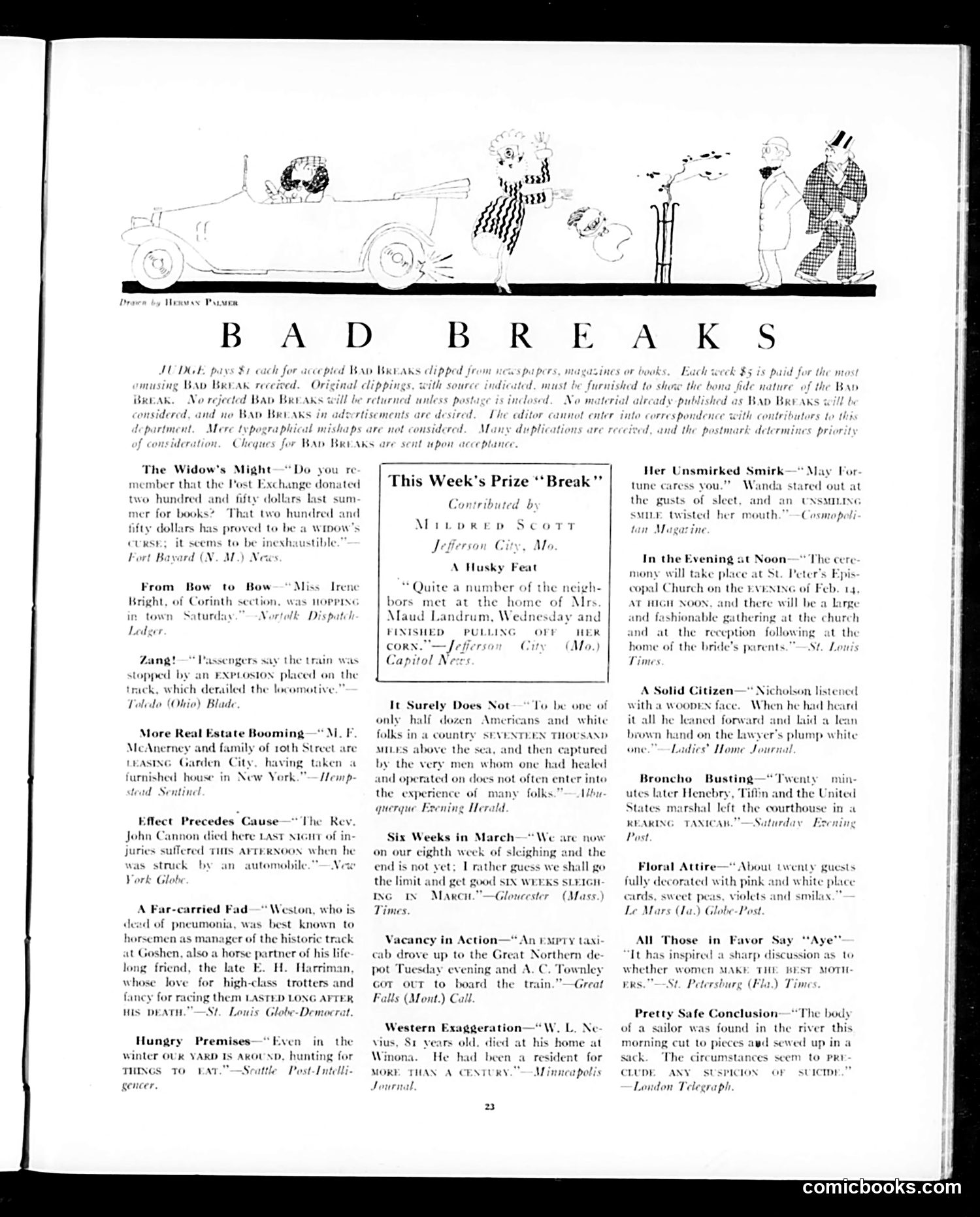
This is a **"Bad Breaks" section**—a regular Judge feature that collected humorous newspaper clipping errors and contradictions. The cartoon at top, by Herman Pfeifer, illustrates the concept: absurd juxtapositions or logical impossibilities extracted from real newspaper text. The page shows examples of **unintentional comedy from actual newspaper clippings**: contradictions ("In the Evening at Noon"), impossible scenarios ("An empty taxi cab drove up...and A. C. Townley got out"), and ridiculous statements ("a sailor was found in the river...served up in a pickle"). The satire targets **careless newspaper editing and absurd reporting**—not political figures. The humor comes from newspapers' own mistakes: inconsistent facts, awkward phrasing, and logical impossibilities that went to print uncaught. **"This Week's Prize 'Break'"** highlights the best submission from readers who spotted these gems in other publications. It's essentially pre-internet crowd-sourced media criticism, mocking journalistic sloppiness.
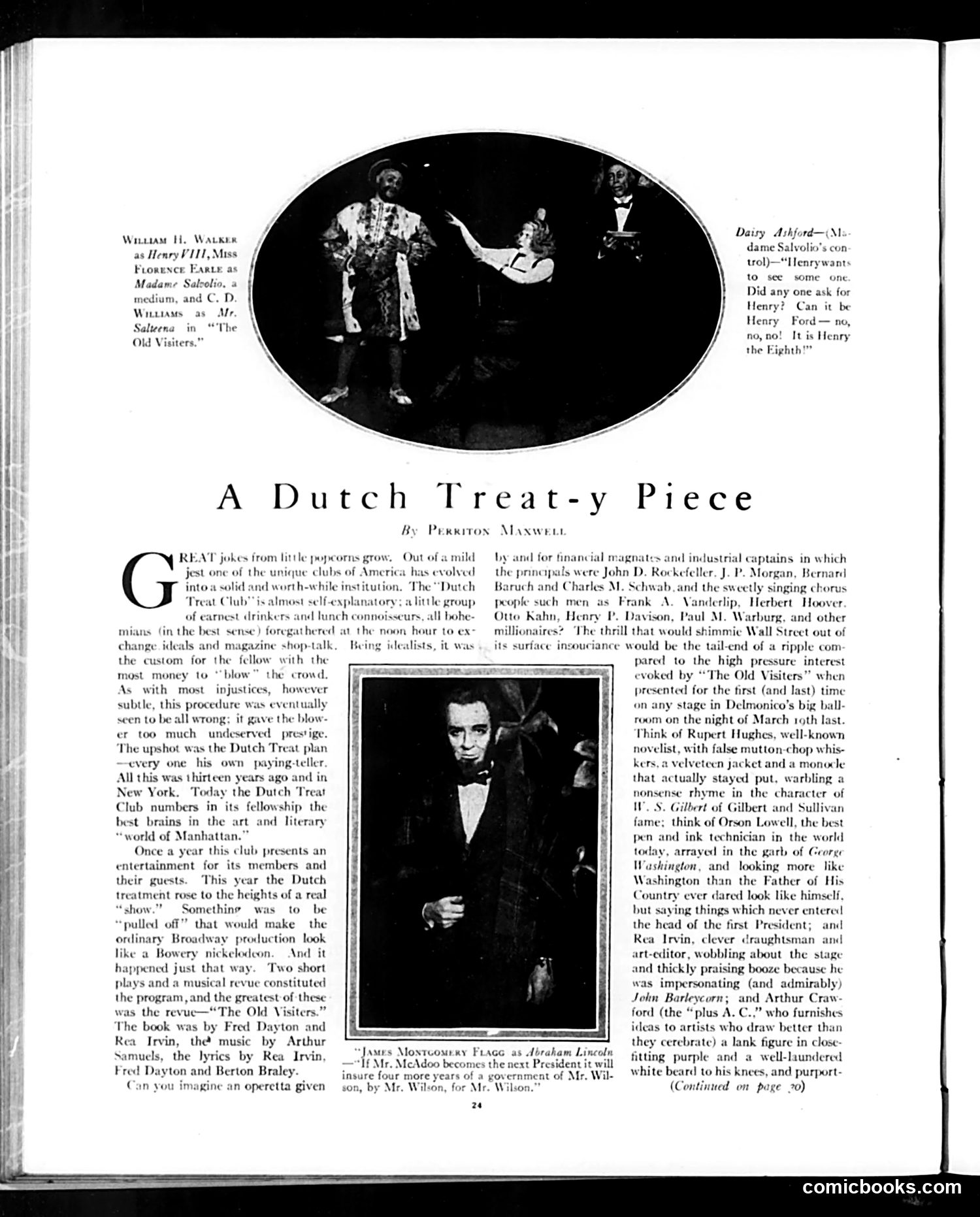
This page documents a 1916 theatrical revue staged by the Dutch Treat Club, a prestigious Manhattan arts-and-letters organization. The satirical point: the club's annual show cleverly mocked wealthy industrialists and politicians by casting famous artists and writers as caricatures of real power brokers. The revue, "The Old Visitors," featured Rupert Hughes impersonating W.S. Gilbert, Orson Lowell dressed as George Washington, and Arthur Crawford as John Barleycorn—all performing alongside fictional portrayals of actual tycoons like Rockefeller, Morgan, and Schwab. The humor exploited the incongruity of serious artists performing as these figures in "nonsense rhyme." A caption references James Montgomery Flagg as Abraham Lincoln, with a contemporary political jab: if McAdoo succeeds Wilson, it's compared to Lincoln's tenure. The joke targets both the vanity of millionaires willing to be theatrically lampooned and the entertainment value of seeing celebrated intellectuals mock powerful men.
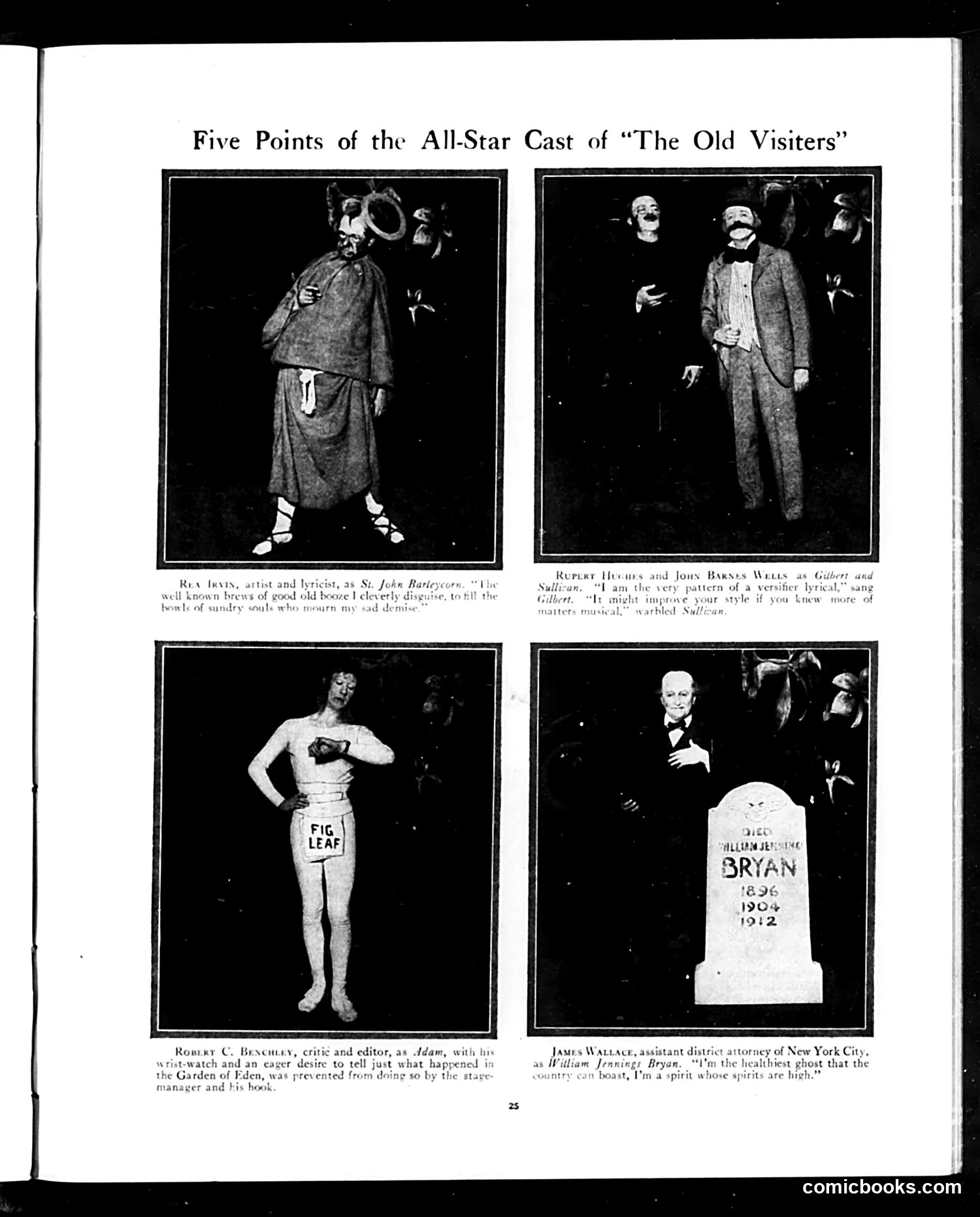
This page showcases five cast members from a theatrical production called "The Old Visitors." Each photograph features a performer in costume with an accompanying caption describing their character. The visible captions identify Robert C. Benchley (critic and editor) as Adam, and James Wallace (assistant district attorney of New York City) as William Jennings Bryan, positioned next to a tombstone dated 1896-1904-1912. The Bryan reference appears satirical—using the real political figure's name and election dates to mock his repeated presidential campaigns. The tombstone suggests commentary on Bryan's repeated electoral defeats. The other three cast members' identities and character names are partially obscured in the OCR text, but the page presents what appears to be a theatrical satire featuring recognizable public figures of the era.
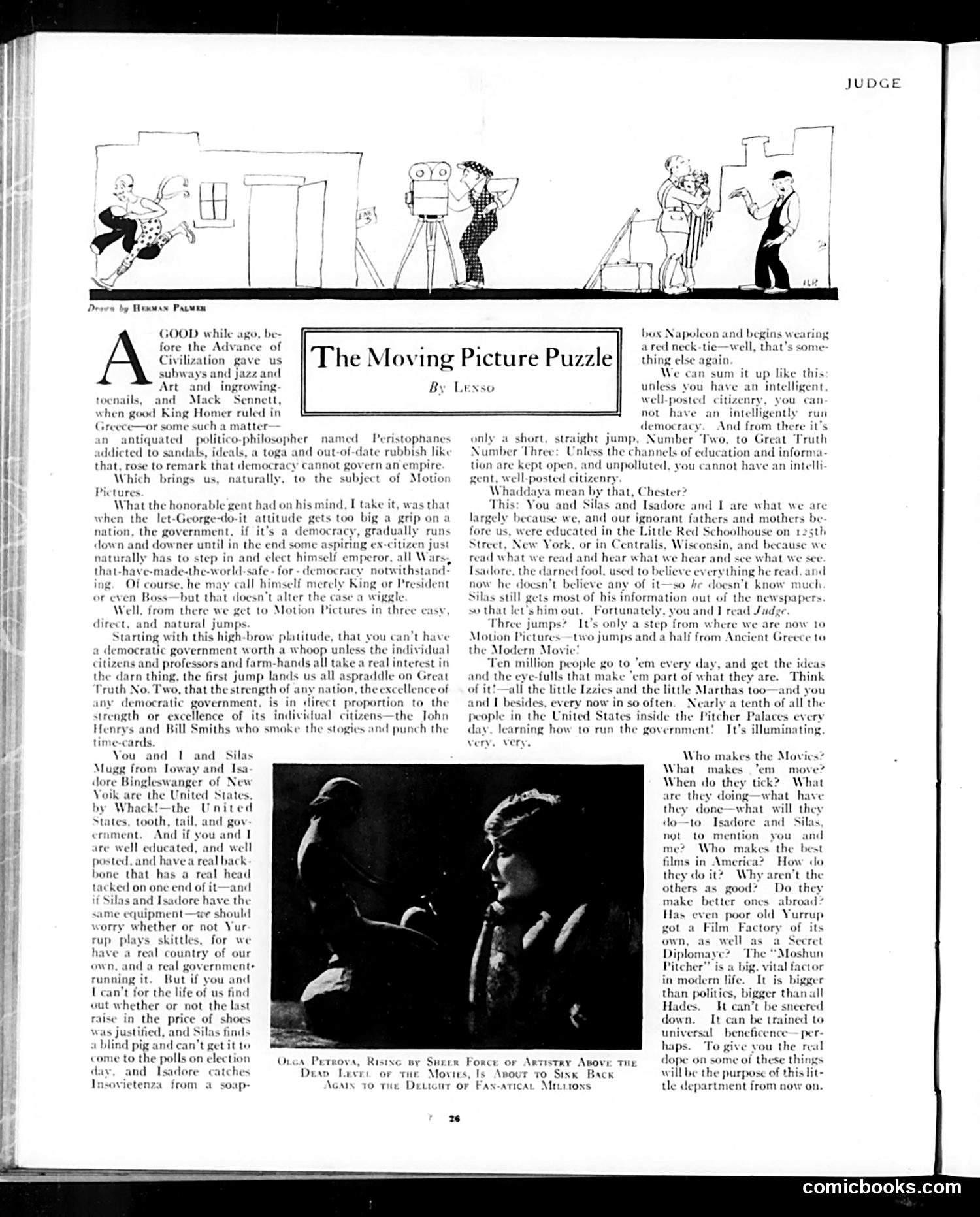
This page presents "The Moving Picture Puzzle," a satirical editorial by Luxo arguing that motion pictures are crucial to democratic citizenship. The argument proceeds through three logical steps: (1) Democracy requires engaged citizens; (2) National strength depends on individual citizens' quality; (3) Citizens need access to reliable information channels to stay educated and informed. The cartoon illustrations at top show film production—a director, camera operator, and actors—suggesting movies are a legitimate information source alongside newspapers. The photograph below shows three figures (likely film industry figures, though names are unclear from the image alone) representing the movie industry's role. The satire's point: movies aren't mere entertainment but educational tools essential for a functioning democracy. The text mocks those who dismiss cinema as frivolous, arguing instead that films reach mass audiences and shape public understanding—making quality filmmaking a civic responsibility comparable to journalism. This reflects 1920s debates about cinema's cultural legitimacy and influence.
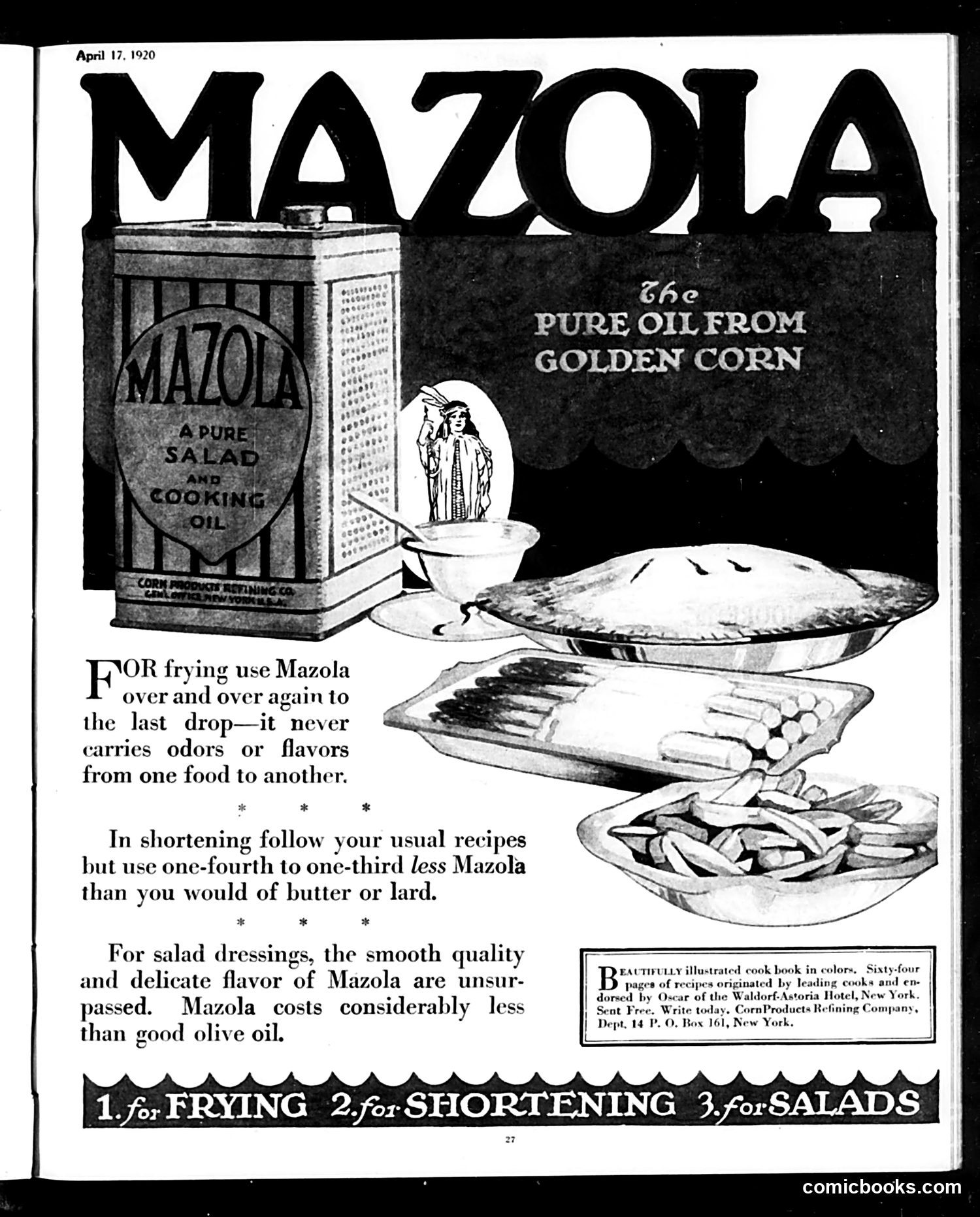
This is primarily a **full-page advertisement**, not satirical content. It promotes Mazola cooking oil (made from corn) in the April 17, 1920 issue of Judge magazine. The ad features an illustrated Native American figure (stereotypically depicted) emerging from a cornstalk, symbolizing the product's origin from American corn. The imagery emphasizes "pure" natural sourcing. The advertisement highlights three practical uses: frying (oil doesn't retain food flavors), shortening (requires less than butter or lard), and salad dressings (cheaper alternative to olive oil). A small box advertises a free cookbook available from Corn Products Refining Company in New York. **For modern readers**: This represents early 20th-century food marketing using Native American imagery for "authenticity," and promotes cooking oil as an economical wartime/postwar substitute for scarcer fats like butter.
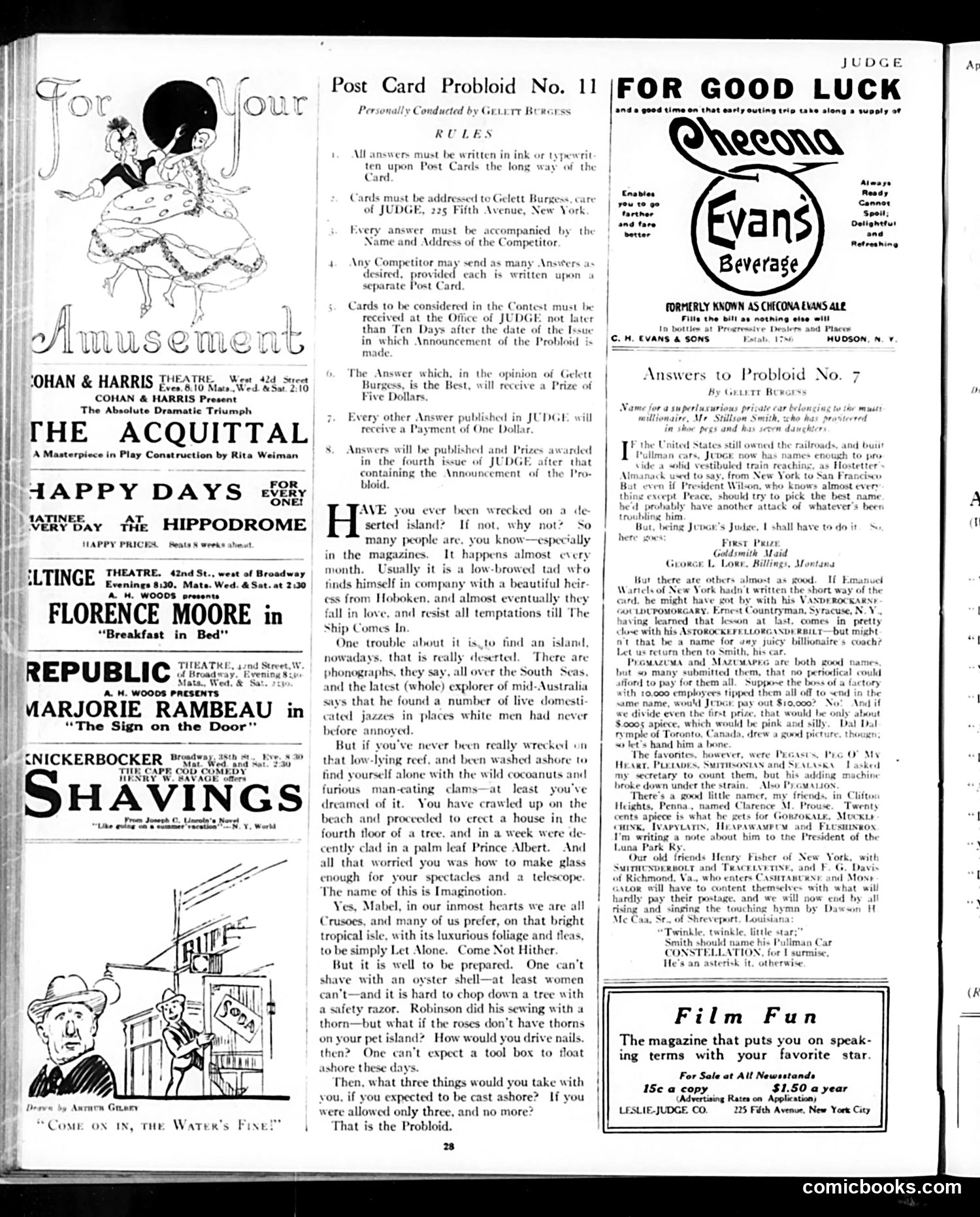
This is primarily a **theatrical advertisements and puzzle page** from Judge magazine, a satirical weekly publication. The page contains: **Main Content:** A "Probloid" (puzzle contest) by Gelett Burgess, a humorist and cartoonist. The puzzle asks readers: if cast away on a deserted island with only three items allowed, what would you bring? It's framed as social satire—mocking the prevalence of "deserted island" romance stories in magazines of the era, and the unrealistic fantasy that castaways could fashion civilized lives (glass spectacles, telescopes, palm-leaf suits) from natural materials. **Surrounding Material:** Theater advertisements for Broadway shows ("The Acquittal," "Happy Days," productions featuring Florence Moore and Marjorie Rambeau). The bottom advertises "Film Fun" magazine. **The Satire:** Burgess gently ridicules popular fiction tropes and the public's romantic fantasies about island survival, while the Probloid encourages reader participation—a common Judge engagement tactic.
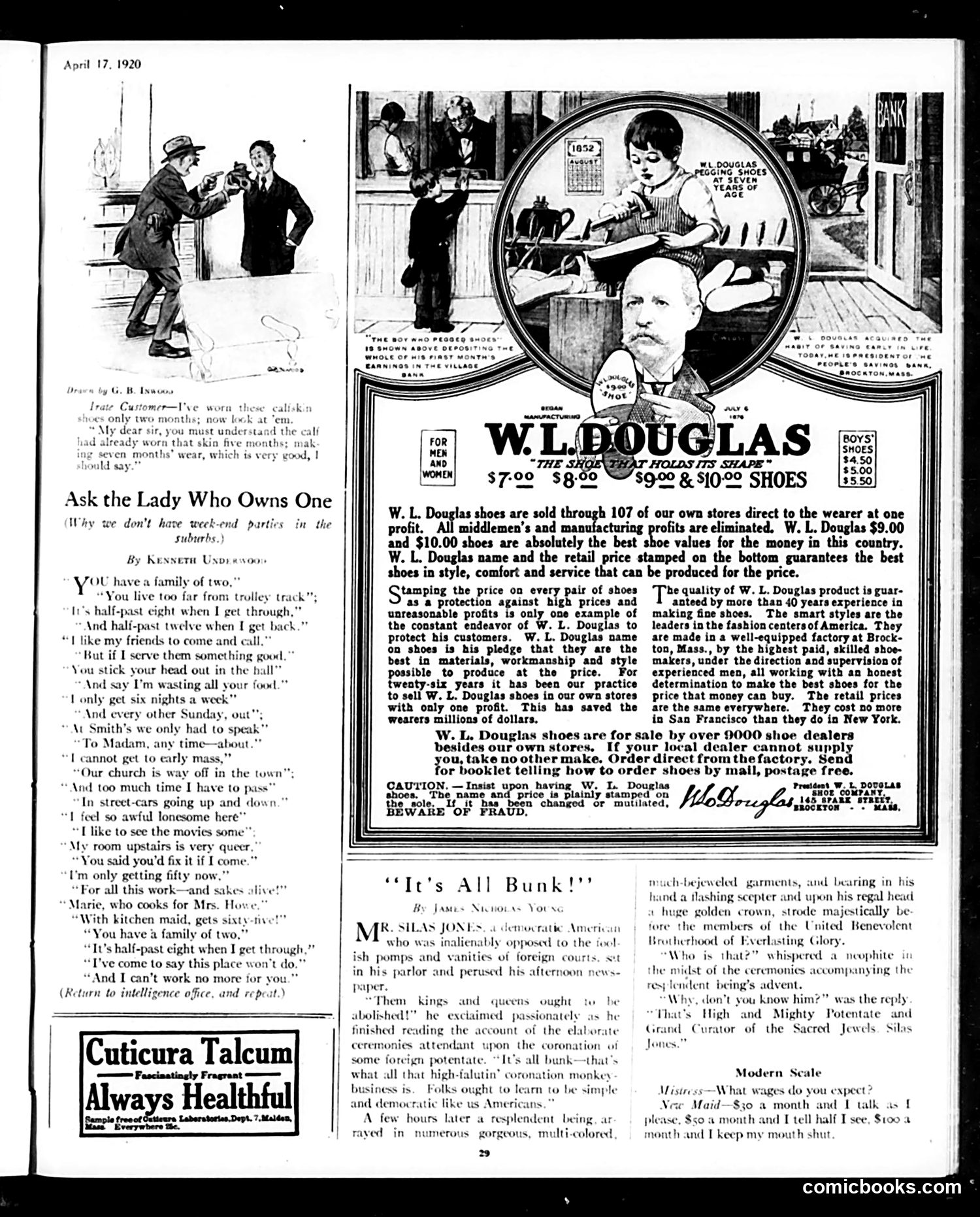
This page contains two distinct pieces of satire: **Left cartoon** ("Ask the Lady Who Owns One"): A domestic servant explains to her employer why she's quitting. The repetitive dialogue satirizes suburban middle-class hypocrisy—the employer complains about distance from the city, the cost of entertaining friends, and the servant's wages, yet refuses to make the suburbs livable or pay competitively. The servant's refrain "I've come to say this place won't do" and her departure mock employers who expected loyalty while offering poor working conditions and low pay relative to what servants earned in the city (comparing herself to "Marie" earning sixty-five dollars). **Right**: Primarily a W.L. Douglas shoe advertisement claiming direct factory-to-consumer sales eliminates middlemen profits. **Bottom story** ("It's All Bunk!"): Begins satirizing Silas Jones, described as a "democratic American" opposed to foreign court pomposity, who then encounters a "huge golden crown" and regalia, suggesting ironic commentary on American pretense or celebrity worship. The domestic servant dialogue reflects post-WWI labor tensions and the servant shortage affecting middle-class households.
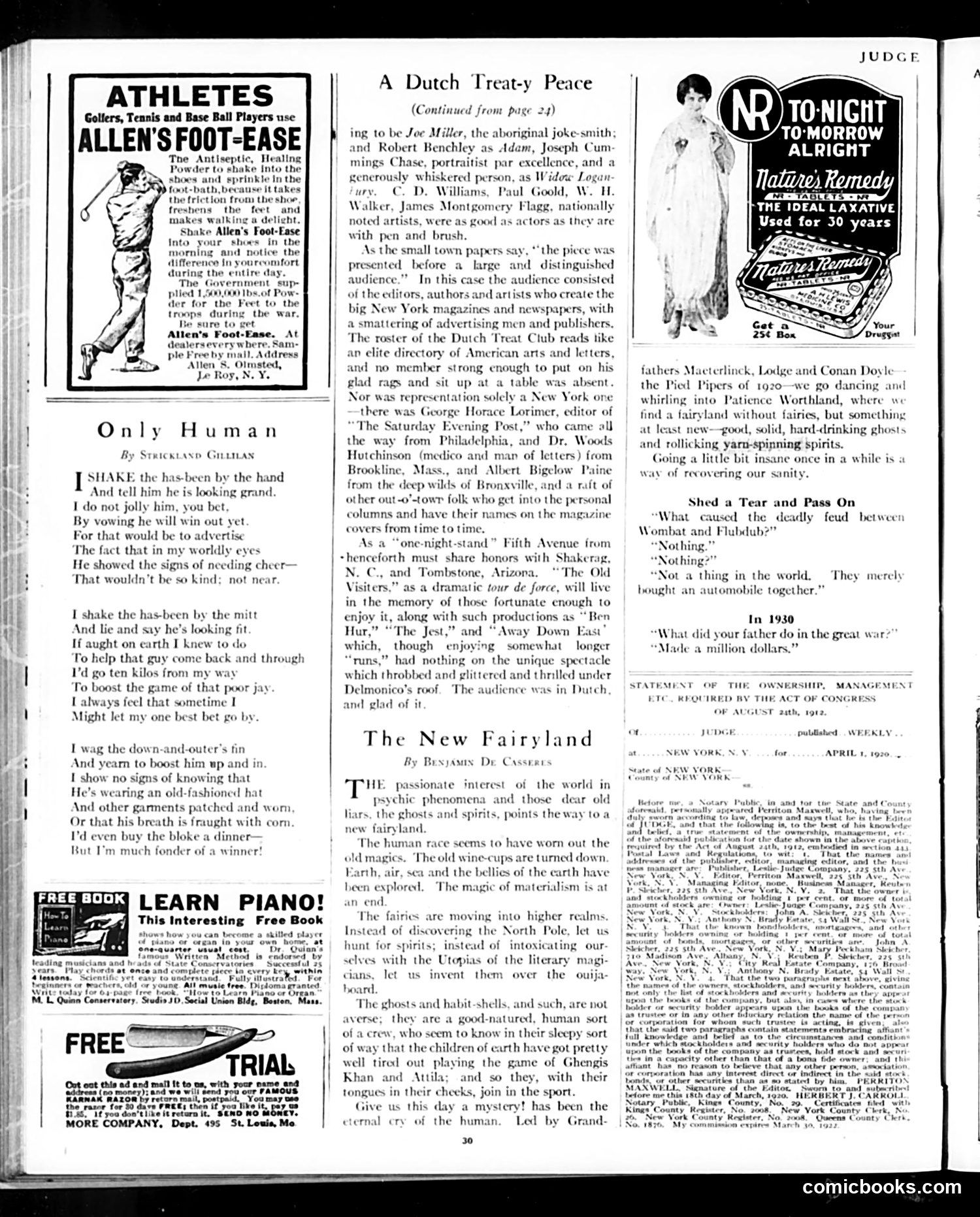
This page is primarily **advertisements and light entertainment** rather than political satire. The visible content includes: **"Only Human"** by Strickland Gillilan—a humorous poem about social courtesy. It mocks the tension between honesty and kindness: the speaker pretends to encourage struggling people ("has-beens," "down-and-outers") while secretly admiring winners. The satirical point is gentle social commentary on human hypocrisy and our preference for success over sympathy. **"A Dutch Treaty Peace"** (continued article) describes a theatrical event by the Dutch Treat Club—an organization of New York editors, artists, and writers. It mentions prominent figures like George Horace Lorimer and celebrates their dramatic production "The Old Visiters" as superior entertainment. The remaining content consists of **product advertisements** (Allen's Foot-Ease powder, piano lessons) with the standard marketing claims of the era. No clear political cartoon is visible on this page. The satire is social rather than political—commentary on everyday American attitudes and commercial culture.
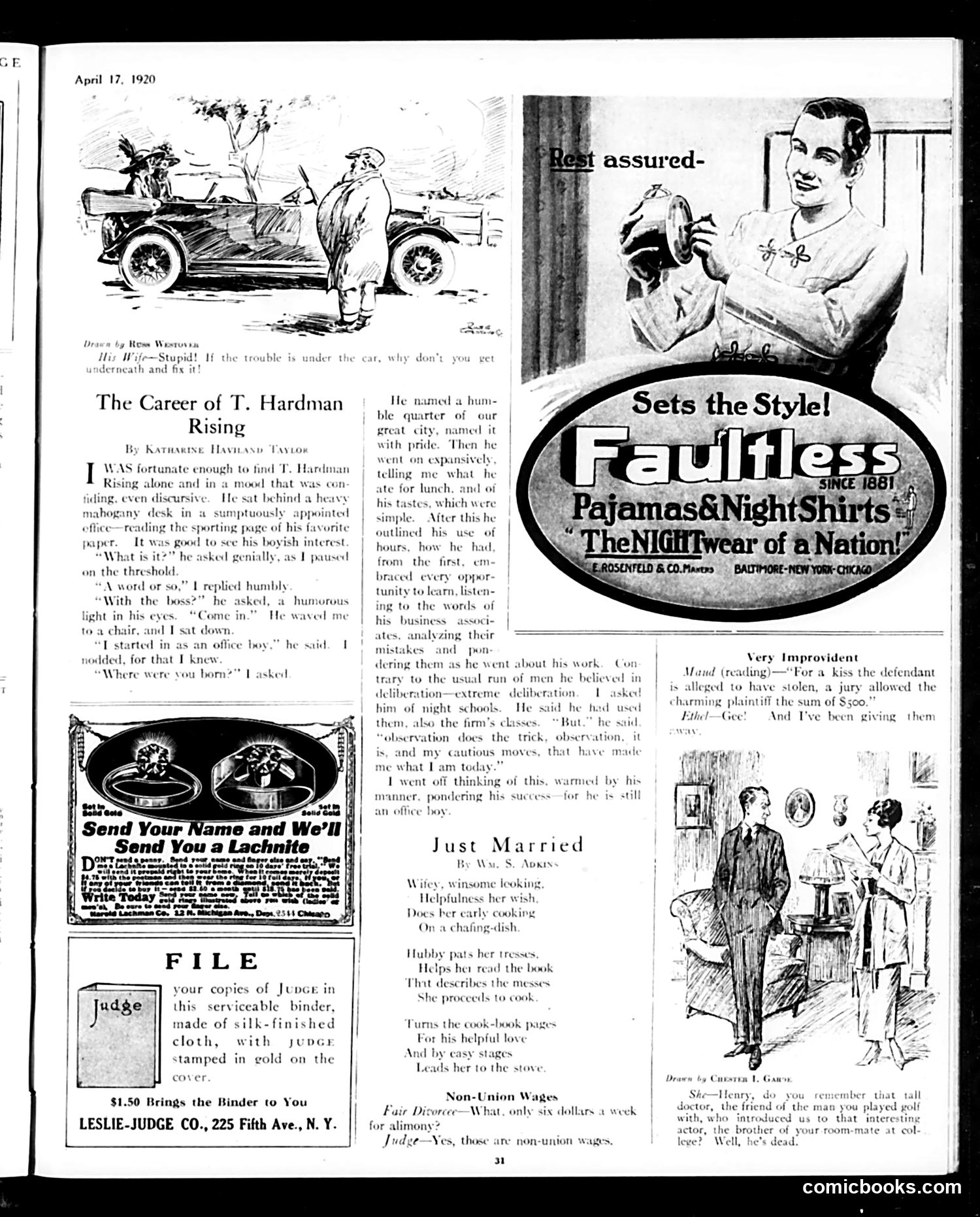
This page contains three distinct pieces of satirical content: **"The Career of T. Hardman Rising"** (main story): A profile of an ambitious young man working his way up from office boy through observation and self-education, celebrating the American success narrative and work ethic valued in post-WWI America. **"Just Married"** (poem with illustration): Gentle domestic satire depicting newlywed gender roles—the wife's cooking and housekeeping, the husband's approving patronization. This reflects 1920 attitudes about marriage and women's domestic duties, presented as charming rather than critically. **"Very Improvident"** (comic): A brief joke about a woman suing for $500 in damages over a stolen kiss, with a follow-up about low alimony payments. This satirizes both the commercialization of romance/morality litigation and post-divorce financial disputes—contemporary legal oddities. The ads (Faultless Pajamas, Lachmite jewelry, Judge binder) occupy significant space, typical for magazines of this era.
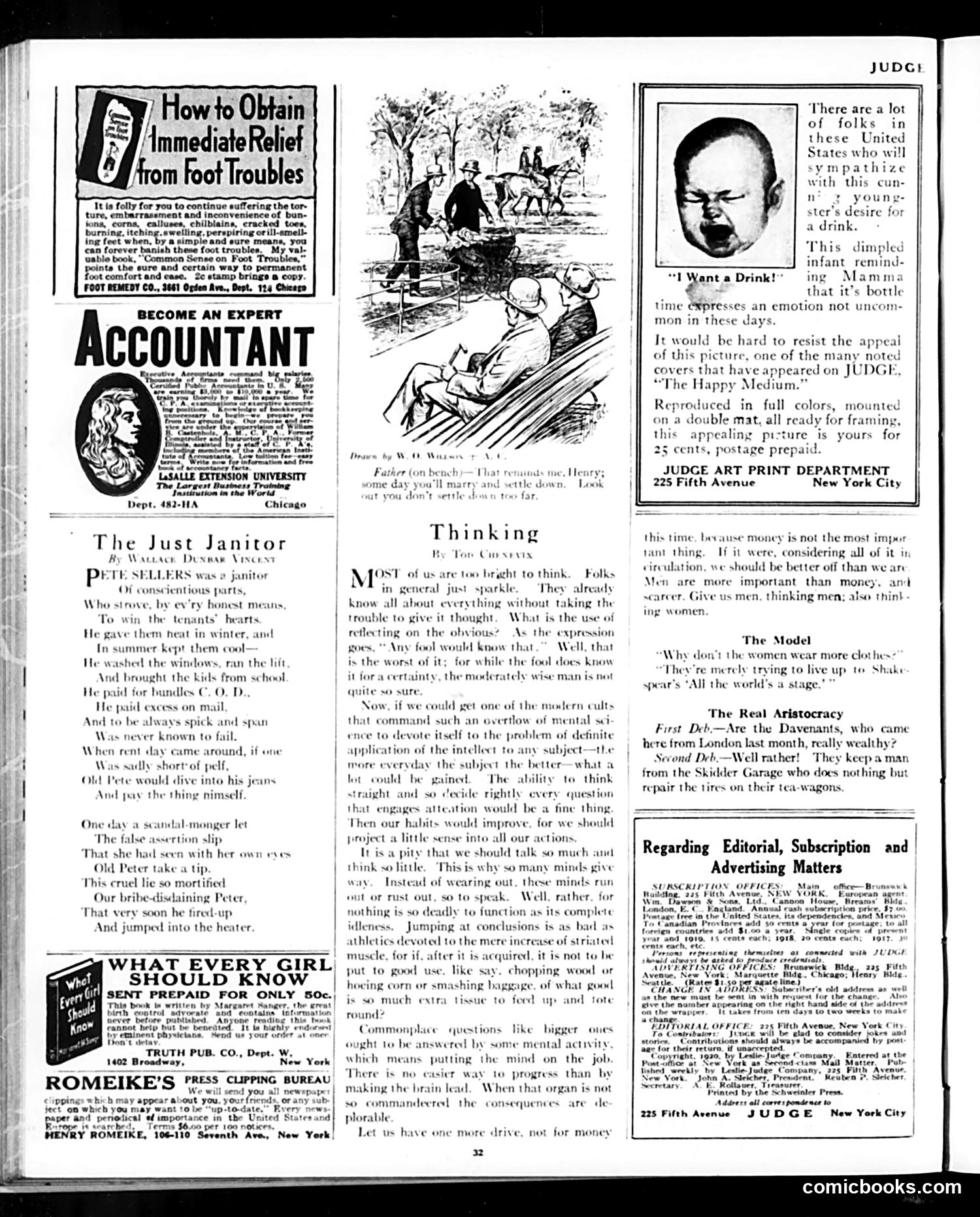
This page is primarily **advertisements and filler content** with minimal political satire. The notable elements include: **Main Content:** - A sentimental poem, "The Just Janitor," celebrating working-class virtue—a janitor of impeccable integrity who even pays tenants' overdue rent from his own pocket, then kills himself when falsely accused of accepting a tip. This reflects early 20th-century nostalgia for honest labor and class deference. - An essay titled "Thinking" critiquing Americans' intellectual laziness—arguing people prefer easy answers to genuine reflection. **Advertisements:** - Foot remedy products, accountancy courses, and notably, Margaret Sanger's birth control advocacy book ("What Every Girl Should Know")—reflecting Judge's relatively progressive stance on women's health information for the era. The page lacks direct political cartoon satire; instead it showcases Judge's mix of moralistic humor and commercial messaging typical of 1910s-era magazines.
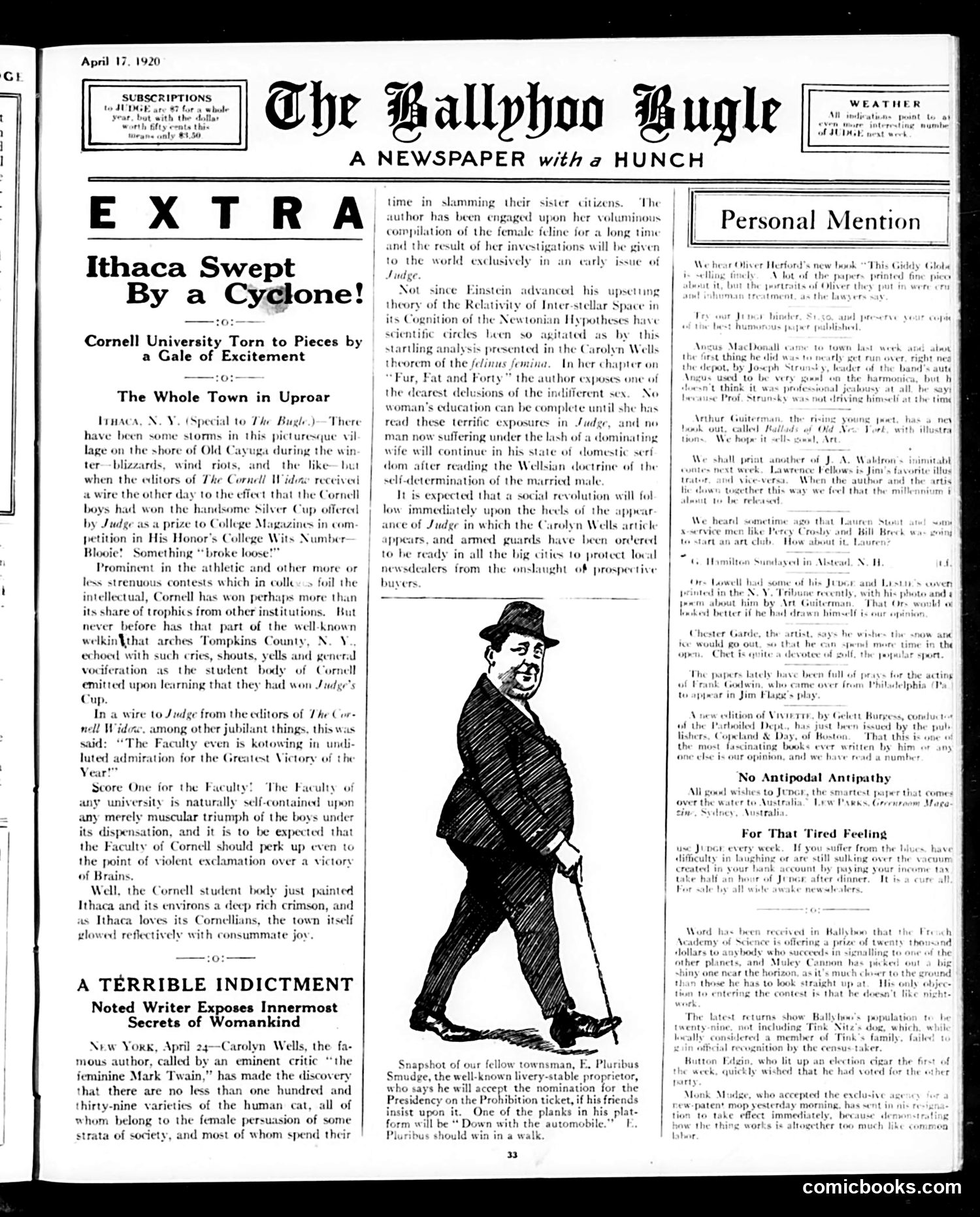
This is a satirical magazine page celebrating Cornell University's student magazine *The Cornell Widow* winning Judge magazine's "College Wits Number" competition. The cartoon depicts a jubilant townsman (likely representing Cornell or Ithaca), shown in exaggerated celebratory pose—the visual joke being that winning a *humor* magazine contest is treated as monumentally as athletic victory. The satire mocks academic pretension: Cornell's faculty supposedly celebrates this "victory of brains" with the same fervor they'd show for athletic triumphs, which Judge finds absurdly self-congratulatory. The page also includes a separate satirical piece on author Carolyn Wells's supposed exposé cataloging 139 varieties of catty women—typical early-20th-century misogynistic humor treating female gossip as a pseudo-scientific phenomenon worthy of Einstein-level attention. The overall tone is lighthearted mockery of both collegiate self-importance and contemporary gender stereotypes.
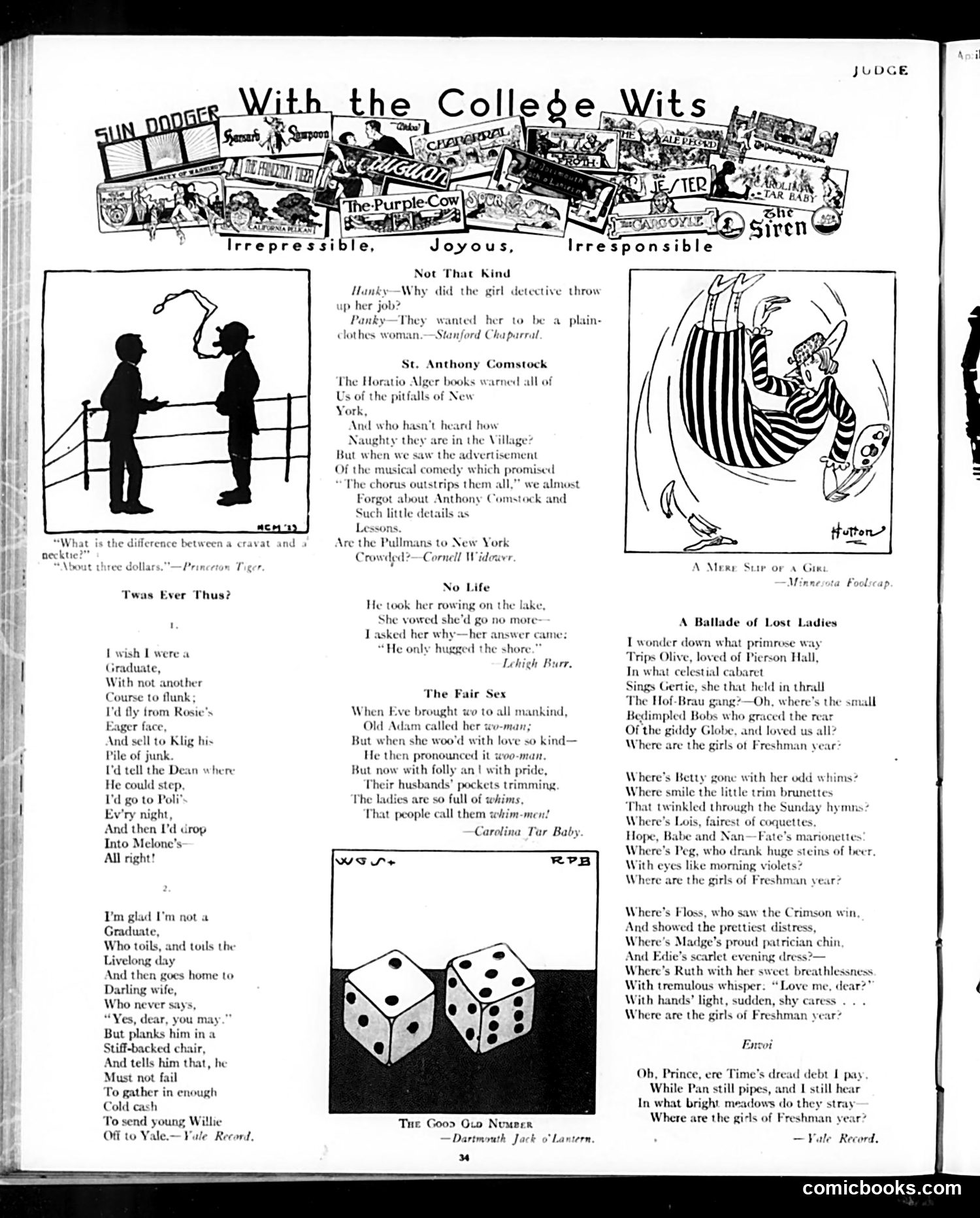
This page collects humorous college-themed content from various universities' student publications. The satire targets early-1900s campus life and gender relations. **Key content:** The **top cartoon** shows two silhouetted men at a fence discussing the difference between a cravat and necktie—the punchline being "three dollars" (implying the necktie costs more, a commentary on frivolous spending). **"The Fair Sex"** poem mocks how men refer to women, playing on the shift from "wo-man" to "woman" while criticizing women for their spending habits and nagging about money. **"A Ballade of Lost Ladies"** is nostalgic verse asking where various female college acquaintances have gone, romanticizing past female students—a melancholic reflection on transient college friendships. **"Not That Kind"** jokes reference **Anthony Comstock**, the famous censorship crusader, mocking how easily shocked authorities were by theatrical performances. The overall theme: college anxiety about money, gender dynamics, nostalgia for student days, and irreverent attitudes toward social authorities.
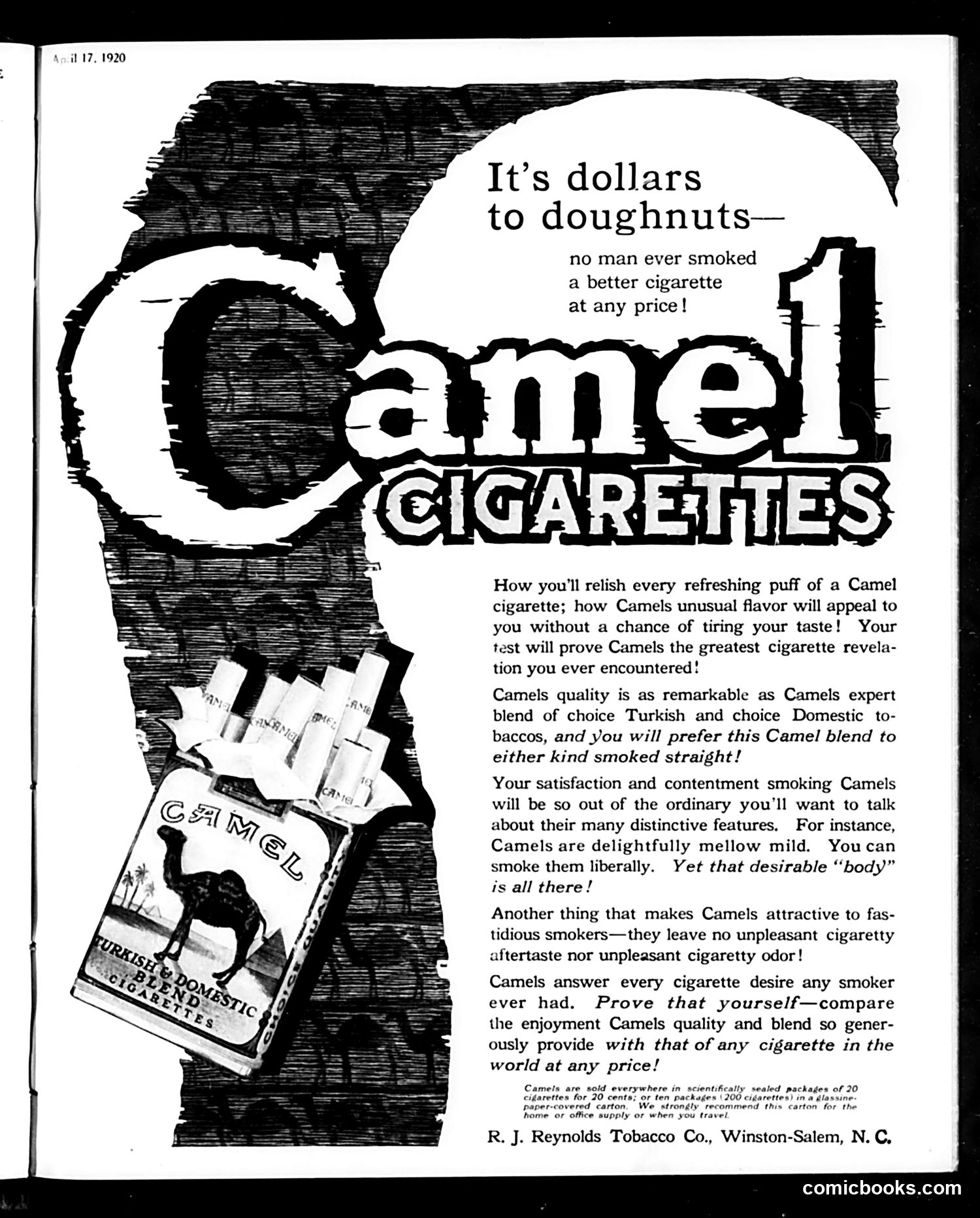
This is a full-page **cigarette advertisement**, not a political cartoon. It appeared in *Judge* magazine on April 17, 1920. The ad features large Camel branding with a camel illustration and a pack of cigarettes. The headline uses the colloquial phrase "dollars to doughnuts" (meaning a safe bet) to claim Camel cigarettes are superior to competitors. The text emphasizes Camel's blend of Turkish and domestic tobacco, claiming the cigarettes are "mellow mild" with no aftertaste or unpleasant odor—selling points meant to distinguish them from rival brands in an increasingly competitive cigarette market of the 1920s. **Modern context**: This predates health warnings and represents early aggressive tobacco marketing. The ad's emphasis on quality and taste reflects pre-regulation advertising practices when such claims were unregulated.
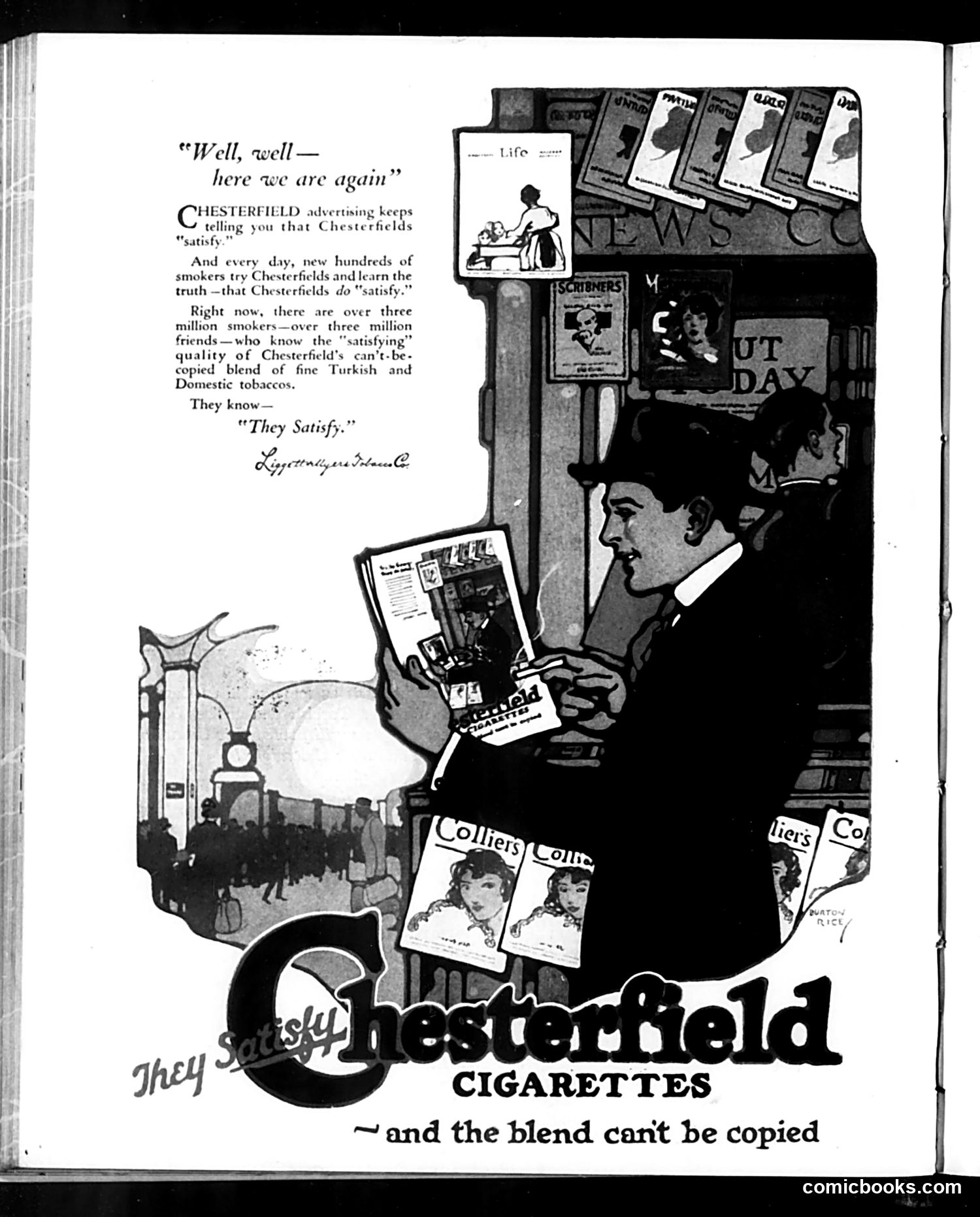
This is a **cigarette advertisement**, not political satire. The page promotes Chesterfield cigarettes to a modern reader by claiming their blend "satisfies" smokers and cannot be copied by competitors. The illustration shows a well-dressed man in a newsstand or tobacco shop, surrounded by magazines (*Life*, *Colliers*, *News*) and competing cigarette brands. The visual joke suggests that while other products advertise everywhere, Chesterfields need no such effort—satisfied customers naturally return ("here we are again"). The ad emphasizes brand loyalty among "over three million" smokers who know the product's "satisfying quality" of Turkish and domestic tobacco. This reflects early-20th-century advertising techniques: building brand prestige through testimonials and claims of superiority that competitors allegedly cannot match.