
A complete issue · 36 pages · 1919
Judge — October 18, 1919
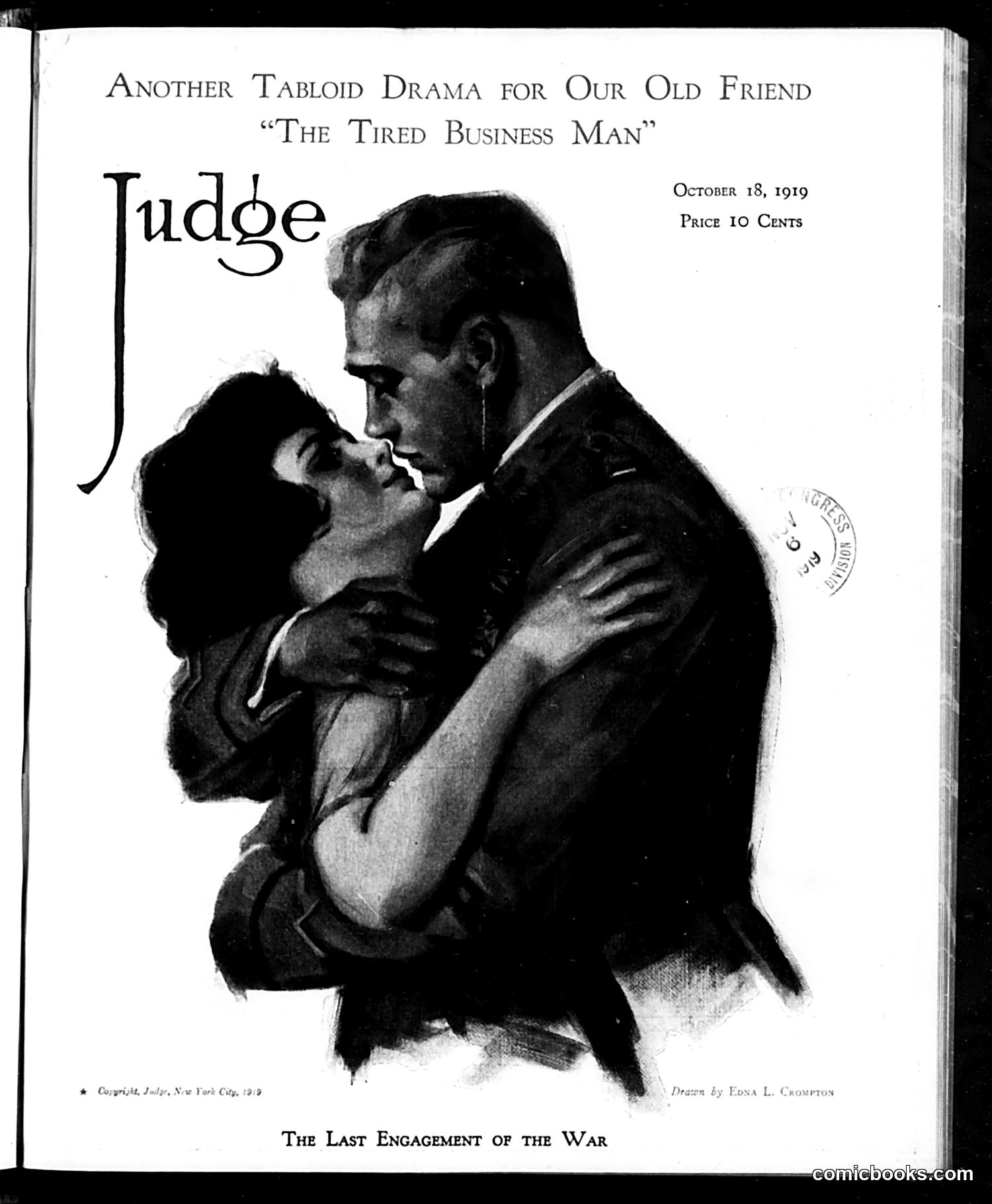
This is a tabloid drama illustration titled "The Tired Business Man," drawn by Edna L. Crumpton. The cover depicts a man in business attire carrying a woman, with the caption "The Last Engagement of the War." The satire likely references post-WWI social anxieties about returning soldiers and changing gender dynamics. "The Tired Business Man" was a stock character in 1920s humor representing urban male exhaustion from modern life and work. The phrase "Last Engagement of the War" appears to be a double entendre—playing on military terminology while depicting a romantic scenario, suggesting the end of wartime restrictions on civilian social behavior and romantic encounters. The illustration reflects contemporary anxieties about postwar social upheaval and changing relationships.
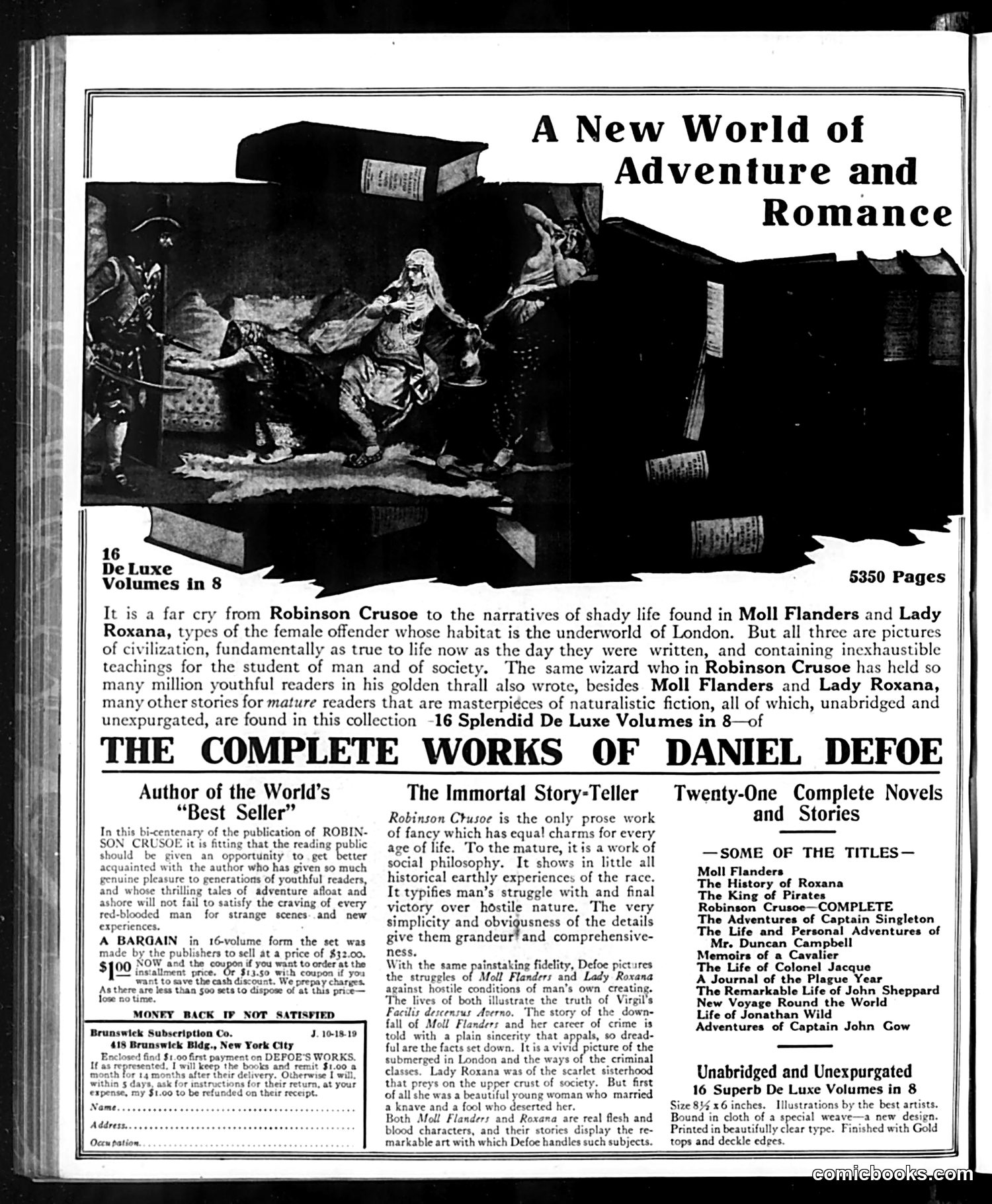
This page is primarily **advertising**, not political satire. It promotes "The Complete Works of Daniel Defoe" — a 16-volume book set selling for $12.00. The advertisement emphasizes Defoe's famous works like *Robinson Crusoe*, *Moll Flanders*, and *Lady Roxana*, positioning them as foundational literature spanning from children's adventure stories to mature realistic fiction. The illustrated vignette at top appears to depict a scene from one of these narratives, showing period-costumed figures in what looks like a dramatic moment. The marketing copy stresses that Defoe's works contain "inexhaustible teachings for the student of men and of society" alongside entertainment value. The "Money Back If Not Satisfied" guarantee and publisher details (Burt, New York) indicate this is a standard direct-mail book promotion from the early 20th century. No political cartoon or satire is present on this page.
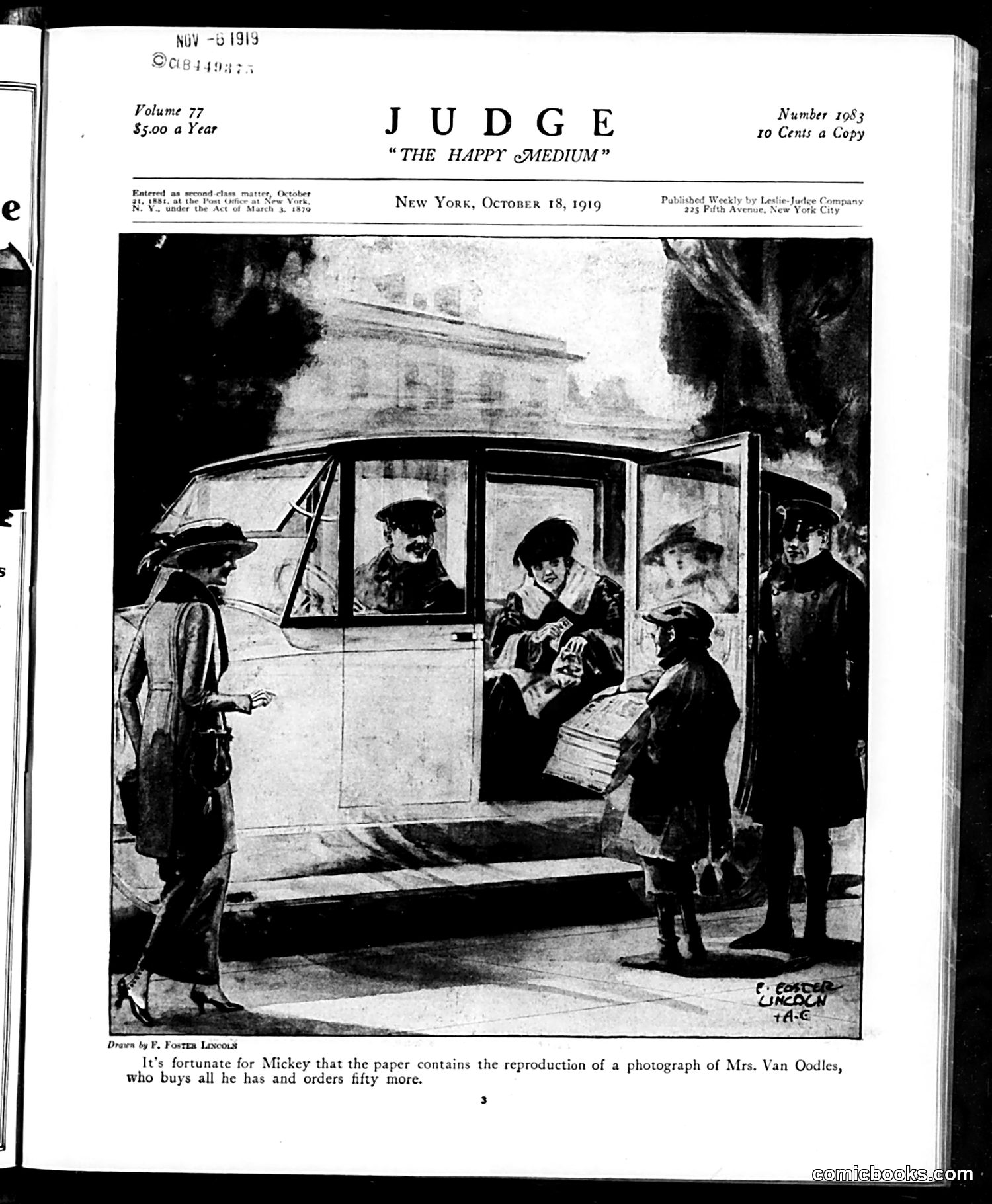
This Judge magazine cover from October 18, 1919 depicts a humorous scene involving an automobile and multiple figures conducting a transaction. The caption references "Mickey" and "Mrs. Van Oodles," suggesting this is satirizing wealth and consumer behavior among the affluent during the post-WWI period. The joke appears to center on Mickey (likely a chauffeur or servant character) benefiting from Mrs. Van Oodles' extravagant purchasing habits—she "buys all he has and orders fifty more." The cartoon mocks excessive consumption and the relationship between wealthy patrons and service workers who profit from their spending sprees. The illustration, drawn by F. Foster Lincoln, uses the automobile as a symbol of modern commerce and social status typical of 1919 satirical commentary.
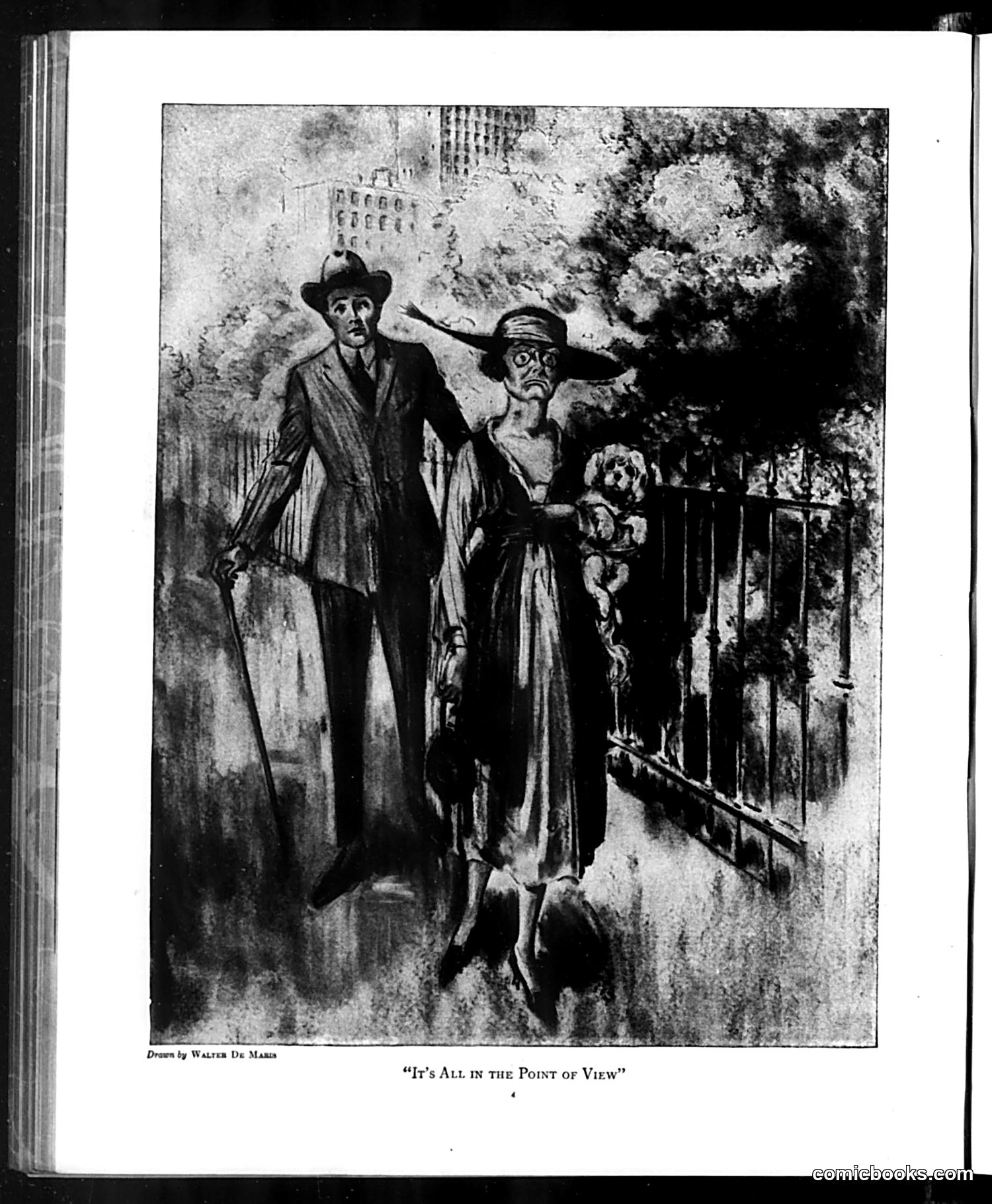
This Walter De Maris cartoon illustrates a perspective-based satire. Two figures stand at a gate in what appears to be an urban setting: a man in a cowboy hat and long coat, and a woman in a striped dress holding a small dog. The title suggests the cartoon critiques how the same situation can be interpreted differently depending on one's viewpoint. Without additional context from the magazine's date or surrounding articles, the specific political or social target remains unclear. However, the composition—contrasting the figures' poses and expressions—suggests commentary on differing interpretations of a social scenario, possibly relating to class, propriety, or public perception during the early-to-mid 20th century when Judge published this work.
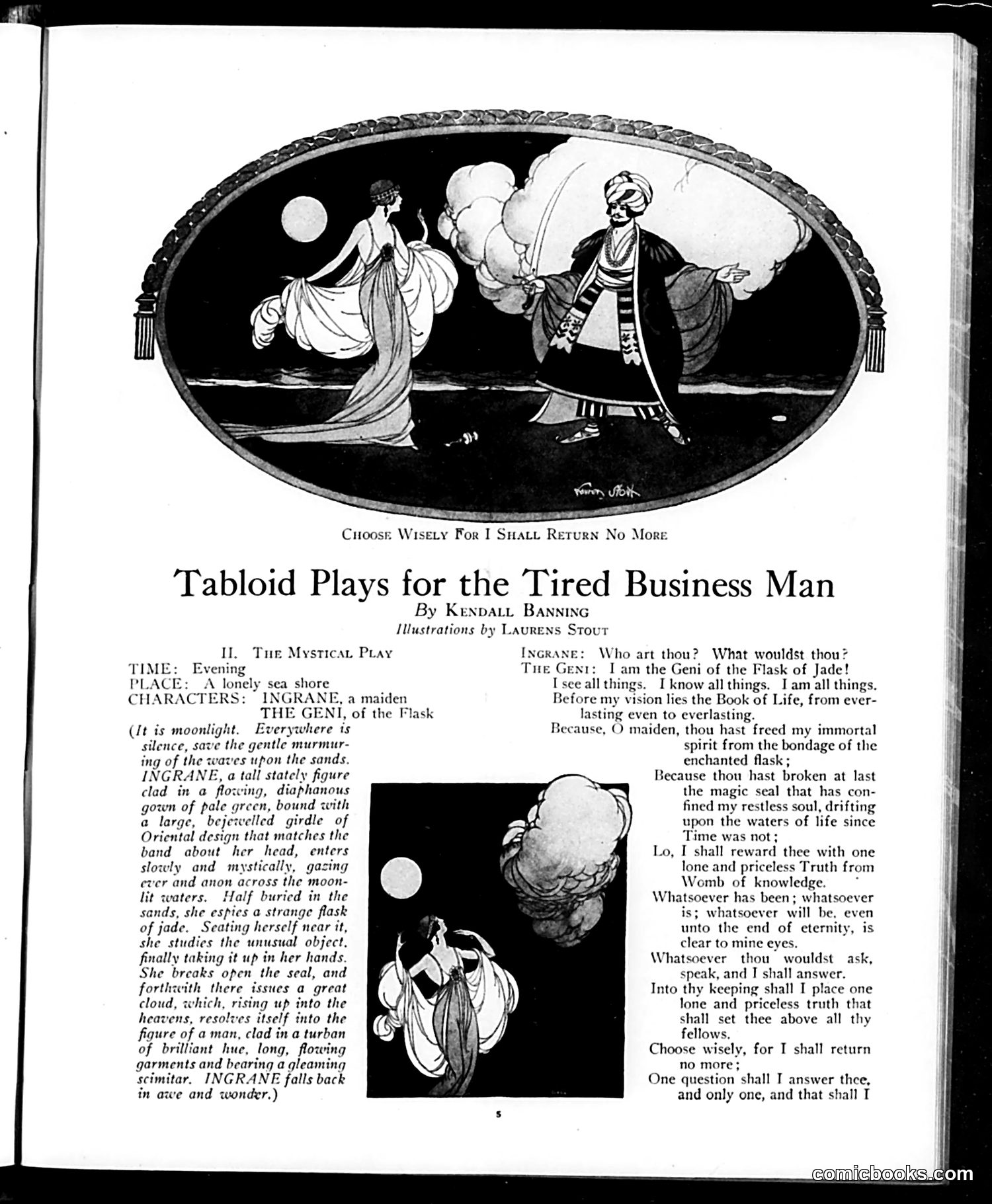
This is a literary/theatrical piece rather than political satire. The page presents "The Mystical Play," part of a series offering escapist entertainment for weary professionals. The top illustration shows a moonlit seaside scene with ethereal figures—a maiden in flowing robes and a turbaned genie emerging from clouds. The accompanying text is a mystical dialogue where the Genie of the Flask offers the maiden unlimited knowledge and truth in exchange for her wisdom in choosing wisely before he returns "no more." This appears designed as whimsical, fantastical entertainment—offering businessmen brief imaginative escape through orientalist imagery and supernatural drama. The illustrations are credited to Laurens Stout, suggesting this was a regular feature in Judge magazine.
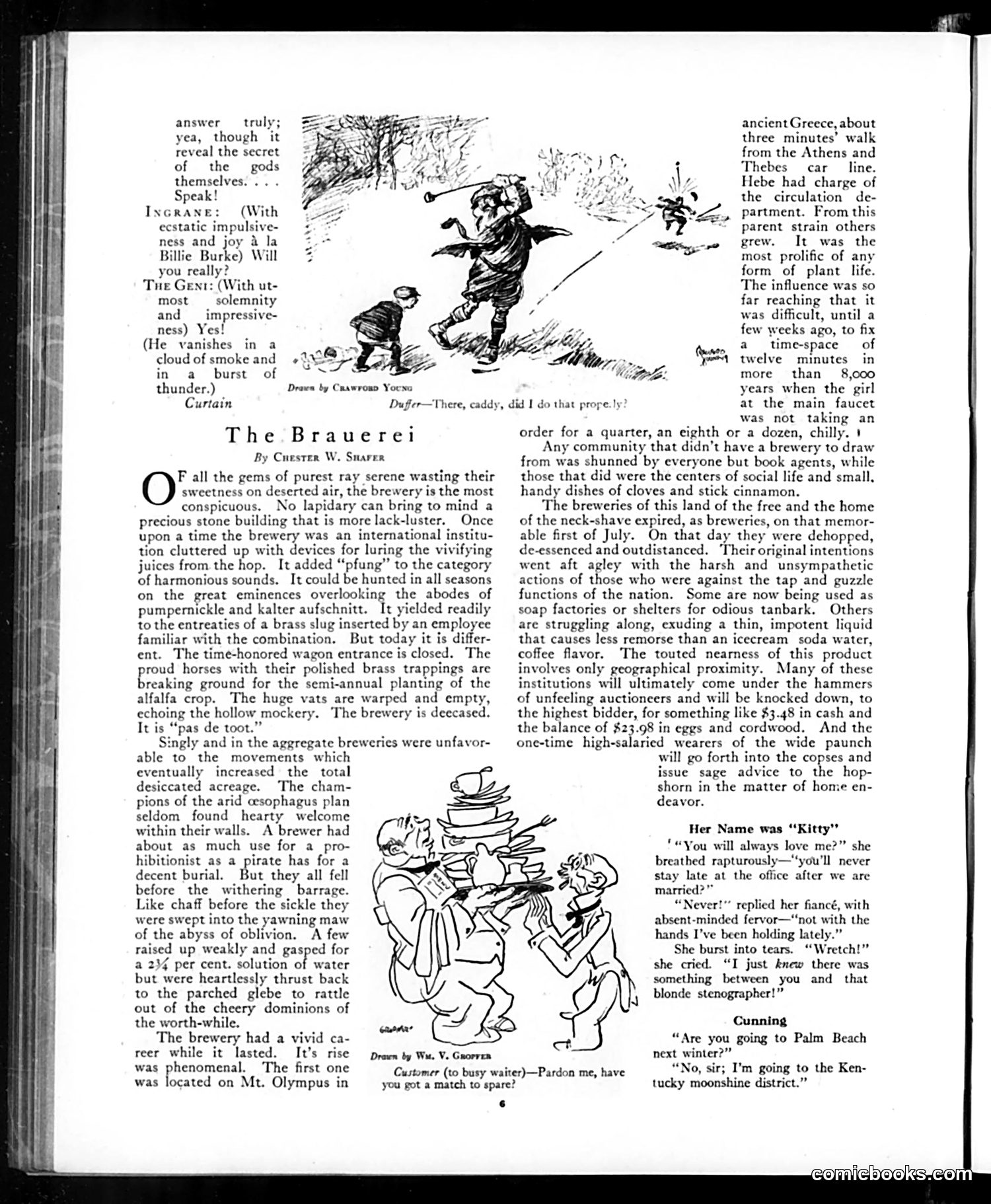
This page contains two main elements: **Top cartoon** ("Duffer"): Shows a golfer and caddy. The golfer asks "Duffer—There, caddy, did I do that properly?" This appears to be a simple golf joke about an incompetent player seeking reassurance from his caddy—a common sporting humor theme. **Main article**: "The Brauerei" by Chester W. Shafer is a prose piece satirizing German breweries and beer culture. It mocks their grand historical importance while describing their actual decline—breweries being converted to soap factories or other uses. The satire contrasts their prestigious past with their diminished present status. **Bottom cartoon**: Shows a domestic scene about marriage expectations, with dialogue suggesting tension between a couple regarding work schedules and fidelity—typical early 20th-century relationship humor. The page blends sports, cultural, and domestic satire typical of Judge magazine's format.
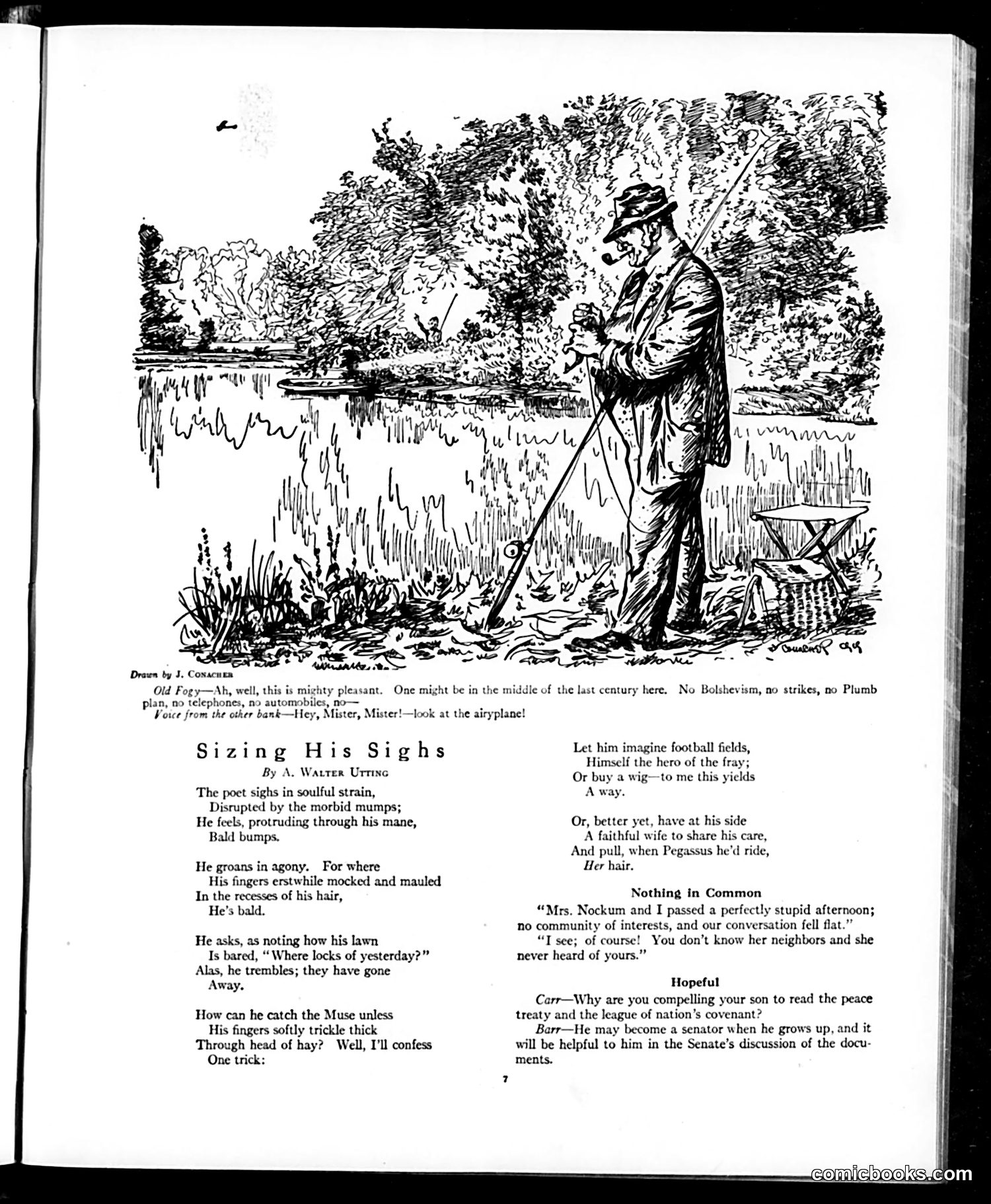
**The Main Cartoon:** An elderly man ("Old Fogy") attempts to escape modernity by fishing in a pastoral setting, fantasizing about the previous century without "Bolshevism, no strikes, no Plumb plan, no telephones, no automobiles." His reverie is immediately shattered when someone shouts "look at the airplane!"—symbolizing that progress and modern disruptions are inescapable, even in nature. **The Context:** This reflects post-WWI anxieties (references to Bolshevism suggest early 1920s), when traditional Americans feared rapid social change: labor unrest (strikes, the Plumb Plan for railroad nationalization), technological acceleration, and socialist ideology. **The Satire:** The cartoon mocks nostalgic conservatism as futile—you cannot hide from the modern world, no matter how hard you try. The page also contains miscellaneous lighter pieces (poems about baldness, domestic life snippets) typical of Judge's mixed-content format.
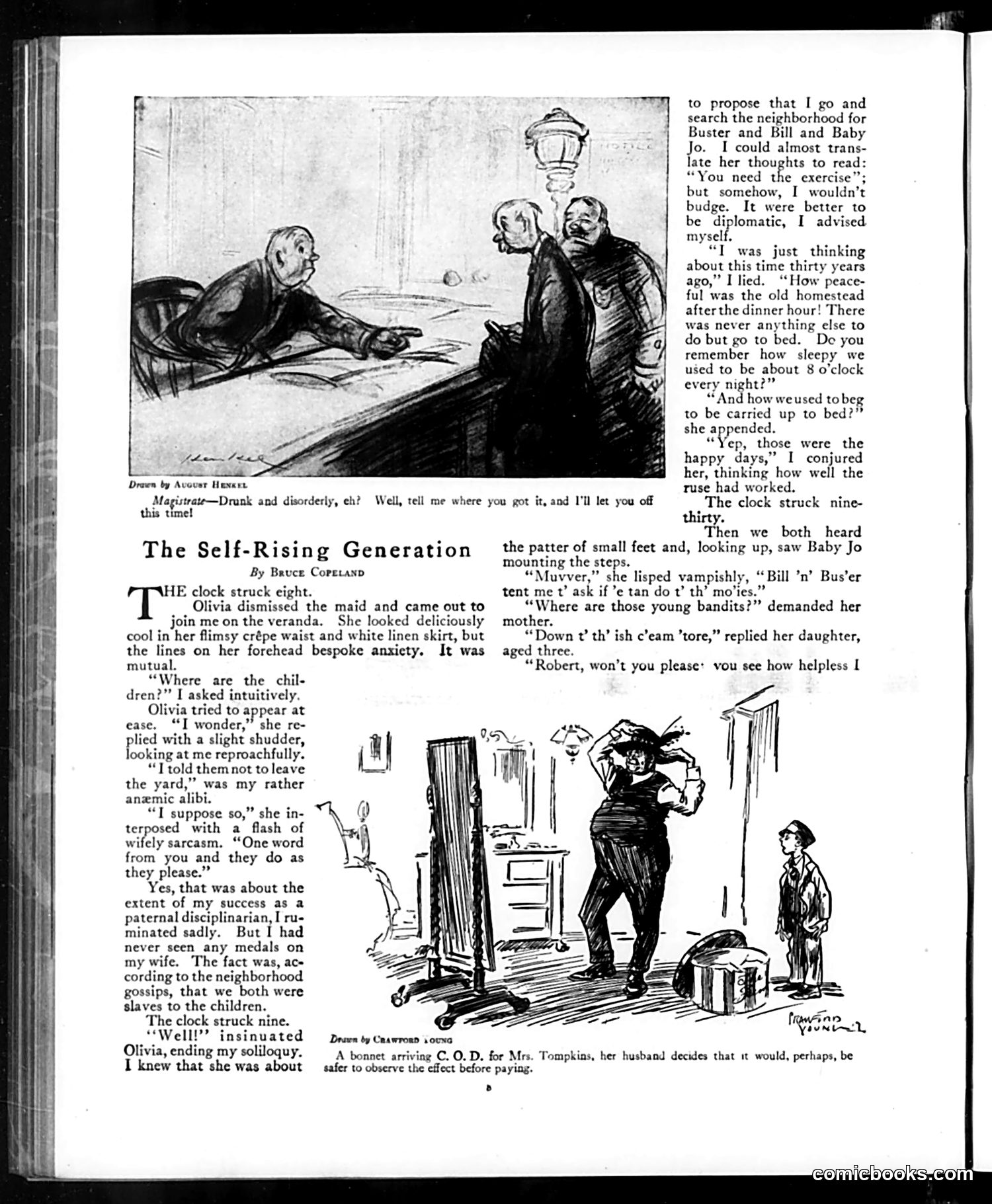
This story satirizes late 19th/early 20th-century anxieties about changing family dynamics and children's independence. The narrative follows a husband and wife whose children—Buster, Bill, and Baby Jo—roam freely unsupervised, visiting ice cream parlors and movie theaters at night without parental control. The satire targets the "self-rising generation": children who ignore parental authority and do as they please, with parents rendered helpless. The husband admits his complete failure as a "paternal disciplinarian," while the wife's sarcasm ("One word from you and they do as they please") underscores their reversed roles as servants to their children rather than authorities over them. The accompanying cartoon about a drunken man arrested suggests broader societal disorder. Overall, the piece mocks modern parents' inability to discipline their offspring, presenting this as a decline from "happy days" of strict bedtimes and parental control.
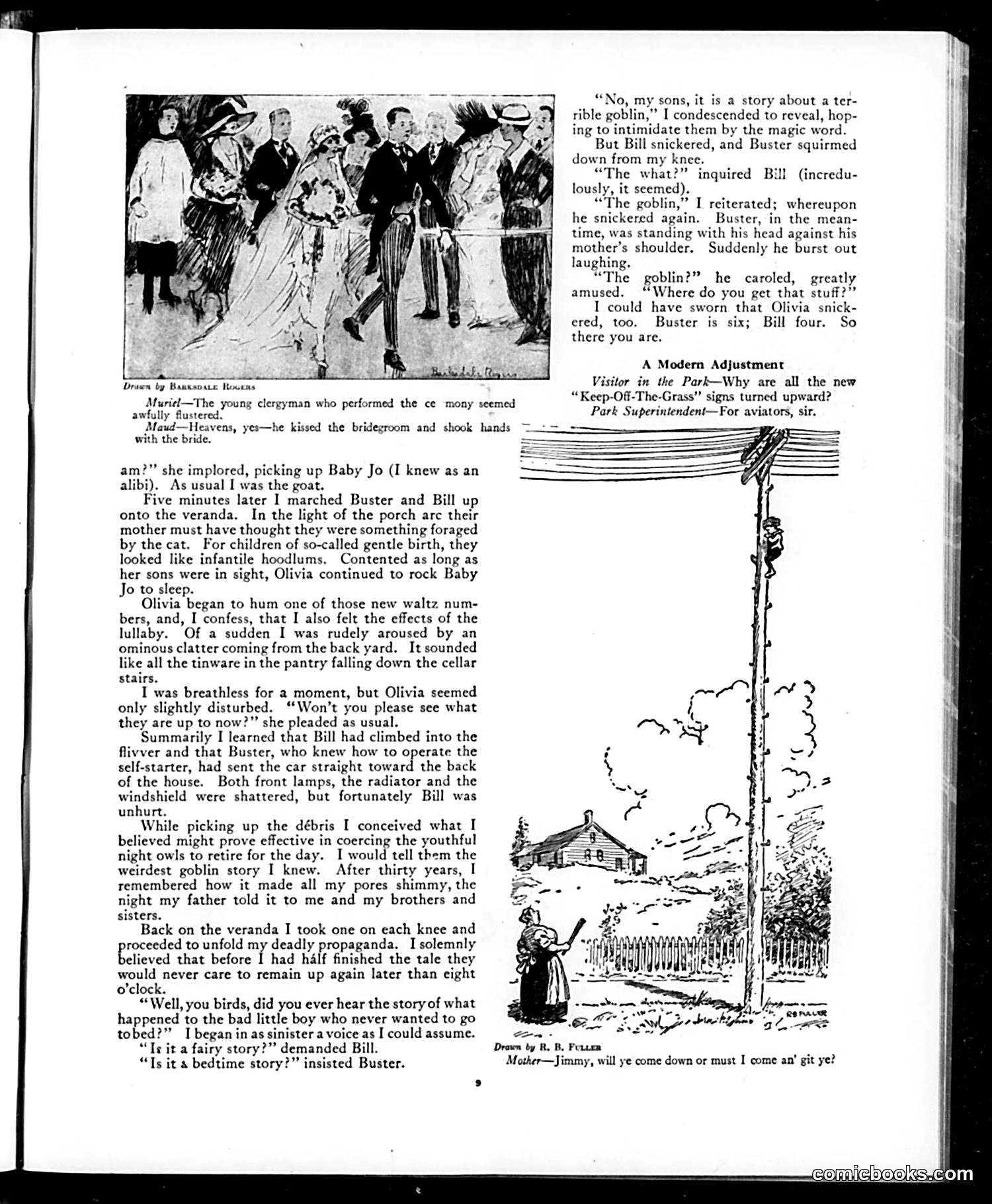
This page contains three separate comic items from an early 20th-century American satirical magazine: **Main Story/Cartoon (top left):** A humorous domestic narrative about a father attempting to frighten his young sons (Bill, age 4, and Buster, age 6) with a "goblin" bedtime story. The joke is that modern children find the threat utterly unbelievable—they scoff at such old-fashioned scare tactics. The reference to a "flivver" (Model T Ford) crashing through the yard establishes contemporary setting. The humor targets changing generational attitudes: children's skepticism toward parental authority and traditional discipline methods. **Small "Modern Adjustment" cartoon (right):** A visual gag about park signs now angled upward "for aviators"—a reference to early aviation interest, suggesting airplanes are so common they've become a concern even in city parks. **Bottom caption joke:** A brief gag about a confused wedding guest kissing the bridegroom instead of bride. The overall tone mocks both outdated parenting and rapid technological change of the era.
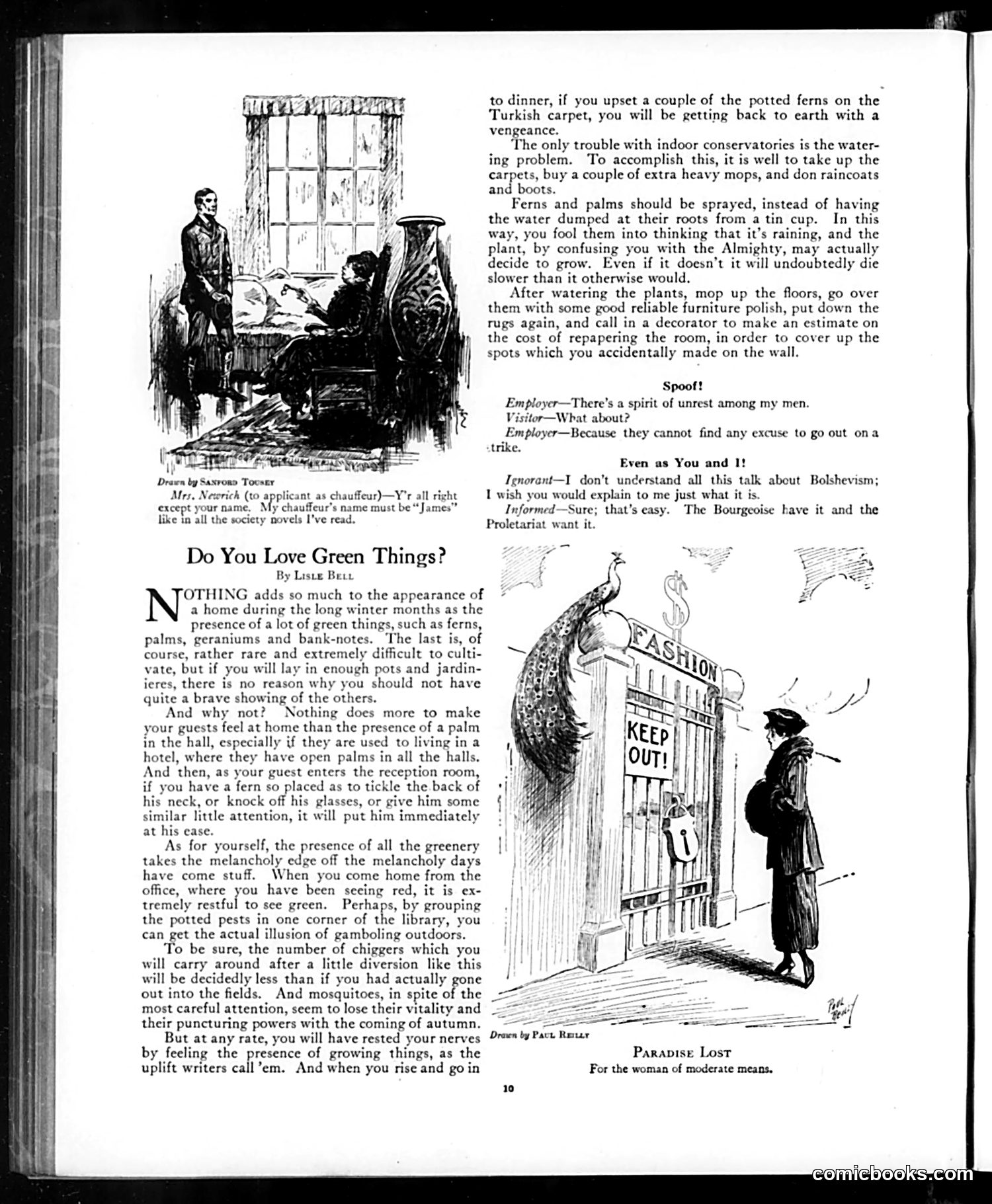
**Top Cartoon (Saxons Tooker):** Satirizes wealthy nouveaux riches pretension. Mrs. Newrich rejects a qualified chauffeur applicant solely because his name isn't "James"—she wants her servant to match names from society novels she reads. The joke mocks how the newly rich obsess over superficial social conventions while ignorant of actual aristocratic values. **"Do You Love Green Things?" (Lisle Bell):** A humorous how-to article mocking indoor plant culture among the wealthy. It's deliberately tongue-in-cheek—plants are called "potted pests," watering requires raincoats and mops, and results in water damage requiring expensive repairs. The satire targets both the faddishness of keeping houseplants and wealthy people's impractical pretensions to nature appreciation. **Bottom Cartoon (Paul Henley):** "Paradise Lost—For the woman of moderate means" shows a fashionably-dressed woman excluded from an exclusive boutique. It satirizes class divisions and luxury retail's gatekeeping, suggesting "paradise" (fashionable shopping) is inaccessible to working/middle-class women.
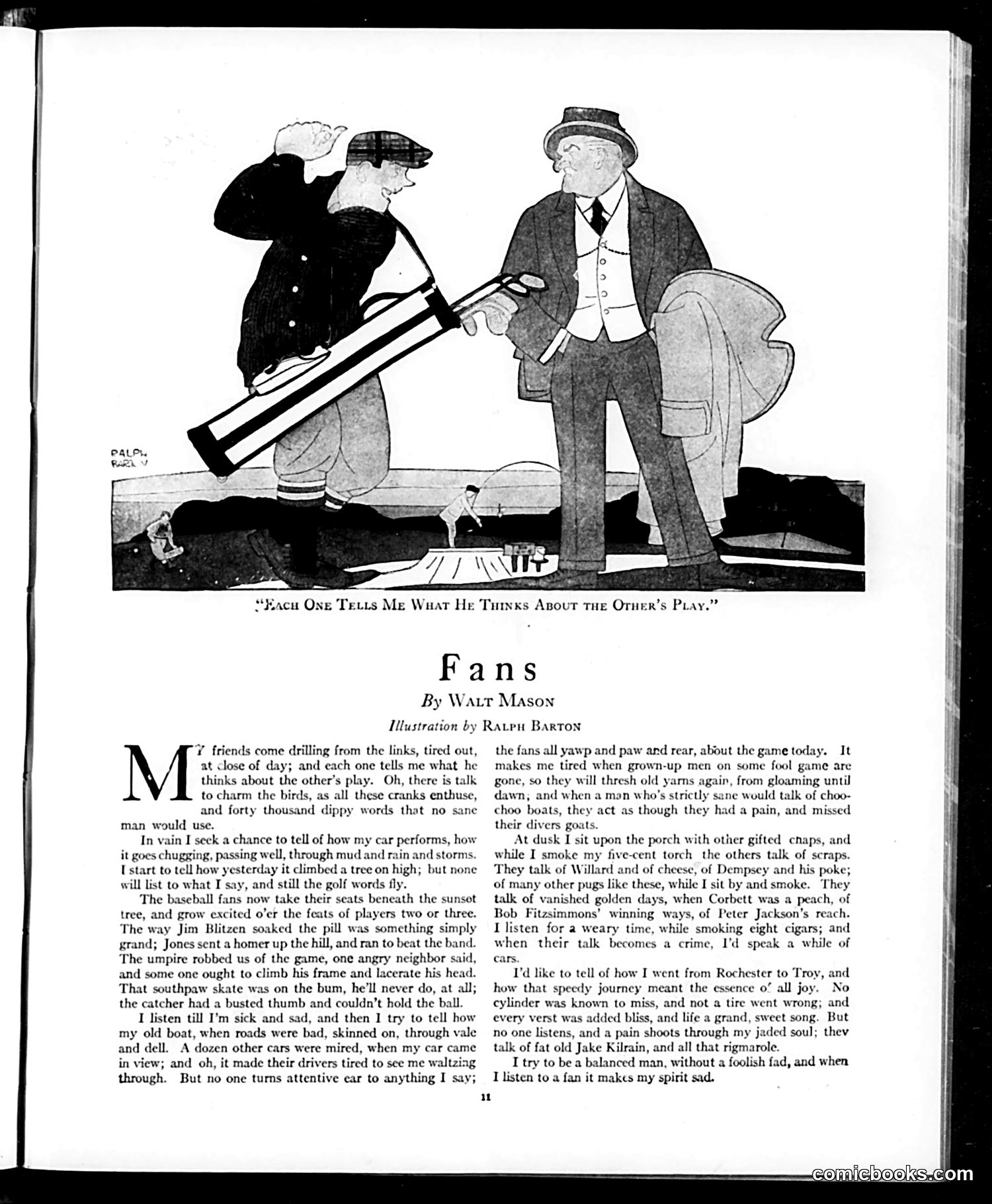
**The Cartoon and Story:** This is a humorous commentary on social bores and obsessive sports fans. The illustration shows two men—one gesturing animatedly with a megaphone while discussing baseball, the other appearing resigned—embodying the text's theme. **The Point:** Walt Mason's poem satirizes grown men who monopolize conversation with endless, tedious details about sports (baseball, boxing, golf) and athletes (Jim Blitzen, Corbett, Dempsey, Jake Kilrain). The narrator tries repeatedly to discuss his own interests—his car's performance, a successful drive from Rochester to Troy—but is consistently ignored because listeners are too absorbed in rehashing games and fighters. **The Satire:** The joke targets the shallow enthusiasm and social rudeness of sports fans whose obsession makes them deaf to anything else. Mason presents this as a form of madness—"forty thousand dippy words that no sane man would use"—making fans appear foolish and tiresome rather than passionate. The illustration's exaggerated gesture reinforces this mockery of overwrought fan behavior.
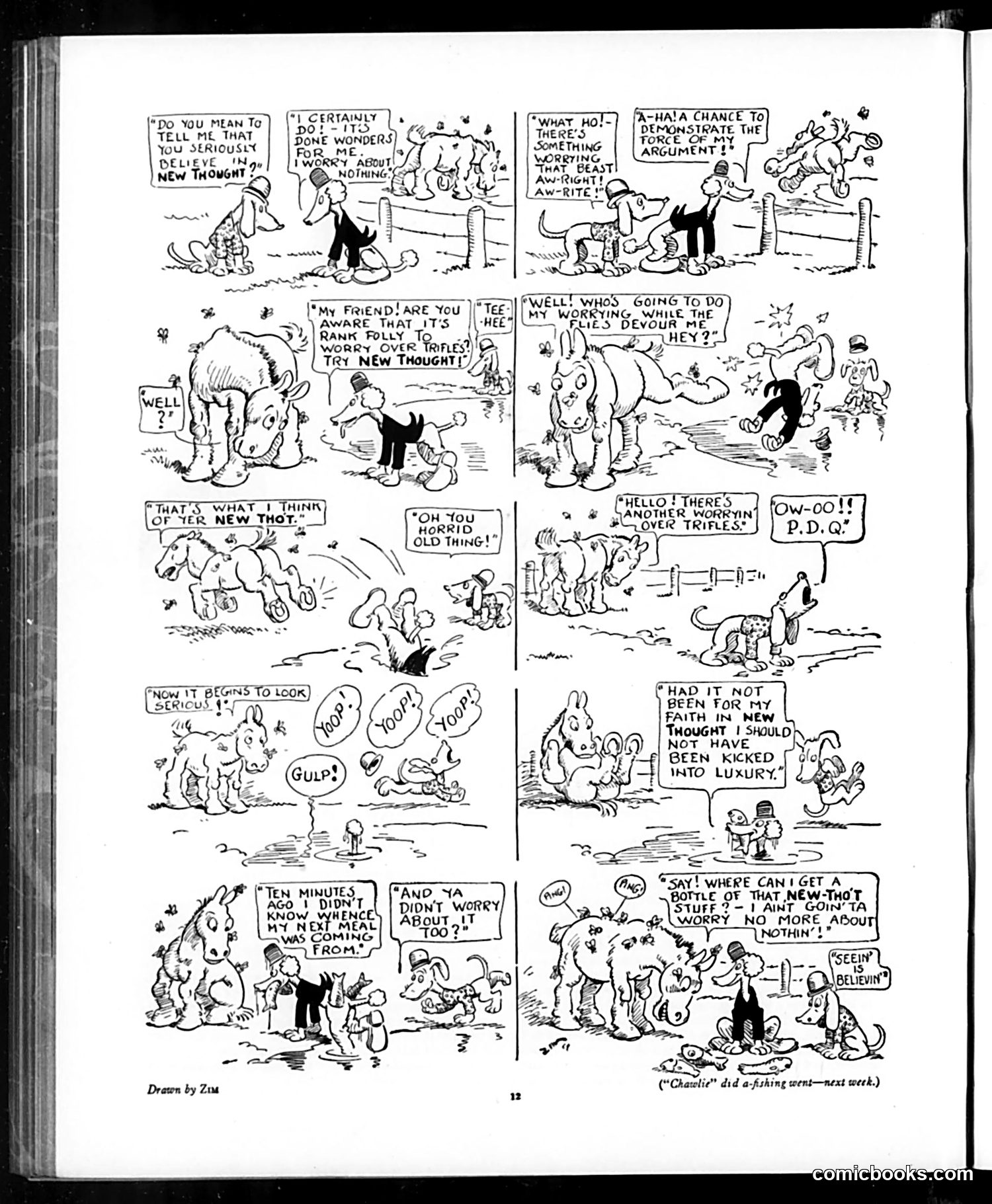
This comic mocks the "New Thought" movement—a late-19th/early-20th-century self-help philosophy emphasizing positive thinking and mental discipline to overcome life's problems. The cartoon ridicules adherents who claim the doctrine solves all anxieties through belief alone. A character proudly professes faith in "New Thought," insisting worry is unnecessary. But when practical problems arise—a cow needs milking, flies attack, work goes undone—the philosophy proves useless. The character is literally "kicked into luxury" (knocked down), yet still credits "New Thought" for their misfortune. The satire's point: blind faith in trendy self-help philosophies cannot replace actual work or practical problem-solving. The comic suggests New Thought adherents are delusional, prioritizing mental attitude over reality. By the end, even skeptics want to buy "New Thought" bottles—mocking how such movements become commercialized fads. The humor targets intellectual pretension and the gap between idealistic philosophy and messy reality.
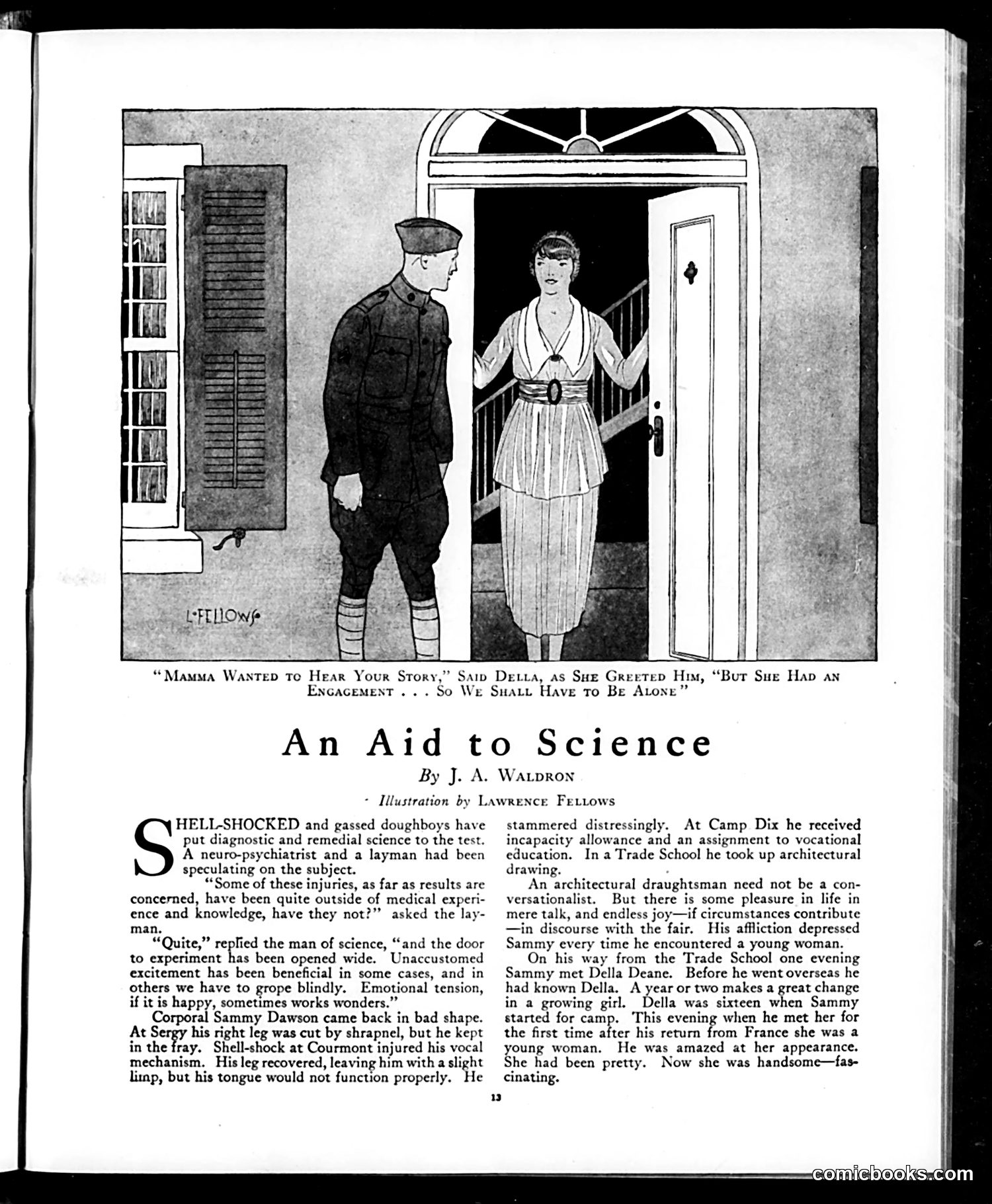
This is a post-WWI story about "shell shock" (now called PTSD). A wounded soldier, Corporal Sammy Dawson, returns from France with two injuries: a healed leg wound and severe stammering caused by shell-shock at the Battle of Courmont. The narrative illustrates a contemporary medical theory: that emotional excitement—specifically romantic attraction—could therapeutically help traumatized soldiers recover speech function. Sammy, assigned to vocational training, encounters Della Deane, a girl he knew before the war who has matured into an attractive woman. The illustration shows their first meeting after his return. The caption hints at the "treatment": Della's mother wants to hear his story, but the couple must be alone together—the implication being that romantic/emotional engagement might help restore his ability to speak. This reflects genuine 1920s beliefs about trauma recovery, blending early psychiatry with Victorian romance conventions.
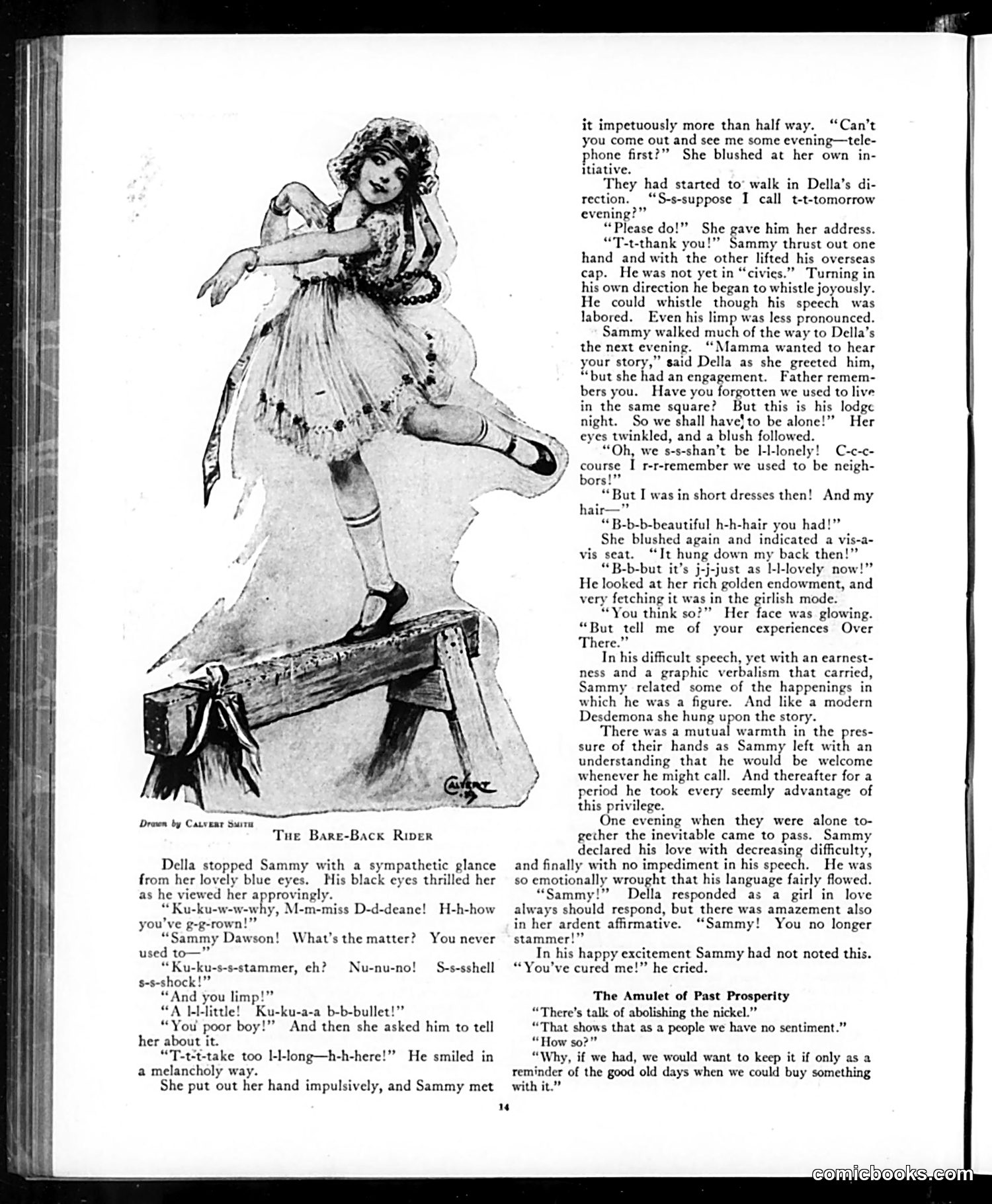
This romantic illustration and accompanying story depict a sentimental post-WWI narrative. The cartoon shows a young woman (Della) greeting a returning soldier named Sammy, who bears visible war wounds—a limp and a speech stammer from a shell injury. The satire lies in the sentimental treatment of the soldier's condition. Sammy's stutter and limp symbolize his sacrifice, making him oddly appealing to Della, who reconnects with her childhood neighbor. The joke culminates when Sammy declares his love: his emotional intensity temporarily cures his stammer entirely, suggesting that romantic passion transcends physical disability. This reflects 1920s American attitudes toward veterans—romanticizing their wounds while offering them emotional (rather than practical) support. The accompanying brief text about abolishing the nickel mocks public nostalgia for simpler times, reinforcing the page's theme of sentiment versus reality in post-war America.
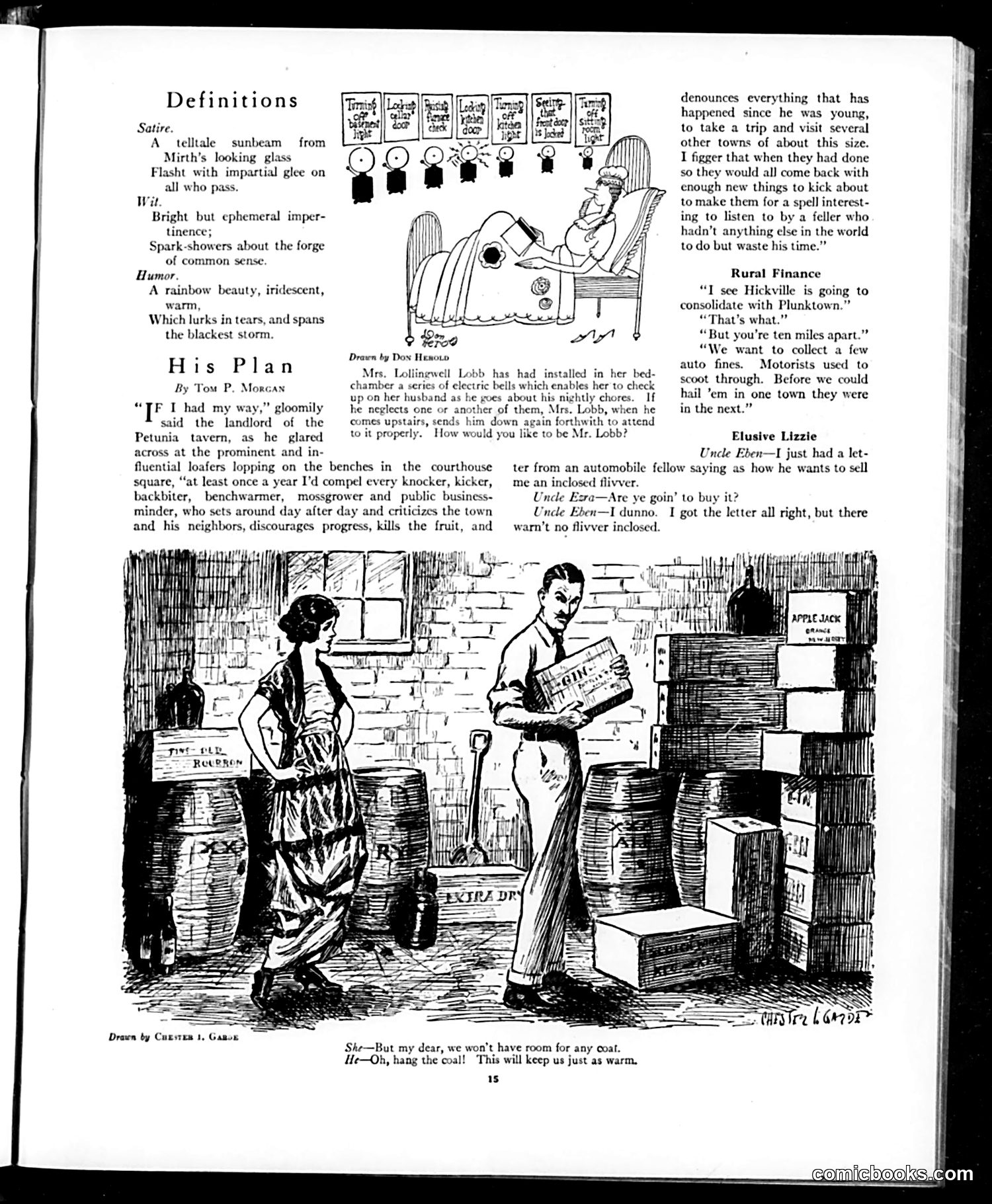
This page contains several satirical pieces typical of early 20th-century American humor: **"His Plan"** depicts a tavern landlord complaining about courthouse loafers who spend their days criticizing the town without contributing. The satire targets idle complainers and chronic fault-finders—a common subject of social criticism. **"Rural Finance"** mocks small-town municipal consolidation schemes, suggesting towns merge primarily to collect automobile fines from passing motorists rather than legitimate civic purposes. **"Elusive Lizzie"** jokes about mail-order automobile sales, where Uncle Eben receives a sales letter for a "flivver" (cheap car) but finds no vehicle actually enclosed—playing on rural skepticism of modern commerce. The bottom illustration shows a couple's domestic dispute over space, with the husband suggesting burning coal as a coat substitute rather than storing winter clothing—humorously depicting household frugality or overcrowding. The page opens with poetic definitions of satire, wit, and humor, establishing the magazine's intellectual pretensions about its own comedic mission.
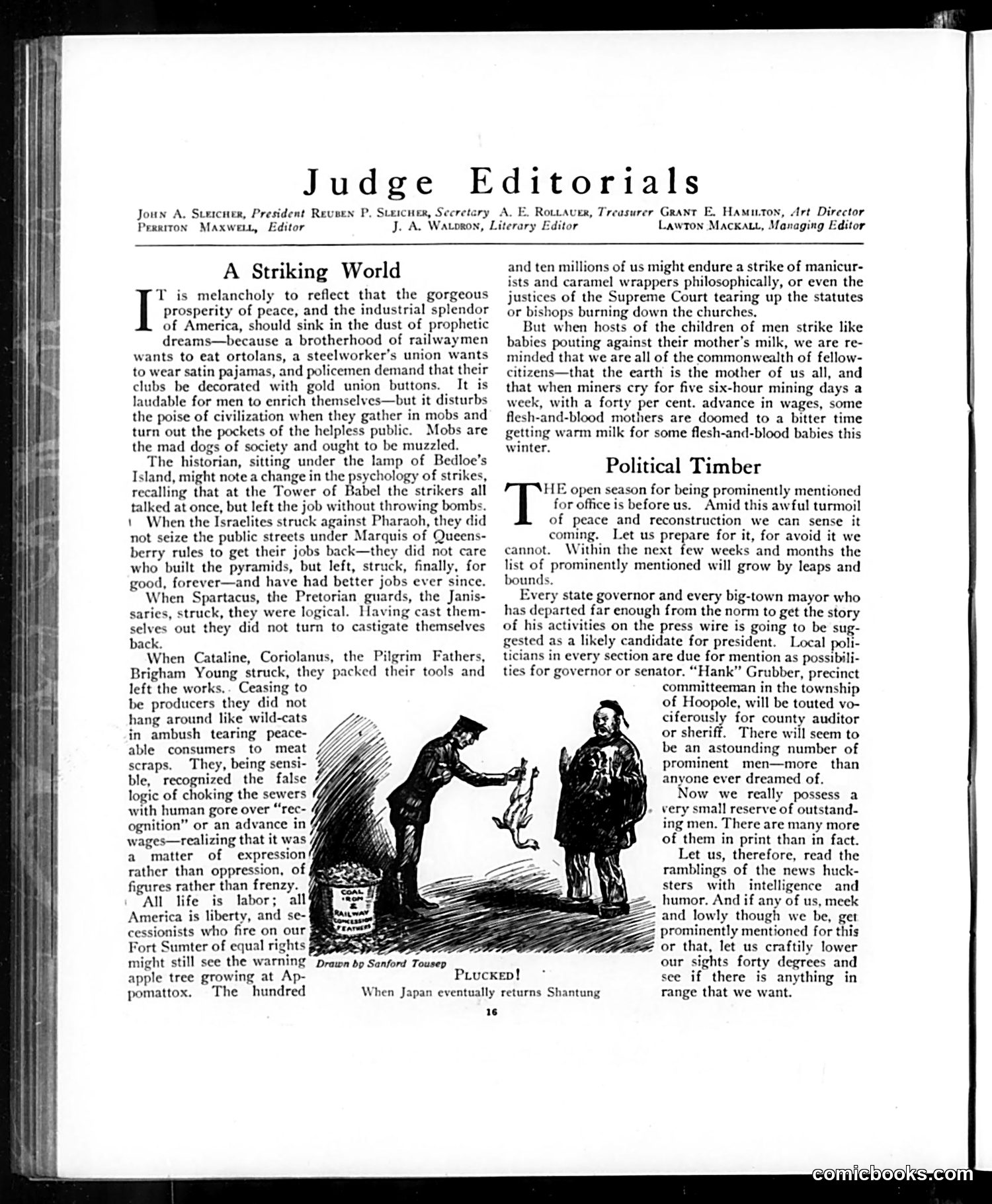
This page contains two editorials criticizing labor strikes and speculating about post-war politics. **"A Striking World"** denounces workers' strikes as uncivilized mob behavior. The editorial argues that historical strikers (Spartacus, the Pilgrim Fathers, Brigham Young) simply left their jobs rather than disrupting society. It mocks contemporary strikers—railwaymen demanding luxuries like ortolans and satin pajamas, miners seeking shorter hours and wage increases—as selfish children harming innocent mothers and babies who need milk. The accompanying cartoon (by Sanford Tousey) shows a figure being struck or beaten, labeled "Plucked! When Japan eventually returns Shantung," suggesting the satire conflates labor unrest with international humiliation. **"Political Timber"** warns that post-war elections will flood the press with obscure candidates promoted as presidential material, with even minor local politicians suddenly touted for high office. Both editorials reflect Judge's conservative, anti-labor stance typical of early 20th-century satirical magazines aligned with business interests.
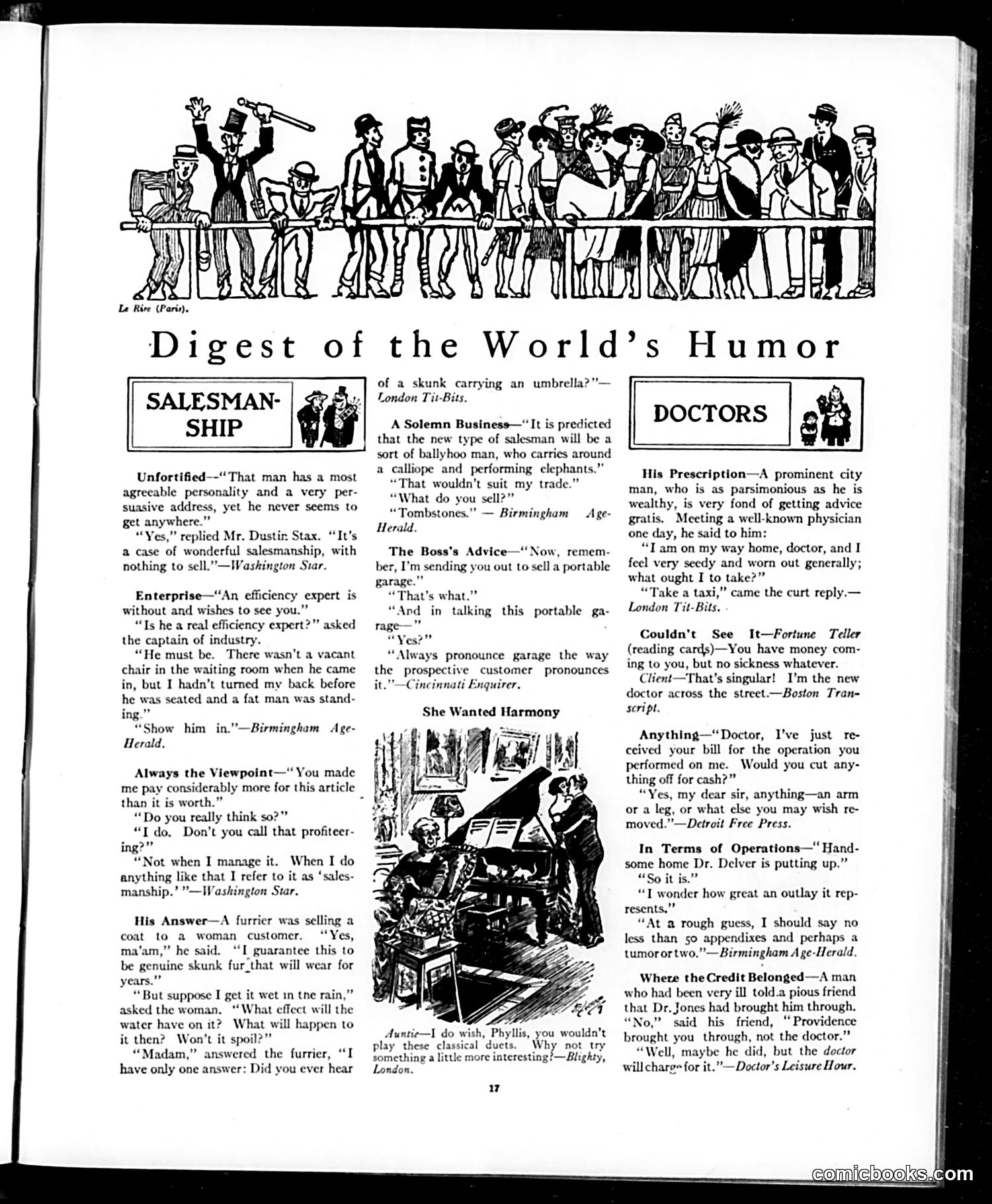
This page collects brief humorous anecdotes organized by profession (salesmen, doctors). The jokes satirize early-20th-century business practices and professional attitudes. **Salesman jokes** mock aggressive "salesmanship"—the ability to sell anything through persuasion rather than product quality. One anecdote plays on pronunciation snobbery ("garage"), another on how salesmen rebrand unethical practices as technique. A furrier's absurd defense of a skunk-fur coat's rain-resistance (suggesting skunks carry umbrellas) exemplifies the genre. **Doctor jokes** target physician greed and callousness. A wealthy but stingy patient is told to "take a taxi" (implying rest, or mocking his reluctance to pay). Others joke about doctors profiting from unnecessary surgeries (counting "appendixes" removed). One final joke cynically notes a doctor demands payment despite Providence receiving credit for the patient's recovery. The satire reflects Progressive-era skepticism toward unregulated capitalism and professional ethics, common in *Judge* magazine's social commentary.
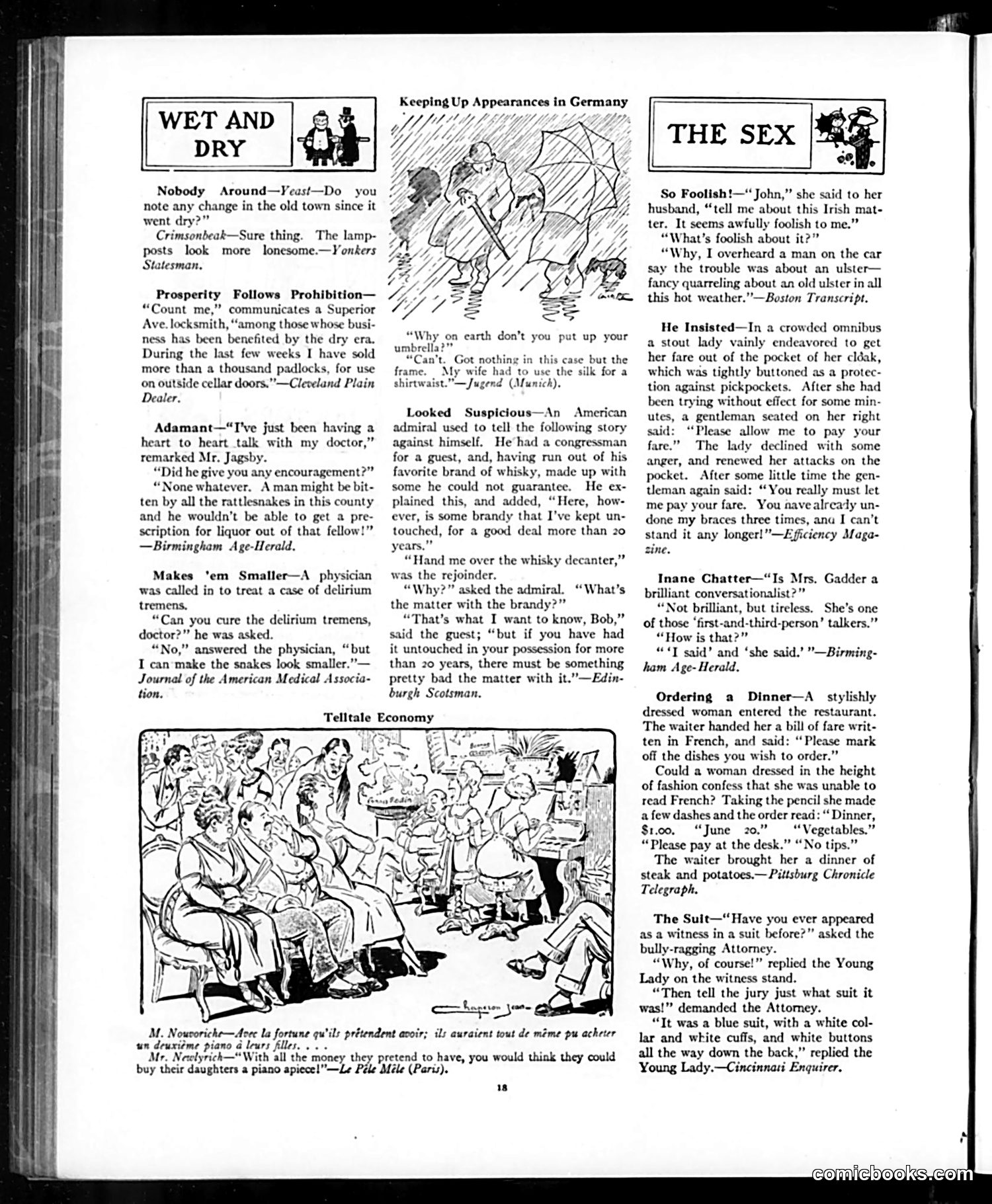
This page satirizes **Prohibition's social effects** through multiple anecdotes. "Wet and Dry" jokes mock the ban on alcohol: lampposts look "lonesome," a locksmith profits from selling padlocks for cellar doors (people hiding illegal liquor), and a doctor can't prescribe whiskey even for delirium tremens. The humor targets Prohibition's ineffectiveness and hypocrisy. "Keeping Up Appearances in Germany" lampoons postwar German poverty—a woman lacks silk for an umbrella because she repurposed it as a shirtwaist. "The Sex" section contains gender-focused humor, mostly about women's perceived foolishness or chattiness. One joke mocks a woman misunderstanding Irish political conflict as quarreling over an "ulster" (coat), while another ridicules a woman so eager to pay her omnibus fare that she undoes a man's suspenders. The **Telltale Economy** cartoon illustrates class pretension: nouveau-riche families can't afford second pianos despite claimed wealth, revealing financial fraud.
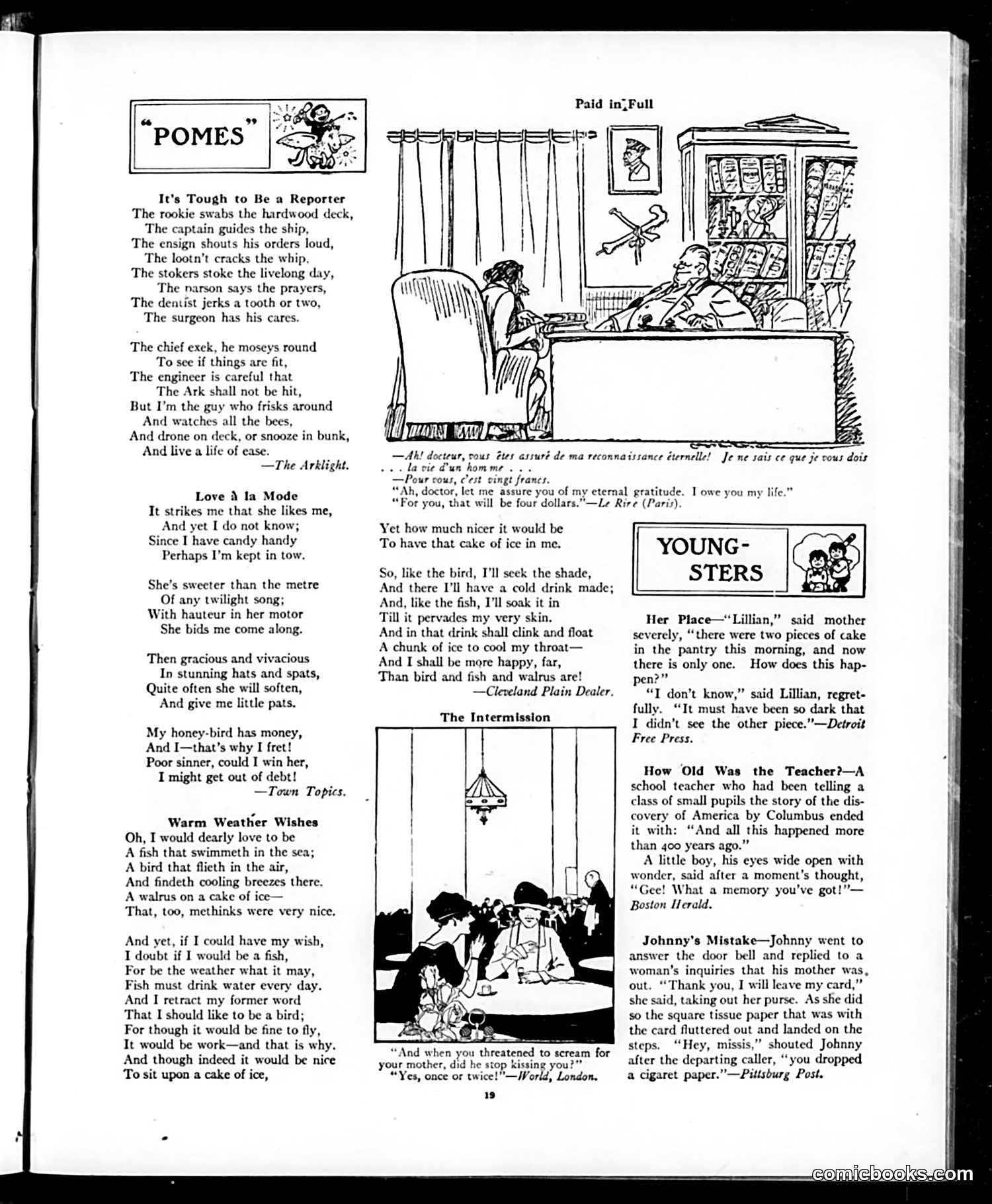
This page from *Judge* magazine contains several humorous poems and anecdotes typical of early 20th-century American humor. The main cartoon shows a ship's reporter lounging in a chair while other crew members work—satirizing the reporter's relatively easy job compared to sailors' laborious duties. The poem "It's Tough to Be a Reporter" ironically celebrates this cushy position. Other poems address romance and weather whimsically: "Love à la Mode" mocks a man uncertain whether a woman likes him (suspecting she only tolerates him for candy), while "Warm Weather Wishes" humorously explores the impracticality of being various animals. The sidebar "Youngsters" contains brief jokes: one features a child explaining missing cake by claiming darkness; another shows a boy innocently calling tissue paper a "cigaret paper" to a departing visitor. The humor relies on gentle ironies, logical absurdities, and mild embarrassment situations—typical of *Judge*'s accessible comedic style for middle-class readers.
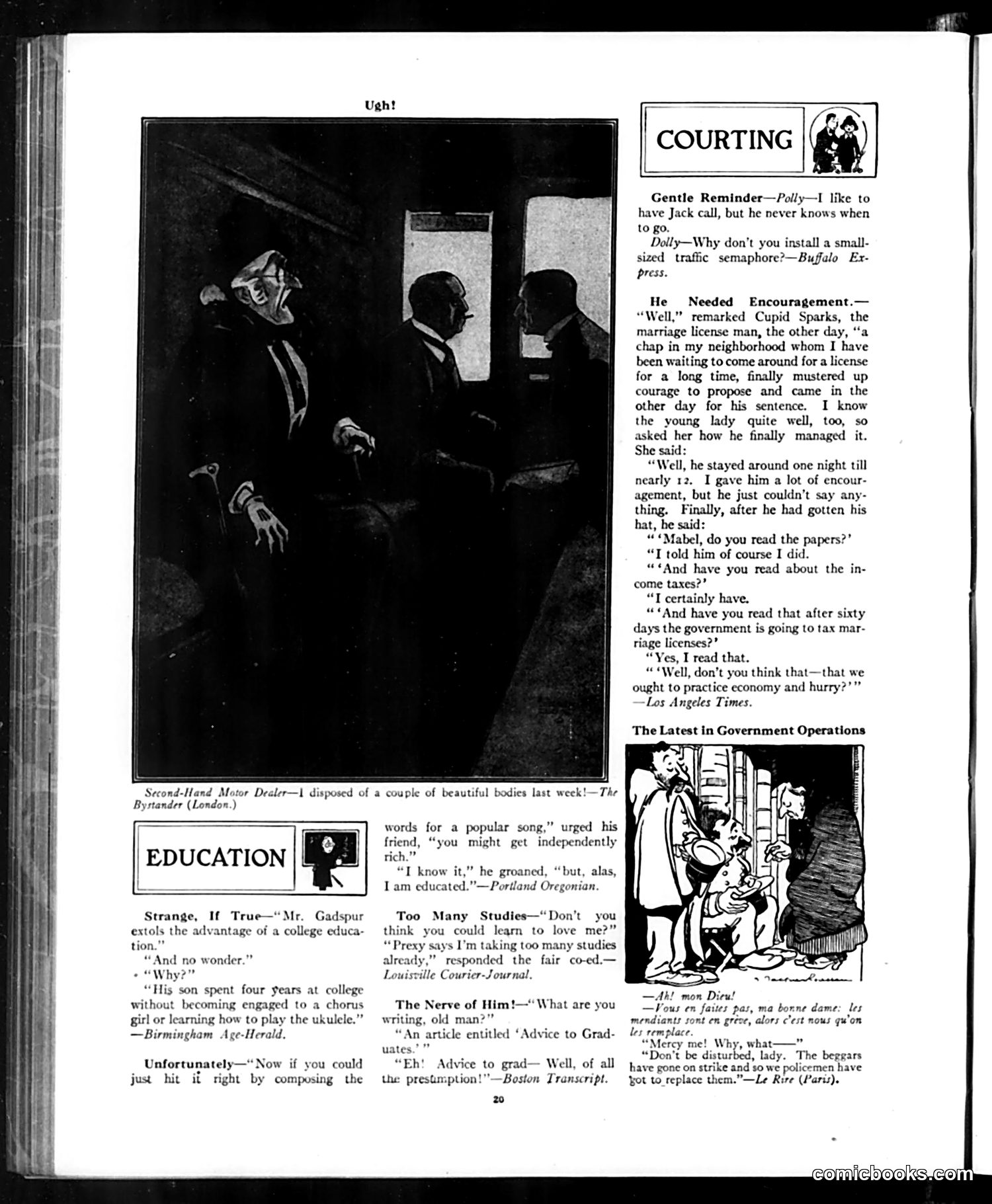
This page contains multiple short satirical anecdotes mocking early 20th-century social conventions, particularly around education and courtship. **The "Second-Hand Motor Dealer" cartoon** (top left) depicts a shady transaction—likely a used-car salesman, a fixture of contemporary fraud anxieties. **The "Education" section** jokes that college's main value is keeping sons away from chorus girls and ukuleles—mocking both higher education's pretensions and the "Jazz Age" culture emerging in the 1920s. **The "Courting" section** contains humor about marriage proposals and gender dynamics. The final anecdote satirizes government overreach: a man finally proposes to his reluctant girlfriend only after reading about coming taxes on marriage licenses, framing marriage as a financial burden rather than romantic commitment. **The "Government Operations" cartoon** (bottom) shows Paris police replacing striking beggars—dark satire on government inefficiency and labor unrest, likely referencing 1920s European strikes. Overall, the page satirizes modern anxieties: education, courtship rituals, government expansion, and social change.
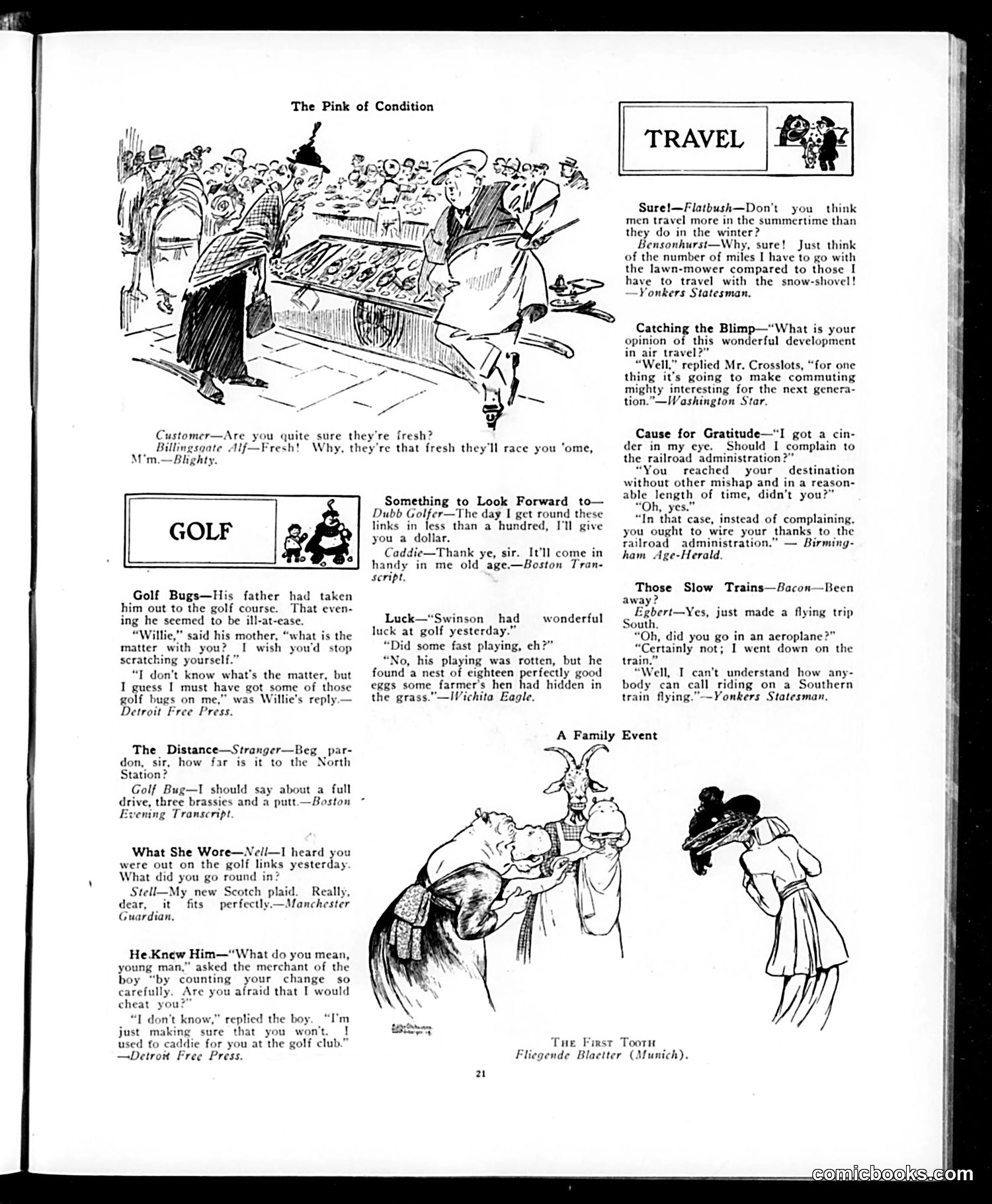
This page collects humor pieces about golf and travel, popular leisure topics of the early 20th century. **"The Pink of Condition"** depicts a fishmonger (Billingsgate Alf) assuring a customer that fish are so fresh they'll "race you home"—exaggerating freshness as a sales pitch. The **golf section** contains several jokes playing on golf terminology and obsession: a child thinks he caught "golf bugs" from the course; a caddie measures distance in golf strokes rather than miles; jokes about golf clothing and finding eggs instead of golfballs. The **travel section** includes humor about modern transportation. References to "blimps" (early airships) and "aeroplanes" suggest these were novel, cutting-edge technologies. The railroad jokes mock slow trains, particularly Southern ones. One joke suggests grateful passengers should thank railroad administration for reaching destinations despite delays. "A Family Event" illustration shows a goat, likely a punchline about family disruptions. The humor reflects early 1900s preoccupations: golf as a fad, emerging aviation technology, and frustration with railroad service.
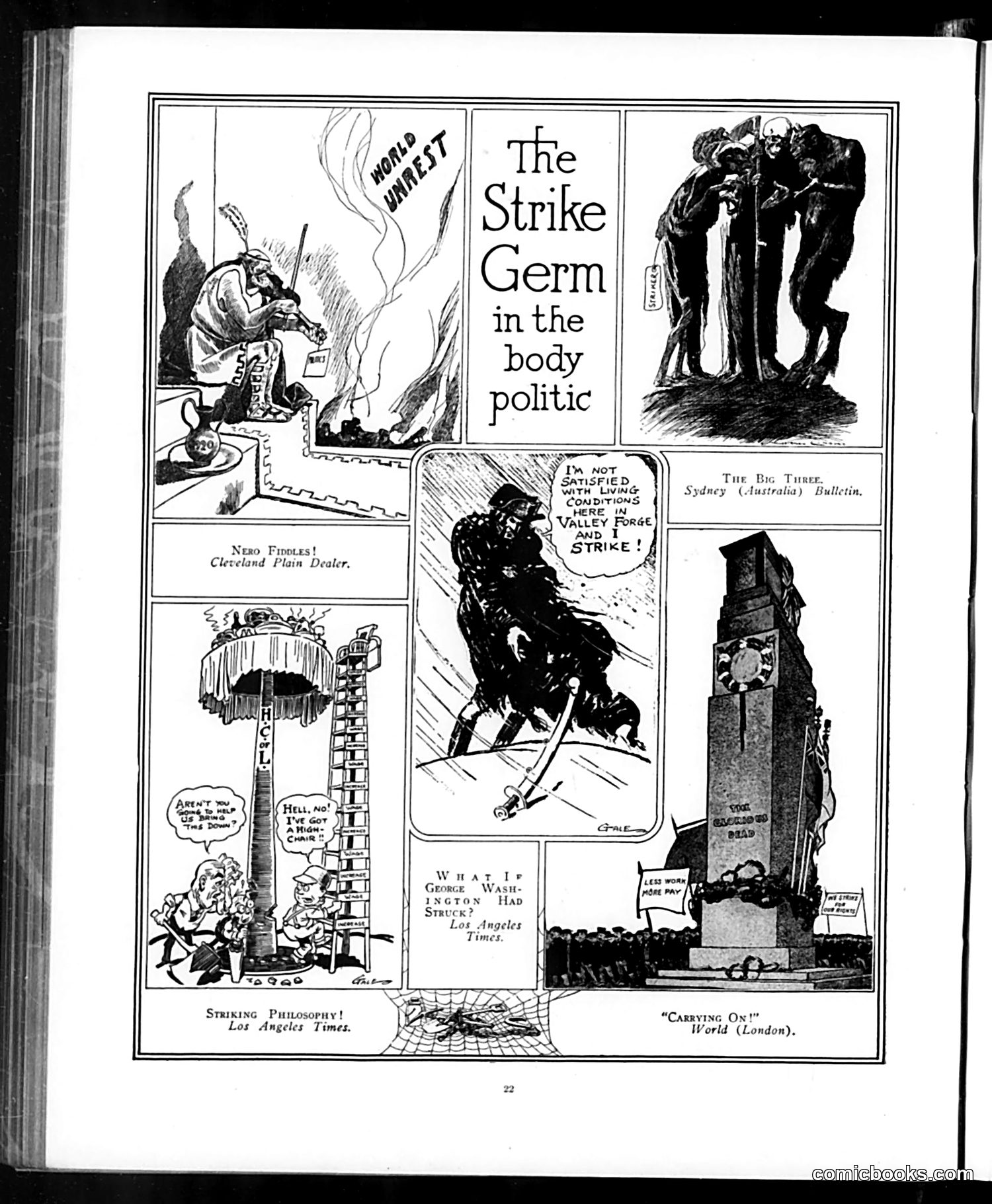
This page uses disease metaphors to satirize labor strikes as infectious illness afflicting society. The title panel positions strikes as a pathogenic threat to the social "body." The cartoons reference specific strike incidents: Cleveland's labor unrest (comparing a striker to Nero), and what appears to be unrest in Los Angeles and other locations. One panel shows a character saying he's "not satisfied with living conditions here in Valley Forge and I strike"—mocking strikers by comparing their complaints to Revolutionary War-era hardship. The bottom right image shows a war memorial captioned "Carrying On," suggesting strikers betray soldiers' sacrifice. The overall message: strikes are selfish, diseased social disruptions endangering the nation. This reflects early 20th-century anti-labor sentiment common in mainstream publications, treating worker activism as pathological rather than legitimate grievance.
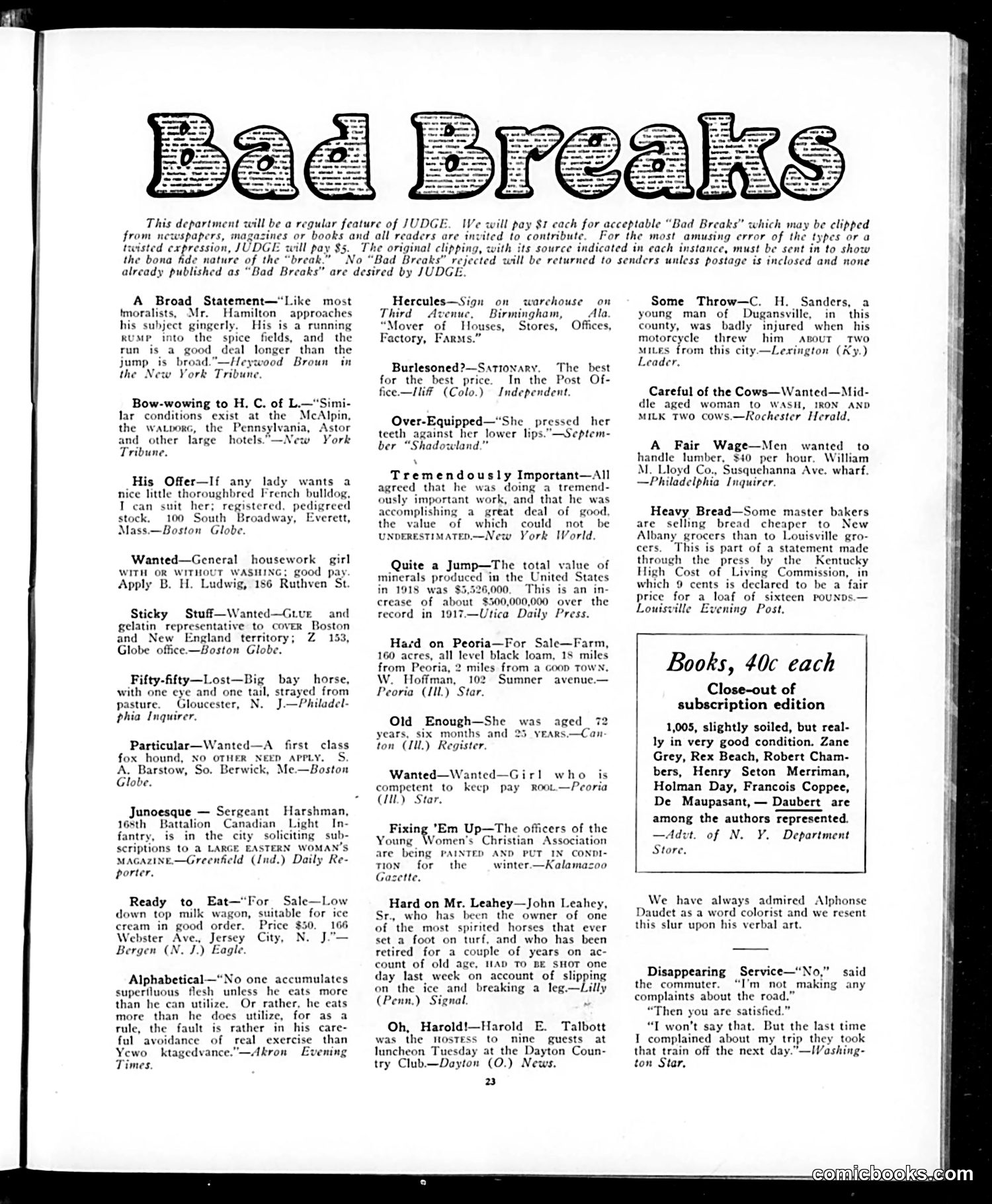
This is a humor column collecting typographical and editorial errors clipped from newspapers and magazines. Judge paid $1 per accepted submission, inviting readers to spot amusing printing mistakes. The jokes work by presenting real errors that create unintended meanings. Examples include: a warehouse sign reading "Mover of Houses, Stores, Offices, Factory, **Faras**" (apparently "Farms"); the phrase "She pressed her teeth against her lower lips" appearing in a story titled "Shadowland"; and a farm listing mentioning proximity to a "**Goop Town**" (likely "Good Town"). Another notes mineral production jumped from "$5,526,000" in 1918 versus 1917—an obvious typo, since it claims an increase of $10 million but shows an impossibly small base figure. The humor relies on readers' recognition that these errors—whether typos, OCR failures, or editorial mishaps—create absurd or unintentionally suggestive meanings. It's essentially early 20th-century crowdsourced entertainment mocking the press's carelessness.
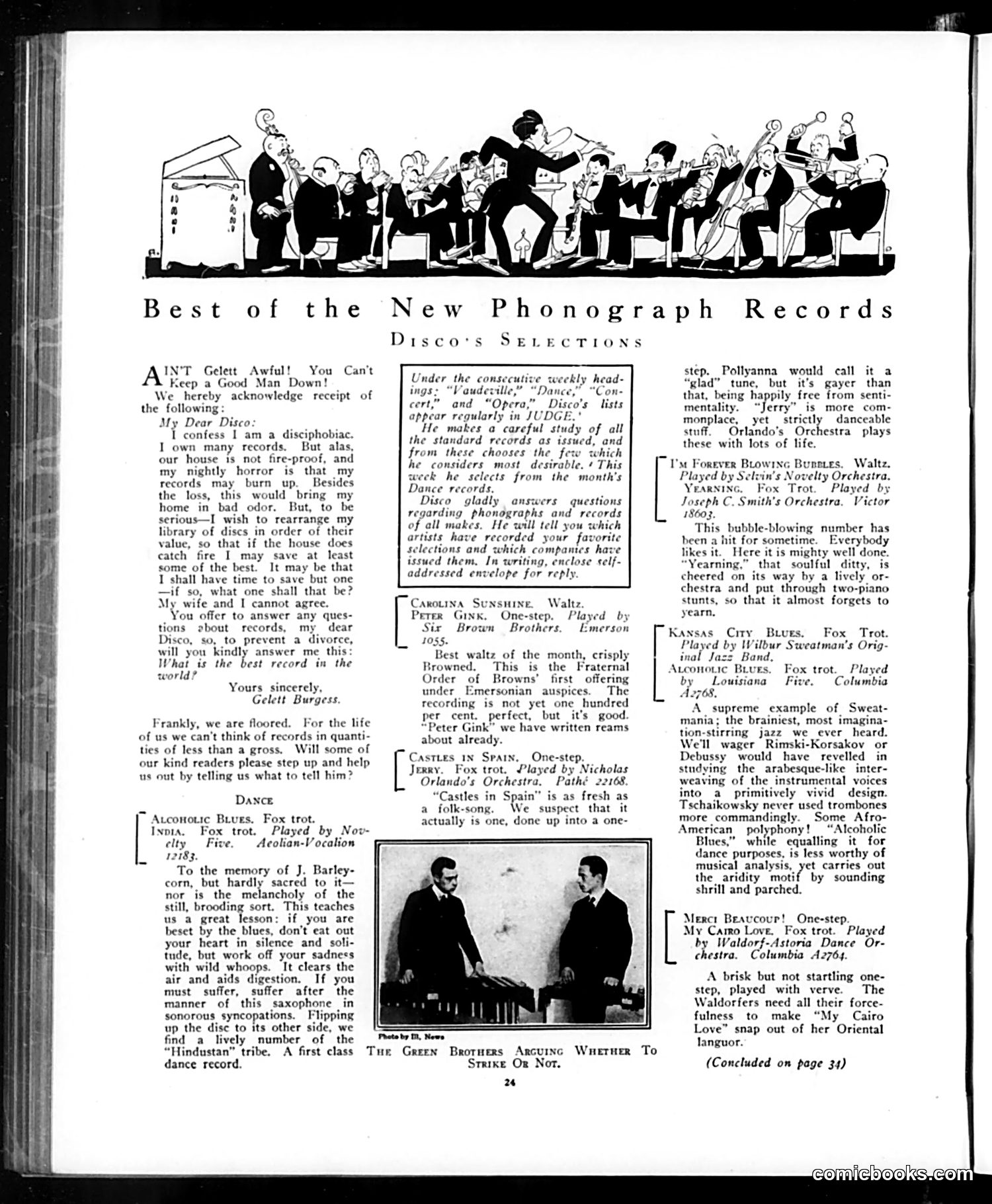
This page reviews phonograph records, a popular entertainment medium of the 1920s. The masthead illustration shows an orchestra, establishing the musical subject. The content includes: 1. **A humorous letter** from writer Gelett Burgess asking "Disco" (the magazine's records columnist) which single record is "best in the world"—he wants to know which to save first if his house catches fire. This satirizes both the proliferation of records and the difficulty of choosing among them. 2. **Record reviews** evaluating dance music, waltzes, and jazz recordings from labels like Victor, Columbia, and Emerson. The reviews are written in a casual, opinionated style typical of Judge's satirical tone. 3. **A photograph** captioned "The Green Brothers Arguing Whether to Strike or Not"—likely referencing a contemporary labor dispute or social issue, though the specific context is unclear without additional historical information. The page reflects 1920s consumer culture around recorded music as a major entertainment industry.
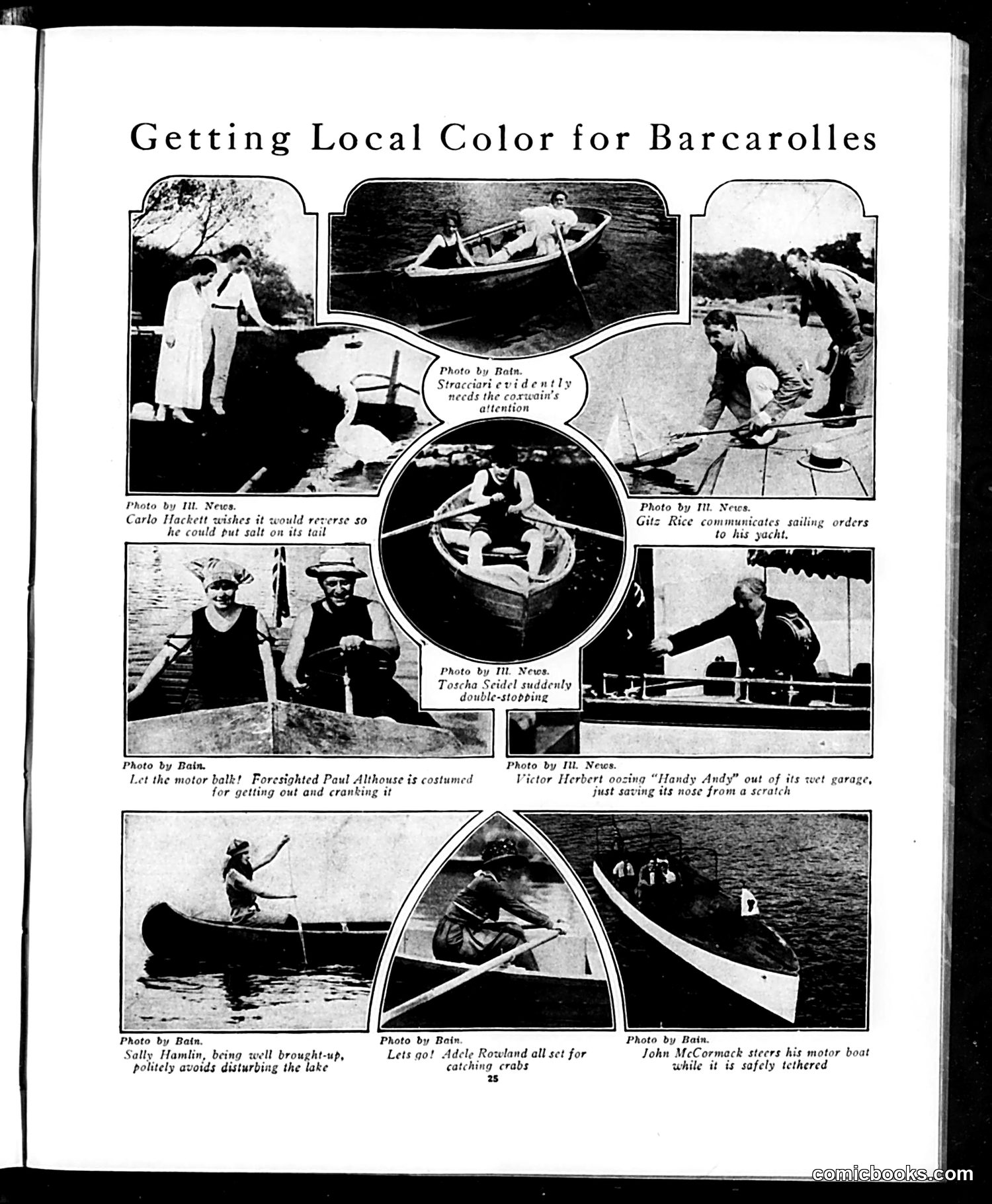
This page satirizes famous opera singers and musicians attempting to gather authentic material for a musical composition called "Barcarolles" (traditionally Venetian boat songs) by engaging in clumsy, comedic boating mishaps. The figures appear to be prominent early 20th-century performers—Carlo Hackett, Gitz Rice, Toscha Seidel, Paul Althouse, Victor Herbert, Adele Rowland, Sally Hamlin, and John McCormack—portrayed as comically inept with boats. The joke mocks the contrast between their refined artistic status and their bumbling practical incompetence: one tries to salt a fish's tail, another worries about scratching a wet garage door, one attempts hand-cranking a motor. The satire suggests these sophisticated artists are absurdly out of their element in ordinary situations, playing at "getting local color" for their art while actually just making fools of themselves on the water. The humor relies on the reader recognizing these celebrities and finding their predicaments amusing.
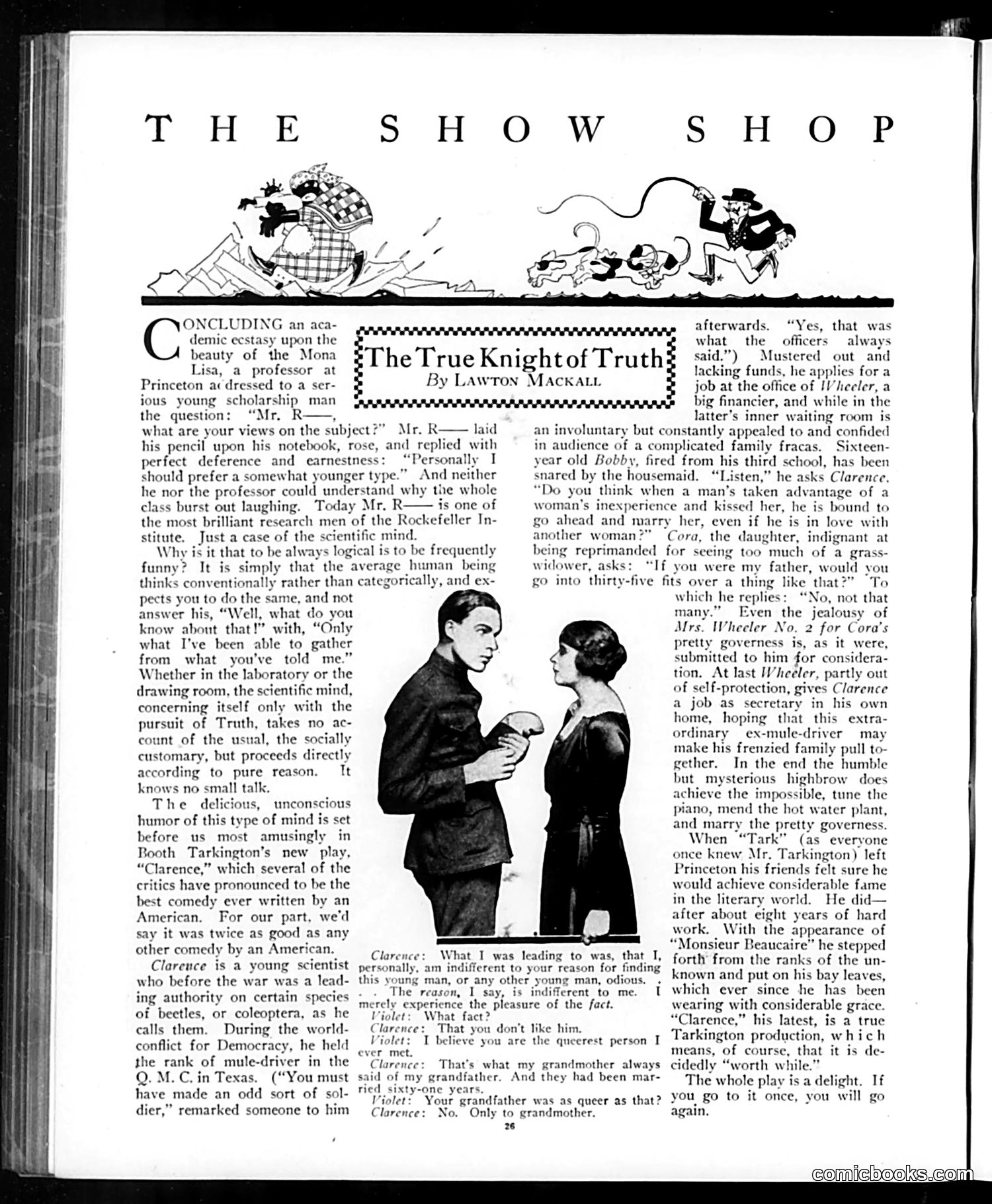
This page reviews Booth Tarkington's play "Clarence," which satirizes the "scientific mind" that pursues pure logic while ignoring social convention. The humor centers on a former beetle expert turned mule-driver in WWI who becomes a secretary to a wealthy financier. The text argues that truly logical people are funny because they answer straightforward social questions literally rather than conventionally—like a Princeton professor's student who, asked his views on the Mona Lisa, replies he prefers "a somewhat younger type" of woman. Clarence embodies this absurdist logic: he calmly addresses the family's scandals and crises with rational detachment while inadvertently solving their problems. The satire mocks both the impractical idealism of intellectuals and the anxieties of wealthy families over propriety and romantic entanglements. The play suggests that pure reason—disconnected from social niceties—can paradoxically accomplish what emotional family drama cannot.
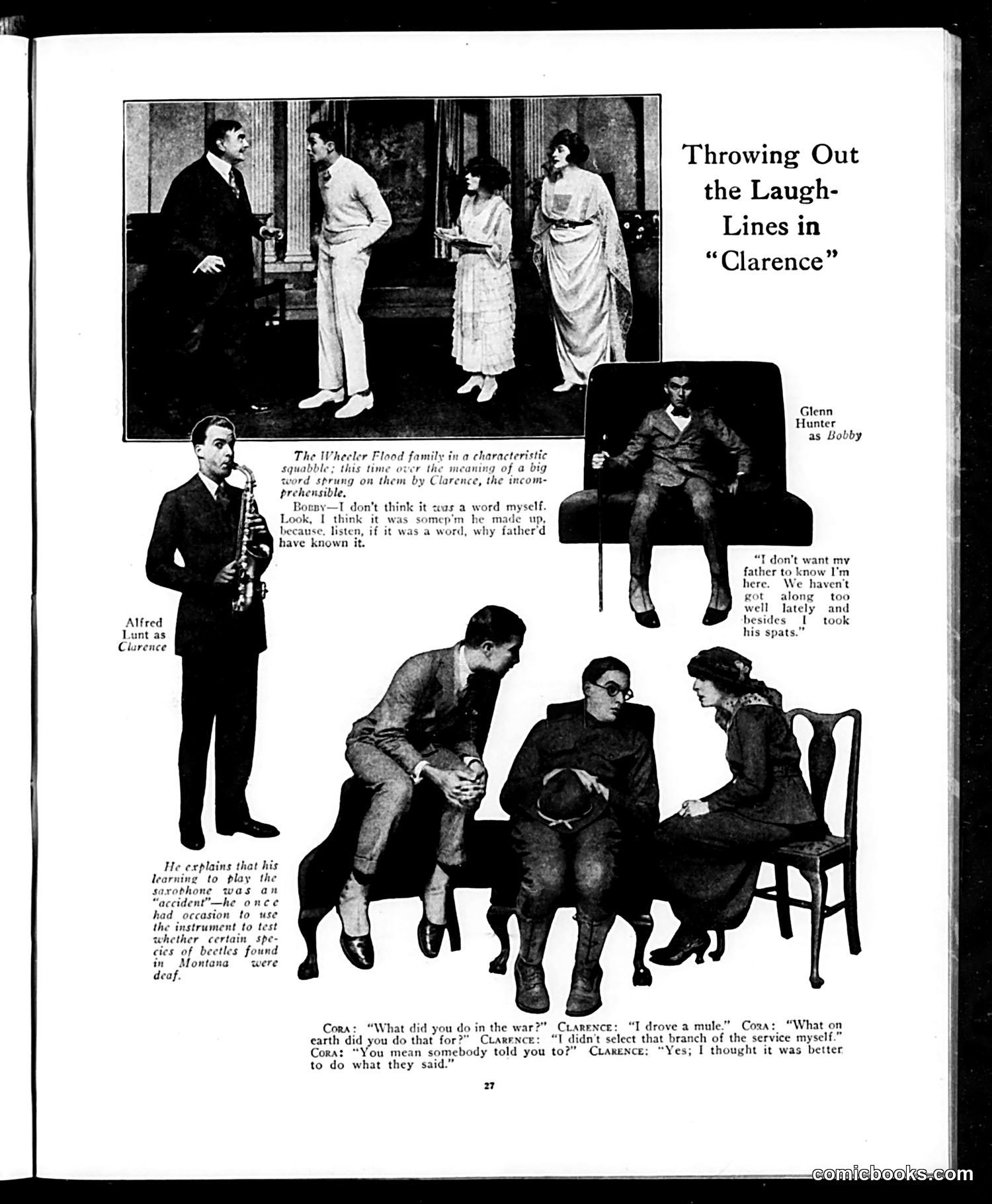
This page documents a Broadway play called *Clarence* (starring Glenn Hunter as Bobby and Alfred Lunt as Clarence), presenting scenes where the character Clarence—described as "incomprehensible"—confuses the Wheeler Flood family with his nonsensical statements and absurd explanations. The satire mocks the play itself: the title suggests the producers are "throwing out" the laugh-lines, implying the comedy isn't actually working. The dialogue examples show Clarence's character type—a bumbling, illogical figure who gives ridiculous answers (driving a mule in wartime, learning saxophone from a "beetle-testing accident") that are supposed to be humorous but apparently aren't landing with audiences or critics. Judge magazine is essentially panning the play as unfunny, using these awkward dialogue excerpts as evidence.
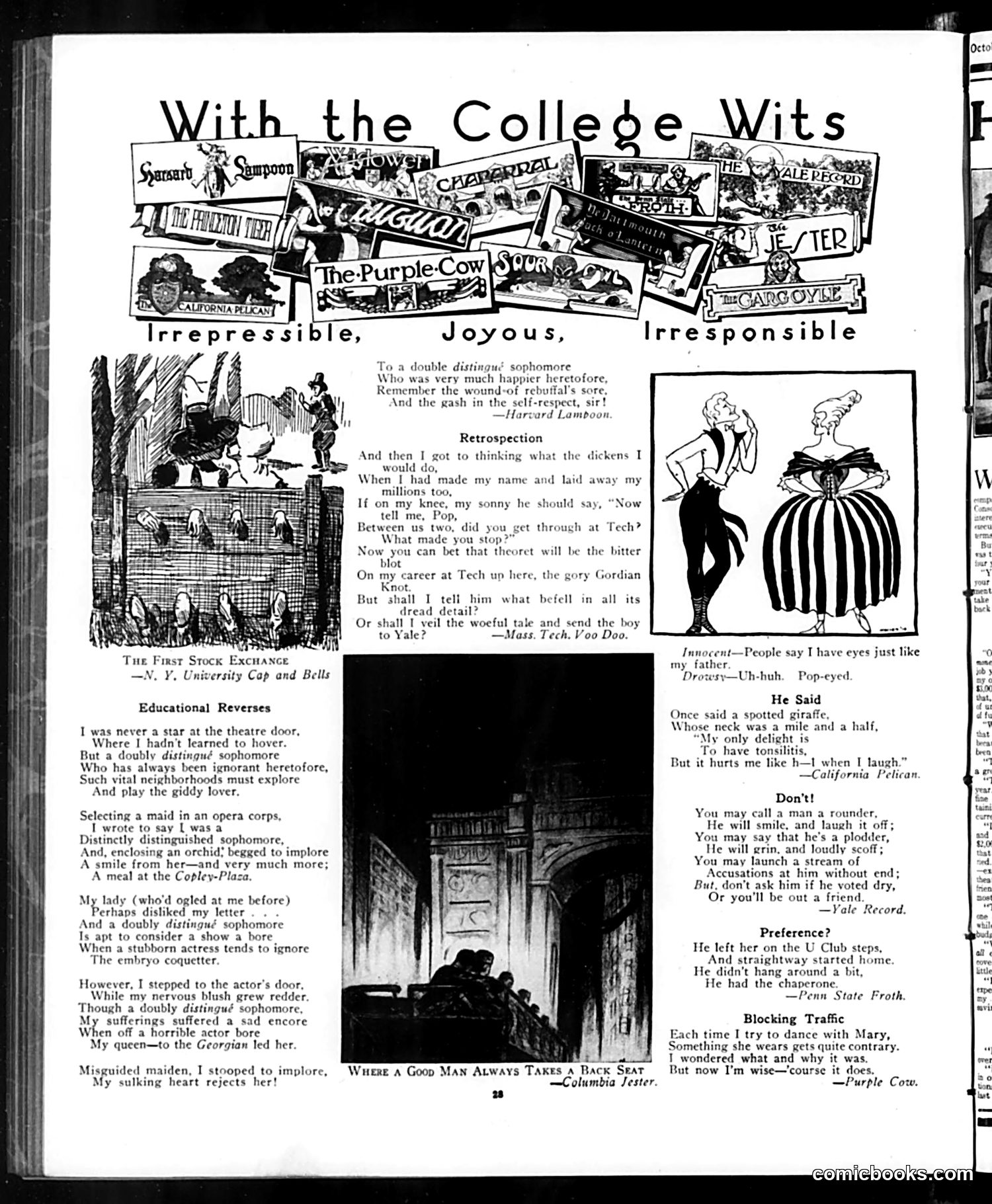
This page from *Judge* collects humorous poems and illustrations from various college publications (Harvard Lampoon, Columbia Jester, Yale Record, etc.). The content satirizes college life, particularly sophomore social pretensions and romantic mishaps. **Key pieces:** - **"Educational Reverses"**: A self-important sophomore's attempt to court an opera chorus girl fails when she's spirited away by an actor—mocking collegiate romantic delusions. - **"Retrospection"**: A man worries his future son will ask embarrassing questions about his college years at MIT ("Tech"), particularly whether he "got through" successfully—satirizing regrets over wasted academic time. - Other brief jokes mock Prohibition-era politics, chaperone awkwardness, and dance-floor mishaps. The *Judge* magazine frames these as representative college humor—absurdist, self-deprecating jokes about youthful folly, academic underperformance, and romantic failure. The cartoons and verse target the pomposity of college social hierarchies and young men's overconfidence.
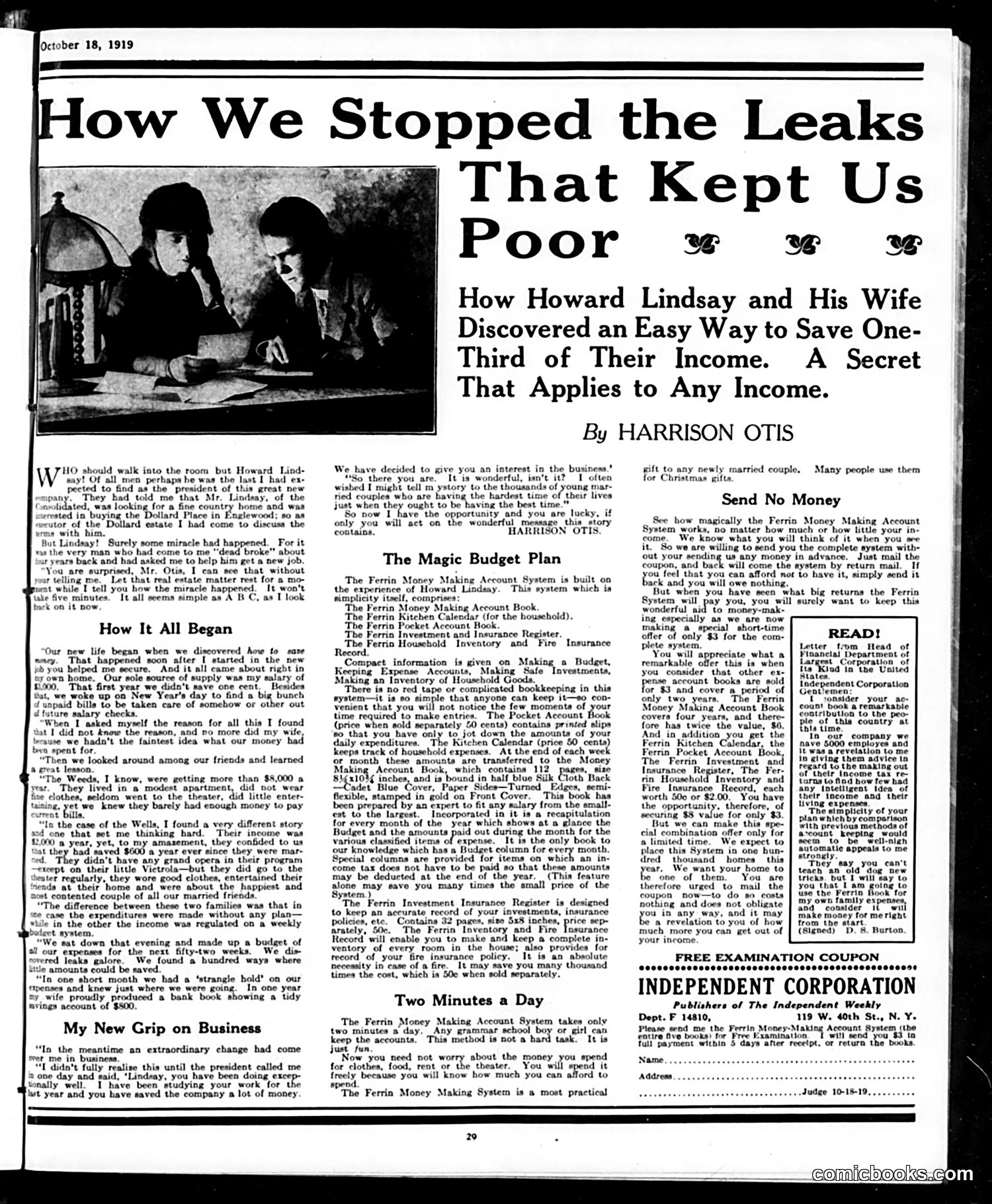
This is an advertorial (advertisement disguised as editorial content) from October 1919, promoting the "Ferrin Money Making Account System" — a budgeting/bookkeeping product. The narrative presents Howard Lindsay, a company executive who was initially poor despite earning $7,000 annually. His salvation came from adopting a detailed weekly budget system that revealed "leaks" (untracked spending). By controlling expenses, he saved $800 in one year, impressed his employer, and earned a business stake. **The appeal to 1919 readers:** This story addressed widespread anxiety about middle-class financial stability during the post-WWI period. The implicit message: working men's wives could prevent poverty through disciplined household accounting—a responsibility gendered feminine. The "miraculous" transformation from broke to prosperous required no wage increase, only better money management. **The satire/irony:** Judge magazine, typically satirical, here runs what appears to be sincere self-help messaging, blurring the line between editorial and advertising. The story's earnestness about budgeting as a path to business success reflects both period optimism and commercial opportunism. The system promised to save "one-third of income" through systematic expense tracking.
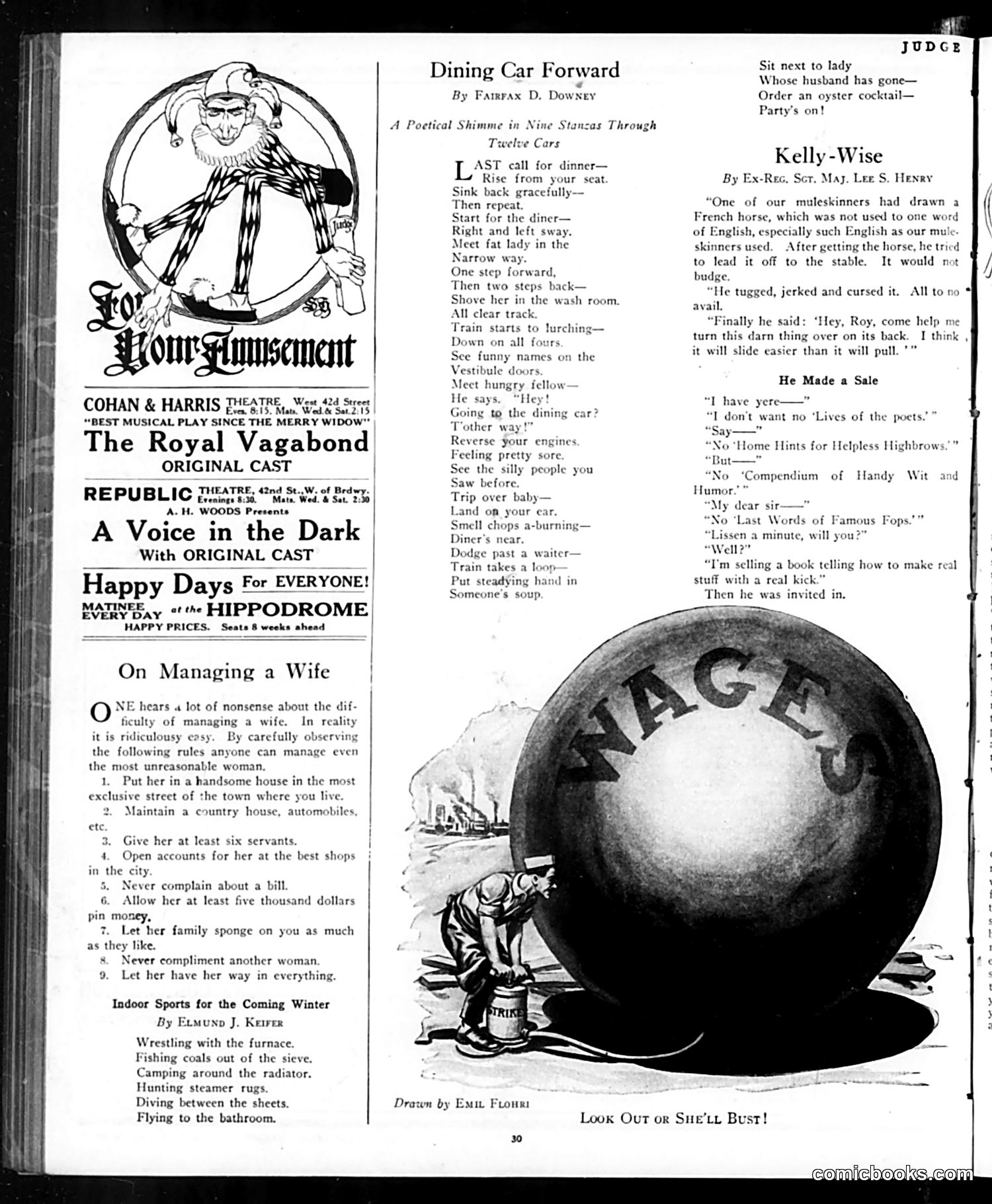
This page from *Judge* (a satirical weekly) contains mostly **advertisements and humor columns** rather than political cartoons. The main content includes: **Theater ads** for Broadway shows ("The Royal Vagabond," "A Voice in the Dark," "Happy Days") **Satirical humor pieces:** - "On Managing a Wife" — a tongue-in-cheek guide listing absurdly expensive/indulgent rules (maintain country houses, give five thousand dollars pin money, never complain about bills). The satire targets both wealthy husbands' extravagance and the expense of maintaining wives in luxury. - "Dining Car Forward" — a comedic poem about the physical chaos of moving through a train dining car, with passengers stumbling, dodging, and colliding. - "Kelly-Wise" and "He Made a Sale" — anecdotal humor pieces. **The illustration** (drawn by Emil Flohri) shows a man struggling with a giant wrecking ball labeled "AGE," captioned "Look Out or She'll Bust!" — likely commentary on aging or deterioration. The page reflects *Judge's* satirical focus on urban, upper-class American life and domestic humor.
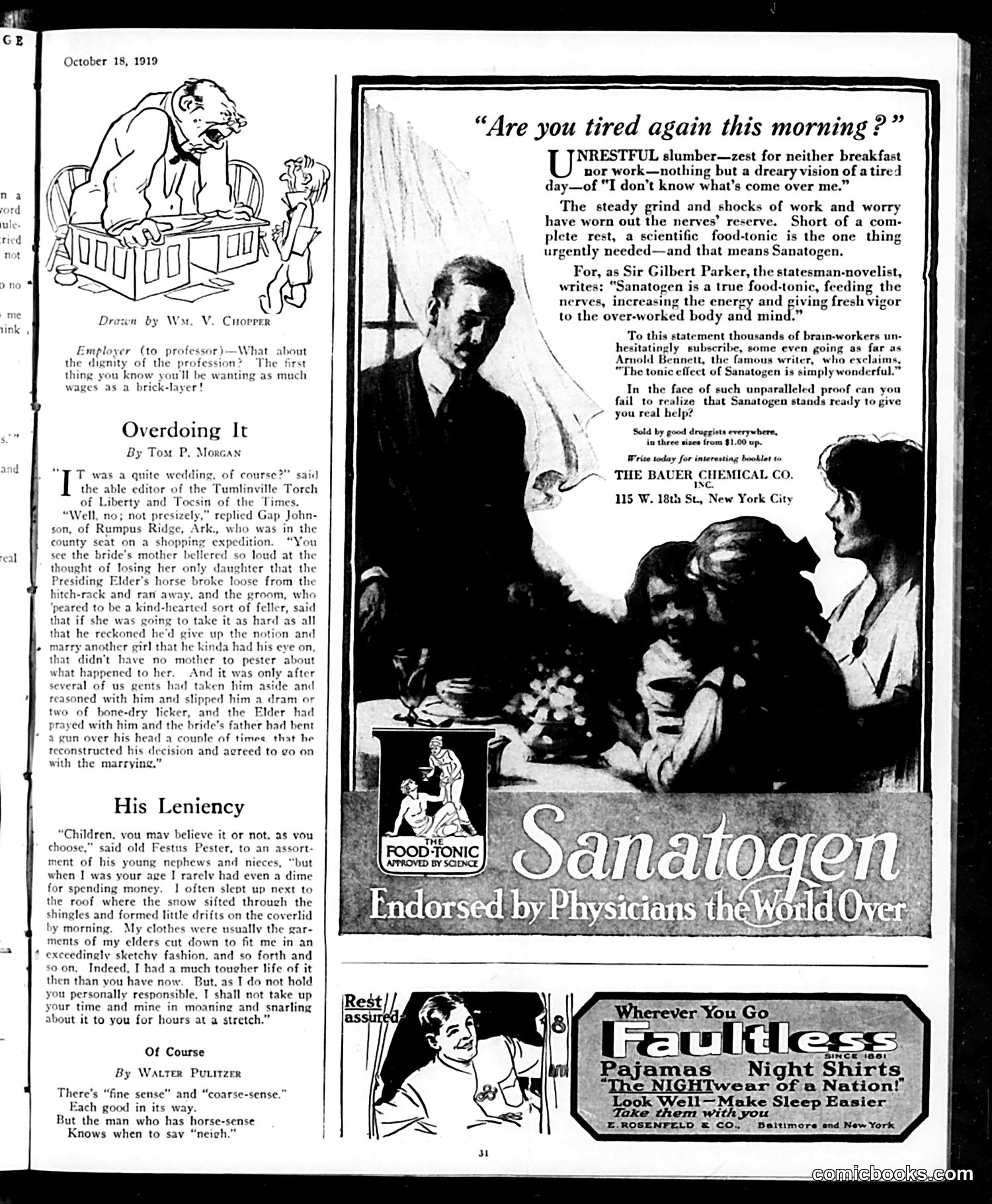
This page mixes satirical cartoons with period advertisements. The top cartoon, drawn by W.V. Chopper, depicts an employer dismissing a professor's complaint about dignity and wages—the joke being that professors might soon demand wages equal to manual laborers like bricklayers, a class-based insult reflecting anxiety about social hierarchy post-WWI. The remaining content is primarily **advertising** for Sanatogen, a patent "food-tonic" claiming to cure fatigue and nervous exhaustion. The ad quotes statesman-novelist Sir Gilbert Parker and author Arnold Bennett endorsing it. This reflects 1919 anxieties about overwork and "nerve" depletion among white-collar workers—pseudoscientific remedies were marketed heavily during this era as cure-alls for modern stress. The bottom advertisements for Faultless pajamas complete the lifestyle-product messaging. The brief humor pieces ("Overdoing It," "His Leniency," "Of Course") are folksy anecdotes with mild wordplay, typical of Judge's lighter editorial content.
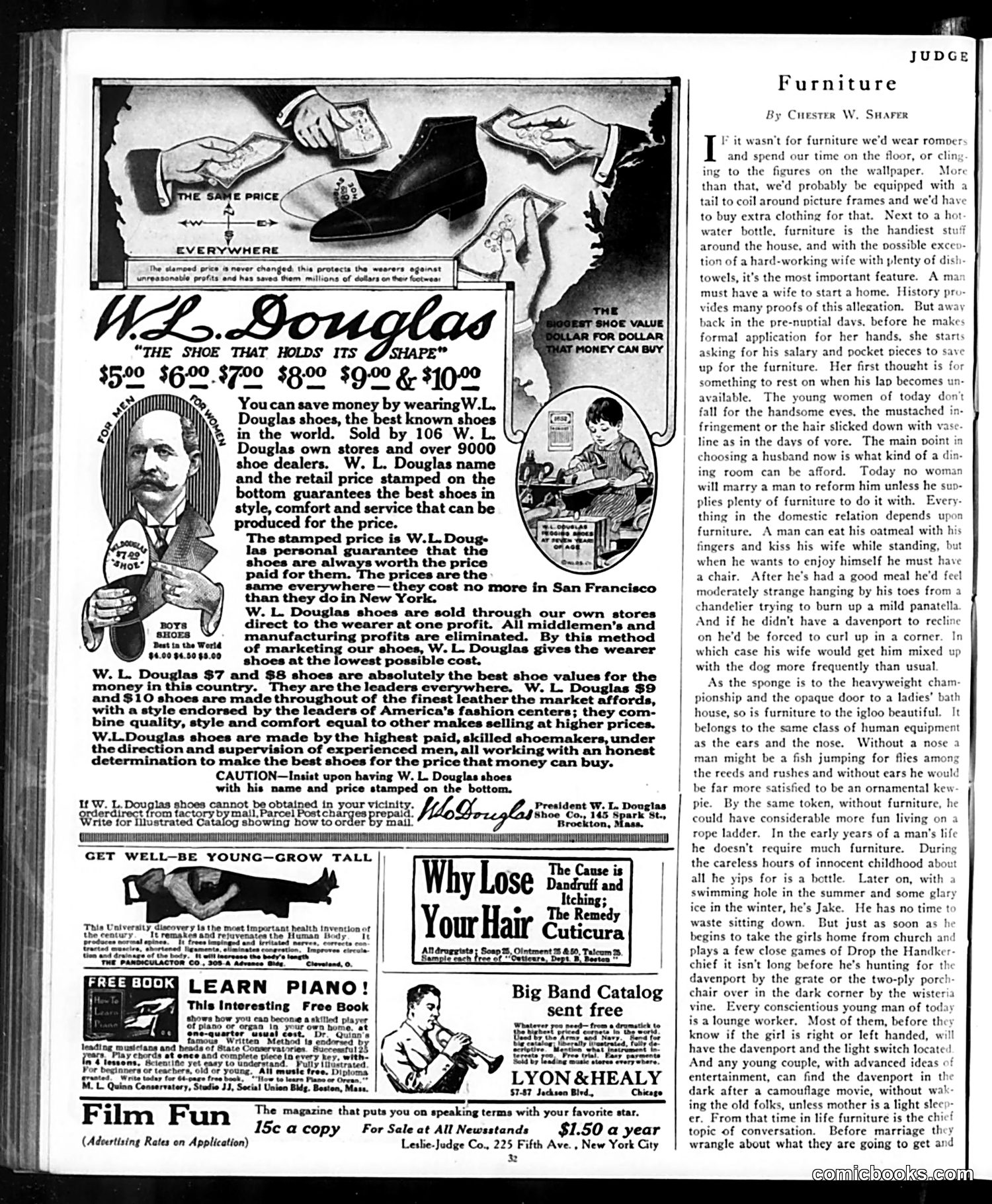
This page is primarily **advertising**, dominated by a large W.L. Douglas shoe advertisement featuring a mustachioed man (likely W.L. Douglas himself) promoting shoes at various price points ($5-$10) with claims of quality and value. The accompanying **article "Furniture"** by Chester W. Shaper is satirical social commentary on marriage and domesticity. It humorously argues that modern women don't marry for love or appearance ("handsome eyes, the mustached [face]") but rather for a man's ability to furnish a home. The piece uses absurdist comparisons—furniture to a heavyweight champion, to bathroom doors, to a nose on a man—to mock how essential domestic furnishings have become to courtship. The satire targets both gender relations and consumerism: young women are portrayed as pragmatically demanding material comfort before marriage, while men must provide furniture to attract wives. It's commentary on early 20th-century commercialism and shifting courtship expectations.
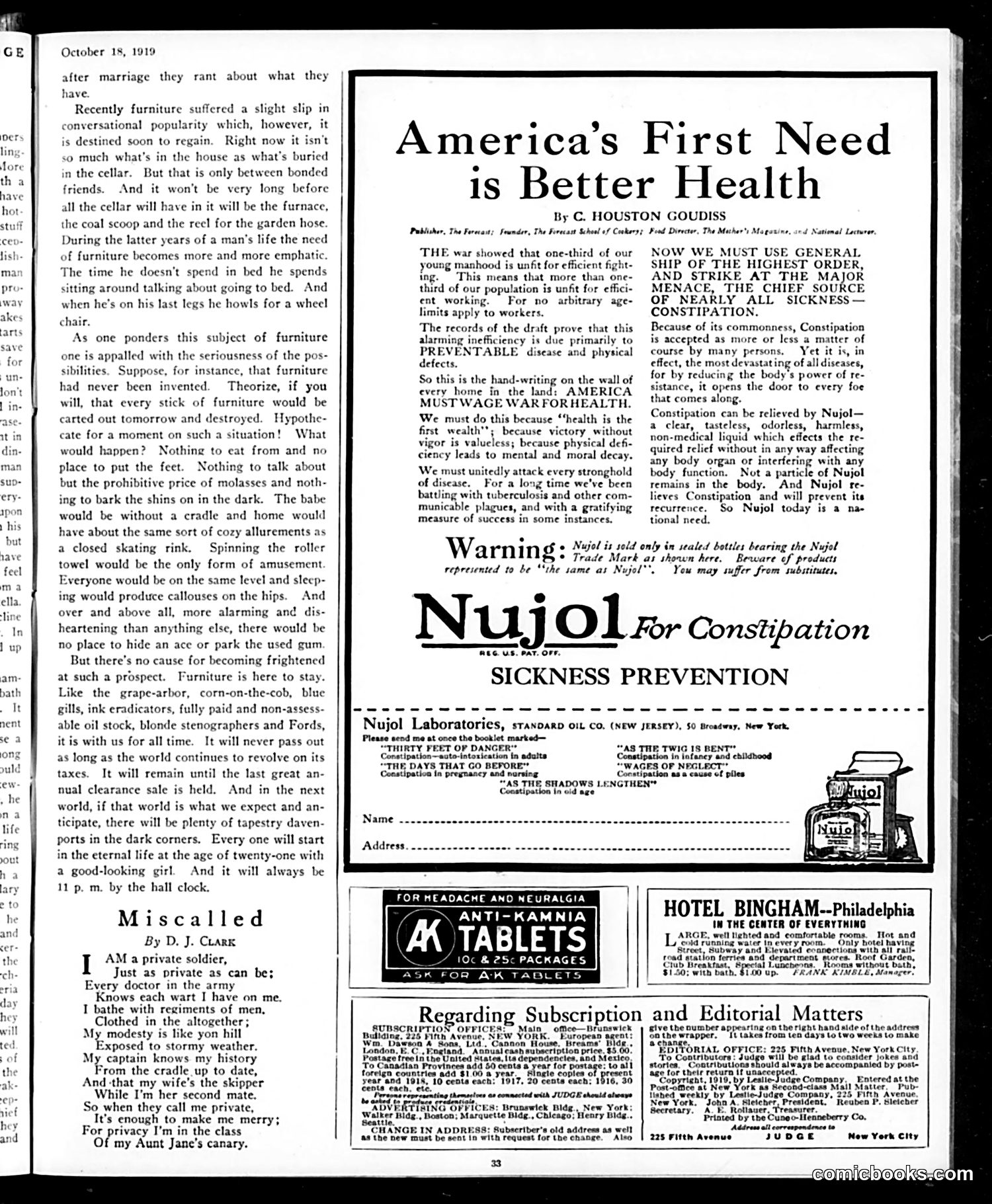
This page contains two distinct elements: **Main Content:** A humorous essay on furniture's importance to civilization, written in Judge's characteristic tongue-in-cheek style. The author posits that furniture is so fundamental that without it, society would collapse into chaos—people couldn't eat, sleep properly, or hide embarrassing items. It's satirizing both the mundane seriousness with which Americans debate household goods and the implicit absurdity of treating furniture as civilizationally essential. **Advertisement:** The dominant feature is a full-page Nujol laxative ad, capitalizing on post-WWI health anxieties. It references the draft's revelation that one-third of young men were physically unfit, reframing constipation relief as patriotic duty under the heading "America's First Need is Better Health." **Poem:** "Miscalled" jokes about soldiers' complete lack of privacy, making puns on the word "private"—the military rank versus actual privacy. The page reflects 1919's preoccupations: Prohibition (cellar references), post-war health concerns, and the medicalization of everyday complaints.
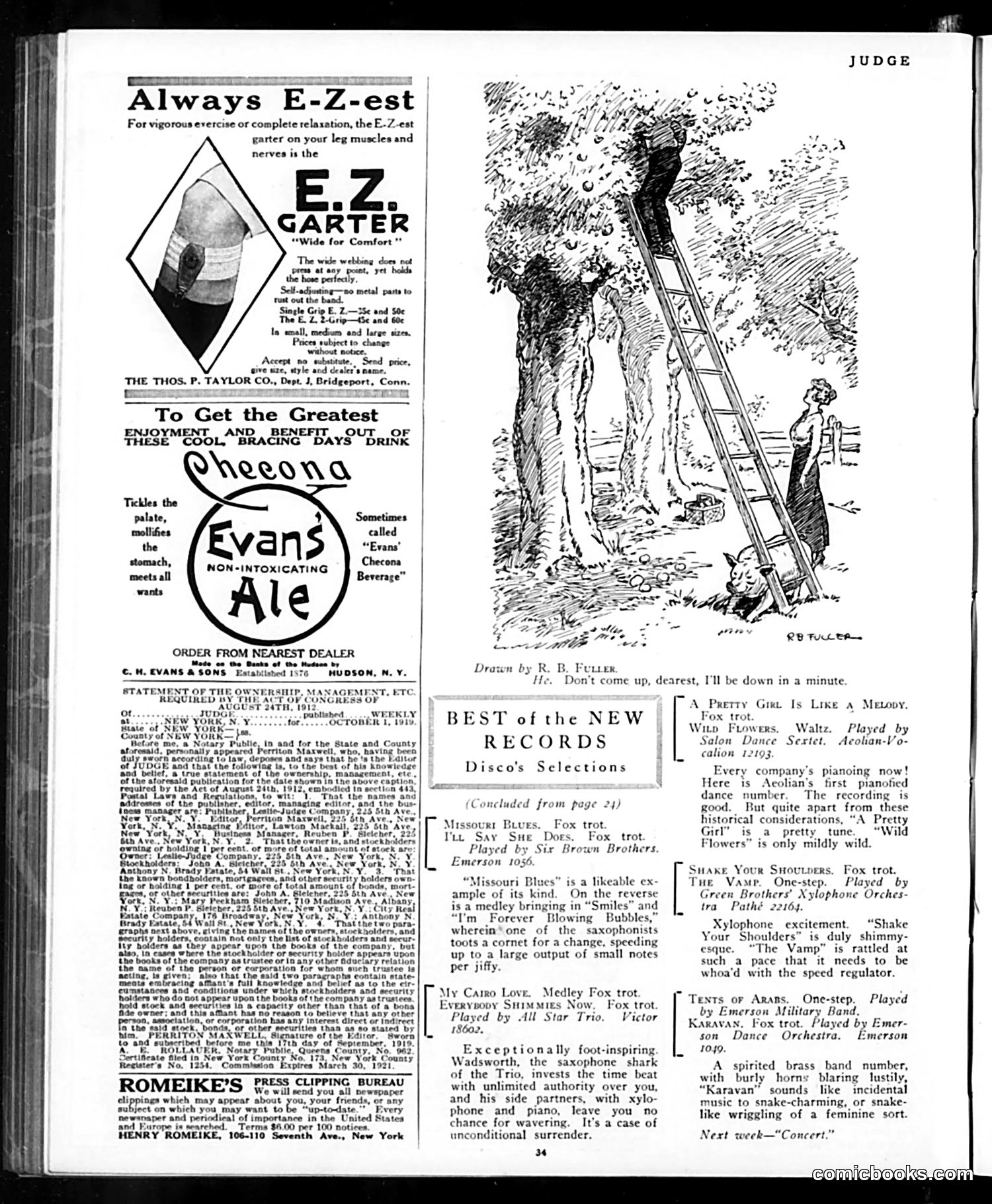
This page is primarily **advertisements and magazine administration**, not political satire. The notable content includes: **Main Cartoon (right side):** A simple domestic humor sketch by R.B. Fuller showing a woman climbing down a tall tree on a ladder, telling someone below she'll be down shortly. The joke appears to be innocent slapstick—unclear why she's in the tree, making the punchline opaque to modern viewers. **Advertisements:** The page features product ads for E-Z garters (leg supports), Checona Evans Ale (a "non-intoxicating" beverage), and Romeike's Press Clipping Bureau—typical early 20th-century consumer goods with period marketing language. **Administrative Content:** Most of the page contains boring legal declarations of ownership and editorship required by postal law, listing publisher Leslie-Judge Company and various stockholders. **Music Reviews:** A "Best of the New Records" section reviews fox trots and dance recordings—reflecting 1920s popular entertainment. No significant political commentary is evident on this page.
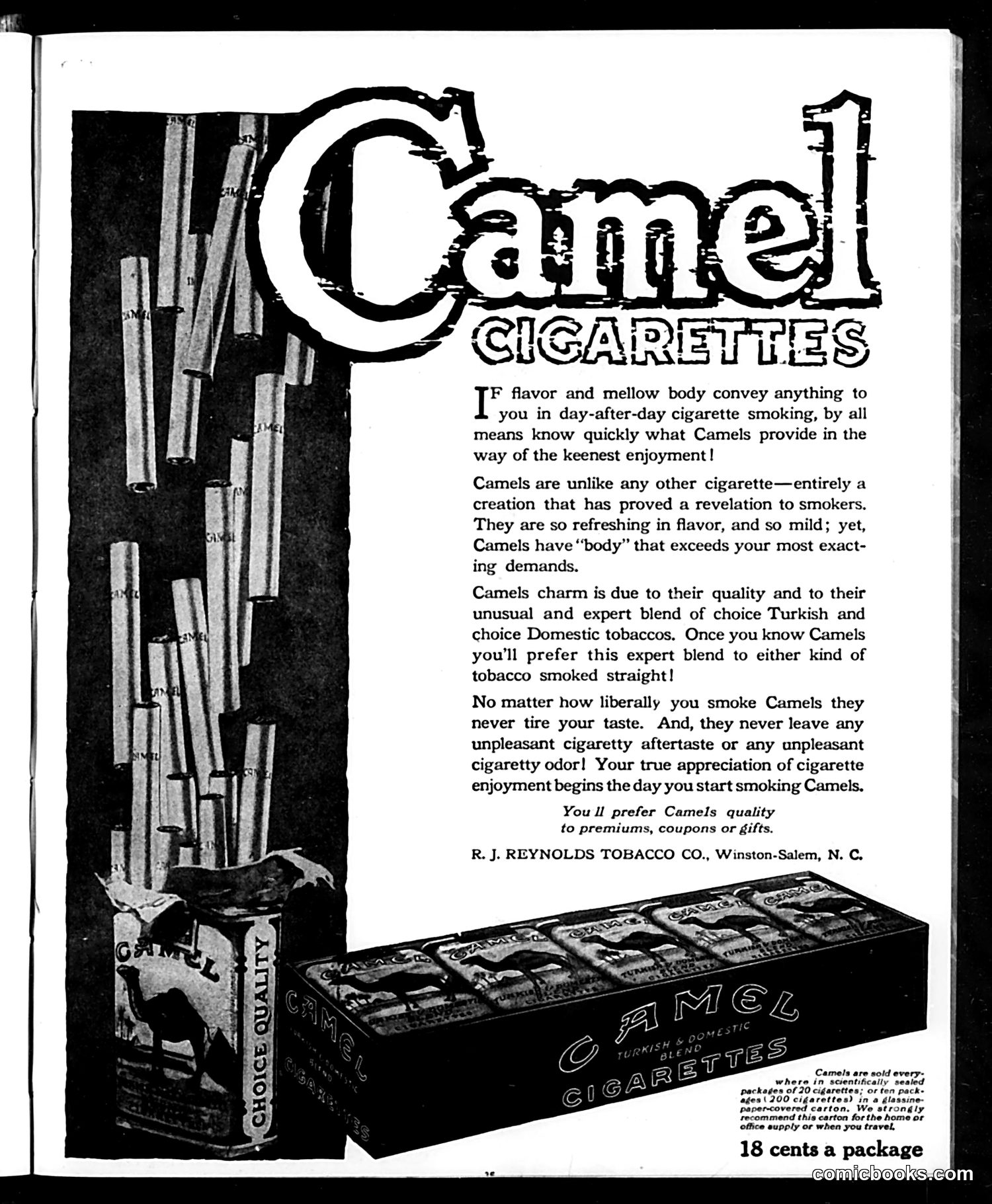
This page is primarily a **cigarette advertisement**, not political satire. It's a Camel cigarettes ad from R.J. Reynolds Tobacco Company featuring product imagery (cigarettes and a carton) alongside marketing copy. The ad makes claims typical of early-to-mid 20th century tobacco advertising: that Camels provide superior "flavor and mellow body," never tire the taste, leave no unpleasant aftertaste or odor, and represent an "expert blend" of Turkish and domestic tobacco. It emphasizes quality over promotional gimmicks like "premiums, coupons or gifts." The price listed (18 cents per package) and the mention of sealed packaging and carton sizes reflect the era's distribution methods. **For modern readers:** This represents a time when cigarette companies could make direct health and quality claims without restriction, and when such ads regularly appeared in mainstream magazines. The specific claims about taste and lack of odor would be legally impossible today.
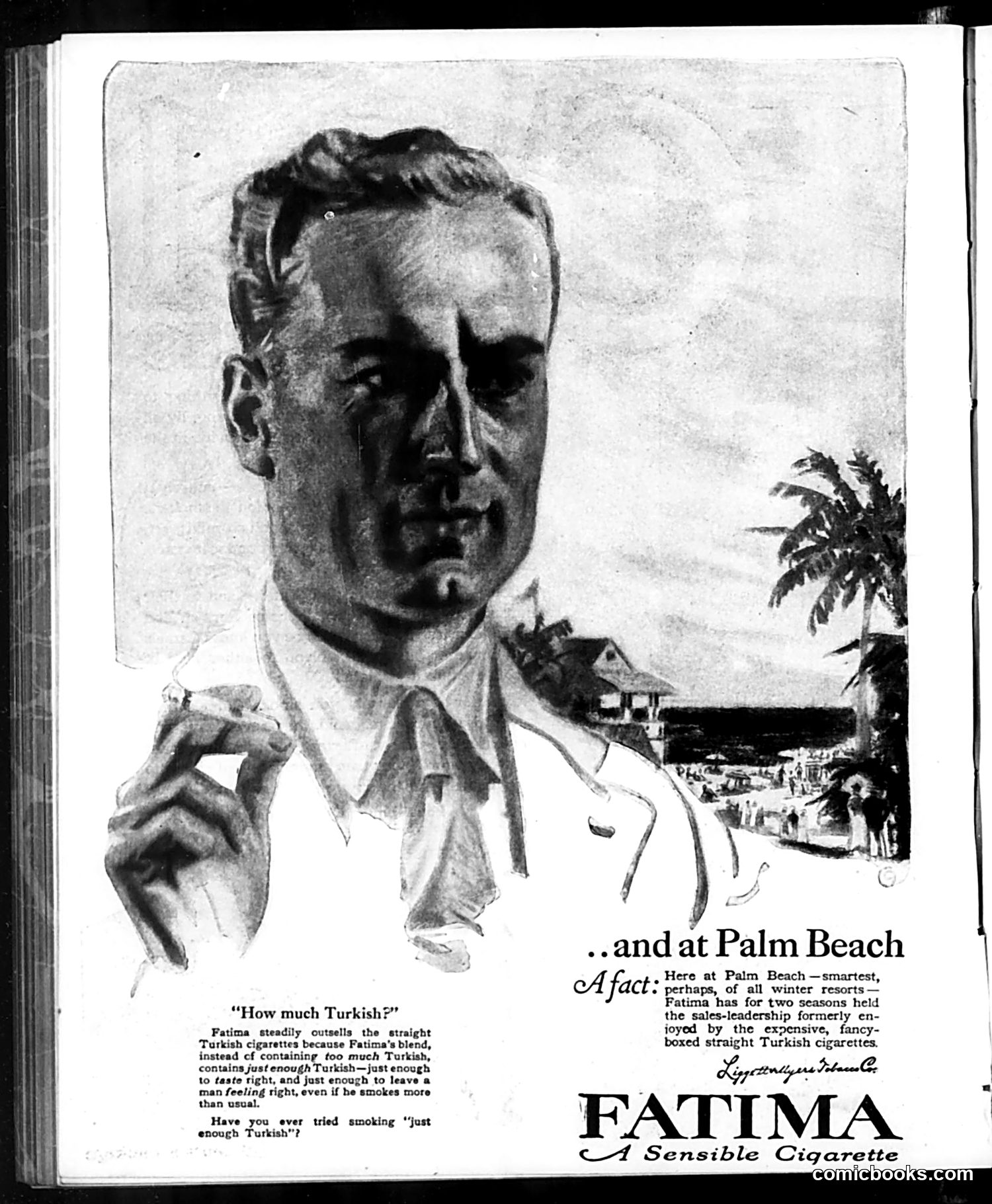
This is a **cigarette advertisement**, not political satire. It features a portrait of an unnamed man in formal attire, positioned as a testimonial for Fatima brand cigarettes. The ad's pitch emphasizes a "sensible" middle ground: Fatima contains "just enough Turkish"—not too much like competitors' "straight Turkish" brands, but enough to satisfy smokers. This appeals to consumers seeking moderation and quality balance rather than excess. The secondary claim references Palm Beach, a luxury winter resort, asserting that Fatima outsells fancier, more expensive competitors there, positioning it as the smart choice among the wealthy. The implicit message: sophistication means restraint, not ostentation. The ad targets affluent consumers by suggesting that premium brands' elaborate packaging doesn't guarantee superiority—Fatima's balanced formula proves more popular among discerning Palm Beach elites. This reflects early-20th-century advertising strategy: positioning mass-market products as secretly preferred by the wealthy.