
Judge, 1919-10-18 · page 6 of 36
Judge — October 18, 1919 — page 6: what you’re looking at
What you’re looking at
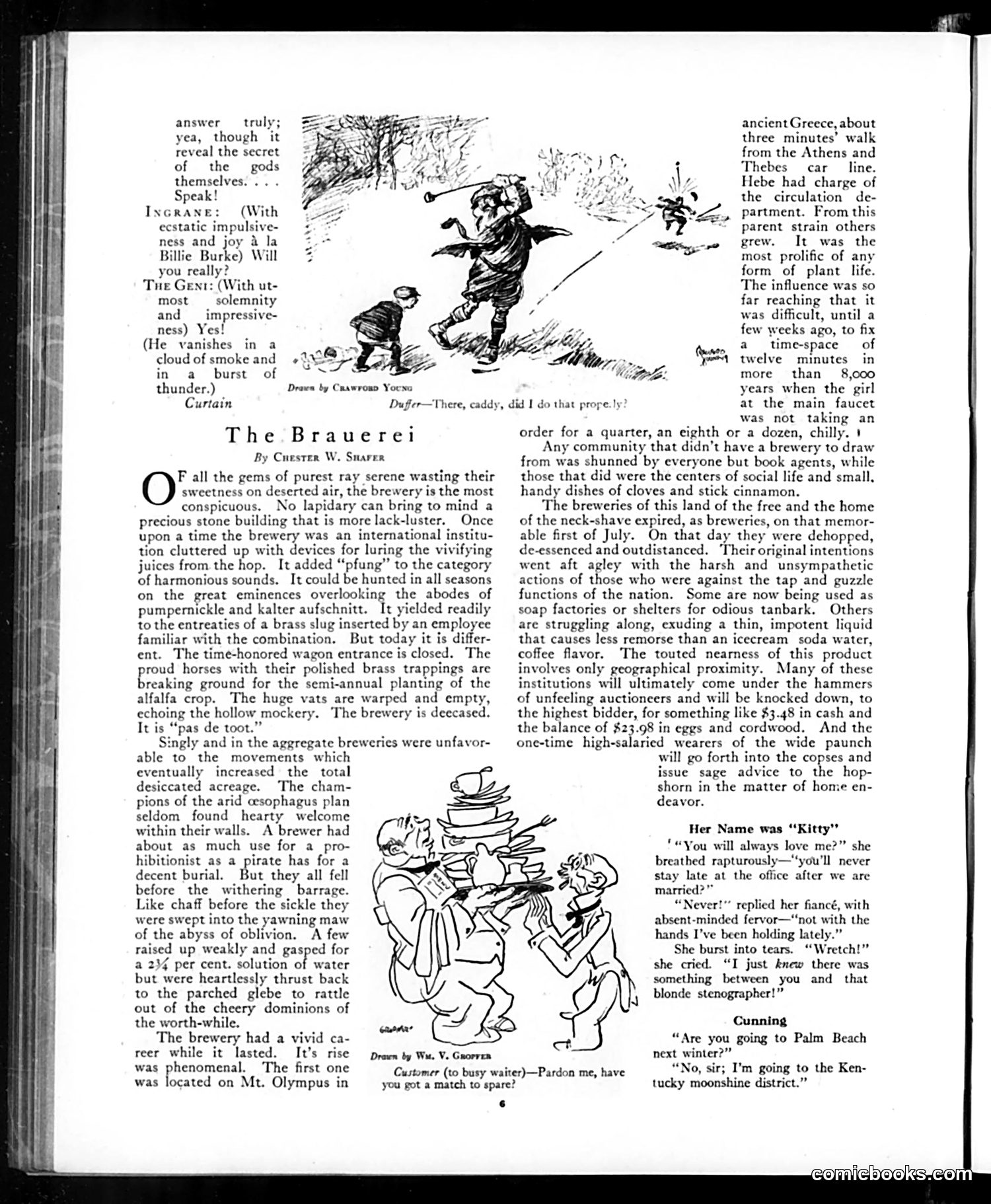
This page contains two main elements: **Top cartoon** ("Duffer"): Shows a golfer and caddy. The golfer asks "Duffer—There, caddy, did I do that properly?" This appears to be a simple golf joke about an incompetent player seeking reassurance from his caddy—a common sporting humor theme. **Main article**: "The Brauerei" by Chester W. Shafer is a prose piece satirizing German breweries and beer culture. It mocks their grand historical importance while describing their actual decline—breweries being converted to soap factories or other uses. The satire contrasts their prestigious past with their diminished present status. **Bottom cartoon**: Shows a domestic scene about marriage expectations, with dialogue suggesting tension between a couple regarding work schedules and fidelity—typical early 20th-century relationship humor. The page blends sports, cultural, and domestic satire typical of Judge magazine's format.
📄 Transcribed text from this page (OCR, searchable)
Machine-transcribed from the original scan — historical spelling and the odd misread are preserved.
answer truly; yea, though it reveal the secret of the gods themselves. . . . Speak! Incrane: (With ecstatic impulsive- ness and joy a la Billie Burke) Will you really? Tue Gent: (With ut- most solemnity and _ impressive- ness) Yes! (He vanishes in a cloud of smoke and in a burst of thunder.) Curtain Draws by Cuawroun Youxo The Brauerei By Cnester W. Snarer F all the gems of purest ray serene wasting their O sweetness on deserted air, the brewery is the most conspicuous. No lapidary can bring to mind a precious stone building that is more lack-luster. Once upon a time the brewery was an international institu- tion cluttered up with devices for luring the vivifying juices from the hop. It added “‘pfung”’ to the category of harmonious sounds. It could be hunted in all seasons on the great eminences overlooking the abodes of pumpernickle and kalter aufschnitt. It yielded readily to the entreaties of a brass slug inserted by an employee familiar with the combination. But today it is differ- ent. The time-honored wagon entrance is closed. The roud horses with their polished brass trappings are Breaking ground for the semi-annual planting of the alfalfa crop. The huge vats are warped and empty, echoing the hollow mockery. The brewery is deecased. It is “pas de toot.” Singly and in the aggregate breweries were unfavor- able to the movements which eventually increased the total desiccated acreage. The cham- pions of the arid oesophagus plan seldom found hearty welcome within their walls. A brewer had about as much use for a_pro- hibitionist as a pirate has for a decent burial. But they all fell before the withering barrage. Like chaff before the sickle they were swept into the yawning maw of the abyss of oblivion. A few raised up weakly and gasped for a 234 per cent. solution ol lerates but were heartlessly thrust back to the parched glebe to rattle out of the cheery dominions of the worth-while. The brewery had a vivid ca- reer while it lasted. It’s rise was phenomenal. The first one was located on Mt. Olympus in Duffer—There, caddy, did I do that prore.ly? Customer (to busy waiter)—Pardon me, have you got a match to spare? ancient Greece, about three minutes’ walk from the Athens and Thebes car __ line. Hebe had charge of the circulation de- partment. From this parent strain others grew. It was the most prolific of any form of plant life. The influence was so far reaching that it was difficult, until a few weeks ago, to fix a time-space of twelve minutes in more than _ 8,000 years when the girl at the main faucet was not taking an order for a quarter, an eighth or a dozen, chilly. 1 Any community that didn’t have a brewery to draw from was shunned by everyone but book agents, while those that did were the centers of social life and small, handy dishes of cloves and stick cinnamon. The breweries of this land of the free and the home of the neck-shave expired, as breweries, on that memor- able first of July. On that day they were dehopped, de-essenced and outdistanced. Their original intentions went aft agley with the harsh and unsympathetic actions of those who were against the tap and guzzle functions of the nation. Some are now being used as soap factories or shelters for odious tanbark. Others are struggling along, exuding a thin, impotent liquid that causes less remorse than an icecream soda water, coffee flavor. The touted nearness of this product involves only geographical proximity. Many of these institutions will ultimately come under the hammers of unfeeling auctioneers and will be knocked down, to the highest bidder, for something like $3.48 in cash and the balance of $23.98 in eggs and cordwood. And the one-time high-salaried wearers of the wide paunch will go forth into the copses and issue sage advice to the hop- shorn in the matter of home en- deavor. Her Name was “Kitty’’ ‘“You will always love me?” she breathed rapturously—‘‘you’ll never stay late at the office after we are married?” “Never!” replied her fiancé, with absent-minded fervor—‘“not with the hands I've been holding lately.” She burst into tears. ‘Wretch!”” she cried. “I just knew there was something between you and that blonde stenographer!” Cunning “Are you going to Palm Beach next winter?” “No, sir; I’m going to the Ken- tucky moonshine district.”