
Judge, 1919-10-18 · page 26 of 36
Judge — October 18, 1919 — page 26: what you’re looking at
What you’re looking at
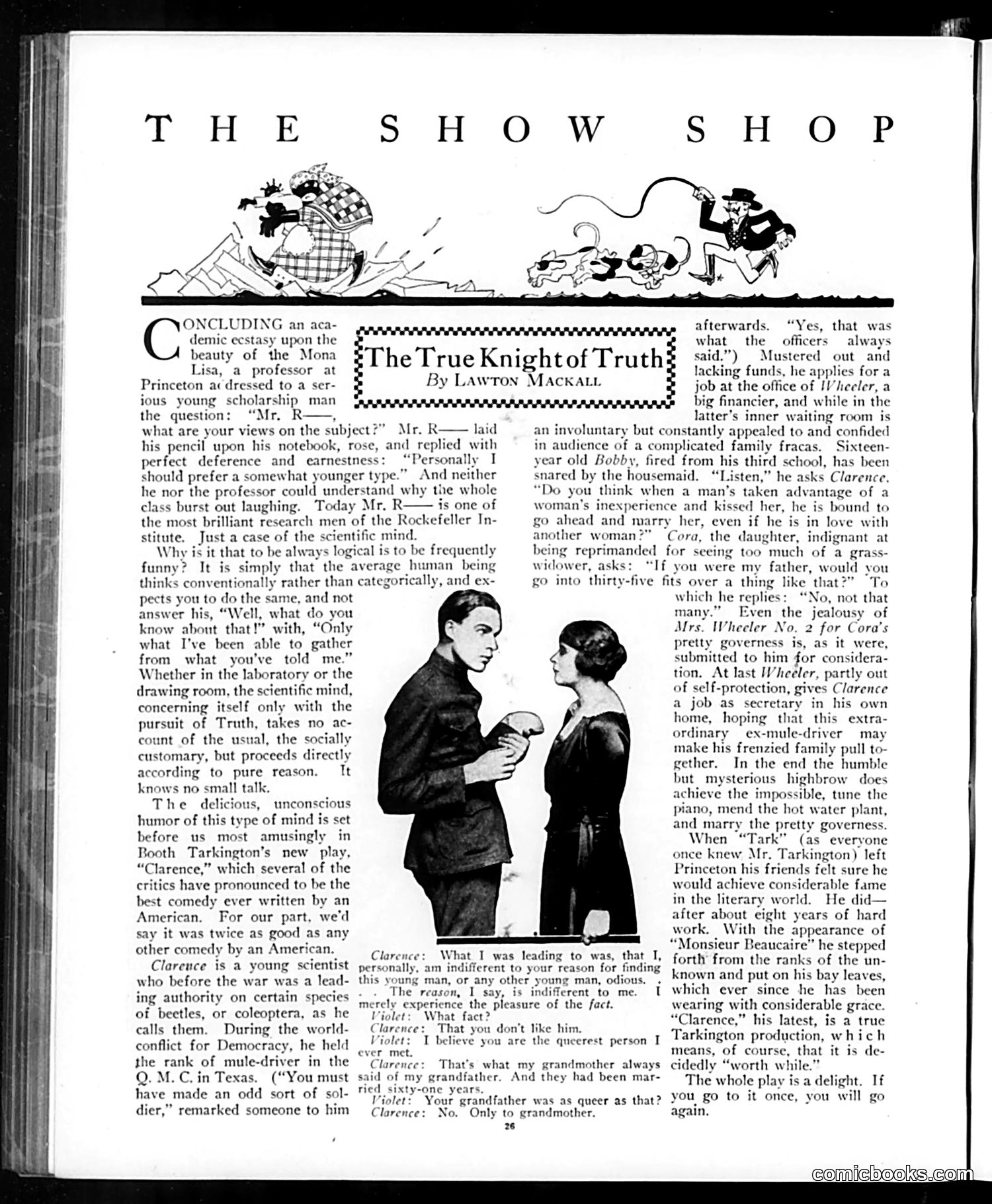
This page reviews Booth Tarkington's play "Clarence," which satirizes the "scientific mind" that pursues pure logic while ignoring social convention. The humor centers on a former beetle expert turned mule-driver in WWI who becomes a secretary to a wealthy financier. The text argues that truly logical people are funny because they answer straightforward social questions literally rather than conventionally—like a Princeton professor's student who, asked his views on the Mona Lisa, replies he prefers "a somewhat younger type" of woman. Clarence embodies this absurdist logic: he calmly addresses the family's scandals and crises with rational detachment while inadvertently solving their problems. The satire mocks both the impractical idealism of intellectuals and the anxieties of wealthy families over propriety and romantic entanglements. The play suggests that pure reason—disconnected from social niceties—can paradoxically accomplish what emotional family drama cannot.
📄 Transcribed text from this page (OCR, searchable)
Machine-transcribed from the original scan — historical spelling and the odd misread are preserved.
S H O W ONCLUDING an aca- demic ecstasy upon the beauty of the Mona Lisa, a professor at Princeton acdressed to a ser- ious young scholarship man the question: “Mr. what are your views on the subject?” Mr. R his pencil upon his notebook, rose, and replied with perfect deference and earnestness: “Personally I should prefer a somewhat younger type.” And neither he nor the professor could understand why the whole class burst out laughing. Today Mr, R s one of the most brilliant research men of the Rockefeller In- stitute. Just a case of the scient mind. Why is it that to be always logical is to be frequently funny? It is simply that the average human bein thinks conventionally rather than categorically, and eo pects you to do the same, and not answer his, “Well, what do you know about that!” with, “Only what I’ve been able to gather from what you've told me.” Whether in the laboratory or the drawing room, the scientific mind, concerning itself only with the pursuit of Truth, takes no ac- count of the ustial, the socially customary, but proceeds directly according to pure reason. It knows no small talk. The delicious, unconscious humor of this type of mind is set before us most amusingly in Booth Tarkington’s new play, “Clarence,” which several of the critics have pronounced to be the best comedy ever written by an American. For our part, we'd say it was twice as good as any other comedy by an Amet Clarence is a young scientist who before the war was a lead- ing authority on certain species of beetles, or coleoptera, as he calls them. During the world- conflict for Democracy, he held the rank of mule-driver in the Q. M.C. in Texas. (“You must have made an odd sort of sol- dier,” remarked someone to him laid Clarence: personally this young 1 The Viole Clarence: What fact? ever met. Clarence said of my grandfather. ried sixty-one years. Violet: Clarence: No. 26 The True Knight of Truth By Lawtron Mackatt T was leading to was, am indifferent to your reason for finding , or any other you merely experi nce the pleasure of the fact. That you don't like him. I believe you are the queerest person I That's what my grandmother always And they had been mar- Your grandfather was as queer as that? Only to grandmother. S H O P afterwards. that was what the officers always said.”) | Mustered out and lacking funds, he applies for a job at the office of Wheeler, a big financier, and while in the iting room is an involuntary but constantly appealed to and confided in audience of a complicated family frac: Sixteen- year old Bobby, fired from his third school, has been snared by the housemaid. “Listen,” he asks Clarence. “Do you think when a man ken advantage of a woman's inexperience and kissed her, he is bound te go ahead and marry her, even if he is in love with another woman?” Cora, the daughter, indignant at being reprimanded for seeing too much of a grass- widower, asks: “If you were my father, would you go into thirty-five fits over a thing like that?” “To which he replies: “No, not that many Even the jealousy of Mrs. Wheeler No, 2 for Cora’s pretty governess is, as it were, submitted to him for considera- tion, At last Wheeler, partly out of self-protection, gives Clarence a job as secretary in his own home, hoping that this extra- ordinary —ex-mule-driver may make his frenzied family pull to- gether. In the end the humble but mysterious highbrow does chieve the impossible, tune the piano, mend the hot water plant, and marry the pretty governess. When “Tark” (as everyone once knew Mr, Tarkington) left Princeton his friends felt sure he would achieve considerable fame in the literary world. He did— after about eight years of hard work, With the appearance of “Monsieur Beaucaire” he stepped forth from the ranks of the un- known and put on his bay leaves, which ever since he has been wearing with considerable grace. “Clarence,” his latest, is a true Tarkington production, which means, of course, that it is de- cidedly “worth while.” The whole play is a delight. If you go to it once, you will go again. that man, odious. rent to me.