
Judge, 1919-10-18 · page 14 of 36
Judge — October 18, 1919 — page 14: what you’re looking at
What you’re looking at
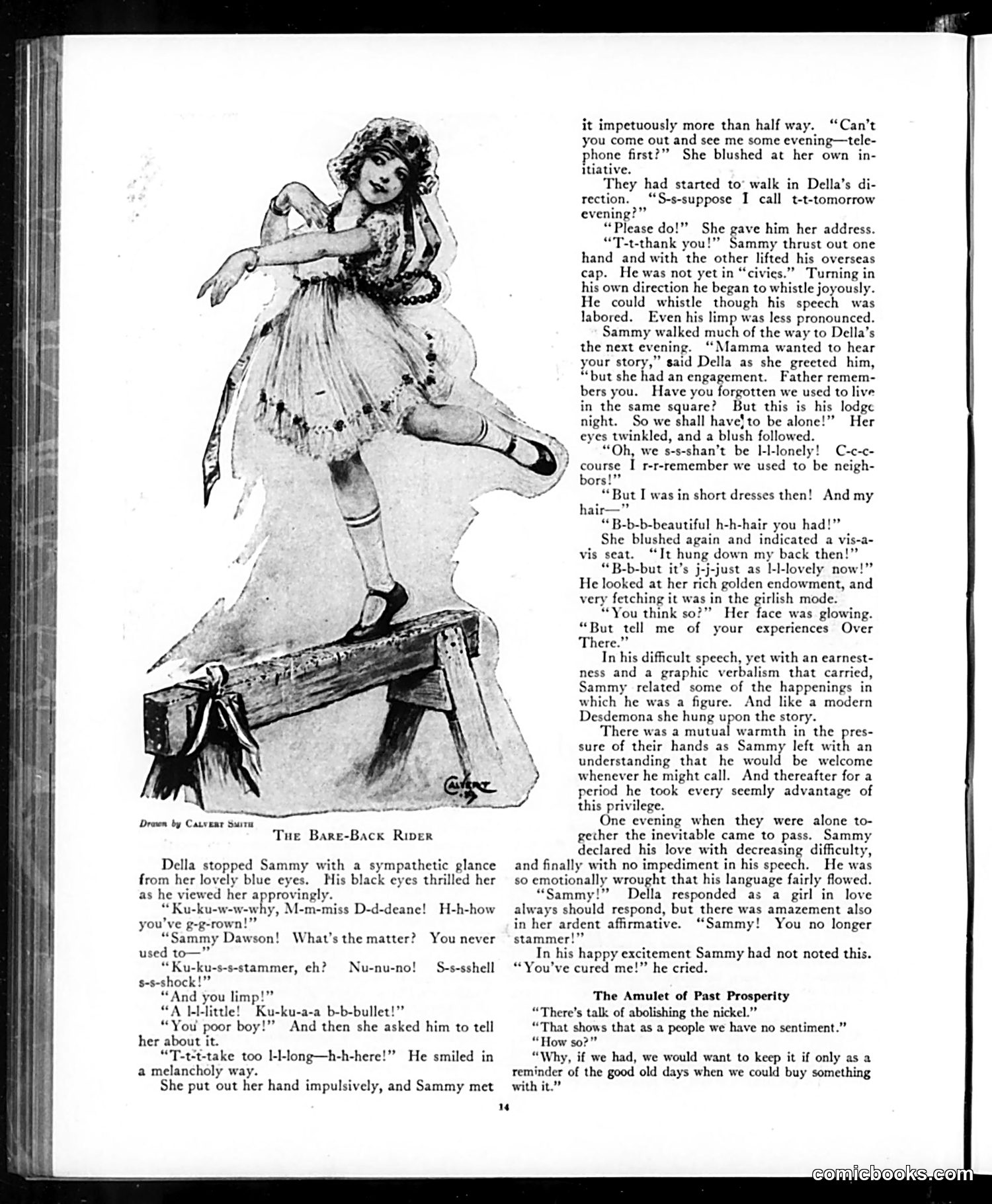
This romantic illustration and accompanying story depict a sentimental post-WWI narrative. The cartoon shows a young woman (Della) greeting a returning soldier named Sammy, who bears visible war wounds—a limp and a speech stammer from a shell injury. The satire lies in the sentimental treatment of the soldier's condition. Sammy's stutter and limp symbolize his sacrifice, making him oddly appealing to Della, who reconnects with her childhood neighbor. The joke culminates when Sammy declares his love: his emotional intensity temporarily cures his stammer entirely, suggesting that romantic passion transcends physical disability. This reflects 1920s American attitudes toward veterans—romanticizing their wounds while offering them emotional (rather than practical) support. The accompanying brief text about abolishing the nickel mocks public nostalgia for simpler times, reinforcing the page's theme of sentiment versus reality in post-war America.
📄 Transcribed text from this page (OCR, searchable)
Machine-transcribed from the original scan — historical spelling and the odd misread are preserved.
Droon by Catvenr Suir Tue Bare-Back River Della stopped Sammy with a sympathetic glance from her lovely blue eyes. Mis black eyes thrilled her as he viewed her approvingly. “ Ku-ku-w-w-why, M-m-miss D-d-deane! H-h-how you've g-g-rown!”” “Sammy Dawson! used to—”” “Ku-ku-s-s-stammer, eh? s-s-shock!”” “And you limp!” “A |-l-little! Ku-ku-a-a b-b-bullet!”’ “You poor boy!”” And then she asked him to tell her about it. “T-t-t-take too |-l-long—h-h-here!”” He smiled in a melancholy way. She put out her hand impulsively, and Sammy met What's the matter? You never Nu-nu-no! — S-s-sshell it impetuously more than half way. “Can't you come out and see me some evening—tele- hone first?” She blushed at her own in- itiative. They had started to’ walk in Della’s di- rection. “S-s-suppose I call t-t-tomorrow evening?” “Please do!” She gave him her address. “T-t-thank you!"”” Sammy thrust out one hand and with the other lifted his overseas cap. He was not yet in “civies.” Turning in his own direction he began to whistle joyously. He could whistle though his speech was labored. Even his limp was less pronounced. Sammy walked much of the way to Della’s the next evening. “Mamma wanted to hear your story,” said Della as she greeted him, “but she had an engagement. Father remem- bers you. Have you forgotten we used to live in the same square? But this is his lodge night. So we shall have!to be alone!” Her eyes twinkled, and a blush followed. “Oh, we s-s-shan’t be I-I-lonely! C-c-c- course I r-r-remember we used to be neigh- bors!” st But I was in short dresses then! And my hair—" “B-b-b-beautiful h-h-hair you had!” She blushed again and indicated a vis-a- vis seat. “It hung down my back then!” “B-b-but it’s j-j-just as |-l-lovely now!” He looked at her rich golden endowment, and very fetching it was in the girlish mode. “You think so?” Her face was glowing. “But tell me of your experiences Over There.” In his difficult speech, yet with an earnest- ness and a graphic verbalism that carried, Sammy related some of the happenings in which he was a figure. And like a modern Desdemona she hung upon the story. There was a mutual warmth in the pres- sure of their hands as Sammy left with an understanding that he would be welcome whenever he might call. And thereafter for a period he took every seemly advantage of this privilege. One evening when they were alone to- gether the inevitable came to pass. Sammy declared his love with decreasing difficulty, and finally with no impediment in his speech. He was so emotionally wrought that his language fairly flowed. “Sammy!” Della responded as a girl in love always should respond, but there was amazement also in her ardent affirmative. “Sammy! You no longer stammer!” In his happy excitement Sammy had not noted this. “You've cured me!” he cried. The Amulet of Past Prosperity “There’s talk of abolishing the nickel.” “That shows that as a people we have no sentiment.” “How so?” “Why, if we had, we would want to keep it if only as a reminder of the good old days when we could buy something with it.”