
Judge, 1919-10-18 · page 8 of 36
Judge — October 18, 1919 — page 8: what you’re looking at
What you’re looking at
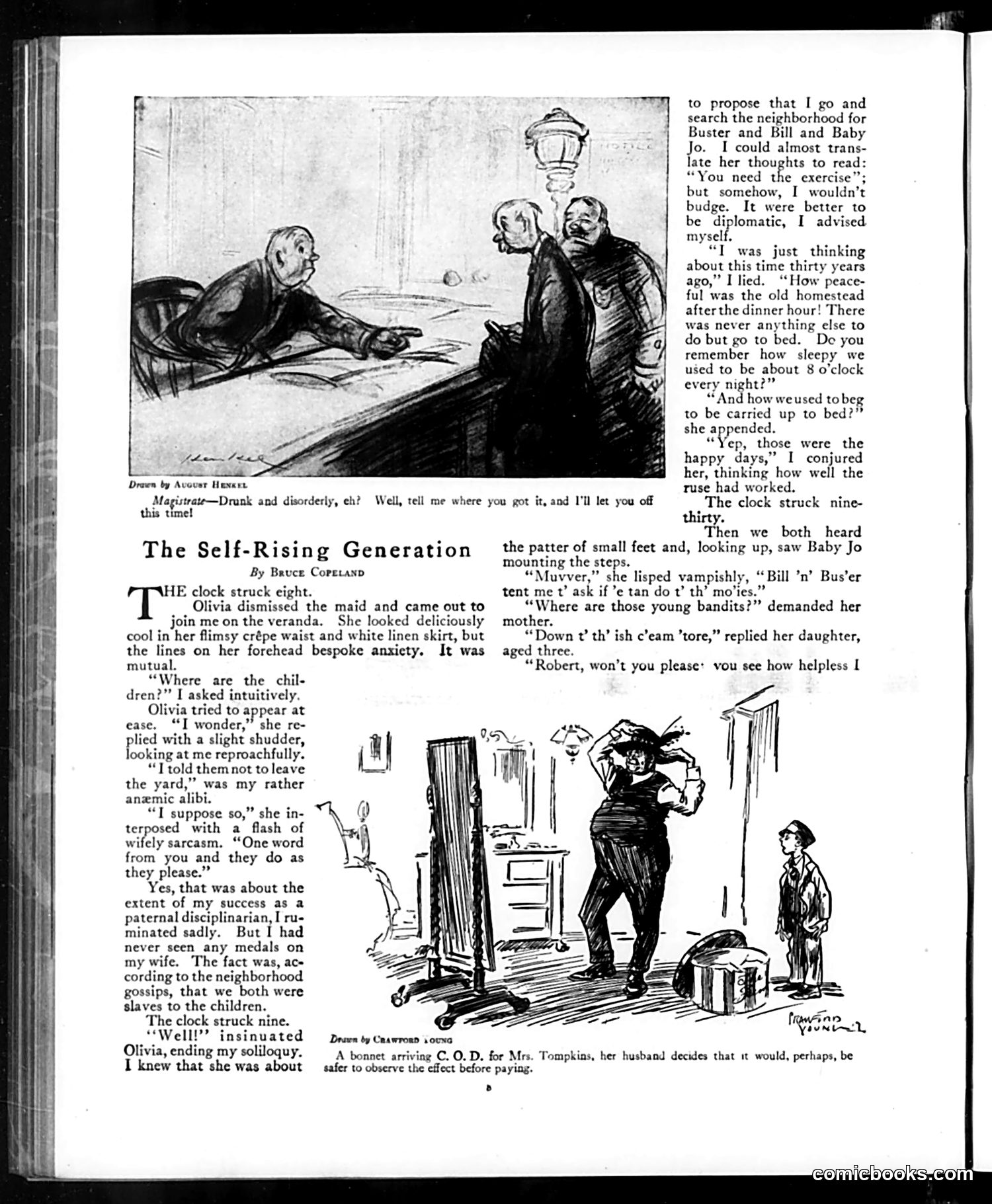
This story satirizes late 19th/early 20th-century anxieties about changing family dynamics and children's independence. The narrative follows a husband and wife whose children—Buster, Bill, and Baby Jo—roam freely unsupervised, visiting ice cream parlors and movie theaters at night without parental control. The satire targets the "self-rising generation": children who ignore parental authority and do as they please, with parents rendered helpless. The husband admits his complete failure as a "paternal disciplinarian," while the wife's sarcasm ("One word from you and they do as they please") underscores their reversed roles as servants to their children rather than authorities over them. The accompanying cartoon about a drunken man arrested suggests broader societal disorder. Overall, the piece mocks modern parents' inability to discipline their offspring, presenting this as a decline from "happy days" of strict bedtimes and parental control.
📄 Transcribed text from this page (OCR, searchable)
Machine-transcribed from the original scan — historical spelling and the odd misread are preserved.
Drawn by Avoust Hexcet Magistrate—Drank and disorderly, eh? this time! The Self-Rising Generation By Bruce Coretand HE clock struck eight. Olivia dismissed the maid and came out to join me on the veranda. She looked deliciously cool in her flimsy crépe waist and white linen skirt, but the lines on her forehead bespoke anxiety. It was mutual. “Where are the chil- dren?” I asked intuitively. Olivia tried to appear at ease. “I wonder,” she re- plied with a slight shudder, looking at me reproachfully. “T told them not to leave the yard,” was my rather anzmic alibi. “T suppose so,” she in- terposed with a flash of wifely sarcasm. “One word from you and they do as they please.” Yes, that was about the extent of my success as a paternal disciplinarian, I ru- minated sadly. But I had never seen any medals on my wife. The fact was, ace cording to the neighborhood gossips, that we both were slaves to the children. The clock struck nine. ““Welll’? insinuated Olivia, ending my soliloquy. I knew that she was about if Drawn by Caawronn .00xa Well, tell me where you got it, and I'll let you off to propose that I go and search the neighborhood for Buster and Bill and Baby Jo. I could almost trans- late her thoughts to read: “You need the exercise”; but somehow, I wouldn’t budge. It were better to be diplomatic, I advised myself, “IT was just thinking about this time thirty years ago,” I lied. “How peace- ful was the old homestead after the dinner hour! There was never anything else to do but go to bed. De you remember how sleepy we used to be about 8 o'clock every night?” “And how weused tobeg to be carried up to bed?” she appended. “Yep, those were the happy days,” I conjured her, thinking how well the tuse had worked. The clock struck nine- thirty. Then we both heard the patter of small feet and, looking up, saw Baby Jo mounting the steps. “Muvver,” she lisped vampishly, “Bill ’n’ Bus’er tent me t’ ask if ’e tan do t’ th’ mo'ies.” “Where are those young bandits?” demanded her mother. “Down v’ th’ ish c’eam ’tore,” replied her daughter, aged three. “Robert, won’t you please: vou see how helpless L A bonnet arriving C. O.D. for Mrs. Tompkins, her husband decides that it would, perhaps, be safer to observe the effect before paying.