
A complete issue · 36 pages · 1919
Judge — September 20, 1919
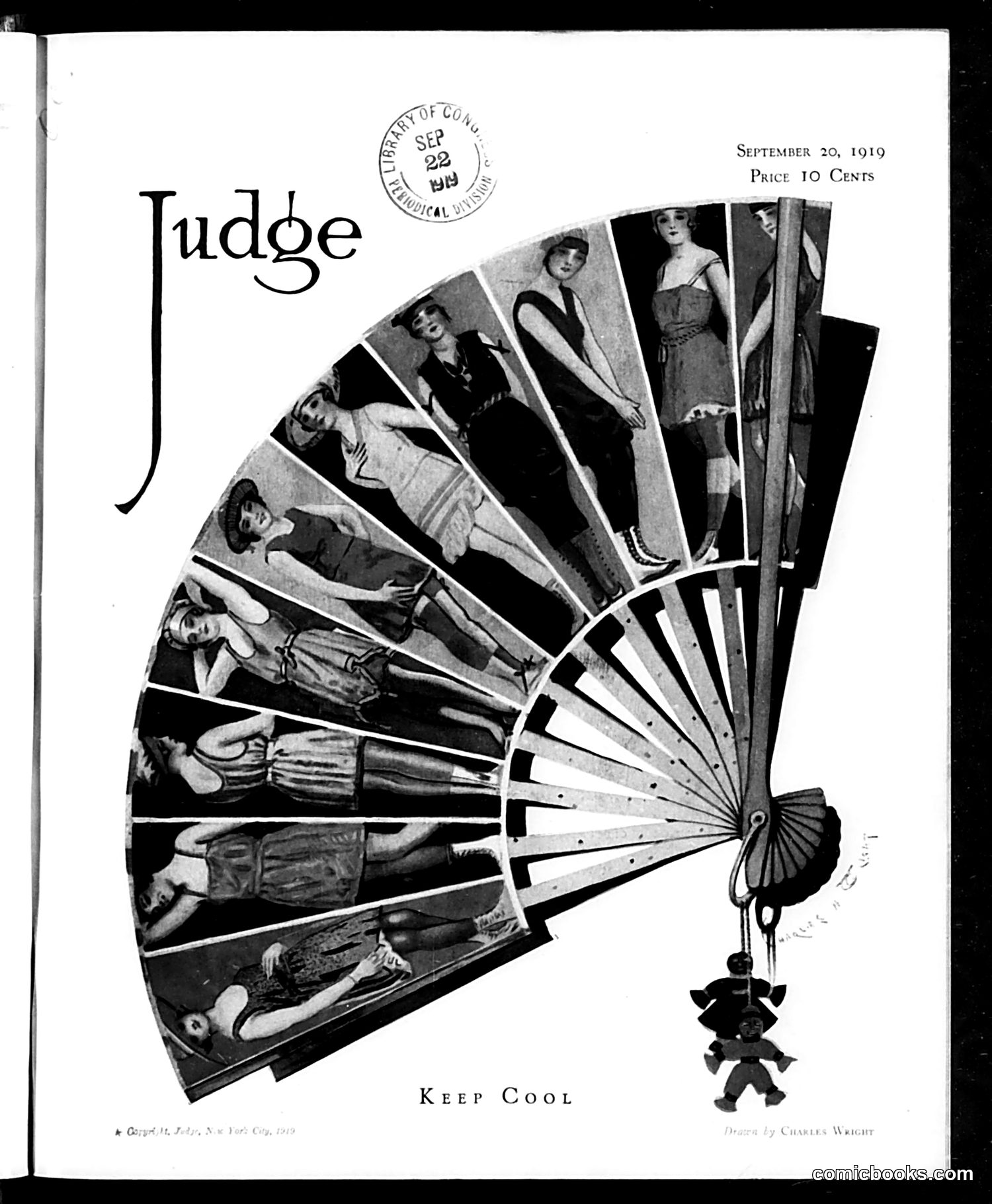
This is primarily an **advertisement, not a political cartoon**. It's a cover or full-page ad for Judge magazine (September 20, 1919, 10 cents). The image shows a decorative **fan design displaying multiple women in various fashions and poses**. The visual pun centers on the fan itself—a practical cooling device essential in pre-air-conditioning summers. The phrase "Keep Cool" serves as both literal advice (use a fan to beat the heat) and figurative encouragement during what was likely a tense period in 1919 (post-WWI, labor unrest, Prohibition debates). The diverse female figures represent fashionable modern women, appealing to Judge's readers. The artwork is credited to Charles Wright. This is essentially a stylish promotional image using seasonal relevance and attractive imagery rather than satire.
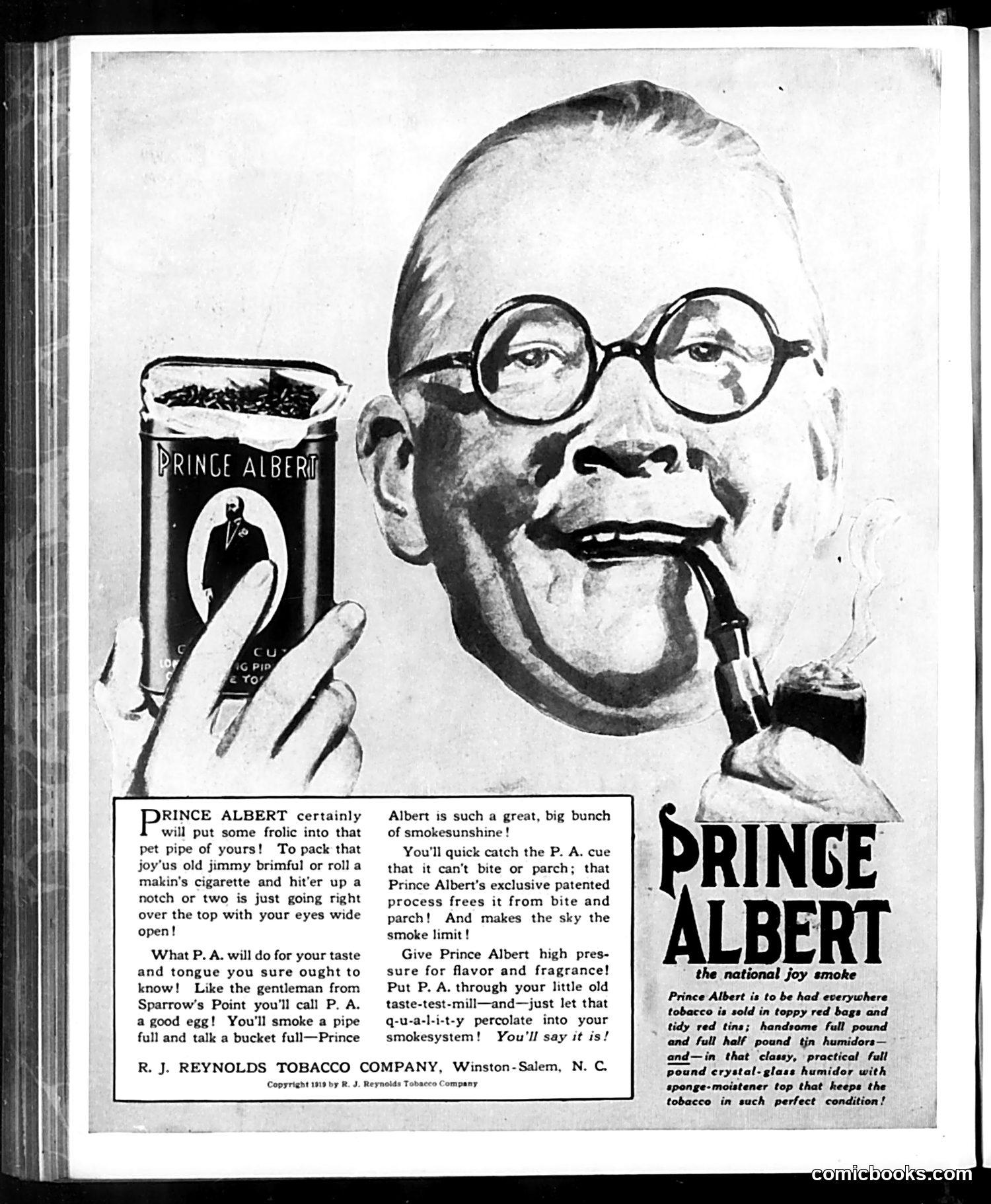
This is a **tobacco advertisement**, not political satire. It promotes Prince Albert brand pipe tobacco to male smokers. The ad features a man with round glasses smoking a pipe, holding a tin of Prince Albert tobacco. The copy uses casual, colloquial language ("frolic," "jimmy brimful") to appeal to working-class smokers and emphasizes the product's supposed advantages: it won't "bite or parch" the mouth, has superior flavor and fragrance, and comes in convenient packaging (tins and humidors). The humor derives from exaggerated claims and the jovial tone rather than political commentary. This reflects early 20th-century advertising practices before tobacco health warnings existed. The ad ran in *Judge* magazine, which mixed satirical content with commercial advertisements.
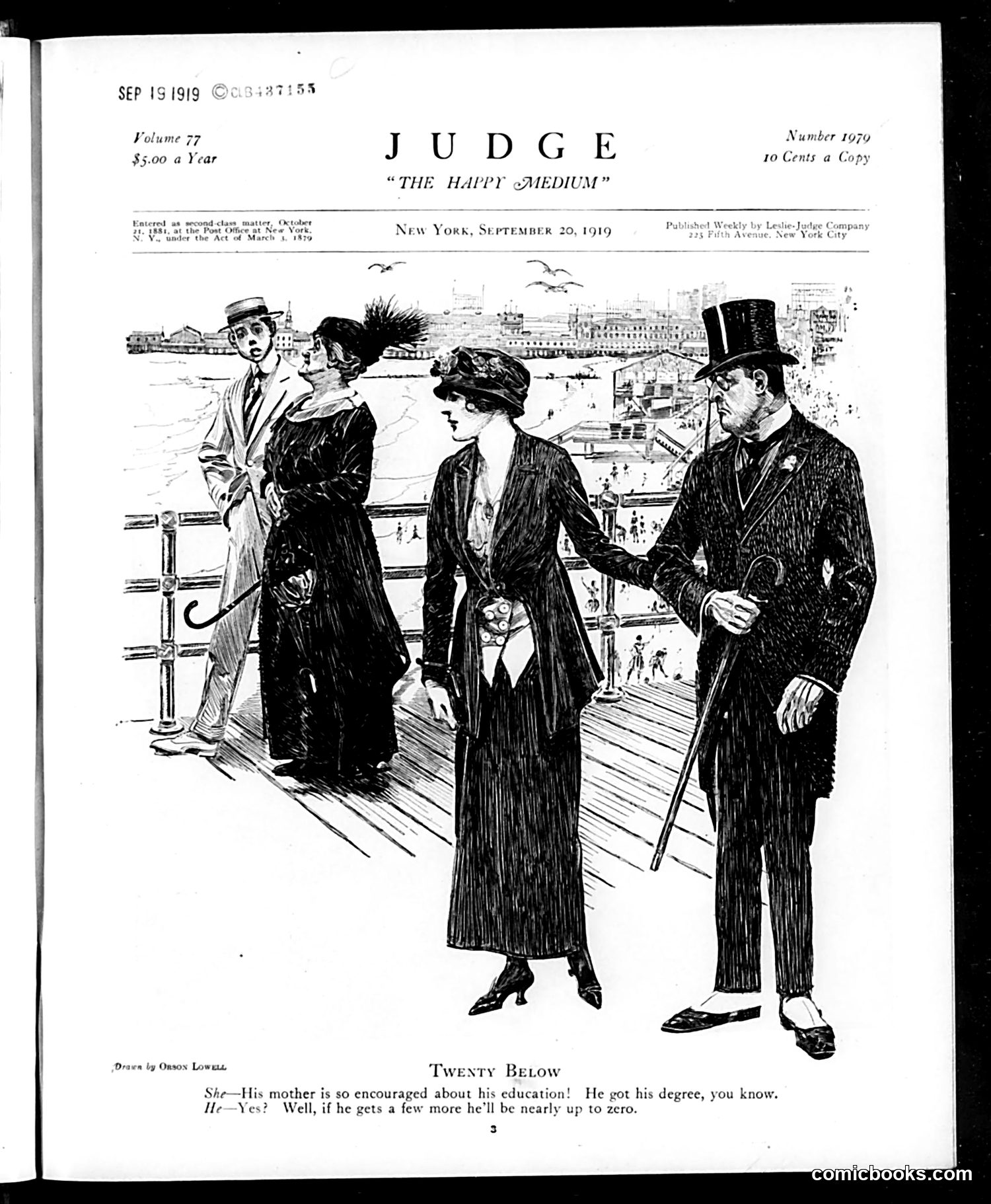
This cartoon satirizes educational aspirations and class anxiety in post-WWI America. A well-dressed man in a top hat converses with a woman on what appears to be a ship or observation deck overlooking New York's harbor and skyline. The caption's joke relies on a crude pun: the mother is "encouraged about his education" because he obtained a degree, but the man quips that "if he gets a few more he'll be nearly up to zero"—meaning additional degrees won't improve his worthless prospects or character. The satire targets educated but unemployed or underemployed young men of the era, mocking the assumption that formal education guarantees social or financial success. The gentleman's formal attire underscores the irony.
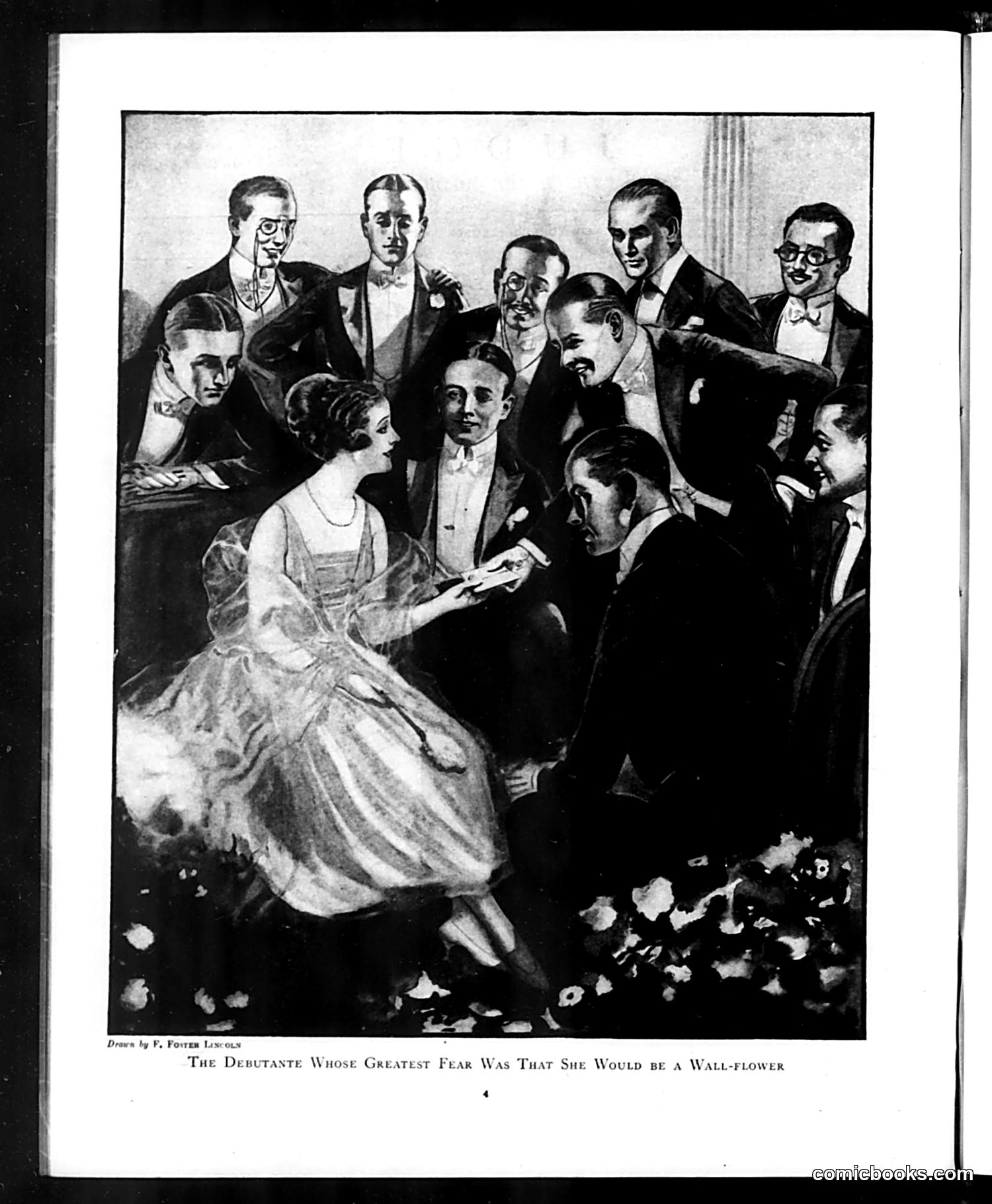
This illustration from *Judge* magazine, drawn by F. Foster Lincoln, depicts "The Debutante Whose Greatest Fear Was That She Would be a Wall-flower." The cartoon satirizes social anxieties surrounding debutante balls—formal events where young women from elite families were presented to society. The composition shows a young woman in an elaborate gown surrounded by numerous attentive men, all focused on her. The satire targets both the debutante's vanity (her fear of being ignored) and the social absurdity of the situation: she's so surrounded by suitors that her original anxiety appears completely unfounded. The joke relies on the contrast between her worried expectation and the eager reality—she's the center of attention, making her fear laughably unnecessary. This mocks upper-class social pretensions and feminine insecurity.
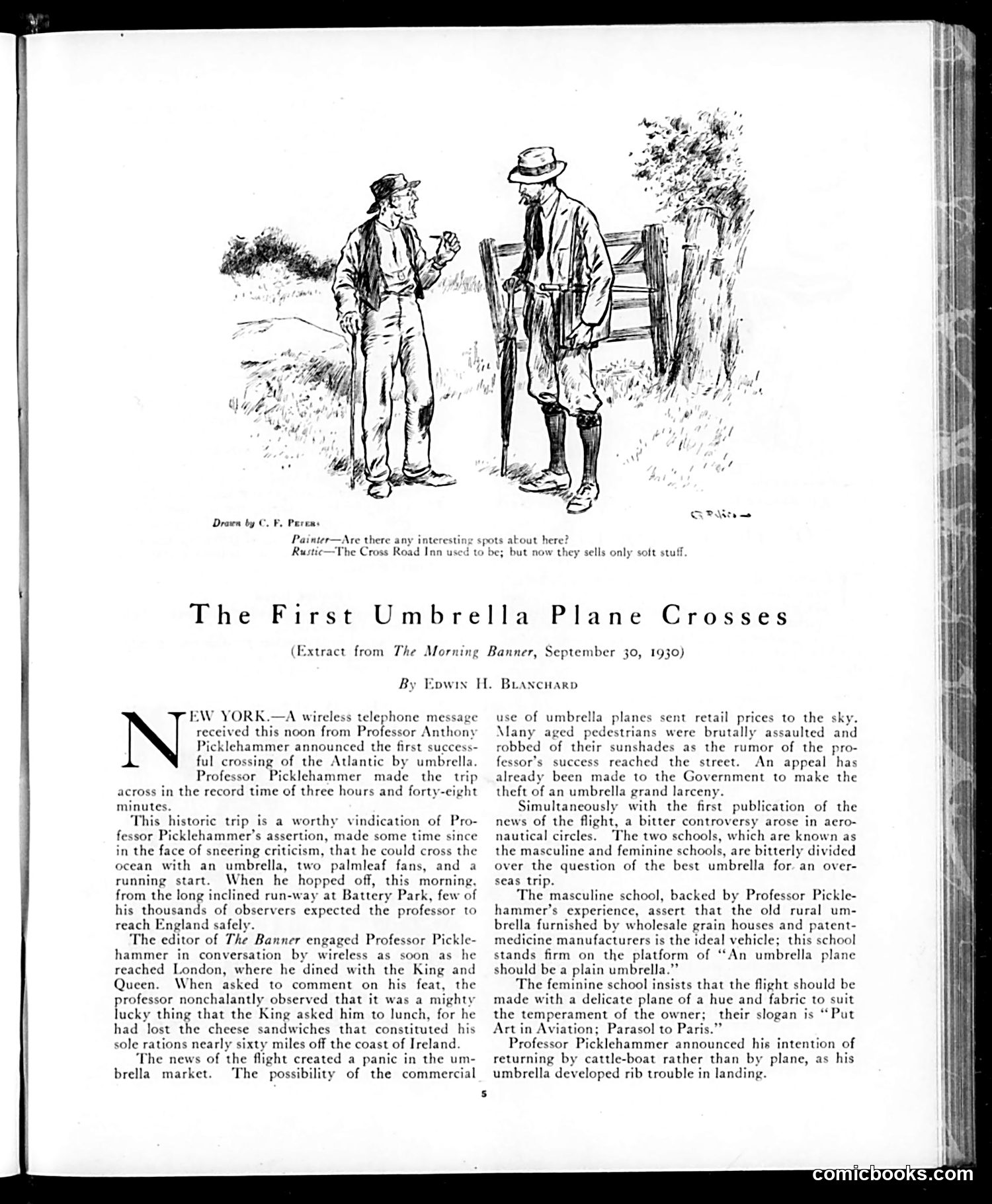
This satirical piece from *The Morning Banner* (September 30, 1930) mocks Professor Pickelhammer's claimed transatlantic flight using an umbrella, two palmleaf fans, and a running start. The cartoon depicts two men discussing the implausible achievement at a rural crossroads. The satire targets both the absurdity of such a claim and the commercial opportunism it sparked—umbrella manufacturers capitalized on the "historic" flight. A secondary joke notes the controversy between "masculine" and "feminine" schools debating whether the umbrella should be plain or delicate for ocean crossings. The piece appears to be satirizing credulous public belief in dubious aviation claims and the entrepreneurial hype surrounding 1930s aviation achievements, when genuine aviation breakthroughs were still novel enough to capture public imagination.
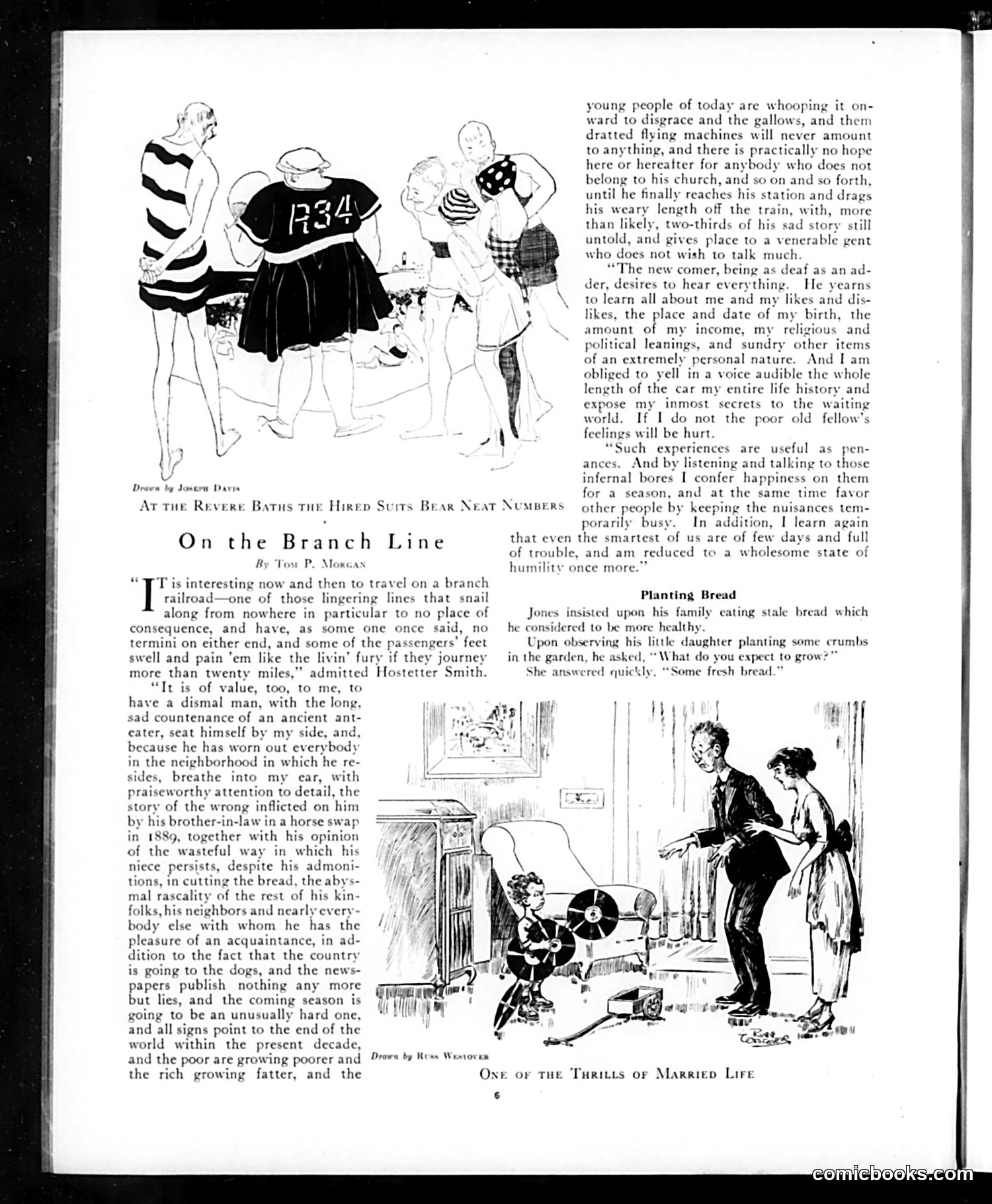
This page contains two distinct pieces: **"On the Branch Line"** by Tom P. Morgan is a humorous short story about traveling on a minor railroad. The accompanying cartoon (drawn by Jameson Davis) shows young women in fashionable 1920s swimwear at "the Revere Baths," with one wearing a sweater labeled "R34"—likely a sorority or school designation. The satire targets the loud, attention-seeking behavior of young travelers on these obscure rail lines. **"Planting Bread"** is a brief anecdote joke about a father asking his daughter what she expects to grow from bread crumbs she's planting. Her answer—"Some fresh bread"—satirizes childish logic. **"One of the Thrills of Married Life"** (drawn by Miss Westover) depicts a domestic scene where a wife discovers her husband in a compromising situation, commenting on the tensions of married life.
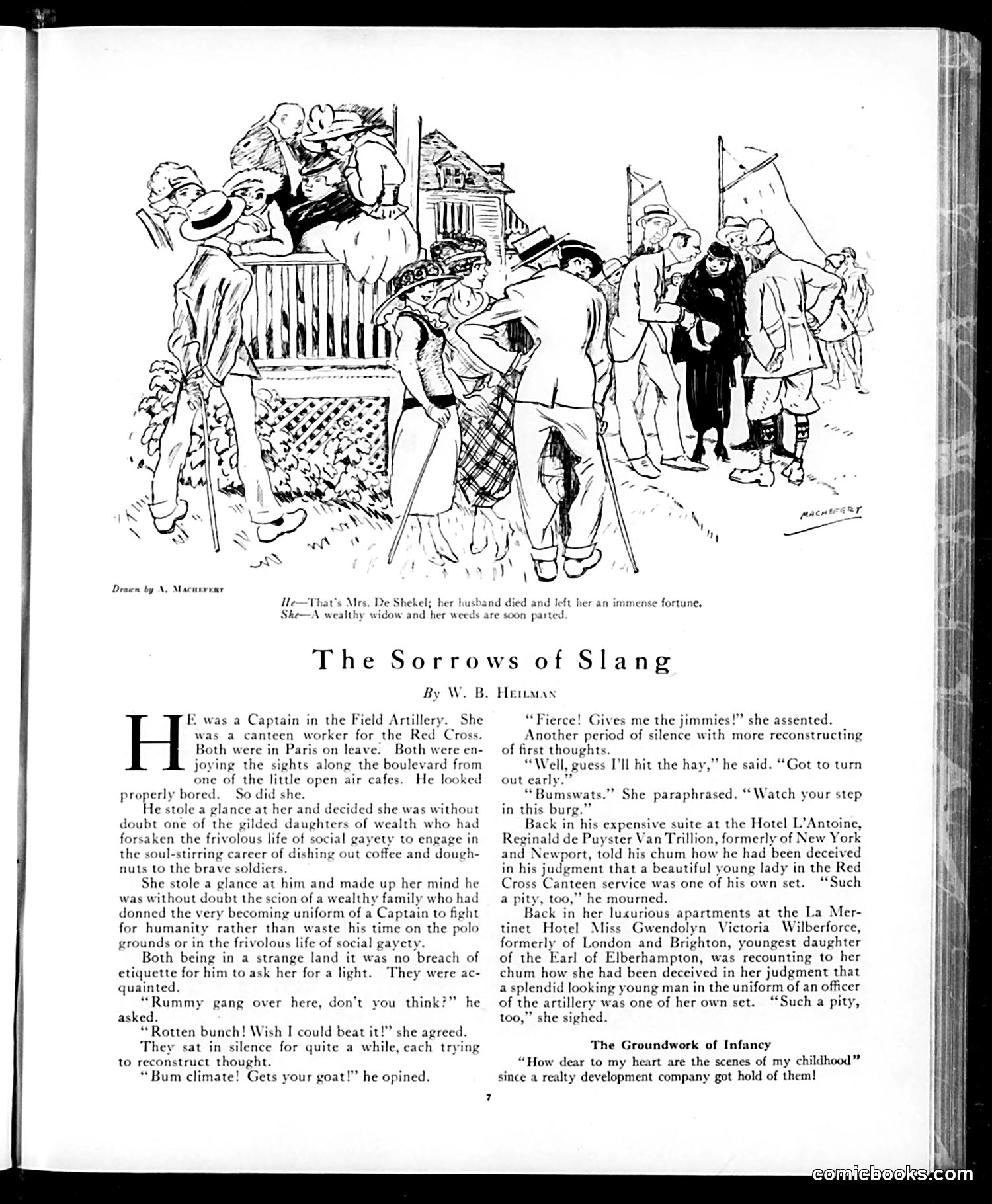
This page contains two satirical pieces from Judge magazine (likely WWI-era, based on references to Paris leave and Red Cross canteen work). **Top cartoon:** A visual joke about a wealthy widow ("Mrs. De Shekel"—the name itself mocking wealth). The caption's punchline relies on slang: "her weeds are soon parted" plays on "widow's weeds" (mourning clothes) while suggesting her money is quickly spent. **"The Sorrows of Slang":** This story satirizes class pretense. Two wealthy aristocrats—Reginald de Puyster Van Trillion and Miss Gwendolyn Victoria Wilberforce—meet in Paris during WWI, each believing the other is a working-class volunteer (soldier and Red Cross worker). Both speak in deliberately crude slang ("gets your goat," "hit the hay," "bumswats") to seem relatable. The irony: they're actually social equals but mutually deceived by surface appearances and slang affectation. The satire targets both aristocratic condescension and the gap between authentic and performative speech. **"The Groundwork of Infancy":** Brief satirical caption mocking developers destroying nostalgic childhood landscapes.
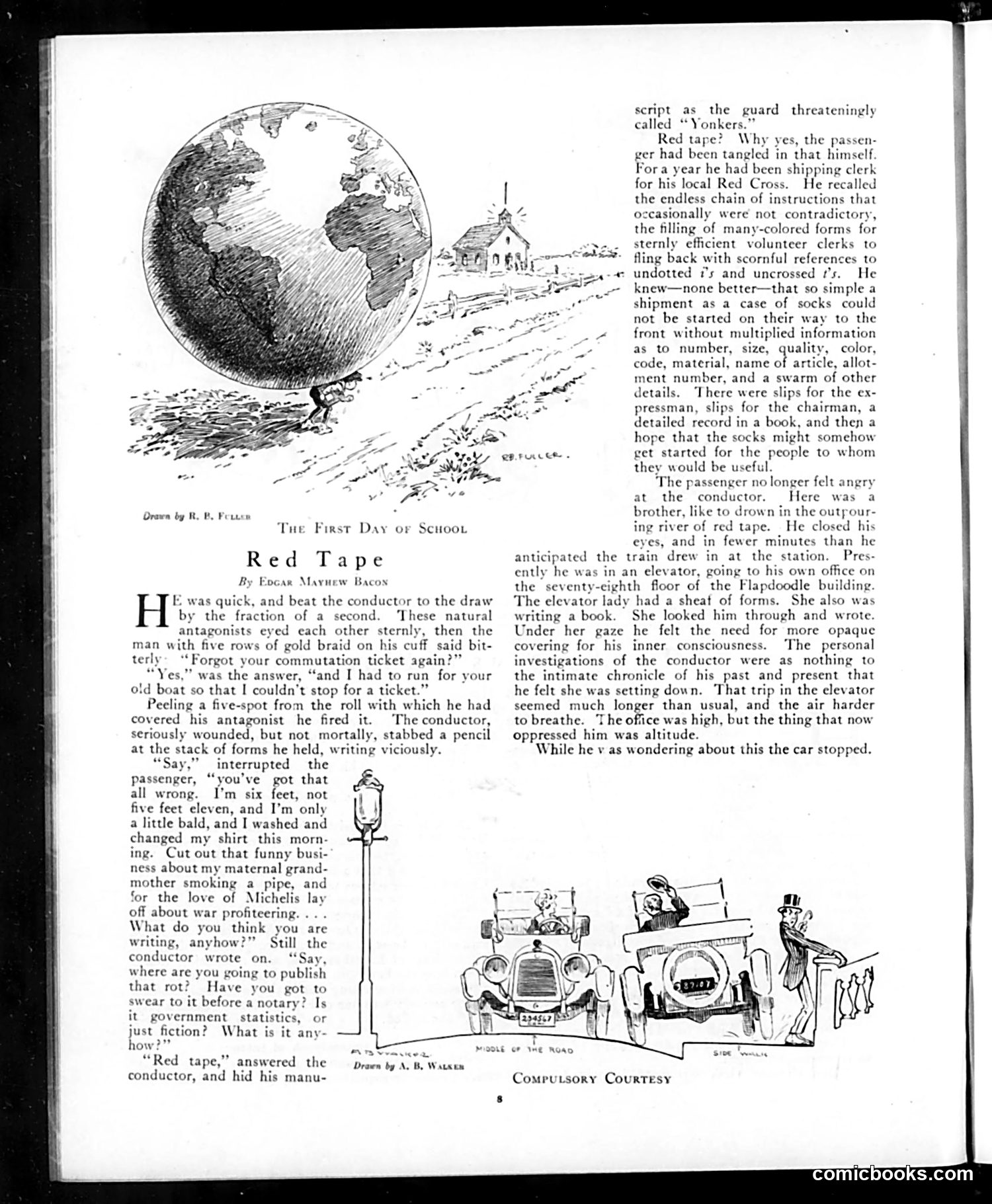
This satirical piece critiques the proliferation of bureaucratic paperwork, particularly during World War I. A train conductor and passenger clash over a forgotten commutation ticket. The conductor responds by filling out excessive forms—"red tape"—with unnecessary details about the passenger's appearance and background. The passenger, recognizing the absurdity, realizes he's experienced worse through his Red Cross shipping clerk work: simple sock shipments required endless colored forms, contradictory instructions, and multiple sign-offs before reaching the front. The satire extends to an elevator operator who interrogates him with yet more forms. The joke cuts across institutional inefficiency—whether railroads, charity organizations, or office buildings—all bury simple transactions under mountains of paperwork. The piece mocks how wartime bureaucracy has metastasized into everyday life, turning minor interactions into nightmarish form-filling exercises. "Compulsory Courtesy" (the second cartoon's title, showing traffic chaos) reinforces themes of modern institutional absurdity.
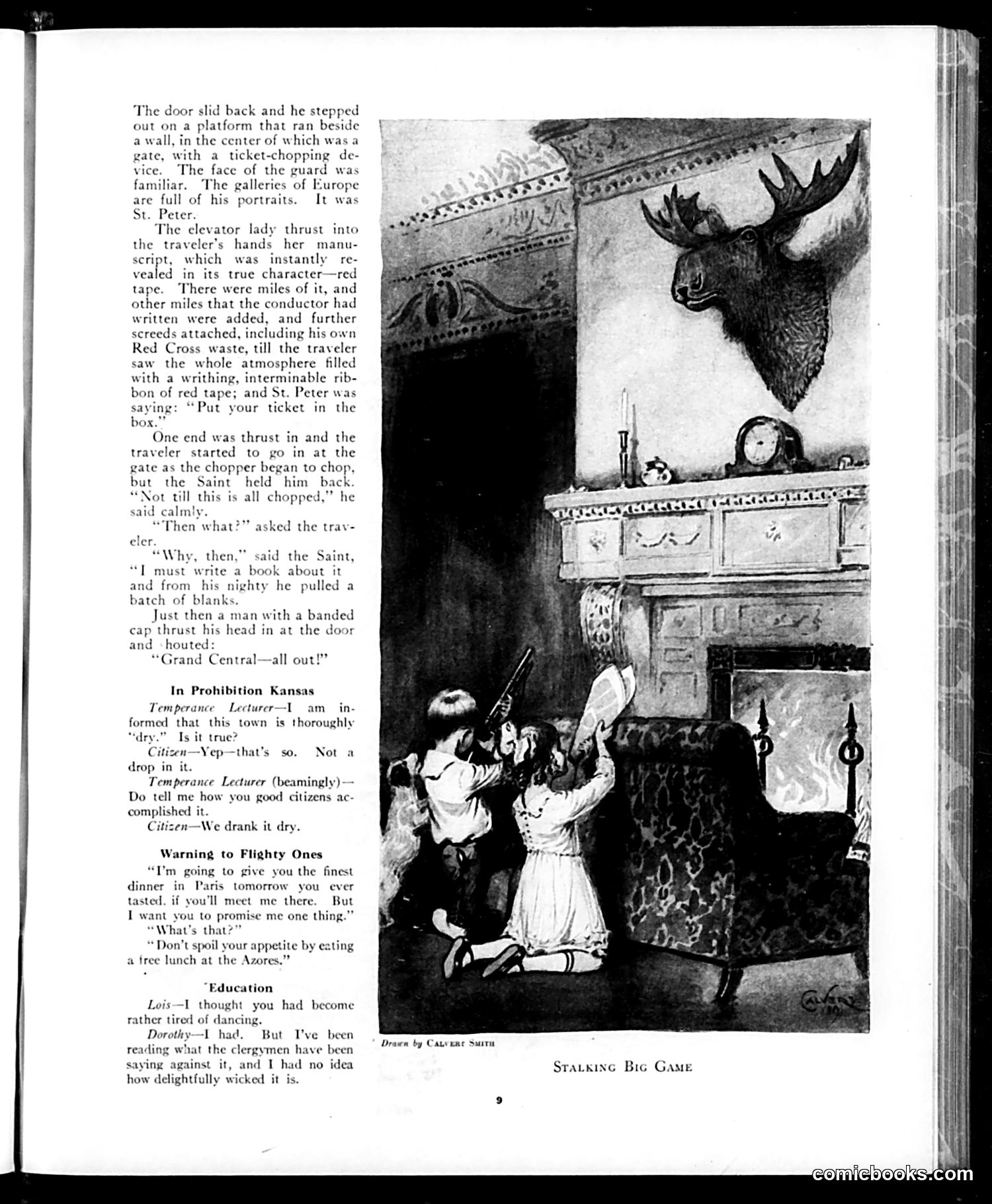
This page contains a satirical story-illustration titled "Stalking Big Game" (drawn by Cesare Siva) depicting a heavenly bureaucratic encounter, plus three separate comic vignettes below. **Main Illustration**: A traveler arrives at heaven's gate where St. Peter demands endless "red tape"—bureaucratic paperwork—before entry. The satire mocks excessive governmental or institutional bureaucracy that creates endless obstacles. A conductor's Red Cross waste adds to the pile, suggesting wartime or organizational inefficiency. **The Three Jokes**: 1. **Prohibition Kansas**: Citizens claim their town is "dry" (alcohol-free) because they "drank it dry"—mocking the hypocrisy of Prohibition-era enforcement. 2. **Paris Warning**: A man warns a woman not to eat free lunch before a fancy dinner, sarcastically playing on transatlantic travel naiveté. 3. **Education Paradox**: A woman abandons dancing until clergy condemn it, then suddenly finds it appealing because it's deemed "wicked"—satirizing how prohibition increases desire. The page's theme: institutional absurdity, hypocrisy, and human nature's contrarian impulses.
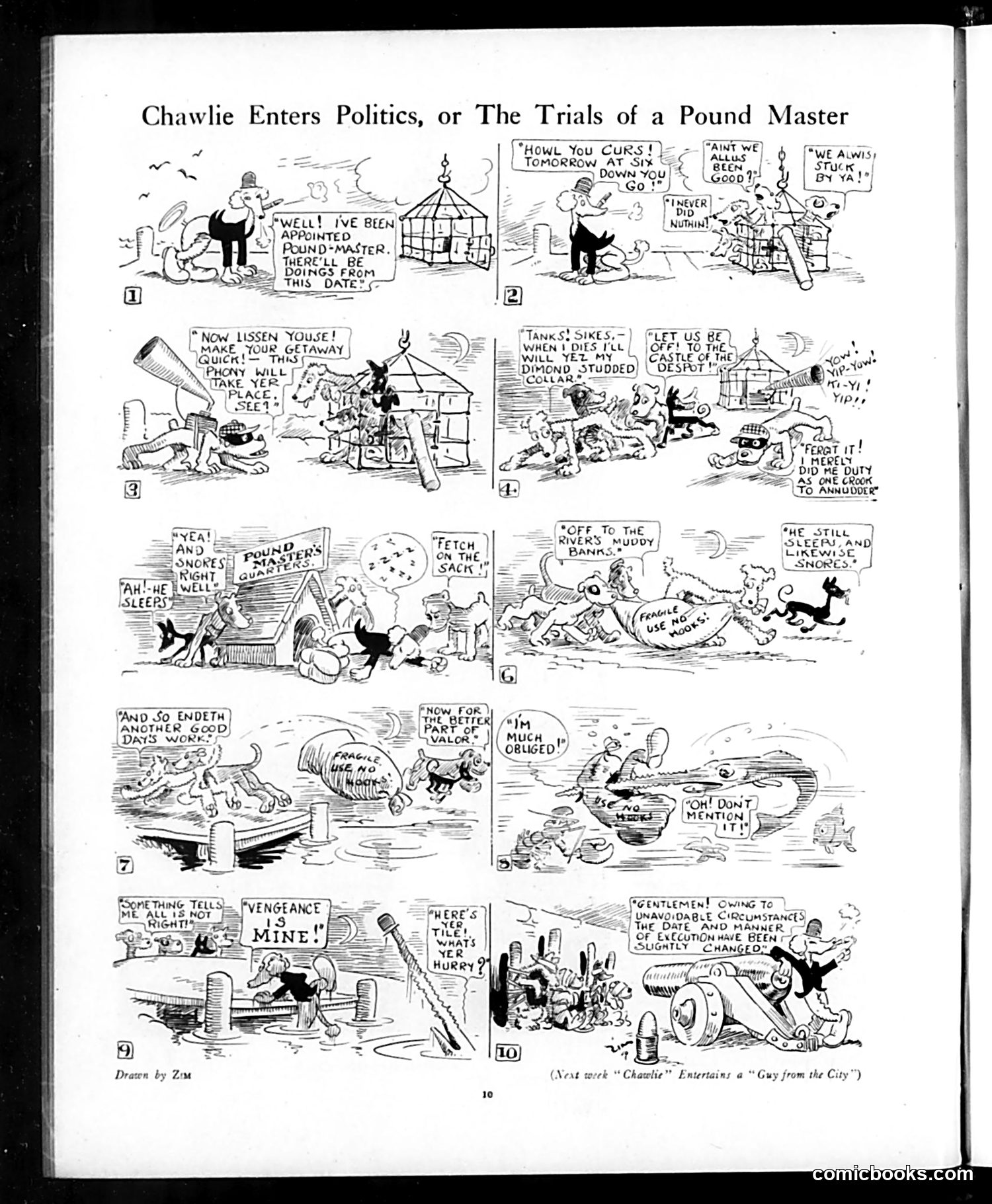
This is a sequential comic strip following a character named "Chawlie" (likely an Irish or working-class immigrant stereotype, given the dialect) who becomes a "Pound Master"—a municipal dog-catcher. The satire concerns **political patronage and corruption**. Chawlie receives this government appointment through connections rather than merit, as suggested by panel 1's announcement. The strip then follows his incompetent attempts at the job: he chases stray dogs, gets into absurd scrapes with various characters (including apparent gangsters or thugs), falls in rivers, and ultimately appears to bungle the execution of his duties spectacularly. The final panels joke about the "unavoidable circumstances" delaying his official "execution"—a dark pun suggesting his inevitable removal from office due to his incompetence. The broader satire **mocks the spoils system** of American politics, where unqualified party loyalists received government jobs as rewards, regardless of capability. Chawlie's appointment and subsequent disasters exemplify why this system was criticized.
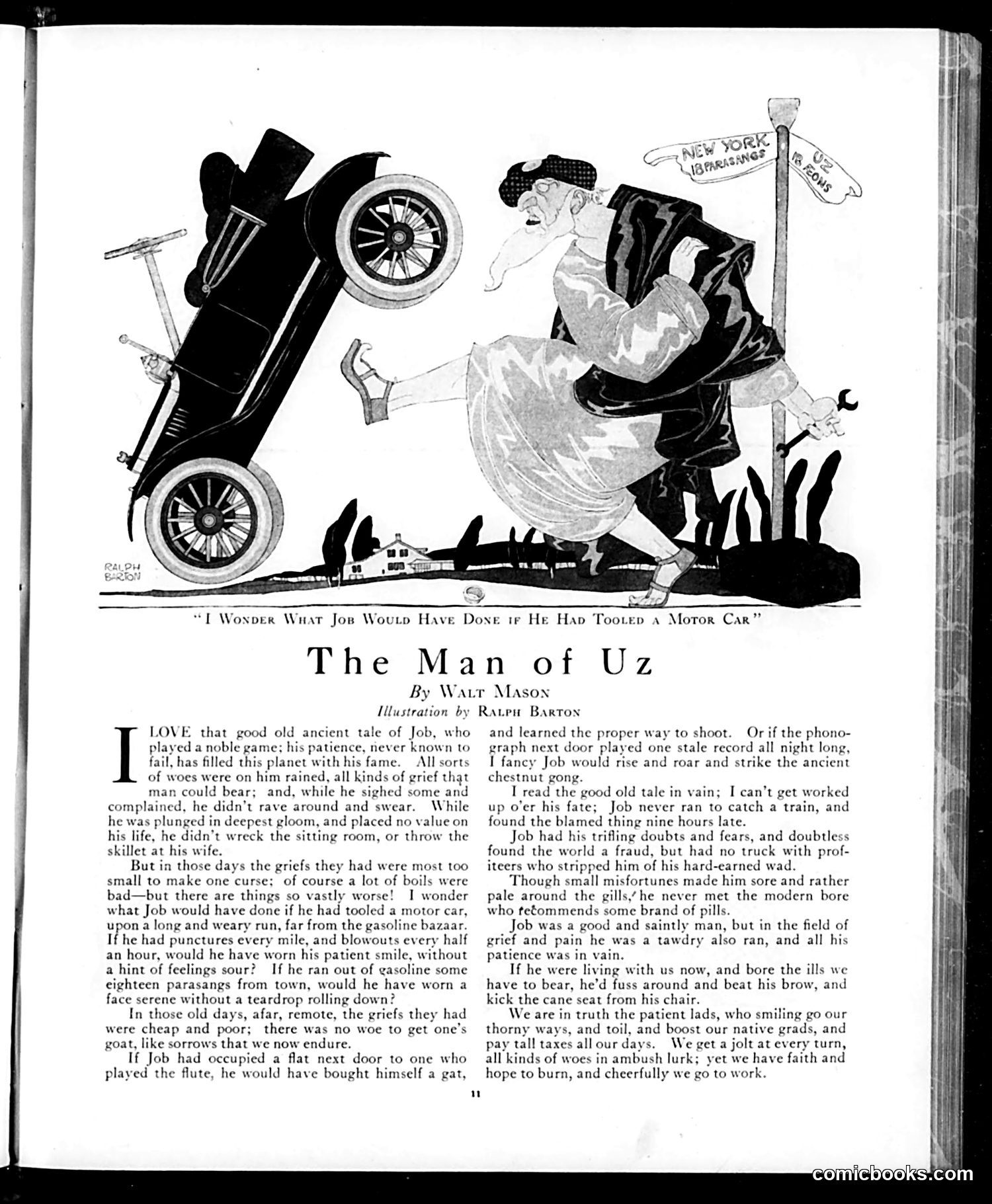
This is a humorous poem by Walt Mason with Ralph Barton's illustration comparing the biblical Job's ancient patience to modern hardships—specifically, early automobile troubles. The cartoon shows a man struggling with a motorcar that's tipped over, contrasting with Job's biblical trials. The joke: Job endured boils and catastrophes with grace, but modern people face *worse* irritations—flat tires, breakdowns far from gas stations, missed trains, neighbors playing phonographs or recommending pills, profiteers, and taxes. The satire argues that contemporary Americans, despite facing "trivial" modern annoyances (mechanical failures, noise, commercialism), still maintain Job-like patience and keep working. It's gently mocking early-20th-century complaints about automobiles and modern life's minor inconveniences while praising resilience. The tone suggests these "new" problems are petty compared to biblical suffering, yet modern people handle them with surprising forbearance.
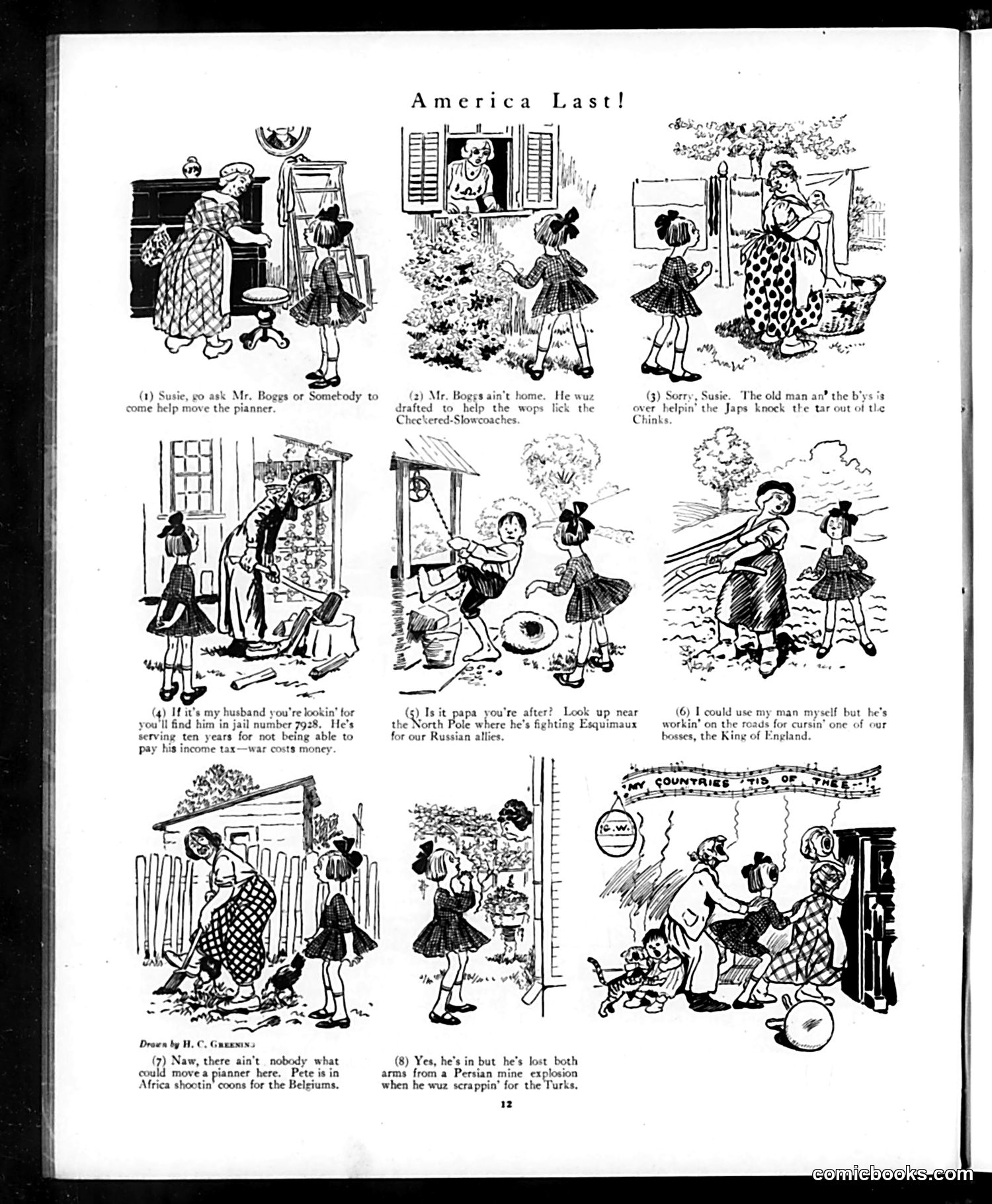
This comic strip critiques American involvement in World War I by showing how military service and war production have depleted the home front of able-bodied men. Each panel presents a woman seeking help with domestic tasks (moving a piano) only to learn the men are absent due to war efforts. The satire's point: American resources and manpower are being diverted to foreign conflicts—helping Belgians, fighting alongside Russians, supporting the British against Germany and the Japanese against China—while American civilians suffer neglect at home. The title "America Last!" encapsulates the complaint that American interests are subordinated to global entanglements. References include income taxes funding war costs, military conscription ("drafted"), and various theaters of combat. The drawing style and colloquialisms suggest a rural, working-class perspective, emphasizing how ordinary Americans bear the burden of international commitments while their own needs go unmet.
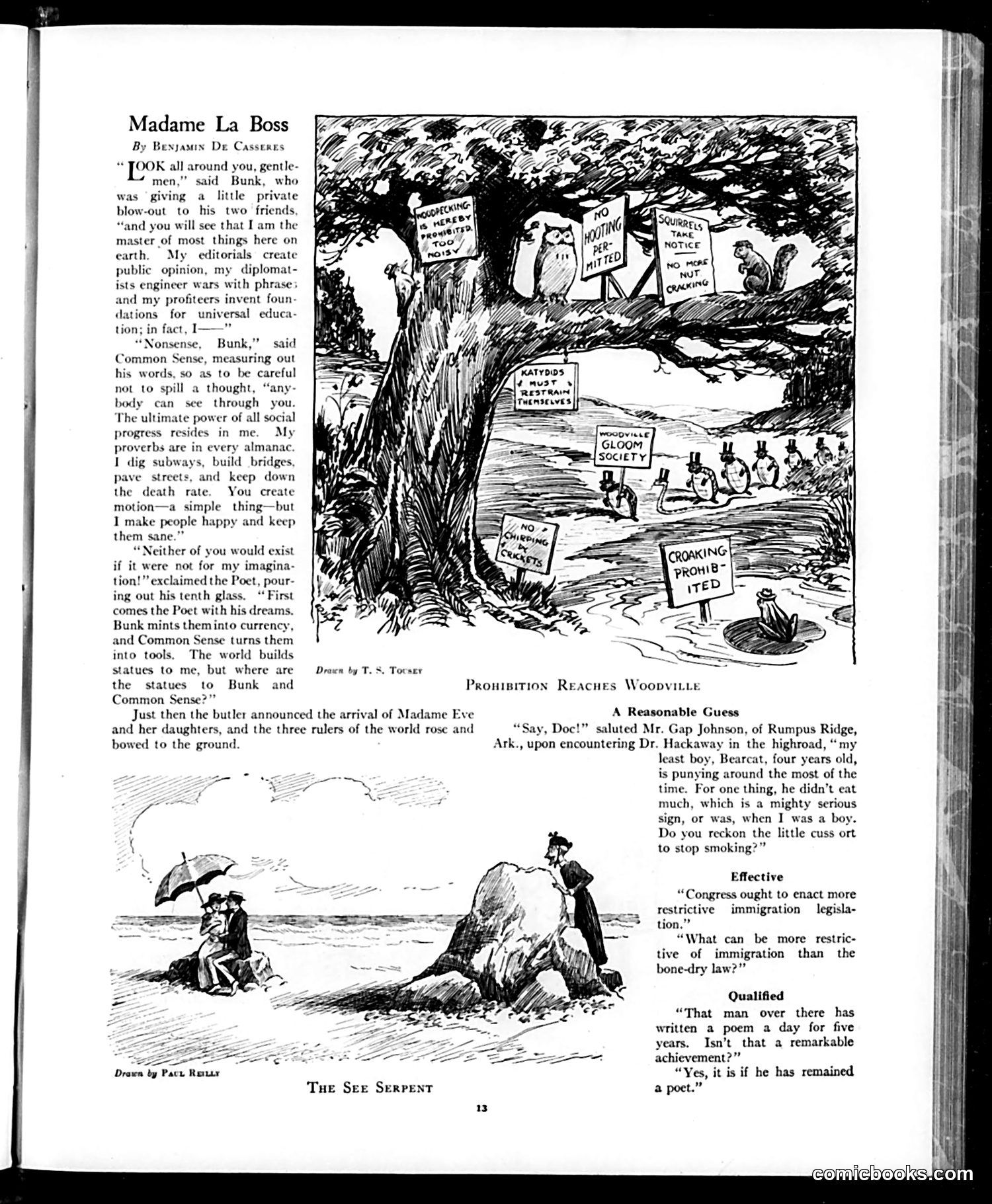
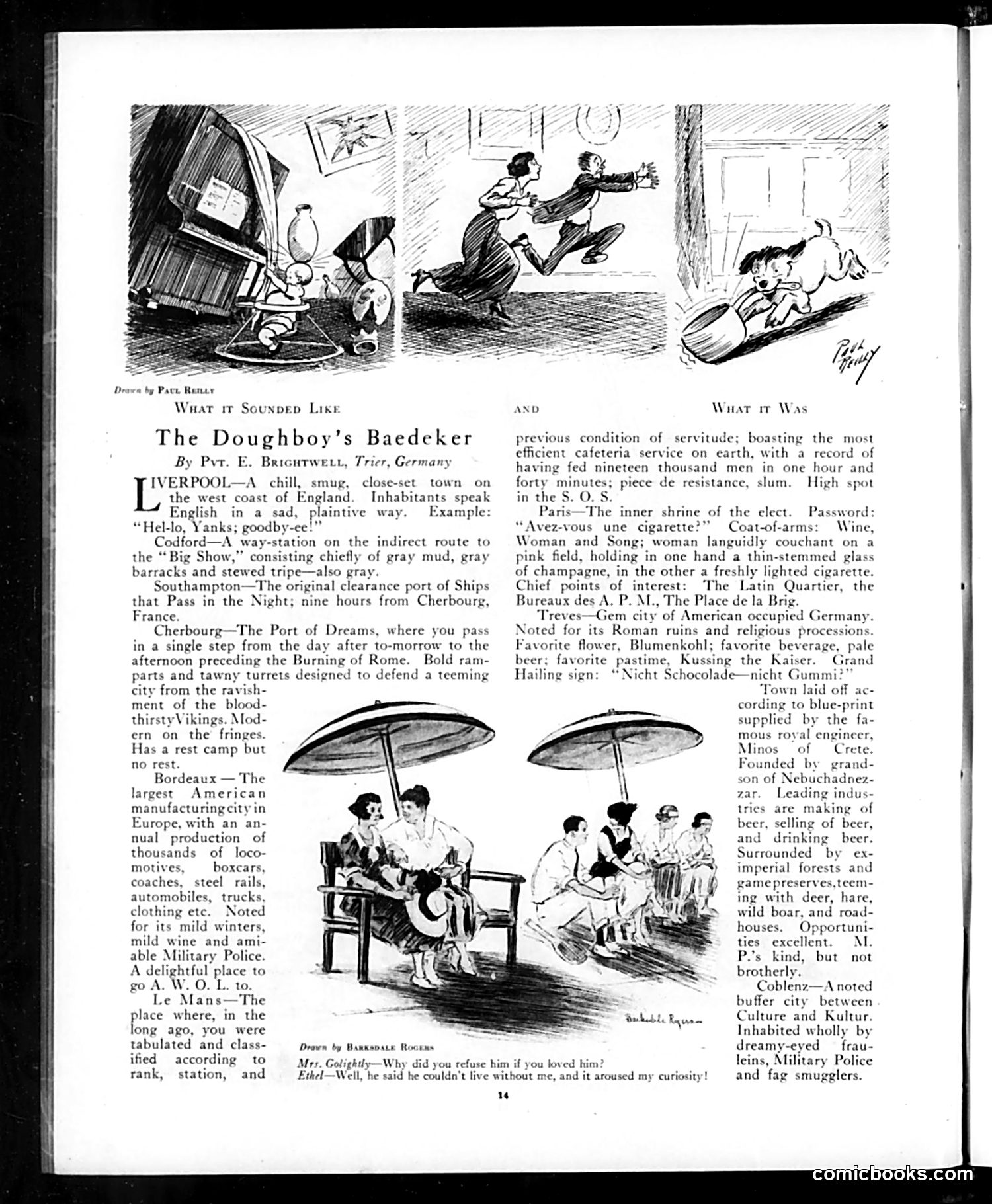
This is a satirical travel guide written by a fictional American soldier (Pvt. E. Brightwell) stationed in Europe during World War I. It humorously describes various towns where American troops were stationed or passed through—from Liverpool to occupied German cities like Trier and Coblenz. The satire works by presenting mundane or unpleasant military realities in mock-tourist language. Liverpool is "chilly" and "plaintive"; Codford consists of "gray mud" and "stewed tripe"; Le Mans is where soldiers were processed like inventory. The Paris entry mocks soldier fantasies about wine, women, and song. The cartoons above show slapstick scenes of soldiers mishaving—one chasing another, another sliding in a bucket—illustrating the chaotic reality behind the guide's dry descriptions. This targets both military bureaucracy and soldiers' actual experiences abroad, deflating romantic notions of the Great War through irreverent humor.
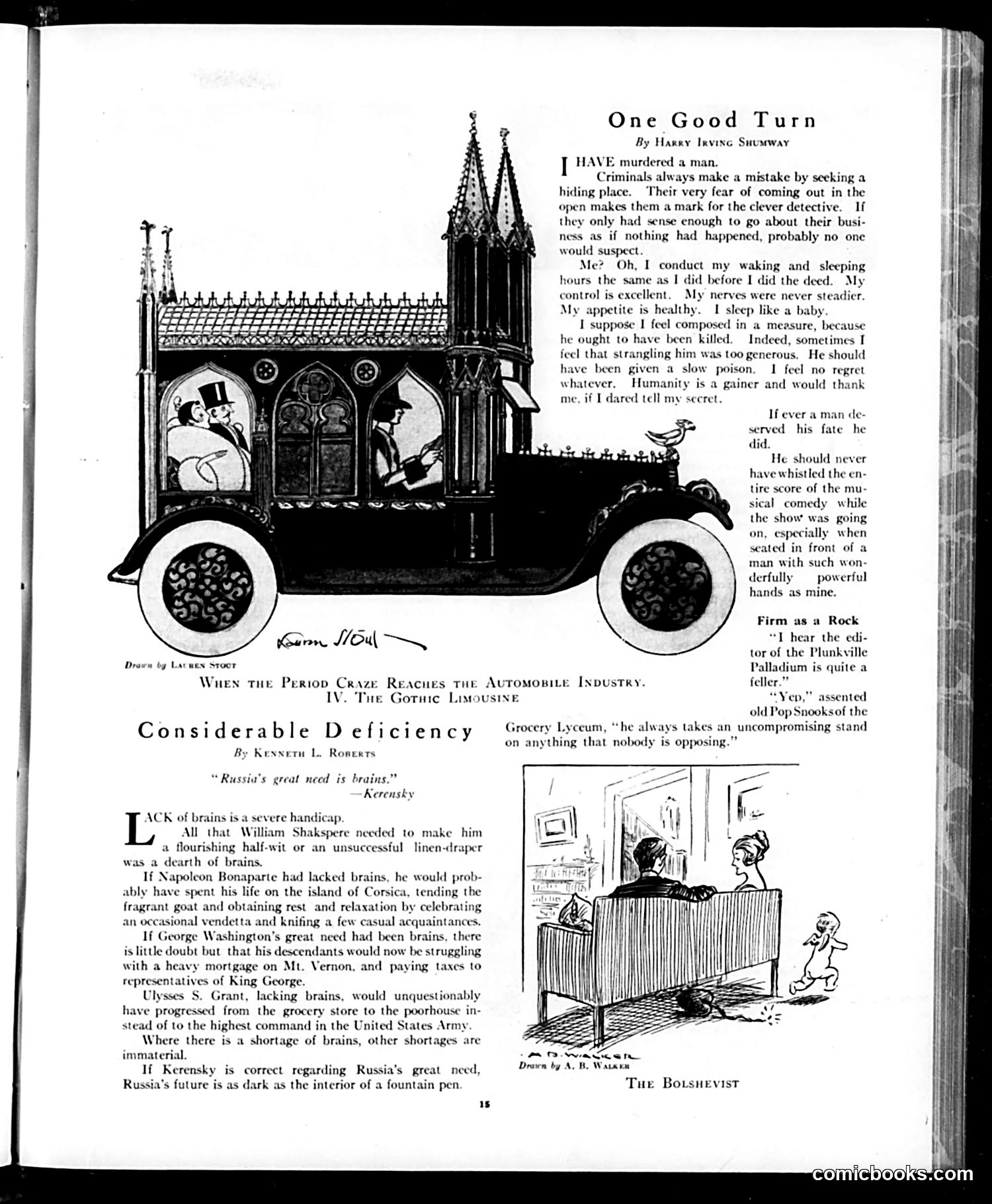
**Top Cartoon ("The Gothic Limousine"):** Satirizes the "period craze"—early 20th-century fascination with historical styles. A Gothic cathedral-shaped automobile represents the absurd extreme of applying medieval aesthetics to modern automotive design. The joke mocks how far this decorative trend had gone. **"Considerable Deficiency" Article:** A biting political satire on Russian revolutionary leader Kerensky's 1917 statement that "Russia's great need is brains." The author uses ironic examples (Shakespeare, Napoleon, Washington, Grant) showing that lack of brains would have prevented greatness. The implication: Kerensky's Russia lacks the intelligence to succeed—a cutting critique of the revolution's leadership during the chaotic 1917-1918 period. **"One Good Turn" Story:** Dark satire about a murderer justifying killing someone who whistled loudly during a musical comedy performance—poking fun at how people construct elaborate moral justifications for trivial rage. **"The Bolshevik" Cartoon:** Brief social commentary on conformist editorial positions.
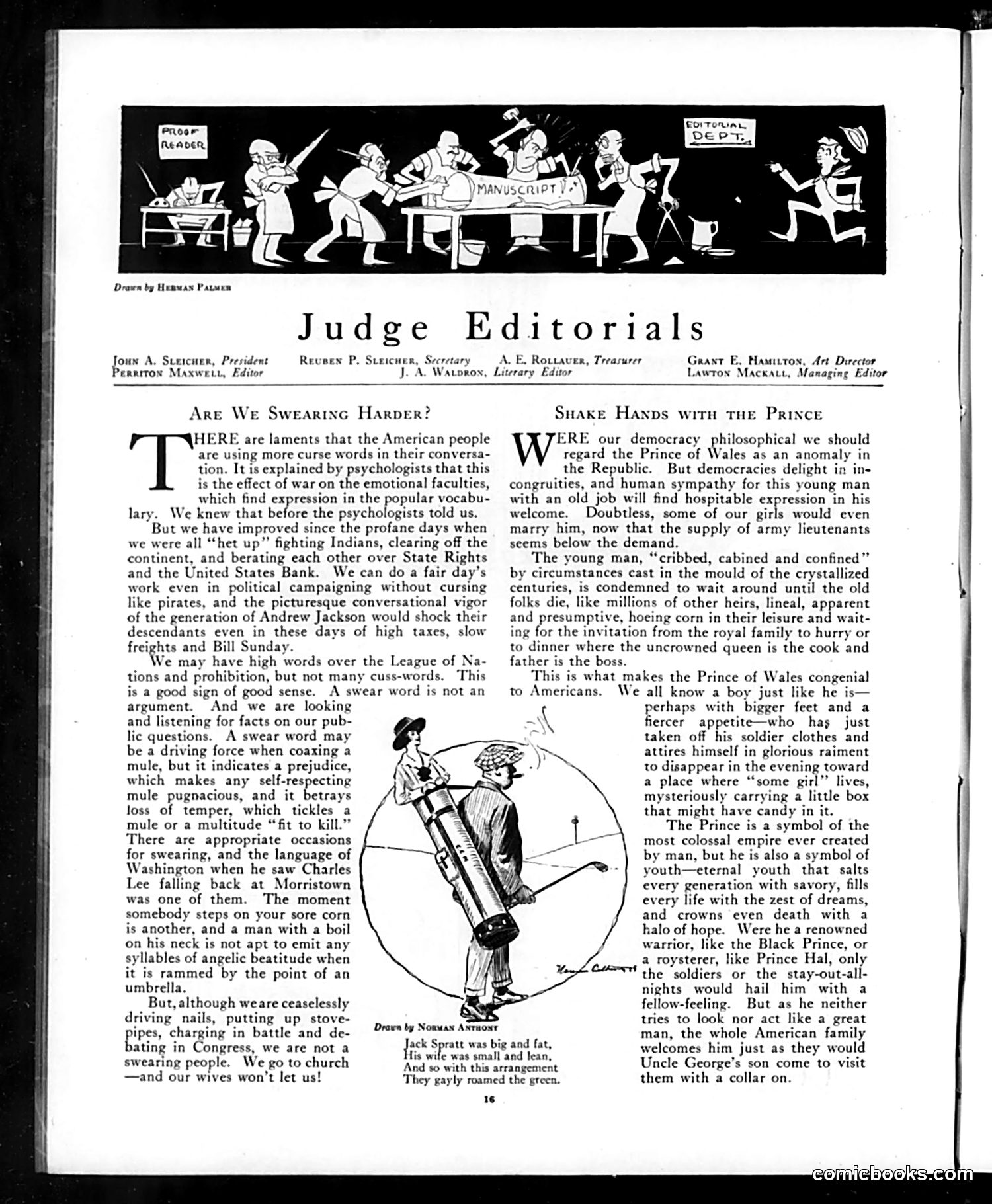
This page contains two satirical editorials with accompanying cartoons: **"Are We Swearing Harder?"** critiques concerns that Americans curse more due to wartime emotional stress. The editorial argues Americans are actually *less* profane than previous generations (citing Andrew Jackson's era), and that swearing indicates prejudice rather than argument. It allows exceptions—Washington's outbursts during the Revolution, or a man with a boil on his neck. The accompanying cartoon (by Norman Anthony) illustrates the nursery rhyme about Jack Sprat and his wife. **"Shake Hands with the Prince"** welcomes the Prince of Wales visiting America. The piece humorously treats royalty as oddly democratic-compatible, comparing the constrained young prince—waiting for elderly relatives to die before inheriting—to relatable American boys sneaking off to impress girlfriends. The prince represents both imperial grandeur and universal youthful restlessness that transcends class. Both editorials use humor to comment on contemporary social attitudes: linguistic decorum and attitudes toward hierarchy/tradition.
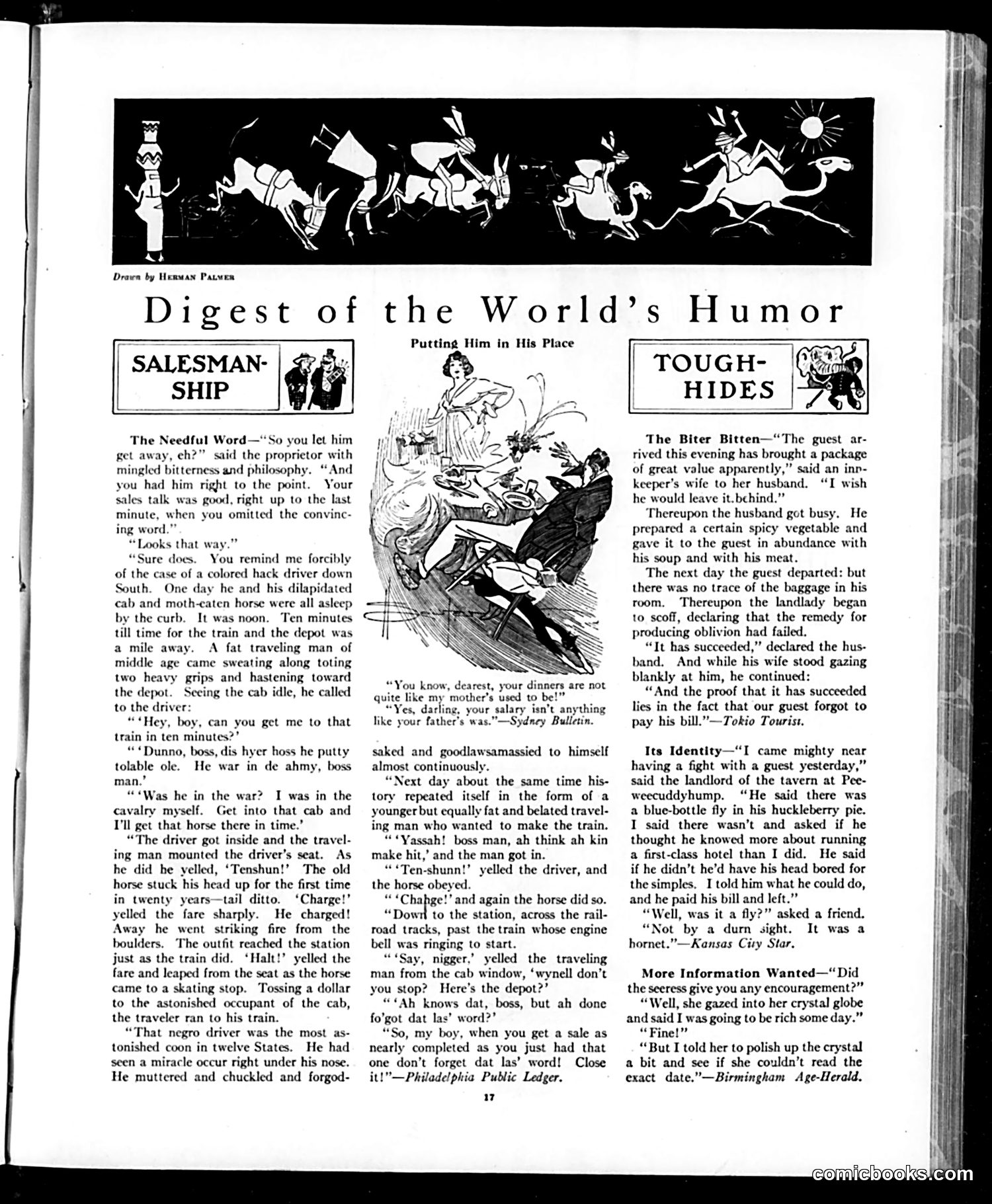
This page from Judge magazine presents three brief humorous anecdotes rather than political cartoons: **"The Needful Word"** (Salesman-Ship): A sales manager criticizes a salesman for nearly closing a deal but failing at the final moment—the "convincing word." He illustrates with a racist anecdote about a Black cab driver in the South whose horse only obeys military commands ("Tenshun!" and "Charge!"). The joke plays on the driver's supposed inability to remember the crucial command needed to complete a second ride. **"The Biter Bitten"** (Tough-Hides): An innkeeper's wife wants a guest's valuable baggage, so the husband feeds him extremely spicy food to make him forget it. The joke subverts expectations: the guest does forget something, but only to forget paying his bill. **"Its Identity"**: Incomplete in this excerpt, but appears to involve mistaken identity at a tavern. These are genteel, turn-of-century humor pieces—emphasis on wordplay and unexpected reversals rather than satire of specific political events or figures.
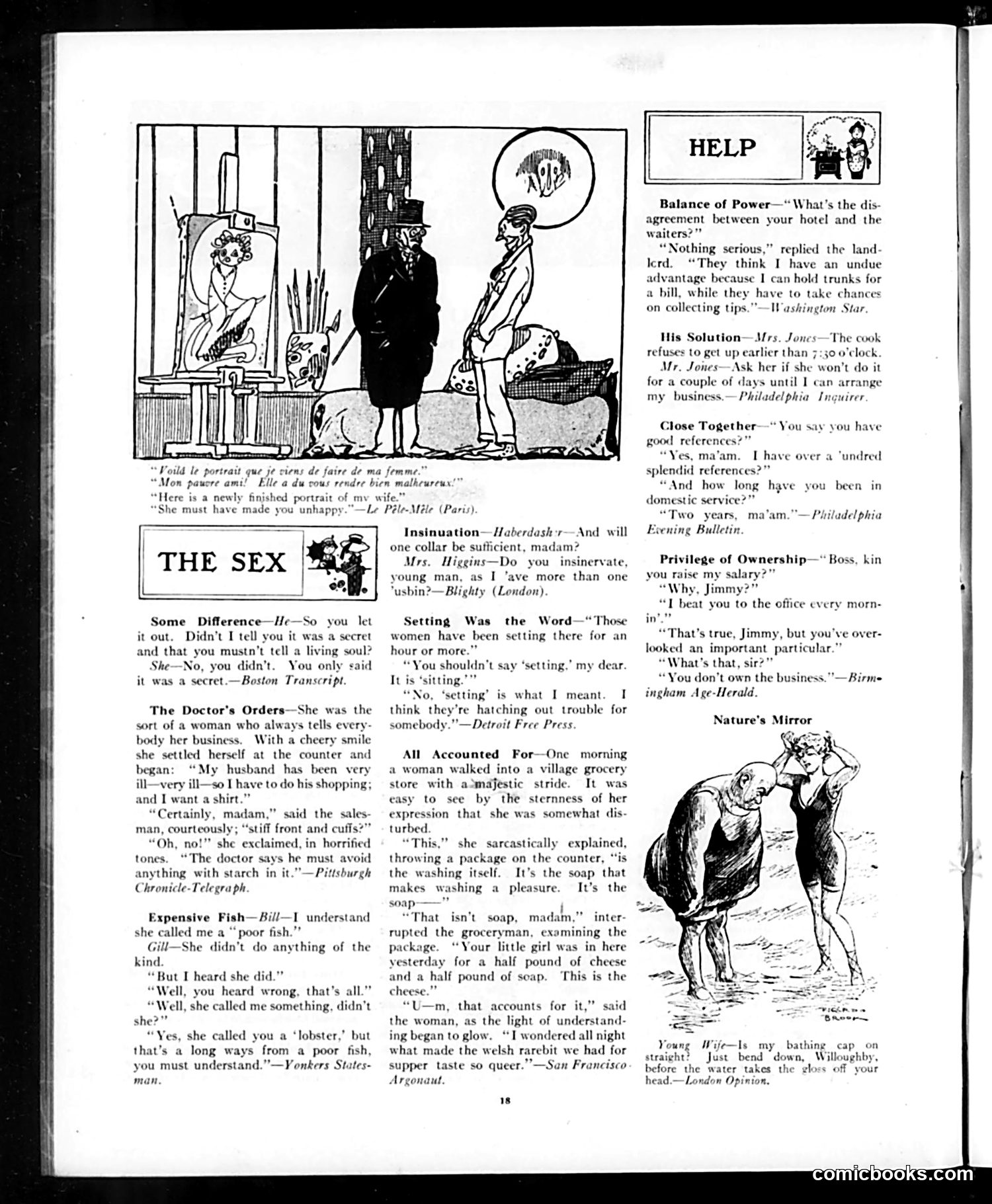
This page from Judge (an American satirical weekly) contains multiple short humorous anecdotes rather than political cartoons. The humor targets domestic life and class dynamics of early 20th-century America. Key jokes include: a husband's marital troubles (top cartoon, in French); wordplay about "setting" versus "sitting" (implying women cause trouble); a grocer's mix-up between soap and cheese; a hotel owner's advantage over striking waiters; a cook's wage negotiation; and domestic service references. The satire reflects period anxieties: wives who gossip and violate confidentiality; servants' labor disputes; the "servant problem" (difficulty hiring domestic help); and class tensions between employers and workers. The "Nature's Mirror" cartoon appears to comment on vanity. The magazine targets middle and upper-class readers, poking fun at their domestic frustrations while reinforcing social hierarchies. These are gentle, domestic jokes rather than political satire—typical of Judge's lighter content pages.
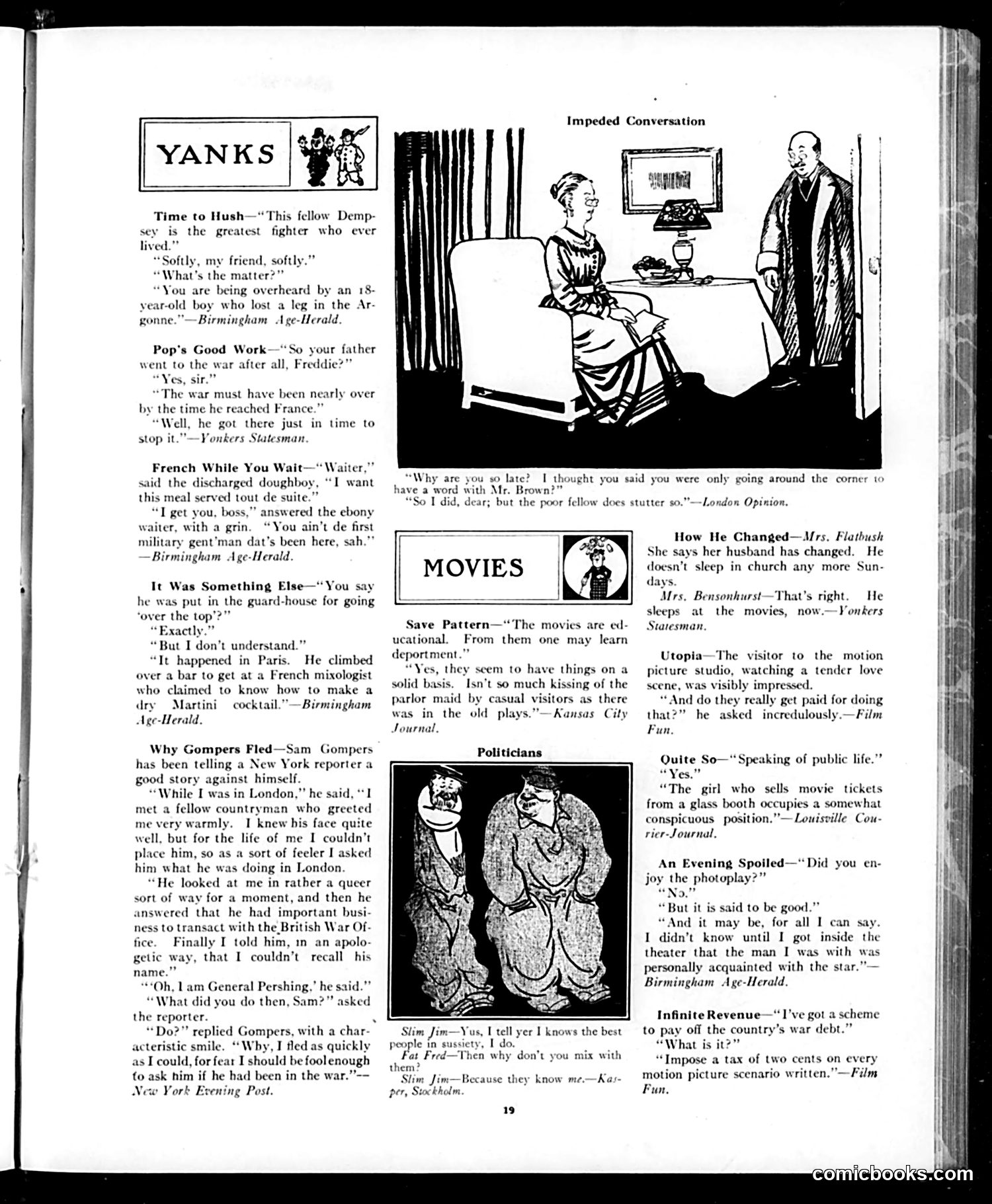
This page from Judge (likely post-WWI, given war references) contains satirical humor about contemporary American life, organized into several joke sections: **"Time to Hush"** mocks excessive praise of boxer Jack Dempsey, suggesting it's disrespectful to wounded war veterans who sacrificed limbs. **"Pop's Good Work"** and related jokes satirize soldiers who arrived in France too late to meaningfully participate in WWI combat—poking fun at their claims of importance. **"French While You Wait"** and "It Was Something Else"** stereotype both Black waiters and discharged soldiers' rowdy post-war behavior in Paris. **"Why Gompers Fled"** references real labor leader Sam Gompers, humorously claiming he fled rather than face General Pershing (WWI commander) after not recognizing him. The **"MOVIES"** section satirizes cinema's growing social role—mocking movie studios' pretensions to educational value while depicting them as sites of casual romance and lower-class aspiration. **"Politicians"** cartoons appear to reference social class and networking humor. Overall, the page reflects post-WWI American anxieties about soldier reintegration, changing entertainment culture, and class dynamics.
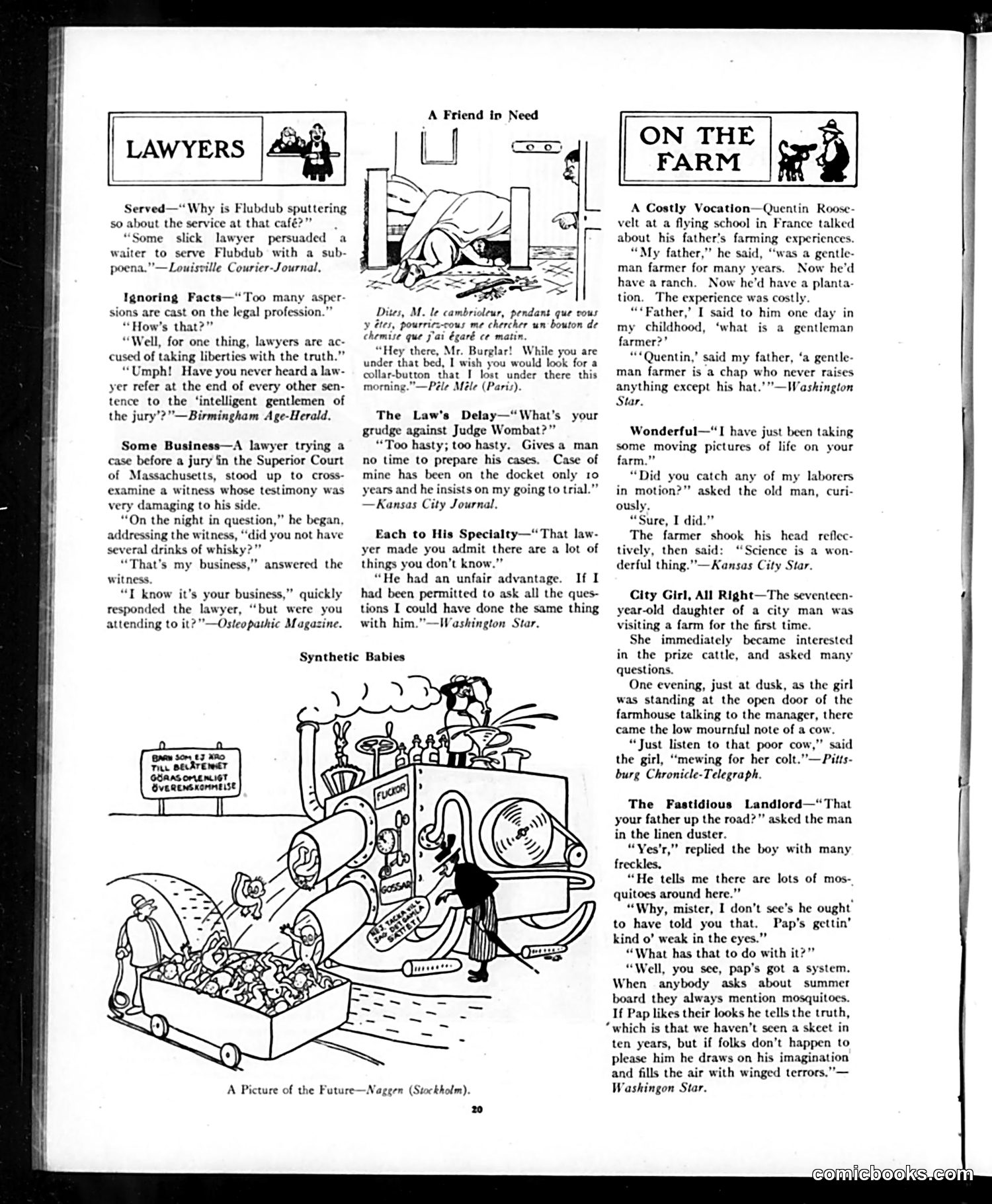
This page from Judge magazine contains lawyer jokes and farm anecdotes typical of early 20th-century American humor. **The Lawyers section** satirizes the legal profession through brief jokes mocking lawyers' deceptiveness ("taking liberties with the truth"), delays in court proceedings, and manipulation of witnesses. One anecdote depicts a Massachusetts lawyer cross-examining a witness about drinking, revealing professional cynicism. **The Farm section** features rural humor, including a joke about Quentin Roosevelt (son of President Theodore Roosevelt) discussing his father's expensive gentleman farming, and several stories contrasting city ignorance with farm realities—a city girl mistaking a cow's moo for "mewing," and a landlord's son admitting his father lies about mosquitoes to discourage summer boarders. **"Synthetic Babies"** is a Swedish cartoon (credited to Naggen of Stockholm) depicting an industrial machine producing babies—likely satirizing mechanization and anxieties about modern artificial reproduction replacing natural processes. The humor reflects rural-urban tensions and professional skepticism characteristic of early 1900s American satire.
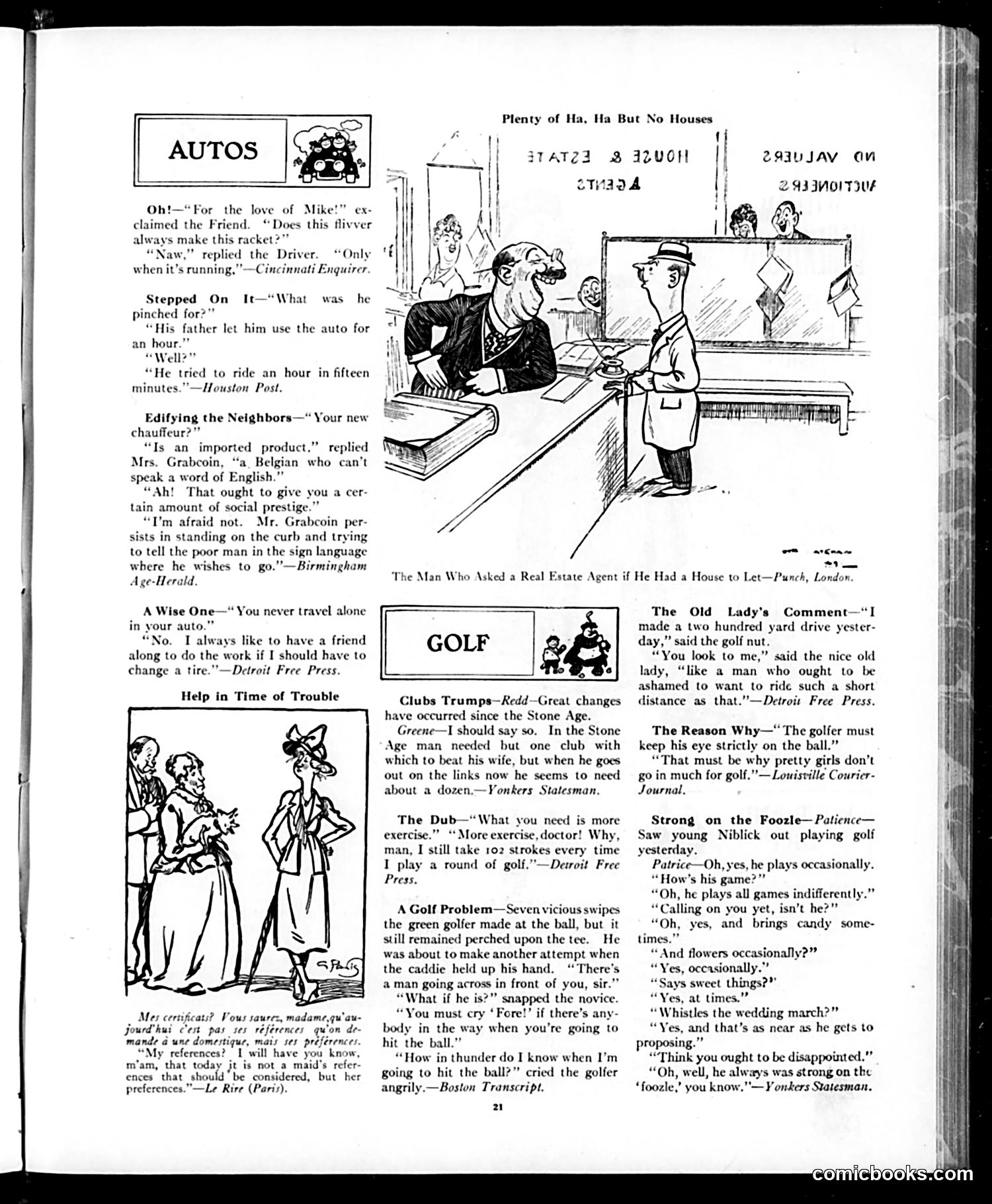
This Judge magazine page (page 21) contains early automobile and golf humor, primarily jokes rather than political satire. **The "AUTOS" section** mocks early car culture through short jokes: the noise and unreliability of early automobiles ("flivvers"), a teenager trying to drive too fast, and social pretension around hiring foreign chauffeurs. The humor targets both car owners' vanity and the mechanical frustrations of primitive vehicles. **The "GOLF" section** satirizes golf's popularity among the wealthy and upper-middle classes. Jokes reference golf's excessive equipment requirements, the absurdity of golf rules (like "Fore!"), and—in "Strong on the Foozle"—a young man's inability to commit to marriage despite courtship. "Foozle" is golf slang for a clumsy stroke, used here as a double meaning. The real estate cartoon shows a man asking about rental housing—likely reflecting post-WWI housing shortages ("Plenty of Ha, Ha But No Houses"). The overall tone reflects pre-1920s American leisure culture, targeting educated, affluent readers familiar with automobiles and golf as status symbols.
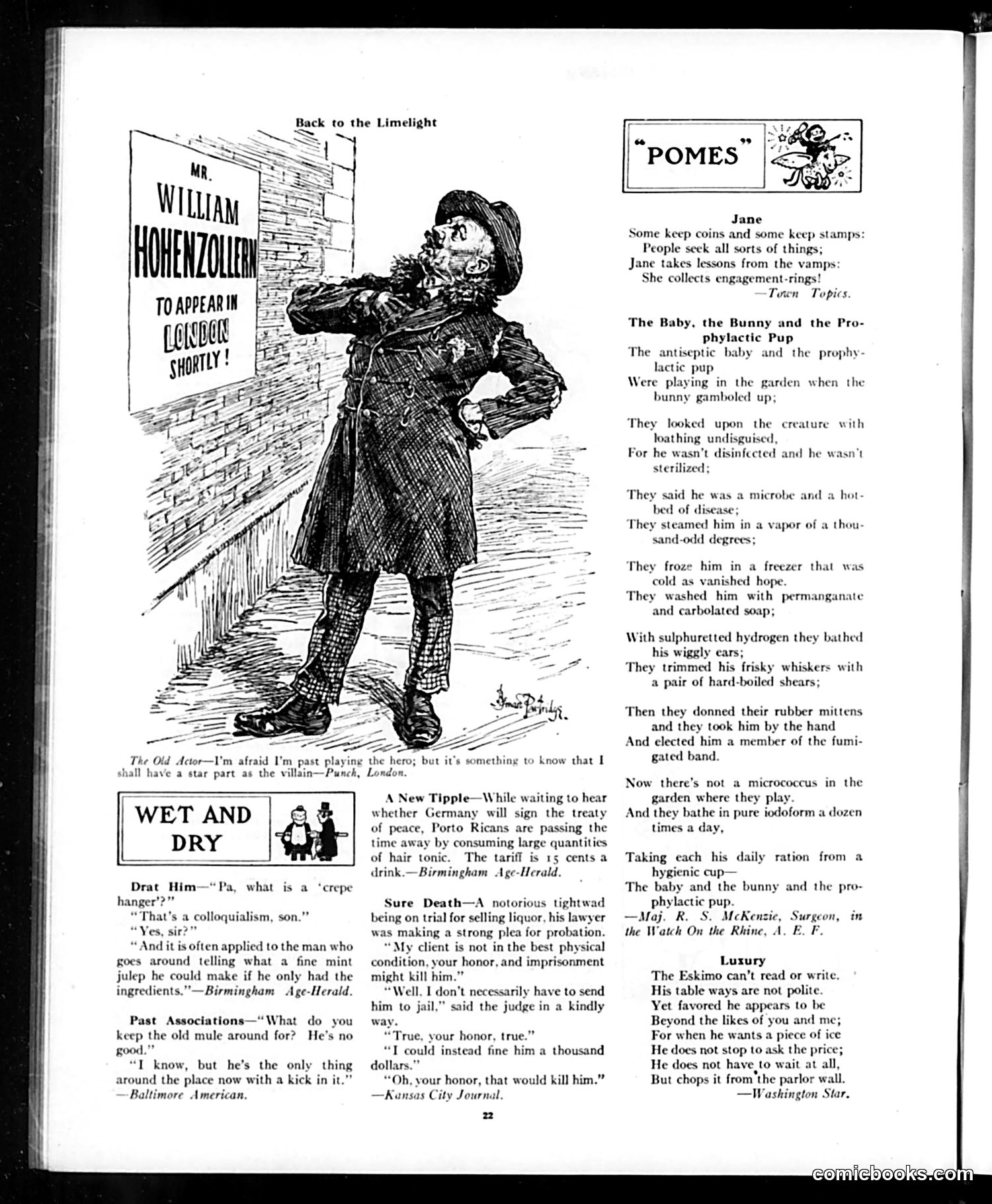
The main cartoon depicts **William Hohenzollern** (German Kaiser Wilhelm II) being literally "Back to the Limelight"—a theatrical reference suggesting his return to public prominence, likely during WWI peace treaty negotiations (referenced in the "New Tipple" joke about Germany signing a peace treaty). The accompanying jokes satirize **post-WWI American social anxieties**: - "Crepe hanger" mocks men who brag about mint juleps they can't make—Southern pretension - The mule joke plays on outdated things still having "kick"—obsolescence - "Sure Death" mocks a tightwad so cheap that even fines threaten him more than imprisonment The poetry section ridicules **1920s excess and superficiality**: Jane collecting engagement rings from vamps; overwrought parental obsession with sanitization (the "prophylactic pup" poem satirizes germ-phobia); and Eskimos' "luxury" of free ice versus Americans' consumer anxiety about pricing. The humor targets American materialism, pretension, and modernist anxieties during post-war adjustment.
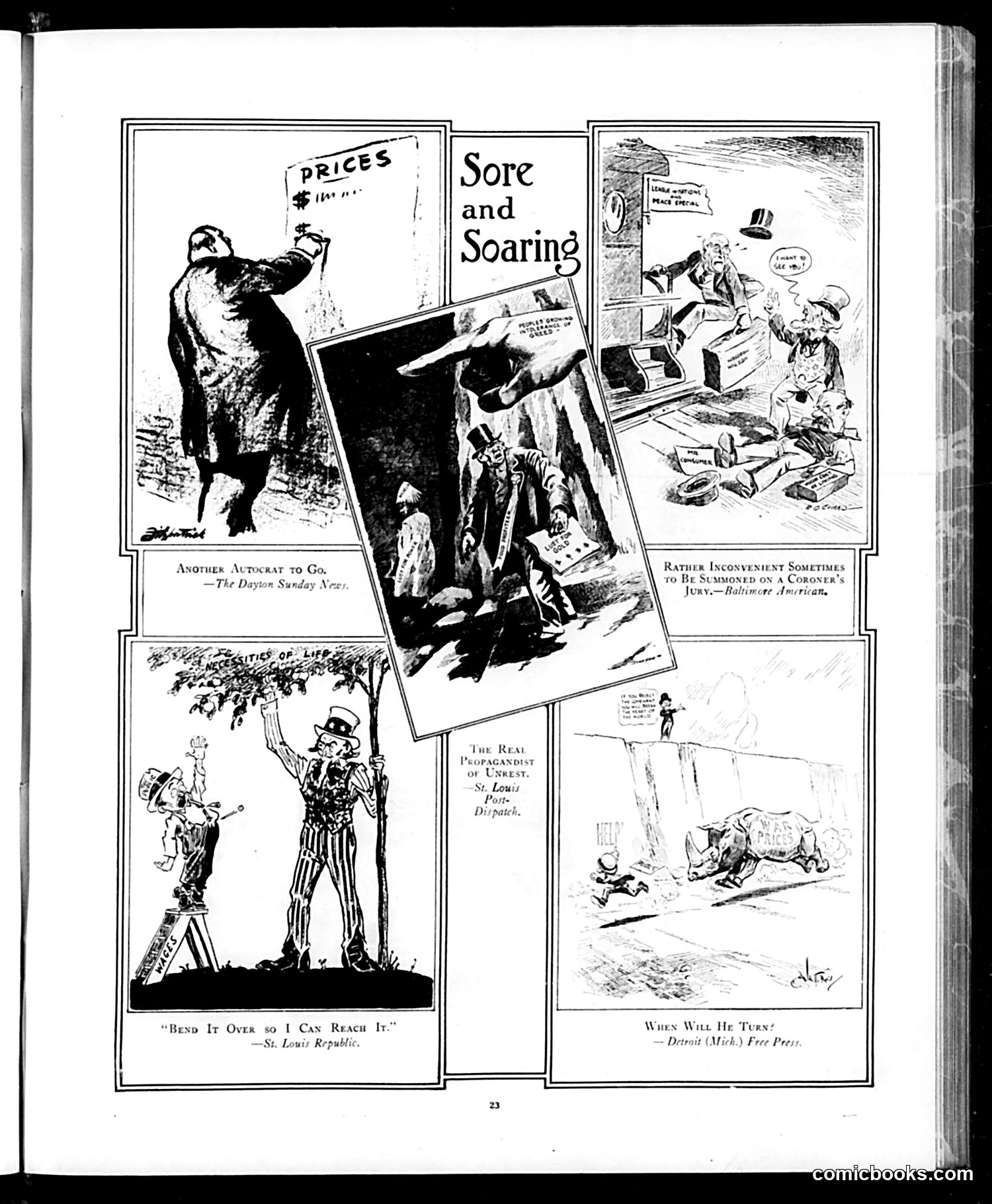
This page collects five editorial cartoons addressing economic hardship and social unrest. The central theme concerns rising prices and their consequences. **Key cartoons:** - **Top left**: An autocrat posting inflated prices—critiques government or corporate control over costs - **Center**: Depicts civil unrest, suggesting public anger over economic conditions - **Top right**: Shows people struggling with poverty, labeled "Rather Inconvenient Sometimes to Be Summoned on a Coroner's Jury"—darkly jokes that poor people are dying, making jury duty inconvenient - **Bottom left**: A figure stretching to "reach" something, suggesting difficulty affording basic necessities - **Bottom right**: Shows a collapsed figure, asking "When Will He Turn?"—likely about economic recovery or political change The cartoons collectively satirize the tension between rising costs and working-class suffering circa early 20th century. Attribution lines indicate these appeared in various newspapers including the *St. Louis Republic* and *Detroit Free Press*.
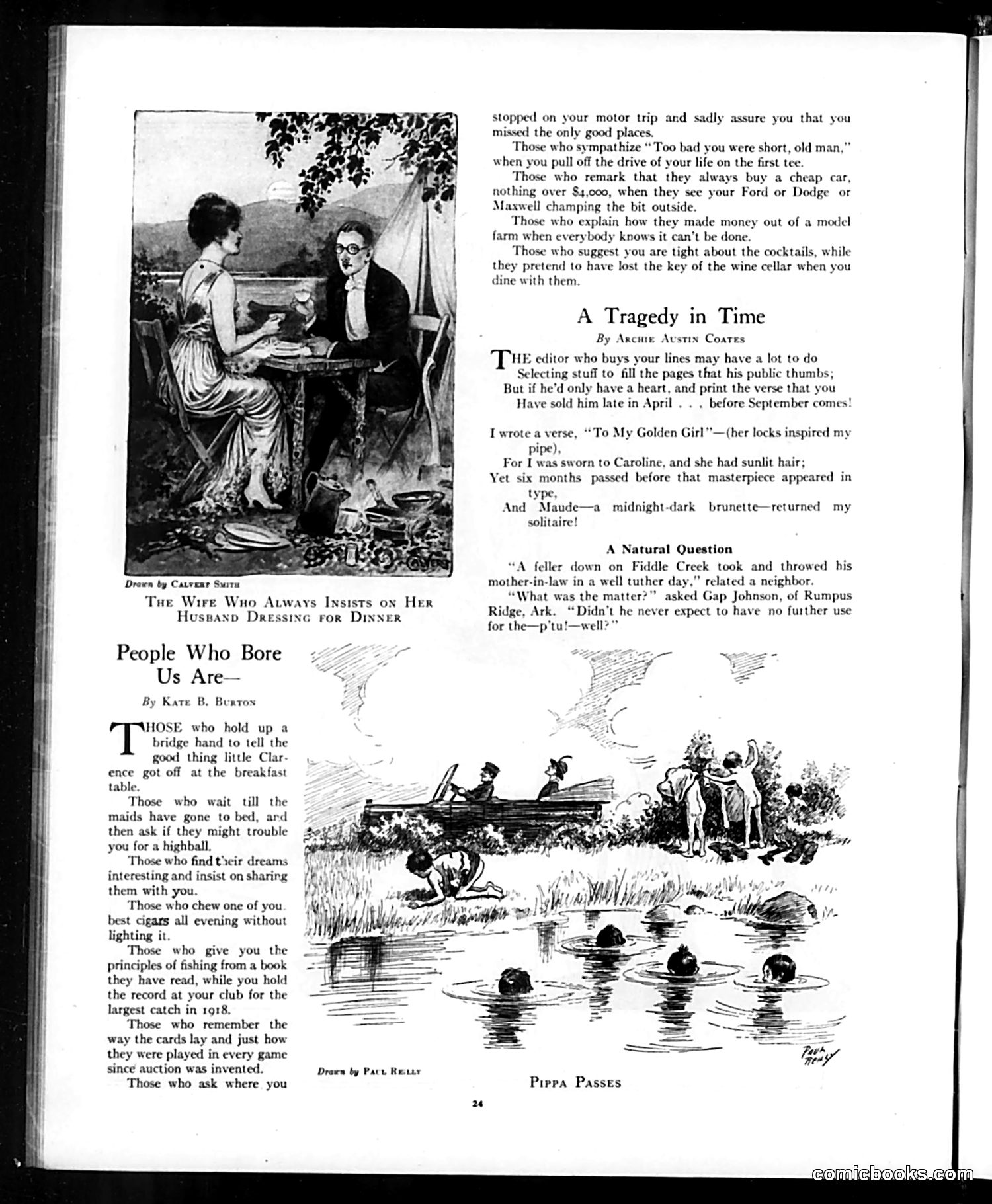
This page contains three humorous pieces satirizing early 20th-century American social annoyances. **"People Who Bore Us Are—"** by Kate B. Burton catalogs tedious social types: people who monopolize conversation with bridge hands or dreams, borrow cigars without smoking them, rehash card games obsessively, and boast about cheap cars or failed farm ventures. The satire mocks pretentiousness and social one-upmanship among the leisure class. **"A Tragedy in Time"** by Archie Austin Coates humorously laments editorial delays—a poet sells verses in April that don't publish until September, by which time his romantic circumstances have changed (Caroline replaced by Maude). It satirizes magazine editors' slowness and writers' frustrations. **"A Natural Question"** presents rural dialect humor: a man throws his mother-in-law down a well, and when asked why, replies he saw no further use for her. This reflects period acceptance of mother-in-law jokes as standard comedy fodder. The page reflects Jazz Age sensibilities: leisure activities, romantic pursuits, social climbing, and publishing frustrations among educated readers.
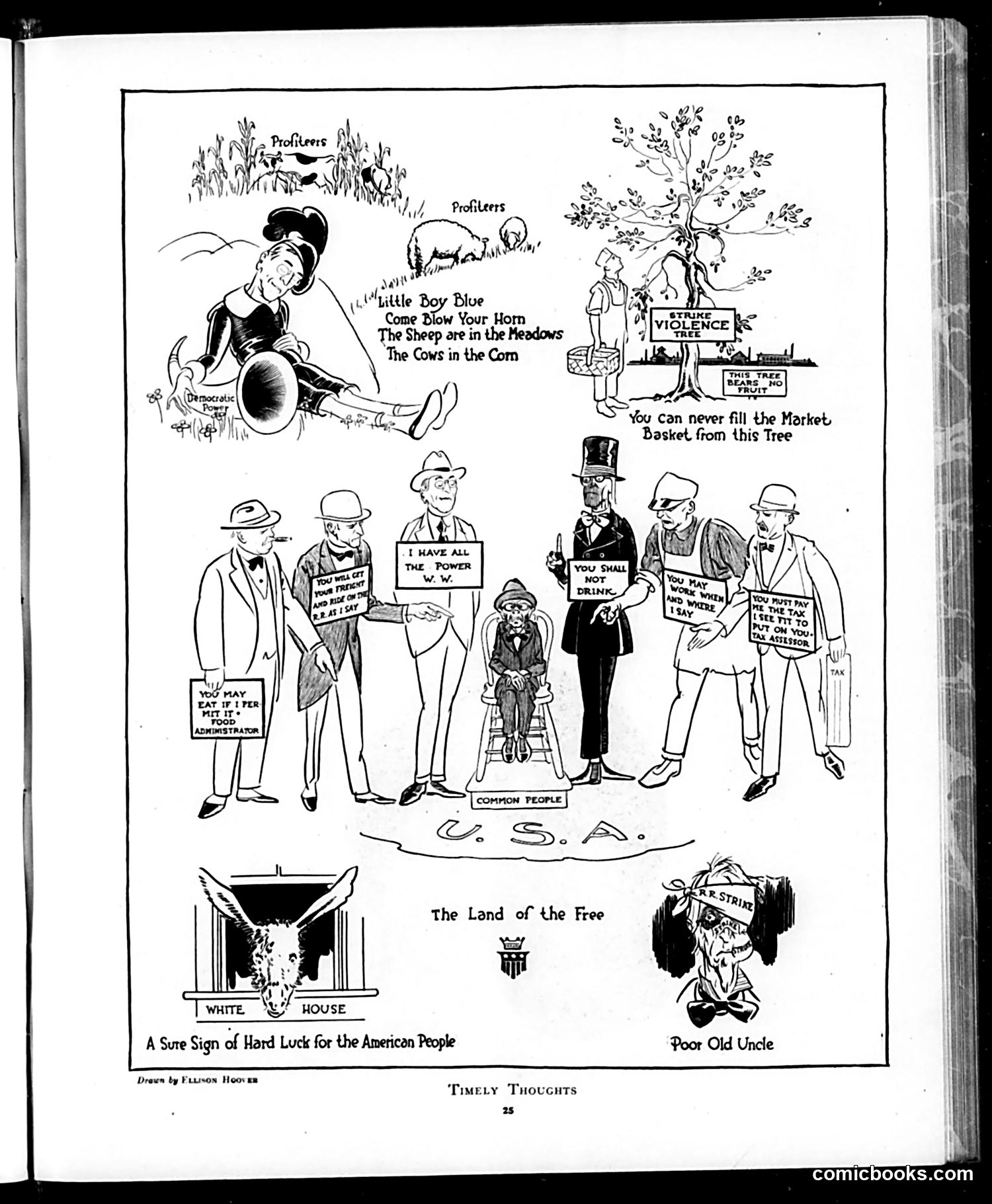
This page satirizes American political and economic power structures circa the early 20th century. The top section shows "Profiteers" exploiting nursery rhymes, suggesting war profiteering. The central panel depicts "Common People" dwarfed by authority figures labeled with restrictions ("You Shall Not Drink," "You Must Work," etc.), representing government and corporate control over ordinary citizens. A tree labeled "Striking Violence" and another marked "This Tree Bears No Fruit" critique labor unrest and economic futility. The bottom panels are titled "The Land of the Free"—the White House labeled "A Sure Sign of Hard Luck for the American People"—and show "Poor Old Uncle" (likely Uncle Sam, representing America) battered and worn. The overall message criticizes how concentrated power among politicians, industrialists, and profiteers exploits and impoverishes common Americans while claiming democratic ideals.
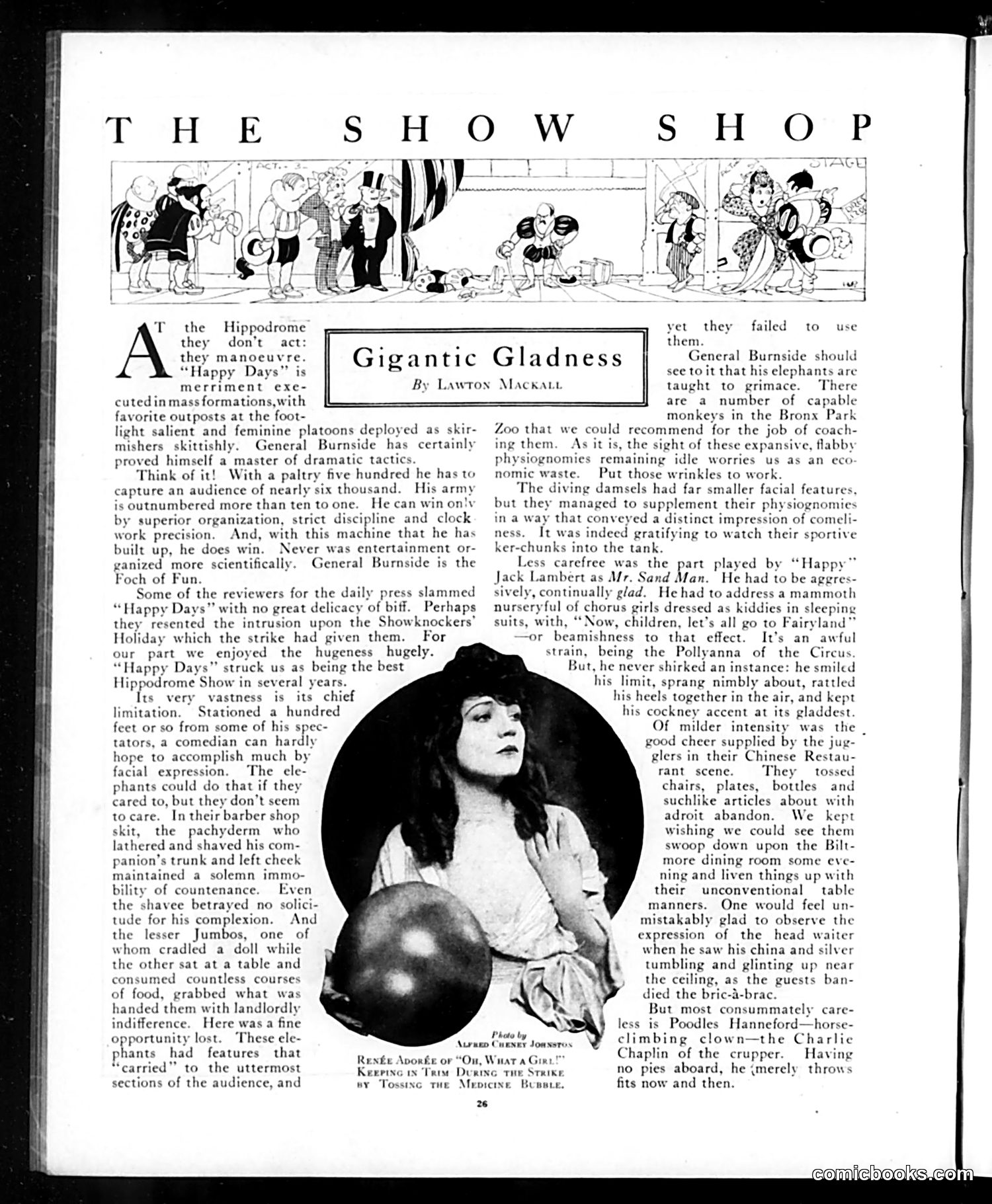
This page reviews the theatrical production "Happy Days" at New York's Hippodrome theater, featuring General Burnside as director/organizer. The critic praises Burnside's military-like logistical mastery—managing 500 performers for 6,000 spectators—comparing him to WWI General Foch as "the Foch of Fun." The review critiques specific acts: elephants performing a barber shop skit with emotionless faces (wasting their expressive features), diving girls who compensate through physical charm, and Jack Lambert as the perpetually cheerful "Sand Man" character. The critic also enjoys Chinese restaurant juggling acts. The top cartoon strip depicts the show's mass choreography. Overall, the piece celebrates the Hippodrome's technical spectacle while noting that enormous scale limits subtle comedic effects like facial expressions—a tension between grandeur and intimacy that characterizes early-20th-century vaudeville theater production.
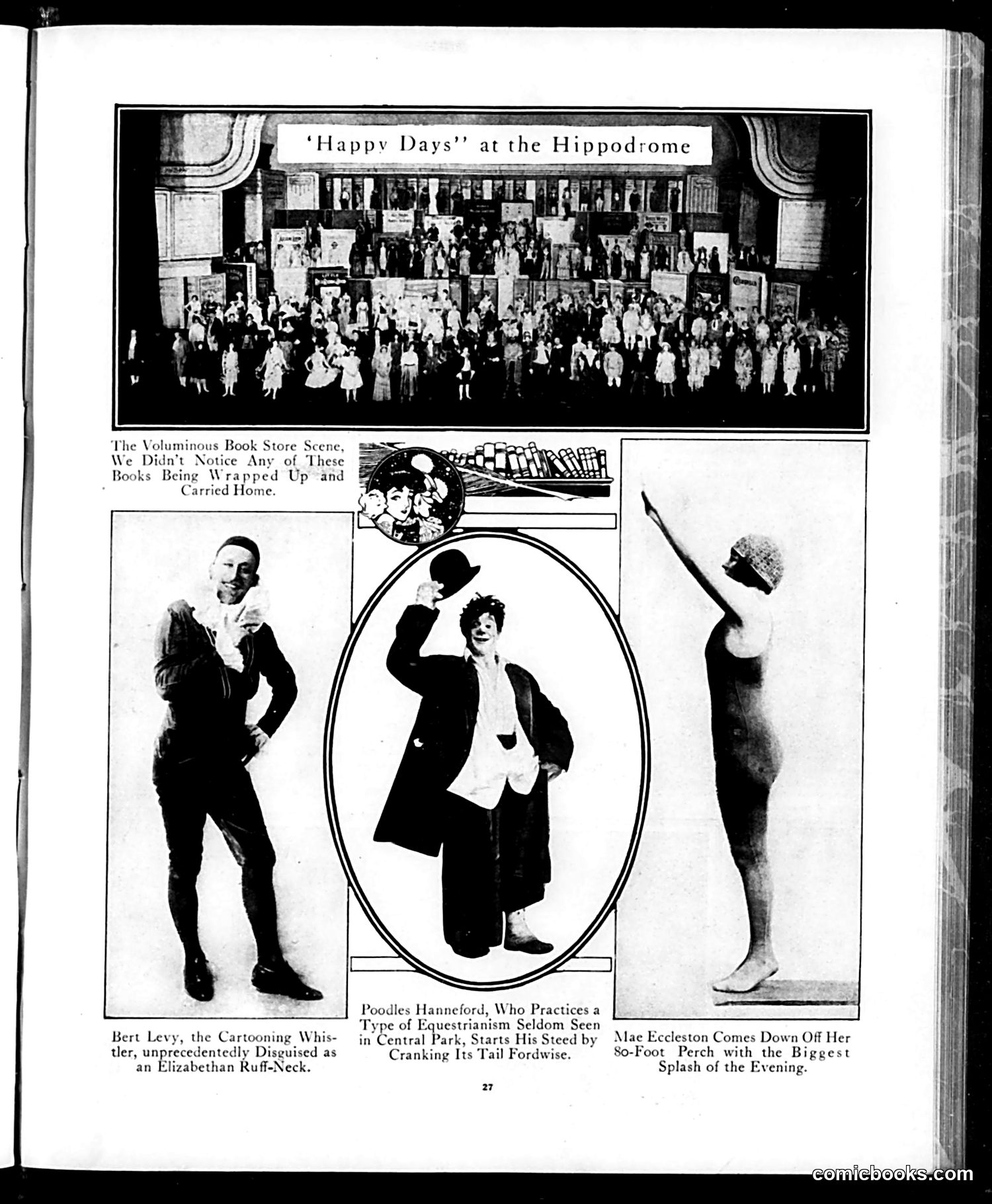
This page documents a theatrical performance at the Hippodrome (a major New York entertainment venue). The top image shows the crowded "Book Store Scene" from the show, with a satirical note that despite its prominence, nobody seemed to actually purchase books—suggesting either the scene's theatrical artificiality or commentary on theater audiences. Below are three performance highlights featuring identifiable performers: - **Bert Levy**, a cartooning whistler, appears in an Elizabethan costume (an unusual disguise for his act) - **Poodles Hanneford** practices unconventional horseback riding in Central Park, notably starting his horse by pulling its tail - **Mae Eccleston** performs an acrobatic stunt, diving 80 feet into water with maximum splash The page is essentially promotional coverage of novelty acts and spectacle—typical Judge magazine entertainment reporting that combined mild satire with show business publicity.
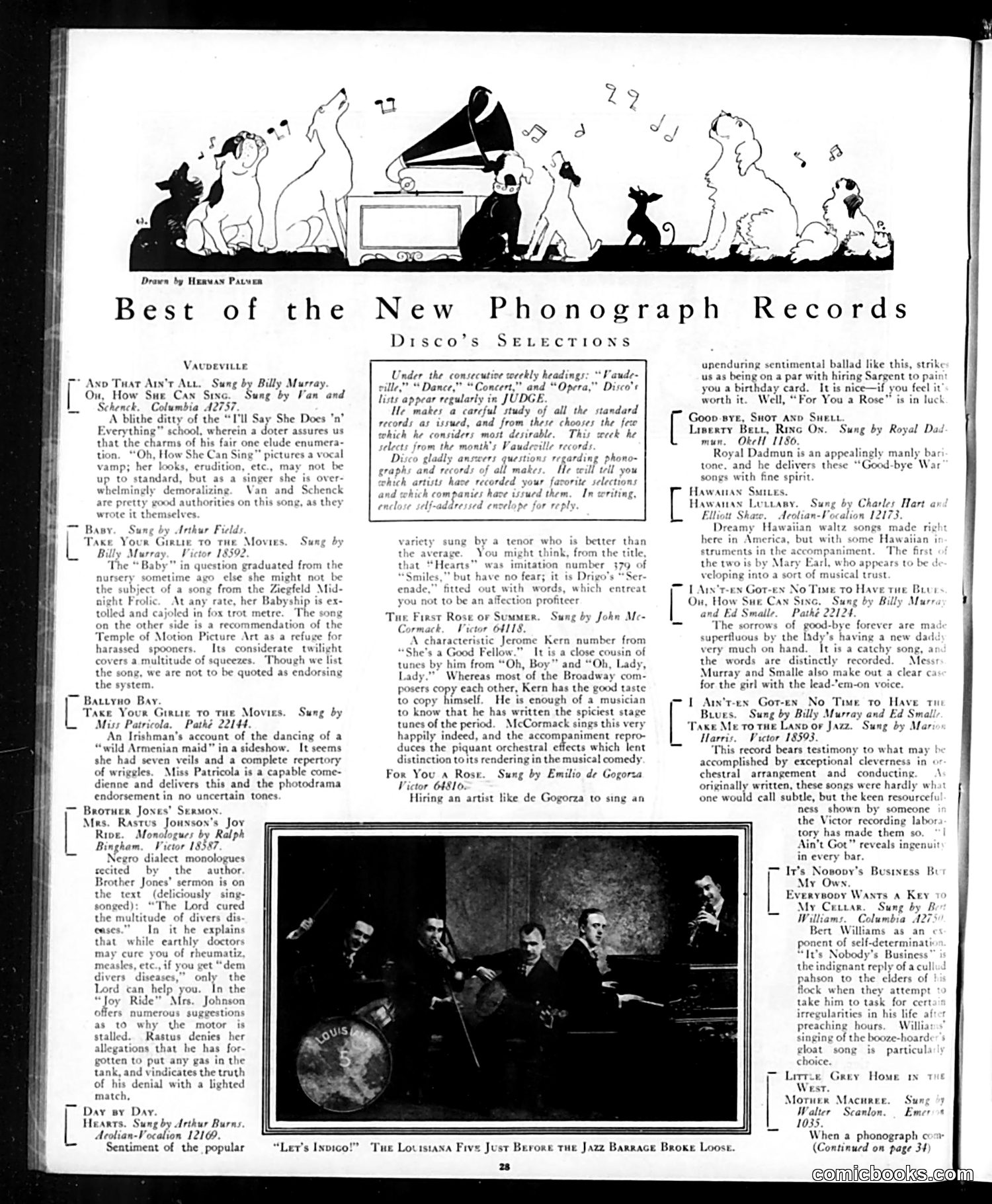
This page is primarily a **record review column** from Judge magazine, not a political cartoon. The illustrated header by Heanan Pletcher depicts animals enjoying music from a gramophone—a whimsical framing device for the reviews below. The content discusses newly released phonograph recordings, organized by category (Vaudeville, Concert, Opera). Reviews critique performers like Billy Murray, Van and Schenck, and Emilio de Gogorza, evaluating both songs and vocal performances. **Notable context**: References to "Broadway composers" and Jerome Kern indicate this is from the early 20th century when musical theater dominated popular music. The inclusion of "Negro dialect monologues" and "Hawaiian Waltzes" reflects period entertainment conventions (and racial attitudes) now considered offensive. The page's photograph at bottom shows "The Louisiana Five Just Before the Jazz Barrage Broke Loose"—capturing an early jazz ensemble. This is entertainment journalism reflecting contemporary popular culture, not satirical commentary.
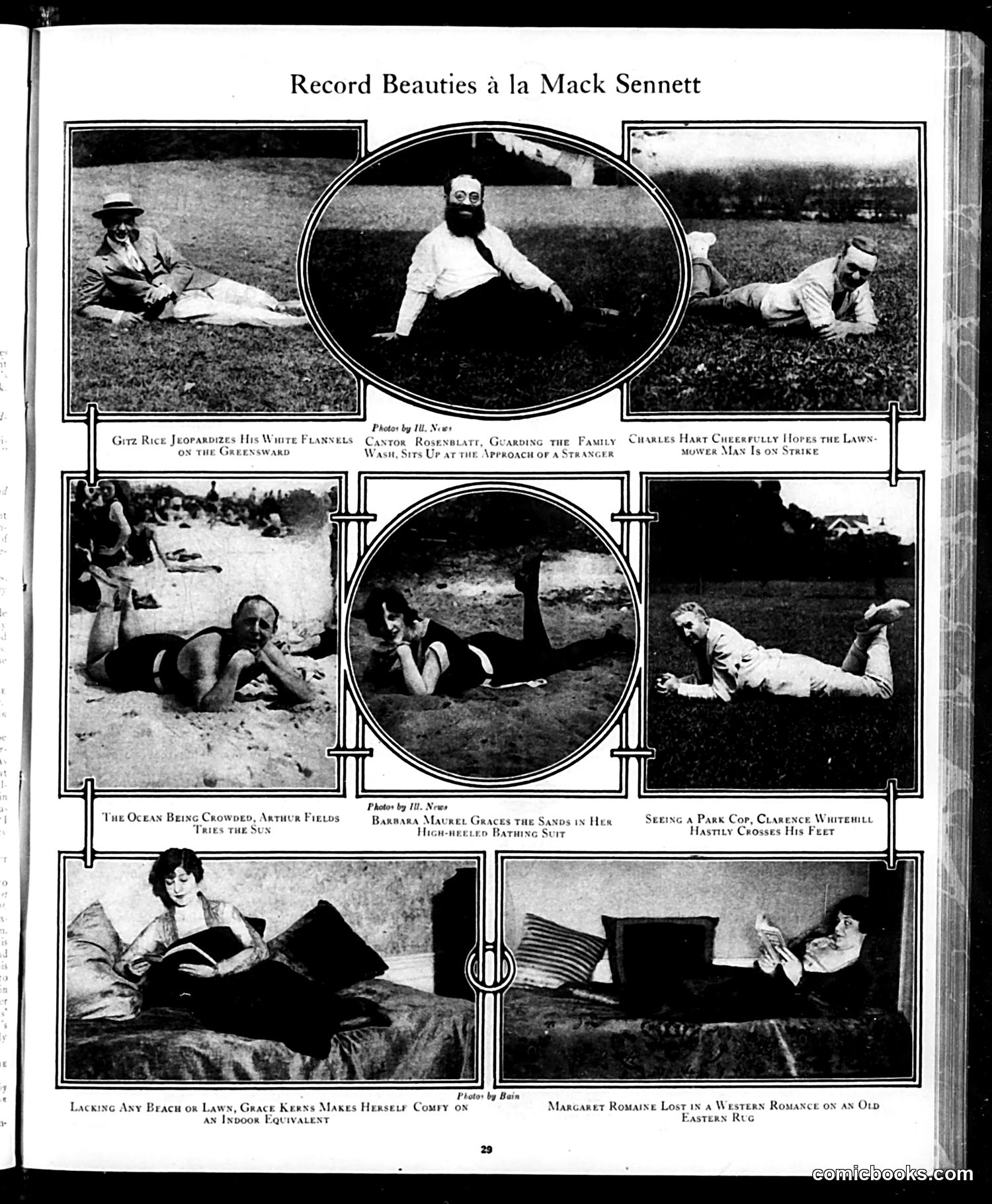
This page satirizes *Mack Sennett's* famous silent film comedies by staging humorous "record beauties" — posed tableaux of various celebrities performing absurd physical comedy outdoors. The captions reference real figures like Gitz Rice, Canton Rosenblatt, Charles Hart, Arthur Fields, Barbara Maurel, and Grace Kerns engaging in slapstick scenarios: jeopardizing white flannels, guarding families from strangers, hoping lawnmowers will strike, crowding oceans, gracing sands, fleeing park cops, and lounging indoors. The satire mocks both Sennett's low-brow physical humor and the celebrities willing to participate in undignified antics for publicity. The photos (credited to Underwood & Underwood News and Bain) present these "beauties" not as glamorous but as ridiculous — lying in grass, sprawling on beaches, desperately avoiding lawn maintenance. The joke targets the era's entertainment culture: even respectable performers would debase themselves for the camera's gaze.
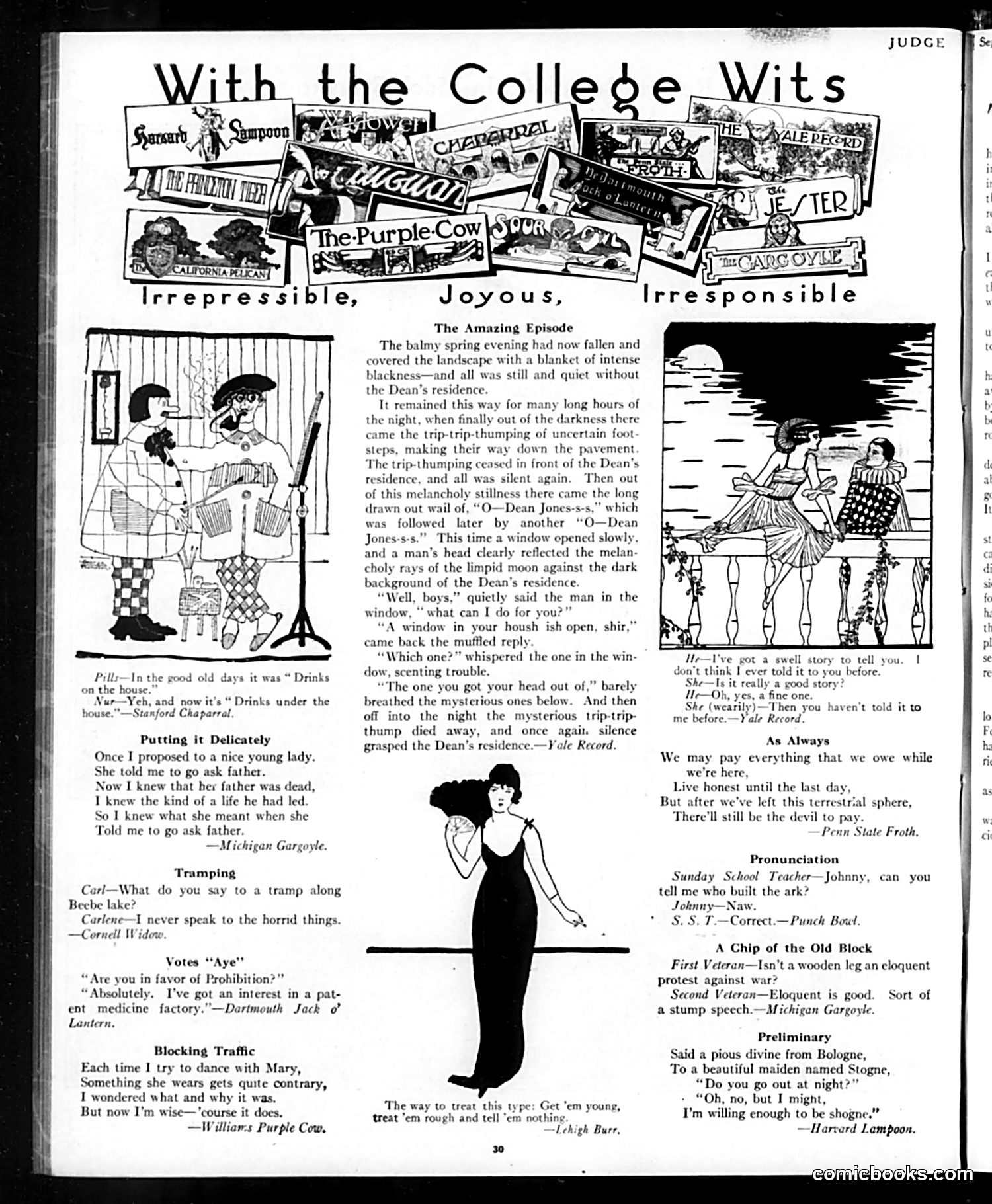
This page collects humor pieces from various college magazines (Stanford Chaparral, Michigan Gargoyle, Yale Record, etc.), featuring jokes about early 20th-century college life and social concerns. **Key satirical targets:** - **Prohibition**: One joke mocks hypocrisy—a man supports Prohibition while profiting from patent medicines (which often contained alcohol), exposing how economic self-interest drives political positions. - **Gender politics**: Multiple jokes reference courtship conventions and women's clothing ("Something she wears gets quite contrary"), reflecting anxieties about changing social roles. - **"The Amazing Episode"**: A humorous narrative about drunk students serenading the Dean's residence late at night, then complaining about an open window—satirizing both student rowdiness and authority figures' exasperation. The humor is gentle, collegiate satire typical of campus publications of this era, poking fun at drinking culture, dating customs, and the eternal tension between students and administrative authority.
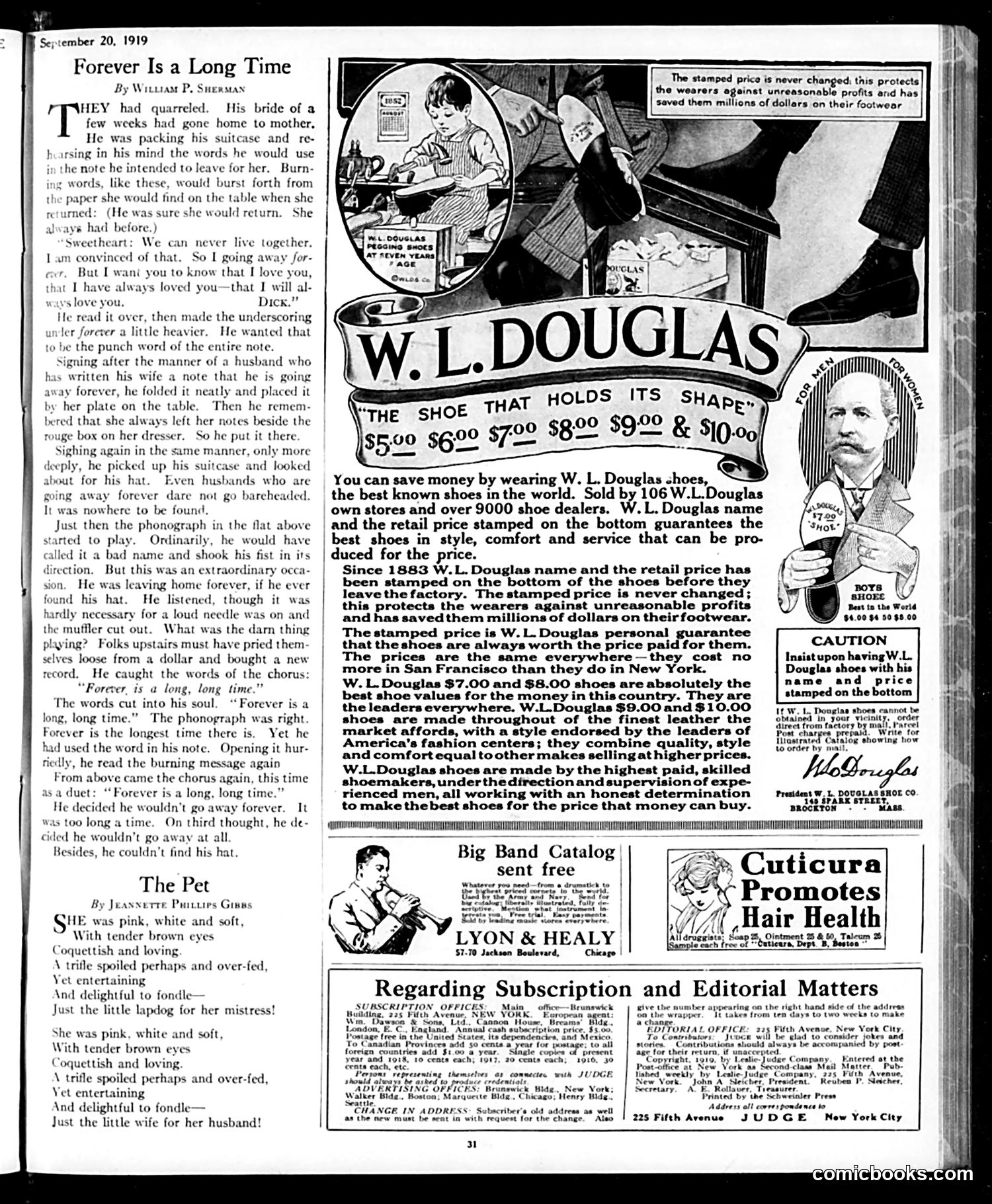
This page contains two short stories and a major shoe advertisement, rather than political cartoons. **"Forever Is a Long Time"** satirizes marital reconciliation. A husband, angry after a quarrel, writes a dramatic farewell note emphasizing "forever" as he plans to leave his wife. However, a phonograph upstairs playing a song with the lyric "Forever is a long, long time" makes him reconsider—the word suddenly feels too permanent. He abandons his dramatic exit, unable even to find his hat. The satire mocks both theatrical romantic gestures and how easily men reconsider grand decisions. **"The Pet"** uses parallel structure to compare a spoiled lapdog to a wife, both described identically as "pink, white and soft" with "tender brown eyes"—a cutting commentary on how husbands regard wives as pet-like possessions rather than equals. The page is otherwise dominated by a **W.L. Douglas shoe advertisement** emphasizing the brand's stamped retail price, positioned as consumer protection against "unreasonable profits."
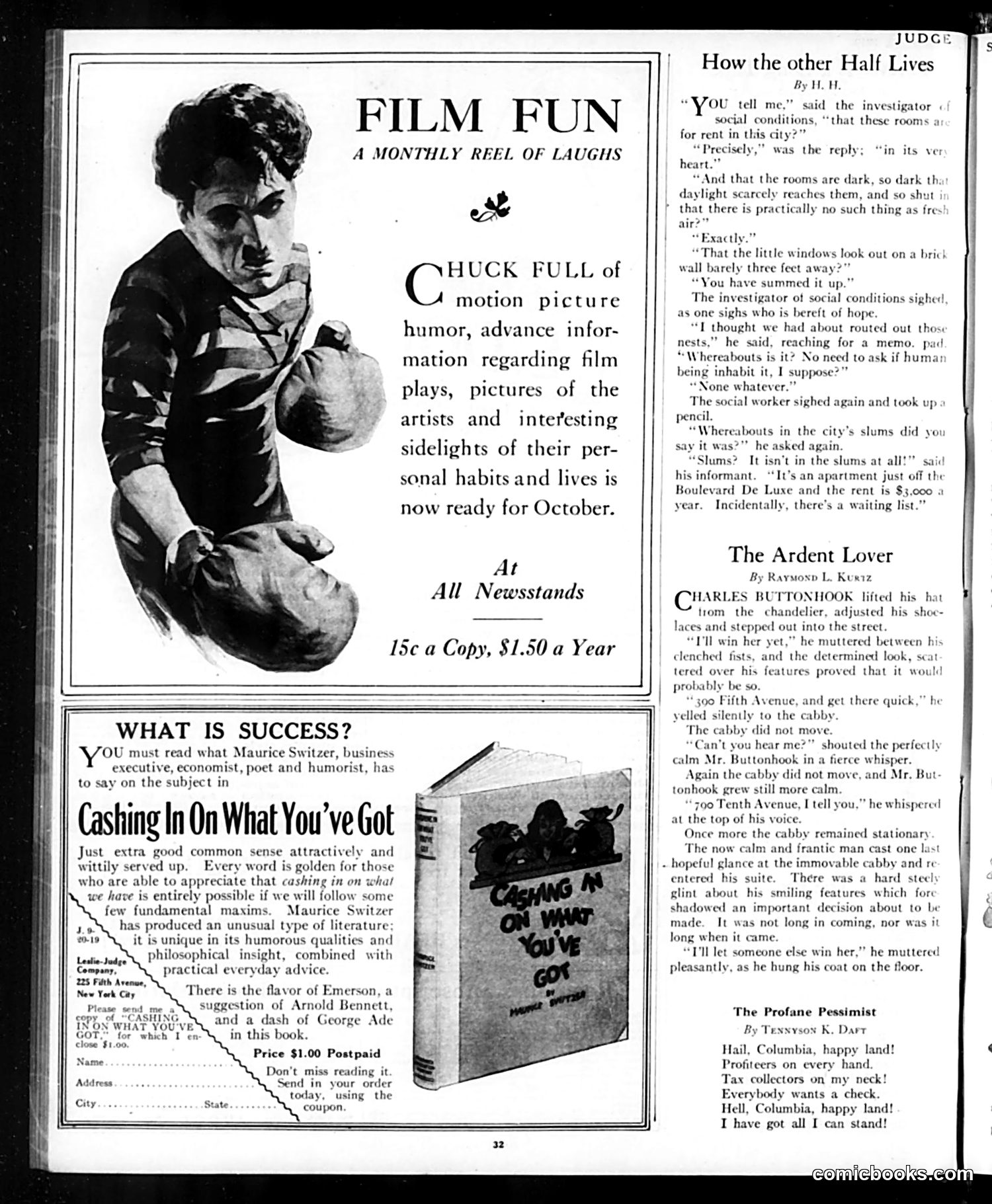
This page contains **three satirical short stories** and advertisements, typical of Judge's humor format. **"How the Other Half Lives"** satirizes progressive era social reformers. An investigator interviewing a tenement informant expects squalid slum housing, only to learn the deplorable conditions exist in a luxurious apartment building on Boulevard De Luxe—renting at $3,000 yearly with a waiting list. The joke: poverty and overcrowding aren't limited to traditional slums; wealthy neighborhoods harbor the same miserable conditions at inflated prices. **"The Ardent Lover"** mocks romantic melodrama. A determined suitor repeatedly orders a cab driver to Fifth Avenue, becoming increasingly agitated yet somehow "calm." When the driver won't move, the protagonist gives up entirely and lets someone else win the woman—undermining his passionate declarations. **"The Profane Pessimist"** offers brief cynical verses about American economic conditions, mentioning profiteers and tax collectors—likely referencing post-WWI economic anxieties. The page reflects Judge's satirical approach: deflating pretension, mocking social contradictions, and using everyday situations for humor commentary.
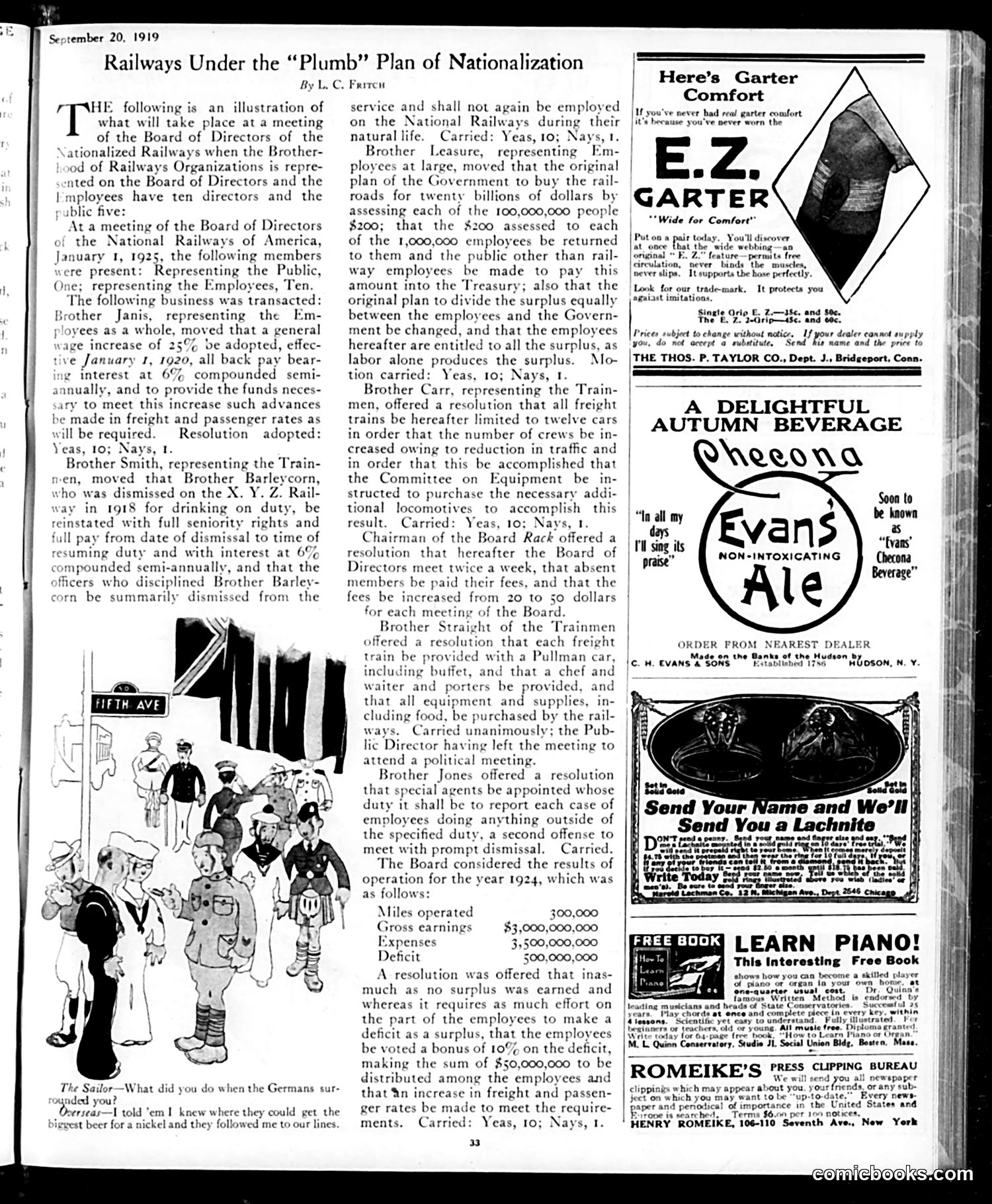
This cartoon satirizes the "Plumb Plan," a real 1919 proposal to nationalize American railways under worker control. The artist depicts a dystopian 1925 board meeting where railway employees hold ten of eleven director seats, with the public holding just one. The satire shows absurd resolutions passing by 10-1 votes: wage increases with retroactive pay and compound interest; rehiring a worker dismissed for drinking; shifting taxpayer costs to benefit only railway employees; limiting freight trains to increase crew positions; and providing Pullman luxury cars with chefs for all trains. The final irony: the single public representative leaves before voting on worker surveillance measures. The cartoon argues that worker-controlled nationalization would become a self-interested monopoly enriching labor at the public's expense, with bloated costs and incompetent management. The overwhelming employee majority ensures the public interest vanishes entirely.
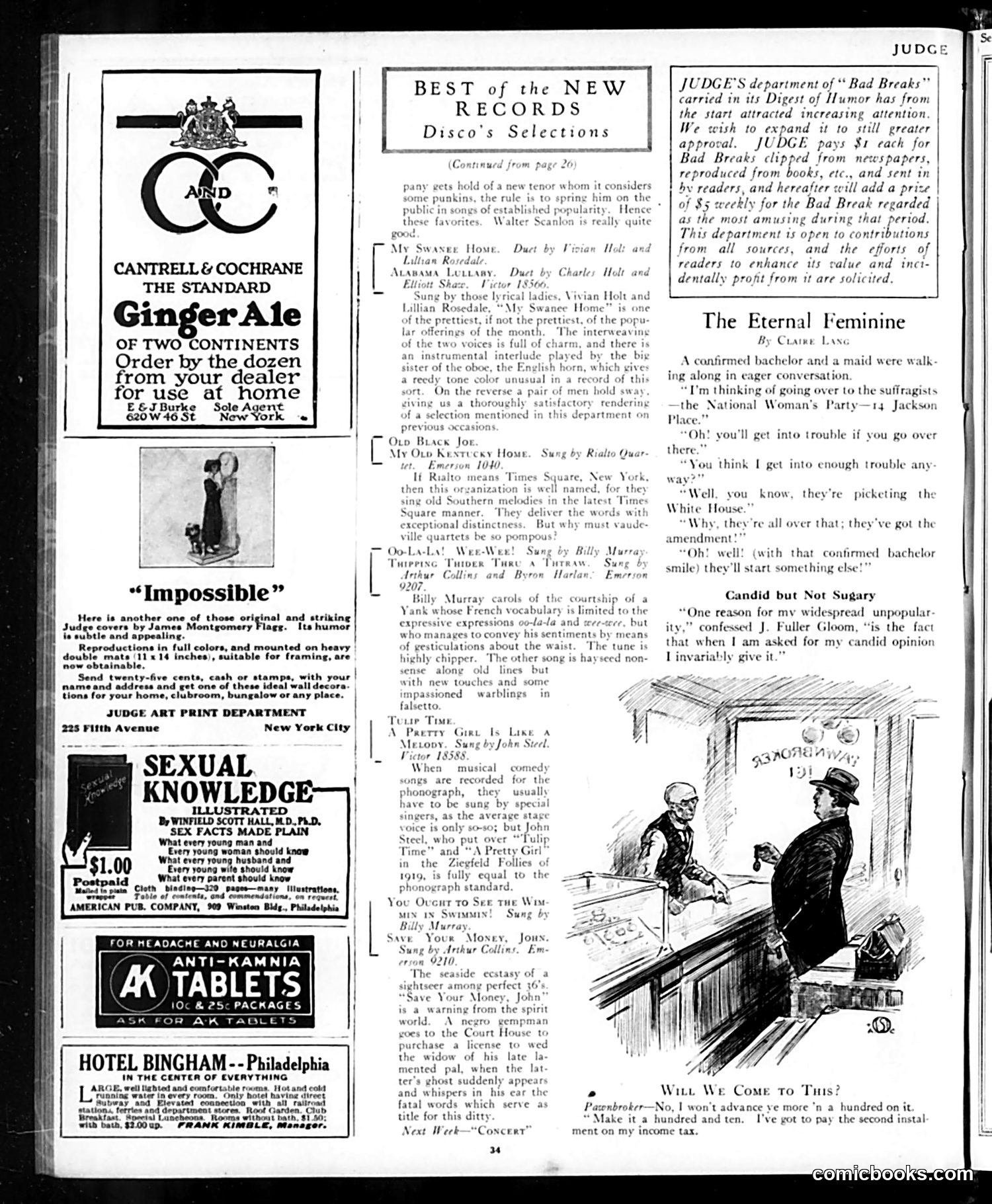
This page contains primarily **advertisements and entertainment content** rather than political satire. The main cartoon depicts two figures on what appears to be a rooftop or ledge—likely illustrating the caption "Impossible," though the exact context isn't clear from the visible text. The page's substantive content is "The Eternal Feminine," a dialogue between a bachelor and a woman discussing her interest in joining the National Woman's Party suffragist movement at Jackson Place. The joke plays on the woman's claim that suffrage activism won't trouble her, with the bachelor suggesting she'll inevitably "start something else"—a commentary on women's unpredictability. This reflects the era's skeptical or dismissive attitudes toward women's political organizing. The remaining content consists of advertisements for ginger ale, phonograph records, patent medicines, and hotels—typical Judge magazine filler material from the early 20th century.
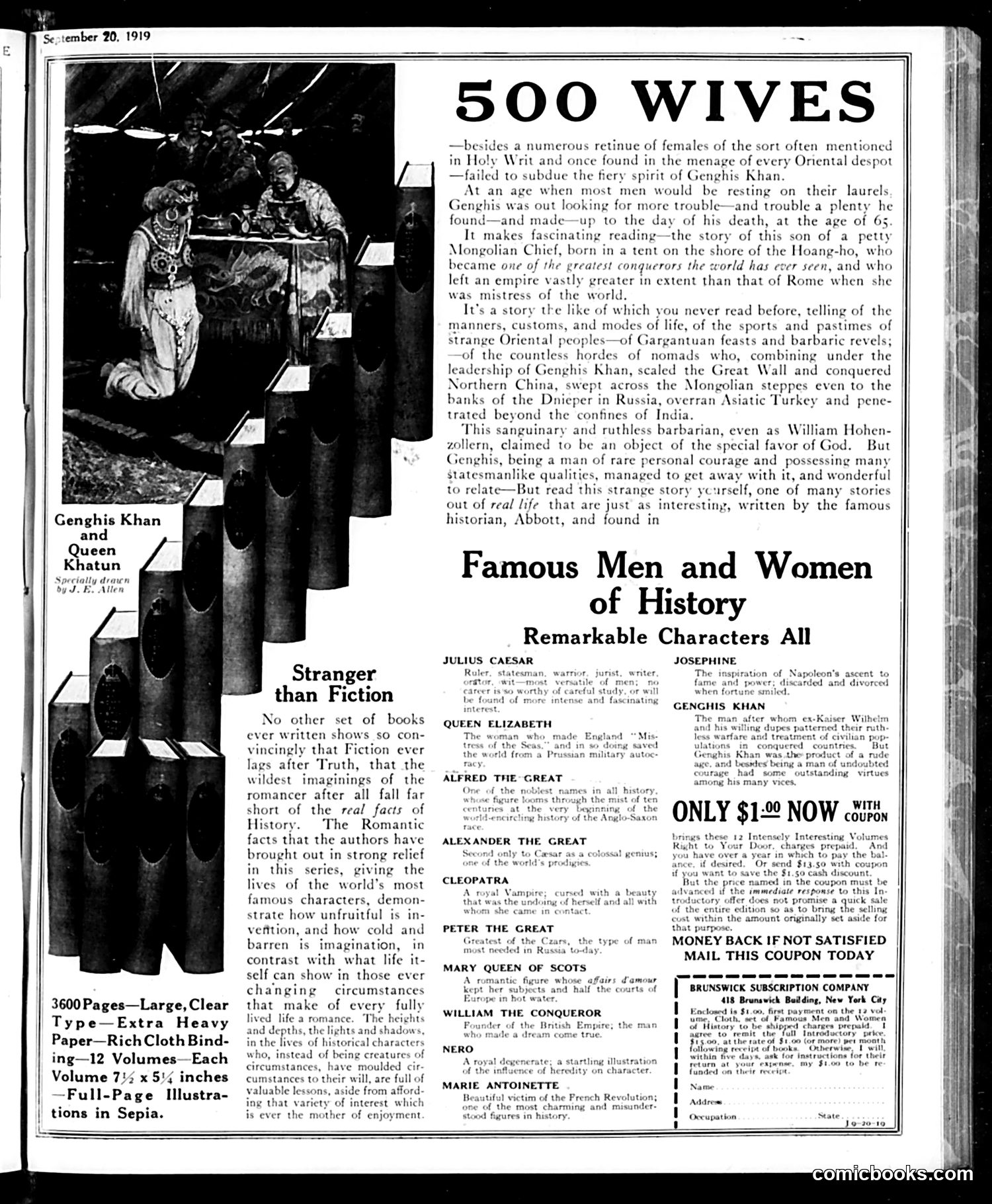
This is primarily a **book advertisement**, not a satirical cartoon. Judge magazine's September 20, 1919 issue features a full-page promotion for a 12-volume encyclopedia titled "Famous Men and Women of History." The illustration shows **Genghis Khan and Queen Khatun**, drawn to depict Mongol rulers in exotic dress. The promotional text emphasizes the sensational angle: Khan's "500 wives" and his ruthless conquests, positioning him as a barbaric but capable leader. Notably, the text compares Genghis Khan to **William Hohenzollern** (Kaiser Wilhelm II of Germany), claiming both "claimed to be an object of the special favor of God." This is the page's only satirical element—a subtle jab at the recently-defeated German emperor, comparing him to history's most notorious conquerors. This reference makes sense given the ad's 1919 date, just after World War I's conclusion. The advertisement emphasizes that real history surpasses fiction in drama and interest.
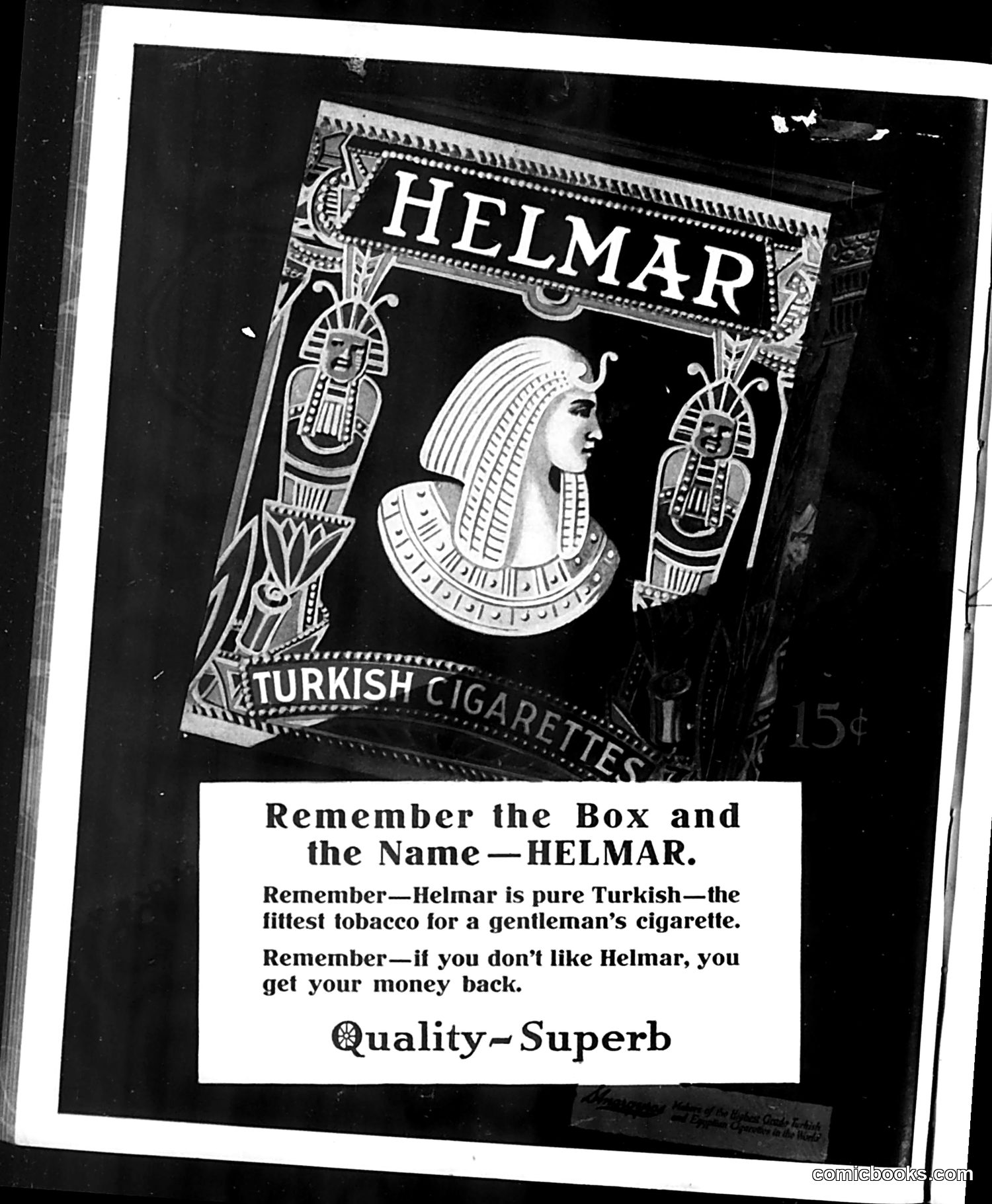
This is a cigarette advertisement for Helmar Turkish cigarettes, not political satire. The image shows an ornate box featuring Egyptian/pharaonic imagery—specifically a woman in profile wearing a traditional Egyptian headdress, flanked by pharaonic figures and hieroglyphic-style decorations. The ad uses exotic "Orientalist" imagery popular in early 20th-century marketing to suggest luxury and sophistication. The text emphasizes the product's "pure Turkish" origin and appeals to gentlemen by promising quality and a money-back guarantee. This reflects the historical marketing practice of using non-Western imagery to imply exoticism and premium quality—a common advertising trope of that era that would be considered culturally appropriative today.