
Judge, 1919-09-20 · page 18 of 36
Judge — September 20, 1919 — page 18: what you’re looking at
What you’re looking at
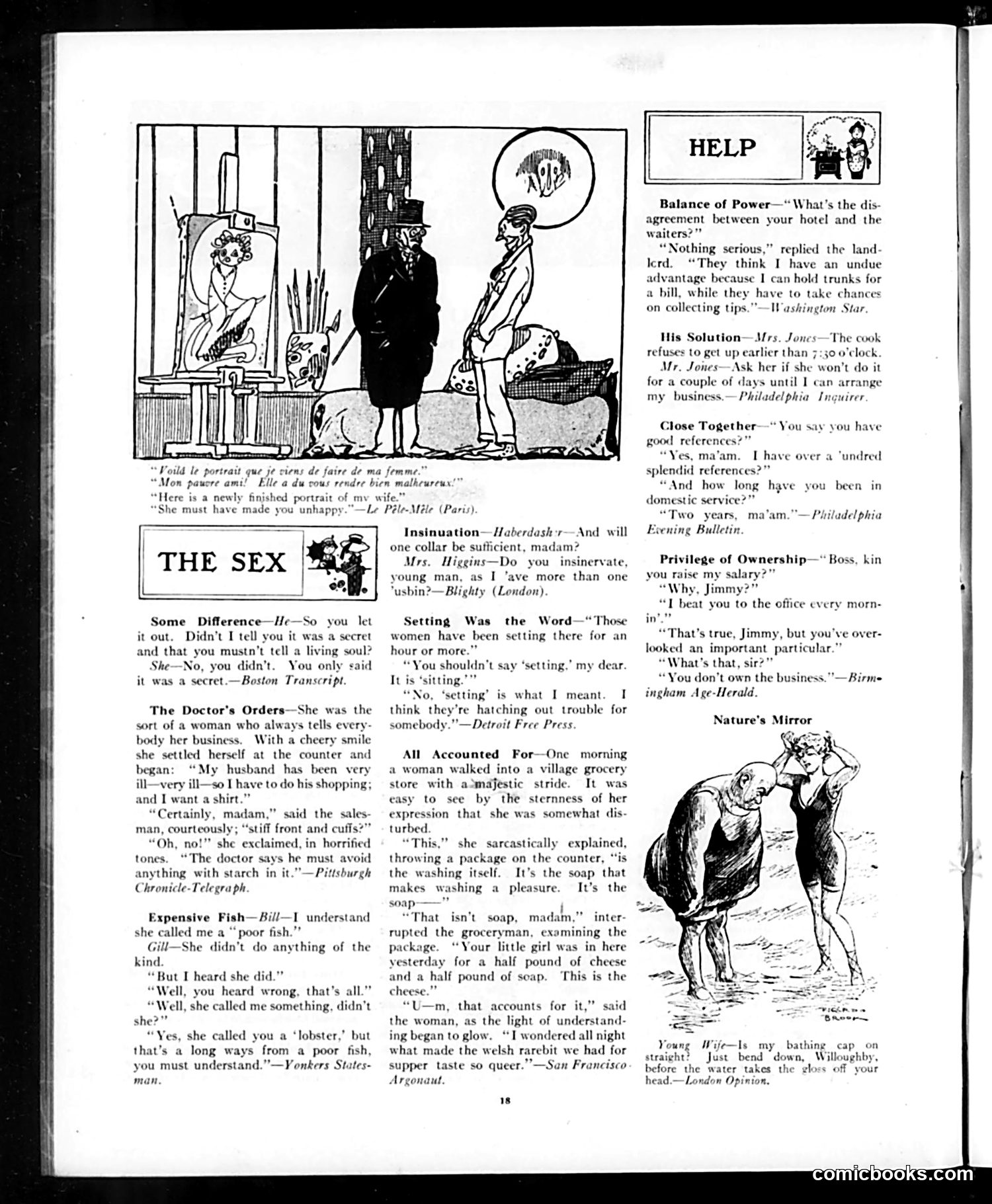
This page from Judge (an American satirical weekly) contains multiple short humorous anecdotes rather than political cartoons. The humor targets domestic life and class dynamics of early 20th-century America. Key jokes include: a husband's marital troubles (top cartoon, in French); wordplay about "setting" versus "sitting" (implying women cause trouble); a grocer's mix-up between soap and cheese; a hotel owner's advantage over striking waiters; a cook's wage negotiation; and domestic service references. The satire reflects period anxieties: wives who gossip and violate confidentiality; servants' labor disputes; the "servant problem" (difficulty hiring domestic help); and class tensions between employers and workers. The "Nature's Mirror" cartoon appears to comment on vanity. The magazine targets middle and upper-class readers, poking fun at their domestic frustrations while reinforcing social hierarchies. These are gentle, domestic jokes rather than political satire—typical of Judge's lighter content pages.
📄 Transcribed text from this page (OCR, searchable)
Machine-transcribed from the original scan — historical spelling and the odd misread are preserved.
“Voild le portrait que je viens de faire de ma femme.” “Mon paucre ami! “Here is a newly finjs “She must have made } Some Difference—He—So you let it out. Didn't I tell you it was a secret and that you mustn’t tell a living soul? She—No, you didn’t. You only said it was a secret.—Boston Transcript. The Doctor's Orders—She was the sort of a woman who always tells every- body her business. With a cheery smile she settled herself at the counter and began: “My husband has been ill—very ill—so I have to do his shopping; and I want a shirt.” “Certainly, madam,” said the sales. man, courteously; “stiff front and cuffs?” “Oh, no!” she exclaimed, in horrified tones. “The doctor s he must avoid anything with starch in it.”—Pittsburgh Chronicle-Telegra ph. Expensive Fish—Bil/—I understand she called me a “poor fish.”” Gill—She didn’t do anything of the kind “But I heard she did.”” Well, you heard wrong, that’s all.” “Well, she called me something, didn’t she? “Yes, she called you a ‘lobster,’ but that’s a long ways from a poor fish, you must understand.”—Yonkers States- man. Elle a du cous rendre bien malheureux. Insinuation—Haberdashr—And will one collar be sufficient, madam? Mrs. Higgins—Do you insinervate, young man, as I ‘ave more than one "usbin?—Blighty (London) Setting Was the Word—“ Those women have been setting there for an hour or more.” “You shouldn't say ‘setting.’ my dear. It is ‘sitting.”” “No, ‘setting’ is what I meant. I think they’re hatching out trouble for somebody."’—Detroit Free Press. All Accounted For—One morning a woman walked into a village grocery store with aomajestic stride. It was easy to see by the sternness of her expression that she was somewhat dis- turbed. “This,” sarcastically explained, throwing a package on the counter, “is the washing itself. It’s the soap that makes washing a pleasure. It’s the soap-—"" j “That isn’t. soap, mada rupted the groceryman, examining the package. “Your little girl was in here yesterday for a half pound of cheese and a half pound of scap. This is the cheese. “U—m, that accounts for it,” said the woman, as the light of understand- ing began to glow. “I wondered all night what made the welsh rarebit we had for supper taste so queer.” —San Francisco Argonaut. inte Balance of Power—* What's the dis- agreement between your hotel and the waiters?” Nothing serious,” replied the land- lerd. “They think I have an undue advantage because I can hold trunks for a bill, while they have to take chances on collecting tips.”— Washington Star His Solution— Mrs. Jones—The cook refuses to get up earlier than 7:30 o'clock Mr. Jones—Ask her if she won't do it for a couple of days until I can arrange my business.— Philadelphia Inquirer Close Together—-* You say you have good references?” “Yes, ma’am. I have over a ‘undred splendid references?” “And how long hgve you been in domestic service Two years, Soening Bulletin. ma’am."— Philadelphia Privilege of Ownership—" Boss, kin you raise my salary?” “Why, Jimmy?’ you to the office every morn- “1 bea in’ ‘That's true, Jimmy, but you've over- looked an important particular.” “What's that, sir?” “You don’t own the business.” ingham Age-Herald. —Birme Nature's Mirror Yo Wife—Is- my bathing cap on straight? Just bend down, Willoughby, before the water takes the s off your head.—London Opinion.